REVIEW 4 major objections 6 minor 5 cited by
Generalized and Efficient 2D Gaussian Splatting for Arbitrary-scale Super-Resolution
T0 review · 4 major / 6 minor · reviewed 2026-08-10 · deepseek-v4-flash
Pith's one-line read A feed-forward network that predicts image-conditioned 2D Gaussians and renders them with a scale-aware CUDA rasterizer can outperform implicit neural representations for arbitrary-scale super-resolution in both quality and speed.
desk verdict Solid quality gains and a real high-scale efficiency story, but the paper's speed claim is undercut by a self-contradictory rasterization-ratio setting that must be resolved. read the letter →
The pith
A machine-rendered reading of the paper's core claim, the machinery that carries it, and where it could break.
The reading
What carries the argument
The central object is the 2D Gaussian as an image primitive: each Gaussian contributes α·c·f(x,y) where f is a bivariate normal density with mean μ, standard deviations σ, and correlation ρ, and the image is the sum of all Gaussians. Because this sum is a continuous field, the scaling factor only changes the sampling interval, so arbitrary magnifications are rendered by the same parameter-free rasterizer. The second load-bearing piece is the differentiable CUDA rasterizer that processes Gaussians in parallel and touches only pixels within a local range, controlled by a rasterization ratio r = 0.1, reducing complexity to O(r²s²HWN) while keeping gradients flowing to the decoder.
What would settle it
Render the same natural image after partitioning it into windows of size 12 and as a whole, then compare outputs along the seams: if the tiling assumption fails, visible discontinuities or a measurable PSNR gap should appear. A second check is to run GSASR on LR images whose width and height are not multiples of 12 and compare PSNR against divisible sizes.
Extended reading notes
Core claim
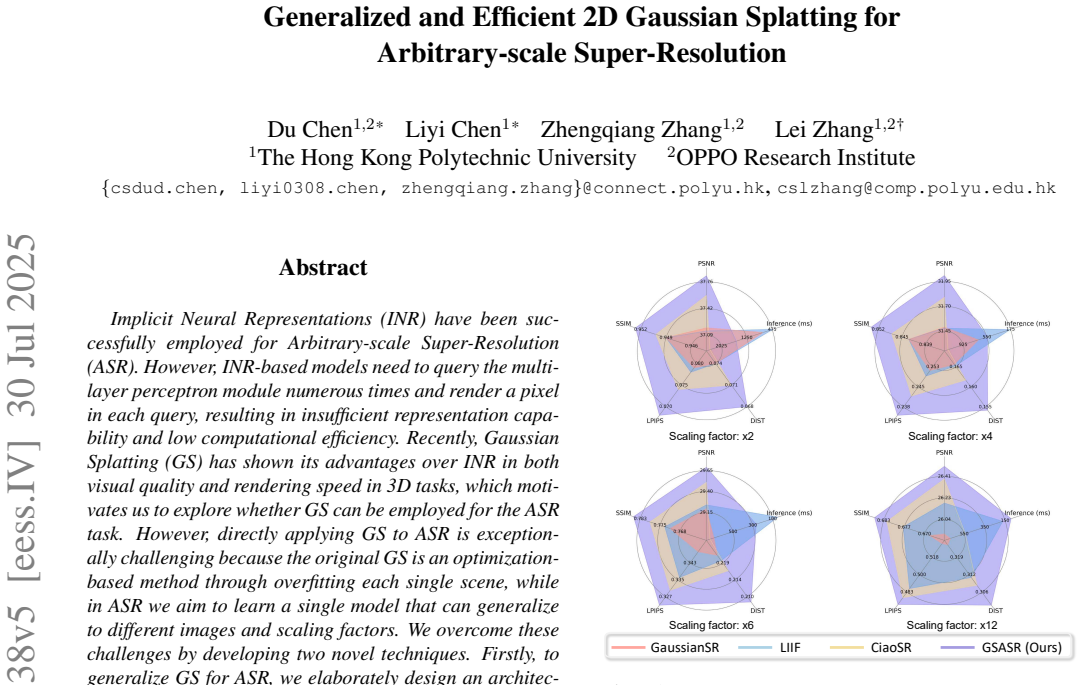
The paper claims that representing an LR image as a sum of N continuous 2D Gaussians, rather than as a field of individually queried pixels, gives a more powerful and cheaper representation for arbitrary-scale super-resolution. Each Gaussian carries opacity, center position, standard deviation, correlation coefficient, and peak RGB color, so it can locally adapt to the shape and orientation of textures. The decoder conditions learnable Gaussian embeddings on LR image features through windowed cross-attention and shifted-window self-attention, then five heads predict the Gaussian properties. A differentiable, GPU-parallel, scale-aware rasterizer samples the continuous field at a density set by the scaling factor, with a local-range truncation that keeps complexity low. On standard benchmarks with EDSR and RDN backbones, the paper reports that GSASR outperforms listed INR methods and the concurrent GaussianSR in PSNR, SSIM, LPIPS, and DISTS across scaling factors from ×2 to ×30, and that its inference is substantially faster at high scales.
Load-bearing premise
The claim that arbitrary image sizes work rests on the untested assumption that duplicating one shared base Gaussian embedding across all windows produces Gaussians that stay consistent across window boundaries.
Editorial extensions
If this is right
- A single GSASR model, trained with scaling factors sampled from 1.0 to 4.0, reportedly keeps improving over INR baselines on unseen scales up to ×30, so the Gaussian representation itself carries scale generalization.
- Because the rasterizer is differentiable, the whole pipeline of encoder, Gaussian decoder, and rendering is trained end-to-end with L1 loss, so the Gaussians are optimized directly for the final super-resolved image.
- At ×12 for a 720×720 output, GSASR reports 91 ms versus about 540 ms for CiaoSR, indicating that windowed attention plus the GPU rasterizer avoids the per-pixel MLP cost that dominates INR models.
- The learnable center offsets let Gaussians cluster on textured regions while flat areas stay covered by evenly spaced Gaussians, which is the mechanism behind the reported sharpness on edges and windows.
Reading between the lines
- If the window-tiling generalization is shown to be safe, the same Gaussian decoder could be applied to other continuous-coordinate tasks, such as image compression or video frame interpolation, without changing the rendering core.
- The speed advantage over INR models at high scales suggests that the bottleneck of arbitrary-scale super-resolution is per-pixel MLP sampling rather than the number of Gaussians, so models with fewer, adaptively placed Gaussians may reach similar quality at even larger scales.
- A testable extension is to replace the fixed window cross-attention with overlap-aware or global attention for a subset of embeddings, preserving locality where it helps while checking whether boundary consistency improves.
Signed reviews
Editorial analysis
A structured set of objections, weighed in public.
Referee Report
Summary. The paper proposes GSASR, a feed-forward 2D Gaussian splatting model for arbitrary-scale super-resolution. An LR image is encoded by a standard SR backbone, Gaussian embeddings are conditioned on the encoded features through window-based cross-attention and Gaussian interaction blocks, and a custom differentiable CUDA rasterizer renders the SR image by sampling the predicted continuous Gaussians at scale-dependent positions. The model is trained with L1 loss on scales sampled from [1,4] and tested on scales up to ×30. The main claims are that GSASR outperforms INR-based ASR methods in quality and is much faster, especially at high scaling factors.
Significance. If substantiated, the paper's central claim is significant: a Gaussian-based feed-forward representation would outperform INR-based arbitrary-scale SR in both fidelity and speed, while scaling efficiently to large upsampling factors. The manuscript's strengths include the breadth of evaluation (multiple datasets, two encoder backbones, four metrics, scales up to ×30), the ablations reported in the supplementary material, the exploration of a larger HAT-L backbone, and the promise of released code and models. The CUDA rasterization is a useful engineering contribution, and the position-distribution visualizations in Figures 6 and 9 give useful insight into why the representation helps on textured regions.
major comments (4)
- [§4.2, Table 1 (LSDIR columns)] The sentence 'GSASR outperforms existing methods in terms of both fidelity metrics (PSNR and SSIM) and perceptual quality metrics (LPIPS and DISTS) under scaling factors from ×2 to ×30' is not supported by the LSDIR columns of Table 1. At ×30, CiaoSR has higher PSNR (19.87 vs 19.82) and lower LPIPS (0.7284 vs 0.7368); at ×24 and ×18, CiaoSR also has higher PSNR (20.40 vs 20.38 and 21.18 vs 21.14). Please either restrict the claim to the datasets and metrics where it holds, or provide a statistical or qualitative justification for the small differences at the largest scales.
- [§3.1 vs Supplementary §6.3] The rasterization ratio is stated as r = 0.1 in §3.1 ('we set the ratio as r = 0.1'), but Supplementary §6.3 concludes 'we set r = 1.0 cautiously.' Supplementary Table 13 reports r = 1.0 inference times of 9419 ms (×4) and 3285 ms (×8), while main-text Table 2 reports 543 ms and 195 ms for GSASR, exactly matching the r = 0.1 columns. This is an internal contradiction on the load-bearing efficiency claim. Please state unambiguously which ratio the released code uses and make the text, tables, and code consistent; if r = 1.0 is the deployed setting, the reported speed advantage over CiaoSR no longer holds.
- [Table 2 and Supplementary Table 11] The introduction's claim that 'GSASR is much faster than state-of-the-art INR-based models' is contradicted by Table 2 at low scales: at ×2 GSASR takes 1573 ms versus 86 ms for LINF, 107 ms for SRNO, 126 ms for LTE, and 454 ms for LIIF; at ×3 GSASR takes 806 ms versus 89 ms for LINF and 114 ms for SRNO. The same pattern appears in Supplementary Table 11 with the RDN backbone (×2: 1679 ms vs 178 ms for Meta-SR and 202 ms for LINF). The speed advantage is real only against some methods and mostly at larger scales (e.g., versus CiaoSR at ×3/×4 and beyond). Please rephrase the speed claims to state this precisely, or report timings that do not depend on the rasterization ratio.
- [§3.2 Gaussian Embedding] The arbitrary-image-size claim relies on duplicating a single learned Ebase across all windows and letting reference positions plus window cross-attention specialize the embeddings. The paper does not analyze whether this tiling produces consistent Gaussians across window boundaries, and training is done on fixed 48×48 patches while testing uses larger images. Please add a quantitative check (e.g., PSNR computed on boundary strips versus image interiors, or a visualization of seams) or at least a discussion of when this tiling assumption could break.
minor comments (6)
- [§5] The conclusion contains typos: 'brandly-new' should be 'brand-new' and 'all thoes ablation studies' should be 'all those ablation studies'.
- [Supplementary §6.3] The final sentence 'we set r = 1.0 cautiously' directly contradicts the main text and the table in the same section; please reword so the chosen default is clear.
- [Supplementary Table 8 caption] The caption lists 'scaling factors × 2, × 3, × 4, × 8, × 8'; the second ×8 appears to be a duplicate, probably intended as ×6 or another scale, and the table rows should be checked against the caption.
- [Supplementary Table 11] In the ×4 row for RDN, the LPIPS value '23.88' appears to be a typo for '0.2388' (or a similarly formatted value).
- [Figure 2 caption] The caption says 'differential rasterization' where 'differentiable rasterization' is meant.
- [Reference [37]] The reference title contains 'manga eetrieval' and should read 'manga retrieval'.
Circularity Check
No circular derivation: GSASR's arbitrary-scale outputs are genuine extrapolations from end-to-end training; the rasterization-ratio inconsistency is a reproducibility flaw, not circularity.
full rationale
The paper's derivation chain is self-contained. The central claim, that a feed-forward Gaussian decoder trained with L1 loss on scales s in [1,4] generalizes to unseen scales up to x30, is checked against external benchmarks (DIV2K, LSDIR, Set5, etc.) with downloaded official models under a unified protocol; no predicted quantity is defined in terms of the fitted parameters. Hyperparameters (m=16, d=180, k=12, L=6) are chosen by ablation and do not encode the test-scale outcomes. The comparison with GaussianSR, from which Lei Zhang is an author, is experimental and not used to justify any premise of the method. The contradictory statements on rasterization ratio r (main text Section 3.1, 'we set the ratio as r = 0.1', vs Supplementary Section 6.3, 'we set r = 1.0 cautiously') are a serious internal inconsistency that affects the speed claim and reproducibility, but it is not circularity: the timings are empirical measurements, not identities derived from the method's own definitions. No uniqueness theorem, ansatz-by-citation, or fitted-input-called-prediction pattern is present in the derivation.
Assumptions & free parameters
free parameters (6)
- Gaussian density m =
16
- Embedding dimension d =
180
- Window size k =
12
- Number of Gaussian interaction blocks L =
6
- Rasterization ratio r =
0.1
- Training scale range =
[1.0, 4.0]
assumptions (3)
- domain assumption Bicubic downsampling is the correct degradation model for generating LR/HR training pairs.
- standard math Gradients through the custom CUDA rasterizer are numerically correct.
- domain assumption Training on DIV2K with random scales in [1,4] transfers to other benchmarks and scales up to 30.
Cite this review
Pith. "Pith review of Generalized and Efficient 2D Gaussian Splatting for Arbitrary-scale Super-Resolution." pith.science (2026). https://pith.science/paper/CDPJUHWP
@misc{pith2026250106838,
  author       = {Pith},
  title        = {Pith review of: Generalized and Efficient 2D Gaussian Splatting for Arbitrary-scale Super-Resolution},
  year         = {2026},
  howpublished = {\url{https://pith.science/paper/CDPJUHWP}},
  note         = {Machine review of arXiv:2501.06838}
}
read the original abstract
Implicit Neural Representations (INR) have been successfully employed for Arbitrary-scale Super-Resolution (ASR). However, INR-based models need to query the multi-layer perceptron module numerous times and render a pixel in each query, resulting in insufficient representation capability and low computational efficiency. Recently, Gaussian Splatting (GS) has shown its advantages over INR in both visual quality and rendering speed in 3D tasks, which motivates us to explore whether GS can be employed for the ASR task. However, directly applying GS to ASR is exceptionally challenging because the original GS is an optimization-based method through overfitting each single scene, while in ASR we aim to learn a single model that can generalize to different images and scaling factors. We overcome these challenges by developing two novel techniques. Firstly, to generalize GS for ASR, we elaborately design an architecture to predict the corresponding image-conditioned Gaussians of the input low-resolution image in a feed-forward manner. Each Gaussian can fit the shape and direction of an area of complex textures, showing powerful representation capability. Secondly, we implement an efficient differentiable 2D GPU/CUDA-based scale-aware rasterization to render super-resolved images by sampling discrete RGB values from the predicted continuous Gaussians. Via end-to-end training, our optimized network, namely GSASR, can perform ASR for any image and unseen scaling factors. Extensive experiments validate the effectiveness of our proposed method. The code and models are available at https://github.com/ChrisDud0257/GSASR.
Figures


Figures from the paper (13 more)


Forward citations
Cited by 5 Pith papers
-
2D Gaussian Splatting with Semantic Alignment for Image Inpainting
A 2D Gaussian Splatting encoder-rasterization network with DINO-based semantic alignment achieves competitive image inpainting results.
-
SAT-SKYLINES: 3D Building Generation from Satellite Imagery and Coarse Geometric Priors
A 3D building generator that combines satellite imagery with coarse geometric priors via cosine interpolation between noise and prior latents, trained on a new 50K building dataset.
-
Fine-structure Preserved Real-world Image Super-resolution via Transfer VAE Training
A transfer training scheme converts Stable Diffusion's 8x VAE into a 4x VAE that stays compatible with the pretrained UNet, improving fine-structure preservation in real-world super-resolution at lower FLOPs.
-
Texture++: Elevating 3D Asset Texture Resolution with a Region-Aware Diffusion Model
A view-based, mask-guided diffusion pipeline that super-resolves 3D model textures at 4× without gradient optimization.
-
Efficient Difficulty-Aware Dynamic Routing for Diffusion-Based Real-World Image Super-Resolution
DDR-SR routes each real-world low-resolution image to one of two diffusion experts based on a high-frequency-loss difficulty score, using a low-compression VAE for hard images and a high-compression VAE for easy image...
Reference graph
Works this paper leans on
-
[1]
Low-complexity single-image super-resolution based on nonnegative neighbor embedding
Marco Bevilacqua, Aline Roumy, Christine Guillemot, and Marie Line Alberi-Morel. Low-complexity single-image super-resolution based on nonnegative neighbor embedding. In BMVC, pages 135.1–135.10, 2012. 1, 5
work page 2012
-
[2]
Jiezhang Cao, Qin Wang, Y ongqin Xian, Y awei Li, Bingbing Ni, Zhiming Pi, Kai Zhang, Y ulun Zhang, Radu Timofte, and Luc V an Gool. Ciaosr: Continuous implicit attention-in-attention network for arbitrary-scale image super-resolution. In Proceedings of the IEEE/CVF Conference on Computer Vision and Pattern Recognition , pages 1796–1807, 2023. 1, 2
work page 2023
-
[3]
Activating more pixels in image super-resolution transformer
Xiangyu Chen, Xintao Wang, Jiantao Zhou, Y u Qiao, and Chao Dong. Activating more pixels in image super-resolution transformer. In IEEE Conference on Computer Vision and Pattern Recognition , pages 22367–22377. IEEE, 2023. 13
work page 2023
-
[4]
Learning continuous image representation with local implicit image function
Yinbo Chen, Sifei Liu, and Xiaolong Wang. Learning continuous image representation with local implicit image function. In IEEE Conference on Computer Vision and Pattern Recognition, pages 8628–8638, 2021. 1, 2
work page 2021
-
[5]
Flashattention: Fast and memory-efficient exact attention with io-awareness
Tri Dao, Dan Fu, Stefano Ermon, Atri Rudra, and Christopher R ´e. Flashattention: Fast and memory-efficient exact attention with io-awareness. Advances in Neural Information Processing Systems , 35:16344–16359, 2022. 13
work page 2022
-
[6]
Image quality assessment: Unifying structure and texture similarity
Keyan Ding, Kede Ma, Shiqi Wang, and Eero P Simoncelli. Image quality assessment: Unifying structure and texture similarity. IEEE Transactions on Pattern Analysis and Machine Intelligence , 44(5):2567–2581, 2020. 1
work page 2020
-
[7]
Accelerating the super-resolution convolutional neural network
Chao Dong, Chen Change Loy, and Xiaoou Tang. Accelerating the super-resolution convolutional neural network. In European Conference on Computer Vision, pages 391–407. Springer, 2016. 1, 4
work page 2016
-
[8]
Latent modulated function for computational optimal continuous image representation
Zongyao He and Zhi Jin. Latent modulated function for computational optimal continuous image representation. In Proceedings of the IEEE/CVF Conference on Computer Vision and Pattern Recognition , pages 26026–26035, 2024. 1
work page 2024
Show all 28 references
-
[9]
Rotary position embedding for vision transformer
Byeongho Heo, Song Park, Dongyoon Han, and Sangdoo Y un. Rotary position embedding for vision transformer. In European Conference on Computer Vision, pages 289–305. Springer, 2024. 13
2024
-
[10]
Gaussiansr: High fidelity 2d gaussian splatting for arbitrary-scale image super-resolution
Jintong Hu, Bin Xia, Bin Chen, Wenming Y ang, and Lei Zhang. Gaussiansr: High fidelity 2d gaussian splatting for arbitrary-scale image super-resolution. In Proceedings of the Association for the Advancement of Artificial Intelligence , 2025. 1, 2, 9
2025
-
[11]
Meta-sr: A magnification-arbitrary network for super-resolution
Xuecai Hu, Haoyuan Mu, Xiangyu Zhang, Zilei Wang, Tieniu Tan, and Jian Sun. Meta-sr: A magnification-arbitrary network for super-resolution. In IEEE Conference on Computer Vision and Pattern Recognition , pages 1575–1584, 2019. 1
2019
-
[12]
Single image super-resolution from transformed self-exemplars
Jia-Bin Huang, Abhishek Singh, and Narendra Ahuja. Single image super-resolution from transformed self-exemplars. In IEEE Conference on Computer Vision and Pattern Recognition, pages 5197–5206, 2015. 1, 3
2015
-
[13]
Adam: A method for stochastic optimization
Diederik P Kingma and Jimmy Ba. Adam: A method for stochastic optimization. arXiv preprint arXiv:1412.6980, 2014. 13
2014 arXiv
-
[14]
Segment anything
Alexander Kirillov, Eric Mintun, Nikhila Ravi, Hanzi Mao, Chloe Rolland, Laura Gustafson, Tete Xiao, Spencer Whitehead, Alexan- der C Berg, Wan-Y en Lo, et al. Segment anything. In Proceedings of the IEEE/CVF International Conference on Computer Vision , pages 4015–4026, 2023. 13
2023
-
[15]
Local texture estimator for implicit representation function
Jaewon Lee and Kyong Hwan Jin. Local texture estimator for implicit representation function. In Proceedings of the IEEE/CVF Conference on Computer Vision and Pattern Recognition, pages 1929–1938, 2022. 1
1929
-
[16]
Lsdir: A large scale dataset for image restoration
Y awei Li, Kai Zhang, Jingyun Liang, Jiezhang Cao, Ce Liu, Rui Gong, Y ulun Zhang, Hao Tang, Y un Liu, Denis Demandolx, et al. Lsdir: A large scale dataset for image restoration. In Proceedings of the IEEE/CVF Conference on Computer Vision and Pattern Recognition, pages 1775–1...
2023
-
[17]
Enhanced deep residual networks for single image super-resolution
Bee Lim, Sanghyun Son, Heewon Kim, Seungjun Nah, and Kyoung Mu Lee. Enhanced deep residual networks for single image super-resolution. In IEEE Conference on Computer Vision and Pattern Recognition Workshop , pages 136–144, 2017. 1, 3, 4, 5, 6, 7, 8, 12
2017
-
[18]
Swin transformer: Hierarchical vision transformer using shifted windows
Ze Liu, Y utong Lin, Y ue Cao, Han Hu, Yixuan Wei, Zheng Zhang, Stephen Lin, and Baining Guo. Swin transformer: Hierarchical vision transformer using shifted windows. In Proceedings of the IEEE/CVF international conference on computer vision , pages 10012–10022, 2021. 13
2021
-
[19]
A database of human segmented natural images and its application to evaluating segmentation algorithms and measuring ecological statistics
David Martin, Charless Fowlkes, Doron Tal, and Jitendra Malik. A database of human segmented natural images and its application to evaluating segmentation algorithms and measuring ecological statistics. In IEEE International Conference on Computer Vision , pages 416–423. IEEE,...
2001
-
[20]
Sketch-based manga eetrieval using manga109 dataset
Y usuke Matsui, Kota Ito, Y uji Aramaki, Azuma Fujimoto, Toru Ogawa, Toshihiko Y amasaki, and Kiyoharu Aizawa. Sketch-based manga eetrieval using manga109 dataset. Multimedia Tools and Applications, 76(20):21811–21838, 2017. 1, 3
2017
-
[21]
Ntire 2017 challenge on single image super- resolution: Methods and results
Radu Timofte, Eirikur Agustsson, Luc V an Gool, Ming-Hsuan Y ang, and Lei Zhang. Ntire 2017 challenge on single image super- resolution: Methods and results. In IEEE Conference on Computer Vision and Pattern Recognition Workshop, pages 114–125, 2017. 1, 2, 7, 12
2017
-
[22]
Image quality assessment: From error visibility to structural similarity
Zhou Wang, Alan C Bovik, Hamid R Sheikh, and Eero P Simoncelli. Image quality assessment: From error visibility to structural similarity. IEEE Transactions on Image Processing, 13(4):600–612, 2004. 1, 3, 4, 5
2004
-
[23]
Super-resolution neural operator
Min Wei and Xuesong Zhang. Super-resolution neural operator. In Proceedings of the IEEE/CVF Conference on Computer Vision and Pattern Recognition, pages 18247–18256, 2023. 1
2023
-
[24]
Local implicit normalizing flow for arbitrary- scale image super-resolution
Jie-En Y ao, Li-Y uan Tsao, Yi-Chen Lo, Roy Tseng, Chia-Che Chang, and Chun-Yi Lee. Local implicit normalizing flow for arbitrary- scale image super-resolution. In Proceedings of the IEEE/CVF Conference on Computer Vision and Pattern Recognition , pages 1776–1785, 2023. 1 14
2023
-
[25]
On single image scale-up using sparse-representations
Roman Zeyde, Michael Elad, and Matan Protter. On single image scale-up using sparse-representations. In International Conference on Curves and Surfaces , pages 711–730. Springer, 2010. 1, 5
2010
-
[26]
The unreasonable effectiveness of deep features as a perceptual metric
Richard Zhang, Phillip Isola, Alexei A Efros, Eli Shechtman, and Oliver Wang. The unreasonable effectiveness of deep features as a perceptual metric. In IEEE Conference on Computer Vision and Pattern Recognition , pages 586–595, 2018. 1
2018
-
[27]
Image super-resolution using very deep residual channel attention networks
Y ulun Zhang, Kunpeng Li, Kai Li, Lichen Wang, Bineng Zhong, and Y un Fu. Image super-resolution using very deep residual channel attention networks. In European Conference on Computer Vision, pages 286–301, 2018. 3, 11
2018
-
[28]
Residual dense network for image super-resolution
Y ulun Zhang, Y apeng Tian, Y u Kong, Bineng Zhong, and Y un Fu. Residual dense network for image super-resolution. In IEEE Conference on Computer Vision and Pattern Recognition, pages 2472–2481, 2018. 1, 2, 4, 5, 7, 8, 9 15
2018
Reviewed August 10, 2026 · model on record in the stance chip above.
Discussion (0). Continue with ORCID to comment.