Jamming-Resilient PRB Reservation for Latency-Critical O-RAN Network Slicing
Pith reviewed 2026-06-29 00:05 UTC · model grok-4.3
The pith
A masked Deep Q-Network learns when to activate reserved PRBs for hybrid mitigation of jamming in O-RAN slices.
A machine-rendered reading of the paper's core claim, the machinery that carries it, and where it could break.
Core claim
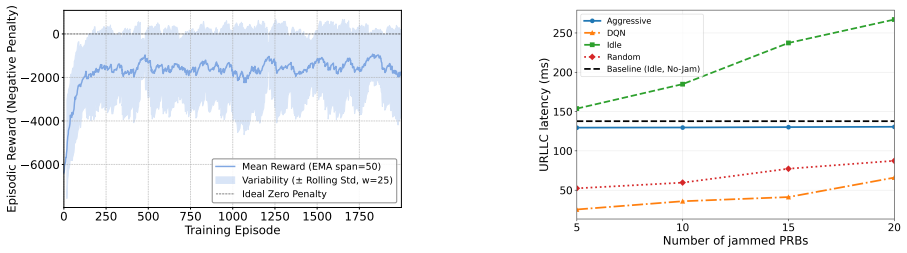
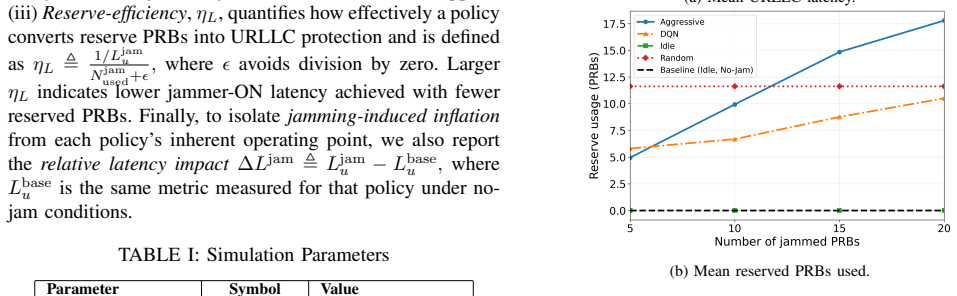
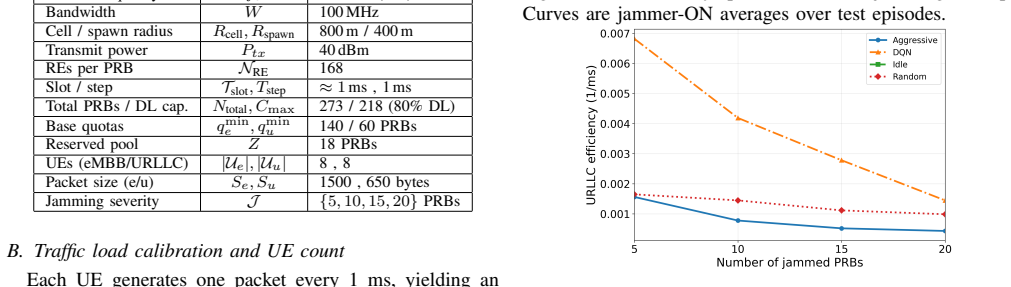
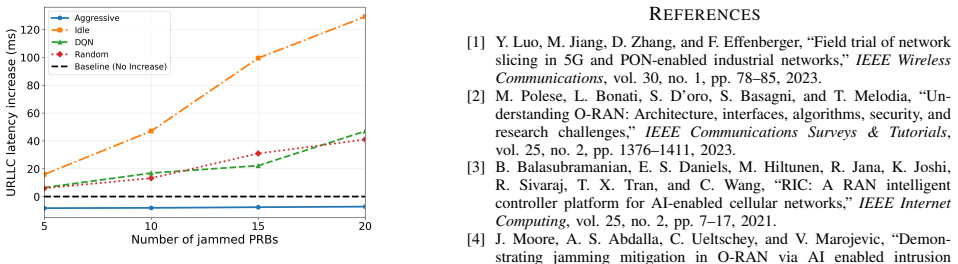
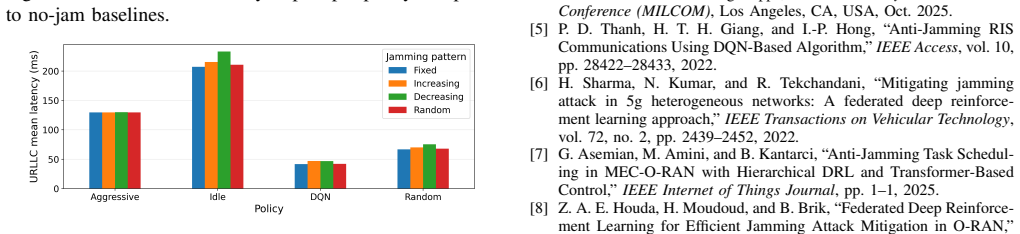
The central claim is that a hybrid proactive-reactive strategy for activating a pool of reserved PRBs, learned via a masked Deep Q-Network, delivers substantial reductions in URLLC latency violations and improved reserve efficiency under jamming compared with reactive baselines in sliced O-RAN deployments.
What carries the argument
The masked Deep Q-Network that learns reserve activation policies as a constrained sequential decision problem under non-stationary jamming.
If this is right
- URLLC slices maintain lower latency violation rates even when effective PRB capacity drops abruptly.
- Reserved capacity is allocated only during active jamming intervals, reducing waste outside attack periods.
- Proactive backlog clearing builds latency margin before jamming begins.
- The learned policy adapts to changing jamming patterns without explicit reprogramming.
Where Pith is reading between the lines
- The same reserve-pool approach could extend to other sudden capacity threats such as strong interference or rapid user mobility.
- Coordinating multiple xApps on the RIC could allow joint reserve decisions across slices with differing latency targets.
- Online fine-tuning of the DQN after initial simulation training might be needed if real jamming statistics differ from the modeled process.
Load-bearing premise
The simulation environment and jamming model are representative enough that policies learned in simulation will transfer to real O-RAN deployments without additional real-world tuning or validation.
What would settle it
Running the trained masked DQN policy on a physical O-RAN testbed with actual jamming signals and measuring whether latency violation rates drop by the margins reported in simulation.
Figures
read the original abstract
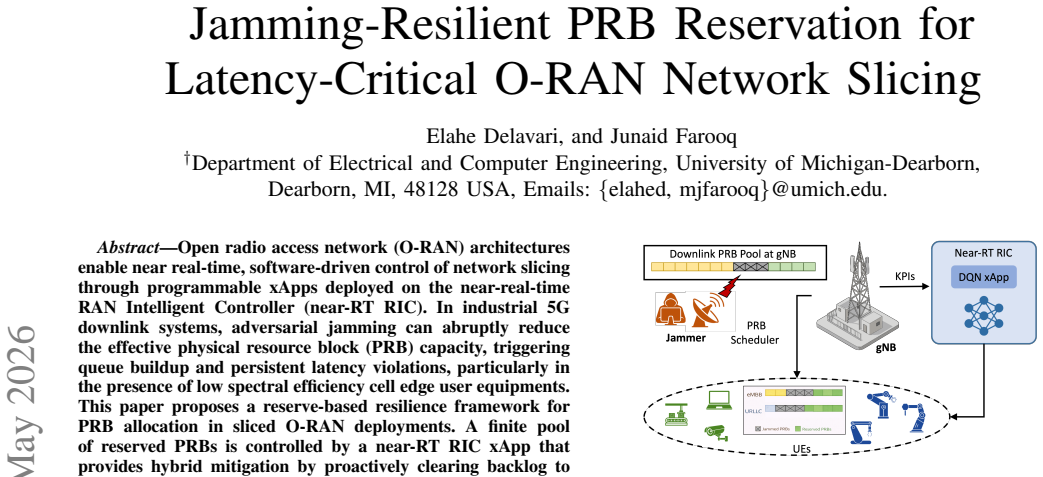
Open radio access network (O-RAN) architectures enable near real-time, software-driven control of network slicing through programmable xApps deployed on the near-real-time RAN Intelligent Controller (near-RT RIC). In industrial 5G downlink systems, adversarial jamming can abruptly reduce the effective physical resource block (PRB) capacity, triggering queue buildup and persistent latency violations, particularly in the presence of low spectral efficiency cell edge user equipments. This paper proposes a reserve-based resilience framework for PRB allocation in sliced O-RAN deployments. A finite pool of reserved PRBs is controlled by a near-RT RIC xApp that provides hybrid mitigation by proactively clearing backlog to build latency margin and reactively allocating reserve capacity during jammer active intervals. We formulate reserve activation as a constrained sequential decision problem and design a masked Deep Q-Network to learn effective control policies under non-stationary jamming. Simulation results show substantial reductions in URLLC latency violations and improved reserve efficiency compared to reactive baselines.
Editorial analysis
A structured set of objections, weighed in public.
Referee Report
Summary. The manuscript proposes a reserve-based resilience framework for PRB allocation in O-RAN network slicing under adversarial jamming. It formulates reserve activation as a constrained sequential decision problem solved by a masked Deep Q-Network xApp on the near-RT RIC that combines proactive backlog clearing and reactive reserve allocation. The central claim, supported by simulation results, is that the learned policy yields substantial reductions in URLLC latency violations and improved reserve efficiency relative to reactive baselines.
Significance. If the simulation outcomes prove robust and the policies transfer beyond the modeled environment, the framework would constitute a practical contribution to jamming-resilient industrial 5G slicing by exploiting O-RAN programmability. It targets a concrete operational vulnerability (abrupt PRB capacity drops causing persistent latency violations at cell-edge UEs) with a hybrid proactive-reactive mechanism.
major comments (2)
- [Abstract] Abstract: the claim of 'substantial reductions in URLLC latency violations and improved reserve efficiency' is presented without any quantitative description of simulation parameters, baseline implementations, statistical tests, sensitivity analyses, or the jamming process (duty cycle, power, frequency selectivity, activation intervals). This omission is load-bearing because the soundness of the central claim rests entirely on these simulation outcomes.
- [Simulation results (inferred from abstract and skeptic note)] The policy is obtained by training a masked DQN on an environment model whose discrete-time step size, PRB capacity drop dynamics, queue evolution, cell-edge spectral efficiency, and relation to O-RAN E2 latency are not specified or validated against real near-RT RIC control loops and 5G PHY behavior. Without such grounding, it is impossible to determine whether performance gains reflect robust features or simulator artifacts.
Simulated Author's Rebuttal
We thank the referee for the constructive and detailed feedback. We address each major comment below and will revise the manuscript to enhance quantitative support in the abstract and to provide fuller specification of the simulation environment.
read point-by-point responses
-
Referee: [Abstract] Abstract: the claim of 'substantial reductions in URLLC latency violations and improved reserve efficiency' is presented without any quantitative description of simulation parameters, baseline implementations, statistical tests, sensitivity analyses, or the jamming process (duty cycle, power, frequency selectivity, activation intervals). This omission is load-bearing because the soundness of the central claim rests entirely on these simulation outcomes.
Authors: We agree that the abstract would be strengthened by quantitative anchors. In the revision we will incorporate specific simulation outcomes (e.g., percentage reductions in latency violations, reserve-utilization gains) together with concise references to the jamming duty cycle, power levels, and baseline definitions while remaining within length limits. The body already contains the full parameter tables and statistical details; the abstract update will simply surface the key numbers that support the central claim. revision: yes
-
Referee: [Simulation results (inferred from abstract and skeptic note)] The policy is obtained by training a masked DQN on an environment model whose discrete-time step size, PRB capacity drop dynamics, queue evolution, cell-edge spectral efficiency, and relation to O-RAN E2 latency are not specified or validated against real near-RT RIC control loops and 5G PHY behavior. Without such grounding, it is impossible to determine whether performance gains reflect robust features or simulator artifacts.
Authors: We will add an explicit subsection that lists the discrete-time step size, the exact PRB-capacity-drop model (including frequency-selective and abrupt-drop cases), the queue-evolution equations, the cell-edge spectral-efficiency values employed, and the mapping of control actions to O-RAN E2 latency budgets. The study remains simulation-based; we will therefore also include a short discussion of how the chosen parameters align with 3GPP NR and O-RAN timing specifications, thereby clarifying the intended scope and reducing the risk that readers interpret results as ungrounded artifacts. revision: yes
Circularity Check
No significant circularity in derivation chain
full rationale
The paper formulates PRB reserve activation as a constrained sequential decision problem and trains a masked DQN policy on a simulated environment under non-stationary jamming, then reports empirical latency and efficiency gains versus baselines. No algebraic derivation chain is claimed that reduces a result to its own inputs by construction; the performance claims are simulation outputs rather than predictions forced by fitted parameters or self-citations. No self-definitional steps, uniqueness theorems, or ansatz smuggling appear in the abstract or described approach. The work is self-contained as a simulation study with independent content from the learned policy.
Axiom & Free-Parameter Ledger
Reference graph
Works this paper leans on
-
[1]
Field trial of network slicing in 5G and PON-enabled industrial networks,
Y . Luo, M. Jiang, D. Zhang, and F. Effenberger, “Field trial of network slicing in 5G and PON-enabled industrial networks,”IEEE Wireless Communications, vol. 30, no. 1, pp. 78–85, 2023
2023
-
[2]
Un- derstanding O-RAN: Architecture, interfaces, algorithms, security, and research challenges,
M. Polese, L. Bonati, S. D’oro, S. Basagni, and T. Melodia, “Un- derstanding O-RAN: Architecture, interfaces, algorithms, security, and research challenges,”IEEE Communications Surveys & Tutorials, vol. 25, no. 2, pp. 1376–1411, 2023
2023
-
[3]
RIC: A RAN intelligent controller platform for AI-enabled cellular networks,
B. Balasubramanian, E. S. Daniels, M. Hiltunen, R. Jana, K. Joshi, R. Sivaraj, T. X. Tran, and C. Wang, “RIC: A RAN intelligent controller platform for AI-enabled cellular networks,”IEEE Internet Computing, vol. 25, no. 2, pp. 7–17, 2021
2021
-
[4]
Demon- strating jamming mitigation in O-RAN via AI enabled intrusion detection and secure slicing xApps,
J. Moore, A. S. Abdalla, C. Ueltschey, and V . Marojevic, “Demon- strating jamming mitigation in O-RAN via AI enabled intrusion detection and secure slicing xApps,” inIEEE Military Communications Conference (MILCOM), Los Angeles, CA, USA, Oct. 2025
2025
-
[5]
Anti-Jamming RIS Communications Using DQN-Based Algorithm,
P. D. Thanh, H. T. H. Giang, and I.-P. Hong, “Anti-Jamming RIS Communications Using DQN-Based Algorithm,”IEEE Access, vol. 10, pp. 28422–28433, 2022
2022
-
[6]
Mitigating jamming attack in 5g heterogeneous networks: A federated deep reinforce- ment learning approach,
H. Sharma, N. Kumar, and R. Tekchandani, “Mitigating jamming attack in 5g heterogeneous networks: A federated deep reinforce- ment learning approach,”IEEE Transactions on Vehicular Technology, vol. 72, no. 2, pp. 2439–2452, 2022
2022
-
[7]
Anti-Jamming Task Schedul- ing in MEC-O-RAN with Hierarchical DRL and Transformer-Based Control,
G. Asemian, M. Amini, and B. Kantarci, “Anti-Jamming Task Schedul- ing in MEC-O-RAN with Hierarchical DRL and Transformer-Based Control,”IEEE Internet of Things Journal, pp. 1–1, 2025
2025
-
[8]
Federated Deep Reinforce- ment Learning for Efficient Jamming Attack Mitigation in O-RAN,
Z. A. E. Houda, H. Moudoud, and B. Brik, “Federated Deep Reinforce- ment Learning for Efficient Jamming Attack Mitigation in O-RAN,” IEEE Transactions on Vehicular Technology, vol. 73, pp. 9334–9343, July 2024
2024
-
[9]
Dynamic spectrum reservation for CR networks in the presence of channel failures: Channel allocation and reliability analysis,
I. A. Balapuwaduge, F. Li, and V . Pla, “Dynamic spectrum reservation for CR networks in the presence of channel failures: Channel allocation and reliability analysis,”IEEE Transactions on Wireless Communica- tions, vol. 17, no. 2, pp. 882–898, 2018
2018
-
[10]
Centralized dynamic channel reservation mechanism via SDN for CR networks spectrum allocation,
N. M. El Azaly, E. F. Badran, H. N. Kheirallah, and H. H. Farag, “Centralized dynamic channel reservation mechanism via SDN for CR networks spectrum allocation,”IEEE Access, vol. 8, pp. 192493– 192505, 2020
2020
-
[11]
Spectrum efficiency in CRNs using hybrid dynamic channel reservation and enhanced dynamic spectrum access,
G. Abbas, Z. H. Abbas, T. Baker, M. Waqas,et al., “Spectrum efficiency in CRNs using hybrid dynamic channel reservation and enhanced dynamic spectrum access,”Ad Hoc Networks, vol. 107, p. 102246, 2020
2020
-
[12]
An enhanced spectrum reservation framework for heterogeneous users in CR-Enabled IoT networks,
A. U. Khan, M. Tanveer, W. U. Khan, J. Nebhen, X. Li, M. Zeng, and O. A. Dobre, “An enhanced spectrum reservation framework for heterogeneous users in CR-Enabled IoT networks,”IEEE Wireless Communications Letters, 2021
2021
-
[13]
A novel reservation- based MAC scheme for distributed cognitive radio networks,
M. Lu ´ıs, R. Oliveira, R. Dinis, and L. Bernardo, “A novel reservation- based MAC scheme for distributed cognitive radio networks,”IEEE Transactions on Vehicular Technology, vol. 66, no. 5, pp. 4327–4340, 2016
2016
-
[14]
5G; study on channel model for frequencies from 0.5 to 100 GHz (3GPP TR 38.901 version 16.1.0 release 16),
ETSI, “5G; study on channel model for frequencies from 0.5 to 100 GHz (3GPP TR 38.901 version 16.1.0 release 16),” Tech. Rep. TR 138 901 V16.1.0, European Telecommunications Standards Institute, Nov. 2020
2020
-
[15]
NR; Physical layer procedures for data (Release 15),
3GPP, “NR; Physical layer procedures for data (Release 15),” Technical Specification TS 38.214 V15.3.0, 3rd Generation Partnership Project (3GPP), 2018
2018
-
[16]
Action space shaping in deep reinforcement learning,
A. Kanervisto, C. Scheller, and V . Hautam ¨aki, “Action space shaping in deep reinforcement learning,” inIEEE conference on games (CoG), Osaka, Japan, Aug. 2020
2020
-
[17]
AI-RAN simulator
“AI-RAN simulator.” https://github.com/ntutangyun/ai-ran-sim. Ac- cessed: 2025-11-24
2025
-
[18]
Jamming Attacks and Anti-Jamming Strategies in Wireless Networks: A Comprehensive Survey,
H. Pirayesh and H. Zeng, “Jamming Attacks and Anti-Jamming Strategies in Wireless Networks: A Comprehensive Survey,”IEEE Communications Surveys & Tutorials, vol. 24, no. 2, pp. 767–809, 2022
2022
discussion (0)
Sign in with ORCID, Apple, or X to comment. Anyone can read and Pith papers without signing in.