REVIEW 2 major objections 6 minor 44 references
Star Quasiconvexity: a Unified Approach for Linear Convergence of First-Order Methods Beyond Convexity
T0 review · 2 major / 6 minor · reviewed 2026-08-15 · deepseek-v4-flash
Pith's one-line read Strongly star quasiconvex functions unify convex, quasiconvex, star-convex, and quasar-convex classes, and the proximal point algorithm converges linearly to their unique minimizer on closed star-shaped sets.
desk verdict The PPA-on-star-shaped-sets theorem is real and clean; the heavy-ball/Nesterov claims in Section 4 are not actually proved. read the letter →
The pith
A machine-rendered reading of the paper's core claim, the machinery that carries it, and where it could break.
The reading
What carries the argument
The load-bearing object is the star quasiconvexity inequality (15), together with the geometric fact it encodes: every sublevel set $S_\delta(h)=\{x:h(x)\le\delta\}$ is star-shaped at the minimizer $\bar{x}$, meaning that the segment $[\bar{x},x]$ lies inside the sublevel set for every $x$ in it. In the differentiable case the same inequality is equivalent to the restricted secant condition $\langle\nabla h(y), y-\bar{x}\rangle\ge \frac{\gamma}{2}\|y-\bar{x}\|^2$, and the proximal point analysis runs through inequality (22), which bounds the prox step by comparing it with the minimizer along the segment inside the star-shaped set $K$. That segment is what turns a one-dimensional ray argument into a global squared-distance contraction for Algorithm 1.
What would settle it
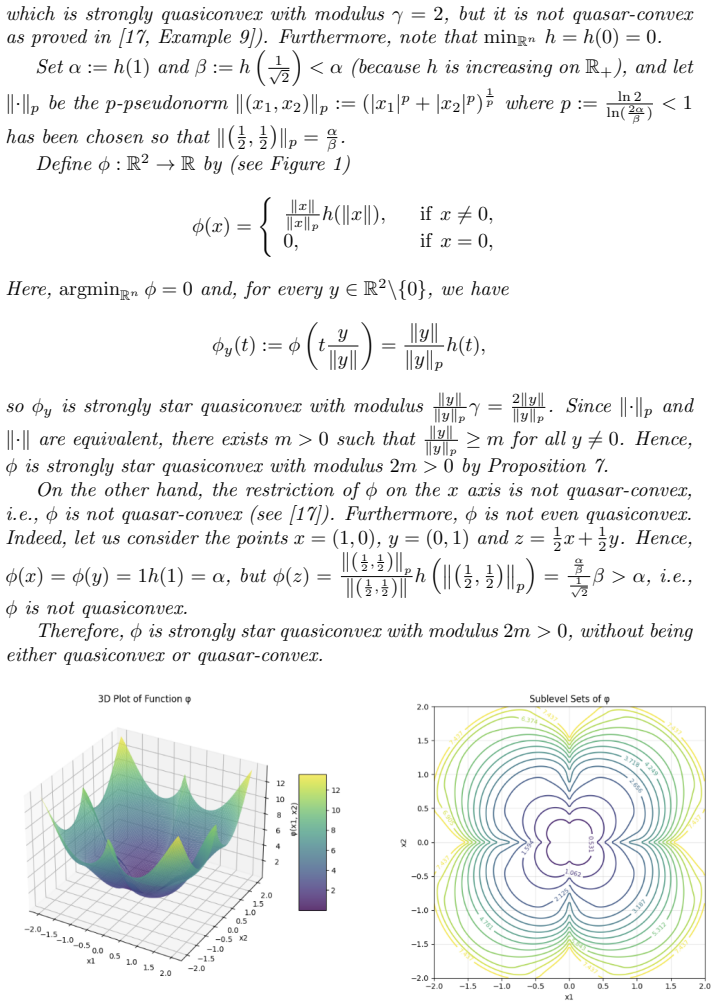
Run Algorithm 1 on a closed, bounded star-shaped set that is not convex (for example, a four-leaf clover domain) with a strongly star quasiconvex function such as the one constructed in Example 8, and record the ratio $\|x_{k+1}-\bar{x}\|^2/\|x_k-\bar{x}\|^2$. If at any step this ratio exceeds $1/(1+\beta'\gamma)$, the contraction (34) and Theorem 33 are false.
Extended reading notes
Core claim
The paper's central claim is that the class of strongly star quasiconvex functions is the right umbrella for linear convergence beyond convexity. After fixing the unique minimizer $\bar{x}$, the defining inequality says that moving from any point $y$ toward $\bar{x}$ cannot increase $h$ by more than the quadratic penalty $\lambda(1-\lambda)\frac{\gamma}{2}\|y-\bar{x}\|^2$. Theorem 9 proves that this is equivalent, in the non-strong case, to every sublevel set being star-shaped at $\bar{x}$; Theorem 12 proves equivalence with quasiconvexity along each ray emanating from $\bar{x}$; Proposition 24 identifies the differentiable form as the restricted secant inequality $\langle\nabla h(y), y-\bar{x}\rangle\ge \frac{\gamma}{2}\|y-\bar{x}\|^2$, and Proposition 26 shows Lipschitz-smooth strongly star quasiconvex functions satisfy a gradient-dominance inequality with constant $\gamma^2/(2L)$. Theorem 33 then derives the contraction $\|x_{k+1}-\bar{x}\|^2\le \|x_k-\bar{x}\|^2/(1+\beta'\gamma)$ for the proximal point algorithm on a closed star-shaped set, giving linear convergence to the unique solution; the same rate is exactly as good as in the strongly convex case.
Load-bearing premise
The load-bearing premise is geometric: the feasible set $K$ must be star-shaped at the unique minimizer $\bar{x}$, so that every segment $[\bar{x}, x^*]$ used in the proof lies inside $K$; nothing in the function class alone guarantees this, and the paper notes that prox steps on star-shaped sets are still impractical.
Editorial extensions
If this is right
- Every convex, quasiconvex, star-convex, quasar-convex, and positively homogeneous function considered in the paper falls into the star quasiconvex framework, so the linear-convergence results for those classes become special cases of a single inequality; the inclusion is proper, as shown by Example 8.
- A function is star quasiconvex with respect to a minimizer if and only if all its sublevel sets are star-shaped at that minimizer, giving a purely geometric certificate that can be checked without computing gradients (Theorem 9).
- In the differentiable case, strong star quasiconvexity coincides with the restricted secant inequality, and Lipschitz-smooth strongly star quasiconvex functions satisfy a gradient-dominance inequality with constant $\gamma^2/(2L)$ (Propositions 24 and 26).
- The proximal point algorithm on a closed, star-shaped feasible set converges linearly to the unique minimizer with rate at least $1/(1+\beta'\gamma)$, matching the strongly convex rate (Theorem 33).
- Gradient descent, the heavy-ball method, and the momentum-accelerated gradient method all converge linearly for strongly star quasiconvex functions, with the same rates previously known for strongly quasiconvex functions (Theorems 27 and 30).
Reading between the lines
- Because strong star quasiconvexity is equivalent to quasiconvexity along every ray from the minimizer, one-dimensional convergence proofs for strongly quasiconvex functions should in principle lift to star-shaped domains, provided the domain is star-shaped at the minimizer; this could simplify future algorithm analysis without reproving contraction estimates from scratch.
- The gradient-dominance inequality obtained in Proposition 26 is a known sufficient condition for linear convergence of stochastic and incremental gradient methods, so the framework may extend to randomized first-order algorithms under the same star-shaped sublevel-set condition; the paper itself treats only deterministic methods.
- Remark 36 concedes that prox computations on star-shaped sets are largely unexplored. Finding tractable star-shaped sets with computable proximity operators, such as unions of convex cones or balls sharing a common center, would turn Theorem 33 from a theoretical statement into a practical algorithm.
- The conclusion's suggested connection to prospect theory is testable: one could check whether utility functions whose sublevel sets are star-shaped at a reference point reproduce reference-dependent behavior such as loss aversion, since star quasiconvexity fixes the minimizer as the reference point.
Signed reviews
Editorial analysis
A structured set of objections, weighed in public.
Referee Report
Summary. The paper introduces the class of (strongly) star quasiconvex functions, defined by inequality (15), in which every point y is compared with a fixed minimizer xbar along the segment [xbar,y]. It claims this class unifies convex, star-convex, quasiconvex, quasar-convex, and positively homogeneous functions. The main theoretical contributions are: a geometric characterization via star-shaped sublevel sets (Theorem 9), a characterization as quasiconvexity along rays through the minimizer (Theorem 12), a gradient characterization via the restricted secant inequality (24) in the differentiable case (Proposition 24), derived properties such as quadratic growth, 2-supercoercivity, and the Polyak- Lojasiewicz inequality, and a linear convergence result for the proximal point algorithm on closed star-shaped domains (Theorem 33). The paper also claims linear convergence for gradient, heavy-ball, and Nesterov accelerated methods, with proofs delegated to a companion paper [17] by setting a parameter to zero.
Significance. If the main claims hold, the paper provides a genuinely unifying framework: Theorem 33 is, to the authors' knowledge, the first linear convergence result for PPA on nonconvex star-shaped sets, and the characterization results in Section 3 are clean and potentially useful for subsequent work. The PPA proof in Theorem 33 is self-contained, short, and algebraically sound after a few notation fixes, and the paper is honest about limitations: Remark 36 acknowledges that computing proximity operators on star-shaped sets is currently impractical, and Remark 35(c) notes that no function-value convergence rate is available. These are real strengths. However, the paper's advertised reach extends beyond PPA to gradient-type methods, and that portion of the manuscript is not supported by the present text; the main inclusion example also contains a miscalculation. These issues are load-bearing for the paper's central claim as stated in the abstract, but they are local and fixable, so major revision rather than rejection is appropriate.
major comments (2)
- [Section 4, Theorems 27 and 30] The proofs of the heavy-ball and Nesterov acceleration results are not provided; each is disposed of with a sentence of the form 'Same proof than [17, Theorem 13] with θ=0' or 'Same proof than [17, Proposition 16 and Theorem 17] with θ=0'. This is not an automatic transfer. The Lyapunov arguments in [17] are built on the pairwise quasiconvex implication (10), which controls arbitrary pairs x,y with h(x)≤h(y), whereas strong star quasiconvexity gives only the restricted secant inequality (24), which controls each point against the fixed minimizer xbar. The manuscript does not show that (24) implies the pairwise control needed by the cited proofs, and the two conditions are not equivalent in general. Moreover, Theorem 30's hypothesis reads 'strongly quasiconvex' rather than 'strongly star quasiconvex', so either the statement is a typo or the claimed extension is not actually proved. Since the abstract and Section 4 advertise linear convergence of heavy-ball and Nesterov accelerations for strongly star quasiconvex functions, this gap is load-bearing and must be fixed, either by supplying the missing argument or by explicitly restricting the claims to the proven cases.
- [Section 3.1, Example 8] The definition of phi(x) in Example 8 is phi(x)=||x||/||x||_p h(||x||). For z=(1/2,1/2), one has ||z||=1/sqrt(2), ||z||_p=alpha/beta, and h(||z||)=h(1/sqrt(2))=beta, so the displayed formula gives phi(z)=beta^2/(sqrt(2) alpha), which is less than alpha and therefore does not demonstrate non-quasiconvexity. The displayed relation phi(z)=(alpha/beta)/(1/sqrt(2)) beta = sqrt(2) alpha > alpha uses the reciprocal ratio ||z||_p/||z|| instead of the stated ||z||/||z||_p. This example is the one used to establish that the inclusion of strongly star quasiconvex functions in the union of quasiconvex and quasar-convex functions is proper, so the claim is currently unsupported as written. The formula and computation must be made consistent, and the star quasiconvexity and non-quasiconvexity of the corrected function must be re-verified.
minor comments (6)
- [Title] The title contains the typo 'an Unified Approach'; it should be 'a Unified Approach'.
- [Theorem 9] The statement says S_delta(h) for all alpha in R, but the sublevel notation uses delta. Use the same symbol throughout.
- [Corollary 28] The formula for E_1 contains the double equality symbol ':==': it should read E_1 := h(x_k) - h^* + (alpha^2/beta)||x_k - x_{k-1}||^2.
- [Theorem 33 proof] The sentence 'taking z=x^k, x^*=x^{k+1} and x=x^k in (22)' is inconsistent with Proposition 23, where the third argument is the minimizer xbar. The displayed inequality (33) is correct if x is read as xbar, but the notation must be corrected and the minimizer should be denoted consistently, for instance by xbar, throughout the proof.
- [Theorem 30 statement] If the intended extension is to strongly star quasiconvex functions, the hypothesis should read 'strongly star quasiconvex' rather than 'strongly quasiconvex'; as written, the theorem does not state the claimed result.
- [Remark 21] Remark 21(i) cites 'Corollary 18' for 2-supercoercivity, but the result is Proposition 18.
Circularity Check
Heavy-ball/Nesterov linear convergence is delegated to self-cited [17] by 'same proof', not derived from the paper's star-quasiconvex machinery; the PPA proof is self-contained.
-
self citation load bearing
[Section 4, Theorem 27 (and Theorem 30), after Proposition 26]
"Using Propositions 24 and 26, we can ensure the linear convergence of the Heavy-ball and Nesterov accelerations of the gradient method following [17, 26]. The similar proofs are omitted. ... Proof. Same proof than [17, Theorem 13] with θ=0."
The abstract and introduction advertise linear convergence of gradient, heavy-ball, and Nesterov methods for strongly star quasiconvex functions as part of the paper's contribution. In the manuscript itself, however, these results are not proved: Theorem 27 is disposed of by 'Same proof than [17, Theorem 13] with θ=0', and Theorem 30 similarly invokes [17, Proposition 16 and Theorem 17]. Reference [17] overlaps with author F. Lara, so the load-bearing argument is a self-citation rather than an in-paper derivation from Proposition 24.
full rationale
The paper's main self-contained contribution is the PPA linear convergence result. Theorem 33 is derived from Proposition 23, which is proven in-text from the definition (15) of strong star quasiconvexity, using the fact that K is star-shaped at the minimizer and the algebraic identity (1); the contraction (34) follows from (33) without any fitted parameter or circular reuse of the conclusion. The characterizations in Theorem 9, Theorem 12, and Proposition 24 are genuine equivalences, not definitions renamed, and Proposition 24's forward direction is cited to external work [34]. No quantity is fitted and then 'predicted'. The circularity concern is localized to Section 4: the paper promises linear convergence of gradient, heavy-ball, and Nesterov methods for strongly star quasiconvex functions, but the theorems are assigned to prior work [17] by 'same proof ... with θ=0'. Reference [17] overlaps with author F. Lara, and the manuscript does not exhibit the Lyapunov transfer from the pairwise strong-quasiconvexity condition (10) to the weaker ray-restricted inequality (24). This makes a central advertised result load-bearing on self-citation, even though the independent PPA derivation and the main characterizations remain valid. Overall score 4: some self-citation is load-bearing, but the central PPA claim has independent content.
Assumptions & free parameters
assumptions (5)
- standard math The identities ∥βx+(1−β)y∥² = β∥x∥²+(1−β)∥y∥²−β(1−β)∥x−y∥² and ⟨x−z,y−x⟩ = (1/2)∥z−y∥² − (1/2)∥x−z∥² − (1/2)∥y−x∥² hold for all vectors and scalars.
- domain assumption Strong quasiconvexity can be characterized by inequality (17), and differentiable strong quasiconvexity by inequality (10), as stated in [18] and [41].
- domain assumption The heavy-ball and Nesterov linear convergence proofs in [17, Theorems 13, 16, 17] are correct and, with θ=0, apply verbatim under star quasiconvexity.
- domain assumption The functions in Example 8 and Example 20 have the claimed strong quasiconvexity and non-quasar-convexity properties, per [17, Example 9] and [13] respectively.
- domain assumption An L-smooth strongly star quasiconvex function satisfies the PL property with modulus γ²/(2L) (Proposition 26), whose proof is omitted and borrowed from [26, Proposition 7].
Cite this review
Pith. "Pith review of Star Quasiconvexity: a Unified Approach for Linear Convergence of First-Order Methods Beyond Convexity." pith.science (2026). https://pith.science/paper/CDXMXKQ6
@misc{pith2026251024981,
  author       = {Pith},
  title        = {Pith review of: Star Quasiconvexity: a Unified Approach for Linear Convergence of First-Order Methods Beyond Convexity},
  year         = {2026},
  howpublished = {\url{https://pith.science/paper/CDXMXKQ6}},
  note         = {Machine review of arXiv:2510.24981}
}
abstract
We introduce and study a new class of generalized convex functions termed star quasiconvex functions. This class includes convex, star-convex, quasiconvex, quasar-convex, and positively homogeneous functions of any degree $p>0$ as special cases. Furthermore, we provide several characterizations of this class covering both nonsmooth and differentiable cases. In particular, in the general nonsmooth case, star quasiconvex functions are characterized by functions for which all its sublevel sets are star-shaped at a minimizer, while in the differentiable case strongly star quasiconvex functions coincides with those satisfying the restricted secant inequality property, and star quasiconvex functions are related with variationally coherent functions, thereby providing a rich framework for differentiable first-order methods. Additionally, we develop standard properties of the proximity operator and prove that the proximal point algorithm converges linearly to the unique solution when applied to strongly star quasiconvex functions defined over closed star-shaped sets that are not necessarily convex.
Figures


Reference graph
Works this paper leans on
-
[34]
N.H. Nguyen, T.Q. Trinh, P.T. Vuong , The projected heavy-ball method for quasar-monotone variational inequalities and quasar-convex optimization, Submitted , (2025)
work page 2025
- [44]
-
[17]
N. Hadjisavvas, F. Lara, R.T. Marcavillaca, P.T. Vuong , Heavy ball and Nesterov accelerations with Hessian-driven damping for nonconvex optimization, arXiv: 2506.15632 , (2025)
arXiv 2025
-
[1]
N.T. An, N.M. Nam , Convergence analysis of a proximal point algorithm for minimizing differences of functions, Optimization , 66 , 129--147, (2017)
work page 2017
-
[2]
K.J. Arrow, A.C. Enthoven , Quasiconcave programming, Econo\-me\-tri\-ca , 29, 779--800, (1961)
work page 1961
-
[3]
H. Attouch, J. Bolte, B.F. Svaiter , Convergence of descent me\-thods for semi-algebraic and tame problems: proximal algorithms, forward--backward splitting, and regularized Gauss--Seidel methods. Math. Program. 137, 91--129, (2013)
work page 2013
-
[4]
A. Auslender, M. Teboulle . ``Asymptotic Cones and Functions in Optimization and Variational Inequalities''. Springer-Verlag, New York, (2003)
work page 2003
- [5]
Show all 44 references
-
[6]
Banert, R.I
S. Banert, R.I. Bo t , A general double-proximal gradient algorithm for d.c. programming, Math. Programm. , 178 , 301--326, (2019)
2019
-
[7]
Bauschke, P.L
H.H. Bauschke, P.L. Combettes . ``Convex Analysis and Monotone Operators Theory in Hilbert Spaces''. CMS Books in Mathematics. Springer-Verlag, second edition, (2017)
2017
-
[8]
de Brito, F
J. de Brito, F. Lara, D. Liu , Extending linear convergence of the pro\-xi\-mal point algorithm: the quasar-convex case, arXiv: 2509.04375 , (2025)
2025 arXiv
-
[9]
Cabot, H
A. Cabot, H. Engler, S. Gadat , On the long time behavior of second order differential equations with asymptotically small dissipation, Trans. Amer. Math. Soc. , 361 , 5983--6017 (2009)
2009
-
[10]
Cambini, L
A. Cambini, L. Martein . ``Generalized Convexity and Optimization: Theo\-ry and Applications''. Springer, (2009)
2009
-
[11]
Combettes, T
P.L. Combettes, T. Pennanen , Proximal methods for co\-hy\-pomonotone operators, SIAM J. Control Optim. , 43, 731--742, (2004)
2004
-
[12]
G. Debreu . ``Theory of value". John Wiley, New York, (1959)
1959
-
[13]
S.-M. Grad, F. Lara, R.T. Marcavillaca , Strongly quasiconvex functions: what we know (so far), J. Optim. Theory Appl. , 205 , article number 38, (2025)
2025
-
[14]
Guminov, A
S. Guminov, A. Gasnikov , Accelerated methods for -weakly-quasi-convex problems, arXiv preprint, arXiv: 1710.00797 , (2017)
2017 arXiv
-
[15]
Guminov, A
S. Guminov, A. Gasnikov, I. Kuruzov , Accelerated methods for weakly quasi convex optimization problems, Comp. Manag. Sci. , 20, 36, (2023)
2023
-
[16]
Hadjisavvas, S
N. Hadjisavvas, S. Komlosi, S. Schaible . ``Handbook of Gene\-ra\-li\-zed Convexity and Gene\-ra\-li\-zed Monotonicity''. Springer-Verlag, Boston, (2005)
2005
-
[18]
Hadjisavvas, F
N. Hadjisavvas, F. Lara , Characterizations of strongly quasiconvex functions, arXiv: 2509.21580 , (2025)
2025
-
[19]
Hermant, J.-F
J. Hermant, J.-F. Aujol, C. Dossal, A. Rondepierre , Study of the behaviour of Nesterov accelerated gradient in a non convex setting: the strongly quasar convex case. (2024). hal-04589853
2024
-
[20]
Hinder, A
O. Hinder, A. Sidford, N. Sohoni , Near-optimal methods for minimizing star-convex functions and beyond. Proc. 33th Conf. on Lear. Theory , 125 , 1894--1938, (2020)
2020
-
[21]
Iusem, T
A. Iusem, T. Pennanen, B.F. Svaiter , Inexact variants of the proximal point algorithm without monotonicity, SIAM, J. Optim., 13, 1080--1097, (2003)
2003
-
[22]
Jovanovi\'c , A note on strongly convex and quasiconvex functions, Math
M. Jovanovi\'c , A note on strongly convex and quasiconvex functions, Math. Notes , 60, 584--585, (1996)
1996
-
[23]
Kahneman, A
D. Kahneman, A. Tversky , Prospect theory: an analysis of decision under risk, Econometrica , 47 , 2, 263--292, (1979)
1979
-
[24]
Karimi, J
H. Karimi, J. Nutini, M. Schmidt , Linear convergence of gradient and proximal-gradient methods under the Polyak- ojasiewicz condition. In ``Machine Learning and Knowledge Discovery in Databases", pages 795--811. Springer, (2016)
2016
-
[25]
Lara , On strongly quasiconvex functions: existence results and proximal point algorithms, J
F. Lara , On strongly quasiconvex functions: existence results and proximal point algorithms, J. Optim. Theory Appl. , 192 , 891--911, (2022)
2022
-
[26]
Lara, R.T
F. Lara, R.T. Marcavillaca, P.T. Vuong , Characterizations, dyna\-mi\-cal systems and gradient methods for strongly quasiconvex functions. J. Optim. Theory Appl. , 206 , article number 60, (2025)
2025
-
[27]
F. Lara, C. Vega , Delayed feedback in online non-convex opti\-mi\-za\-tion: a non-stationary approach with applications. arXiv: 2412.14506, (2024)
2024
-
[28]
ojasiewicz , A topological property of real analytic subsets
S. ojasiewicz , A topological property of real analytic subsets. Coll. du CNRS, Les \'equations aux d\'eriv\'ees partielles, 117 , 87--89, (1963)
1963
-
[29]
M.N. Nam, J. Sharkansky , On strong quasiconvexity of functions in infinite dimensions, Optim. Letters, DOI: 10.1007/s11590-025-02261-x , (2025)
2025 doi
-
[30]
Necoara, Y.E
I. Necoara, Y.E. Nesterov, F. Glineur , Linear convergence of first order methods for non-strongly convex optimization, Math. Programm. , 175 , 69--107, (2019)
2019
-
[31]
Nesterov , A method for solving the convex programming pro\-blem with convergence rate O ( 1 k^ 2 ) , Dokl
Y.E. Nesterov , A method for solving the convex programming pro\-blem with convergence rate O ( 1 k^ 2 ) , Dokl. Akad. Nauk SSSR , 269 , 543--547, (1983)
1983
-
[32]
Nesterov
Y.E. Nesterov . ``Lectures on Convex Optimization''. Springer, New York, Se\-cond Edition, (2018)
2018
-
[33]
Nesterov, B.T
Y.E. Nesterov, B.T. Polyak , Cubic regularization of newton method and its global performance, Math. Programm. , 108(1), 177--205, (2006)
2006
-
[35]
Pennanen , Local convergence of the proximal point algorithm and multiplier methods without monotonicity, Math
T. Pennanen , Local convergence of the proximal point algorithm and multiplier methods without monotonicity, Math. Oper. Res., 27, 170--191, (2002)
2002
-
[36]
Polyak , Gradient methods for minimizing functionals, Zh
B.T. Polyak , Gradient methods for minimizing functionals, Zh. Vychisl. Math. Mat. Fiz. , 3 , 643--653, (1963)
1963
-
[37]
Polyak , Existence theorems and convergence of minimizing sequences in extremum problems with restrictions, Soviet Math., 7, 72--75, (1966)
B.T. Polyak , Existence theorems and convergence of minimizing sequences in extremum problems with restrictions, Soviet Math., 7, 72--75, (1966)
1966
-
[38]
Rockafellar , Monotone operators and proximal point algorithms, SIAM J
R.T. Rockafellar , Monotone operators and proximal point algorithms, SIAM J. Control Optim., 14, 877--898, (1976)
1976
-
[39]
Sun, R.J.B
W.Y. Sun, R.J.B. Sampaio, M.A.B. Candido , Proximal point algorithm for minimization of DC function, J. Comp. Math. , 21 , 452--462, (2003)
2003
-
[40]
Tversky, D
A. Tversky, D. Kahneman , Advances in prospect theory: cumulative representation of uncertainty, J. Risk Uncertainty , 5 , 297--323, (1992)
1992
-
[41]
Vladimirov, Ju.E
A.A. Vladimirov, Ju.E. Nesterov, Ju.N. Chekanov , On uniformly quasi-convex functionals. (English. Russian original), Mosc. Univ. Comput. Math. Cybern. 1978, no 4, 19-30 (1978); translation from: O ravnomerno kvazivypuklyh funkcionalah, Vestn. Mosk. Univ., Ser. XV 1978, no. 4,...
1978
-
[42]
Vuong , A second-order dynamical system and its discretization for strongly pseudo-monotone variational inequality, SIAM J
P.T. Vuong , A second-order dynamical system and its discretization for strongly pseudo-monotone variational inequality, SIAM J. Control Optim. , 59 , 2875--2897, (2021)
2021
-
[43]
J.-K. Wang, A. Wibisono , Continuized acceleration for quasar convex functions in non-convex optimization, arXiv: 2302.07851 , ICLR, (2023)
2023 arXiv
Reviewed August 15, 2026 · model on record in the stance chip above.
Discussion (0). Continue with ORCID to comment.