REVIEW 3 major objections 5 minor 25 references
Influence of the trap potential waveform on surface oscillation and breakup of a levitated charged drop
T0 review · 3 major / 5 minor · reviewed 2026-08-14 · deepseek-v4-flash
Pith's one-line read A levitated charged droplet imprints the harmonic content of the trap's AC waveform onto its surface oscillations, while its Rayleigh breakup looks the same for sine, square, and ramp drives.
desk verdict Useful experimental extension of Singh et al. (2018) showing that drop deformation follows the Fourier content of non-sinusoidal drives, but the claim that breakup characteristics are waveform-independent is under-supported and needs to be treated as a hypothesis, not a result. read the letter →
The pith
A machine-rendered reading of the paper's core claim, the machinery that carries it, and where it could break.
The reading
What carries the argument
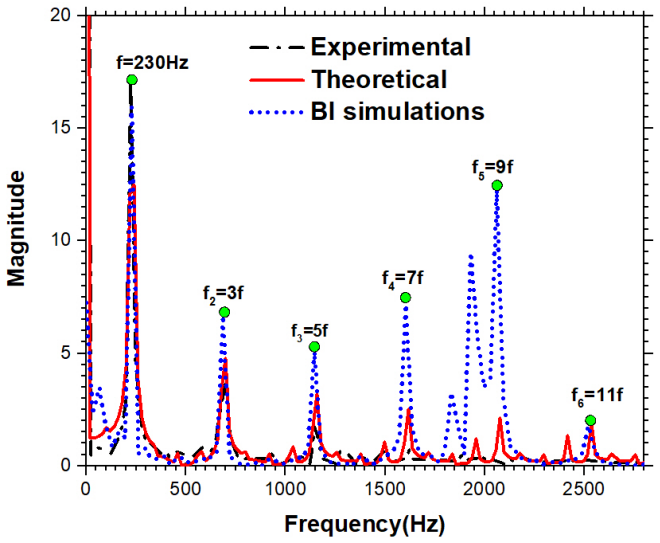
The central object is the set of modal amplitude equations for Legendre modes $P_1$ through $P_4$ obtained from linear viscous potential flow, governing center-of-mass motion and shape deformation. These are driven by the waveform function $\zeta(t)$ through electric stress terms proportional to $\zeta$ (the charge interacting with the local uniform field $E=4\Lambda z_{\mathrm{shift}}$) and to $\zeta^2$ (the Maxwell stress of the quadrupole field). The $P_2$ equation, with its $\zeta$ and $\zeta^2$ forcing, is what produces oscillation at both $f$ and $2f$, and the same equations with $\zeta$ taken as a smoothed square wave or a sawtooth ramp predict the odd or all-integer harmonic peaks seen in experiments. The companion machinery is the boundary-integral simulation in the potential-flow limit, which captures the extra nonlinear harmonics ($3f$, $4f$, and inter-harmonics near the natural frequency) that the linear theory misses, and the FFT of the tracked droplet boundary is the measuring device that connects all three.
What would settle it
Measure the droplet's offset $z_{\mathrm{shift}}$ directly from the high-speed images and record the absolute FFT amplitudes of the deformation; then compute the theoretical FFT using the independently measured $z_{\mathrm{shift}}$ and no amplitude scaling. If the predicted ratios of $2f/f$ and $3f/f$ peaks disagree with experiment beyond the 10-15% imaging uncertainty, the claim that the waveform's harmonic content governs the measured deformation spectrum in a quantitatively predictable way would be refuted.
Extended reading notes
Core claim
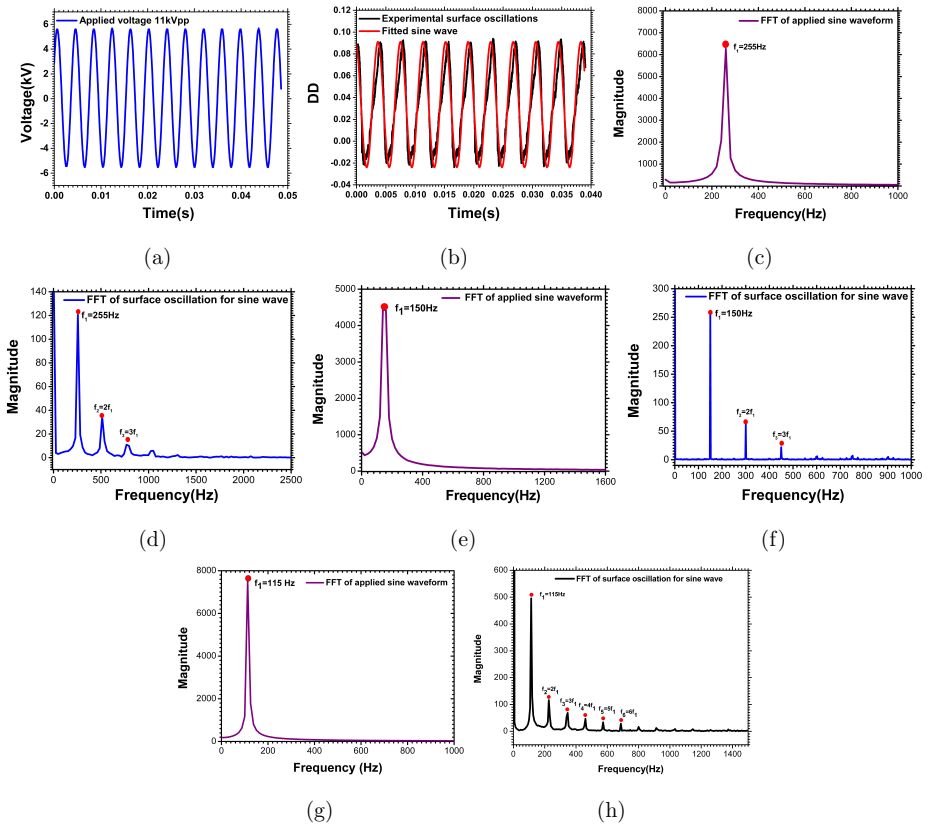
On its own terms, the paper establishes that the deformation of a sub-Rayleigh charged droplet levitated in a quadrupole trap is waveform-following: the Fourier content of the Taylor deformation parameter $DD$ (major-minus-minor over major-plus-minor) contains the fundamental forcing frequency and the harmonics of the applied signal, while nonlinearities add extra peaks. For a pure sine drive the droplet still emits measurable $2f$ and $3f$ harmonics, with $3f$ attributed to the quadrupole field acting on charge induced on the deformed surface; for square drive the odd harmonics $3f$, $5f$ appear; for ramp drive all integer harmonics appear. At the same time, breakup of a droplet that has evaporated to the Rayleigh charge is asymmetric and upward in all three cases, with no significant change in breakup mode or jet character. The paper therefore claims that the harmonic signature of the waveform is impressed onto the surface dynamics, while the breakup event itself is controlled by charge, offset from the trap center, and field strength rather than by the temporal shape of the drive.
Load-bearing premise
The load-bearing premise is that the small-amplitude linear perturbation theory, with the droplet's offset from the trap center ($z_{\mathrm{shift}}$) treated as a fitted parameter and the theoretical FFT amplitudes freely scaled, is an adequate explanation of experimental oscillations that are visibly large-amplitude and nonlinear; if those oscillations leave the linear regime, the reported agreement in FFT peak positions, not amplitudes, does not independently confirm the quantitative model.
Editorial extensions
If this is right
- For any periodic trap potential, the droplet surface oscillation frequency content can be read off from the Fourier series of the applied waveform, so the droplet acts as a live spectrum analyzer of the drive.
- Non-sinusoidal waveforms can be used to excite several harmonic deformation modes simultaneously, which may make a single levitation experiment informative at multiple frequencies for property measurement.
- Rayleigh breakup of an offset charged droplet is robust to waveform shape, so electrodynamic levitation remains a reliable breakup platform even with non-ideal amplifiers or distorted signals.
- The linear theory plus FFT provides a quick predictive check for whether a given driving waveform will remain within stable center-of-mass and deformation limits.
- The observed $3f$, $4f$, and inter-harmonic peaks, reproduced only by the nonlinear boundary-integral model, mark where a second-order analytical theory is needed for quantitative amplitude prediction.
Reading between the lines
- If the harmonic response is as clean as reported, a quadrupole trap could be driven by a designed multi-harmonic waveform to excite specific Legendre modes selectively, effectively tuning drop shape oscillations without changing droplet charge or size.
- Waveform-independent breakup hints that the critical fission event is determined by local surface charge and field asymmetry near the poles rather than by the time-history of forcing; a direct test would compare jet direction and ejected volume for sawtooth drives with different asymmetry.
- The inter-harmonic clusters seen in simulations near the natural frequency suggest that sweeping the fundamental frequency of a square wave could reveal the damped natural frequency of a droplet from the FFT alone, an extension the paper leaves for future higher-order theory.
- For applications like electrospray mass spectrometry, the results imply that replacing a sine drive with a square or ramp drive of the same peak voltage should not change the fission products, but may alter the deformation spectrum and hence the sampling conditions at the surface.
Signed reviews
Editorial analysis
A structured set of objections, weighed in public.
Referee Report
Summary. The manuscript reports an experimental study of surface oscillations and breakup of charged droplets levitated in a quadrupole electrodynamic trap under sine, square, and ramp AC waveforms. Using high-speed imaging at 100-130 kfps and FFT analysis of the Taylor deformation parameter, the authors find that the droplet oscillates at the drive frequency and that higher harmonics appear in the deformation spectrum, with square and ramp waveforms admitting a harmonic series consistent with the Fourier content of the applied signal. For a sub-Rayleigh charged droplet, the deformation is analyzed with a linear viscous-potential-flow model (equations 14-17) and with boundary integral simulations in the potential flow limit; the authors report reasonable agreement for the frequency response. Finally, the manuscript presents breakup sequences for a critically charged droplet under each waveform and claims that breakup characteristics are unaffected by the waveform type.
Significance. If the oscillation-frequency result is robust, the paper provides a useful experimental demonstration that the spectral content of droplet shape oscillations in an electrodynamic balance mirrors the harmonic content of the applied trap waveform, which is relevant for using levitated droplets as a measurement platform for interfacial properties. The high-speed measurements at up to 130 kfps and the FFT-based comparison between experiment, linear theory, and boundary integral simulation are valuable assets. However, the strength of the paper is diminished by the fact that the theory comparison relies on a fitted z_shift and arbitrary FFT amplitude scaling, so the quantitative content is mostly in the positions of spectral peaks rather than in their amplitudes. The breakup-related claim is explicitly identified by the authors as a novel contribution, but it currently lacks quantitative support.
major comments (3)
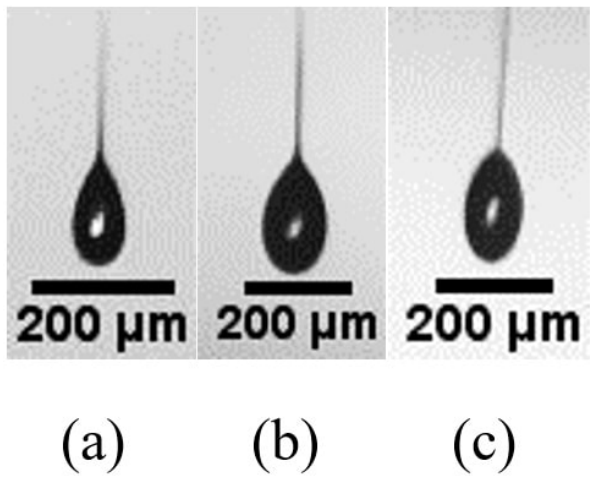
- [Section IV.A and Fig. 9] The abstract and conclusions state that breakup characteristics are 'unaffected' by the type of applied waveform and that 'there is no significant difference in the breakup mode' (Section IV.A). The supporting evidence is one high-speed sequence for each of sine, square, and ramp waveforms, shown as still images in Fig. 9, with no repeated trials, no quantitative breakup metric (jet length, jet thickness, breakup time, ejected volume, progeny size), and no statistical uncertainty. A null claim of this type requires demonstrating similarity of distributions under controlled variation; three single observations can only show that the same qualitative breakup mode occurred in those particular events. I recommend either adding quantitative metrics with replicates or explicitly restricting the claim to the statement that the tested events displayed the same qualitative jetting mode.
- [Section IV, Figs. 6-8] The comparison between experimental and theoretical FFT spectra is weakened by arbitrary amplitude scaling: the captions state that 'the magnitude of theoretical FFT is scaled by the factor of 10/5/5,' and Section IV further states that 'z_shift of the droplet is kept as a fitting parameter.' Consequently, the 'reasonable agreement' validates the positions of spectral peaks, not their magnitudes, and the comparison is not a parameter-free validation. The paper should explicitly acknowledge this limitation and avoid implying that harmonic amplitudes are predicted. A quantitative metric for spectral peak positions (e.g., a table of peak frequencies and their assignment) would also strengthen the comparison.
- [Section III.C and Section IV] Equations (14)-(17) are presented without derivation, with the text stating that 'the details of the model are omitted here.' For a self-contained validation, the paper should show how the applied waveform ζ(t) enters the linear oscillator equations and how the harmonic structure of the response follows from the Fourier content of ζ and ζ². In particular, the linear equations (15)-(17) produce harmonics only through nonlinear terms such as ζ², so the explicit Fourier series of the square and ramp waveforms (Eqs. 36-37) should be used to demonstrate that the predicted peak positions are emergent rather than fitted. As written, the smoothing parameter δ in Eq. (36) and the floor-function notation in Eq. (37) are ambiguous, which limits reproducibility of the theoretical spectra.
minor comments (5)
- [Section III.B and Fig. 3] The text on page 8 states that the fundamental applied frequency is '225 Hz,' while the caption and the FFT plots for Fig. 3 indicate 255 Hz; please correct this inconsistency.
- [Fig. 5 caption] The caption of Fig. 5 repeats 'square waveform' and '220Hz' for what should be the ramp-waveform case at 205 Hz; this will confuse readers.
- [Section IV, last paragraph] The statement that 'if one doubles the sampling frequency... it will double the amplitude of the FFT result' is imprecise; the amplitude of an FFT peak depends on the bin width and windowing, not simply on the sampling frequency. The explanation should be rephrased or removed.
- [Section II] The text says the camera can record '130-150 hundred thousand fps'; this should read '130-150 thousand fps' or '130-150 kfps' to avoid an order-of-magnitude ambiguity.
- [Data availability statement] Given that one of the central claims is a null result about breakup, making representative high-speed videos or processed deformation-time traces publicly available would substantially improve the verifiability of the study.
Circularity Check
Experimental frequency response is independent, but the analytical-validation leg is partly circular: fitted z_shift and arbitrary FFT scaling make theoretical peak heights non-predictive, and the linear forced-oscillator model reproduces input waveform harmonics by construction.
-
fitted input called prediction
[Section IV (Validation), near Eq. (35) and Figs. 6-8 captions]
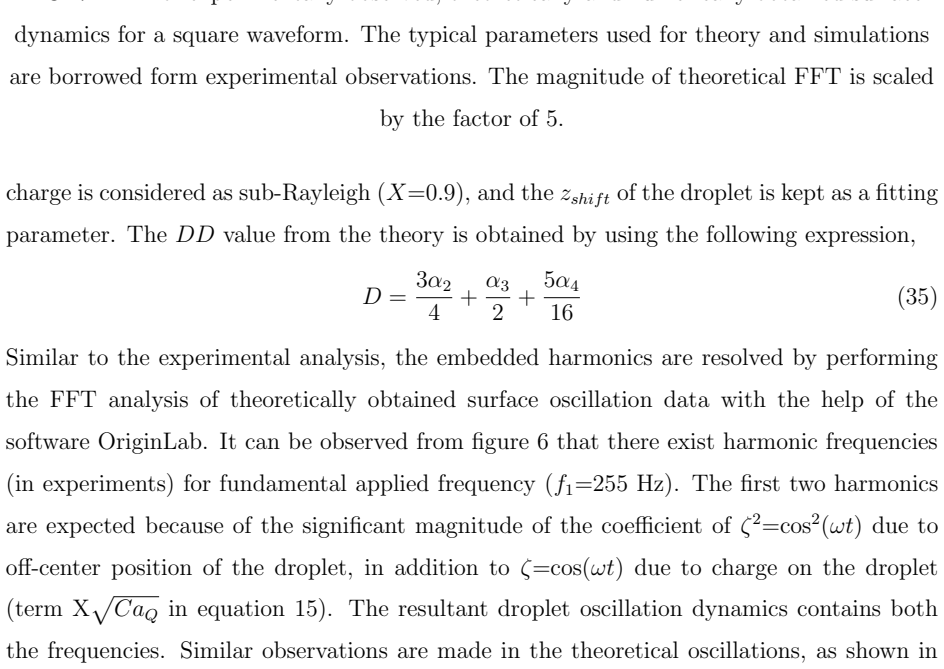
"Since the oscillations are recorded before the droplet breakup, the charge is considered as sub-Rayleigh (X=0.9), and the zshift of the droplet is kept as a fitting parameter. ... The magnitude of theoretical FFT is scaled by the factor of 10."
The theoretical FFT is presented as validating the experiments, but its amplitude is not a prediction: z_shift is fitted and the theoretical spectrum is arbitrarily rescaled (factors 10 and 5 in Figs. 6-8). Moreover, Eqs. (15)-(17) are linear forced oscillators, so their steady-state frequency content is exactly the harmonics of the input ζ and ζ²; for square and ramp inputs, ζ is defined in Eqs. (36)-(37) with the standard odd/integer harmonics, so the theoretical FFT necessarily contains those peaks. The apparent agreement in peak positions therefore reduces to feeding the waveform into a linear oscillator, while the peak heights reduce to a fitted/scaled comparison. The independent evidence for the frequency claim is the experimental FFT, not the theory.
full rationale
The paper's main observational claim, that a levitated charged drop oscillates at the forced frequency and admits the harmonics of the applied waveform, is supported by FFT analysis of high-speed deformation data (Figs. 3-5) and does not depend on the analytical model; this part is not circular. The theoretical section is the weaker link: Eqs. (14)-(17) are imported from the authors' prior work (ref. 13), z_shift is used as a fitting parameter, and the theoretical FFT amplitudes are scaled by arbitrary factors. Because the model is a linear forced oscillator, the harmonic positions in the theoretical output follow by construction from the chosen ζ, so the theory-experiment 'agreement' is a consistency check rather than a parameter-free first-principles prediction. This partial circularity affects only the validation layer, not the core experimental frequency result. The breakup-waveform-independence conclusion in Sec. IV.A is under-evidenced (single videos, no quantitative breakup metric), but that is an evidential-support concern, not a circular-reasoning defect. Overall, the central frequency claim has independent content, so a moderate score of 3 is appropriate.
Assumptions & free parameters
free parameters (3)
- z_shift (droplet vertical offset from trap center) =
not specified numerically; tuned to match experimental FFT
- FFT amplitude scaling factor =
10 (sine), 5 (square and ramp)
- delta (square-wave corner smoothing parameter) =
0.01
assumptions (5)
- domain assumption The droplet is a perfect conductor with an equipotential surface and the surrounding air is a perfect dielectric.
- domain assumption The flow inside and outside the drop is irrotational and incompressible (potential flow), with viscosity accounted for only through the normal stress balance.
- domain assumption The droplet shape can be represented as a small-amplitude perturbation around a sphere, keeping only Legendre modes P1-P4 (Eq. 5).
- domain assumption Natural inertial oscillations of the drop are damped out within half a cycle of the applied oscillation and do not affect the forced frequency response.
- standard math The applied waveforms are represented by the given analytic functions for the time-periodic function zeta (Eq. 36 for square wave, Eq. 37 for ramp wave).
Cite this review
Pith. "Pith review of Influence of the trap potential waveform on surface oscillation and breakup of a levitated charged drop." pith.science (2026). https://pith.science/paper/CE3XS5JY
@misc{pith2026190804131,
  author       = {Pith},
  title        = {Pith review of: Influence of the trap potential waveform on surface oscillation and breakup of a levitated charged drop},
  year         = {2026},
  howpublished = {\url{https://pith.science/paper/CE3XS5JY}},
  note         = {Machine review of arXiv:1908.04131}
}
abstract
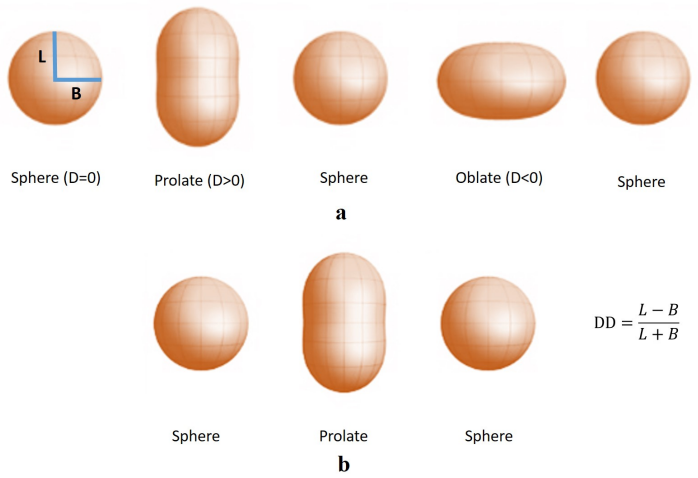
A charged droplet can be electrodynamically levitated in the air using a quadrupole trap by typically applying a sinusoidal electric field. When a charged drop is levitated it exhibits surface oscillations simultaneously building charge density due to continuous evaporation and subsequently undergoes breakup due to Rayleigh instability. In this work, we examined large-amplitude surface oscillations of a sub-Rayleigh charged drop and its subsequent breakup, levitated by various applied signals such as sine, square and ramp waveform at various imposed frequencies, using high-speed imaging (recorded at 100-130 thousand Frames Per Second (fps)). It is observed that the drop surface oscillates in sphere-prolate-sphere-oblate (SPSO) mode and seldom in the sphere-prolate-sphere (SPS) mode depending on the intricate interplay of various forces due to charge(q), the intensity of applied field ($\Lambda$) and shift of the droplet from the geometric center of the trap ($z_{shift}$). The Fast Fourier Transformation (FFT) analysis shows that the droplet oscillates with the forced frequency irrespective of the type of the applied waveform. While in the sinusoidal case, the nonlinearities are significant, in the square and ramp potentials, there is an admittance of all the harmonic frequencies of the applied potential. Interestingly, the breakup characteristics of a critically charged droplet is found to be unaffected by the type of the applied waveform. The experimental observations are validated with an analytical theory as well as with the Boundary Integral (BI) simulations in the potential flow limit and the results are found to be in a reasonable agreement.
Figures

Figures from the paper (7 more)



Reference graph
Works this paper leans on
-
[1]
author author J. Choi , author Y.-J. \ Kim , author S. Lee , author S. U. \ Son , author H. S. \ Ko , author V. D. \ Nguyen , \ and\ author D. Byun ,\ title title Drop-on-demand printing of conductive ink by electrostatic field induced inkjet head , \ @noop journal journal Applied Physics Letters \ volume 93 ,\ pages 193508 ( year 2008 ) NoStop
work page 2008
-
[2]
author author J. Shrimpton \ and\ author A. Yule ,\ title title Characterisation of charged hydrocarbon sprays for application in combustion systems , \ @noop journal journal Experiments in fluids \ volume 26 ,\ pages 460--469 ( year 1999 ) NoStop
work page 1999
-
[3]
author author A. Bailey ,\ title title The theory and practice of electrostatic spraying , \ @noop journal journal Atomisation Spray Technology \ volume 2 ,\ pages 95--134 ( year 1986 ) NoStop
work page 1986
-
[4]
author author J. B. \ Fenn , author M. Mann , author C. K. \ Meng , author S. F. \ Wong , \ and\ author C. M. \ Whitehouse ,\ title title Electrospray ionization for mass spectrometry of large biomolecules , \ @noop journal journal Science \ volume 246 ,\ pages 64--71 ( year 1989 ) NoStop
work page 1989
-
[5]
author author A. Yeung \ and\ author L. Zhang ,\ title title Shear effects in interfacial rheology and their implications on oscillating pendant drop experiments , \ @noop journal journal Langmuir \ volume 22 ,\ pages 693--701 ( year 2006 ) NoStop
work page 2006
-
[6]
author author F. Mashayek \ and\ author N. Ashgriz ,\ title title Nonlinear oscillations of drops with internal circulation , \ @noop journal journal Physics of Fluids \ volume 10 ,\ pages 1071--1082 ( year 1998 ) NoStop
work page 1998
-
[7]
author author M. von Bahr , author F. Tiberg , \ and\ author B. Zhmud ,\ title title Oscillations of sessile drops of surfactant solutions on solid substrates with differing hydrophobicity , \ @noop journal journal Langmuir \ volume 19 ,\ pages 10109--10115 ( year 2003 ) NoStop
work page 2003
-
[8]
author author F. Ravera , author G. Loglio , \ and\ author V. I. \ Kovalchuk ,\ title title Interfacial dilational rheology by oscillating bubble/drop methods , \ @noop journal journal Current Opinion in Colloid & Interface Science \ volume 15 ,\ pages 217--228 ( year 2010 ) NoStop
work page 2010
Show all 25 references
-
[9]
\ Chang , author J
author author C.-T. \ Chang , author J. Bostwick , author S. Daniel , \ and\ author P. Steen ,\ title title Dynamics of sessile drops. part 2. experiment , \ @noop journal journal Journal of Fluid Mechanics \ volume 768 ,\ pages 442--467 ( year 2015 ) NoStop
2015
-
[10]
author author P. L. \ Marston \ and\ author R. E. \ Apfel ,\ title title Quadrupole resonance of drops driven by modulated acoustic radiation pressure—experimental properties , \ @noop journal journal The Journal of the Acoustical Society of America \ volume 67 ,\ pages 27--37...
1980
-
[11]
Shen , author W
author author C. Shen , author W. Xie , author Z. Yan , \ and\ author B. Wei ,\ title title Internal flow of acoustically levitated drops undergoing sectorial oscillations , \ @noop journal journal Physics Letters A \ volume 374 ,\ pages 4045--4048 ( year 2010 ) NoStop
2010
-
[12]
Hill \ and\ author L
author author R. Hill \ and\ author L. Eaves ,\ title title Shape oscillations of an electrically charged diamagnetically levitated droplet , \ @noop journal journal Applied Physics Letters \ volume 100 ,\ pages 114106 ( year 2012 ) NoStop
2012
-
[13]
Singh , author N
author author M. Singh , author N. Gawande , author Y. Mayya , \ and\ author R. Thaokar ,\ title title Surface oscillations of a sub-rayleigh charged drop levitated in a quadrupole trap , \ @noop journal journal Physics of Fluids \ volume 30 ,\ pages 122105 ( year 2018 ) NoStop
2018
-
[14]
author author Z. Feng ,\ title title Instability caused by the coupling between non-resonant shape oscillation modes of a charged conducting drop , \ @noop journal journal Journal of Fluid Mechanics \ volume 333 ,\ pages 1--21 ( year 1997 ) NoStop
1997
-
[15]
author author R. W. \ Hasse ,\ title title Inertia, friction, and angular momentum of an oscillating viscous charged liquid drop under surface tension , \ @noop journal journal Annals of Physics \ volume 93 ,\ pages 68--87 ( year 1975 ) NoStop
1975
-
[16]
Tsamopoulos , author T
author author J. Tsamopoulos , author T. Akylas , \ and\ author R. Brown ,\ title title Dynamics of charged drop break-up , \ in\ @noop booktitle Proceedings of the Royal Society of London A: Mathematical, Physical and Engineering Sciences ,\ Vol.\ volume 401 \ ( organization ...
1985
-
[17]
Singh , author Y
author author M. Singh , author Y. Mayya , author J. Gaware , \ and\ author R. M. \ Thaokar ,\ title title Levitation dynamics of a collection of charged droplets in an electrodynamic balance , \ @noop journal journal Journal of Applied Physics \ volume 121 ,\ pages 054503 ( y...
2017
-
[18]
Duft , author T
author author D. Duft , author T. Achtzehn , author R. M \"u ller , author B. A. \ Huber , \ and\ author T. Leisner ,\ title title Coulomb fission: Rayleigh jets from levitated microdroplets , \ @noop journal journal Nature \ volume 421 ,\ pages 128--128 ( year 2003 ) NoStop
2003
-
[19]
Duft , author H
author author D. Duft , author H. Lebius , author B. A. \ Huber , author C. Guet , \ and\ author T. Leisner ,\ title title Shape oscillations and stability of charged microdroplets , \ @noop journal journal Physical Review Letters \ volume 89 ,\ pages 084503--084507 ( year 200...
2002
-
[20]
author author E. W. \ Weisstein ,\ title title Fourier series , \ @noop \ ( year 2004 ) NoStop
2004
-
[21]
author author E. W. \ Weisstein ,\ title title Fourier series—sawtooth wave , \ @noop journal journal MathWorld—A Wolfram Web Resource \ ( year 1999 ) NoStop
1999
-
[22]
Gawande , author Y
author author N. Gawande , author Y. Mayya , \ and\ author R. Thaokar ,\ title title Numerical study of rayleigh fission of a charged viscous liquid drop , \ @noop journal journal Physical Review Fluids \ volume 2 ,\ pages 113603 ( year 2017 ) NoStop
2017
-
[23]
Lundgren \ and\ author N
author author T. Lundgren \ and\ author N. Mansour ,\ title title Oscillations of drops in zero gravity with weak viscous effects , \ @noop journal journal Journal of Fluid Mechanics \ volume 194 ,\ pages 479--510 ( year 1988 ) NoStop
1988
-
[24]
Singh , author N
author author M. Singh , author N. Gawande , author Y. Mayya , \ and\ author R. Thaokar ,\ title title Subcritical asymmetric rayleigh breakup of a charged drop in an ac quadrupole trap , \ @noop journal journal arXiv preprint arXiv:1907.02294 \ ( year 2019 a ) NoStop
1907 arXiv
-
[25]
Singh , author N
author author M. Singh , author N. Gawande , author Y. Mayya , \ and\ author R. Thaokar ,\ title title Effect of the quadrupolar trap potential on the rayleigh instability and breakup of a levitated charged droplet , \ @noop journal journal Langmuir \ volume 35 ,\ pages 15759-...
2019
Reviewed August 14, 2026 · model on record in the stance chip above.
Discussion (0). Continue with ORCID to comment.