Scene-Conditioned PINN-GNN for Multipath RF Maps: Cross-Scene Generation and In-Scene Completion
Pith reviewed 2026-07-03 08:06 UTC · model grok-4.3
The pith
A PINN-GNN framework constructs accurate multipath RF maps from sparse receiver locations across new scenes or within known ones.
A machine-rendered reading of the paper's core claim, the machinery that carries it, and where it could break.
Core claim
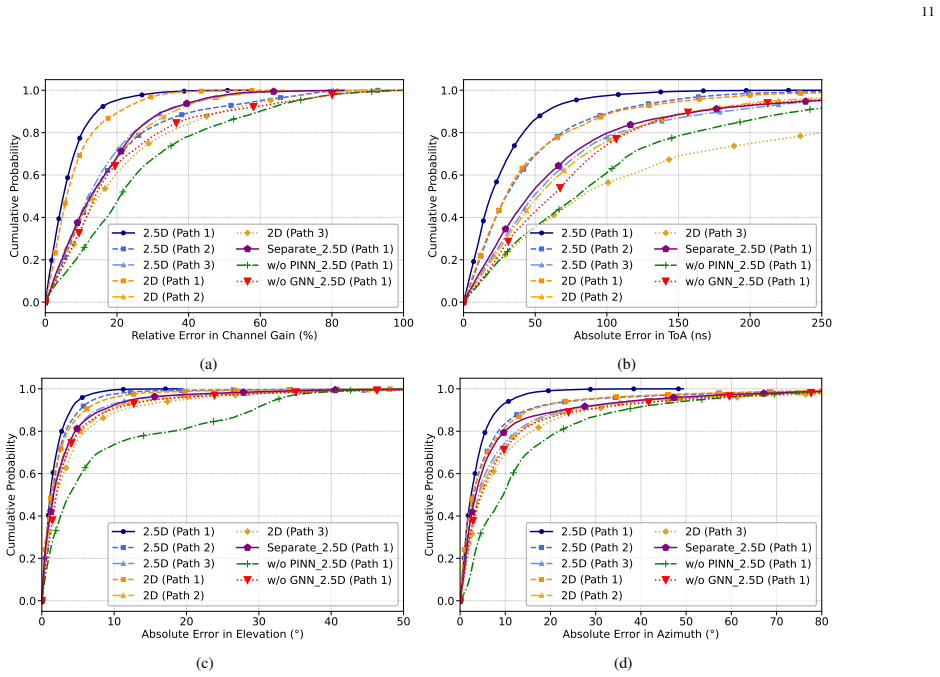
The central claim is that a scene-conditioned PINN-GNN model, which embeds electromagnetic propagation constraints in the PINN to map receiver locations to multipath parameters and uses the GNN to enforce spatial correlations, produces physically consistent multipath RF maps that enable both cross-scene generation and in-scene completion under sparse observations, outperforming image-based, diffusion-based, and interpolation baselines on map-level and multipath-level metrics.
What carries the argument
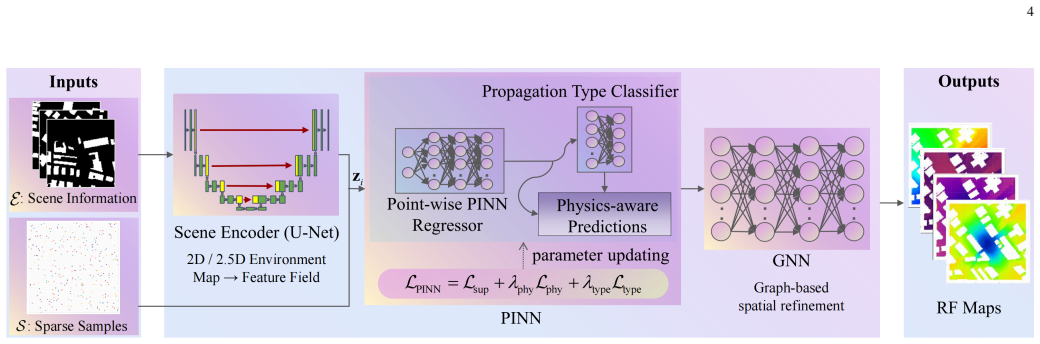
Scene-conditioned PINN-GNN that maps receiver locations to multipath parameters while embedding electromagnetic constraints and enforcing spatial consistency via graph modeling.
If this is right
- The method achieves high-fidelity RF map construction under sparse observations.
- It supports robust generalization to unseen scenes.
- It delivers improved accuracy on both map-level and multipath-level metrics relative to baselines.
- It enables more reliable channel modeling and coverage analysis for wireless systems.
Where Pith is reading between the lines
- The framework could support real-time updates if the GNN component is extended to handle time-varying receiver graphs.
- It may lower the cost of large-scale wireless network planning by reducing required measurement density.
- Validation on full 3D scene scans would test whether the current 2.5D limit restricts performance in complex vertical environments.
Load-bearing premise
That 2D and 2.5D environmental representations together with embedded electromagnetic constraints in the PINN and spatial modeling in the GNN suffice to produce physically consistent multipath parameters from receiver locations.
What would settle it
A measurement campaign in a scene containing vertical structures absent from the 2.5D input where the model's predicted angles of arrival deviate substantially from ground-truth channel measurements.
Figures
read the original abstract
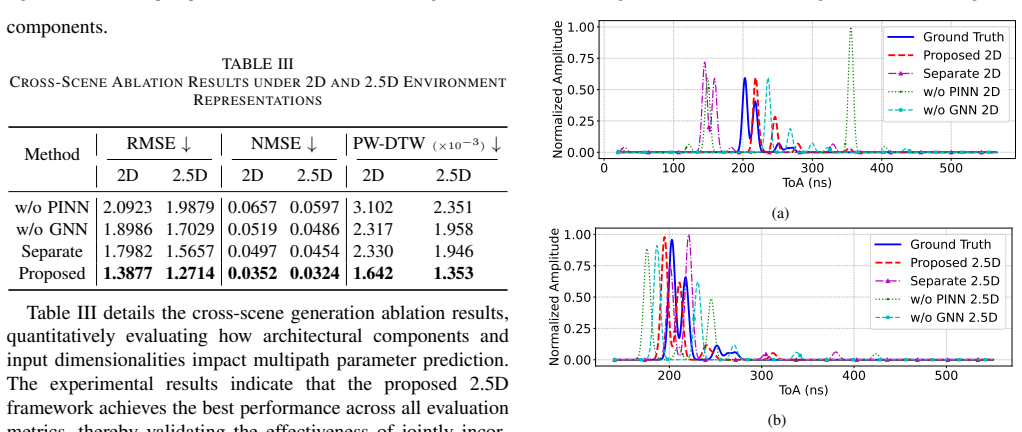
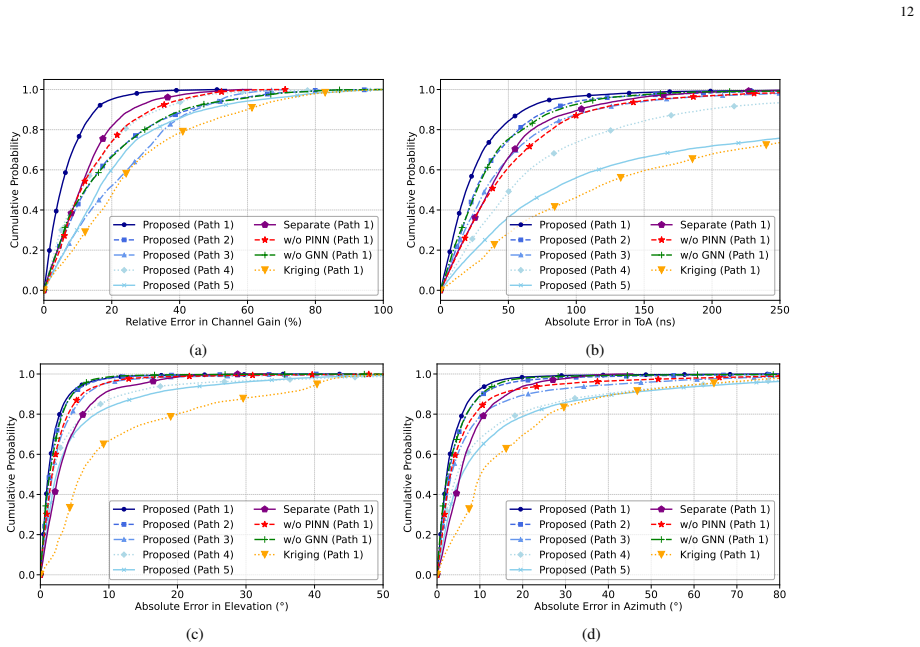
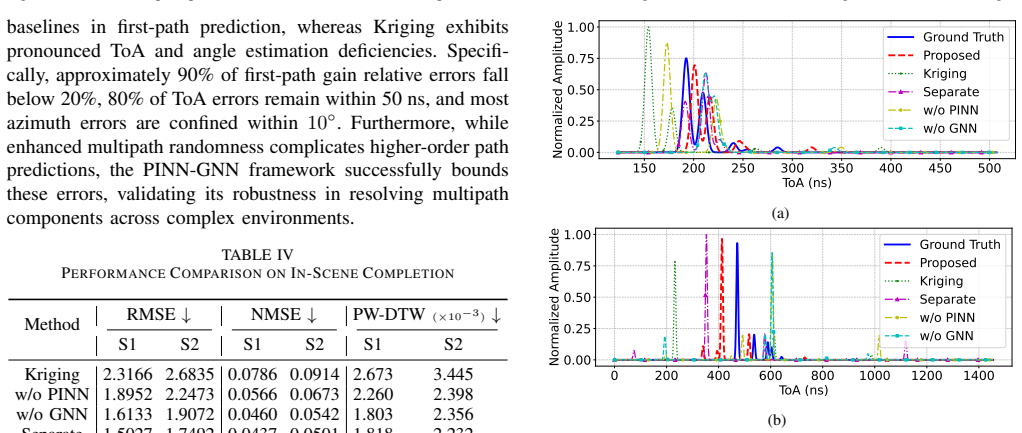
Radio frequency (RF) maps provide a compact representation of multipath propagation characteristics and are fundamental to channel modeling, coverage analysis, and environment-aware wireless optimization. This paper proposes a unified RF map construction framework based on a physics-informed neural network (PINN) and a graph neural network (GNN), supporting both cross-scene generation and in-scene completion with 2D and 2.5D environmental representations. The PINN embeds electromagnetic propagation constraints to establish a physically consistent mapping from receiver locations to multipath parameters, including path gain, time of arrival, and angles, while the GNN enforces spatial consistency by modeling correlations among neighboring receivers. To comprehensively evaluate multipath reconstruction quality, we propose a peak-weighted dynamic time warping metric that jointly accounts for amplitude errors and peak delay misalignment in channel impulse responses. Extensive experiments demonstrate that the proposed method consistently outperforms image-based, diffusion-based, and interpolation baselines across both map-level and multipath-level metrics, achieving robust generalization and high-fidelity RF map construction under sparse observations.
Editorial analysis
A structured set of objections, weighed in public.
Referee Report
Summary. The manuscript proposes a unified PINN-GNN framework for RF map construction that takes 2D and 2.5D scene representations as input. The PINN component embeds electromagnetic propagation constraints to map receiver locations to multipath parameters (path gain, ToA, angles), while the GNN enforces spatial consistency across neighboring receivers. The method targets both cross-scene generation and in-scene completion under sparse observations and introduces a peak-weighted dynamic time warping metric for evaluating channel impulse response fidelity. The abstract asserts consistent outperformance over image-based, diffusion-based, and interpolation baselines on map-level and multipath-level metrics.
Significance. If the embedded constraints produce genuinely physically consistent multipath parameters that generalize beyond the training scenes, the approach could meaningfully advance environment-aware channel modeling and coverage optimization by reducing reliance on dense measurements. The combination of physics-informed losses with graph-based spatial modeling is a reasonable direction for handling sparse RF data, and the new peak-weighted DTW metric addresses a relevant gap in multipath evaluation.
major comments (2)
- [Abstract] Abstract: the central claim that the method 'consistently outperforms' baselines on both map-level and multipath-level metrics is asserted without any numerical results, error bars, dataset descriptions, or experimental setup details. This absence prevents verification that the reported gains are statistically meaningful or that they arise from the claimed physical consistency rather than scene-specific artifacts.
- [Abstract] The construction of the PINN (described in the abstract as embedding 'electromagnetic propagation constraints') does not specify how the wave equation, Snell's law, or elevation-dependent reflections/diffractions are enforced when the only geometric inputs are 2D floor plans and 2.5D height maps. Because real multipath includes non-planar 3D effects that 2.5D representations omit by construction, the physical-consistency guarantee required for the cross-scene generalization claim is not demonstrated.
minor comments (1)
- [Abstract] The abstract would be clearer if it briefly indicated the scale of the test scenes, number of receivers, or sparsity levels used in the experiments.
Simulated Author's Rebuttal
We thank the referee for the constructive comments on our manuscript. We address each major comment point by point below, indicating where revisions will be made to improve clarity and address the concerns raised.
read point-by-point responses
-
Referee: [Abstract] Abstract: the central claim that the method 'consistently outperforms' baselines on both map-level and multipath-level metrics is asserted without any numerical results, error bars, dataset descriptions, or experimental setup details. This absence prevents verification that the reported gains are statistically meaningful or that they arise from the claimed physical consistency rather than scene-specific artifacts.
Authors: We agree that the abstract would be strengthened by including key quantitative results to support the outperformance claim. The full experimental results, including numerical values, error bars, dataset descriptions, and setup details, are reported in Sections 4 and 5 of the manuscript. In the revised version, we will update the abstract to incorporate concise numerical highlights of the performance gains (e.g., average improvements on map-level and multipath-level metrics) while maintaining brevity. revision: yes
-
Referee: [Abstract] The construction of the PINN (described in the abstract as embedding 'electromagnetic propagation constraints') does not specify how the wave equation, Snell's law, or elevation-dependent reflections/diffractions are enforced when the only geometric inputs are 2D floor plans and 2.5D height maps. Because real multipath includes non-planar 3D effects that 2.5D representations omit by construction, the physical-consistency guarantee required for the cross-scene generalization claim is not demonstrated.
Authors: The PINN embeds constraints through a physics-informed loss that approximates electromagnetic propagation using geometric models derived from the 2D floor plans and 2.5D height maps, including distance-based path gains, ToA calculations, and angle estimations. We do not enforce the full 3D wave equation or Snell's law for complex non-planar effects, as these exceed the scope of the 2.5D inputs; the approach relies on simplified geometric optics adapted to the available geometry. We will expand Section 3.2 to explicitly detail the loss terms and clarify the approximations. The cross-scene generalization is supported by empirical results on the evaluated scenes rather than a universal physical guarantee, and we acknowledge the inherent limitations of 2.5D representations for full 3D multipath phenomena. revision: partial
Circularity Check
No circularity; derivation self-contained via standard PINN embedding of known constraints
full rationale
The paper's core construction embeds established electromagnetic propagation constraints directly into the PINN loss and uses GNN for neighbor correlations, then trains and evaluates on held-out scene data against external baselines. No step reduces a claimed prediction to a fitted parameter by definition, no load-bearing uniqueness theorem is imported via self-citation, and the proposed peak-weighted DTW metric is an independent evaluation tool rather than a redefinition of the training objective. The reported generalization therefore rests on empirical outperformance rather than tautological equivalence to inputs.
Axiom & Free-Parameter Ledger
axioms (1)
- domain assumption Electromagnetic propagation laws can be incorporated as constraints in neural network training
Reference graph
Works this paper leans on
-
[1]
PINN and GNN- based RF map construction for wireless communication systems,
L. Liu, X. Chen, Z. Tang, M. Ma, and W. Zhang, “PINN and GNN- based RF map construction for wireless communication systems,” in 2025 International Conference on Future Communications and Networks (FCN), Belgrade, Serbia, Aug. 2025, pp. 1–6
work page 2025
-
[2]
A survey on beyond 5G network slicing for smart cities applications,
W. Rafique, J. Barai, A. O. Fapojuwo, and D. Krishnamurthy, “A survey on beyond 5G network slicing for smart cities applications,”IEEE Commun. Surveys Tuts., vol. 27, no. 1, pp. 595–628, Feb. 2025
work page 2025
-
[3]
A tutorial on extremely large-scale MIMO for 6G: Fundamentals, signal processing, and applications,
Z. Wanget al., “A tutorial on extremely large-scale MIMO for 6G: Fundamentals, signal processing, and applications,”IEEE Commun. Surveys Tuts., vol. 26, no. 3, pp. 1560–1605, 3rd Quart., 2024
work page 2024
-
[4]
Satellite- terrestrial integrated 6G: An ultra-dense LEO networking management architecture,
T. Ma, B. Qian, X. Qin, X. Liu, H. Zhou, and L. Zhao, “Satellite- terrestrial integrated 6G: An ultra-dense LEO networking management architecture,”IEEE Wireless Commun., vol. 31, no. 1, pp. 62–69, Feb. 2024
work page 2024
-
[5]
R. Sunet al., “A comprehensive survey of knowledge-driven deep learning for intelligent wireless network optimization in 6G,”IEEE Commun. Surveys Tuts., vol. 28, pp. 1099–1135, May 2025
work page 2025
-
[6]
A tutorial on environment-aware communications via channel knowledge map for 6G,
Y . Zenget al., “A tutorial on environment-aware communications via channel knowledge map for 6G,”IEEE Commun. Surveys Tuts., vol. 26, no. 3, pp. 1478–1519, 3rd Quart., 2024
work page 2024
-
[7]
Field strength and its variability in VHF and UHF land- mobile radio service,
Y . Okumura, “Field strength and its variability in VHF and UHF land- mobile radio service,”Rev. Electr. Commun. Lab., vol. 16, pp. 825–873, 1968
work page 1968
-
[8]
Empirical formula for propagation loss in land mobile radio services,
M. Hata, “Empirical formula for propagation loss in land mobile radio services,”IEEE Trans. Veh. Technol., vol. 29, no. 3, pp. 317–325, Aug. 1980
work page 1980
-
[9]
3GPP, “3GPP TR38.901,” 3rd Generation Partner- ship Project (3GPP), Tech. Rep., 2023. [On- line]. Available: https://portal.3gpp.org/desktopmodules/Specifications/ SpecificationDetails.aspx?specificationId=3173
work page 2023
-
[10]
Two-dimensional ray-tracing modeling for propagation prediction in microcellular environments,
K. Rizk, J.-F. Wagen, and F. Gardiol, “Two-dimensional ray-tracing modeling for propagation prediction in microcellular environments,” IEEE Trans. Veh. Technol., vol. 46, no. 2, pp. 508–518, May 1997
work page 1997
-
[11]
Sionna RT: Differentiable ray tracing for radio propagation modeling,
J. Hoydis, F. A. Aoudia, S. Cammerer, M. Nimier-David, N. Binder, G. Marcus, and A. Keller, “Sionna RT: Differentiable ray tracing for radio propagation modeling,”arXiv preprint arXiv:2303.11103, 2023
-
[12]
Channel gain map tracking via distributed Kriging,
E. Dall’Anese, S.-J. Kim, and G. B. Giannakis, “Channel gain map tracking via distributed Kriging,”IEEE Trans. Veh. Technol., vol. 60, no. 3, pp. 1205–1211, Mar. 2011
work page 2011
-
[13]
Tensor completion for radio map reconstruction using low rank and smoothness,
D. Schaufele, R. L. G. Cavalcante, and S. Stanczak, “Tensor completion for radio map reconstruction using low rank and smoothness,” in Proc. IEEE 20th Int. Workshop Signal Process. Adv. Wireless Commun. (SPAWC), Cannes, France, Jul. 2019, pp. 1–5
work page 2019
-
[14]
A method to reconstruct coverage loss maps based on matrix completion and adaptive sampling,
S. Chouvardas, S. Valentin, M. Draief, and M. Leconte, “A method to reconstruct coverage loss maps based on matrix completion and adaptive sampling,” inProc. IEEE Int. Conf. Acoust., Speech Signal Process. (ICASSP), Shanghai, China, Mar. 2016, pp. 6390–6394
work page 2016
-
[15]
RadioUNet: fast radio map estimation with convolutional neural networks,
R. Levie, C. Yapar, G. Kutyniok, and G. Caire, “RadioUNet: fast radio map estimation with convolutional neural networks,”IEEE Trans. Wireless Commun., vol. 20, pp. 4001–4015, Jun. 2021
work page 2021
-
[16]
Geo2SigMap: High-fidelity RF signal mapping using geographic databases,
Y . Li, Z. Li, Z. Gao, and T. Chen, “Geo2SigMap: High-fidelity RF signal mapping using geographic databases,” in2024 IEEE International Symposium on Dynamic Spectrum Access Networks (DySPAN), May 2024, pp. 277–285
work page 2024
-
[17]
A graph neural network based radio map construction method for urban environment,
G. Chen, Y . Liu, T. Zhang, J. Zhang, X. Guo, and J. Yang, “A graph neural network based radio map construction method for urban environment,”IEEE Commun. Lett., vol. 27, no. 5, pp. 1327–1331, May 2023
work page 2023
-
[18]
S. Zhang, A. Wijesinghe, and Z. Ding, “RME-GAN: A learning framework for radio map estimation based on conditional generative adversarial network,”IEEE Internet Things J., vol. 10, no. 20, pp. 18 016–18 027, Oct. 2023
work page 2023
-
[19]
ACT-GAN: Radio map construction based on generative adversarial networks with ACT blocks,
Q. Chen, J. Yang, M. Huang, and Q. Zhou, “ACT-GAN: Radio map construction based on generative adversarial networks with ACT blocks,” IET Commun., vol. 18, no. 19, pp. 1541–1550, Dec. 2024
work page 2024
-
[20]
RecuGAN: A novel generative AI approach for synthesizing RF coverage maps,
S. Sarkar, M. H. Manshaei, M. Krunz, and H. Ravaee, “RecuGAN: A novel generative AI approach for synthesizing RF coverage maps,” in33rd International Conference on Computer Communications and Networks (ICCCN), Kailua-Kona, HI, USA, 2024, pp. 1–9
work page 2024
-
[21]
RadioDiff: An effective generative diffusion model for sampling-free dynamic radio map construction,
X. Wang, K. Tao, N. Cheng, Z. Yin, Z. Li, Y . Zhang, and X. Shen, “RadioDiff: An effective generative diffusion model for sampling-free dynamic radio map construction,”IEEE Trans. Cogn. Commun. Netw., vol. 11, no. 2, pp. 738–750, Apr. 2025
work page 2025
-
[22]
X. Wanget al., “RadioDiff-3D: A 3D×3D radio map dataset and generative diffusion based benchmark for 6G environment-aware com- munication,”IEEE Trans. Netw. Sci. Eng., vol. 13, pp. 3773–3789, Jul. 2025
work page 2025
-
[23]
Generative CKM construction using partially observed data with diffusion model,
S. Fu, Z. Wu, D. Wu, and Y . Zeng, “Generative CKM construction using partially observed data with diffusion model,”arXiv preprint arXiv:2412.14812, 2024
-
[24]
BeamCKMDiff: Beam-aware channel knowledge map construction via diffusion trans- former,
L. Zhao, Y . Wang, X. Wang, Z. Fei, and Y . Zeng, “BeamCKMDiff: Beam-aware channel knowledge map construction via diffusion trans- former,”arXiv preprint arXiv:2601.10207, 2026
-
[25]
Z. Wu, D. Wu, S. Fu, Y . Qiu, and Y . Zeng, “CKMImageNet: A dataset for AI-based channel knowledge map toward environment-aware communication and sensing,”IEEE Trans. Commun., vol. 73, no. 12, pp. 14 430–14 443, Dec. 2025
work page 2025
-
[26]
Deep machine learning-based AoD map and AoA map construction for wireless networks,
R. Moet al., “Deep machine learning-based AoD map and AoA map construction for wireless networks,” inIEEE Vehicular Technology Conference (VTC), Singapore, Singapore, Jun. 2024, pp. 1–5
work page 2024
-
[27]
Indoor environment learning via RF-mapping,
R. Amiriet al., “Indoor environment learning via RF-mapping,”IEEE J. Sel. Areas Commun., vol. 41, no. 6, pp. 1859–1872, Jun. 2023
work page 2023
-
[28]
Physics-informed machine learning,
G. E. Karniadakiset al., “Physics-informed machine learning,”Nat. Rev. Phys., vol. 3, no. 6, pp. 422–440, May 2021
work page 2021
-
[29]
E. Zhu, H. Sun, and M. Ji, “Physics-informed generalizable wireless channel modeling with segmentation and deep learning: Fundamentals, methodologies, and challenges,”IEEE Wireless Commun., vol. 31, no. 6, pp. 170–177, Dec. 2024
work page 2024
-
[30]
The graph neural network model,
F. Scarselli, M. Gori, A. C. Tsoi, M. Hagenbuchner, and G. Monfardini, “The graph neural network model,”IEEE Trans. Neural Netw., vol. 20, no. 1, pp. 61–80, Jan. 2009
work page 2009
-
[31]
Inductive representation learning on large graphs,
W. Hamilton, Z. Ying, and J. Leskovec, “Inductive representation learning on large graphs,” inProc. Int. Conf. Neural Inf. Process. Syst. (NeurIPS), Long Beach, CA, USA, Dec. 2017, pp. 1025–1035
work page 2017
-
[32]
R. Hoppe, G. Wolfle, and U. Jakobus, “Wave propagation and radio network planning software WinProp added to the electromagnetic solver package FEKO,” inProc. Int. Appl. Comput. Electromagn. Soc. Symp. Italy (ACES), Florence, Italy, Mar. 2017, pp. 1–2
work page 2017
-
[33]
OpenPathNet: An open-source RF multipath data generator for AI-driven wireless systems,
L. Liu, X. Chen, and W. Zhang, “OpenPathNet: An open-source RF multipath data generator for AI-driven wireless systems,”arXiv preprint arXiv:2512.17286, 2025
-
[34]
DeepMIMO: A generic deep learning dataset for mil- limeter wave and massive MIMO applications,
A. Alkhateeb, “DeepMIMO: A generic deep learning dataset for mil- limeter wave and massive MIMO applications,” inInformation Theory and Applications Workshop (ITA), Feb. 2019, pp. 1–8
work page 2019
discussion (0)
Sign in with ORCID, Apple, or X to comment. Anyone can read and Pith papers without signing in.