Proof of Source of Funds: Efficient On-chain Provenance of Cryptoassets
Pith reviewed 2026-06-27 15:59 UTC · model grok-4.3
The pith
Users generate zero-knowledge proofs that their crypto deposits come only from compliant sources, letting platforms verify in constant time without monitoring or leaks.
A machine-rendered reading of the paper's core claim, the machinery that carries it, and where it could break.
Core claim
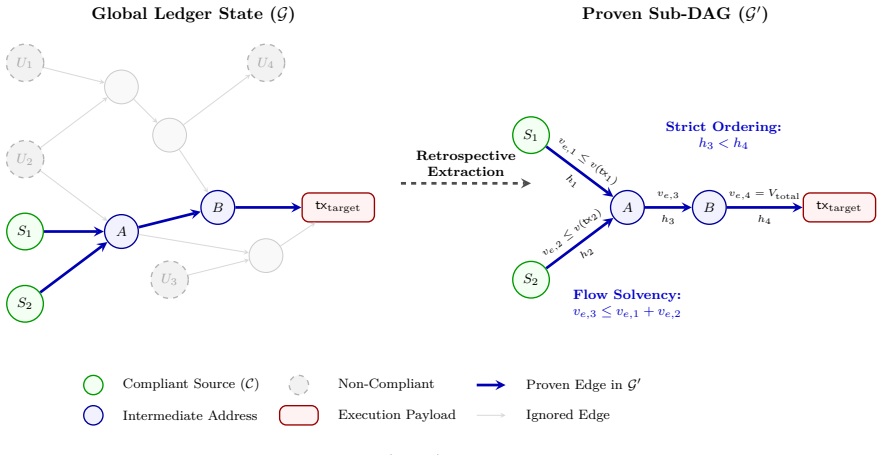
PoSoF lets a user extract a compliant sub-DAG from their transaction history and use IVC to prove that the deposited value satisfies rigorous state-transition predicates ensuring exclusive origin from compliant sources, without revealing the topology, addresses, or specific origins, while reducing on-chain verification to constant time.
What carries the argument
Incrementally Verifiable Computation (IVC) over a temporal Directed Acyclic Graph (DAG) abstraction of generalized value flows, used to prove compliant sub-histories.
Load-bearing premise
Users can always extract a compliant sub-DAG from their full history and prove the required state transitions with IVC without leakage or prohibitive cost.
What would settle it
A deposit from non-compliant sources that still produces a verifying proof, or a set of compliant funds for which no valid proof can be generated in reasonable time.
Figures
read the original abstract
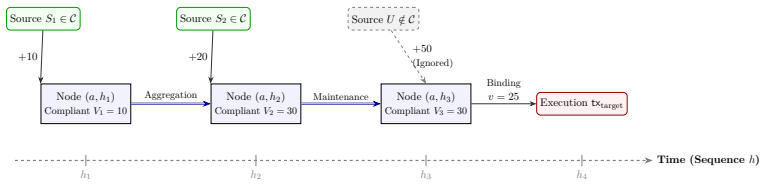
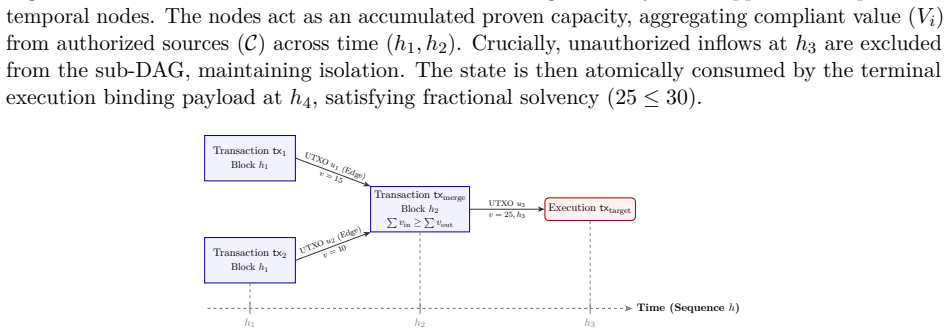
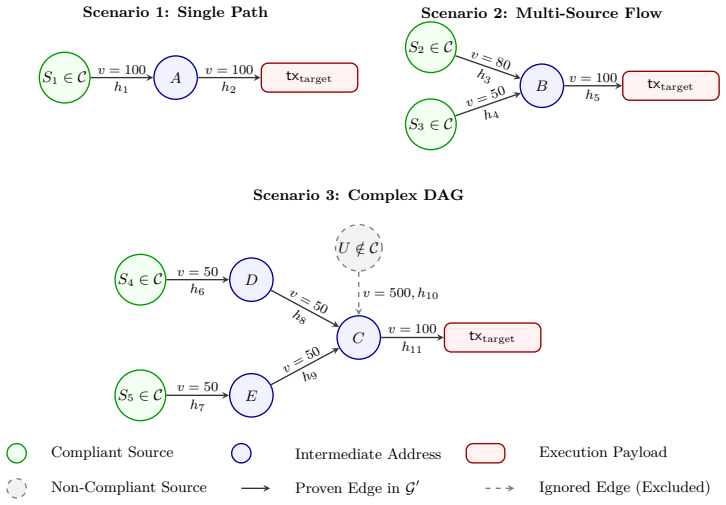
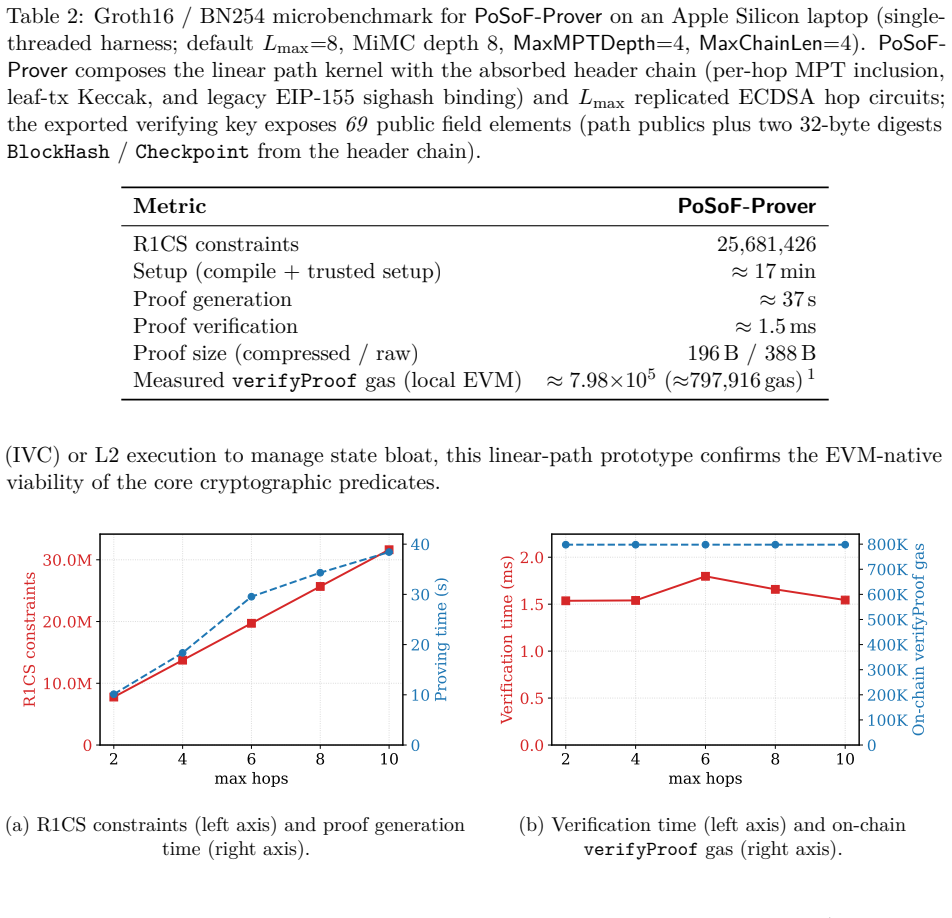
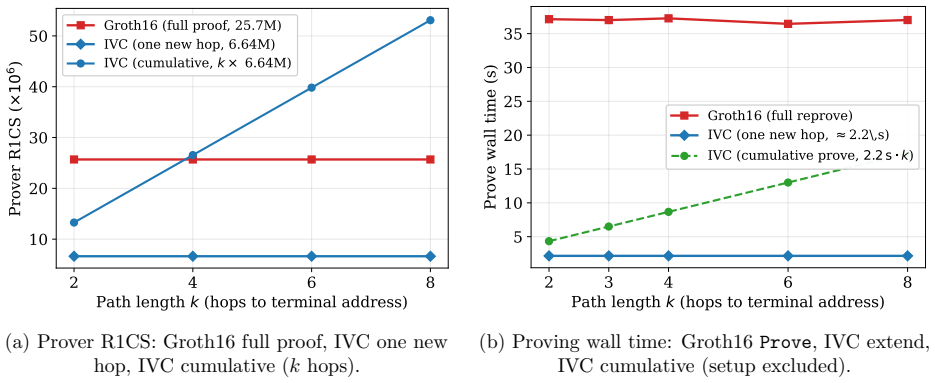
Regulatory compliance is increasingly mandatory for decentralized finance and privacy-enhancing technologies. Current approaches rely on binary inclusion/exclusion lists or retroactive graph analysis by centralized blockchain intelligence firms. This approach strips honest users of their financial privacy, leads to false positives and negatives, and forces decentralized platforms to bear the burden of on-chain transaction monitoring. In this work, we propose a paradigm shift: moving from platform-side surveillance to user-side provenance. We introduce Proof of Source of Funds (PoSoF), a novel cryptographic framework that shifts the burden to the user. Rather than the platform tracing funds, the user locally generates a zero-knowledge proof demonstrating that their deposit originates exclusively from a set of compliant sources. The platform is thus relieved of chain-analysis duties, requiring a constant-time, O(1) verification to enforce admission control. We formulate a unified temporal Directed Acyclic Graph (DAG) abstraction that formalizes both UTXO and account-based ledger histories within a generalized value-flow model. Users extract a compliant sub-DAG of their transaction history and utilize Incrementally Verifiable Computation (IVC) to prove rigorous state-transition predicates that protect against various attack vectors. Crucially, PoSoF provides verifiable cryptographic provenance; it guarantees the legitimacy of the funds without leaking the intermediate transaction topology, intermediary addresses, or the specific origins utilized. We formally define the security properties of PoSoF and evaluate an Ethereum-compatible prototype. Our benchmarks demonstrate that fully private, proactive compliance is highly practical, requiring only ~1.8 s to incrementally update a user's PoSoF per new transaction, and a constant-time ~1.5 ms (~800k gas) for final on-chain EVM verification.
Editorial analysis
A structured set of objections, weighed in public.
Referee Report
Summary. The paper proposes Proof of Source of Funds (PoSoF), a cryptographic framework that shifts regulatory compliance burden to users via zero-knowledge proofs. Users extract a compliant sub-DAG from their transaction history (modeled as a unified temporal DAG for UTXO and account-based ledgers) and use Incrementally Verifiable Computation (IVC) to prove state-transition predicates ensuring funds originate only from compliant sources. The platform performs constant-time O(1) verification. The work formally defines security properties and reports an Ethereum prototype with ~1.8 s incremental updates and ~1.5 ms (~800k gas) on-chain verification, claiming no leakage of topology, addresses, or origins.
Significance. If the security properties, sub-DAG extraction feasibility, and IVC performance hold, the result would be significant for privacy-preserving DeFi compliance. It offers a user-side alternative to centralized chain analysis, unifies ledger models, and demonstrates practical on-chain verification costs. The incremental IVC approach and proactive compliance paradigm address real regulatory pressures while preserving privacy, provided the zero-knowledge guarantees are rigorously established.
major comments (2)
- [Abstract and security definitions section] The central security claims (no leakage of topology or origins, and prevention of non-compliant mixing) rest on the existence of an always-extractable compliant sub-DAG and efficient IVC circuits for the value-flow predicates. No extraction algorithm, formal predicate definitions, or circuit construction details are supplied, making it impossible to verify that the predicates are expressible without prohibitive cost or leakage; this is load-bearing for all stated security properties.
- [Evaluation and benchmarks section] The reported timings (~1.8 s incremental update, ~1.5 ms verification) are presented without specifying history length, IVC recursion depth, circuit size growth, or error analysis. If circuit size scales with transaction count or extraction is non-canonical, both the zero-knowledge property and the constant-time claim become conditional; this directly affects the practicality evaluation.
minor comments (2)
- [Abstract] The abstract claims formal definitions of security properties but the provided text contains none; adding explicit definitions (e.g., for the sub-DAG extraction and IVC predicates) would improve clarity.
- [Model section] Notation for the temporal DAG and value-flow model should be introduced with a dedicated figure or table to aid readers unfamiliar with the unified UTXO/account abstraction.
Simulated Author's Rebuttal
We thank the referee for the constructive and detailed feedback. The comments highlight areas where additional detail will strengthen the manuscript's verifiability. We respond to each major comment below and commit to revisions that address the concerns without altering the core claims.
read point-by-point responses
-
Referee: [Abstract and security definitions section] The central security claims (no leakage of topology or origins, and prevention of non-compliant mixing) rest on the existence of an always-extractable compliant sub-DAG and efficient IVC circuits for the value-flow predicates. No extraction algorithm, formal predicate definitions, or circuit construction details are supplied, making it impossible to verify that the predicates are expressible without prohibitive cost or leakage; this is load-bearing for all stated security properties.
Authors: We acknowledge that the manuscript does not supply the extraction algorithm, formal predicate definitions, or circuit construction details. These omissions make independent verification of the security properties difficult. In the revised manuscript we will add a new subsection that presents the sub-DAG extraction algorithm, supplies formal definitions of the value-flow predicates, and outlines the IVC circuit constructions (including predicate encoding and recursion structure) at a level sufficient to assess expressibility, cost, and zero-knowledge guarantees. revision: yes
-
Referee: [Evaluation and benchmarks section] The reported timings (~1.8 s incremental update, ~1.5 ms verification) are presented without specifying history length, IVC recursion depth, circuit size growth, or error analysis. If circuit size scales with transaction count or extraction is non-canonical, both the zero-knowledge property and the constant-time claim become conditional; this directly affects the practicality evaluation.
Authors: The referee is correct that the evaluation section omits key experimental parameters. We will expand the benchmarks section to report the transaction-history lengths tested, IVC recursion depths, observed circuit-size growth, and any error or variability analysis. These additions will make explicit the conditions under which the reported timings hold and will clarify the scope of the constant-time verification claim. revision: yes
Circularity Check
No circularity in derivation chain
full rationale
The paper introduces PoSoF as a new construction that shifts compliance to user-generated zero-knowledge proofs over a generalized DAG value-flow model, using standard IVC primitives to prove state-transition predicates. No load-bearing step reduces by definition or self-citation to its own inputs; the unified temporal DAG abstraction, security properties, and extraction of compliant sub-DAGs are presented as independent formalizations rather than tautological renamings or fitted predictions. Benchmarks are reported as empirical prototype measurements, not derived outputs. The framework is self-contained against external cryptographic assumptions without self-referential loops.
Axiom & Free-Parameter Ledger
axioms (2)
- standard math Soundness and zero-knowledge properties of the underlying ZK and IVC primitives hold.
- domain assumption A compliant sub-DAG can be extracted from any user's transaction history.
invented entities (1)
-
PoSoF framework
no independent evidence
Reference graph
Works this paper leans on
-
[1]
Single-server private outsourcing of zk-snarks.Cryptology ePrint Archive, 2025
Kasra Abbaszadeh, Hossein Hafezi, Jonathan Katz, and Sarah Meiklejohn. Single-server private outsourcing of zk-snarks.Cryptology ePrint Archive, 2025
2025
-
[2]
Blink: an optimal proof of proof-of-work
Lukas Aumayr, Zeta Avarikioti, Matteo Maffei, Giulia Scaffino, and Dionysis Zindros. Blink: an optimal proof of proof-of-work. InInternational Conference on Financial Cryptography and Data Security, pages 173–190. Springer, 2025
2025
-
[3]
Axiom v1 smart contracts: Historical block hash cache.https://github.com/ axiom-crypto/axiom-v1-contracts, 2024
Axiom Crypto. Axiom v1 smart contracts: Historical block hash cache.https://github.com/ axiom-crypto/axiom-v1-contracts, 2024. Accessed: 2026-05-12
2024
-
[4]
The case for on-chain privacy and compliance.Stan
Shlomit Azgad-Tromer, Joey Garcia, and Eran Tromer. The case for on-chain privacy and compliance.Stan. J. Blockchain L. & Pol’y, 6:265, 2023
2023
-
[5]
Haze and daze: Compliant privacy mixers.Cryptology ePrint Archive, 2023
Stanislaw Baranski, Maya Dotan, Ayelet Lotem, and Margarita Vald. Haze and daze: Compliant privacy mixers.Cryptology ePrint Archive, 2023
2023
-
[6]
Derecho: Privacy pools with proof-carrying disclosures
Josh Beal and Ben Fisch. Derecho: Privacy pools with proof-carrying disclosures. InProceedings of the 2024 on ACM SIGSAC Conference on Computer and Communications Security, pages 3197–3211, 2024
2024
-
[7]
What is zkpass (zkp)?https://www.binance.com/en/academy/articles/ what-is-zkpass-zkp, Feb 2026
Binance Academy. What is zkpass (zkp)?https://www.binance.com/en/academy/articles/ what-is-zkpass-zkp, Feb 2026. Accessed: 2026-05-15
2026
-
[8]
Merkle mountain ranges are optimal: On witness update frequency for cryptographic accumulators
Joseph Bonneau, Jessica Chen, Miranda Christ, and Ioanna Karantaidou. Merkle mountain ranges are optimal: On witness update frequency for cryptographic accumulators. InAnnual International Cryptology Conference, pages 170–202. Springer, 2025
2025
-
[9]
Privacy-protecting regulatory solutions using zero-knowledge proofs, 2022
Joseph Burleson, Michele Korver, and Dan Boneh. Privacy-protecting regulatory solutions using zero-knowledge proofs, 2022. 22
2022
-
[10]
Blockchain privacy and regulatory compliance: Towards a practical equilibrium.Blockchain: Research and Applications, 5(1):100176, 2024
Vitalik Buterin, Jacob Illum, Matthias Nadler, Fabian Schär, and Ameen Soleimani. Blockchain privacy and regulatory compliance: Towards a practical equilibrium.Blockchain: Research and Applications, 5(1):100176, 2024
2024
-
[11]
An efficient system for non-transferable anonymous credentials with optional anonymity revocation
Jan Camenisch and Anna Lysyanskaya. An efficient system for non-transferable anonymous credentials with optional anonymity revocation. InInternational conference on the theory and applications of cryptographic techniques, pages 93–118. Springer, 2001
2001
-
[12]
Know-your-transaction (kyt): New standard in crypto compliance.https://www
ChainUp. Know-your-transaction (kyt): New standard in crypto compliance.https://www. chainup.com/blog/kyt-crypto-compliance-procedures/, 2026. Accessed: 2026-05-15
2026
-
[13]
Eos: Efficient private delegation of{zkSNARK}provers
Alessandro Chiesa, Ryan Lehmkuhl, Pratyush Mishra, and Yinuo Zhang. Eos: Efficient private delegation of{zkSNARK}provers. In32nd USENIX Security Symposium (USENIX Security 23), pages 6453–6469, 2023
2023
-
[14]
Proof-carrying data and hearsay arguments from signature cards
Alessandro Chiesa and Eran Tromer. Proof-carrying data and hearsay arguments from signature cards. InICS, volume 10, pages 310–331, 2010
2010
-
[15]
Joss Duff and Henry F. Korth. Privacy preserving compliance. Technical report, Lehigh University, 2026
2026
-
[16]
Hidden costs of aml compliance: How to reduce risk & cut waste.https://www
Flagright. Hidden costs of aml compliance: How to reduce risk & cut waste.https://www. flagright.com/post/overcoming-the-hidden-costs-of-aml-compliance , 2026. Accessed: 2026-05-20
2026
-
[17]
Towards measuring the traceability of cryptocur- rencies
Domokos M Kelen and István András Seres. Towards measuring the traceability of cryptocur- rencies. In2025 IEEE International Conference on Blockchain and Cryptocurrency (ICBC), pages 1–10. IEEE, 2025
2025
-
[18]
Non-interactive proofs of proof-of-work
Aggelos Kiayias, Andrew Miller, and Dionysis Zindros. Non-interactive proofs of proof-of-work. InInternational Conference on Financial Cryptography and Data Security, pages 505–522. Springer, 2020
2020
-
[19]
Nova: Recursive zero-knowledge arguments from folding schemes
Abhiram Kothapalli, Srinath Setty, and Ioanna Tzialla. Nova: Recursive zero-knowledge arguments from folding schemes. InAnnual International Cryptology Conference, pages 359–
-
[20]
True cost of financial crime compliance study
LexisNexis Risk Solutions. True cost of financial crime compliance study. https://risk.lexisnexis.com/global/en/about-us/press-room/press-release/ 20240306-true-cost-of-compliance-emea, 2023. Accessed: 2026-05-20
2023
-
[21]
Evasion under blockchain sanctions
Endong Liu, Mark Ryan, Liyi Zhou, and Pascal Berrang. Evasion under blockchain sanctions. InProceedings of the ACM Web Conference 2026, pages 3507–3518, 2026
2026
-
[22]
A fistful of bitcoins: characterizing payments among men with no names
Sarah Meiklejohn, Marjori Pomarole, Grant Jordan, Kirill Levchenko, Damon McCoy, Geof- frey M Voelker, and Stefan Savage. A fistful of bitcoins: characterizing payments among men with no names. InProceedings of the 2013 conference on Internet measurement conference, pages 127–140, 2013
2013
-
[23]
Tornado cash and blockchain privacy: a primer for economists and policymakers.Federal Reserve Bank of St
Matthias Nadler and Fabian Schär. Tornado cash and blockchain privacy: a primer for economists and policymakers.Federal Reserve Bank of St. Louis Review, 2023. 23
2023
-
[24]
Bitcoin: A peer-to-peer electronic cash system.Satoshi Nakamoto, 2008
Satoshi Nakamoto. Bitcoin: A peer-to-peer electronic cash system.Satoshi Nakamoto, 2008
2008
-
[25]
Everything you need to know about kyc in crypto.https://ondato.com/blog/ kyc-crypto/, 2026
Ondato. Everything you need to know about kyc in crypto.https://ondato.com/blog/ kyc-crypto/, 2026. Accessed: 2026-05-20
2026
-
[26]
Tornado cash privacy solution version 1.4.Tornado cash privacy solution version, 1(6), 2019
Alexey Pertsev, Roman Semenov, and Roman Storm. Tornado cash privacy solution version 1.4.Tornado cash privacy solution version, 1(6), 2019
2019
-
[27]
Privacy-preserving on-chain permissioning for kyc-compliant decentralized applications
Fabian Piper, Karl Wolf, and Jonathan Heiss. Privacy-preserving on-chain permissioning for kyc-compliant decentralized applications. In2025 7th Conference on Blockchain Research & Applications for Innovative Networks and Services (BRAINS), pages 1–10. IEEE, 2025
2025
-
[28]
RAILGUN github repository
RAILGUN. RAILGUN github repository. https://github.com/railgun-privacy, 2026. Accessed: 2026-05-19
2026
-
[29]
Succinct network: Prove the world’s software, 2024
Uma Roy, John Guibas, M Pai, K Kulkarni, and Dan Robinson. Succinct network: Prove the world’s software, 2024
2024
-
[30]
Naveen Sahu, Mitul Gajera, Amit Chaudhary, and Hamish Ivey-Law. Sede: Balancing blockchain privacy and regulatory compliance by selective de-anonymization.arXiv preprint arXiv:2311.08167, 2023
arXiv 2023
-
[31]
Zerocash: Decentralized anonymous payments from bitcoin
Eli Ben Sasson, Alessandro Chiesa, Christina Garman, Matthew Green, Ian Miers, Eran Tromer, and Madars Virza. Zerocash: Decentralized anonymous payments from bitcoin. In2014 IEEE symposium on security and privacy, pages 459–474. IEEE, 2014
2014
-
[32]
Auditpay: Anonymous payments with controlled oversight.Cryptology ePrint Archive, 2026
Elkana Tovey, Yossi Gilad, and Aviv Zohar. Auditpay: Anonymous payments with controlled oversight.Cryptology ePrint Archive, 2026
2026
-
[33]
Department of the Treasury
U.S. Department of the Treasury. U.s. treasury sanctions notorious virtual currency mixer tornado cash. https://home.treasury.gov/news/press-releases/jy0916, August 2022. Office of Foreign Assets Control (OFAC)
2022
-
[34]
Blockchain transaction censorship:(in) secure and (in) efficient? InThe International Conference on Mathematical Research for Blockchain Economy, pages 78–94
Zhipeng Wang, Xihan Xiong, and William J Knottenbelt. Blockchain transaction censorship:(in) secure and (in) efficient? InThe International Conference on Mathematical Research for Blockchain Economy, pages 78–94. Springer, 2023
2023
-
[35]
Ethereum: A secure decentralised generalised transaction ledger.Ethereum project yellow paper, 151(2014):1–32, 2014
Gavin Wood et al. Ethereum: A secure decentralised generalised transaction ledger.Ethereum project yellow paper, 151(2014):1–32, 2014
2014
-
[36]
cold-start
Zhiying Wu, Jieli Liu, Jiajing Wu, Zibin Zheng, and Ting Chen. Tracer: Scalable graph-based transaction tracing for account-based blockchain trading systems.IEEE Transactions on Information Forensics and Security, 18:2609–2621, 2023. A Zero-Knowledge Argument of Knowledge A proof system enables a proverP to convince a verifierV about some statementu such ...
2023
discussion (0)
Sign in with ORCID, Apple, or X to comment. Anyone can read and Pith papers without signing in.