REVIEW 2 major objections 4 minor 124 references
A Large Outburst, Coma Asymmetries, and the Color of Comet 243P/NEAT
T0 review · 2 major / 4 minor · reviewed 2026-08-15 · deepseek-v4-flash
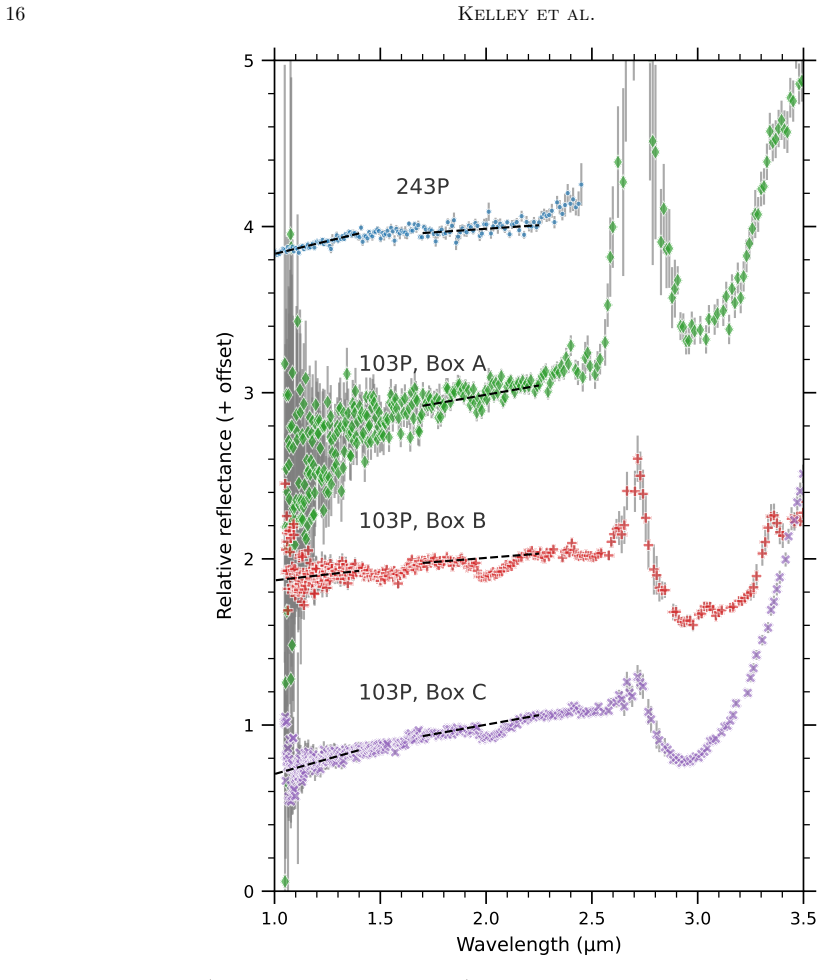
Pith's one-line read The December 2018 outburst of comet 243P/NEAT ejected roughly (3 ± 1) × 10^7 kg of dust, likely including subsurface water ice, yet a near-infrared spectrum taken four days later shows no water-ice absorption above a 3% band-depth upper…
desk verdict Solid, well-documented observational case study; the no-ice detection is robust, but the 'likely ejected ice' conclusion leans on an unverified analogy. read the letter →
The pith
A machine-rendered reading of the paper's core claim, the machinery that carries it, and where it could break.
The reading
What carries the argument
The central mechanism is a dust dynamical Monte Carlo model that computes grain trajectories under solar gravity and radiation pressure, with ejection speeds scaled as $a^{-1/2}$, together with a water-ice sublimation model that balances insolation against sublimation and thermal losses. The dynamical model is used to show that small grains leave the spectroscopic aperture within days, while the sublimation model demonstrates that ice grains containing a small dust fraction sublimate before the observations. A secondary mechanism is the comparison of optical spectral gradient ($S_V$) with water-ice areal fraction in 103P/Hartley 2, which shows that ice-rich regions can be as red as ice-free regions.
What would settle it
Find a water-ice absorption band or a blue color gradient in a similar outburst observed within 1–2 days of onset, or measure the subsurface volatile profile of 243P directly; either would distinguish between the paper's explanation (ice ejected but gone by the time of observation) and the alternative that no ice was excavated. A targeted search for 1.5- and 2.0-µm ice bands within the first 24–48 hours after a future 243P outburst would be the cleanest test.
Extended reading notes
Core claim
On the paper's own terms, the December 2018 outburst of 243P/NEAT ejected (3 ± 1) × $10^{7}$ kg of dust, equivalent to a hemispherical crater roughly 30 m deep, and probably carried water-ice grains from the subsurface. A near-infrared spectrum obtained 4 ± 1 days after the outburst places a 3% upper limit on the 2.0-µm water-ice band depth, and narrow-band colors taken 5 ± 1 days after the outburst show no color gradient out to 40,000 km. The paper concludes that the non-detection is consistent with water-ice ejection through two mechanisms: dynamics remove sub-micrometer and micrometer grains from the 0.8-arcsecond slit before spectroscopy, and dirty ice grains (0.2–0.5% amorphous carbon by volume) sublimate within $10^{4}$–$10^{5}$ seconds at 2.55 au, before either observation was made. It further finds that quiescent lightcurve variations are dominated by coma asymmetries rather than activity changes, that there were one or two additional small −0.3 mag outbursts in September 2018, and that the specific kinetic energy of the outburst (~$10^{1}$–$10^{2}$ J kg−1) is an order of magnitude below that inferred for outbursts of comets 15P, 17P, and 332P, suggesting a different driving process.
Load-bearing premise
The argument that water ice was likely ejected rests on assuming 243P has a subsurface water-ice table within centimeters to meters of the surface, like 9P/Tempel 1 and 67P; if 243P instead has a devolatilized crust thicker than the roughly 30 m excavation depth, no ice would have been ejected and the non-detection needs no dynamical or sublimation explanation.
Editorial extensions
If this is right
- If the non-detection is correctly explained, then outbursts can excavate water ice that is invisible in post-outburst spectroscopy unless observations are made within hours, before small icy grains leave the slit or sublimate.
- Water-ice-free color maps do not rule out ice in the ejecta; continuum color alone cannot serve as a proxy for ice content, as shown by the 103P Box C counterexample.
- The ~10^7 kg outburst represents up to ~55% of the mass loss around the 2018 perihelion and is comparable in mass to the quiescent activity over the observed 251-day arc.
- The grouping of specific kinetic energies (243P and P/2010 H2 near 10^1–10^2 J kg−1; 15P, 17P, and 332P near 10^4–10^5 J kg−1) points to at least two distinct outburst mechanisms, with trapped volatile abundance as a plausible modulator if amorphous-ice crystallization is involved.
Reading between the lines
- A testable extension of the paper's models is that near-infrared spectroscopy taken within the first 24 hours after a future 243P outburst should show a measurable 2.0-µm water-ice band, because micrometer-sized ice grains would still be inside the slit.
- The dynamical depletion argument implies that spectroscopic searches for outburst-excavated ice are systematically biased toward early observations, and that wider-slit or slit-scanning spectroscopy could recover ice that a narrow slit misses.
- If the specific-energy grouping holds, the low-energy class may be powered by ordinary sublimation temporarily enhanced by cliff collapse rather than by exothermic crystallization, which would change how modelers interpret outburst masses.
Signed reviews
Editorial analysis
A structured set of objections, weighed in public.
Referee Report
Summary. The manuscript presents a multi-observatory study of Comet 243P/NEAT centered on a -3 mag outburst discovered in December 2018. It constructs a 251-day lightcurve, identifies two small September outbursts and a tentative third, uses a Monte Carlo dust dynamical model to characterize the quiescent coma and the outburst ejecta, and derives an ejected dust mass of (3±1)×10^7 kg. An IRTF/SpeX spectrum taken four days after the outburst shows no water-ice absorption, with a 3% upper limit on the 2.0-µm band depth; optical colors and a color map also show no ice signature. The authors propose dynamical depletion of small icy grains and sublimation of dirty ice as reasons for the non-detection, under the assumption that the outburst excavated subsurface ice. They reanalyze Deep Impact observations of 103P/Hartley 2 and a SpeX spectrum of C/2013 US10 (Catalina) to argue that continuum color cannot serve as a one-to-one proxy for water ice, and they compare specific kinetic energies of five cometary outbursts to suggest a grouping into low- and high-energy processes.
Significance. The observational core is solid and valuable: a well-sampled 251-day lightcurve, a carefully reduced near-infrared spectrum, a quantitative 3% upper limit on the 2.0-µm ice band, and a useful demonstration that optical color is not a reliable ice proxy even within a single comet. The non-detection is independent of the dynamical model, and the paper ships reproducible software and data-behind-the-figure spectra. The interpretive steps, however, are more fragile: the claim that the outburst 'likely ejected water ice grains' rests on an explicitly conditional analogy with 9P and 67P, and the dynamical explanation of the non-detection uses a model that the authors themselves describe as not matching the images precisely and as requiring a production function that is unphysical for a point source on a spherical nucleus. These caveats reduce confidence in the interpretive conclusions, not in the measurements themselves.
major comments (2)
- [Sections 6.1 and 7] The central inference that the December 2018 outburst 'likely ejected water ice grains' is supported only by the analogy with 9P/Tempel 1 and 67P, and the paper itself states the conditional form: 'If the sub-surface composition of 243P is the same as that of 9P/Tempel 1, then we should expect icy grains to have been ejected.' The Conclusions then upgrade this conditional to an unconditional 'likely.' If 243P has a devolatilized crust thicker than the ~30 m excavation depth implied by the (3±1)×10^7 kg mass, or if the event originated in the coma via a disintegrating ~24 m fragment as discussed in Section 6.4, then no ice was ever in the ejecta and the dynamical and sublimation explanations in Sections 6.2 and 6.3 are unnecessary. Please either present independent evidence for subsurface ice at the excavated depths or keep the abstract and conclusions at the same level of conditionality as Section 6.1, explicitly listing the devolatilized-crust and coma-origin alternatives.
- [Sections 5.3.2, 6.2, and Table 4] The quantitative small-grain depletion argument—that the areal fraction of grains smaller than 3 µm in the SpeX aperture drops from 67% to 1–2%, implying a factor-of-50 depletion—is computed with Model M, whose production function cos²(θ/2) centered at RA=140°, Dec=30° is acknowledged in Section 6.4 to be impossible for a point source on a spherical nucleus because it emits material into the nucleus. The text also states that no model precisely matches the observed morphology. Because Models I, K, M, and N in Table 4 give comparably acceptable fits to the lightcurve, the remaining-areal-fraction calculation is not robust. Please repeat the depletion estimate over the acceptable parameter range or weaken the conclusion in Section 6.2 from 'suggests they may not be numerous enough to be detected' to a model-dependent possibility with explicit uncertainty.
minor comments (4)
- [Figures 10 and 14 captions] The captions of Figures 10 and 14 refer to the 'December 2021 outburst' and to '243P/NEAT outburst of December 2021'; these should be December 2018, consistent with the text and Table A1.
- [Table 4] The symbol k is used in Table 4 for the grain-size distribution power-law slope, while Section 5.2 uses k for the heliocentric-distance exponent in dust production proportional to r_h^k and N for the grain-size distribution slope; please rename one of these to avoid ambiguity.
- [Appendix A.3] In the ATLAS subsection, 'reducexd' should be 'reduced'.
- [Section 5.1] The statement that the areal ice fraction of 243P is ≲2–5%, obtained by linearly extrapolating band-depth-to-ice-fraction ratios from Catalina and 103P, should explicitly note that the assumed grain size and mixing properties are not independently verified for 243P; the current wording calls the estimate a first-order approximation, which is acceptable, but Section 6.1 should not be phrased more strongly than the underlying scaling.
Circularity Check
No circularity found; the ice non-detection is independent of the fitted dynamical and sublimation models.
full rationale
The derivation chain is self-contained. The 251-day lightcurve and ZTF/LDT morphology are fit by the Monte Carlo dust model (Section 3), with model M selected on the basis of dust morphology and lightcurve agreement (Sections 5.3.2 and 5.3.3); the 3% upper limit on the 2.0-um water-ice band depth (Section 4.4) is not used as an input to that fit. Section 6.2's small-grain depletion argument computes the areal fraction of ejecta remaining in the SpeX slit from model M, but that fraction is a derived consequence of the dust-fit model, not a parameter fitted to the ice non-detection. Section 6.3's sublimation calculation uses the Catalina dirty-ice template from Protopapa et al. (2018) as an external benchmark, and the 0.2-0.5% dust fractions are not tuned to the 243P upper limit. The 'likely ejected water ice' conclusion in Section 6.1 is explicitly conditional on an analogy to 9P/Tempel 1 and 67P ('If the sub-surface composition of 243P is the same as that of 9P/Tempel 1, then we should expect icy grains to have been ejected'), and Section 6.4 itself notes a coma-disintegration alternative that would not require excavated subsurface ice. This is a load-bearing physical assumption, not a circular reduction: the paper does not claim the non-detection proves ice was ejected, precisely because no ice could have been ejected. The acknowledged ad hoc cos^2(theta/2) production function and the conditional analogy are physicality or correctness concerns, not circularity. Numerous self-citations (Kelley 2023a,b; Protopapa et al. 2018, 2021a) appear for software and prior data analysis, but none is invoked as an unverified theorem that forces the conclusion; the central observational result, the absence of water-ice features, is an independent measurement.
Assumptions & free parameters
free parameters (9)
- Quiescent dust ejection speed s1 (1-µm grain) =
38 m/s
- Outburst dust ejection speed s1 =
60 m/s
- Quiescent ejection direction =
(RA, Dec) = (210°, -10°)
- Outburst ejection vector =
(RA, Dec) = (140°, 30°)
- Quiescent cone opening angle w =
90° (Model A)
- Dust size distribution slope N =
-3.3 (quiescent), -3.6 (outburst)
- Grain radius limits =
a_min = 0.1 µm, a_max = 1 mm (quiescent); a_min = 0.5 µm, a_max = 3 mm (outburst Model M)
- Dust production heliocentric distance exponent k =
-2
- Baseline quiescent brightness normalization =
A(0°)fρ ≈ 18.5 to 34.8 cm scaled to each model
assumptions (9)
- domain assumption Dust grains are solid amorphous carbon spheres with Mie scattering and bulk density 1.5 g cm^-3.
- domain assumption Ejection speed scales with grain size as s ∝ a^-1/2 from gas drag.
- domain assumption Dust geometric albedo is 0.04 at 0.55 µm and the Schleicher-Marcus phase function applies.
- domain assumption The nucleus is spherical and dust production comes from discrete active areas, with no planetary perturbations in the dynamical model.
- ad hoc to paper 243P's subsurface contains water ice within centimeters to meters of the surface, by analogy with 9P/Tempel 1 and 67P.
- ad hoc to paper Water-ice grains are homogeneous dust-ice mixtures containing 0.2% or 0.5% amorphous carbon by volume, and the grains2 sublimation model applies.
- ad hoc to paper Outburst ejecta followed a cos^2(θ/2) global production function peaked at (140°, 30°), including material moving in directions that a point source on a spherical nucleus could not populate.
- ad hoc to paper The kinetic-energy-per-mass values for five published outbursts are comparable and form two groups.
- domain assumption Broad-band optical colors are continuum dominated with negligible gas contamination.
Cite this review
Pith. "Pith review of A Large Outburst, Coma Asymmetries, and the Color of Comet 243P/NEAT." pith.science (2026). https://pith.science/paper/CER65ARG
@misc{pith2026250619027,
  author       = {Pith},
  title        = {Pith review of: A Large Outburst, Coma Asymmetries, and the Color of Comet 243P/NEAT},
  year         = {2026},
  howpublished = {\url{https://pith.science/paper/CER65ARG}},
  note         = {Machine review of arXiv:2506.19027}
}
abstract
Water ice is a fundamental building material of comets and other bodies in the outer solar system. Yet, the properties of cometary water ice are challenging to study, due to its volatility and the typical distances at which comets are observed. Cometary outbursts, impulsive mass-loss events that can liberate large amounts of material, offer opportunities to directly observe and characterize cometary water ice. We present a study of comet 243P/NEAT, instigated by a $-3$ mag outburst that occurred in December 2018. Optical images and a 251-day lightcurve were examined to characterize the outburst and the comet's quiescent activity. Variations in the quiescent lightcurve appear to be dominated by coma asymmetries, rather than changing activity levels as the comet approached and receded from the Sun. Furthermore, the lightcurve shows evidence for 1 to 2 additional small outbursts ($-0.3$ mag) occurring in September 2018. The large December 2018 outburst likely ejected water ice grains, yet no signatures of ice were found in color photometry, a color map, nor a near-infrared spectrum. We discuss possible dynamical and thermal reasons for this non-detection. In this context, we examined the comae of comets 103P/Hartley 2 and C/2013 US$_{10}$ (Catalina), and show that a one-to-one mapping between continuum color and the presence of water ice cannot be supported. We also discuss possible causes for the large outburst, and find that there is an apparent grouping in the kinetic energy per mass estimates for the outbursts of 5 comets.
Figures


Figures from the paper (11 more)




Reference graph
Works this paper leans on
-
[1]
thebibliography [1] 20pt to REFERENCES 6pt =0pt -12pt 10pt plus 3pt =0pt =0pt =1pt plus 1pt =0pt =0pt -12pt =13pt plus 1pt =20pt =13pt plus 1pt \@M =10000 =-1.0em =0pt =0pt 0pt =0pt =1.0em @enumiv\@empty 10000 10000 `\.\@m \@noitemerr \@latex@warning Empty `thebibliography' environment \@ifnextchar \@reference \@latexerr Missing key on reference command E...
arXiv 2021
-
[2]
Agarwal , J., Kim , Y., Kelley , M. S. P., & Marschall , R. 2024, in Comets III, ed. K. J. Meech , M. R. Combi , D. Bockel \'e e-Morvan , S. N. Raymodn , & M. E. Zolensky (Tucson, AZ: Univ. Arizona Press ), 653--678, 10.2458/azu_uapress_9780816553631-ch020
-
[3]
Agarwal , J., Della Corte , V., Feldman , P. D., et al. 2017, , 469, s606, 10.1093/mnras/stx2386
-
[4]
A'Hearn , M. F. 2008, , 138, 237, 10.1007/s11214-008-9350-3
-
[5]
A'Hearn , M. F., Schleicher , D. G., Millis , R. L., Feldman , P. D., & Thompson , D. T. 1984, , 89, 579, 10.1086/113552
doi:10.1086/113552 1984
-
[6]
A'Hearn , M. F., Belton , M. J. S., Delamere , W. A., et al. 2005, Sci, 310, 258, 10.1126/science.1118923
-
[7]
2011, Sci, 332, 1396, 10.1126/science.1204054
---. 2011, Sci, 332, 1396, 10.1126/science.1204054
-
[8]
Astropy Collaboration , Robitaille , T. P., Tollerud , E. J., et al. 2013, , 558, A33, 10.1051/0004-6361/201322068
Show all 124 references
-
[9]
M., Sip o cz , B
Astropy Collaboration , Price-Whelan , A. M., Sip o cz , B. M., et al. 2018, , 156, 123, 10.3847/1538-3881/aabc4f
2018 doi
-
[10]
M., Lim , P
Astropy Collaboration , Price-Whelan , A. M., Lim , P. L., et al. 2022, , 935, 167, 10.3847/1538-4357/ac7c74
2022 doi
-
[11]
1983, Numerische Mathematik, 41, 373, 10.1007/BF01418331
Bader, G., & Deuflhard, P. 1983, Numerische Mathematik, 41, 373, 10.1007/BF01418331
1983 doi
-
[12]
2018, SEP: Source Extraction and Photometry , Astrophysics Source Code Library
Barbary , K. 2018, SEP: Source Extraction and Photometry , Astrophysics Source Code Library. 1811.004
2018
-
[13]
C., Hanley , C., et al
Barrett , P., Hsu , J. C., Hanley , C., et al. 2012, PyFITS: Python FITS Module , Astrophysics Source Code Library, record ascl:1207.009
2012
-
[14]
C., Kulkarni , S
Bellm , E. C., Kulkarni , S. R., Graham , M. J., et al. 2019, , 131, 018002, 10.1088/1538-3873/aaecbe
2019 doi
-
[15]
1996, , 117, 393, 10.1051/aas:1996164
Bertin, E., & Arnouts, S. 1996, , 117, 393, 10.1051/aas:1996164
1996 doi
-
[16]
2017, , 469, S443, 10.1093/mnras/stx1950
Bockel \'e e-Morvan , D., Rinaldi , G., Erard , S., et al. 2017, , 469, S443, 10.1093/mnras/stx1950
2017 doi
-
[17]
L., A'Hearn , M
Bodewits , D., Farnham , T. L., A'Hearn , M. F., et al. 2014, , 786, 48, 10.1088/0004-637X/786/1/48
2014 doi
-
[18]
C., Gordon , K
Bohlin , R. C., Gordon , K. D., & Tremblay , P. E. 2014, , 126, 711, 10.1086/677655
2014 doi
-
[19]
F., & Huffman , D
Bohren , C. F., & Huffman , D. R. 1983, Absorption and scattering of light by small particles (New York: Wiley)
1983
-
[20]
P., Villanueva , G
Bonev , B. P., Villanueva , G. L., Paganini , L., et al. 2013, Icar, 222, 740, 10.1016/j.icarus.2012.07.034
2013 doi
-
[21]
Bruggeman , D. A. G. 1935, Annalen der Physik, 416, 636, 10.1002/andp.19354160705
1935 doi
-
[22]
A., Lamy , P
Burns , J. A., Lamy , P. L., & Soter , S. 1979, Icar, 40, 1, 10.1016/0019-1035(79)90050-2
1979 doi
-
[23]
C., Magnier , E
Chambers , K. C., Magnier , E. A., Metcalfe , N., et al. 2016, ArXiv e-prints. 1612.05560
2016 arXiv
-
[24]
L., Barker , E
Cochran , A. L., Barker , E. S., & Gray , C. L. 2012, Icar, 218, 144, 10.1016/j.icarus.2011.12.010
2012 doi
-
[25]
A., Kielkopf , J
Collins , K. A., Kielkopf , J. F., Stassun , K. G., & Hessman , F. V. 2017, , 153, 77, 10.3847/1538-3881/153/2/77
2017 doi
-
[26]
Combi , M. R. 1994, , 108, 304, 10.1086/117070
1994 doi
-
[27]
C., Vacca , W
Cushing , M. C., Vacca , W. D., & Rayner , J. T. 2004, , 116, 362, 10.1086/382907
2004 doi
-
[28]
M., Riddle , R., et al
Dekany , R., Smith , R. M., Riddle , R., et al. 2020, , 132, 038001, 10.1088/1538-3873/ab4ca2
2020 doi
-
[29]
H., & Miller , D
Delsemme , A. H., & Miller , D. C. 1971, , 19, 1229, 10.1016/0032-0633(71)90180-2
1971 doi
-
[30]
1983, PhD thesis, The University of Arizona, Tucson, AZ
Edoh , O. 1983, PhD thesis, The University of Arizona, Tucson, AZ
1983
-
[31]
L., Schleicher , D
Farnham , T. L., Schleicher , D. G., & A'Hearn , M. F. 2000, Icar, 147, 180, 10.1006/icar.2000.6420
2000
-
[32]
L., Wellnitz , D
Farnham , T. L., Wellnitz , D. D., Hampton , D. L., et al. 2007, Icar, 191, 146, 10.1016/j.icarus.2006.10.038
2007 doi
-
[33]
R., Lisse , C
Fern \'a ndez , Y. R., Lisse , C. M., Kelley , M. S., et al. 2007, Icar, 187, 220, 10.1016/j.icarus.2006.09.019
2007 doi
-
[34]
R., Kelley , M
Fern \'a ndez , Y. R., Kelley , M. S., Lamy , P. L., et al. 2013, Icar, 226, 1138, 10.1016/j.icarus.2013.07.021
2013 doi
-
[35]
2012, Icar, 221, 721, 10.1016/j.icarus.2012.09.001
Fink , U., & Rubin , M. 2012, Icar, 221, 721, 10.1016/j.icarus.2012.09.001
2012 doi
-
[36]
A., Magnier , E
Flewelling , H. A., Magnier , E. A., Chambers , K. C., et al. 2020, , 251, 7, 10.3847/1538-4365/abb82d
2020 doi
-
[37]
H., Barucci , M
Fornasier , S., Hasselmann , P. H., Barucci , M. A., et al. 2015, , 583, A30, 10.1051/0004-6361/201525901
2015 doi
-
[38]
2016, , 588, A134, 10.1051/0004-6361/201527889
Fougere , N., Altwegg , K., Berthelier , J.-J., et al. 2016, , 588, A134, 10.1051/0004-6361/201527889
2016 doi
-
[39]
V., et al
Gicquel , A., Bockel \'e e-Morvan , D., Zakharov , V. V., et al. 2012, , 542, A119, 10.1051/0004-6361/201118718
2012 doi
-
[40]
J., Kulkarni , S
Graham , M. J., Kulkarni , S. R., Bellm , E. C., et al. 2019, , 131, 078001, 10.1088/1538-3873/ab006c
2019 doi
-
[41]
S., Abou Mrad , N., Blum , J., et al
Gudipati , M. S., Abou Mrad , N., Blum , J., et al. 2015, , 197, 101, 10.1007/s11214-015-0192-5
2015 doi
-
[42]
L., Baer , J
Hampton , D. L., Baer , J. W., Huisjen , M. A., et al. 2005, , 117, 43, 10.1007/s11214-005-3390-8
2005 doi
-
[43]
S., Giese , R
Hanner , M. S., Giese , R. H., Weiss , K., & Zerull , R. 1981, , 104, 42
1981
-
[44]
M., Meech , K., Kolokolova , L., Kuhn , J
Harrington , D. M., Meech , K., Kolokolova , L., Kuhn , J. R., & Whitman , K. 2007, Icar, 187, 177, 10.1016/j.icarus.2006.08.015
2007 doi
-
[45]
2022, , 3, 247, 10.3847/PSJ/ac960d
Harrington Pinto , O., Womack , M., Fernandez , Y., & Bauer , J. 2022, , 3, 247, 10.3847/PSJ/ac960d
2022 doi
-
[46]
2018, Cent
Heinze, A., & Kadota, A. 2018, Cent. Bur. Electron. Telegrams, 4587, 1
2018
-
[47]
2003, , 8209, 2
Hicks , M., Apitzsch , R., Birtwhistle , P., et al. 2003, , 8209, 2
2003
-
[48]
1999, Michigan Spectral Survey, 5, 0
Houk , N., & Swift , C. 1999, Michigan Spectral Survey, 5, 0
1999
-
[49]
2022, Zwicky Transient Facility Image Service, IPAC, 10.26131/IRSA539
IRSA . 2022, Zwicky Transient Facility Image Service, IPAC, 10.26131/IRSA539
2022 doi
-
[50]
2014, , 787, 55, 10.1088/0004-637X/787/1/55
Ishiguro , M., Jewitt , D., Hanayama , H., et al. 2014, , 787, 55, 10.1088/0004-637X/787/1/55
2014 doi
-
[51]
2016 a , , 152, 169, 10.3847/0004-6256/152/6/169
Ishiguro , M., Kuroda , D., Hanayama , H., et al. 2016 a , , 152, 169, 10.3847/0004-6256/152/6/169
2016 doi
-
[52]
2016 b , , 817, 77, 10.3847/0004-637X/817/1/77
Ishiguro , M., Sarugaku , Y., Kuroda , D., et al. 2016 b , , 817, 77, 10.3847/0004-637X/817/1/77
2016 doi
-
[53]
2011, The Messenger, 145, 2
Jehin , E., Gillon , M., Queloz , D., et al. 2011, The Messenger, 145, 2
2011
-
[54]
2015, , 150, 201, 10.1088/0004-6256/150/6/201
Jewitt , D. 2015, , 150, 201, 10.1088/0004-6256/150/6/201
2015 doi
-
[55]
2020, , 1, 77, 10.3847/PSJ/abbef6
Jewitt , D., & Kim , Y. 2020, , 1, 77, 10.3847/PSJ/abbef6
2020 doi
-
[56]
2020, , 896, L39, 10.3847/2041-8213/ab99cb
Jewitt , D., Kim , Y., Mutchler , M., et al. 2020, , 896, L39, 10.3847/2041-8213/ab99cb
2020 doi
-
[57]
Jewitt , D., & Meech , K. J. 1986, , 310, 937, 10.1086/164745
1986 doi
-
[58]
J., Stark , D., Woodward , C
Jones , T. J., Stark , D., Woodward , C. E., et al. 2008, , 135, 1318, 10.1088/0004-6256/135/4/1318
2008 doi
-
[59]
W., Harris , W
Kareta , T., Noonan , J. W., Harris , W. M., & Springmann , A. 2023, , 4, 85, 10.3847/PSJ/accc28
2023 doi
-
[60]
2004, , 601, L191, 10.1086/382073
Kawakita , H., Watanabe , J.-i., Ootsubo , T., et al. 2004, , 601, L191, 10.1086/382073
2004 doi
-
[61]
Kelley , M. S. 2006, PhD thesis, University of Minnesota, Minneapolis
2006
-
[62]
S., Wooden , D
Kelley , M. S., Wooden , D. H., Tubiana , C., et al. 2009, , 137, 4633, 10.1088/0004-6256/137/6/4633
2009 doi
-
[63]
Kelley, M. S. P. 2023 a , mkelley/pycometsuite, v1.0.0, Zenodo, 10.5281/zenodo.10067501
2023 doi
-
[64]
2023 b , mkelley/grains2, v0.5.0, Zenodo, 10.5281/zenodo.10072835
---. 2023 b , mkelley/grains2, v0.5.0, Zenodo, 10.5281/zenodo.10072835
2023 doi
-
[65]
2024, mkelley/dct-redux: v0.8.5, v0.8.5, Zenodo, 10.5281/zenodo.13946957
---. 2024, mkelley/dct-redux: v0.8.5, v0.8.5, Zenodo, 10.5281/zenodo.13946957
2024 doi
-
[66]
Kelley , M. S. P., & Lister, T. 2019, calviacat: Calibrate star photometry by comparison to a catalog, 1.0.2, Zenodo, 10.5281/zenodo.2635841
2019 doi
-
[67]
Kelley , M. S. P., Bodewits , D., Ye , Q., et al. 2019 a , , 886, L16, 10.3847/2041-8213/ab53e0
2019 doi
-
[68]
Kelley , M. S. P., Bodewits, D., Ye, Q., et al. 2019 b , in ASP Conf. Ser., Vol. 523, ADASS XXVIII, ed. P. J. Teuben , M. W. Pound , B. A. Thomas , & E. M. Warner , 471. http://www.aspbooks.org/a/volumes/article_details/?paper_id=39288
2019
-
[69]
P., A'Hearn , M
Klaasen , K. P., A'Hearn , M. F., Baca , M., et al. 2008, Rev. Sci. Instrum., 79, 091301, 10.1063/1.2972112
2008 doi
-
[70]
P., A'Hearn , M., Besse , S., et al
Klaasen , K. P., A'Hearn , M., Besse , S., et al. 2013, Icar, 225, 643, 10.1016/j.icarus.2013.03.024
2013 doi
-
[71]
M., Kokotanekova , R., & Samarasinha , N
Knight , M. M., Kokotanekova , R., & Samarasinha , N. H. 2024, in Comets III, ed. K. J. Meech , M. R. Combi , D. Bockel \'e e-Morvan , S. N. Raymodn , & M. E. Zolensky (Tucson, AZ: Univ. Arizona Press ), 361--404. 2304.09309
2024 arXiv
-
[72]
2005, , 437, 987, 10.1038/nature04236
K \"u ppers , M., Bertini , I., Fornasier , S., et al. 2005, , 437, 987, 10.1038/nature04236
2005 doi
-
[73]
G., Ishiguro , M., Kuroda , D., et al
Kwon , Y. G., Ishiguro , M., Kuroda , D., et al. 2017, , 154, 173, 10.3847/1538-3881/aa89ef
2017 doi
-
[74]
F., et al
La Forgia , F., Bodewits , D., A'Hearn , M. F., et al. 2017, , 154, 185, 10.3847/1538-3881/aa8e03
2017 doi
-
[75]
M., & Jackson , B
Li , J., Jewitt , D., Clover , J. M., & Jackson , B. V. 2011, , 728, 31, 10.1088/0004-637X/728/1/31
2011 doi
-
[76]
F., et al
Li , J.-Y., Besse , S., A'Hearn , M. F., et al. 2013, Icar, 222, 559, 10.1016/j.icarus.2012.11.001
2013 doi
-
[77]
Lichtenegger , H. I. M., & Komle , N. I. 1991, Icar, 90, 319, 10.1016/0019-1035(91)90110-F
1991 doi
-
[78]
Marcus , J. N. 2007, Int. Comet Q., 29, 119
2007
-
[79]
J., Laher , R
Masci , F. J., Laher , R. R., Rusholme , B., et al. 2019, , 131, 018003, 10.1088/1538-3873/aae8ac
2019 doi
-
[80]
W., Bida , T
Massey , P., Dunham , E. W., Bida , T. A., et al. 2013, in American Astronomical Society Meeting Abstracts, Vol. 221, American Astronomical Society Meeting Abstracts \#221, 345.02
2013
-
[81]
T., et al
Mazzotta Epifani , E., Palumbo , P., Capria , M. T., et al. 2008, , 390, 265, 10.1111/j.1365-2966.2008.13718.x
2008
-
[82]
H., Harbeck , D
McCully , C., Volgenau , N. H., Harbeck , D. R., et al. 2018, in , Vol. 10707, Observatory Operations: Strategies, Processes, and Systems VII (SPIE), 107070K
2018
-
[83]
A., Carcich , B., Sackett , S., & Klaasen , K
McLaughlin , S. A., Carcich , B., Sackett , S., & Klaasen , K. P. 2011 a , NASA Planet. Data Syst
2011
-
[84]
2011 b , NASA Planet Data Syst
---. 2011 b , NASA Planet Data Syst
2011
-
[85]
2017, PHOTOMETRYPIPELINE: Automated photometry pipeline , Astrophysics Source Code Library
Mommert , M. 2017, PHOTOMETRYPIPELINE: Automated photometry pipeline , Astrophysics Source Code Library. 1703.004
2017
-
[86]
Mommert , M., Kelley , M., de Val-Borro , M., et al. 2019, J. Open Source Softw., 4, 1426, 10.21105/joss.01426
2019 doi
-
[87]
J., Feaga , L
Moretto , M. J., Feaga , L. M., & A'Hearn , M. F. 2017, Icar, 296, 28, 10.1016/j.icarus.2017.05.013
2017 doi
-
[88]
2018, , 619, A156, 10.1051/0004-6361/201833582
Moulane , Y., Jehin , E., Opitom , C., et al. 2018, , 619, A156, 10.1051/0004-6361/201833582
2018 doi
-
[89]
1981, , 95, 373
Mukai , T., & Schwehm , G. 1981, , 95, 373
1981
-
[90]
R., Altwegg , K., Berthelier , J.-J., et al
M \"u ller , D. R., Altwegg , K., Berthelier , J.-J., et al. 2024, , 529, 2763, 10.1093/mnras/stae622
2024 doi
-
[91]
W., Rinaldi , G., Feldman , P
Noonan , J. W., Rinaldi , G., Feldman , P. D., et al. 2021, , 162, 4, 10.3847/1538-3881/abf8b4
2021 doi
-
[92]
B., et al
Pajola , M., H \"o fner , S., Vincent , J. B., et al. 2017, Nature Astronomy, 1, 0092, 10.1038/s41550-017-0092
2017 doi
-
[93]
2004, in Comets II, ed
Prialnik , D., Benkhoff , J., & Podolak , M. 2004, in Comets II, ed. M. C. Festou , H. U. Keller , & H. A. Weaver (Tucson, AZ: Univ. Arizona Press ), 359--387
2004
-
[94]
2024, in Comets III, ed
Prialnik , D., & Jewitt , D. 2024, in Comets III, ed. K. J. Meech , M. R. Combi , D. Bockel \'e e-Morvan , S. N. Raymodn , & M. E. Zolensky (Tucson, AZ: Univ. Arizona Press ), 823--844, 10.2458/azu_uapress_9780816553631-ch025
2024 doi
- [96]
-
[97]
Protopapa , S., Kelley , M. S. P., & Yang , B. 2021 c , The Astronomer's Telegram, 14961, 1
2021
-
[98]
Protopapa , S., Kelley , M. S. P., Yang , B., et al. 2018, , 862, L16, 10.3847/2041-8213/aad33b
2018 doi
-
[99]
M., Feaga , L
Protopapa , S., Sunshine , J. M., Feaga , L. M., et al. 2014, Icar, 238, 191, 10.1016/j.icarus.2014.04.008
2014 doi
-
[100]
T., Toomey , D
Rayner , J. T., Toomey , D. W., Onaka , P. M., et al. 2003, , 115, 362, 10.1086/367745
2003 doi
-
[101]
T., Kelley , M
Reach , W. T., Kelley , M. S., & Sykes , M. V. 2007, Icar, 191, 298, 10.1016/j.icarus.2007.03.031
2007 doi
-
[102]
E., & Melosh , J
Richardson , J. E., & Melosh , J. H. 2013, Icar, 222, 492, 10.1016/j.icarus.2012.04.019
2013 doi
-
[103]
G., Millis , R
Schleicher , D. G., Millis , R. L., & Birch , P. V. 1998, Icar, 132, 397, 10.1006/icar.1997.5902
1998
-
[104]
P., Keihm , S., von Allmen , P., et al
Schloerb , F. P., Keihm , S., von Allmen , P., et al. 2015, , 583, A29, 10.1051/0004-6361/201526152
2015 doi
-
[105]
H., Hermalyn , B., & Veverka , J
Schultz , P. H., Hermalyn , B., & Veverka , J. 2013, Icar, 222, 502, 10.1016/j.icarus.2012.06.018
2013 doi
-
[106]
M., et al
Schulz , R., Owens , A., Rodriguez-Pascual , P. M., et al. 2006, , 448, L53, 10.1051/0004-6361:200600003
2006 doi
-
[107]
S., Christensen, E
Seaman, R. S., Christensen, E. J., Gibbs, A., Shelly, F., & Larson, S. 2022, NASA Planetary Data System, 10.26033/80fq-dn90
2022 doi
-
[108]
K., & Samarasinha , N
Steckloff , J. K., & Samarasinha , N. H. 2018, Icar, 312, 172, 10.1016/j.icarus.2018.04.031
2018 doi
-
[109]
2018, synphot: Synthetic photometry using Astropy , Astrophysics Source Code Library
STScI development Team . 2018, synphot: Synthetic photometry using Astropy , Astrophysics Source Code Library. 1811.001
2018
-
[110]
M., Groussin , O., Schultz , P
Sunshine , J. M., Groussin , O., Schultz , P. H., et al. 2007, Icar, 190, 284, 10.1016/j.icarus.2007.04.024
2007 doi
-
[111]
M., A'Hearn , M
Sunshine , J. M., A'Hearn , M. F., Groussin , O., et al. 2006, Sci, 311, 1453, 10.1126/science.1123632
2006 doi
-
[112]
1986, in Society of Photo-Optical Instrumentation Engineers (SPIE) Conference Series, Vol
Tody , D. 1986, in Society of Photo-Optical Instrumentation Engineers (SPIE) Conference Series, Vol. 627, Society of Photo-Optical Instrumentation Engineers (SPIE) Conference Series, ed. D. L. Crawford , 733
1986
-
[113]
L., Stubbs, C
Tonry, J. L., Stubbs, C. W., Lykke, K. R., et al. 2012, , 750, 99, 10.1088/0004-637X/750/2/99
2012 doi
-
[114]
L., Denneau , L., Heinze , A
Tonry , J. L., Denneau , L., Heinze , A. N., et al. 2018, , 130, 064505, 10.1088/1538-3873/aabadf
2018 doi
-
[115]
L., Mumma , M
Villanueva , G. L., Mumma , M. J., DiSanti , M. A., et al. 2011, , 216, 227, 10.1016/j.icarus.2011.08.024
2011 doi
-
[116]
E., et al
Virtanen , P., Gommers , R., Oliphant , T. E., et al. 2020, Nature Methods, 17, 261, 10.1038/s41592-019-0686-2
2020 doi
-
[117]
G., & Brandt , R
Warren , S. G., & Brandt , R. E. 2008, J. Geophys. Res. (Atmos..), 113, 14220, 10.1029/2007JD009744
2008 doi
-
[118]
L., Huehnerhoff, J., Levesque, E
Weisenburger, K. L., Huehnerhoff, J., Levesque, E. M., & Massey, P. 2017, Journal of Open Source Software, 2, 102, 10.21105/joss.00102
2017 doi
-
[119]
Whipple , F. L. 1951, , 113, 464, 10.1086/145416
1951 doi
-
[120]
W., & Arakawa , E
Williams , M. W., & Arakawa , E. T. 1972, Journal of Applied Physics, 43, 3460, 10.1063/1.1661738
1972 doi
-
[121]
Willmer , C. N. A. 2018, , 236, 47, 10.3847/1538-4365/aabfdf
2018 doi
-
[122]
Yang , B., Jewitt , D., & Bus , S. J. 2009, , 137, 4538, 10.1088/0004-6256/137/5/4538
2009 doi
-
[123]
2010, , 9139, 2
Yang , B., & Sarid , G. 2010, , 9139, 2
2010
-
[124]
G., Bell , C., et al
Ye , Q., Brown , P. G., Bell , C., et al. 2024, , 970, 99, 10.3847/1538-4357/ad5daf
2024 doi
-
[125]
G., Bell , C., et al
Ye , Q.-Z., Brown , P. G., Bell , C., et al. 2015, , 814, 79, 10.1088/0004-637X/814/1/79
2015 doi
Reviewed August 15, 2026 · model on record in the stance chip above.
Discussion (0). Continue with ORCID to comment.