Programmable optical parametric amplifier synthesizer for cubic phase states and amplified Schrodinger cat states
Pith reviewed 2026-07-01 05:28 UTC · model grok-4.3
The pith
A programmable optical parametric amplifier with heralded photon-number-resolving detection generates cubic phase states from coherent inputs and amplifies Schrödinger cat states from small to large amplitudes at fidelity above 0.99.
A machine-rendered reading of the paper's core claim, the machinery that carries it, and where it could break.
Core claim
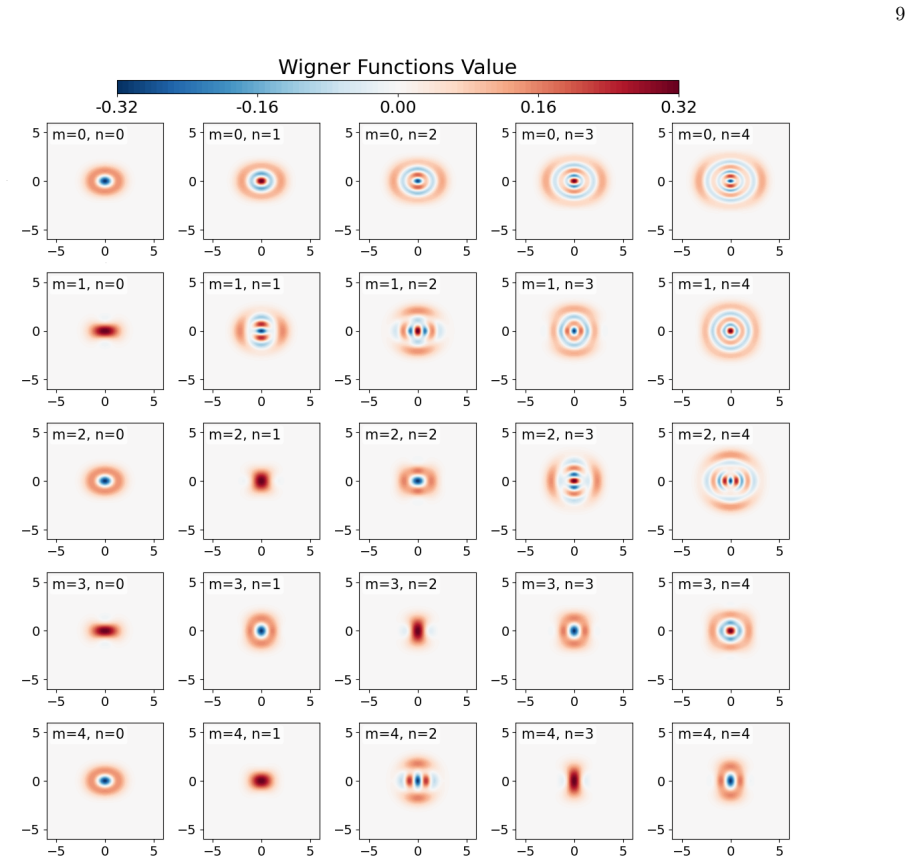
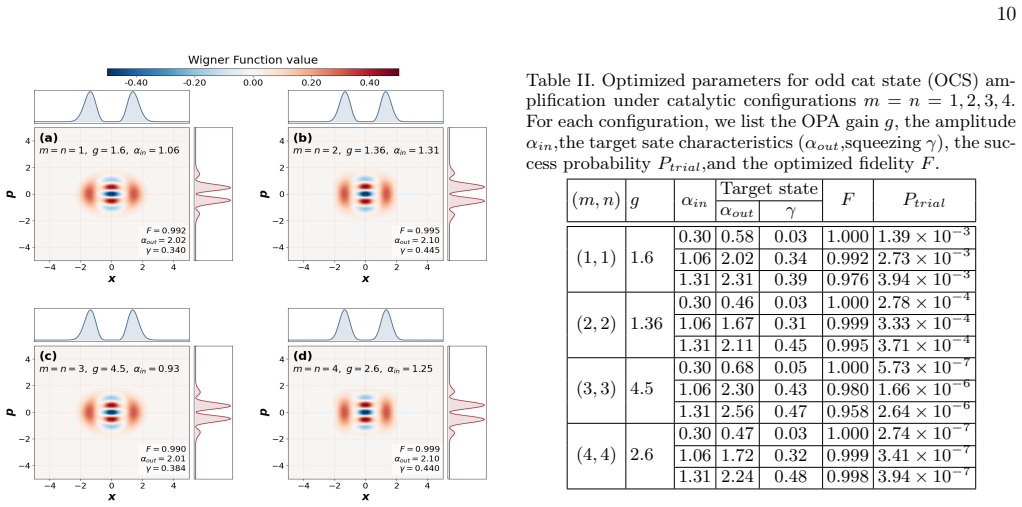
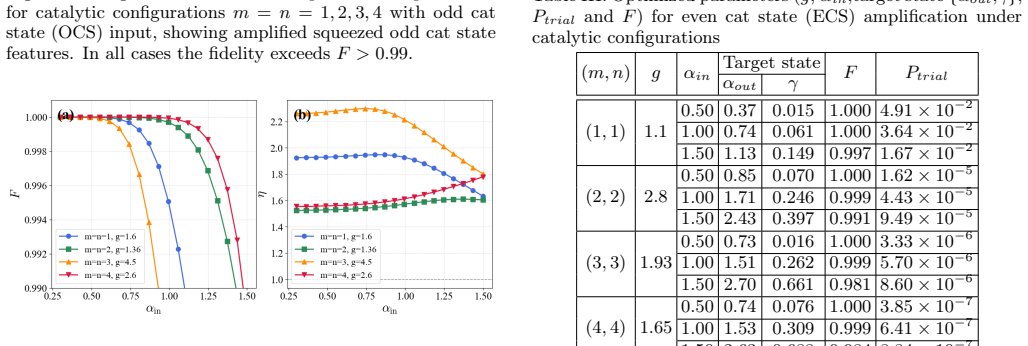
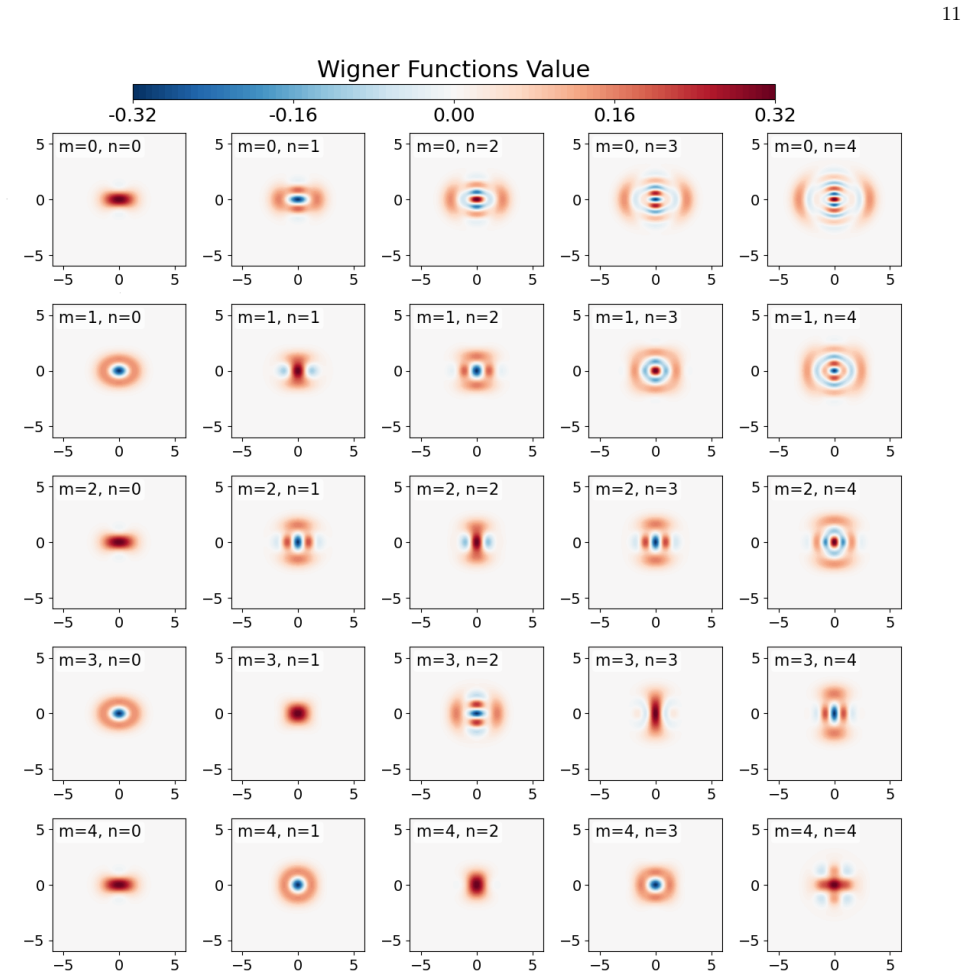
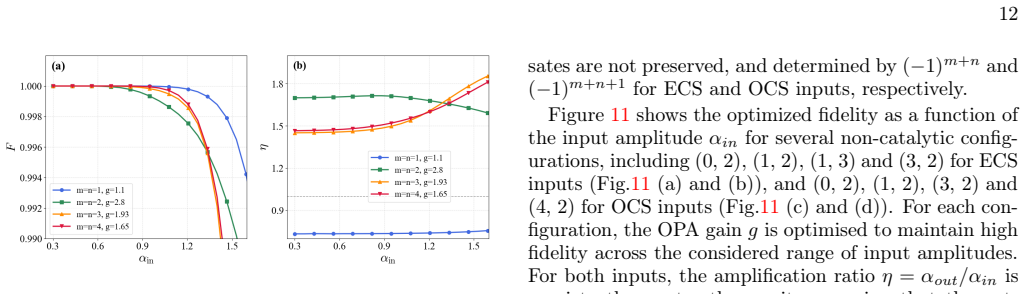
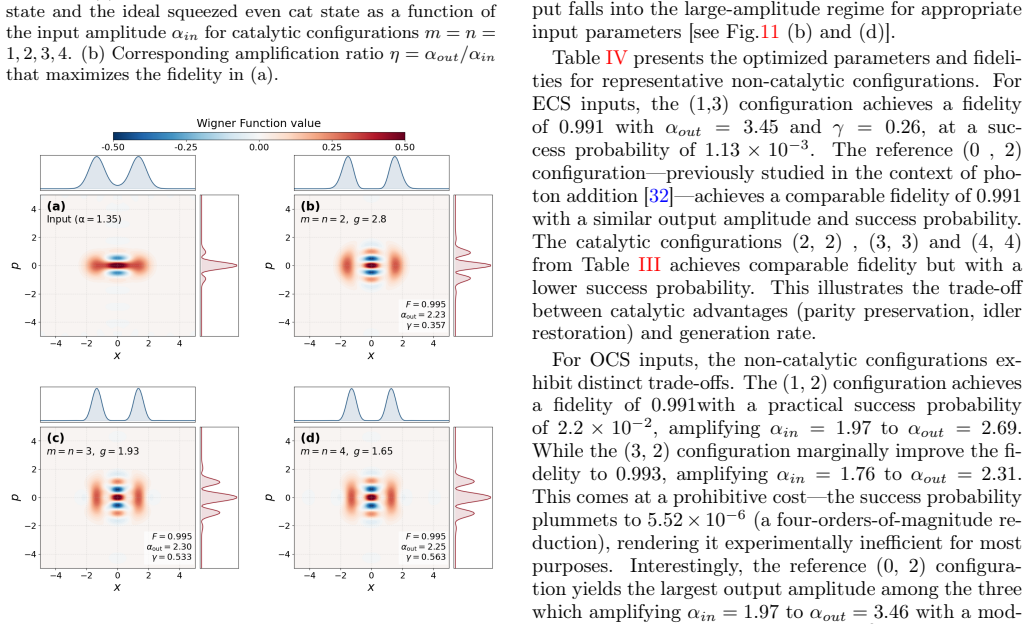
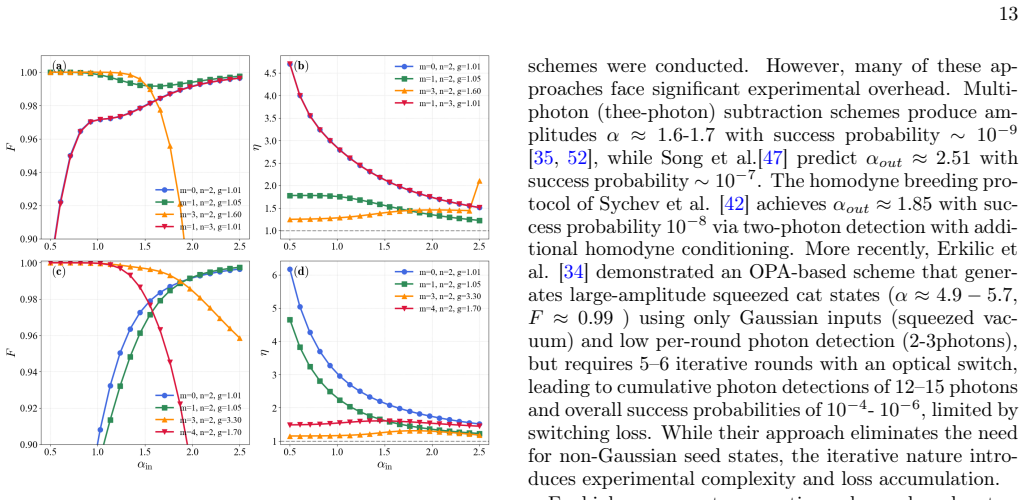
With a coherent-state signal input, the protocol generates cubic phase states with fidelity exceeding 0.99 across a broad range of (m,n) configurations. Using a Schrödinger cat state as the signal input, the same framework amplifies the cat state: an input cat with amplitude α_in ≤1 is transformed into an output squeezed cat with α_out ≥2 while maintaining fidelity above 0.99. The catalytic configuration preserves the input parity and restores the idler state, whereas non-catalytic configurations enable parity-flipping amplification with higher success rates. The amplified output can serve as a seed for subsequent amplification rounds.
What carries the argument
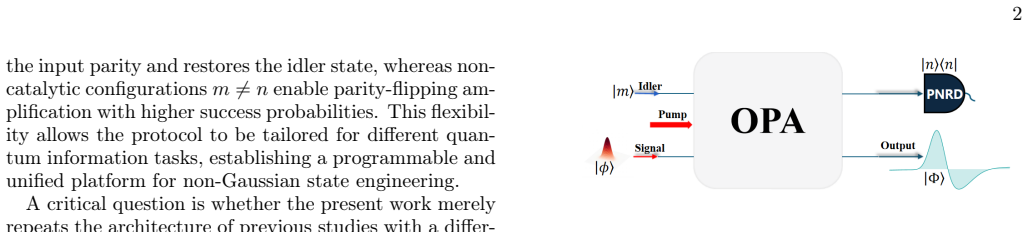
The programmable optical parametric amplifier synthesizer under a heralded photon-number-resolving framework, operating in catalytic (m=n) and non-catalytic (m≠n) idler-photon configurations.
If this is right
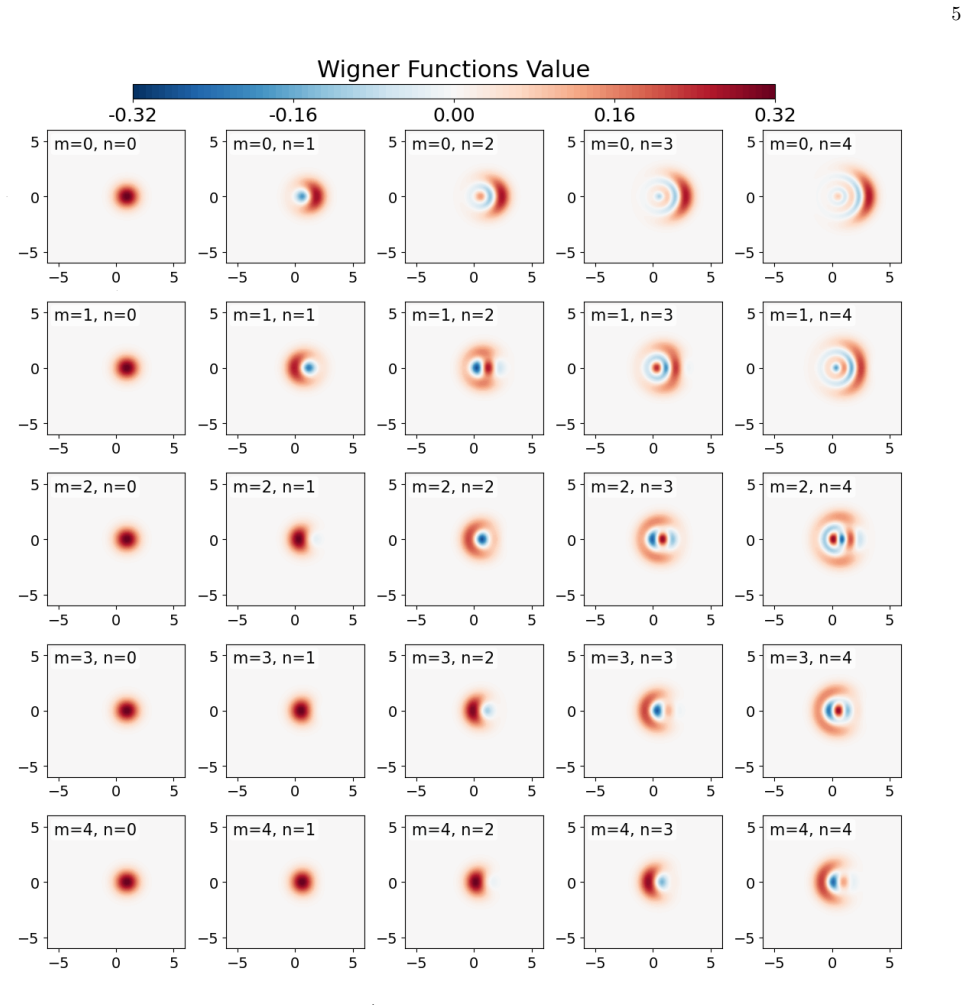
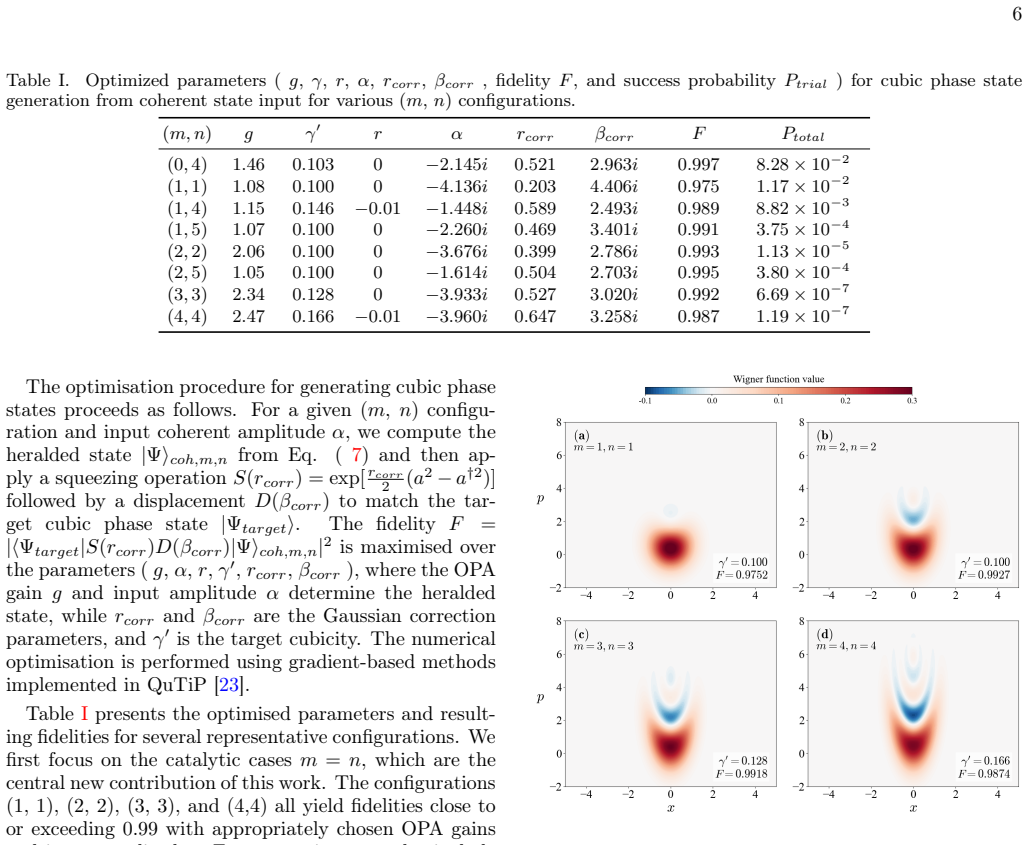
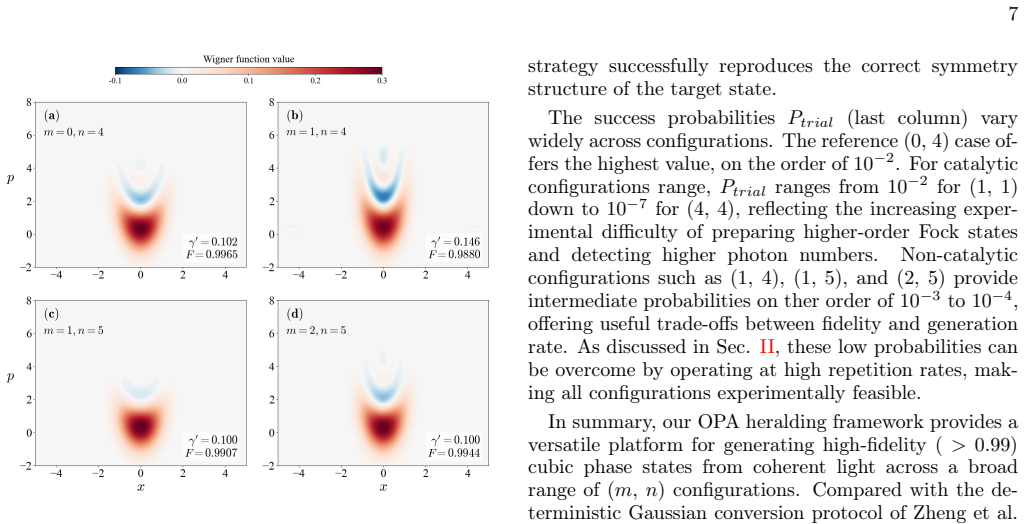
- Cubic phase states become available with fidelity above 0.99 for a wide set of photon-number pairs (m,n).
- Schrödinger cat states can be amplified from input amplitude ≤1 to output amplitude ≥2 at fidelity above 0.99.
- Catalytic operation restores the idler state and preserves parity; non-catalytic operation flips parity at higher success probability.
- Each amplified cat can seed further rounds, enabling progressive growth of cat amplitude through repeated application.
Where Pith is reading between the lines
- If the amplification chain works as described, repeated rounds could bootstrap from readily prepared small cats to states large enough for continuous-variable error correction.
- The method's reliance on moderate gain and low-order detection suggests it could be tested first with existing photon-number-resolving detectors before scaling to higher photon numbers.
- Combining this synthesizer with existing Gaussian operations might yield hybrid circuits for preparing more complex non-Gaussian states without increasing the required OPA gain.
Load-bearing premise
The protocol assumes ideal moderate-gain OPA operation and perfect heralding via photon-number-resolving detection without losses, noise, or mode mismatch that would degrade the reported fidelities.
What would settle it
A laboratory test that measures output fidelity below 0.99 for cubic phase generation from a coherent input, or that fails to produce an output cat amplitude at least twice the input amplitude while keeping fidelity above 0.99, would falsify the central performance claims.
Figures
read the original abstract
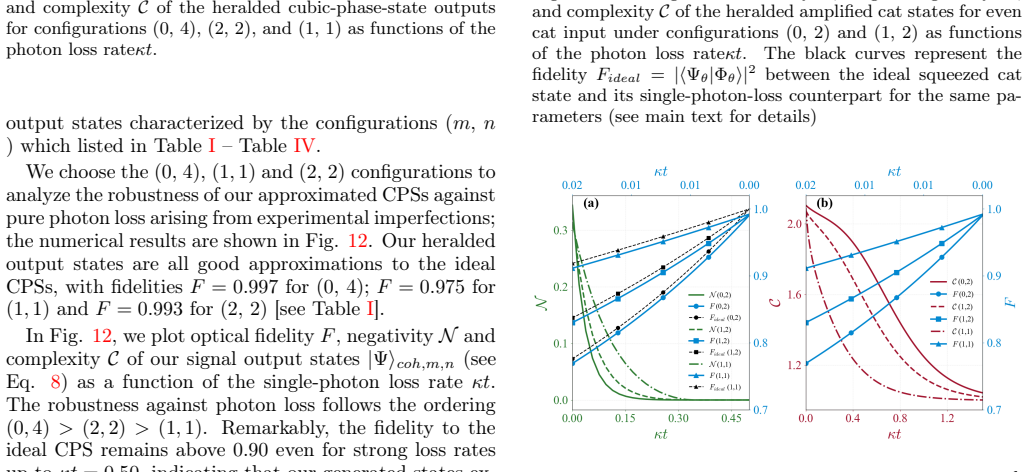
We introduce a programmable optical parametric amplifier (OPA) synthesizer that, under a heralded photon-number-resolving framework, generates high-fidelity cubic phase states and amplifies Schrodinger cat states. By systematically exploring both the catalytic configuration, where the idler input and output contain the same number of photons ($m=n$), and non-catalytic configurations ($m\neq n$), we discover two qualitatively different functionalities. First, with a coherent-state signal input, our protocol generates cubic phase states with fidelity exceeding 0.99 across a broad range of $(m,n)$ configurations. Second, using a Schr\"odinger cat state as the signal input, the same framework amplifies the cat state: an input cat with amplitude $\alpha_{\mathrm{in}}\le 1$ is transformed into an output squeezed cat with $\alpha_{\mathrm{out}}\ge 2$ while maintaining fidelity above 0.99. The catalytic configuration preserves the input parity and restores the idler state, whereas non-catalytic configurations enable parity-flipping amplification with higher success rates. Moreover, the amplified output can serve as a seed for subsequent amplification rounds, offering a self-seeding pathway to progressively larger cat states. Our protocol requires only moderate-gain OPA operation and low-order photon-number-resolving detection, providing a flexible and experimentally accessible platform for cubic phase state preparation and amplified squeezed cat state generation.
Editorial analysis
A structured set of objections, weighed in public.
Referee Report
Summary. The manuscript introduces a programmable optical parametric amplifier (OPA) synthesizer operating under a heralded photon-number-resolving (PNR) detection framework. It claims two main functionalities: (i) generation of cubic phase states with fidelity >0.99 from coherent-state signal inputs across a range of catalytic (m=n) and non-catalytic (m≠n) configurations, and (ii) amplification of Schrödinger cat states, mapping input amplitude α_in ≤1 to output squeezed cats with α_out ≥2 while preserving fidelity >0.99. The catalytic case preserves parity and restores the idler, while non-catalytic cases enable parity-flipping with higher success probability; the output can seed further amplification rounds. The protocol is asserted to require only moderate-gain OPA and low-order PNR detection.
Significance. If the reported fidelities are reproducible under the stated ideal conditions and the underlying model is fully specified, the work would supply a concrete, experimentally accessible route to non-Gaussian state preparation that combines standard OPA physics with heralding. The self-seeding amplification pathway and the distinction between catalytic and non-catalytic regimes are potentially useful for scaling cat-state amplitudes without requiring high-gain or high-order detection.
major comments (2)
- [Abstract and §3] Abstract and §3 (numerical results): the central fidelity claims (>0.99 for both cubic-phase generation and cat amplification across (m,n) pairs) are presented without any displayed equations, Hamiltonian, simulation parameters, or error-budget analysis. The abstract supplies no verification that the fidelities survive even modest loss or mode mismatch, which directly undermines the load-bearing assertion that the protocol works with moderate-gain OPA and low-order PNR.
- [§4] §4 (assumptions and robustness): the protocol is stated to assume ideal moderate-gain OPA operation and perfect heralding with no losses, noise, or mode mismatch. No quantitative degradation curves, Monte-Carlo error analysis, or tolerance thresholds are supplied when these assumptions are relaxed; this omission is load-bearing because the reported fidelities are the primary evidence for both claimed functionalities.
minor comments (1)
- [Abstract] Notation: the abstract writes “Schrodinger” without the umlaut; consistent use of Schr"odinger throughout the manuscript would improve readability.
Simulated Author's Rebuttal
We thank the referee for the careful reading and constructive comments on the presentation of our results. We address the major comments point by point below.
read point-by-point responses
-
Referee: [Abstract and §3] Abstract and §3 (numerical results): the central fidelity claims (>0.99 for both cubic-phase generation and cat amplification across (m,n) pairs) are presented without any displayed equations, Hamiltonian, simulation parameters, or error-budget analysis. The abstract supplies no verification that the fidelities survive even modest loss or mode mismatch, which directly undermines the load-bearing assertion that the protocol works with moderate-gain OPA and low-order PNR.
Authors: Section 2 of the manuscript already specifies the standard OPA Hamiltonian and the heralded PNR protocol. To address the concern, we will revise §3 to explicitly display the Hamiltonian, list all numerical parameters (gain values, photon-number pairs (m,n), Hilbert-space truncation), and add a short error-budget paragraph for the ideal case. The abstract focuses on the ideal performance; we will add a sentence clarifying that the reported fidelities are for the lossless, perfectly matched case and note the protocol's design for moderate gain and low-order detection as a route to experimental accessibility. revision: partial
-
Referee: [§4] §4 (assumptions and robustness): the protocol is stated to assume ideal moderate-gain OPA operation and perfect heralding with no losses, noise, or mode mismatch. No quantitative degradation curves, Monte-Carlo error analysis, or tolerance thresholds are supplied when these assumptions are relaxed; this omission is load-bearing because the reported fidelities are the primary evidence for both claimed functionalities.
Authors: We agree that some quantitative indication of robustness would strengthen the claims. In the revised manuscript we will expand §4 with a new paragraph providing perturbative estimates of fidelity degradation under small loss and mode mismatch, together with indicative tolerance thresholds (e.g., loss levels at which fidelity remains above 0.95). Full Monte-Carlo simulations lie outside the present scope but the added estimates will clarify the practical margin. revision: yes
Circularity Check
No circularity: protocol derives from standard OPA quantum optics with independent numerical fidelity evaluation
full rationale
The paper introduces a programmable OPA-based protocol and reports fidelities >0.99 obtained by direct computation on the heralded output state for coherent and cat inputs across (m,n) configurations. No equations reduce a claimed prediction to a fitted parameter by construction, no self-citation supplies a uniqueness theorem or ansatz, and the model is not self-referential. The derivation chain rests on the standard two-mode squeeze operator and photon-number projection, which are external to the paper and not redefined in terms of the target fidelities. This is the normal case of a self-contained theoretical proposal.
Axiom & Free-Parameter Ledger
Reference graph
Works this paper leans on
-
[1]
Walschaers, PRX Quantum2, 030204 (2021)
M. Walschaers, PRX Quantum2, 030204 (2021)
2021
-
[2]
Yoshida, D
T. Yoshida, D. Okuno, T. Kashiwazaki, T. Umeki, S. Miki, F. China, M. Yabuno, H. Terai, and S. Takeda, PRX Quantum6, 010311 (2025)
2025
-
[3]
A. L. Grimsmo and S. Puri, PRX Quantum2, 020101 (2021)
2021
-
[4]
Y. Zeng, F. Quijandría, C. Gneiting, and F. Nori, Phys. Rev. Lett.136, 190602 (2026)
2026
-
[5]
L. T. Knoll, A. G. Magnoni, and M. A. Larotonda, En- tropy27(2025), 10.3390/e27070712
-
[6]
J. Liu, M. Zhang, H. Chen, L. Wang, and H. Yuan, Adv. Quantum Technol.5, 2100080 (2022)
2022
-
[7]
S. D. Huver, C. F. Wildfeuer, and J. P. Dowling, Phys. Rev. A78, 063828 (2008)
2008
-
[8]
Zhang, Y.-X
X.-X. Zhang, Y.-X. Yang, and X.-B. Wang, Phys. Rev. A88, 013838 (2013)
2013
-
[9]
Sahota and N
J. Sahota and N. Quesada, Phys. Rev. A91, 013808 (2015)
2015
-
[10]
P. A. Knott, T. J. Proctor, A. J. Hayes, J. P. Cooling, and J. A. Dunningham, Phys. Rev. A93, 033859 (2016)
2016
-
[11]
P. M. Anisimov, G. M. Raterman, A. Chiruvelli, W. N. Plick, S. D. Huver, H. Lee, and J. P. Dowling, Phys. Rev. Lett.104, 103602 (2010)
2010
-
[12]
Gottesman, A
D. Gottesman, A. Kitaev, and J. Preskill, Phys. Rev. A 64, 012310 (2001)
2001
-
[13]
Weedbrook, S
C. Weedbrook, S. Pirandola, R. García-Patrón, N. J. Cerf, T. C. Ralph, J. H. Shapiro, and S. Lloyd, Rev. Mod. Phys.84, 621 (2012)
2012
-
[14]
Zheng, O
Y. Zheng, O. Hahn, P. Stadler, P. Holmvall, F. Qui- jandría, A. Ferraro, and G. Ferrini, PRX Quantum2, 010327 (2021)
2021
-
[15]
S. U. Shringarpure and J. D. Franson, Phys. Rev. A100, 043802 (2019)
2019
-
[17]
X.-X. Yao, B. Zhang, and Y. Turek, Phys. Rev. A113, 033712 (2026)
2026
-
[18]
Y. Turek, M.-Y. Sun, and X.-X. Yao, “Multi- photon heralding generates large-amplitude squeezed schrödinger cat states and parity-selective fock super- positions from squeezed vacuum via an opa,” (2026), arXiv:2605.23617 [quant-ph]
work page internal anchor Pith review Pith/arXiv arXiv 2026
-
[19]
Fukui, A
K. Fukui, A. Tomita, A. Okamoto, and K. Fujii, Phys. Rev. X8, 021054 (2018). 17
2018
-
[20]
E. N. Bashmakova, S. B. Korolev, and T. Y. Golubeva, Phys. Rev. A112, 032434 (2025)
2025
-
[21]
Ourjoumtsev, R
A. Ourjoumtsev, R. Tualle-Brouri, J. Laurat, and P. Grangier, Science312, 83 (2006)
2006
-
[22]
Takahashi, K
H. Takahashi, K. Wakui, S. Suzuki, M. Takeoka, K. Hayasaka, A. Furusawa, and M. Sasaki, Phys. Rev. Lett.101, 233605 (2008)
2008
-
[23]
Johansson, P
J. Johansson, P. Nation, and F. Nori, Comput. Phys. Commun.184, 1234 (2013)
2013
-
[24]
A. E. Lita, A. J. Miller, and S. W. Nam, Opt. Express 16, 3032 (2008)
2008
-
[25]
Fukuda, G
D. Fukuda, G. Fujii, T. Numata, K. Amemiya, A.Yoshizawa, H.Tsuchida, H.Fujino, H.Ishii, T.Itatani, S. Inoue, and T. Zama, Opt. Express19, 870 (2011)
2011
-
[26]
W. H. P. Pernice, C. Schuck, O. Minaeva, M. Li, G. N. Goltsman, A. V. Sergienko, and H. X. Tang, Nat. Com- mun.3, 1325 (2012)
2012
-
[27]
Zhang, J
T. Zhang, J. Huang, X. Zhang, C. Ding, H. Yu, Y. Xiao, C. Lv, X. Liu, Z. Wang, L. You, X. Xie, and H. Li, Photon. Res.12, 1328 (2024)
2024
-
[28]
Jornod, M
N. Jornod, M. Jankowski, L. M. Krüger, V. J. Wittwer, N. Modsching, C. Langrock, C. R. Phillips, U. Keller, T. Südmeyer, and M. M. Fejer, inCLEO 2023(Optica Publishing Group, 2023) p. STu3L.3
2023
-
[29]
Wakui, Y
K. Wakui, Y. Tsujimoto, M. Fujiwara, I. Morohashi, T. Kishimoto, F. China, M. Yabuno, S. Miki, H. Terai, M. Sasaki, and M. Takeoka, Opt. Express28, 22399 (2020)
2020
-
[30]
R. A. Brewster, I. C. Nodurft, T. B. Pittman, and J. D. Franson, Phys. Rev. A96, 042307 (2017)
2017
-
[31]
Marek, H
P. Marek, H. Jeong, and M. S. Kim, Phys. Rev. A78, 063811 (2008)
2008
-
[32]
J. Park, J. Joo, A. Zavatta, M. Bellini, and H. Jeong, Opt. Express24, 1331 (2016)
2016
-
[33]
FadrnÜ, M
J. FadrnÃœ, M. Neset, M. Bielak, M. JeÅŸek, J. BÃ- lek, and J. Fiurášek, npj Quantum Information10, 89 (2024)
2024
-
[34]
A unified optical platform for non-gaussian and fault-tolerant gottesman-kitaev- preskill states,
O. Erkilic, A. Das, B. Shajilal, P. K. Lam, T. C. Ralph, and S. M. Assad, “A unified optical platform for non-gaussian and fault-tolerant gottesman-kitaev- preskill states,” (2025), arXiv:2512.02607 [quant-ph]
-
[35]
Gerrits, S
T. Gerrits, S. Glancy, T. S. Clement, B. Calkins, A. E. Lita, A. J. Miller, A. L. Migdall, S. W. Nam, R. P. Mirin, and E. Knill, Phys. Rev. A82, 031802(R) (2010)
2010
-
[36]
Lloyd and S
S. Lloyd and S. L. Braunstein, Phys. Rev. Lett.82, 1784 (1999)
1999
-
[37]
Arzani, N
F. Arzani, N. Treps, and G. Ferrini, Phys. Rev. A95, 052352 (2017)
2017
-
[38]
Yukawa, K
M. Yukawa, K. Miyata, H. Yonezawa, P. Marek, R. Filip, and A. Furusawa, Phys. Rev. A88, 053816 (2013)
2013
-
[39]
Yanagimoto, T
R. Yanagimoto, T. Onodera, E. Ng, L. G. Wright, P. L. McMahon, and H. Mabuchi, Phys. Rev. Lett.124, 240503 (2020)
2020
-
[40]
Kashyap, D
H. Kashyap, D. A. Kopylov, and P. R. Sharapova, Laser Physics Letters23, 045209 (2026)
2026
-
[41]
Miwa, J.-i
Y. Miwa, J.-i. Yoshikawa, N. Iwata, M. Endo, P. Marek, R. Filip, P. van Loock, and A. Furusawa, Phys. Rev. Lett.113, 013601 (2014)
2014
-
[42]
D. V. Sychev, A. E. Ulanov, A. A. Pushkina, M. W. Richards, I. A. Fedorov, and A. I. Lvovsky, Nature Pho- tonics11, 379 (2017)
2017
-
[43]
A. P. Lund, H. Jeong, T. C. Ralph, and M. S. Kim, Phys. Rev. A70, 020101(R) (2004)
2004
-
[44]
Q. Xu, G. Zheng, Y.-X. Wang, P. Zoller, A. A. Clerk, and L. Jiang, npj Quantum Inf.9, 78 (2023)
2023
-
[45]
Fiurášek, S
J. Fiurášek, S. Grebien, and R. Schnabel, Phys. Rev. A 111, 043704 (2025)
2025
-
[46]
N. Wang, X. Zhang, Q. Liu, F. Sun, Q. He, and Y. Gu, J. Opt. Soc. Am. B42, 939 (2025)
2025
-
[47]
H. Song, G. Zhang, X. Wang, H. Yonezawa, and K. Fan, Phys. Rev. A105, 043713 (2022)
2022
-
[48]
Takase, J.-i
K. Takase, J.-i. Yoshikawa, W. Asavanant, M. Endo, and A. Furusawa, Phys. Rev. A103, 013710 (2021)
2021
-
[49]
Eaton, R
M. Eaton, R. Nehra, and O. Pfister, New Journal of Physics21, 113034 (2019)
2019
-
[50]
Yao and Y
X.-X. Yao and Y. Turek, Quantum Sci. Technol.11, 025038 (2026)
2026
-
[51]
Yao and Y
X.-X. Yao and Y. Turek, npj Quantum Inf.12, 30 (2026)
2026
-
[52]
Yukawa, K
M. Yukawa, K. Miyata, T. Mizuta, H. Yonezawa, P. Marek, R. Filip, and A. Furusawa, Opt. Express21, 5529 (2013)
2013
-
[53]
Luo and S
H. Luo and S. Mahmoodian, Phys. Rev. Appl.25, 024046 (2026)
2026
-
[54]
Huang, H
K. Huang, H. LeJeannic, J. Ruaudel, V.B. Verma, M. D. Shaw, F. Marsili, S. W. Nam, E. Wu, H. Zeng, Y.-C. Jeong, R. Filip, O. Morin, and J. Laurat, Phys. Rev. Lett.115, 023602 (2015)
2015
-
[55]
D. S. Schlegel, F. Minganti, and V. Savona, Phys. Rev. A106, 022431 (2022)
2022
-
[56]
Kiryu, K
S. Kiryu, K. Fukui, A. Okamoto, and A. Tomita, Phys. Rev. A112, 042615 (2025)
2025
-
[57]
Kenfack and K
A. Kenfack and K. Życzkowski, J Opt B Quantum Semi- classical Opt6, 396 (2004)
2004
-
[58]
S. Tang, F. Albarelli, Y. Zhang, S. Luo, and M. G. A. Paris, Quantum Sci. Technol.10, 045047 (2025)
2025
-
[59]
Y. S. Teo, S. U. Shringarpure, S. Cho, and H. Jeong, Quantum Science and Technology10, 035003 (2025)
2025
-
[60]
S. B. Korolev and T. Y. Golubeva, Phys. Rev. A113, 022413 (2026)
2026
-
[61]
S. L. Braunstein and P. van Loock, Rev. Mod. Phys.77, 513 (2005)
2005
-
[62]
Walschaers, B
M. Walschaers, B. Sundar, N. Treps, L. D. Carr, and V. Parigi, Quantum Sci. Technol8, 035009 (2023)
2023
-
[63]
Renault, P
P. Renault, P. Yard, R. C. Pooser, M. Eaton, and H. A. Zaidi, Quantum9, 1796 (2025)
2025
-
[64]
L. D. H. My, S. Qin, and H. K. Ng, Quantum9, 1810 (2025)
2025
discussion (0)
Sign in with ORCID, Apple, or X to comment. Anyone can read and Pith papers without signing in.