REVIEW 3 major objections 4 minor 14 references
Binding of muonated hydrogen molecules on the occasionof the Born-Oppenheimer approximation 90th anniversary
T0 review · 3 major / 4 minor · reviewed 2026-08-14 · deepseek-v4-flash
Pith's one-line read The paper argues that a mass swap from electron to muon changes whether a hydrogen-like molecule binds: ordinary di-hydrogen and di-muonated di-hydrogen bind, while the mixed mono-muonated molecule does not, and the Born-Oppenheimer…
desk verdict A clean variational exercise with analytic Gaussian integrals, but the no-bond claim for mono-muonated H2 overreaches what an upper-bound calculation can show, and the paper contradicts itself on weak resonance binding. read the letter →
The pith
A machine-rendered reading of the paper's core claim, the machinery that carries it, and where it could break.
The reading
What carries the argument
The machinery is a variational wavefunction made of four Gaussian orbitals, one per particle, grouped in pairs around two atomic centers separated by a vector $c$; each orbital has its own width, and the product is symmetrized over exchanges of identical particles. All Coulomb and kinetic expectation values reduce to closed-form Gaussian integrals, several involving erf functions, so the energy can be minimized as a function of the widths and $c$ with no numerical quadrature. Translational contamination is removed by subtracting the center-of-mass kinetic energy, defining $H_{\rm int}=H-P^2/(2M_{\rm tot})$. The decisive mechanism is degeneracy: when the two leptons have equal mass, the four permuted configurations share one energy and can resonate to bind the molecule, but in the mixed electron-muon system that degeneracy is broken and the resonance effect disappears; the resulting orbital radii provide the paper's criterion for whether the Born-Oppenheimer approximation is trustworthy.
What would settle it
Run a high-accuracy non-Born-Oppenheimer calculation on the system with two protons, one electron, and one muon, using a many-Gaussian or explicitly correlated basis. If the optimized ground-state energy falls below the separated-atom limit, the paper's no-bond conclusion is falsified; the same calculation's one-particle densities would show whether the muon and proton orbital radii remain comparable, directly testing the radii-based Born-Oppenheimer-validity criterion.
Extended reading notes
Core claim
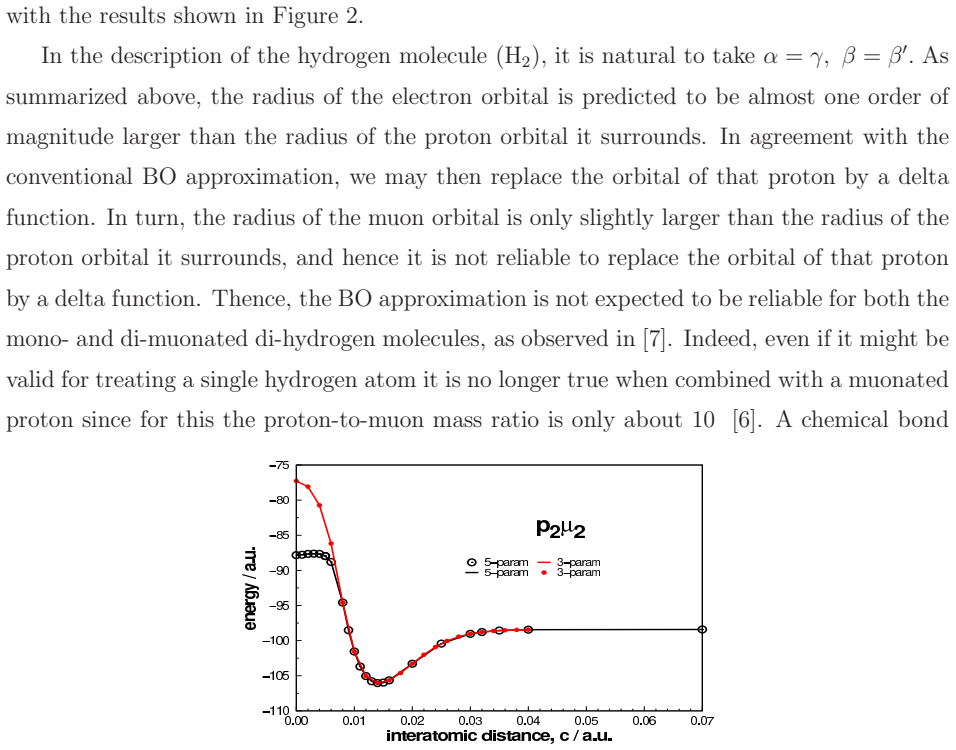
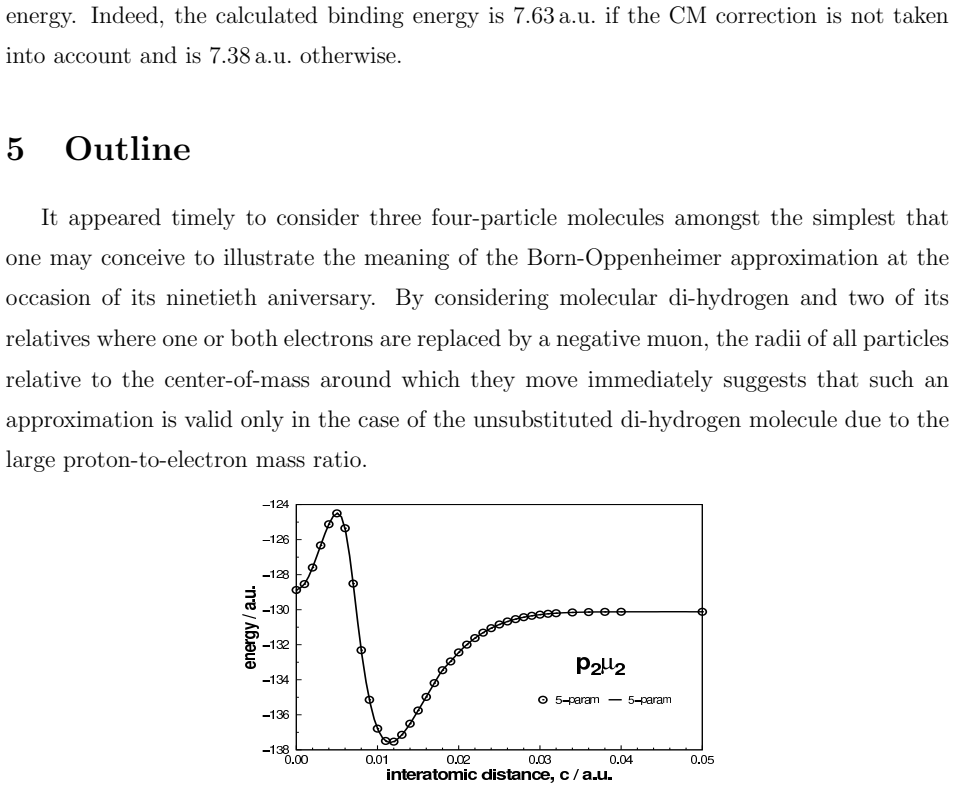
On its own terms, the central claim is that the binding of these four-particle molecules is controlled by a mass-symmetry switch. In H2 and in fully muon-substituted H2, the four wavefunctions obtained by exchanging identical leptons and identical protons are degenerate, so their linear combinations produce a resonance that lowers the energy; the model yields binding energies of 0.125949 a.u. and 7.6337 a.u. (7.38 a.u. after center-of-mass correction) at bond distances of 1.626 a.u. and 0.0142 a.u., respectively. In the mixed system, the muon and electron configurations have different energies, the resonance is suppressed, and the finite-separation variational energy never falls below the separated-atom energy, so the paper concludes there is no chemical bond. The same wavefunction's orbital radii are then used as a diagnostic: the electron orbit radius in H2 is about six times the proton orbit radius, while in muonated species the heavy and light radii are comparable, so fixing the heavy particles as delta-function sources is no longer justified. The proposed conclusion is that the Born-Oppenheimer approximation is valid only for ordinary di-hydrogen.
Load-bearing premise
Everything rests on trusting the single-Gaussian trial wavefunction to represent the true ground state: because it is a variational upper bound, a more flexible wavefunction could still find a bound mixed molecule, and the same model supplies the orbital radii that motivate the Born-Oppenheimer-validity claim.
Editorial extensions
If this is right
- If the Born-Oppenheimer approximation is invalid for mono- and di-muonated hydrogen, then muon-catalyzed fusion models that rely on potential-energy surfaces should be replaced by a full four-particle dynamical treatment.
- The di-muonated molecule's equilibrium distance of about 0.014 a.u. puts the two protons roughly 100 times closer than in H2, and its tiny moment of inertia implies no rotational spectrum, consistent with the nuclear-compression picture of muon catalysis.
- The mixed molecule, even if not chemically bound, is said to be near a resonance between configurations with almost equal energies, with the protons very close together; the paper suggests this resonance may provide a weak binding relevant to catalysis.
- The closed-form single-Gaussian variational treatment, including the center-of-mass correction, provides a reusable recipe for other four-fermion Coulombic systems such as dipositronium.
Reading between the lines
- Because a variational upper bound cannot rule out a deeper exact energy, the no-bond conclusion for mono-muonated di-hydrogen is not settled: a multi-Gaussian or explicitly correlated calculation could still find a shallow bound state, and the paper's result should be read as a model-based prediction rather than a proof.
- The radii-based BO-validity criterion could be made quantitative by sweeping the lepton mass continuously from electron to muon and locating where the proton and lepton orbital radii cross or where binding disappears; the resulting threshold would be a testable prediction for other exotic molecules.
- If the criterion generalizes, then any exotic atom whose lightest charged particle has a mass approaching its nuclear partner's mass, such as other heavy-lepton or antimatter systems, would lie outside the Born-Oppenheimer regime and require nonadiabatic treatment.
Signed reviews
Editorial analysis
A structured set of objections, weighed in public.
Referee Report
Summary. The paper studies a four-fermion model of two protons and two negatively charged leptons, with masses varying to represent H2, mono-muonated dihydrogen (one electron replaced by a muon), and di-muonated dihydrogen. The trial wave function is a symmetrized product of four Gaussian orbitals centered at ±c/2, one for each particle; the Rayleigh quotients for the kinetic and Coulomb terms are evaluated analytically and minimized variationally over the orbital exponents and the center separation c. The authors report binding for H2 and di-muonated H2 and no binding for mono-muonated H2, add a center-of-mass correction, and use the resulting orbital radii to suggest that the Born-Oppenheimer approximation is valid only for ordinary H2 among the three systems considered.
Significance. If its conclusions were established, the paper would provide a compact, fully analytic variational illustration of the Born-Oppenheimer approximation and of the effect of lepton mass on molecular binding. The derivation of the Rayleigh quotients is clean and transparent, and the explicit treatment of the center-of-mass correction is a useful pedagogical feature. The paper also deserves credit for stating its own limitation that the curves have no significant quantitative meaning for small c. However, the main physical claims are not supported by the calculation as presented: the no-binding conclusion for mono-muonated H2 rests on a variational upper-bound argument, and the claim that the Born-Oppenheimer approximation is valid only for di-hydrogen is asserted from qualitative orbital radii rather than demonstrated. These issues affect the central message rather than only the presentation.
major comments (3)
- [Section 4, Figure 3] The conclusion that mono-muonated dihydrogen has 'no binding energy' is not licensed by the calculation. Rayleigh-Ritz variational energies are upper bounds to the exact ground-state energy, so finding E_trial(c) > E_trial(∞) does not exclude an exact state below the dissociation threshold. In fact, the quoted difference is only about 0.0051 a.u. (between -49.6078 at c=0 and -49.6129 at c=∞), while the separated-atom threshold itself is built from single Gaussians per particle; the variational error in that threshold is plausibly of the same order as the claimed non-binding margin. The paper therefore proves at most that the chosen trial ansatz does not bind the mono-muonated system in this model, not that the physical molecule is unbound.
- [Center of mass correction subsection] The text directly contradicts itself: after discussing the center-of-mass-corrected curves, it states that 'It seems very likely that the resonance effect will lead to a weak binding between the non-muonic hydrogen atom and the muonic hydrogen atom,' whereas Section 4 asserts that no chemical bond exists because there is no binding energy. The paper also warns that 'significant quantitative meaning cannot be attributed to the curves in Figures 1, 2 and 3' for c < 0.06, which is precisely the region where the resonance and possible weak binding are discussed. This internal inconsistency must be resolved, and any conclusion about binding or non-binding must be stated as a property of the trial model rather than of the physical system.
- [Section 5] The claim that the Born-Oppenheimer approximation 'is valid only in the case of the unsubstituted di-hydrogen molecule' is not established. The argument uses only the qualitative radii of the particle orbitals relative to their centers, without any quantitative measure of the error introduced by the BO approximation. A defensible claim would require comparing BO and non-BO energies for all three systems, or at least estimating the omitted kinetic-energy contribution of the heavy particles. Because the no-binding result for mono-muonated H2 is itself unsupported (see the first comment), the BO-validity conclusion that leans on it inherits the same fragility.
minor comments (4)
- [Throughout] There are several typographical errors: 'Fot c = ∞' in the Figure 3 caption, 'inf ty' in the Figure 5 caption, 'aniversary' in Section 5, and 'Borm-Openheimer' in references [9]–[11]. These should be corrected.
- [Section 2] The operator S is described as 'the symmetrizing operator,' but it only exchanges particles within the lepton pair and within the proton pair rather than fully symmetrizing all four particles. The intended permutation symmetry should be stated explicitly to avoid confusion.
- [Appendix] The integral I_eP_V_EE and related expressions contain the factor (αβ' − γβ) in the denominator and an error function of the same quantity; in the H2 limit where α=γ and β=β', this combination vanishes and the limiting form should be supplied.
- [Section 4, first paragraph] The bullet list gives binding energies and orbital radii without error bars or convergence information; since the trial basis is a single Gaussian per particle, at least a brief statement about expected basis-set error would help the reader interpret the quantitative claims.
Circularity Check
No significant circularity is found: the variational energies and radii are model outputs, and the same-author citations [6,7] are not load-bearing.
full rationale
The derivation chain is self-contained in the relevant sense. The paper defines a four-fermion Hamiltonian, chooses an explicit two-center single-Gaussian ansatz, and minimizes the resulting Rayleigh quotients over the variational parameters; the reported binding energies are differences between the optimized molecular energy and the optimized separated-atom energy. No fitted parameter is renamed as a prediction, and no equation is defined in terms of the conclusion it is used to support. The suggestion that the Born-Oppenheimer approximation is valid only for di-hydrogen is drawn from model-internal orbital radii and mass ratios, not from a circular reduction. The same-author citations [6,7] are used for the variational procedure and for a qualitative expectation, but the immediate evidence for the no-binding statement is the paper's own Figure 3, so the self-citation is not load-bearing. The variational-upper-bound objection to the no-binding conclusion is a logical-support issue rather than a circularity, and the internal tension between 'no binding energy' and a later 'weak binding' remark is a consistency concern, not a reduction of outputs to inputs.
Assumptions & free parameters
free parameters (2)
- Orbital exponents α, γ, β, β' =
not tabulated; optimized variationally per species
- Center separation c =
1.626 a.u. for H2; 0.0142 a.u. for di-muonic dihydrogen
assumptions (5)
- standard math Variational principle: the expectation value of H with any trial wave function is an upper bound to the exact ground-state energy.
- domain assumption The four-fermion Hamiltonian with Coulomb interactions and masses (1, μ, M, M) describes the three molecules when μ is set appropriately.
- ad hoc to paper The trial wave function is a symmetrized product of four Gaussian orbitals centered at ±c/2, with each lepton associated with one proton.
- domain assumption Spin wave functions are taken antisymmetric or symmetric for identical leptons and protons as specified in Section 4.
- domain assumption The conventional Born-Oppenheimer limit is obtained by letting the proton Gaussian exponents β, β' go to infinity.
Cite this review
Pith. "Pith review of Binding of muonated hydrogen molecules on the occasionof the Born-Oppenheimer approximation 90th anniversary." pith.science (2026). https://pith.science/paper/CF4PETN3
@misc{pith2026190806175,
  author       = {Pith},
  title        = {Pith review of: Binding of muonated hydrogen molecules on the occasionof the Born-Oppenheimer approximation 90th anniversary},
  year         = {2026},
  howpublished = {\url{https://pith.science/paper/CF4PETN3}},
  note         = {Machine review of arXiv:1908.06175}
}
read the original abstract
The stability of four fermionic particles with unit charge, of which, two are positively, and two negatively charged, is discussed. Except for using the simplest approximation of a single Gaussian orbital per particle, the problem is exactly solved variationally and, by varying the masses to simulate molecular di-hydrogen, mono-muonated di-hydrogen and di-muonated di-hydrogen, employed to illustrate the celebrated Born-Oppenheimer approximation on the occasion of its 90th anniversary. It is suggested that it is valid only for di-hydrogen.
Figures


Figures from the paper (4 more)


Reference graph
Works this paper leans on
-
[1]
Zur quantentheorie der moleke n
M. Born and J. R. Oppenheimer, “Zur quantentheorie der moleke n”. Ann. Phys. 84 (1927), 457-484
work page 1927
-
[2]
A Personal Adventure in Muon-Catalyzed Fusio n
J. D. Jackson, “A Personal Adventure in Muon-Catalyzed Fusio n”, Physics in Per- spective,12 (2010), 7488
work page 2010
-
[3]
µ-mesonic molecules. 2. Molecular-Ion For- mation and Nuclear Catalysis
S. Cohen, D.L. Judd, R.J. Riddell Jr., “ µ-mesonic molecules. 2. Molecular-Ion For- mation and Nuclear Catalysis”. Phys. Rev. 119 (1960) 397-411
work page 1960
-
[4]
J. A. Wheeler, “Polyelectrons”, Ann. N. Y. Accad. Sci. 48 (1946) 219-238
work page 1946
-
[5]
Lowest open channels, bound states, a nd narrow resonances of dipositronium
C. G. Bao and T. Y. Shi, “Lowest open channels, bound states, a nd narrow resonances of dipositronium”, Phys. Rev. A 67 (2003) 042505
work page 2003
-
[6]
Or- bitals of the dipositronium
A.J.C. Varandas, M. Brajczewska, J. da Providˆ encia and J. P. d a Providˆ encia, “Or- bitals of the dipositronium” Chem. Phys. Lett. 610-611 (2014) 167-172. 13
work page 2014
-
[7]
On dipositronium and molecular hydrogen: similarities and differences
A. J. C. Varandas, J. da Providˆ encia, M. Brajczewska and J. P . da Providˆ encia, “On dipositronium and molecular hydrogen: similarities and differences” Eu r. Phys. J. D 69 (2015) 114
work page 2015
-
[8]
An rxtension of a b initio molecular orbital theory to nuclear motion
M. Tachikawa, K. Mori, H. Nakai and K. Iguchi, “An rxtension of a b initio molecular orbital theory to nuclear motion”, Chem. Phys. Lett. 290. 437 (1998)
work page 1998
Show all 14 references
-
[9]
Simultaneous Determination of Nuclear and Electronic W ave Functions without Borm-Openheimer: Approximation Ab Inition NO+MO/HF Theo ry
H. Nakai, “Simultaneous Determination of Nuclear and Electronic W ave Functions without Borm-Openheimer: Approximation Ab Inition NO+MO/HF Theo ry”, Int. J. Quant. Chem. 80, 511 (2001)
2001
-
[10]
Pre-Born Openheimer molecular structure theory
E. M´ atyus, “Pre-Born Openheimer molecular structure theory”, Mol. Phys., 117, 590 (2019)
2019
-
[11]
Non-Borm Openheimer effects predicted by translation free nuclear orbitals plus molecular orbital method
K. Sodeyama, K. Miamoto and H. Nakay, “Non-Borm Openheimer effects predicted by translation free nuclear orbitals plus molecular orbital method”, Chem. Phys. Lett. 421, 72 (2006)
2006
-
[12]
Abramowitz and I.A
M. Abramowitz and I.A. Stegun, Handbook of Mathematical Fun ctions: with Formu- las, Graphs, and Mathematical Tables, Dover Books on Mathematic s, 1965
1965
-
[13]
Spontaneously broken s ymmetries
R. E. Peierls, J. Phys. A, Math. Gen. “Spontaneously broken s ymmetries” 24 (1991) 5273
1991
-
[14]
Correlation Energy of an Ele ctron Gas at High Density
M. Gell-Mann and K. A. Brueckner, “Correlation Energy of an Ele ctron Gas at High Density” Phys. Rev. 106 (1957) 364. 14
1957
Reviewed August 14, 2026 · model on record in the stance chip above.
Discussion (0). Continue with ORCID to comment.