REVIEW 3 major objections 5 minor 4 references
The QTF-Backbone: Proposal for a Nationwide Optical Fibre Backbone in Germany for Quantum Technology and Time and Frequency Metrology
T0 review · 3 major / 5 minor · reviewed 2026-08-07 · deepseek-v4-flash
Pith's one-line read This paper proposes a EUR 87.2 million, four-phase dark-fibre backbone across Germany that would deliver quantum signals and ultra-precise time and frequency references to nineteen points of presence.
desk verdict This is a serious, well-sourced infrastructure proposal whose load-bearing cost assumption—dark fibre at 650 €/km/year—is untested and internally inconsistent across tables. read the letter →
The pith
A machine-rendered reading of the paper's core claim, the machinery that carries it, and where it could break.
The reading
What carries the argument
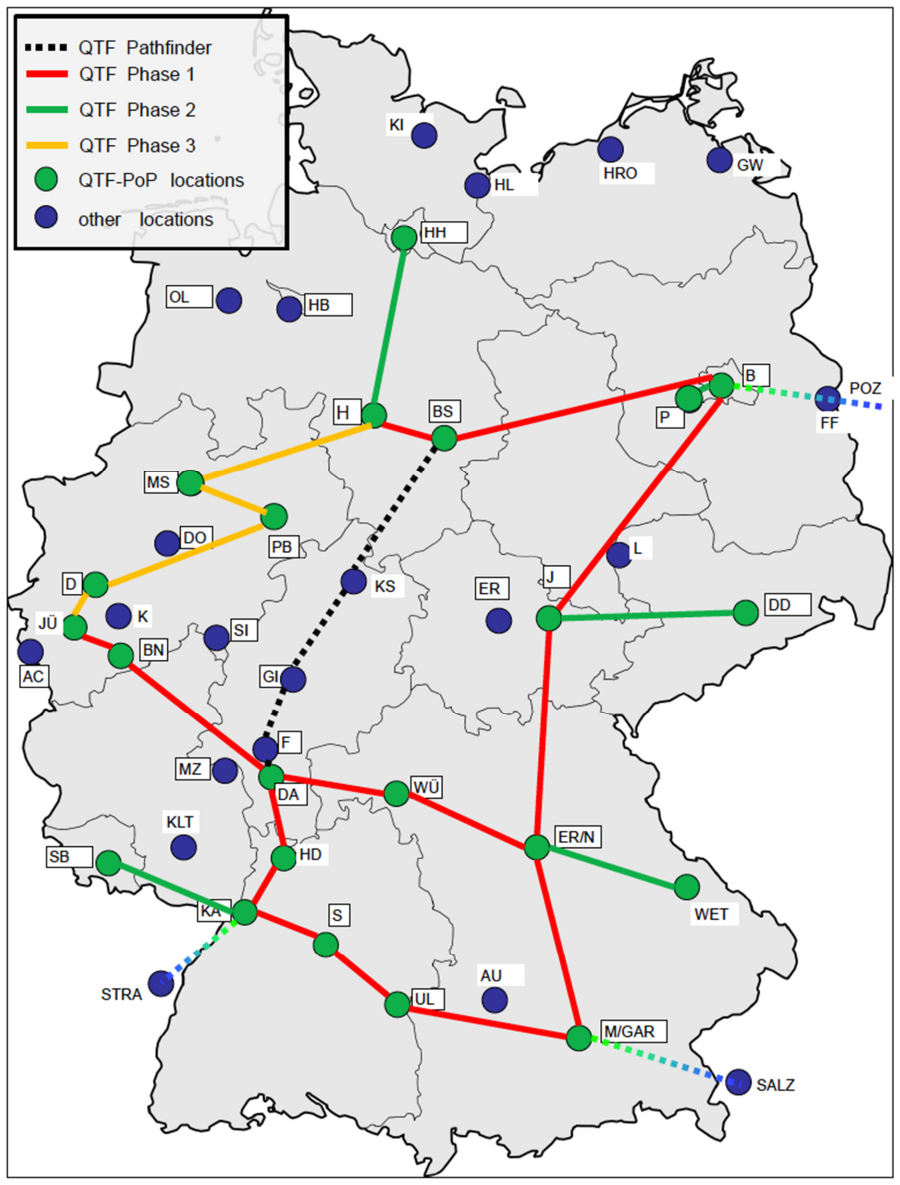
The load-bearing object is the network specification itself, which is deliberately stricter than commercial telecom practice. The basic layer consists of two leased dark-fibre pairs per route, underground only, with fully documented cable geometry and splices, and at most 21 dB attenuation between in-line amplifier sites; this is what makes single-photon-level quantum signals and actively stabilised optical carriers feasible outside a laboratory. The service layer distributes a 194.4 THz ultrastable laser reference plus 10 MHz and pulse-per-second signals using actively delay-compensated bidirectional fibre links of the ELSTAB and White Rabbit type, the techniques that supply the claimed sub-100 ps timing and $10^{-19}$-level frequency comparison. The data layer records the time-dependent propagation delay of every fibre, turning the network's own operation into a distributed strain and seismic sensor. Finally, the two-pair rule is the architectural decision that lets quantum communication and T&F services share one infrastructure without mutual interference, and the four-phase deployment plan (1, then 12, 4, and 2 points of presence) is what makes the ten-year, 87.2 million euro budget administratively credible.
What would settle it
Run the Phase-0 pathfinder procurement literally: solicit offers for roughly 450 km of underground, fully documented dark-fibre pairs on the Braunschweig–Frankfurt route at about 650 euros per kilometre per year with at most 21 dB per span. If the market price is materially higher or requires new construction, the cost model fails. A complementary technical check is to operate a single-photon quantum channel and the stabilised 194.4 THz carrier on the same pair over that distance and measure whether the quantum bit error rate stays below 1%, as in the Italian demonstration the paper relies on; if field conditions degrade that coexistence, the dual-use design premise is in doubt.
Extended reading notes
Core claim
The paper's central claim is the proposal itself: that Germany needs, and can operate, a nationwide dark-fibre backbone dedicated to quantum links (Q) and time and frequency distribution (T&F), because ordinary data networks cannot carry these signals and no such infrastructure exists today. The authors specify what the network would deliver: an ultrastable optical carrier at 194.4 THz (the 1542 nm telecom window) steered to the national clock ensemble, 10 MHz and pulse-per-second references traceable to UTC, and dedicated fibre pairs for quantum experiments, enabling remote optical clock comparisons with accuracy below $10^{-19}$, network-wide synchronisation under 100 ps, and coexistence of quantum and clock signals on one fibre pair with a quantum bit error rate below 1%. They propose a three-layer design (rented dark fibres as the basic layer, an actively compensated service layer, and a data layer whose fibre-delay records double as sensing data), rolled out in four phases over ten years, and governed by a new non-profit association funded federally during installation. The support cited in the paper is the record of European fibre links and stakeholder feedback, not new experiments; the paper's own contribution is the synthesis of that evidence into a concrete, costed national plan.
Load-bearing premise
The whole plan rests on being able to rent existing underground dark-fibre pairs with documented routes and low enough loss (at most 21 dB between amplifier sites) at roughly 650 euros per kilometre per year across Germany; if fibre of that quality is not available at that price, or new routes must be dug, the 87.2 million euro cost estimate and the ten-year schedule would both change substantially.
Editorial extensions
If this is right
- Any German research institution connected to the backbone could compare its optical clocks against the national references at the $10^{-19}$ level, turning the redefinition of the SI second into a distributed national experiment rather than a two-laboratory exercise.
- Quantum communication testbeds (QKD, trusted nodes, quantum repeaters, entanglement distribution) would move from campus fibres to field conditions over hundreds of kilometres, the step the authors argue is needed before deployment.
- Critical infrastructure could test GNSS-independent timing: synchronisation below 100 ps across the network and within 1 ns of UTC is up to two orders of magnitude better than a GNSS receiver, supplying a national testbed for resilience against jamming and spoofing.
- The continuous record of fibre-delay fluctuations would effectively turn 4,030 km of dark fibre into a distributed seismic and strain sensor, an application the paper lists alongside the quantum and metrology goals.
- As the German hub of the planned European networks, the backbone would let German users participate in pan-European optical clock comparisons and cross-border quantum links.
Reading between the lines
- The four-phase schedule doubles as a market test: the 450 km pathfinder would reveal the true rental cost and demand before the larger commitments of Phases 1 to 3 are made, a risk-reduction role the authors do not explicitly stress.
- The network retains value even if several of the ten R&D topics mature slowly, because it remains useful as a metrology service and as a sensing observatory; the investment case does not stand or fall on the quantum timeline alone.
- A testable economic prediction follows: if the network is built, early utilisation should be dominated by time-and-frequency users, since that equipment is commercially available and demand is proven, with quantum users growing later; Phase-1 traffic statistics would discriminate between the metrology-anchored and quantum-anchored views of the project.
Editorial analysis
A structured set of objections, weighed in public.
Referee Report
Summary. The manuscript proposes the QTF-Backbone, a dedicated nationwide dark-fibre infrastructure in Germany for quantum communication (Q) and time-and-frequency (T&F) distribution, to complement the existing X-WiN research network. Part 1 specifies a three-layer design (four-fibre network layer, service layer, and data layer), gives performance levels for T&F services based on European demonstrations, and surveys German state initiatives and European networks (REFIMEVE, LIFT, CITAF, and others) for integration. Part 2 describes ten R&D topics anticipated to be enabled, from quantum communication and distributed quantum computing to chronometric levelling, VLBI, and GNSS resilience. Part 3 presents a deployment path: four phases over ten years, 19 PoPs and roughly 4030 km of links, a cost model with a headline TOTEX of 87.2 M€, access and data-management plans, and a proposed QTF-Backbone e.V. governance structure. The paper contains no new experimental data; its technical claims are referenced to prior European fibre-link demonstrations and its demand estimates to stakeholder feedback.
Significance. If realized, the QTF-Backbone would be the first nationwide German research infrastructure combining quantum links and high-precision T&F distribution on dedicated dark fibres, interconnecting currently isolated testbeds and linking to GÉANT C-TFN and FOREST structures, with credible spillovers into metrology, fundamental physics, geodesy, navigation resilience, and industrial quantum technology development. The manuscript is honest about its own limits: Table 1's caption states that the numbers are 'provided for orientation only,' §3.1 notes that the real topology 'must be determined during the procurement process,' and Table 7's caption defers the ILA-S count to detailed planning. The cost model is explicit enough to be audited, which is a genuine strength, and the European comparison base in Table 5 is concrete and well referenced. These strengths make the proposal a useful design-study document; however, the central quantitative deliverable, the 87.2 M€ TOTEX over four phases, is not yet reconciled internally and rests on a single unverified price assumption, which is why the proposal needs revision rather than acceptance as it stands.
major comments (3)
- [§3.1, Tables 8 and 9] The cost model is internally inconsistent. Table 8 sums the fibre-rental costs over the four phases to 42.5 M€, while Table 9 lists the fibre contribution as 42.1 M€, and the difference is never explained. In addition, Table 9 places the fibre amount in the CAPEX column (the 'Sum' row shows CAPEX 54.5 M€ = 12.4 + 42.1 M€) even though §3.1 describes the fibre as a recurring rental cost (OPEX). Because the 87.2 M€ TOTEX headline is the central quantitative claim of the proposal, the two tables must be reconciled and the CAPEX/OPEX classification corrected or explicitly justified.
- [§3.1, Table 6] The availability of dark fibres satisfying Table 6 (attenuation ≤21 dB per span, underground routing, fully documented geometry) at the assumed ~650 €/km per year for two pairs is load-bearing for the entire cost and schedule model, but the only evidence offered is a 'DFN-internal average' with no procurement data, price range, or supplier indication, and the paper itself notes that the real topology 'must be determined during the procurement process.' The paper also anticipates new route construction, for example to Wettzell (§1.1), whose cost is not separately itemized anywhere in Table 9. The authors should add a sensitivity analysis on the fibre unit price (say ±50%) and a scenario with a new-construction component; doubling the lease rate alone would add roughly 42 M€ to TOTEX and would materially change the four-phase timeline.
- [§1.2, Table 1] The statement that the Table 1 performance levels 'have been verified in Europe for distances of more than 600 km and can also be expected for the QTF-Backbone' extrapolates from point-to-point or linear-chain links to a meshed network with multiple PoP/ILA hops and per-span limits of 21 dB (Table 6). Several Part 2 topics require the extreme end of this performance range, for example Topic #9 needs comparison noise below 1e-19 to validate 1e-18-class clocks, so the authors should discuss how cascaded link noise, single-photon-level optical switching (§1.1), and worst-case multi-span paths affect end-to-end performance. The caveat already present in the Table 1 caption ('provided for orientation only') underscores that this extrapolation needs explicit treatment in the text.
minor comments (5)
- [Throughout] The text contains numerous character-substitution artifacts (e.g., 'oCer' for 'offer', 'eCiciency' for 'efficiency', 'Bline Quantum Computation' in the abbreviation list, and the contributor name 'SteCen Schön'); these should be corrected in a careful editing pass.
- [§2.6] 'Satellite/Laser Laser Ranging (SLR/LLR)' should read 'Satellite Laser Ranging (SLR) and Lunar Laser Ranging (LLR)'.
- [Abbreviation list] The abbreviation list defines ITRF as 'International Height Reference Frame'; the International Terrestrial Reference Frame (ITRF) and the International Height Reference Frame (IHRF) are distinct, and the entry should be corrected.
- [§3.2] The claim that demand has been 'confirmed with feedback from ca. 100 stakeholders' via CLONETS-DS and QR.X is stated without a citation; a reference to the relevant deliverable or report would make the demand base verifiable.
- [Figure 4] In Figure 4 the legend and axis labels are very small, so in print the instability curves will be hard to distinguish; the figure would benefit from larger type or a vector version.
Circularity Check
No circularity: the QTF-Backbone proposal applies externally demonstrated fibre-link technology; cost and performance inputs are assumptions or cited measurements, not outputs derived from themselves.
full rationale
This paper is a research-infrastructure proposal, not a derivation. Its central claim is that a dedicated dark-fibre QTF-Backbone should be built and would enable ten R&D topics; that claim is an application of previously demonstrated link technology, and the paper does not attempt to derive any new physical or statistical result from its own assumptions. Performance claims in Table 1 are explicitly attributed to external measurement campaigns (Cantin, Krehlik, Śliwczyński, Kaur, Dierikx, etc.), and the statement that such performance “has been verified in Europe for distances of more than 600 km” rests on those citations. The cost estimate uses a stated DFN-internal average fibre rental rate (650€/km p.a.) as an input parameter, not as a predicted outcome, and the paper explicitly marks the topology as subject to procurement; a planning assumption is not a circular derivation. No step reduces to its own input, no fitted parameter is renamed a prediction, and the few self-references (e.g., PTB links, SQuaD map, CLONETS-DS deliverables) are supporting context rather than load-bearing justifications. The only related weakness is financial: Table 8 totals 42.5 M€ for fibre while Table 9 lists 42.1 M€, and the 650€/km rate is not backed by binding procurement evidence, but those are correctness and robustness concerns, not circularity. The paper even states that “the real topology, i.e. the exact length of the sections within the QTF-Backbone, must be determined during the procurement process,” confirming that the cost and schedule are openly recognized as input-dependent estimates. Circularity score is therefore 0.
Assumptions & free parameters
free parameters (3)
- Dark fibre rental rate =
650 EUR/km per year
- Personnel cost per FTE =
100 kEUR per year
- TOTEX estimate =
87.2 M€
assumptions (3)
- domain assumption Dark fibres meeting the specified requirements (attenuation <=21 dB per span, underground routes, documented geometry) can be leased across Germany at the assumed rate.
- domain assumption The performance levels in Table 1, verified on point-to-point links >600 km in Europe, will also hold on a meshed, multi-service national network.
- ad hoc to paper Federal and state governments will fund the 10-year installation phase (TOTEX 87.2 M€).
invented entities (1)
-
QTF-Backbone
Cite this review
Pith. "Pith review of The QTF-Backbone: Proposal for a Nationwide Optical Fibre Backbone in Germany for Quantum Technology and Time and Frequency Metrology." pith.science (2026). https://pith.science/paper/CFIAVDAK
@misc{pith2026250603998,
  author       = {Pith},
  title        = {Pith review of: The QTF-Backbone: Proposal for a Nationwide Optical Fibre Backbone in Germany for Quantum Technology and Time and Frequency Metrology},
  year         = {2026},
  howpublished = {\url{https://pith.science/paper/CFIAVDAK}},
  note         = {Machine review of arXiv:2506.03998}
}
read the original abstract
The recent breakthroughs in the distribution of quantum information and high-precision time and frequency (T&F) signals over long-haul optical fibre networks have transformative potential for physically secure communications, resilience of Global Navigation Satellite Systems (GNSS) and fundamental physics. However, so far these capabilities remain confined to isolated testbeds, with quantum and T&F signals accessible, for example in Germany, to only a few institutions. We propose the QTF-Backbone: a dedicated national fibre-optic infrastructure in Germany for the networked distribution of quantum and T&F signals using dark fibres and specialized hardware. The QTF-Backbone is planned as a four-phase deployment over ten years to ensure scalable, sustainable access for research institutions and industry. The concept builds on successful demonstrations of high-TRL time and frequency distribution across Europe, including PTB-MPQ links in Germany, REFIMEVE in France, and the Italian LIFT network. The QTF-Backbone will enable transformative R&D, support a nationwide QTF ecosystem, and ensure the transition from innovation to deployment. As a national and European hub, it will position Germany and Europe at the forefront of quantum networking, as well as time and frequency transfer.
Figures


Figures from the paper (4 more)



Reference graph
Works this paper leans on
-
[5]
Table 5 gives an overview of the current state-of-the-art achieved in EU countries. 20 Figure 5: Map showing already existing fibre link consortia in Europe (acronyms in blue ovals) that are under development in collaboration with NRENs (acronyms only). Table 5: Summary of the European optical fibre infra structures for T&F and/or quantum communication Coun...
work page 2023
-
[8]
Item CAPEX OPEX p.a., year 1 – year 10 OPEX total TOTEX Investment 12.4 M€ 2.3 M € 22.7 M€ 35.1 M€ Personnel - 1.0 M€ 10.0 M€ 10.0 M€ Fibre 42.1 M€ - - 42.1 M€ Sum 54.5 M€ 3.3 M€ 32.7 M€ Total 87.2 M€ 40 Contributions of institutions The DFN-Verein is well suited to play a decisive role in implementing and operating the QTF- Backbone: Plan and carry out...
-
[2025]
Italy In Italy the operation of LIFT, also known as the Italian Quantum Backbone (IQB) 21 , started in 2013 with an 1850 km infrastructure that was at first primarily used for T&F dissemination, but is composed of a pair of fibr es so that one fibre can be devoted to T&F distribution and the second fibre for Quantum Communication activities or any tests that ...
arXiv 2020
-
[2029]
Improved positioning systems for self-driving cars and unmanned aerial vehicles are a promising market. 73 S. Droste et al., New J. Phys. , 17, 083044 (2015). https://doi.org/10.1088/1367-2630/17/8/083044 35 Part 3: Path to Implementation The network will initially connect high-demand scie nce users and serve as the foundation for future expansion. The im...
Reviewed August 7, 2026 · model on record in the stance chip above.
Discussion (0). Sign in to comment.