REVIEW 2 major objections 2 minor 83 references
Interpolating non-Hermitian universality classes A and AI$^\dagger$: eigenvalue density and transition regime
T0 review · 2 major / 2 minor · reviewed 2026-06-28 · grok-4.3
Pith's one-line read Scaling the interpolation parameter as one minus kappa over square root N produces a new transitional edge density for eigenvalues that connects two non-Hermitian classes.
desk verdict The paper derives a finite-N joint eigenvalue-eigenvector distribution via Kac-Rice for an interpolating ensemble and identifies a new transitional edge scaling, but the key density is a conjecture backed only by numerics. read the letter →
The pith
A machine-rendered reading of the paper's core claim, the machinery that carries it, and where it could break.
The reading
What carries the argument
The Kac-Rice formalism applied to the interpolating ensemble, which supplies the exact finite-N joint distribution of eigenvalue and normalized right eigenvector from which the marginal density follows.
What would settle it
Large-N numerical sampling of a non-Gaussian interpolating ensemble with the parameter fixed at one minus kappa over square root N should display the predicted transitional edge density.
Extended reading notes
Core claim
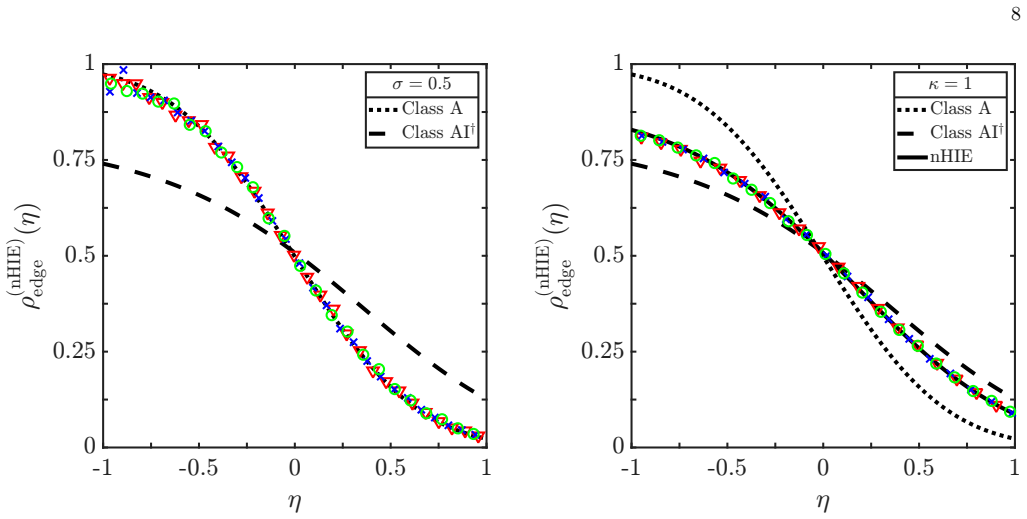
In the interpolating Gaussian ensemble the marginal eigenvalue density follows the circular law in the bulk independent of the parameter. At the edge, fixed values of the parameter yield the density of class A, while the scaling sigma equals one minus kappa N to the minus one half produces a new density that interpolates between class A and class AI dagger edge behaviors. This transitional regime is conjectured to hold for non-Gaussian matrices.
Load-bearing premise
The Kac-Rice formalism supplies the exact joint distribution of eigenvalue and normalized right eigenvector for the Gaussian interpolating ensemble at finite N.
Editorial extensions
If this is right
- The bulk spectrum is the circular law for every fixed value of the interpolation parameter.
- Edge eigenvalues obey class A statistics unless the parameter is tuned to the special N-dependent scaling.
- The transitional edge density provides a continuous connection between the two previously known edge laws.
- Numerical evidence indicates the transitional density persists for non-Gaussian matrices.
Reading between the lines
- Comparable transitional scalings may appear when other pairs of non-Hermitian ensembles are interpolated.
- The new density supplies a concrete model for systems whose symmetry is broken at a rate tied to matrix size.
- Exact analytic expressions for the transitional density could be extracted from the same Kac-Rice starting point.
Signed reviews
Editorial analysis
A structured set of objections, weighed in public.
Referee Report
Summary. The manuscript employs the Kac-Rice formalism to derive the exact finite-N joint distribution of an eigenvalue and its normalized right eigenvector for a Gaussian ensemble interpolating between class A (Ginibre) and class AI† (complex symmetric) matrices. The marginal eigenvalue density is obtained at finite N and analyzed in the large-N limit, recovering the circular law in the bulk for all interpolation parameters σ and the class A edge density for fixed σ. A transitional regime is identified when σ = 1 - κ N^{-1/2}, yielding a new interpolating edge density conjectured to be universal, with numerical support provided.
Significance. If the transitional regime and associated density are placed on a rigorous footing, the result would identify a new universality class for the edge eigenvalues of non-Hermitian matrices under this scaling of the interpolation parameter, providing a smooth interpolation between the known class A and AI† edge laws. The exact finite-N joint distribution via Kac-Rice and the recovery of the circular law and fixed-σ edge limits are clear strengths. The numerical evidence offered for universality is a positive feature, but the conjectural status of the transitional density limits the immediate significance.
major comments (2)
- [Transitional regime analysis] Transitional regime (section following the definition of σ = 1 − κ N^{-1/2}): the new edge density is presented as a conjecture supported by numerics rather than derived from the finite-N marginal via explicit asymptotic analysis under the stated scaling. This is load-bearing for the central claim, since the bulk and fixed-σ results recover known laws while the transitional regime constitutes the novel contribution.
- [Kac-Rice joint distribution] Finite-N marginal density (Kac-Rice section): although the joint distribution is asserted to be exact, the explicit integration over the normalized right-eigenvector component to obtain the marginal eigenvalue density is not shown in sufficient detail for the transitional scaling; without these steps it is unclear whether the subsequent N → ∞ limit is fully controlled by the scaling alone.
minor comments (2)
- [Numerical figures] Figure captions for the numerical histograms in the transitional regime should overlay the conjectured analytic density (if available) or state the precise range of κ and N values used.
- [Introduction/ensemble definition] Notation: the interpolation parameter σ is introduced in the abstract and ensemble definition; a single consolidated definition early in the text would improve readability.
Simulated Author's Rebuttal
We thank the referee for their careful reading and constructive comments. We address each major comment below.
read point-by-point responses
-
Referee: [Transitional regime analysis] Transitional regime (section following the definition of σ = 1 − κ N^{-1/2}): the new edge density is presented as a conjecture supported by numerics rather than derived from the finite-N marginal via explicit asymptotic analysis under the stated scaling. This is load-bearing for the central claim, since the bulk and fixed-σ results recover known laws while the transitional regime constitutes the novel contribution.
Authors: We agree that the transitional edge density is presented as a conjecture rather than a fully derived result. The exact finite-N joint distribution and marginal eigenvalue density are obtained via the Kac-Rice formalism for any σ. The bulk circular law and fixed-σ edge law follow from rigorous asymptotic analysis of this expression. However, the explicit large-N asymptotics under the scaling σ = 1 − κ N^{-1/2} involve substantial technical challenges in controlling the integrals, which we have not completed. The conjectured density is supported by numerical evidence and provides a smooth interpolation between known classes. We will revise the manuscript to more explicitly state the conjectural status and the origin of the scaling, but we do not claim a complete derivation. revision: partial
-
Referee: [Kac-Rice joint distribution] Finite-N marginal density (Kac-Rice section): although the joint distribution is asserted to be exact, the explicit integration over the normalized right-eigenvector component to obtain the marginal eigenvalue density is not shown in sufficient detail for the transitional scaling; without these steps it is unclear whether the subsequent N → ∞ limit is fully controlled by the scaling alone.
Authors: The joint distribution of eigenvalue and normalized right eigenvector is derived exactly via Kac-Rice for finite N and any σ ∈ [0,1]. The marginal eigenvalue density is obtained by integrating out the eigenvector component. The manuscript outlines these steps, but we acknowledge that additional explicit details on the integration, particularly in preparation for the transitional scaling, would improve clarity. We will add these steps (possibly in an appendix) in the revised manuscript to show how the finite-N marginal is controlled before taking N → ∞. revision: yes
- Explicit asymptotic derivation of the transitional edge density under the scaling σ = 1 − κ N^{-1/2}
Circularity Check
No significant circularity; derivation self-contained from ensemble and Kac-Rice
full rationale
The paper defines the interpolating Gaussian ensemble explicitly and applies the Kac-Rice formalism to obtain the exact finite-N joint distribution of eigenvalue and normalized right eigenvector. The marginal eigenvalue density is stated to follow directly by integration, after which the bulk circular law and edge behaviors (including the transitional regime under σ = 1 − κ N^{-1/2}) are extracted by asymptotic analysis. No parameter is fitted to a data subset and then relabeled a prediction, no self-citation supplies a load-bearing uniqueness theorem or ansatz, and the universality conjecture is supported by separate numerical evidence rather than derived by construction. The central claims therefore reduce to the input ensemble definition plus standard asymptotic limits, with no reduction to self-reference.
Assumptions & free parameters
assumptions (1)
- domain assumption Kac-Rice formalism applies to the joint distribution of eigenvalue and eigenvector in this ensemble
Cite this review
Pith. "Pith review of Interpolating non-Hermitian universality classes A and AI$^\dagger$: eigenvalue density and transition regime." pith.science (2026). https://pith.science/paper/CFN3SQTS
@misc{pith2026260603447,
  author       = {Pith},
  title        = {Pith review of: Interpolating non-Hermitian universality classes A and AI$^\dagger$: eigenvalue density and transition regime},
  year         = {2026},
  howpublished = {\url{https://pith.science/paper/CFN3SQTS}},
  note         = {Machine review of arXiv:2606.03447}
}
abstract
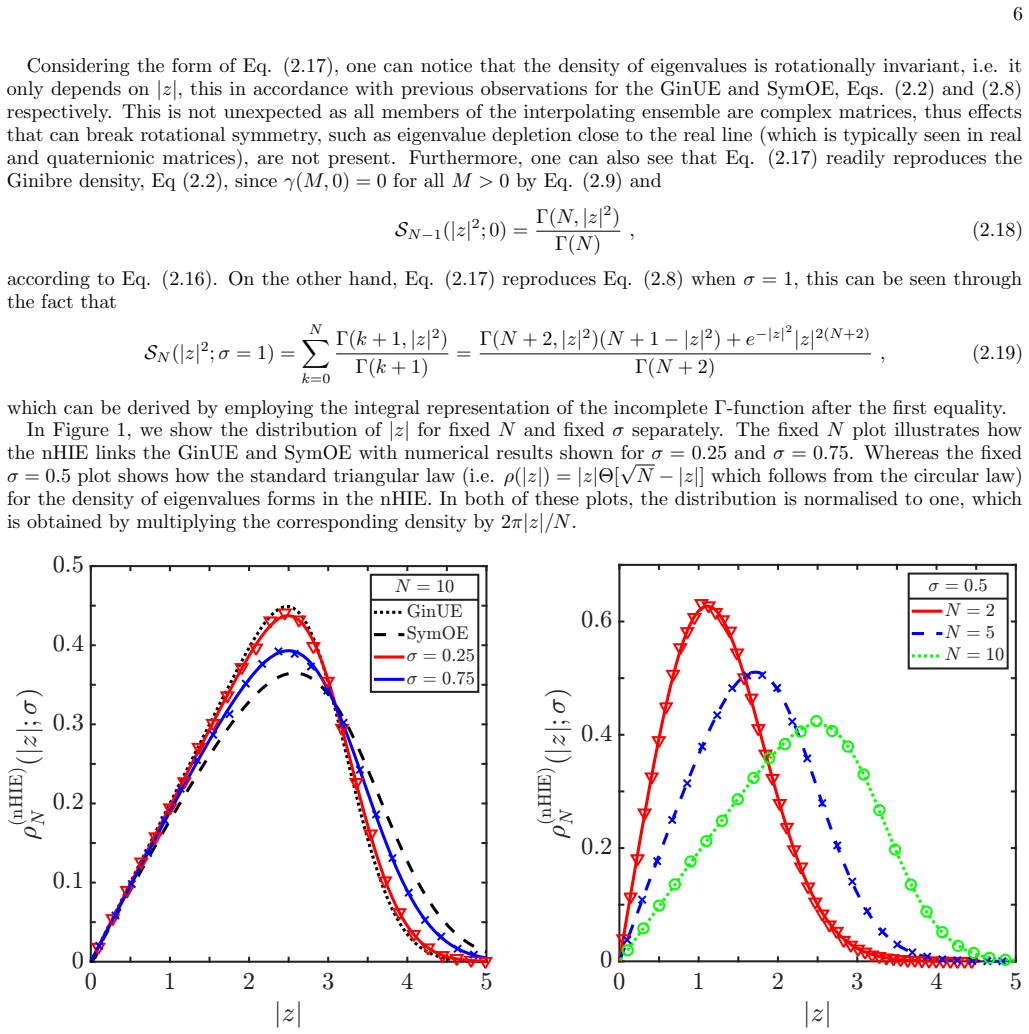
We employ the recently developed Kac-Rice formalism for non-Hermitian random matrices to derive the joint distribution of an eigenvalue and its associated normalised right eigenvector in a Gaussian ensemble that interpolates between complex Ginibre (Class A) and complex symmetric matrices (Class AI$^\dagger$). This distribution is valid at finite matrix size, $N$, for any value of the interpolation parameter $\sigma \in [0,1]$, with $0$ and $1$ corresponding to classes A and AI$^\dagger$ respectively. The marginal distribution for the density of the eigenvalues is derived at finite $N$ and then considered asymptotically as $N \to \infty$. When considering bulk eigenvalues, we recover the standard circular law for all $\sigma$. Furthermore, for edge eigenvalues we find that for fixed $\sigma$, the eigenvalues follow the edge density associated with matrices in Class A. However, a transitional regime is discovered for the interpolation parameter being scaled as $\sigma = 1 - \kappa N^{-1/2}$, where new edge behaviour is observed for the density of eigenvalues - smoothly interpolating two previously known results. This transitional regime and the associated density of eigenvalues is conjectured to be universal for non-Gaussian matrices and we provide numerical evidence in support of this.
Figures
Reference graph
Works this paper leans on
-
[1]
Kac-Rice method
and then was given associated matrix representations in the work of Magnea [21]. Consequently, it was proposed in [17] that these 3 non-Hermitian universality classes can be represented using matrices from the complex Ginibre, the complex symmetric and the complex self-dual ensembles, where classes as denoted as A, AI † and AII † respectively - with the n...
-
[2]
Note that the nomenclature of these abbreviations is chosen to reflect that the JPDFs of the respective ensembles are invariant under unitary and orthogonal transformations
STATEMENT & DISCUSSION OF MAIN RESULTS We start this Section by defining and reviewing some existing results for the two ensembles we will be interpolating, namely: thecomplex Ginibre ensembleand thecomplex symmetric ensemble, abbreviated as GinUE and SymOE respectively. Note that the nomenclature of these abbreviations is chosen to reflect that the JPDFs...
-
[3]
We choose to slightly rescale this result to allow comparisons with the GinUE as defined above, such that both ensembles have a limiting density of the eigenvalues which is uniform in a disk of radius √ N. In such a scaling, the density of complex eigenvalues is given by ρ(SymOE) N (z) = 1 2π Γ(N,|z| 2) Γ(N) + e |z|2 2 4π 2 |z|2 N+1 2 γ N+ 1 2 , |z|2 2 " ...
-
[4]
The results, which seem to strongly support our conjecture, of this numerical experimentation are shown in Figure 2
-
[5]
− i wψT 1 φ2 + wψT 2 φ1 2 + (ψT 1 φ1)(ψT 2 φ2)−σ(φ T 1 φ2)(ψT 1 ψ2) 4 # × Z CN dkdk † (2π)2N exp
PROOF OF FINITENRESULTS In this Section, we shall prove our finite matrix size results for the JPDF of eigenvalue and eigenvector and the density of complex eigenvalues, contained in Theorem 1 and Corollary 2 respectively. To derive this JPDF, we appeal to theKac-Ricemethod for non-Hermitian matrices, recently pioneered by Fyodorov in [26]. Specifically, ...
-
[6]
To this end, we begin by re-expressing ourSandTfunctions, which act as building blocks for the density, in forms that are more amenable to asymptotic analysis
ASYMPTOTIC ANALYSIS In this Section, we aim to prove our asymptotic results for the density of eigenvalues, which we outlined in Corollaries 3, 4 and 5. To this end, we begin by re-expressing ourSandTfunctions, which act as building blocks for the density, in forms that are more amenable to asymptotic analysis. Starting withS N, one can employ the integra...
-
[7]
G. Akemann, Y. V. Fyodorov and D. V. Savin, Spectral Density and Eigenvector Nonorthogonality in Complex Symmetric Random Matrices, arXiv:2511.21643 (2025)
-
[8]
Pandey and M
A. Pandey and M. L. Mehta, Gaussian ensembles of random Hermitian matrices intermediate between orthogonal and unitary ones,Commun. Math. Phys.87(4), 449-468 (1983)
1983
Show all 83 references
-
[9]
M. L. Mehta and A. Pandey, Spacing distributions for some Gaussian ensembles of Hermitian matrices,J. Phys. A: Math. Gen.16(16), (1983)
1983
-
[10]
Kuijlaars, Universality, Chapter 6 inThe Oxford Handbook of Random Matrix Theory, eds
A. Kuijlaars, Universality, Chapter 6 inThe Oxford Handbook of Random Matrix Theory, eds. G. Akemann, J. Baik and P. Di Francesco (Oxford University Press, Oxford, 2011)
2011
-
[11]
F. J. Dyson, The Threefold Way. Algebraic Structure of Symmetry Groups and Ensembles in Quantum Mechanics,J. Math. Phys.3(6), 1199-1215 (1962)
1962
-
[12]
Altland and M
A. Altland and M. Zirnbauer, Nonstandard symmetry classes in mesoscopic normal-superconducting hybrid structures, Phys. Rev. B55(2), 1141-61 (1997)
1997
-
[13]
Kieburg and T
M. Kieburg and T. R. W¨ urfel, Shift of symmetries of naive and staggered fermions in QCD-like lattice theories,Phys. Rev. D96(3), 034502 (2017)
2017
-
[14]
E. P. Wigner, Statistical properties of real symmetric matrices with many dimensions (University of Toronto Press, Toronto, 1957)
1957
-
[15]
M. L. Mehta, Random Matrices (Academic Press, New York, 1967)
1967
-
[16]
C. A. Tracy and H. Widom, Level-spacing distributions and the Airy kernel,Commun. Math. Phys.159, 151-174 (1994)
1994
-
[17]
Pastur and M
L. Pastur and M. Shcherbina, Universality of the local eigenvalue statistics for a class of unitary invariant random matrix ensembles,J. Stat. Phys.86(1-2), 109-147 (1999)
1999
-
[18]
Soshnikov, Universality at the Edge of the Spectrum in Wigner Random Matrices,Commun
A. Soshnikov, Universality at the Edge of the Spectrum in Wigner Random Matrices,Commun. Math. Phys.207, 697–733 (1999)
1999
-
[19]
Tao and V
T. Tao and V. Vu, Random matrices: Universality of local eigenvalue statistics,Acta Math.206(1), 127-204 (2011)
2011
-
[20]
Johansson, Universality for certain Hermitian Wigner matrices under weak moment conditions,Ann
K. Johansson, Universality for certain Hermitian Wigner matrices under weak moment conditions,Ann. Inst. Henri Poincar´ e48(1), 47-79 (2012)
2012
-
[21]
Grobe, F
R. Grobe, F. Haake and H.-J. Sommers, Quantum Distinction of Regular and Chaotic Dissipative Motion,Phys. Rev. Lett. 61(17), 1899 (1988)
1988
-
[22]
B. A. Khoruzhenko and H.-J. Sommers, Non-Hermitian ensembles, Chapter 18 inThe Oxford Handbook of Random Matrix Theory, eds. G. Akemann, J. Baik and P. Di Francesco (Oxford University Press, Oxford, 2011)
2011
-
[23]
Hamazaki, K
R. Hamazaki, K. Kawabata, N. Kura, and M. Ueda, Universality classes of non-Hermitian random matrices,Phys. Rev. Res.2(2), 023286 (2020)
2020
-
[24]
Kawabata, K
K. Kawabata, K. Shiozaki, M. Ueda, and M. Sato, Symmetry and topology in non-Hermitian physics,Phys. Rev. X9(4), 041015 (2019)
2019
-
[25]
Akemann, N
G. Akemann, N. Ayg¨ un, M. Kieburg, and P. P¨ aßler, Complex symmetric, self-dual, and Ginibre random matrices: analytical results for three classes of bulk and edge statistics,J. Phys. A: Math. Theor.58(12), 125204 (2025)
2025
-
[26]
Bernard and A
D. Bernard and A. LeClair, A classification of non-Hermitian random matrices, in Statistical Field Theories, edited by A. Cappelli and G. Mussardo (Springer Netherlands, Dordrecht, 2002) pp. 207–214
2002
-
[27]
Magnea, Random matrices beyond the Cartan classification,J
U. Magnea, Random matrices beyond the Cartan classification,J. Phys. A: Math. Theor.41(4), 045203 (2008)
2008
-
[28]
Ginibre, Statistical ensembles of complex, quaternion and real matrices,J
J. Ginibre, Statistical ensembles of complex, quaternion and real matrices,J. Math. Phys.6(3), 440-449 (1965)
1965
-
[29]
Tao and V
T. Tao and V. Vu, Random matrices: Universality of local spectral statistics of non-Hermitian matrices,Ann. Probab. 43(2), 782-874 (2015)
2015
-
[30]
Cipolloni, L
G. Cipolloni, L. Erd˝ os and D. Schr¨ oder, Edge universality for non-Hermitian random matrices,Probab. Theory Relat. Fields179(1-2), 1-28 (2021)
2021
-
[31]
Maltsev and M
A. Maltsev and M. Osman, Bulk Universality for Complex non-Hermitian Matrices with Independent and Identically Distributed Entries,Probab. Theory Relat. Fields, 1-46 (2024)
2024
-
[32]
Y. V. Fyodorov, Kac-Rice inspired approach to non-Hermitian random matrices, arXiv:2506.21058 (2025)
2025
-
[33]
Disertori and Y
M. Disertori and Y. V. Fyodorov, Gradual eigenvector ergodization in coupled Ginibre matrices, arXiv:2604.23708 (2026)
2026 arXiv
-
[34]
Schomerus, K
H. Schomerus, K. Frahm, M. Patra and C. W. J. Beenakker, Quantum limit of the laser line width in chaotic cavities and statistics of residues of scattering matrix poles,Physica A278(3-4), 469-496 (2000). 26
2000
-
[35]
Y. V. Fyodorov and D. V. Savin, Statistics of resonance width shifts as a signature of eigenfunction nonorthogonality, Phys. Rev. Lett.108(18), 184101 (2012)
2012
-
[36]
J. T. Chalker and B. Mehlig, Eigenvector Statistics in Non-Hermitian Random Matrix Ensembles,Phys. Rev. Lett.81(16), 3367-3370 (1998)
1998
-
[37]
Mehlig and J
B. Mehlig and J. T. Chalker, Statistical properties of eigenvectors in non-Hermitian Gaussian random matrix ensembles, J. Math. Phys.41(5), 3233-3256 (2000)
2000
-
[38]
R. A. Janik, W. N¨ orenberg, M. A. Nowak, G. Papp and I. Zahed, Correlations of eigenvectors for non-Hermitian random matrix models,Phys. Rev. E60(3), 2699-2705 (1999)
1999
-
[39]
Bourgade and G
P. Bourgade and G. Dubach, The distribution of overlaps between eigenvectors of Ginibre matrices,Probab. Theory Relat. Fields177(1), 397-464 (2020)
2020
-
[40]
Y. V. Fyodorov, On statistics of bi-orthogonal eigenvectors in real and complex Ginibre ensembles: combining partial Schur decomposition with supersymmetry,Commun. Math. Phys.363(2), 579-603 (2018)
2018
-
[41]
Akemann, R
G. Akemann, R. Tribe, A. Tsareas and O. Zaboronski, On the determinantal structure of conditional overlaps for the complex Ginibre ensemble,Random Matrices Theory Appl.9(04), 2050015 (2020)
2020
-
[42]
Y. V. Fyodorov and W. Tarnowski, Condition Numbers for Real Eigenvalues in the Real Elliptic Gaussian Ensemble,Ann. Henri Poincar´ e22(70), 309-330 (2021)
2021
-
[43]
T. R. W¨ urfel, M. J. Crumpton and Y. V. Fyodorov, Mean left-right eigenvector self-overlap in the real Ginibre ensemble, Random Matrices Theory Appl.13(04), 2450017 (2024)
2024
-
[44]
M. J. Crumpton, Y. V. Fyodorov and T. R. W¨ urfel, Mean Eigenvector Self-Overlap in the Real and Complex Elliptic Ginibre Ensembles at Strong and Weak Non-Hermiticity,Ann. Henri Poincar´ e262069-2116 (2025)
2025
-
[45]
Tarnowski, Condition numbers for real eigenvalues of real elliptic ensemble: weak non-normality at the edge,J
W. Tarnowski, Condition numbers for real eigenvalues of real elliptic ensemble: weak non-normality at the edge,J. Phys. A: Math. Theor.56, 255204 (2024)
2024
-
[46]
M. J. Crumpton and T. R. W¨ urfel, Spectral density of complex eigenvalues and associated mean eigenvector self-overlaps at the edge of elliptic Ginibre ensembles, arXiv:2405.02103
-
[47]
Osman, Universality for Diagonal Eigenvector Overlaps of non-Hermitian Random Matrices,Electron
M. Osman, Universality for Diagonal Eigenvector Overlaps of non-Hermitian Random Matrices,Electron. J. Probab.31 (15), 1-77 (2024)
2024
-
[48]
Sommers, Y
H.-J. Sommers, Y. V. Fyodorov and M. Titov, S-matrix poles for chaotic quantum systems as eigenvalues of complex symmetric random matrices: from isolated to overlapping resonances,J. Phys. A: Math. Gen.32(5), L77 (1999)
1999
-
[49]
M. S. Kurilov and P. M. Ostrovsky, Density of scattering resonances in a disordered system, arXiv:2512.18717 (2025)
2025
-
[50]
Akemann, A
G. Akemann, A. Mielke, and P. P¨ aßler, Spacing distribution in the two-dimensional Coulomb gas: Surmise and symmetry classes of non-Hermitian random matrices at nonintegerβ,Phys. Rev. E106(1), 014146 (2022)
2022
-
[51]
Mezzadri and H
F. Mezzadri and H. Taylor, A matrix model of a non-Hermitianβ-ensemble,Random Matrices Theory Appl.14(01), 2450027 (2025)
2025
-
[52]
Akemann, F
G. Akemann, F. Mezzadri, P. P¨ aßler and H. Taylor, Logarithmic Spectral Distribution of a non-Hermitianβ-Ensemble, arXiv:2504.12120 (2025)
2025 arXiv
-
[53]
L. S´ a, P. Ribeiro and T. Prosen, Complex Spacing Ratios: A Signature of Dissipative Quantum Chaos,Phys. Rev. X 10(2), 021019 (2020)
2020
-
[54]
Kanazawa and T
T. Kanazawa and T. Wettig, New universality classes of the non-Hermitian Dirac operator in QCD-like theories,Phys. Rev. D104(1), 014509 (2021)
2021
-
[55]
Akemann, G
G. Akemann, G. Angermann, N. Ayg¨ un, A. Mielke, P. P¨ aßler, C. Raitzig and T. Winkler, Three non-Hermitian random matrix universality classes of complex edge statistics: Spacing ratios and distributions, arXiv:2603.28457 (2026)
2026 arXiv
-
[56]
Katori and H
M. Katori and H. Tanemura, Scaling limit of vicious walks and two-matrix model,Phys. Rev. E66(1), 011105 (2002)
2002
-
[57]
V. L. Girko, Elliptic law,Theory Probab. Appl.30(4), 640-651 (1986)
1986
-
[58]
Sommers, A
H.-J. Sommers, A. Crisanti, H. Sompolinksy and Y. Stein, Spectrum of Large Random Asymmetric Matrices,Phys. Rev. Lett.60(19), 1895-1898 (1988)
1988
-
[59]
Di Francesco, M
P. Di Francesco, M. Gaudin, C. Itzykson and F. Lesage, Laughlin’s wave functions, Coulomb gases and expansions of the discriminant,Int. J. Mod. Phys. A9(24), 4257-4351 (1994)
1994
-
[60]
Lehmann and H.-J
N. Lehmann and H.-J. Sommers, Eigenvalue statistics of random real matrices,Phys. Rev. Lett.67(08), 941-944 (1991)
1991
-
[61]
P. J. Forrester and T. Nagao, Skew orthogonal polynomials and the partly symmetric real Ginibre ensemble,J. Phys. A: Math. Theor.41(37), 375003 (2008)
2008
-
[62]
Y. V. Fyodorov, B. A. Khoruzhenko and H.-J. Sommers, Almost-Hermitian random matrices: eigenvalue density in the complex plane,Physics Letters A226(1-2), 46-52 (1997)
1997
-
[63]
Y. V. Fyodorov, B. A. Khoruzhenko and H.-J. Sommers, Almost Hermitian random matrices: crossover from Wigner-Dyson to Ginibre eigenvalue statistics,Phys. Rev. Lett.79(4), 557-560 (1997)
1997
-
[64]
Y. V. Fyodorov, B. A. Khoruzhenko and H.-J. Sommers, Universality in the random matrix spectra in the regime of weak non-Hermiticity,Annales de l’institut Henri Poincar´ e (A) Physique th´ eorique68(4), 449–489 (1998)
1998
-
[65]
Akemann, M
G. Akemann, M. Cikovic and M. Venker, Universality at weak and strong non-Hermiticity beyond the elliptic Ginibre ensemble,Commun. Math. Phys.362, 1111-1141 (2018)
2018
-
[66]
Osman, Universality for Weakly Non-Hermitian Matrices: Bulk Limit, arXiv:2310.15001 (2023)
M. Osman, Universality for Weakly Non-Hermitian Matrices: Bulk Limit, arXiv:2310.15001 (2023)
2023
-
[67]
Akemann and M
G. Akemann and M. J. Phillips, The Interpolating Airy Kernels for theβ= 1 andβ= 4 Elliptic Ginibre Ensembles,J. Stat. Phys.155(3), 421-465 (2014)
2014
-
[68]
Bender, Edge scaling limits for a family of non-Hermitian random matrix ensembles,Probab
M. Bender, Edge scaling limits for a family of non-Hermitian random matrix ensembles,Probab. Theory Relat. Fields147, 241-271 (2010). 27
2010
-
[69]
Rider, A limit theorem at the edge of a non-Hermitian random matrix ensemble,J
B. Rider, A limit theorem at the edge of a non-Hermitian random matrix ensemble,J. Phys. A: Math. Gen.36(12), 3401 (2003)
2003
-
[70]
Lacroix-A-Chez-Toine, S
B. Lacroix-A-Chez-Toine, S. N. Majumdar and G. Schehr, Rotating trapped fermions in two dimensions and the complex Ginibre ensemble: Exact results for the entanglement entropy and number variance,Physical Review A99(2), 021602 (2019)
2019
-
[71]
Akemann, S.-S
G. Akemann, S.-S. Byun, M. Ebke and G. Schehr, Universality in the number variance and counting statistics of the real and symplectic Ginibre ensemble,J. Phys. A: Math. Theor.56(49), 495202 (2023)
2023
-
[72]
Akemann and M
G. Akemann and M. Bender, Interpolation between Airy and Poisson statistics for unitary chiral non-Hermitian random matrix ensembles,J. Math. Phys.51(10), 103524 (2010)
2010
-
[73]
S. Y. Lee and R. Riser, Fine asymptotic behavior for eigenvalues of random normal matrices: Ellipse case,J. Math. Phys. 57(2), 023302 (2016)
2016
-
[74]
Byun and P
S.-S. Byun and P. J. Forrester, Progress on the study of the Ginibre ensemble, Volume3of KIAS Springer Series in Mathematics (Springer Nature, Singapore, 2024)
2024
-
[75]
Bordenave and D
C. Bordenave and D. Chafa¨ ı, Around the circular law,Probab. Surv.9, 1-89 (2012)
2012
-
[76]
F. A. Berezin, Introduction to Superanalysis (Reidel, Dordrecht, 1987)
1987
-
[77]
Verbaarschot, The supersymmetric method in random matrix theory and applications to QCD,AIP Conf
J. Verbaarschot, The supersymmetric method in random matrix theory and applications to QCD,AIP Conf. Proc.744(1), 277-362 (2004)
2004
-
[78]
Sherman and W
J. Sherman and W. J. Morrison, Adjustment of an Inverse Matrix Corresponding to a Change in One Element of a Given Matrix,Ann. Math. Statist.21(1), 124-127 (1950)
1950
-
[79]
Varjas, Generalizations of the Pfaffian to non-antisymmetric matrices, arXiv:2209.02578
D. Varjas, Generalizations of the Pfaffian to non-antisymmetric matrices, arXiv:2209.02578
-
[80]
I. S. Gradshteyn and I. M. Ryzhik, Tables of Integrals, Series and Products 7th Ed. (Academic Press, New York, 2000)
2000
-
[81]
F. W. J. Olver, D. W. Lozier, R. F. Boisvert and C. W. Clark, NIST Handbook of Mathematical Functions (Cambridge University Press, Cambridge, 2010)
2010
-
[82]
Nemes and A
G. Nemes and A. B. Olde Daalhuis, Asymptotic expansions for the incomplete gamma function in the transition regions, Math. Comp.88(318), 1805-1827 (2019)
2019
-
[83]
M. J. Crumpton, Contributions to the theory of non-Hermitian & low-rank random matrices, PhD Thesis, King’s College London, United Kingdom (2026) [To Appear]
2026
Reviewed June 28, 2026 · model on record in the stance chip above.
Discussion (0). Continue with ORCID to comment.