REVIEW 6 minor 68 references
From Test-Time Scaling to Reusable Memory: Measuring Crystallization in Text-to-SQL
T0 review · 0 major / 6 minor · reviewed 2026-08-10 · deepseek-v4-flash
Pith's one-line read Stored verified repair episodes for text-to-SQL transfer to unseen questions, capturing 44.4% of the accuracy headroom that on-demand repair would have spent on the same questions.
desk verdict A clean, carefully scoped measurement of when and why text-to-SQL memory helps; the verification dependence is real but explicitly tested. read the letter →
The pith
A machine-rendered reading of the paper's core claim, the machinery that carries it, and where it could break.
The reading
What carries the argument
The central object is the verified, database-scoped memory bank $M_d = \{ W(e) : e = (q, \hat{y}, y^+, \tau) \in \mathcal{E}_d,\ v(y^+) = 1 \}$, where each episode consists of the question, first attempt, corrected query, and interaction trace, $W$ is a card writer, and $v$ is a verification signal that decides admission. The identity that carries the measurement is the crystallization ratio $\mathrm{CR} = (P_M - P_0)/(P_K - P_0)$: the held-out transfer lift divided by the on-demand repair headroom on the same questions. It is a descriptive ratio, not a probability, and it is only meaningful when the solver, split, repair budget, and collection procedure are held fixed. The paper's controlled-comparison design, varying acquisition, admission, writing, and consumption one at a time while keeping the same greedy solver, is what lets it attribute the gain to database-specific payload rather than to any single design choice.
What would settle it
A held-out transfer test on a benchmark pack where no database appears in the collection split should show no positive memory lift, because the paper's foreign-card control predicts a negative trend below no memory; a positive gain in that setting would contradict the database-specific-content account.
Extended reading notes
Core claim
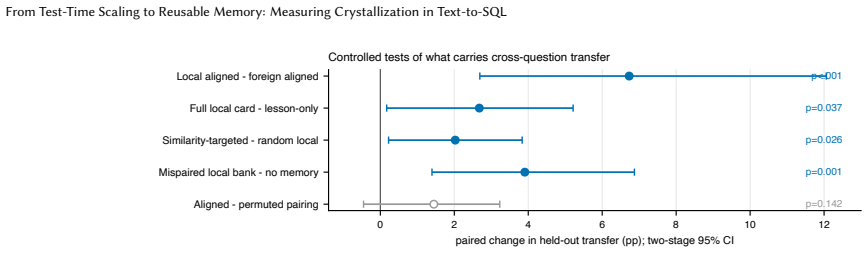
Under controlled evaluation, the paper's central discovery is that a per-database bank of verified, verbatim corrected queries produces value in three distinct future-use settings: exact-query replay (96.1% accuracy when the question's own card is eligible), cross-question retention (56.0% when that card is removed), and held-out same-database transfer (+4.34 pp, CR = 44.4%). The crystallization ratio CR normalizes the memory lift against the on-demand repair headroom measured on the same held-out questions, making the memory gain commensurable with the compute it would otherwise cost to repair. Interventions that permute question–SQL pairings inside the bank preserve 73% of the aligned lift, while equally valid cards from other databases do not transfer, leading the paper to conclude that the cards mainly expose database-specific content rather than supply copyable worked examples. The same experiments show that without a reliable verification gate, storing self-voted corrections is 2.03 pp below no memory and 4.85 pp below the verified bank, so verification is described as necessary, not optional.
Load-bearing premise
The benefit requires an independently reliable verification signal that decides which repaired episodes are stored; without such a gate, the paper's own ablation shows the bank hurts accuracy.
Editorial extensions
If this is right
- If the central claim holds, storing verified corrected queries in a per-database bank substitutes for roughly 44% of per-question repair on seen databases, and the remaining repair headroom is still available on top.
- Recurring questions are nearly free under memory: exact-query replay reaches 96.1% when the originating card is retrieved, so workloads with repeated questions will amortize construction cost faster.
- Verification is the dominant admission decision: gated storage beats ungated by 4.85 pp, and the ungated bank is below no memory, so deployment must supply an independent correctness channel.
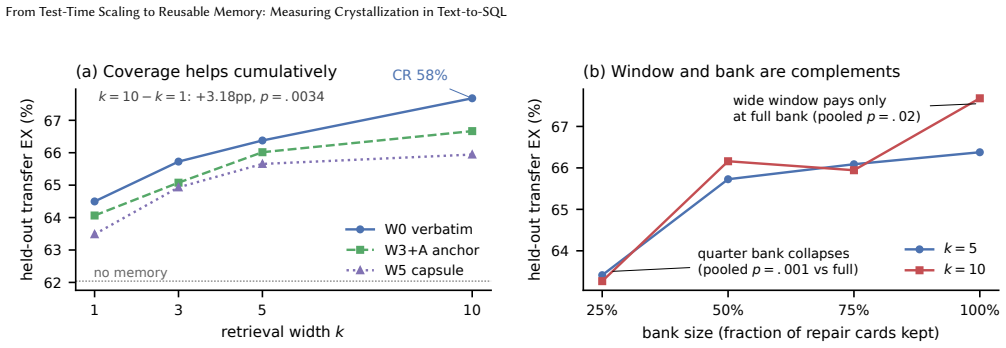
- Widening retrieval from $k=1$ to $k=10$ adds 3.18 pp, which means cumulative coverage of database-specific content, not a smarter matching algorithm, is what increases transfer.
- Richer card formats and more elaborate retrievers have no statistically supported advantage, so the simple operating point, verbatim corrected SQL, broad same-database retrieval, and a reliable gate, is the supported default.
Reading between the lines
- The 44.4% CR is likely a function of the workload mix rather than a universal constant: workloads dominated by novel questions should be bounded by the transfer tier, while recurring questions push effective value toward the near-100% replay tier.
- Because mispairing preserves most of the lift, a testable extension is to strip question text from cards entirely and retrieve on SQL structure alone; if the gain survives, the useful signal is payload rather than natural-language similarity.
- The paper's fix/break symmetry suggests a retrieval-side guard: suppressing cards whose foreign SQL elements, such as LIMIT, aggregation, or literal formats, would alter answer cardinality could reduce the 67 broken cases without losing the 127 fixes.
- The measured amortization horizon of roughly 7.5–9.9K future queries invites a decision rule for when to build memory versus repair on demand, but combining the conditional reuse values into one expected-utility number also requires the workload's recurrence distribution.
Editorial analysis
A structured set of objections, weighed in public.
Referee Report
Summary. This paper formalizes the 'crystallization problem' for text-to-SQL memory: how to measure the future value of verified test-time repair episodes rather than collapsing everything into one end-to-end score. With a fixed single-shot solver, the authors build per-database banks from repair episodes on a 70% collection split, then evaluate exact-query replay, cross-question retention, and held-out same-database transfer on BIRD (with Spider as a secondary probe). The headline result is that a verbatim bank of oracle-verified corrected queries raises held-out first-attempt accuracy from 62.04% to 66.38% (+4.34pp, two-stage bootstrap CI [+1.50, +7.49], p=0.0034), corresponding to 44.4% (CI [24,65]%) of the on-demand repair headroom measured on the same questions. Controlled interventions show that database-specific content, not matched question-SQL examples, is the main carrier; reliable verification and wider retrieval coverage help, while richer card formats and more elaborate retrievers do not show statistically supported gains. Cost, robustness, leakage, and statistical-discipline analyses are reported in depth.
Significance. The contribution is primarily methodological but consequential: it decomposes the single end-to-end memory score into replay, retention, and transfer, and anchors transfer in a descriptive crystallization ratio against a measured repair reference. The experimental protocol is unusually careful: pre-specified confirmatory comparisons, three paired seeds, two-stage hierarchical bootstrap over databases and questions, sentinel-based leakage checks, rerun-drift quantification, and explicit exploratory-versus-confirmatory labeling. The verification-gate dependence is the clearest boundary of the central claim; the paper explicitly identifies it and shows with the ungated ablation that the bank is harmful without a trustworthy gate. Because the claim is conditional on a verified bank, this is a scoped limitation rather than an internal inconsistency. If the results hold, they give practitioners concrete guidance: verified database-scoped banks can substitute for a substantial share of on-demand repair on recurring or same-database workloads.
minor comments (6)
- [Section 3.3 / Eq. (2)] The retrieval operator rho_k is used in Equations (2) and (4) before being formally defined; please add an explicit definition of rho_k(q; M_d) near Eq. (2) so the notation is self-contained.
- [Section 5.1 / Figure 3] The 'remaining headroom +5.42pp' label and the focused scale in panel (a) could be misread; consider adding explicit numeric labels on the bars for P0, PM, and the repair reference, or annotating the scale break directly.
- [Section 5.4 / Table 2] The sentence 'one repair round captures 80% of what three memoryless rounds achieve at 59% of the calls' is terse; please specify exactly which configurations enter this comparison so the reader can verify the 80% and 59% figures.
- [Appendix E / Table 5] The worked-example text says capsule exact-query replay 'stays at 100%,' while Table 5 reports a three-seed mean of 99.7%; please align the wording to avoid an apparent inconsistency.
- [Section 7 / Appendix E] The release does not redistribute the quality-controlled split or raw transcripts; consider releasing question IDs or hashes so the disjointness and leakage checks can be independently verified by readers.
- [Section 5.3 / Appendix D] Because the verification gate is central to practical applicability, please consider reporting the key synthetic verification-noise numbers in the main text rather than only referring to Appendix D.
Circularity Check
No significant circularity: the headline gain and CR are measured quantities on disjoint held-out questions, not reductions to fitted inputs or self-citations.
full rationale
The paper's derivation chain is empirical and self-contained, not circular. The central claim—that a verified, database-scoped bank of verbatim corrected episodes improves held-out same-database first-attempt accuracy by +4.34pp, equal to CR=44.4% of on-demand repair headroom—rests on direct paired measurements. The memory writer receives only the model's episode, never gold SQL ('The writer still never sees the gold query, although benchmark verification v uses the gold execution result'), and held-out questions are disjoint from banked questions ('These questions were never used to build the bank'). CR is explicitly a descriptive ratio of two measured quantities: 'It is the held-out first-attempt gain from memory, divided by the repair headroom on the same questions,' and the paper cautions that it is 'descriptive, not a probability.' No parameter is fitted to the held-out split, and no quantity in Eq. (2) or Eq. (3) is defined in terms of the result it is used to explain. The mechanism claim (database-specific content rather than matched examples) is supported by controlled interventions—local vs. foreign cards, mispairing, grounding-stripping, similarity targeting—whose outcomes are not forced by construction; the aligned-minus-permuted contrast even includes zero, a result the authors report rather than explain away. The verification dependency is acknowledged and tested as a boundary condition, not hidden. The only apparent self-citation, reference [52] (EGREFINE), appears in related-work context and is not load-bearing for the measurement protocol or headline result.
Assumptions & free parameters
assumptions (5)
- domain assumption Execution accuracy, defined as set-equality of the query result with the gold query's result, is a valid and sufficiently noise-free correctness measure for the paired comparisons.
- domain assumption The fixed solver, schema, prompts, and greedy decoding are identical across compared arms, so the retrieved memory block is the only systematic difference.
- domain assumption The two-stage hierarchical bootstrap validly models the clustered data structure for the reported p-values and confidence intervals.
- domain assumption A reliable verification signal, distinct from gold SQL, is available to admit episodes into the bank; in benchmark mode this is the oracle execution check, and in deployment the paper posits user confirmation or executable assertions.
- domain assumption BIRD development set is an adequate testbed for same-database text-to-SQL memory transfer, and Spider serves as a secondary check.
Cite this review
Pith. "Pith review of From Test-Time Scaling to Reusable Memory: Measuring Crystallization in Text-to-SQL." pith.science (2026). https://pith.science/paper/CFWSFMSE
@misc{pith2026260807213,
  author       = {Pith},
  title        = {Pith review of: From Test-Time Scaling to Reusable Memory: Measuring Crystallization in Text-to-SQL},
  year         = {2026},
  howpublished = {\url{https://pith.science/paper/CFWSFMSE}},
  note         = {Machine review of arXiv:2608.07213}
}
read the original abstract
Test-time scaling can correct difficult text-to-SQL queries, but the extra computation is normally discarded after each answer. Systems increasingly retain verified repair episodes, yet evaluations still report one end-to-end score. It cannot distinguish replay on recurring questions from help on unseen questions, or identify the responsible memory choice. We call measuring this future value the crystallization problem. Our controlled evaluation holds the single-shot solver fixed and varies one memory choice at a time. We separately measure replay, cross-question retention, and held-out same-database transfer. On BIRD, storing verified corrected queries improves held-out first-attempt accuracy by 4.34 percentage points. This gain captures 44.4% of the accuracy headroom provided by on-demand repair on the same questions. Controlled interventions identify database-specific content as the main operating ingredient. Reliable verification and broader retrieval coverage yield supported gains; richer formats and elaborate retrievers do not. Open-source code, evaluation artifacts, and reproduction instructions are available at https://github.com/ai-jiaqian/text-to-sql-memory-crystallization.
Figures


Figures from the paper (3 more)

Reference graph
Works this paper leans on
-
[1]
Shubham Agarwal, Asim Biswal, Sepanta Zeighami, Alvin Cheung, Joseph Gon- zalez, and Aditya G. Parameswaran. 2026. Arming Data Agents with Tribal Knowledge.arXiv preprint arXiv:2602.13521(2026). (Tk-Boost)
arXiv 2026
-
[2]
Arian Askari et al . 2025. MAGIC: Generating Self-Correction Guideline for In-Context Text-to-SQL. InProceedings of AAAI
work page 2025
-
[3]
Baek et al . 2025. Knowledge Base Construction for Knowledge-Augmented Text-to-SQL. InFindings of the Association for Computational Linguistics: ACL
work page 2025
-
[4]
Biswal et al. 2026. AgentSM: Semantic Memory for Agentic Text-to-SQL.arXiv preprint arXiv:2601.15709(2026)
arXiv 2026
- [5]
-
[6]
Hasan Alp Caferoğlu and Özgür Ulusoy. 2024. E-SQL: Direct Schema Linking via Question Enrichment in Text-to-SQL.arXiv preprint arXiv:2409.16751(2024)
arXiv 2024
-
[7]
Zhenbiao Cao et al . 2024. RSL-SQL: Robust Schema Linking in Text-to-SQL Generation.arXiv preprint arXiv:2411.00073(2024)
arXiv 2024
-
[8]
Xinyun Chen et al. 2024. Teaching Large Language Models to Self-Debug. In International Conference on Learning Representations (ICLR)
work page 2024
Show all 68 references
-
[9]
Zui Chen, Han Li, Xinhao Zhang, et al . 2025. RubikSQL: Lifelong Learning Agentic Knowledge Base as an Industrial NL2SQL System.arXiv preprint arXiv:2508.17590(2025)
2025 arXiv
-
[10]
Zhiyi Chen, Jie Song, and Peng Li. 2026. TAHOE: Text-to-SQL with Automated Hint Optimization from Experience.arXiv preprint arXiv:2606.12387(2026)
2026 arXiv
-
[11]
Zhibo Chu, Zichong Wang, and Qitao Qin. 2024. Leveraging Prior Experi- ence: An Expandable Auxiliary Knowledge Base for Text-to-SQL.arXiv preprint arXiv:2411.13244(2024)
2024 arXiv
-
[12]
Thomas Cook, Kelly Patel, Sivapriya Vellaichamy, et al. 2025. Continual Learning of Domain Knowledge from Human Feedback in Text-to-SQL.arXiv preprint arXiv:2511.10674(2025)
2025
-
[13]
Xuemei Dong et al . 2023. C3: Zero-shot Text-to-SQL with ChatGPT.arXiv preprint arXiv:2307.07306(2023)
2023 arXiv
-
[14]
Thomas Palmeira Ferraz, Romain Deffayet, Vassilina Nikoulina, Hervé Déjean, and Stéphane Clinchant. 2026. Retrieval-Augmented LLM Agents: Learning to Learn from Experience.arXiv preprint arXiv:2603.18272(2026)
2026
-
[15]
Dawei Gao et al. 2024. Text-to-SQL Empowered by Large Language Models: A Benchmark Evaluation.Proceedings of the VLDB Endowment17, 5 (2024)
2024
-
[16]
Huan-ang Gao et al. 2026. A Survey of Self-Evolving Agents: What, When, How, and Where to Evolve on the Path to Artificial Super Intelligence.Transactions on Machine Learning Research (TMLR)(2026)
2026
-
[17]
Yingqi Gao et al. 2025. XiYan-SQL: A Multi-Generator Ensemble Framework for Text-to-SQL.arXiv preprint arXiv:2507.04701(2025)
2025 arXiv
-
[18]
Zijin Hong et al . 2024. Knowledge-to-SQL: Enhancing SQL Generation with Data Expert LLM. InFindings of the Association for Computational Linguistics: ACL
2024
-
[19]
Yuanzhe Hu, Yu Wang, and Julian McAuley. 2025. Evaluating Memory in LLM Agents via Incremental Multi-Turn Interactions.arXiv preprint arXiv:2507.05257 (2025)
2025 arXiv
-
[20]
Jie Huang, Xinyun Chen, Swaroop Mishra, Huaixiu Steven Zheng, Adams Wei Yu, Xinying Song, and Denny Zhou. 2024. Large Language Models Cannot Self- Correct Reasoning Yet. InInternational Conference on Learning Representations (ICLR)
2024
-
[21]
Yiwen Jiao et al. 2025. ORANGE: An Online Reflection and Generation Frame- work with Domain Knowledge for Text-to-SQL.arXiv preprint arXiv:2511.00985 (2025)
2025
-
[22]
Fangyu Lei et al. 2025. Spider 2.0: Evaluating Language Models on Real-World Enterprise Text-to-SQL Workflows. InInternational Conference on Learning Rep- resentations (ICLR)
2025
-
[23]
Boyan Li, Chong Chen, Zhujun Xue, Yinan Mei, and Yuyu Luo. 2025. DeepEye- SQL: A Software-Engineering-Inspired Text-to-SQL Framework.arXiv preprint arXiv:2510.17586(2025)
2025 arXiv
-
[24]
Haoyang Li et al. 2023. RESDSQL: Decoupling Schema Linking and Skeleton Parsing for Text-to-SQL. InProceedings of AAAI
2023
-
[25]
Jinyang Li et al. 2023. Can LLM Already Serve as a Database Interface? A Big Bench for Large-Scale Database Grounded Text-to-SQLs. InAdvances in Neural Information Processing Systems (NeurIPS)
2023
-
[26]
Xuancheng Li et al . 2026. Beyond Experience Retrieval: Learning to Gener- ate Utility-Optimized Structured Experience for Frozen LLMs.arXiv preprint arXiv:2602.02556(2026)
2026 arXiv
-
[27]
Xianxuan Long, Zhikai Chen, Shenglai Zeng, Shouren Wang, Kai Guo, and Jiliang Tang. 2026. MemTrace: Probing What Final Accuracy Misses in Long-Term Memory.arXiv preprint arXiv:2606.17328(2026)
2026 arXiv
-
[28]
Peixian Ma et al. 2025. SQL-R1: Training Natural Language to SQL Reasoning Model by Reinforcement Learning. InAdvances in Neural Information Processing Systems (NeurIPS)
2025
-
[29]
Karime Maamari, Fadhil Abubaker, Daniel Jaroslawicz, and Amine Mhedhbi
-
[30]
Aman Madaan et al. 2023. Self-Refine: Iterative Refinement with Self-Feedback. InAdvances in Neural Information Processing Systems (NeurIPS)
2023
-
[31]
Sewon Min, Xinxi Lyu, Ari Holtzman, Mikel Artetxe, Mike Lewis, Hannaneh Hajishirzi, and Luke Zettlemoyer. 2022. Rethinking the Role of Demonstrations: What Makes In-Context Learning Work?. InProceedings of the Conference on Empirical Methods in Natural Language Processing (EMN...
2022
-
[32]
Ouyang et al. 2025. ReasoningBank: Scaling Agent Self-Evolving with Reasoning Memory.arXiv preprint arXiv:2509.25140(2025)
2025 arXiv
-
[33]
Charles Packer et al. 2023. MemGPT: Towards LLMs as Operating Systems.arXiv preprint arXiv:2310.08560(2023)
2023 arXiv
-
[34]
Joon Sung Park et al. 2023. Generative Agents: Interactive Simulacra of Human Behavior. InProceedings of the ACM Symposium on User Interface Software and Technology (UIST)
2023
-
[35]
Mohammadreza Pourreza et al. 2025. CHASE-SQL: Multi-Path Reasoning and Preference Optimized Candidate Selection in Text-to-SQL. InInternational Con- ference on Learning Representations (ICLR)
2025
-
[36]
Mohammadreza Pourreza et al. 2025. Reasoning-SQL: Reinforcement Learning with SQL-Tailored Partial Rewards for Reasoning-Enhanced Text-to-SQL. In Conference on Language Modeling (COLM)
2025
-
[37]
Mohammadreza Pourreza and Davood Rafiei. 2023. DIN-SQL: Decomposed In- Context Learning of Text-to-SQL with Self-Correction. InAdvances in Neural Information Processing Systems (NeurIPS)
2023
-
[38]
Nils Reimers and Iryna Gurevych. 2019. Sentence-BERT: Sentence Embeddings Using Siamese BERT-Networks. InProceedings of EMNLP-IJCNLP
2019
-
[39]
Tonghui Ren et al. 2024. PURPLE: Making a Large Language Model a Better SQL Writer. InIEEE International Conference on Data Engineering (ICDE)
2024
-
[40]
Shao et al. 2026. Your Agent May Misevolve: Emergent Risks in Self-Evolving LLM Agents. InInternational Conference on Learning Representations (ICLR)
2026
-
[41]
Lei Sheng and Shuai-Shuai Xu. 2025. CSC-SQL: Corrective Self-Consistency in Text-to-SQL via Reinforcement Learning. InFindings of IJCNLP-AACL
2025
-
[42]
Noah Shinn et al. 2023. Reflexion: Language Agents with Verbal Reinforcement Learning. InAdvances in Neural Information Processing Systems (NeurIPS)
2023
-
[43]
Charlie Snell, Jaehoon Lee, Kelvin Xu, and Aviral Kumar. 2024. Scaling LLM Test- Time Compute Optimally Can Be More Effective than Scaling Model Parameters. arXiv preprint arXiv:2408.03314(2024)
2024 arXiv
-
[44]
Saksham Sahai Srivastava. 2026. Causal Intervention-Based Memory Selection for Long-Horizon LLM Agents.arXiv preprint arXiv:2605.17641(2026)
2026 arXiv
-
[45]
Sumers, Shunyu Yao, Karthik Narasimhan, and Thomas L
Theodore R. Sumers, Shunyu Yao, Karthik Narasimhan, and Thomas L. Griffiths
-
[46]
Mirac Suzgun et al. 2026. Dynamic Cheatsheet: Test-Time Learning with Adaptive Memory. InProceedings of EACL
2026
-
[47]
Cognitive Architectures for Language Agents.Transactions on Machine Learning Research (TMLR)(2024)
2024
-
[48]
Wang et al. 2026. Learning to Retrieve: Dual-Level Long-Term Memory for Text-to-SQL Agents.arXiv preprint arXiv:2606.00547(2026)
2026 arXiv
-
[49]
Shayan Talaei et al . 2024. CHESS: Contextual Harnessing for Efficient SQL Synthesis.arXiv preprint arXiv:2405.16755(2024)
2024 arXiv
-
[50]
Boshi Wang, Sewon Min, Xiang Deng, Jiaming Shen, You Wu, Luke Zettlemoyer, and Huan Sun. 2023. Towards Understanding Chain-of-Thought Prompting: An Empirical Study of What Matters. InProceedings of the Annual Meeting of the Association for Computational Linguistics (ACL). 2717–2739
2023
-
[51]
Bing Wang et al. 2025. MAC-SQL: A Multi-Agent Collaborative Framework for Text-to-SQL. InProceedings of COLING. Jiaqian Wang, Yutao Qi, Wenjin Hou, Yuanxi Che, and Muning Wen
2025
-
[52]
Jiaqian Wang, Yutao Qi, Wenjin Hou, Yu Pang, and Rui Yang. 2026. EGREFINE: An Execution-Grounded Optimization Framework for Text-to-SQL Schema Re- finement.arXiv preprint arXiv:2605.00628(2026)
2026 arXiv
-
[53]
Guanzhi Wang et al. 2024. Voyager: An Open-Ended Embodied Agent with Large Language Models.Transactions on Machine Learning Research (TMLR)(2024)
2024
-
[54]
Zhiruo Wang et al. 2025. Agent Workflow Memory. InInternational Conference on Machine Learning (ICML)
2025
-
[55]
Xuezhi Wang et al. 2023. Self-Consistency Improves Chain of Thought Reasoning in Language Models. InInternational Conference on Learning Representations (ICLR)
2023
-
[56]
Zerui Yang, Weichuan Wang, Yanwei Xu, Linqi Song, Yudai Matsuda, Wei Han, and Bo Bai. 2026. Memo-SQL: Structured Decomposition and Experience-Driven Self-Correction for Training-Free NL2SQL.arXiv preprint arXiv:2601.10011 (2026)
2026
-
[57]
Jason Wei et al . 2022. Chain-of-Thought Prompting Elicits Reasoning in Large Language Models. InAdvances in Neural Information Processing Systems (NeurIPS)
2022
-
[58]
Zhewei Yao, Guoheng Sun, Łukasz Borchmann, et al. 2025. Arctic-Text2SQL- R1: Simple Rewards, Strong Reasoning in Text-to-SQL.arXiv preprint arXiv:2505.20315(2025)
2025
-
[59]
Shunyu Yao et al. 2023. ReAct: Synergizing Reasoning and Acting in Language Models. InInternational Conference on Learning Representations (ICLR)
2023
-
[60]
Yun and Lee. 2025. SEED: Enhancing Text-to-SQL Performance and Practical Us- ability Through Automatic Evidence Generation.arXiv preprint arXiv:2506.07423 (2025)
2025 arXiv
-
[61]
Tao Yu et al. 2018. Spider: A Large-Scale Human-Labeled Dataset for Complex and Cross-Domain Semantic Parsing and Text-to-SQL Task. InProceedings of EMNLP
2018
-
[62]
Zhang et al. 2025. Reward-SQL: Boosting Text-to-SQL via Stepwise Reasoning and Process-Supervised Rewards.arXiv preprint arXiv:2505.04671(2025)
2025
-
[63]
Eric Zelikman et al. 2022. STaR: Bootstrapping Reasoning with Reasoning. In Advances in Neural Information Processing Systems (NeurIPS)
2022
-
[64]
Yi Zhang et al. 2024. ScienceBenchmark: A Complex Real-World Benchmark for Evaluating Natural Language to SQL Systems.Proceedings of the VLDB Endowment17, 6 (2024)
2024
-
[65]
Qiyuan Zhang et al. 2025. A Survey on Test-Time Scaling in Large Language Models: What, How, Where, and How Well?arXiv preprint arXiv:2503.24235 (2025)
2025 arXiv
-
[66]
within rerun drift
Denny Zhou et al. 2023. Least-to-Most Prompting Enables Complex Reasoning in Large Language Models. InInternational Conference on Learning Representations (ICLR). A Per-Seed Results and Full Grids This section expands the means reported in Section 5 to their per- seed values a...
2023
-
[67]
Andrew Zhao et al . 2024. ExpeL: LLM Agents Are Experiential Learners. In Proceedings of AAAI
2024
-
[2024]
The Death of Schema Linking? Text-to-SQL in the Age of Well-Reasoned Language Models.arXiv preprint arXiv:2408.07702(2024)
2024 arXiv
Reviewed August 10, 2026 · model on record in the stance chip above.
Discussion (0). Continue with ORCID to comment.