REVIEW 4 major objections 5 minor 71 references
ReBaNO: Reduced Basis Neural Operator Mitigating Generalization Gaps and Achieving Discretization Invariance
T0 review · 4 major / 5 minor · reviewed 2026-08-04 · deepseek-v4-flash
Pith's one-line read ReBaNO builds a neural operator from a handful of PINN solutions, closing generalization gaps and achieving true mesh invariance.
desk verdict A genuinely new reduced-basis-plus-PINN operator learner with attractive data-lean properties, but the headline claims outrun the evidence: online cost is high, the discretization-invariance test is confounded, and several uniqueness claims lack support. read the letter →
The pith
A machine-rendered reading of the paper's core claim, the machinery that carries it, and where it could break.
The reading
What carries the argument
The central object is the reduced basis of PINN solutions {u_i^PINN} built by a mathematically rigorous greedy algorithm (Algorithm 1): starting from one random full-order solve, at each step the input with the largest residual loss of the current rank-n surrogate is chosen, and its PINN solution is added as a new hidden neuron. The online solver then minimizes the same residual loss (Eq. 14) over the coefficients c, using precomputed derivatives; for linear PDEs this collapses to a small least-squares problem.
What would settle it
Run ReBaNO on an advection-dominated problem with a boundary layer; if the greedy indicator selects basis inputs that do not resolve the layer, and online solutions have small PDE residual but large L2 error compared to a high-fidelity solver, the central claim would be falsified. Alternatively, find a PDE where the residual minimum is non-unique and the chosen coefficients produce poor predictions despite small residual.
Extended reading notes
Core claim
ReBaNO treats each full-order PINN solution as a neuron and constructs a rank-N surrogate space by a greedy algorithm that repeatedly adds the PINN solution of the input for which the current surrogate's PDE-residual loss is largest. Online, a new input is mapped to coefficients by minimizing the same residual loss over the linear combination; because the basis functions are mesh-free PINNs and all derivatives are precomputed, the prediction is indifferent to discretization. In all three benchmarks, ReBaNO had test/training error ratios near 1 for both in-distribution and out-of-distribution inputs, while data-driven models showed gaps of 1.5x to 30x, and its accuracy remained flat when grid
Load-bearing premise
The greedy selection and online coefficient solve both rely on the PDE residual loss being a trustworthy proxy for the actual solution error; the paper provides no certified error bound for this proxy.
Editorial extensions
If this is right
- If ReBaNO works as claimed, operator learning no longer requires large labeled training datasets: 8-48 full-order PINN solves replace thousands of input-output pairs.
- The online solve is physics-informed per test instance, which is why out-of-distribution generalization gaps shrink compared to purely data-driven operators.
- Strict discretization invariance follows because the basis functions are continuous mesh-free functions (PINNs), not grid-dependent features; this is the only method in the comparison that does not degrade under resolution changes.
- ReBaNO is data-lean in the sense that it does not need high-fidelity training data for the operator, only for the handful of selected basis solutions.
Reading between the lines
- If the residual loss is a trustworthy error indicator (which the paper assumes but does not certify), the same greedy construction could be applied to any PDE family with a stable weak form, including inverse problems or time-dependent controls, giving a physics-driven alternative to transfer learning.
- The method's online cost scales with the number of reduced basis functions and the cost of evaluating PINNs; for problems requiring many basis functions, the greedy selection may become expensive, but one could replace full PINNs with cheaper surrogate solvers as activations without losing the framework.
- The reported discretization invariance suggests a testable extension: train ReBaNO on one grid and evaluate on an adaptively refined mesh in regions of high gradients; if accuracy stays flat, it would support the claim of true continuous-discrete equivalence rather than mere insensitivity to uniform resolution.
- Since the paper defers convergence analysis, an immediate research question is whether the greedy residual indicator yields provable convergence rates like classical reduced basis methods; if not, the method's robustness in adversarial PDEs is an open question.
Editorial analysis
A structured set of objections, weighed in public.
Referee Report
Summary. The paper proposes ReBaNO, a physics-informed operator learning method that builds a one-hidden-layer network whose activation functions are full PINN solutions selected greedily from a training input set. Online, for a new input, only the linear coefficients are tuned by minimizing the PDE residual. The authors claim that ReBaNO is data-lean, has minimal online computational cost, is mathematically rigorous due to the greedy basis construction, shrinks the generalization gap relative to PCA-Net, DeepONet, FNO, CNO, and PINO, and is the only operator learner with strict discretization invariance. These claims are tested on 1D Poisson, 2D Darcy flow, and 2D Navier-Stokes problems, with in-distribution and out-of-distribution tasks and a resolution-transfer experiment.
Significance. If the central claims held, ReBaNO would be a genuinely useful contribution: a physics-driven operator learner with adaptive basis construction, no paired training data, and strong generalization. The paper has tangible strengths: the code is available, the method is clearly positioned within the encoder-decoder framework, and the greedy residual-based selection is a sensible adaptation of reduced-basis ideas to PINN-based surrogates. The three benchmark problems are standard and the comparisons include both data-driven and physics-informed baselines. However, several headline claims are not supported by the paper's own numerical evidence, and the most distinctive claim, strict discretization invariance, rests on a comparison that appears to be confounded. The underlying algorithmic idea remains interesting, but the manuscript needs substantial revision before the conclusions can be accepted.
major comments (4)
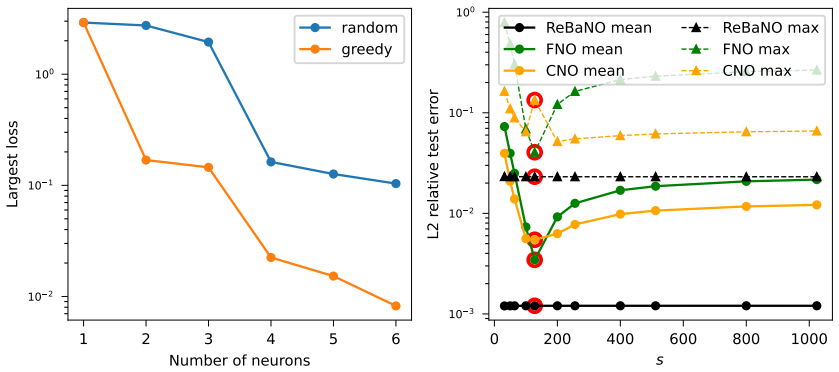
- [Section 5.1, Figure 5 Right] The 'strict discretization invariance' claim is confounded. ReBaNO's online phase minimizes the physics loss Eq. (14), which requires f evaluated on the collocation set C_R (Eq. 15). The paper never states how f is represented to ReBaNO when the test input is provided only on a varying s-point grid. If ReBaNO evaluates f on its own fixed or continuous functional representation while FNO and CNO only receive the s discrete samples, the flat error curve in Figure 5 Right is an artifact of asymmetric information, not a learned discretization-invariant operator. At minimum, the authors must specify the exact representation and interpolation procedure for f in the resolution test, and rerun the comparison under identical input information. The claim that ReBaNO is 'the only operator learning algorithm achieving strict discretization invariance' is not established by the current experiment, an
- [Abstract and Table 3] The abstract's claim of 'minimal computational cost online' is contradicted by Table 3. For Poisson, ReBaNO inference is 0.399 s per case versus 1.235 ms for FNO and 3.698 ms for PINO; for Darcy flow it is 1.940 s versus 4.222 ms for CNO; for Navier-Stokes it is 14.092 s versus 4.919 ms for CNO. ReBaNO is three to four orders of magnitude slower in online inference. The paper even reports 5000 online fine-tuning epochs for Navier-Stokes. This is not 'minimal computational cost' under any standard reading, and it materially affects the efficiency contribution claimed in the introduction and conclusion.
- [Section 5.1 and Table 2] The claim that ReBaNO 'significantly outperforms' baselines in shrinking the generalization gap is not supported by Table 2. For Poisson, the OOD mean error ratio of ReBaNO is 6.975, essentially identical to FNO's 6.976 and worse than PINO's 4.090; the absolute OOD mean error of ReBaNO is 0.023 versus PINO's 0.007. The text states 'PINO achieves the smallest ratio in the OOD test while ReBaNO yields the smallest errors,' which is contradicted by the table. For Navier-Stokes, ReBaNO's absolute errors (0.036 train, 0.072 OOD) are far larger than FNO's (0.002, 0.013) and CNO's (0.004, 0.044). The only metric on which ReBaNO can be said to 'shrink the gap' is the ratio e_test/e_train, and even there the advantage is not uniform. The paper must either soften the superiority claim or define precisely what 'outperforms' means and defend it against the absolute-error numbers.
- [Section 4.3, Algorithm 1, and Section 6] The abstract and contribution list call the greedy algorithm 'mathematically rigorous,' but no a posteriori error bound or certified residual-to-error estimator is provided. Algorithm 1 selects basis inputs by minimizing L_p (Eq. 14), yet there is no proof that a small physics loss controls the true approximation error in the relevant function norm; the paper itself defers convergence analysis to future work. The reasoning is not circular, and the greedy selection is a legitimate heuristic, but without a bound the adjective 'rigorous' is an overstatement. The authors should either supply a residual-based error estimate for the ReBaNO surrogate or replace 'rigorous' with language appropriate to an empirical greedy strategy.
minor comments (5)
- [Section 2.2] The VPINN/RVPINN formulations cite two references as '[?]' instead of actual citations; these should be filled in. The notation L_b and L_i is introduced but not consistently used later.
- [Section 1] There is a typo in 'strict discretizations invariance' (should be 'discretization invariance'). The informal tone of 'ReBaNo' vs. 'ReBaNO' should be unified.
- [Table 3] The inference time column is labeled 'infer time/N test'; it would help to state explicitly whether the reported numbers are per test case or averaged over the 200/1000 test cases. The parameter counts like '8+901×8' are opaque and deserve a brief explanation.
- [Section 5.1] The ablation study in Figure 5 Left compares greedy with random selection but reports only the largest loss, not the mean or median, and does not show the corresponding test errors. A boxplot or additional statistics would make the advantage of the greedy strategy more convincing.
- [Section 5.2] The Darcy flow experiment uses RVPINN as the high-fidelity solver, whereas the Poisson and Navier-Stokes experiments use plain PINNs. The paper does not discuss whether this choice affects the comparison or the internal consistency of the ReBaNO framework.
Circularity Check
No significant circularity; ReBaNO's physics-residual-driven construction is self-contained.
full rationale
ReBaNO's derivation chain is self-contained. The reduced basis is selected offline by Algorithm 1 using the physics-residual indicator Δ_{n-1}(f)=min_c L_p[Ψ_{n-1}(f);c], and the online coefficients are the minimizers of the same residual in Eq. (34); the reported test errors are relative L2 errors against high-fidelity PDE solutions, which are never used in either the greedy selection or the online solve. Thus the method does not fit a parameter to the quantity it later 'predicts'. The self-citations (GPT-PINN, Chen & Koohy [15]) are motivational rather than load-bearing; the central construction is the paper's own residual-based greedy algorithm and is benchmarked against external baselines. The main caveats are evidential rather than circular: the discretization-invariance comparison is asymmetric (ReBaNO can evaluate f on its own collocation grid while FNO/CNO receive only s-point samples), no a posteriori error bound justifies L_p as a greedy indicator, and the VPINN/RVPINN citations are unresolved placeholders ('[?]') with convergence analysis deferred to future work. These concerns weaken evidential support but do not make the central derivation equivalent to its inputs.
Assumptions & free parameters
free parameters (3)
- Number of reduced basis neurons N =
8 (Poisson), 48 (Darcy), 20 (Navier-Stokes)
- PINN architecture and training epochs =
[1,20,20,20,1] with 40000 epochs (Poisson), [2,40,40,40,40,40,40,1] with 60000 epochs (Darcy), [3,20,20,20,20,20,20,2] w
- Online fine-tuning epochs =
100 (Poisson and Darcy), 5000 (Navier-Stokes)
assumptions (4)
- domain assumption The PDE residual loss L_p (Eq. 14) is a reliable indicator of approximation error for greedy selection and online tuning.
- domain assumption The full-order PINN solutions are sufficiently accurate to serve as a high-fidelity reduced basis.
- domain assumption The solution manifold of the parametric PDE is low-dimensional enough to be approximated by N=8, 48, or 20 basis functions.
- domain assumption The discrete input set F used for greedy selection is representative of the test distribution, including OOD inputs.
Cite this review
Pith. "Pith review of ReBaNO: Reduced Basis Neural Operator Mitigating Generalization Gaps and Achieving Discretization Invariance." pith.science (2026). https://pith.science/paper/CG4POSYG
@misc{pith2026250909611,
  author       = {Pith},
  title        = {Pith review of: ReBaNO: Reduced Basis Neural Operator Mitigating Generalization Gaps and Achieving Discretization Invariance},
  year         = {2026},
  howpublished = {\url{https://pith.science/paper/CG4POSYG}},
  note         = {Machine review of arXiv:2509.09611}
}
read the original abstract
We propose a novel data-lean operator learning algorithm, the Reduced Basis Neural Operator (ReBaNO), to solve a group of PDEs with multiple distinct inputs. Inspired by the Reduced Basis Method and the recently introduced Generative Pre-Trained Physics-Informed Neural Networks, ReBaNO relies on a mathematically rigorous greedy algorithm to build its network structure offline adaptively from the ground up. Knowledge distillation via task-specific activation function allows ReBaNO to have a compact architecture requiring minimal computational cost online while embedding physics. In comparison to state-of-the-art operator learning algorithms such as PCA-Net, DeepONet, FNO, and CNO, numerical results demonstrate that ReBaNO significantly outperforms them in terms of eliminating/shrinking the generalization gap for both in- and out-of-distribution tests and being the only operator learning algorithm achieving strict discretization invariance.
Figures


Figures from the paper (6 more)



Reference graph
Works this paper leans on
-
[1]
Neural Operator: Graph Kernel Network for Partial Differential Equations
Anima Anandkumar, Kamyar Azizzadenesheli, Kaushik Bhattacharya, Nikola Kovachki, Zongyi Li, Burigede Liu, and Andrew Stuart. Neural Operator: Graph Kernel Network for Partial Differential Equations. InICLR 2020 Workshop on Integration of Deep Neural Models and Differential Equations, 2020
2020
-
[2]
Representation Equivalent Neural Operators: A Framework for Alias-free Operator Learning
Francesca Bartolucci, Emmanuel de Bezenac, Bogdan Raonic, Roberto Molinaro, Siddhartha Mishra, and Rima Alaifari. Representation Equivalent Neural Operators: A Framework for Alias-free Operator Learning. InThirty-Seventh Conference on Neural Information Processing Systems, 2023. 23 Figure 9: Navier-Stokes OOD test pointwise (top) and𝐿2 relative (bottom) e...
2023
-
[3]
A survey of projection-based model reduction methods for parametric dynamical systems.SIAM Review, 57(4):483–531, jan 2015
P Benner, S Gugercin, and K Willcox. A survey of projection-based model reduction methods for parametric dynamical systems.SIAM Review, 57(4):483–531, jan 2015
2015
-
[4]
finite-element
Gilles Besnard, François Hild, and Stéphane Roux. “finite-element” displacement fields analysis from digital images: application to portevin–le châtelier bands.Experimental mechanics, 46(6):789–803, 2006
2006
-
[5]
Kovachki, and Andrew M
Kaushik Bhattacharya, Bamdad Hosseini, Nikola B. Kovachki, and Andrew M. Stuart. Model Reduction AndNeuralNetworksForParametricPDEs.TheSMAIJournalofcomputationalmathematics,7:121–157, 2021
2021
-
[6]
Convergence rates for greedy algorithms in reduced basis methods.SIAM Journal on Mathematical Analysis, 43(3):1457–1472, 2011
P Binev, Albert Cohen, W Dahmen, R Devore, G Petrova, and P Wojtaszczyk. Convergence rates for greedy algorithms in reduced basis methods.SIAM Journal on Mathematical Analysis, 43(3):1457–1472, 2011
2011
-
[7]
AndreaBonito,RonaldDeVore,GuerganaPetrova,andJonathanW.Siegel. Convergenceanderrorcontrol of consistent PINNs for elliptic PDEs.arXiv preprint arXiv:2406.09217, 2025
arXiv 2025
-
[8]
Springer, 2008
Susanne C Brenner.The mathematical theory of finite element methods. Springer, 2008
2008
Show all 71 references
-
[9]
Model reduction on manifolds: A differential geometric framework.Physica D: Nonlinear Phenomena, 468:134299, 2024
Patrick Buchfink, Silke Glas, Bernard Haasdonk, and Benjamin Unger. Model reduction on manifolds: A differential geometric framework.Physica D: Nonlinear Phenomena, 468:134299, 2024
2024
-
[10]
Physics-informed neural networks (PINNs) for fluid mechanics: A review.Acta Mechanica Sinica, pages 1–12, 2022
ShengzeCai,ZhipingMao,ZhichengWang,MinglangYin,andGeorgeEmKarniadakis. Physics-informed neural networks (PINNs) for fluid mechanics: A review.Acta Mechanica Sinica, pages 1–12, 2022
2022
-
[11]
Choose a transformer: Fourier or galerkin.Advances in neural information processing systems, 34:24924–24940, 2021
Shuhao Cao. Choose a transformer: Fourier or galerkin.Advances in neural information processing systems, 34:24924–24940, 2021
2021
-
[12]
Machine learning and the physical sciences.Reviews of Modern Physics, 91(4):045002, 2019
Giuseppe Carleo, Ignacio Cirac, Kyle Cranmer, Laurent Daudet, Maria Schuld, Naftali Tishby, Leslie Vogt-Maranto, and Lenka Zdeborová. Machine learning and the physical sciences.Reviews of Modern Physics, 91(4):045002, 2019
2019
-
[13]
Chen and H
T. Chen and H. Chen. Universal approximation to nonlinear operators by neural networks with arbitrary activation functions and its application to dynamical systems.IEEE transactions on neural networks, 6:911–917, 1995
1995
-
[14]
TGPT-PINN: Nonlinear model reduction with transformed GPT-PINNs.Computer Methods in Applied Mechanics and Engineering, 430:117198, 2024
Yanlai Chen, Yajie Ji, Akil Narayan, and Zhenli Xu. TGPT-PINN: Nonlinear model reduction with transformed GPT-PINNs.Computer Methods in Applied Mechanics and Engineering, 430:117198, 2024
2024
-
[15]
GPT-PINN: Generative pre-trained physics-informed neural networks toward non-intrusive meta-learning of parametric pdes.Finite Elements in Analysis and Design, 228:104047, 2024
Yanlai Chen and Shawn Koohy. GPT-PINN: Generative pre-trained physics-informed neural networks toward non-intrusive meta-learning of parametric pdes.Finite Elements in Analysis and Design, 228:104047, 2024
2024
-
[16]
de Hoop, Daniel Zhengyu Huang, Elizabeth Qian, and Andrew M
Maarten V. de Hoop, Daniel Zhengyu Huang, Elizabeth Qian, and Andrew M. Stuart. The Cost-Accuracy Trade-Off in Operator Learning with Neural Networks.Journal of Machine Learning, 1:299–341, 2022. 25
2022
-
[17]
Approximation rates of deeponets for learning operators arising from advection–diffusion equations.Neural Networks, 153:411–426, 2022
Beichuan Deng, Yeonjong Shin, Lu Lu, Zhongqiang Zhang, and George Em Karniadakis. Approximation rates of deeponets for learning operators arising from advection–diffusion equations.Neural Networks, 153:411–426, 2022
2022
-
[18]
One-shot transfer learning of physics-informed neural networks.arXiv preprint arXiv:2110.11286, 2021
Shaan Desai, Marios Mattheakis, Hayden Joy, Pavlos Protopapas, and Stephen Roberts. One-shot transfer learning of physics-informed neural networks.arXiv preprint arXiv:2110.11286, 2021
2021 arXiv
-
[19]
Machine-learning-assisted modeling.Physics Today, 74(7):36–41, 2021
Weinan E, Jiequn Han, and Linfeng Zhang. Machine-learning-assisted modeling.Physics Today, 74(7):36–41, 2021
2021
-
[20]
Limitations of physics informed machine learning for nonlinear two-phase transport in porous media.Journal of Machine Learning for Modeling and Computing, 1(1), 2020
Olga Fuks and Hamdi A Tchelepi. Limitations of physics informed machine learning for nonlinear two-phase transport in porous media.Journal of Machine Learning for Modeling and Computing, 1(1), 2020
2020
-
[21]
Knowledge-based modeling of material behavior with neural networks.Journal of engineering mechanics, 117(1):132–153, 1991
J Ghaboussi, JH Garrett Jr, and Xiping Wu. Knowledge-based modeling of material behavior with neural networks.Journal of engineering mechanics, 117(1):132–153, 1991
1991
-
[22]
Autoprogressive training of neural network constitutive models.International Journal for Numerical Methods in Engineering, 42(1):105–126, 1998
Jamshid Ghaboussi, David A Pecknold, Mingfu Zhang, and Rami M Haj-Ali. Autoprogressive training of neural network constitutive models.International Journal for Numerical Methods in Engineering, 42(1):105–126, 1998
1998
-
[23]
Loss landscape engineering via data regulation on pinns.Machine Learning with Applications, 12:100464, 2023
Vignesh Gopakumar, Stanislas Pamela, and Debasmita Samaddar. Loss landscape engineering via data regulation on pinns.Machine Learning with Applications, 12:100464, 2023
2023
-
[24]
Transfer learning enhanced physics informed neural network for phase-field modeling of fracture.Theoretical and Applied Fracture Mechanics, 106:102447, 2020
Somdatta Goswami, Cosmin Anitescu, Souvik Chakraborty, and Timon Rabczuk. Transfer learning enhanced physics informed neural network for phase-field modeling of fracture.Theoretical and Applied Fracture Mechanics, 106:102447, 2020
2020
-
[25]
Physics-informeddeepneural operator networks
SomdattaGoswami,AniruddhaBora,YueYu,andGeorgeEmKarniadakis. Physics-informeddeepneural operator networks. InMachine Learning in Modeling and Simulation: Methods and Applications, pages 219–254. Springer, 2023
2023
-
[26]
Multiwavelet-based operator learning for differential equations.Advances in neural information processing systems, 34:24048–24062, 2021
Gaurav Gupta, Xiongye Xiao, and Paul Bogdan. Multiwavelet-based operator learning for differential equations.Advances in neural information processing systems, 34:24048–24062, 2021
2021
-
[27]
Bernard Haasdonk.Chapter 2: Reduced Basis Methods for Parametrized PDEs: A Tutorial Introduction for Stationary and Instationary Problems, pages 65–136
-
[28]
An equivariant neural operator for developing nonlocal tensorial constitutive models.Journal of Computational Physics, 488:112243, 2023
Jiequn Han, Xu-Hui Zhou, and Heng Xiao. An equivariant neural operator for developing nonlocal tensorial constitutive models.Journal of Computational Physics, 488:112243, 2023
2023
-
[29]
Manifoldlearningbaseddata-driven modeling for soft biological tissues.Journal of Biomechanics, 117:110124, 2021
QizhiHe,DevinWLaurence,Chung-HaoLee,andJiun-ShyanChen. Manifoldlearningbaseddata-driven modeling for soft biological tissues.Journal of Biomechanics, 117:110124, 2021
2021
-
[30]
SpringerBriefs in Mathematics
JanS.Hesthaven,GianluigiRozza,andBenjaminStamm.Certifiedreducedbasismethodsforparametrized partial differential equations. SpringerBriefs in Mathematics. Springer, Cham; BCAM Basque Center for Applied Mathematics, Bilbao, 2016. BCAM SpringerBriefs. 26
2016
-
[31]
Peridynamic neural operators: A data-driven nonlocal constitutive model for complex material responses.Computer Methods in Applied Mechanics and Engineering, 425:116914, 2024
Siavash Jafarzadeh, Stewart Silling, Ning Liu, Zhongqiang Zhang, and Yue Yu. Peridynamic neural operators: A data-driven nonlocal constitutive model for complex material responses.Computer Methods in Applied Mechanics and Engineering, 425:116914, 2024
2024
-
[32]
Physics-informed machine learning.Nature Reviews Physics, 3(6):422–440, 2021
George Em Karniadakis, Ioannis G Kevrekidis, Lu Lu, Paris Perdikaris, Sifan Wang, and Liu Yang. Physics-informed machine learning.Nature Reviews Physics, 3(6):422–440, 2021
2021
-
[33]
Meta-learning loss functions of parametric partial differential equations using physics-informed neural networks
Michail Koumpanakis and Ricardo Vilalta. Meta-learning loss functions of parametric partial differential equations using physics-informed neural networks. InInternational Conference on Discovery Science, pages 183–197. Springer, 2024
2024
-
[34]
Onuniversalapproximationanderrorbounds for fourier neural operators.Journal of Machine Learning Research, 22(290):1–76, 2021
NikolaKovachki,SamuelLanthaler,andSiddharthaMishra. Onuniversalapproximationanderrorbounds for fourier neural operators.Journal of Machine Learning Research, 22(290):1–76, 2021
2021
-
[35]
Chapter9-Operatorlearning: Algorithms and analysis
NikolaB.Kovachki, SamuelLanthaler, andAndrewM.Stuart. Chapter9-Operatorlearning: Algorithms and analysis. In Siddhartha Mishra and Alex Townsend, editors,Handbook of Numerical Analysis, volume 25 ofNumerical Analysis Meets Machine Learning, pages 419–467. Elsevier, 2024
2024
-
[36]
Neural operator: Learning maps between function spaces with applications to PDEs.Journal of Machine Learning Research, 24(89):1–97, 2023
NikolaBKovachki,ZongyiLi,BurigedeLiu,KamyarAzizzadenesheli,KaushikBhattacharya,AndrewM Stuart, and Anima Anandkumar. Neural operator: Learning maps between function spaces with applications to PDEs.Journal of Machine Learning Research, 24(89):1–97, 2023
2023
-
[37]
Galerkin proper orthogonal decomposition methods for a general equation in fluid dynamics.SIAM J
K Kunisch and S Volkwein. Galerkin proper orthogonal decomposition methods for a general equation in fluid dynamics.SIAM J. Numer. Anal., 40(2):492—-515 (electronic), 2002
2002
-
[38]
Operator learning with PCA-Net: upper and lower complexity bounds.Journal of Machine Learning Research, 24(318):1–67, 2023
Samuel Lanthaler. Operator learning with PCA-Net: upper and lower complexity bounds.Journal of Machine Learning Research, 24(318):1–67, 2023
2023
-
[39]
Data-drivendesignformetamaterials and multiscale systems: A review.Advanced Materials, 36(8):2305254, 2024
DoksooLee,WeiChen,LiweiWang,Yu-ChinChan,andWeiChen. Data-drivendesignformetamaterials and multiscale systems: A review.Advanced Materials, 36(8):2305254, 2024
2024
-
[40]
SIAM, 2007
Randall J LeVeque.Finite difference methods for ordinary and partial differential equations: steady-state and time-dependent problems. SIAM, 2007
2007
-
[41]
Multipole graph neural operator for parametric partial differential equations.Advances in Neural Information Processing Systems, 33:NeurIPS 2020, 2020
Zongyi Li, Nikola Kovachki, Kamyar Azizzadenesheli, Burigede Liu, Andrew Stuart, Kaushik Bhat- tacharya, and Anima Anandkumar. Multipole graph neural operator for parametric partial differential equations.Advances in Neural Information Processing Systems, 33:NeurIPS 2020, 2020
2020
-
[42]
Fourier neural operator for parametric partial differential equations
Zongyi Li, Nikola Borislavov Kovachki, Kamyar Azizzadenesheli, Burigede liu, Kaushik Bhattacharya, Andrew Stuart, and Anima Anandkumar. Fourier neural operator for parametric partial differential equations. InInternational Conference on Learning Representations, 2021
2021
-
[43]
Physics-Informed Neural Operator for Learning Partial Differential Equations.ACM / IMS J
Zongyi Li, Hongkai Zheng, Nikola Kovachki, David Jin, Haoxuan Chen, Burigede Liu, Kamyar Azizzadenesheli, and Anima Anandkumar. Physics-Informed Neural Operator for Learning Partial Differential Equations.ACM / IMS J. Data Sci., 1:9:1–9:27, 2024. 27
2024
-
[44]
Domain agnostic fourier neural operators.Advances in Neural Information Processing Systems, 36, 2024
Ning Liu, Siavash Jafarzadeh, and Yue Yu. Domain agnostic fourier neural operators.Advances in Neural Information Processing Systems, 36, 2024
2024
-
[45]
Rajanna, Edward W
Ning Liu, Xuxiao Li, Manoj R. Rajanna, Edward W. Reutzel, Brady Sawyer, Prahalada Rao, Jim Lua, Nam Phan, and Yue Yu. Deep neural operator enabled digital twin modeling for additive manufacturing. Advances in Computational Science and Engineering, 2:174–201, Sun Sep 01 00:00:0...
2024
-
[46]
Learning nonlinear operators via DeepONet based on the universal approximation theorem of operators.Nature Machine Intelligence, 3(3):218–229, 2021
Lu Lu, Pengzhan Jin, Guofei Pang, Zhongqiang Zhang, and George Em Karniadakis. Learning nonlinear operators via DeepONet based on the universal approximation theorem of operators.Nature Machine Intelligence, 3(3):218–229, 2021
2021
-
[47]
A comprehensive and fair comparison of two neural operators (with practical extensions) based on fair data.Computer Methods in Applied Mechanics and Engineering, 393:114778, 2022
LuLu, XuhuiMeng, ShengzeCai, ZhipingMao, SomdattaGoswami, ZhongqiangZhang, andGeorgeEm Karniadakis. A comprehensive and fair comparison of two neural operators (with practical extensions) based on fair data.Computer Methods in Applied Mechanics and Engineering, 393:114778, 2022
2022
-
[48]
Transolver++: An Accurate Neural Solver for PDEs on Million-Scale Geometries
Huakun Luo, Haixu Wu, Hang Zhou, Lanxiang Xing, Yichen Di, Jianmin Wang, and Mingsheng Long. Transolver++: An Accurate Neural Solver for PDEs on Million-Scale Geometries. InForty-Second International Conference on Machine Learning, 2025
2025
-
[49]
A reduced-basis element method.Journal of scientific computing, 17:447–459, 2002
Yvon Maday and Einar M Rønquist. A reduced-basis element method.Journal of scientific computing, 17:447–459, 2002
2002
-
[50]
Weakbaselinesandreportingbiasesleadtooveroptimisminmachine learning for fluid-related partial differential equations.Nature Machine Intelligence, pages 1–14, 2024
NickMcGreivyandAmmarHakim. Weakbaselinesandreportingbiasesleadtooveroptimisminmachine learning for fluid-related partial differential equations.Nature Machine Intelligence, pages 1–14, 2024
2024
-
[51]
Integral Autoencoder Network for Discretization- Invariant Learning.Journal of Machine Learning Research, 23:1–45, 2022
Yong Zheng Ong, Zuowei Shen, and Haizhao Yang. Integral Autoencoder Network for Discretization- Invariant Learning.Journal of Machine Learning Research, 23:1–45, 2022
2022
-
[52]
Ab initio solution of the many-electron schrödinger equation with deep neural networks.Physical Review Research, 2(3):033429, 2020
David Pfau, James S Spencer, Alexander GDG Matthews, and W Matthew C Foulkes. Ab initio solution of the many-electron schrödinger equation with deep neural networks.Physical Review Research, 2(3):033429, 2020
2020
-
[53]
Physics- informedneuralnetworkwithtransferlearning(tl-pinn)basedondomainsimilaritymeasureforprediction of nuclear reactor transients.Scientific Reports, 13(1):16840, 2023
Konstantinos Prantikos, Stylianos Chatzidakis, Lefteri H Tsoukalas, and Alexander Heifetz. Physics- informedneuralnetworkwithtransferlearning(tl-pinn)basedondomainsimilaritymeasureforprediction of nuclear reactor transients.Scientific Reports, 13(1):16840, 2023
2023
-
[54]
Springer International Publishing, Cham, 2016
Alfio Quarteroni, Andrea Manzoni, and Federico Negri.Reduced Basis Methods for Partial Differential Equations, volume 92 ofUNITEXT. Springer International Publishing, Cham, 2016
2016
-
[55]
Maziar Raissi, Paris Perdikaris, and George E Karniadakis. Physics-informed neural networks: A deep learning framework for solving forward and inverse problems involving nonlinear partial differential equations.Journal of Computational physics, 378:686–707, 2019
2019
-
[56]
Hidden fluid mechanics: Learning velocity and pressure fields from flow visualizations.Science, 367(6481):1026–1030, 2020
Maziar Raissi, Alireza Yazdani, and George Em Karniadakis. Hidden fluid mechanics: Learning velocity and pressure fields from flow visualizations.Science, 367(6481):1026–1030, 2020. 28
2020
-
[57]
Convolutional Neural Operators for robust and accurate learning of PDEs
Bogdan Raonic, Roberto Molinaro, Tim De Ryck, Tobias Rohner, Francesca Bartolucci, Rima Alaifari, Siddhartha Mishra, and Emmanuel de Bezenac. Convolutional Neural Operators for robust and accurate learning of PDEs. InThirty-Seventh Conference on Neural Information Processing S...
2023
-
[58]
U-Net: Convolutional Networks for Biomedical Image Segmentation
Olaf Ronneberger, Philipp Fischer, and Thomas Brox. U-Net: Convolutional Networks for Biomedical Image Segmentation. In Nassir Navab, Joachim Hornegger, William M. Wells, and Alejandro F. Frangi, editors,Medical Image Computing and Computer-Assisted Intervention – MICCAI 2015,...
2015
-
[59]
Hyposvi: Hypocentre inversion with stein variational inference and physics informed neural networks.Geophysical Journal International, 228(1):698–710, 2022
Jonthan D Smith, Zachary E Ross, Kamyar Azizzadenesheli, and Jack B Muir. Hyposvi: Hypocentre inversion with stein variational inference and physics informed neural networks.Geophysical Journal International, 228(1):698–710, 2022
2022
-
[60]
Factorized Fourier Neural Operators
Alasdair Tran, Alexander Mathews, Lexing Xie, and Cheng Soon Ong. Factorized Fourier Neural Operators. InThe Eleventh International Conference on Learning Representations, 2022
2022
-
[61]
Understanding and mitigating gradient flow pathologies in physics-informed neural networks.SIAM Journal on Scientific Computing, 43(5):A3055–A3081, 2021
Sifan Wang, Yujun Teng, and Paris Perdikaris. Understanding and mitigating gradient flow pathologies in physics-informed neural networks.SIAM Journal on Scientific Computing, 43(5):A3055–A3081, 2021
2021
-
[62]
Learning the solution operator of parametric partial differential equations with physics-informed deeponets.Science advances, 7(40):eabi8605, 2021
Sifan Wang, Hanwen Wang, and Paris Perdikaris. Learning the solution operator of parametric partial differential equations with physics-informed deeponets.Science advances, 7(40):eabi8605, 2021
2021
-
[63]
When and why pinns fail to train: A neural tangent kernel perspective.Journal of Computational Physics, 449:110768, 2022
Sifan Wang, Xinling Yu, and Paris Perdikaris. When and why pinns fail to train: A neural tangent kernel perspective.Journal of Computational Physics, 449:110768, 2022
2022
-
[64]
U-FNO—An enhanced Fourier neural operator-based deep-learning model for multiphase flow.Advances in Water Resources, 163:104180, 2022
GegeWen,ZongyiLi,KamyarAzizzadenesheli,AnimaAnandkumar,andSallyM.Benson. U-FNO—An enhanced Fourier neural operator-based deep-learning model for multiphase flow.Advances in Water Resources, 163:104180, 2022
2022
-
[65]
Transolver: A fast transformer solver for PDEs on general geometries
Haixu Wu, Huakun Luo, Haowen Wang, Jianmin Wang, and Mingsheng Long. Transolver: A fast transformer solver for PDEs on general geometries. InProceedings of the 41st International Conference on Machine Learning, volume 235 ofICML’24, pages 53681–53705, Vienna, Austria, 2024. JMLR.org
2024
-
[66]
Transfer learning based physics-informed neural networks for solving inverse problems in engineering structures under different loading scenarios
Chen Xu, Ba Trung Cao, Yong Yuan, and Günther Meschke. Transfer learning based physics-informed neural networks for solving inverse problems in engineering structures under different loading scenarios. Computer Methods in Applied Mechanics and Engineering, 405:115852, 2023
2023
-
[67]
Nonlocal kernel network (NKN): A stable and resolution-independent deep neural network.Journal of Computational Physics, page arXiv preprint arXiv:2201.02217, 2022
Huaiqian You, Yue Yu, Marta D’Elia, Tian Gao, and Stewart Silling. Nonlocal kernel network (NKN): A stable and resolution-independent deep neural network.Journal of Computational Physics, page arXiv preprint arXiv:2201.02217, 2022
2022 arXiv
-
[68]
Learning deep implicit fourier neural operators (ifnos) with applications to heterogeneous material modeling.Computer Methods in Applied Mechanics and Engineering, 398:115296, 2022
Huaiqian You, Quinn Zhang, Colton J Ross, Chung-Hao Lee, and Yue Yu. Learning deep implicit fourier neural operators (ifnos) with applications to heterogeneous material modeling.Computer Methods in Applied Mechanics and Engineering, 398:115296, 2022. 29
2022
-
[69]
Deep potential molecular dynamics: a scalable model with the accuracy of quantum mechanics.Physical Review Letters, 120(14):143001, 2018
Linfeng Zhang, Jiequn Han, Han Wang, Roberto Car, and Weinan E. Deep potential molecular dynamics: a scalable model with the accuracy of quantum mechanics.Physical Review Letters, 120(14):143001, 2018
2018
-
[70]
MetaNO: How to transfer your knowledge on learning hidden physics.Computer Methods in Applied Mechanics and Engineering, 417:116280, 2023
Lu Zhang, Huaiqian You, Tian Gao, Mo Yu, Chung-Hao Lee, and Yue Yu. MetaNO: How to transfer your knowledge on learning hidden physics.Computer Methods in Applied Mechanics and Engineering, 417:116280, 2023
2023
-
[71]
Alias-free mamba neural operator
Jianwei Zheng, Ni Xu, Junwei Zhu, Xiaoqin Zhang, et al. Alias-free mamba neural operator. InThe Thirty-eighth Annual Conference on Neural Information Processing Systems. A Experimental setup A.1 Poisson Setup ThefullPINNsaretrainedongridofsize128uniformlydiscretizedover Ω=[0,1...
Reviewed August 4, 2026 · model on record in the stance chip above.
Discussion (0). Sign in to comment.