Gauging the Spacetime Code
Pith reviewed 2026-06-28 01:31 UTC · model grok-4.3
The pith
Gauging the spacetime code produces a lattice gauge theory that carries fault tolerance from circuits, with Gauss laws linking error configurations and Wilson loops serving as detectors.
A machine-rendered reading of the paper's core claim, the machinery that carries it, and where it could break.
Core claim
Gauging the spacetime code gives rise to a lattice gauge theory that inherits the elements of fault tolerance associated with a circuit, with Gauss laws corresponding to equivalence relations between configurations of spacetime errors and Wilson loops corresponding to detectors.
What carries the argument
The gauging procedure applied to the spacetime code, which transfers circuit fault-tolerance elements into a lattice gauge theory via Gauss laws and Wilson loops.
If this is right
- The theory contains foliated computation and therefore supplies one version of a gauge theory for measurement-based quantum computation.
- For certain topologically ordered mixed states the construction supplies a gauge-theoretic description of the associated classical memory.
- Gauge-invariant observables in the theory coincide with the learnable degrees of freedom under circuit Pauli noise.
Where Pith is reading between the lines
- The same gauging step might extend to other spacetime-based descriptions of dynamical stability in quantum many-body systems.
- Links could appear between the detector observables here and classical learning tasks outside Pauli noise models.
- The construction offers a possible route to embed measurement-based protocols inside existing lattice gauge theory toolkits.
Load-bearing premise
The gauging procedure transfers the fault-tolerance structure of the spacetime code to the gauge theory without loss of the correspondences between Gauss laws, Wilson loops, and error detection.
What would settle it
Explicit computation in a small spacetime code example showing whether the Wilson loops of the gauged theory match the detector outcomes of the original circuit under a chosen error model.
Figures

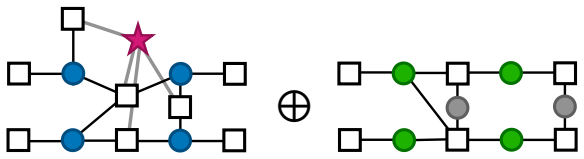
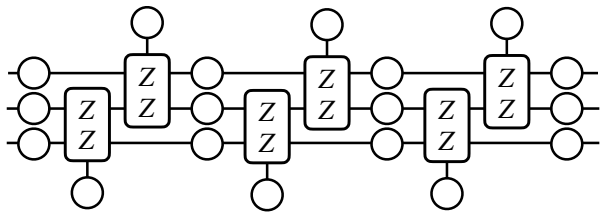
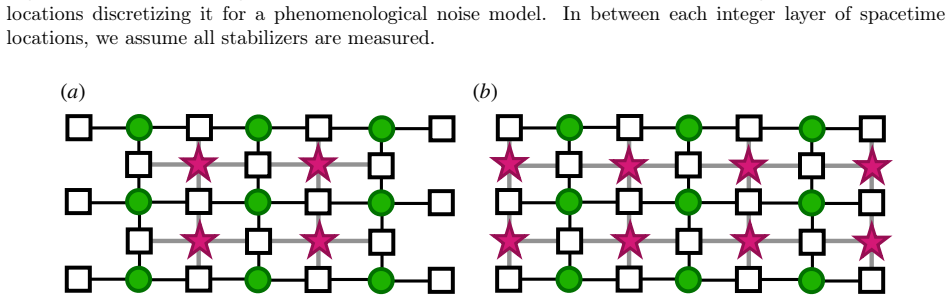
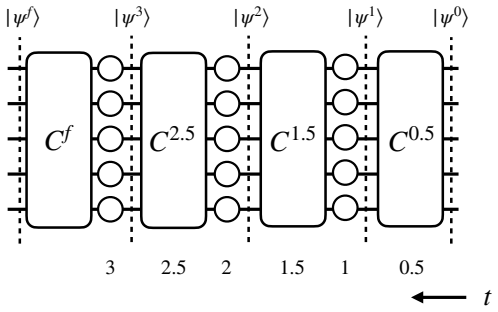
read the original abstract
In recent years, the spacetime code has arisen as a candidate for a unifying view of fault tolerance in space and time. On the other hand, the recent study of dynamical phases has increasingly turned its attention to fault tolerance as a notion of a dynamically stable process. In this work, I explore one pathway between the two, achieved by gauging the spacetime code. This gives rise to a lattice gauge theory that inherits the elements of fault tolerance associated with a circuit, with Gauss laws corresponding to equivalence relations between configurations of spacetime errors and Wilson loops corresponding to detectors. The obtained gauge theory finds a surprisingly wide array of applications, from quantum error correction to condensed matter physics, and even learning theory: (1) It contains in its description foliated computation, and hence gives rise to one version of a gauge theory for measurement-based quantum computation. (2) For a class of topologically ordered mixed states, it gives us a gauge-theoretic language to describe the classical memory associated with the state. (3) The gauge-invariant observables of the theory which describe detectors also coincide with the learnable degrees of freedom of circuit Pauli noise.
Editorial analysis
A structured set of objections, weighed in public.
Referee Report
Summary. The manuscript proposes gauging the spacetime code to obtain a lattice gauge theory inheriting fault-tolerance properties from the underlying circuit. Gauss laws are identified with equivalence relations among spacetime error configurations, while Wilson loops correspond to detectors. Three applications are outlined: a gauge-theoretic formulation of foliated computation for measurement-based quantum computation, a description of classical memory in topologically ordered mixed states, and the identification of gauge-invariant observables with learnable degrees of freedom under circuit Pauli noise.
Significance. If the central correspondences are rigorously derived, the work supplies a gauge-theoretic language that unifies circuit-level fault tolerance with dynamical phases and error models, potentially enabling new analyses in quantum error correction, condensed-matter dynamics, and noise learning. Explicit machine-checked or parameter-free aspects are not indicated in the provided description.
major comments (2)
- [Abstract / §2 (construction)] The central claim that gauging maps circuit-level spacetime error equivalence relations directly onto Gauss-law constraints (and detectors onto Wilson loops) without loss or additional assumptions is load-bearing for all three applications. The abstract asserts this inheritance but supplies no explicit construction, error-model definition, or verification that the promotion of global symmetries to local gauge symmetries preserves the original equivalence classes; this must be shown in the main text (e.g., via a concrete spacetime code example) to establish that no new undetectable errors are introduced.
- [Application (1)] Application (1) states that the gauge theory 'contains in its description foliated computation' and thereby yields a gauge theory for MBQC. The correspondence between foliated layers and gauge-invariant sectors requires an explicit mapping from the spacetime code stabilizers to the gauge constraints; without this, it is unclear whether the fault-tolerance properties survive the gauging step or require extra commutation conditions on the gauge group.
minor comments (2)
- Notation for spacetime errors, equivalence relations, and the gauge group should be introduced with explicit definitions before the applications are discussed.
- [Abstract] The abstract's phrasing ('inherits', 'correspond') should be replaced by precise statements once the construction is given, to avoid any appearance of definitional circularity.
Simulated Author's Rebuttal
We thank the referee for their careful reading and constructive comments on our manuscript. We address each major comment below and will revise the text to improve clarity and explicitness where needed.
read point-by-point responses
-
Referee: [Abstract / §2 (construction)] The central claim that gauging maps circuit-level spacetime error equivalence relations directly onto Gauss-law constraints (and detectors onto Wilson loops) without loss or additional assumptions is load-bearing for all three applications. The abstract asserts this inheritance but supplies no explicit construction, error-model definition, or verification that the promotion of global symmetries to local gauge symmetries preserves the original equivalence classes; this must be shown in the main text (e.g., via a concrete spacetime code example) to establish that no new undetectable errors are introduced.
Authors: We agree that an explicit example would make the central correspondence more transparent. In the revised manuscript we will insert a worked example in §2 using the spacetime repetition code, explicitly defining the error model, showing the promotion of global symmetries to local gauge symmetries, and verifying that the original equivalence classes are preserved with no new undetectable errors introduced. revision: yes
-
Referee: [Application (1)] Application (1) states that the gauge theory 'contains in its description foliated computation' and thereby yields a gauge theory for MBQC. The correspondence between foliated layers and gauge-invariant sectors requires an explicit mapping from the spacetime code stabilizers to the gauge constraints; without this, it is unclear whether the fault-tolerance properties survive the gauging step or require extra commutation conditions on the gauge group.
Authors: The mapping from spacetime-code stabilizers to gauge constraints is already given in the foliated-computation section via the layer-by-layer promotion. To address the concern about commutation conditions and survival of fault tolerance, we will add a short paragraph confirming that the gauge group is chosen so that the relevant stabilizers commute with the gauge generators, thereby preserving the original fault-tolerance properties. revision: partial
Circularity Check
No circularity identified from provided abstract; full derivation not inspectable
full rationale
The abstract presents gauging the spacetime code as producing a lattice gauge theory where Gauss laws correspond to spacetime error equivalences and Wilson loops to detectors. This is described as inheritance from the circuit's fault tolerance. However, with only the abstract available and no equations, sections, or self-citations quoted from the manuscript, no load-bearing step can be shown to reduce by construction to its inputs. No fitted predictions, self-definitional mappings, or uniqueness theorems are exhibited. The central claim is a construction whose independence cannot be assessed without the full text, so the default non-circular finding applies.
Axiom & Free-Parameter Ledger
Reference graph
Works this paper leans on
-
[1]
Improved simulation of stabilizer circuits
Scott Aaronson and Daniel Gottesman. “Improved simulation of stabilizer circuits”. In:Phys. Rev. A 70 (5 2004), p. 052328.doi:10.1103/PhysRevA.70.052328.url:https://link.aps.org/doi/10. 1103/PhysRevA.70.052328
work page doi:10.1103/physreva.70.052328.url:https://link.aps.org/doi/10 2004
-
[2]
Cory T. Aitchison and Benjamin Béri.Spacetime Spins: Statistical mechanics for error correction with stabilizer circuits. 2026. arXiv:2512.21991 [quant-ph].url:https://arxiv.org/abs/2512.21991
arXiv 2026
-
[3]
Panos Aliferis, Daniel Gottesman, and John Preskill.Quantum accuracy threshold for concatenated distance-3 codes. 2005. arXiv:quant-ph/0504218 [quant-ph].url:https://arxiv.org/abs/quant- ph/0504218
Pith/arXiv arXiv 2005
-
[4]
Alexei Ashikhmin, Ching-Yi Lai, and Todd A. Brun. “Quantum Data-Syndrome Codes”. In:IEEE Journal on Selected Areas in Communications38.3 (2020), pp. 449–462.doi:10.1109/JSAC.2020. 2968997
-
[5]
SparseQuantumCodesfromQuantumCircuits
DaveBaconetal.“SparseQuantumCodesfromQuantumCircuits”.In:Proceedings of the Forty-Seventh Annual ACM Symposium on Theory of Computing. STOC ’15. Portland, Oregon, USA: Association for Computing Machinery, 2015, 327–334.isbn: 9781450335362.doi:10.1145/2746539.2746608.url: https://doi.org/10.1145/2746539.2746608
-
[6]
Topological error correcting processes from fixed-point path integrals
Andreas Bauer. “Topological error correcting processes from fixed-point path integrals”. In:Quantum 8 (2024), p. 1288.issn: 2521-327X.doi:10.22331/q-2024-03-20-1288.url:http://dx.doi.org/ 10.22331/q-2024-03-20-1288
work page doi:10.22331/q-2024-03-20-1288.url:http://dx.doi.org/ 2024
-
[7]
On Fault Tolerant Single-Shot Logical State Preparation and RobustLong-RangeEntanglement
Thiago Bergamaschi and Yunchao Liu. “On Fault Tolerant Single-Shot Logical State Preparation and RobustLong-RangeEntanglement”.en.In:vol.325.SchlossDagstuhl–Leibniz-ZentrumfürInformatik, 2025, 16:1–16:9.doi:10.4230/LIPICS.ITCS.2025.16.url:https://drops.dagstuhl.de/entities/ document/10.4230/LIPIcs.ITCS.2025.16
work page doi:10.4230/lipics.itcs.2025.16.url:https://drops.dagstuhl.de/entities/ 2025
-
[8]
Keller Blackwell and Jeongwan Haah.The code distance of Floquet codes. 2025. arXiv:2510.05549 [quant-ph].url:https://arxiv.org/abs/2510.05549
arXiv 2025
-
[9]
Foliated Quantum Error-Correcting Codes
A. Bolt et al. “Foliated Quantum Error-Correcting Codes”. In:Phys. Rev. Lett.117 (7 2016), p. 070501. doi:10.1103/PhysRevLett.117.070501.url:https://link.aps.org/doi/10.1103/PhysRevLett. 117.070501
work page doi:10.1103/physrevlett.117.070501.url:https://link.aps.org/doi/10.1103/physrevlett 2016
-
[10]
Unifying flavors of fault tolerance with the ZX calculus
Hector Bombin et al. “Unifying flavors of fault tolerance with the ZX calculus”. In:Quantum8 (2024), p. 1379.issn: 2521-327X.doi:10.22331/q-2024-06-18-1379.url:http://dx.doi.org/10.22331/ q-2024-06-18-1379
work page doi:10.22331/q-2024-06-18-1379.url:http://dx.doi.org/10.22331/ 2024
-
[11]
S. B. Bravyi and A. Yu. Kitaev.Quantum codes on a lattice with boundary. 1998. arXiv:quant - ph/9811052 [quant-ph].url:https://arxiv.org/abs/quant-ph/9811052
arXiv 1998
-
[12]
Quantum Low-Density Parity-Check Codes
Nikolas P. Breuckmann and Jens Niklas Eberhardt. “Quantum Low-Density Parity-Check Codes”. In: PRX Quantum2 (4 2021), p. 040101.doi:10.1103/PRXQuantum.2.040101.url:https://link.aps. org/doi/10.1103/PRXQuantum.2.040101
work page doi:10.1103/prxquantum.2.040101.url:https://link.aps 2021
-
[13]
Universal fault-tolerant measurement-based quantum compu- tation
Benjamin J. Brown and Sam Roberts. “Universal fault-tolerant measurement-based quantum compu- tation”. In:Phys. Rev. Res.2 (3 2020), p. 033305.doi:10.1103/PhysRevResearch.2.033305.url: https://link.aps.org/doi/10.1103/PhysRevResearch.2.033305
-
[15]
Flag Fault-Tolerant Error Correction for any Stabilizer Code
Rui Chao and Ben W. Reichardt. “Flag Fault-Tolerant Error Correction for any Stabilizer Code”. In: PRX Quantum1 (1 2020), p. 010302.doi:10.1103/PRXQuantum.1.010302.url:https://link.aps. org/doi/10.1103/PRXQuantum.1.010302
work page doi:10.1103/prxquantum.1.010302.url:https://link.aps 2020
-
[16]
Quantum Error Correction with Only Two Extra Qubits
Rui Chao and Ben W. Reichardt. “Quantum Error Correction with Only Two Extra Qubits”. In: Phys. Rev. Lett.121 (5 2018), p. 050502.doi:10 . 1103 / PhysRevLett . 121 . 050502.url:https : //link.aps.org/doi/10.1103/PhysRevLett.121.050502
-
[17]
Efficient Self-Consistent Learning of Gate Set Pauli Noise
Senrui Chen et al. “Efficient Self-Consistent Learning of Gate Set Pauli Noise”. In:PRX Quantum7 (1 2026), p. 010305.doi:10.1103/1pnv-t9px.url:https://link.aps.org/doi/10.1103/1pnv-t9px
work page doi:10.1103/1pnv-t9px.url:https://link.aps.org/doi/10.1103/1pnv-t9px 2026
-
[18]
Classification of phases for mixed states via fast dissipative evolution
Andrea Coser and David Pérez-García. “Classification of phases for mixed states via fast dissipative evolution”. In:Quantum3 (2019), p. 174.issn: 2521-327X.doi:10.22331/q-2019-08-12-174.url: http://dx.doi.org/10.22331/q-2019-08-12-174. 54
-
[19]
Systematic construction of stabilizer codes via gauging abelian boundary symmetries
Bram Vancraeynest-De Cuiper and José Garre-Rubio. “Systematic construction of stabilizer codes via gauging abelian boundary symmetries”. In:Quantum9 (2025), p. 1852.issn: 2521-327X.doi: 10.22331/q-2025-09-08-1852.url:http://dx.doi.org/10.22331/q-2025-09-08-1852
work page doi:10.22331/q-2025-09-08-1852.url:http://dx.doi.org/10.22331/q-2025-09-08-1852 2025
-
[20]
Margarita Davydova et al.Universal fault tolerant quantum computation in 2D without getting tied in knots. 2025. arXiv:2503.15751 [quant-ph].url:https://arxiv.org/abs/2503.15751
arXiv 2025
-
[21]
Extended flag gadgets for low-overhead circuit verification
Dripto M. Debroy and Kenneth R. Brown. “Extended flag gadgets for low-overhead circuit verification”. In:Phys. Rev. A102 (5 2020), p. 052409.doi:10.1103/PhysRevA.102.052409.url:https://link. aps.org/doi/10.1103/PhysRevA.102.052409
work page doi:10.1103/physreva.102.052409.url:https://link 2020
-
[22]
Nicolas Delfosse and Adam Paetznick.Spacetime codes of Clifford circuits. 2023. arXiv:2304.05943 [quant-ph].url:https://arxiv.org/abs/2304.05943
arXiv 2023
-
[23]
Eric Dennis et al. “Topological quantum memory”. In:Journal of Mathematical Physics43.9 (2002), 4452–4505.issn:1089-7658.doi:10.1063/1.1499754.url:http://dx.doi.org/10.1063/1.1499754
work page doi:10.1063/1.1499754.url:http://dx.doi.org/10.1063/1.1499754 2002
-
[24]
Designing fault-tolerant circuits using detector error models
Peter-Jan H.S. Derks et al. “Designing fault-tolerant circuits using detector error models”. In:Quantum 9 (2025), p. 1905.issn: 2521-327X.doi:10.22331/q-2025-11-06-1905.url:http://dx.doi.org/ 10.22331/q-2025-11-06-1905
work page doi:10.22331/q-2025-11-06-1905.url:http://dx.doi.org/ 2025
-
[25]
Error Correction in Dynamical Codes
Esther Xiaozhen Fu and Daniel Gottesman. “Error Correction in Dynamical Codes”. In:Quantum9 (2025), p. 1886.issn: 2521-327X.doi:10.22331/q-2025-10-20-1886.url:http://dx.doi.org/10. 22331/q-2025-10-20-1886
work page doi:10.22331/q-2025-10-20-1886.url:http://dx.doi.org/10 2025
-
[26]
Subsystem spacetime code
Esther Xiaozhen Fu and Daniel Gottesman. “Subsystem spacetime code”
-
[27]
Ability of stabilizer quantum error correction to protect itself from its own im- perfection
Yuichiro Fujiwara. “Ability of stabilizer quantum error correction to protect itself from its own im- perfection”. In:Phys. Rev. A90 (6 2014), p. 062304.doi:10 . 1103 / PhysRevA . 90 . 062304.url: https://link.aps.org/doi/10.1103/PhysRevA.90.062304
-
[28]
Stim: a fast stabilizer circuit simulator
Craig Gidney. “Stim: a fast stabilizer circuit simulator”. In:Quantum5 (2021), p. 497.issn: 2521-327X. doi:10.22331/q-2021-07-06-497.url:http://dx.doi.org/10.22331/q-2021-07-06-497
work page doi:10.22331/q-2021-07-06-497.url:http://dx.doi.org/10.22331/q-2021-07-06-497 2021
-
[29]
Distance measures to compare real and ideal quantum processes
Alexei Gilchrist, Nathan K. Langford, and Michael A. Nielsen. “Distance measures to compare real and ideal quantum processes”. In:Phys. Rev. A71 (6 2005), p. 062310.doi:10.1103/PhysRevA.71.062310. url:https://link.aps.org/doi/10.1103/PhysRevA.71.062310
-
[30]
DanielGottesman.Opportunities and Challenges in Fault-Tolerant Quantum Computation.2022.arXiv: 2210.15844 [quant-ph].url:https://arxiv.org/abs/2210.15844
arXiv 2022
-
[31]
Theory of fault-tolerant quantum computation
Daniel Gottesman. “Theory of fault-tolerant quantum computation”. In:Phys. Rev. A57 (1 1998), pp. 127–137.doi:10 . 1103 / PhysRevA . 57 . 127.url:https : / / link . aps . org / doi / 10 . 1103 / PhysRevA.57.127
1998
-
[32]
Gauging Quantum States: From Global to Local Symmetries in Many-Body Systems
Jutho Haegeman et al. “Gauging Quantum States: From Global to Local Symmetries in Many-Body Systems”. In:Phys. Rev. X5 (1 2015), p. 011024.doi:10.1103/PhysRevX.5.011024.url:https: //link.aps.org/doi/10.1103/PhysRevX.5.011024
-
[33]
Practical Introduction to Benchmarking and Characterization of Quantum Com- puters
Akel Hashim et al. “Practical Introduction to Benchmarking and Characterization of Quantum Com- puters”. In:PRX Quantum6 (3 2025), p. 030202.doi:10.1103/PRXQuantum.6.030202.url:https: //link.aps.org/doi/10.1103/PRXQuantum.6.030202
-
[34]
Dynamically Generated Logical Qubits
Matthew B. Hastings and Jeongwan Haah. “Dynamically Generated Logical Qubits”. In:Quantum5 (2021), p. 564.issn: 2521-327X.doi:10.22331/q-2021-10-19-564.url:http://dx.doi.org/10. 22331/q-2021-10-19-564
work page doi:10.22331/q-2021-10-19-564.url:http://dx.doi.org/10 2021
-
[35]
Timo Hillmann et al.Single-shot and measurement-based quantum error correction via fault complexes
-
[36]
arXiv:2410.12963 [quant-ph].url:https://arxiv.org/abs/2410.12963
-
[37]
Fault-tolerant quantum computation by anyons
A.Yu. Kitaev. “Fault-tolerant quantum computation by anyons”. In:Annals of Physics303.1 (2003), 2–30.issn: 0003-4916.doi:10.1016/s0003-4916(02)00018-0.url:http://dx.doi.org/10.1016/ S0003-4916(02)00018-0
work page doi:10.1016/s0003-4916(02)00018-0.url:http://dx.doi.org/10.1016/ 2003
-
[38]
An introduction to lattice gauge theory and spin systems
John B. Kogut. “An introduction to lattice gauge theory and spin systems”. In:Rev. Mod. Phys.51 (4 1979), pp. 659–713.doi:10.1103/RevModPhys.51.659.url:https://link.aps.org/doi/10.1103/ RevModPhys.51.659
work page doi:10.1103/revmodphys.51.659.url:https://link.aps.org/doi/10.1103/ 1979
-
[39]
AleksanderKubicaandMichaelVasmer.“Single-shotquantumerrorcorrectionwiththethree-dimensional subsystem toric code”. In:Nature Communications13.1 (2022).issn: 2041-1723.doi:10.1038/s41467- 022-33923-4.url:http://dx.doi.org/10.1038/s41467-022-33923-4
-
[40]
Aleksander Kubica and Beni Yoshida.Ungauging quantum error-correcting codes. 2018. arXiv:1805. 01836 [quant-ph].url:https://arxiv.org/abs/1805.01836. 55
Pith/arXiv arXiv 2018
-
[42]
Amir-Reza Negari, Tyler D. Ellison, and Timothy H. Hsieh.Spacetime Markov length: a diagnostic for fault tolerance via mixed-state phases. 2025. arXiv:2412.00193 [quant-ph].url:https://arxiv. org/abs/2412.00193
arXiv 2025
-
[43]
Generating Fault-Tolerant Cluster States from Crystal Structures
Michael Newman, Leonardo Andreta de Castro, and Kenneth R. Brown. “Generating Fault-Tolerant Cluster States from Crystal Structures”. In:Quantum4 (2020), p. 295.issn: 2521-327X.doi:10 . 22331/q-2020-07-13-295.url:http://dx.doi.org/10.22331/q-2020-07-13-295
-
[44]
M.A.Nielsen.The entanglement fidelity and quantum error correction.1996.arXiv:quant-ph/9606012 [quant-ph].url:https://arxiv.org/abs/quant-ph/9606012
Pith/arXiv arXiv 1996
-
[45]
Nielsen and Isaac L
Michael A. Nielsen and Isaac L. Chuang.Quantum computation and quantum information. Cambridge University Press, 2019
2019
-
[46]
url:https://arxiv.org/abs/2509.09603
ArthurPesahetal.Fault-tolerant transformations of spacetime codes.2025.arXiv:2509.09603 [quant-ph]. url:https://arxiv.org/abs/2509.09603
arXiv 2025
-
[47]
Gauging permutation symmetries as a route to non-Abelian fractons
Abhinav Prem and Dominic Williamson. “Gauging permutation symmetries as a route to non-Abelian fractons”. In:SciPost Physics7.5 (2019).issn: 2542-4653.doi:10.21468/scipostphys.7.5.068.url: http://dx.doi.org/10.21468/SciPostPhys.7.5.068
-
[48]
Defining Stable Phases of Open Quantum Systems
Tibor Rakovszky, Sarang Gopalakrishnan, and Curt von Keyserlingk. “Defining Stable Phases of Open Quantum Systems”. In:Phys. Rev. X14 (4 2024), p. 041031.doi:10.1103/PhysRevX.14.041031. url:https://link.aps.org/doi/10.1103/PhysRevX.14.041031
-
[49]
Gauging and dualities
Tibor Rakovszky and Vedika Khemani.The Physics of (good) LDPC Codes I. Gauging and dualities
-
[50]
arXiv:2310.16032 [quant-ph].url:https://arxiv.org/abs/2310.16032
-
[51]
A fault-tolerant one-way quantum computer
R. Raussendorf, J. Harrington, and K. Goyal. “A fault-tolerant one-way quantum computer”. In:Annals of Physics321.9 (2006), 2242–2270.issn: 0003-4916.doi:10.1016/j.aop.2006.01.012.url:http: //dx.doi.org/10.1016/j.aop.2006.01.012
-
[52]
Topological fault-tolerance in cluster state quantum computation
R Raussendorf, J Harrington, and K Goyal. “Topological fault-tolerance in cluster state quantum computation”. In:New Journal of Physics9.6 (2007), 199–199.issn: 1367-2630.doi:10.1088/1367- 2630/9/6/199.url:http://dx.doi.org/10.1088/1367-2630/9/6/199
-
[53]
Long-range quantum entanglement in noisy cluster states
Robert Raussendorf, Sergey Bravyi, and Jim Harrington. “Long-range quantum entanglement in noisy cluster states”. In:Physical Review A71.6 (2005).issn: 1094-1622.doi:10.1103/physreva.71.062313. url:http://dx.doi.org/10.1103/PhysRevA.71.062313
-
[54]
Fault-Tolerant Quantum Computation with High Thresh- old in Two Dimensions
Robert Raussendorf and Jim Harrington. “Fault-Tolerant Quantum Computation with High Thresh- old in Two Dimensions”. In:Physical Review Letters98.19 (2007).issn: 1079-7114.doi:10 . 1103 / physrevlett.98.190504.url:http://dx.doi.org/10.1103/PhysRevLett.98.190504
-
[55]
Benjamin Rodatz, Boldizsár Poór, and Aleks Kissinger.Fault Tolerance by Construction. 2026. arXiv: 2506.17181 [quant-ph].url:https://arxiv.org/abs/2506.17181
arXiv 2026
-
[56]
Stability of Mixed-State Quantum Phases via Finite Markov Length
Shengqi Sang and Timothy H. Hsieh. “Stability of Mixed-State Quantum Phases via Finite Markov Length”. In:Physical Review Letters134.7 (2025).issn: 1079-7114.doi:10.1103/physrevlett.134. 070403.url:http://dx.doi.org/10.1103/PhysRevLett.134.070403
-
[57]
Noisy Approach to Intrinsically Mixed-State Topological Order
Ramanjit Sohal and Abhinav Prem. “Noisy Approach to Intrinsically Mixed-State Topological Order”. In:PRX Quantum6 (1 2025), p. 010313.doi:10.1103/PRXQuantum.6.010313.url:https://link. aps.org/doi/10.1103/PRXQuantum.6.010313
work page doi:10.1103/prxquantum.6.010313.url:https://link 2025
-
[58]
Long-Range Entanglement from Measuring Symmetry-Protected Topological Phases
Nathanan Tantivasadakarn et al. “Long-Range Entanglement from Measuring Symmetry-Protected Topological Phases”. In:Physical Review X14.2 (2024).issn: 2160-3308.doi:10.1103/physrevx.14. 021040.url:http://dx.doi.org/10.1103/PhysRevX.14.021040
-
[59]
Quantum error correction for quantum memories
Barbara M. Terhal. “Quantum error correction for quantum memories”. In:Rev. Mod. Phys.87 (2 2015), pp. 307–346.doi:10.1103/RevModPhys.87.307.url:https://link.aps.org/doi/10.1103/ RevModPhys.87.307
work page doi:10.1103/revmodphys.87.307.url:https://link.aps.org/doi/10.1103/ 2015
-
[60]
Noise tailoring for scalable quantum computation via random- ized compiling
Joel J. Wallman and Joseph Emerson. “Noise tailoring for scalable quantum computation via random- ized compiling”. In:Phys. Rev. A94 (5 2016), p. 052325.doi:10.1103/PhysRevA.94.052325.url: https://link.aps.org/doi/10.1103/PhysRevA.94.052325
-
[61]
Oxford University Press, 2017
Xiao-Gang Wen.Quantum Field Theory of many-body systems from the origin of sound to an origin of light and electrons Xiao-Gang Wen. Oxford University Press, 2017. 56
2017
-
[62]
John van de Wetering.ZX-calculus for the working quantum computer scientist. 2020. arXiv:2012. 13966 [quant-ph].url:https://arxiv.org/abs/2012.13966
arXiv 2020
-
[63]
Dominic J. Williamson and Theodore J. Yoder.Low-overhead fault-tolerant quantum computation by gauging logical operators. 2024. arXiv:2410.02213 [quant-ph].url:https://arxiv.org/abs/2410. 02213
Pith/arXiv arXiv 2024
-
[64]
Sparse blossom: correcting a million errors per core second with minimum-weight matching,
Gabriel Wong, Robert Raussendorf, and Bartlomiej Czech. “The Gauge Theory of Measurement-Based Quantum Computation”. In:Quantum8 (2024), p. 1397.issn: 2521-327X.doi:10.22331/q- 2024- 07-04-1397.url:http://dx.doi.org/10.22331/q-2024-07-04-1397
work page doi:10.22331/q- 2024
-
[65]
Xiao Xiao et al.In-situ benchmarking of fault-tolerant quantum circuits. I. Clifford circuits. 2026. arXiv: 2601.21472 [quant-ph].url:https://arxiv.org/abs/2601.21472
arXiv 2026
-
[66]
BeiZengetal.Quantum Information Meets Quantum Matter: From Quantum Entanglement to Topolog- ical Phases of Many-Body Systems. 1st ed. Quantum Science and Technology. New York, NY: Springer, 2019.isbn: 978-1-4939-9084-9.doi:10.1007/978-1-4939-9084-9
-
[67]
Shuhan Zhang, Deepak Aryal, and Yi-Zhuang You.Quantum Process Realization of LDPC Code Du- alities and Product Constructions. 2026. arXiv:2603.13538 [quant-ph].url:https://arxiv.org/ abs/2603.13538
arXiv 2026
-
[68]
Generalized Cycle Benchmarking Algorithm for Characterizing Midcircuit Mea- surements
Zhihan Zhang et al. “Generalized Cycle Benchmarking Algorithm for Characterizing Midcircuit Mea- surements”. In:PRX Quantum6 (1 2025), p. 010310.doi:10 . 1103 / PRXQuantum . 6 . 010310.url: https://link.aps.org/doi/10.1103/PRXQuantum.6.010310
-
[69]
Near-Optimal Performance of Quantum Error Correction Codes
Guo Zheng et al. “Near-Optimal Performance of Quantum Error Correction Codes”. In:Phys. Rev. Lett.132 (25 2024), p. 250602.doi:10.1103/PhysRevLett.132.250602.url:https://link.aps. org/doi/10.1103/PhysRevLett.132.250602
work page doi:10.1103/physrevlett.132.250602.url:https://link.aps 2024
-
[70]
Han Zheng et al.Efficient learning of logical noise from syndrome data. 2026. arXiv:2601 . 22286 [quant-ph].url:https://arxiv.org/abs/2601.22286. 57
arXiv 2026
discussion (0)
Sign in with ORCID, Apple, or X to comment. Anyone can read and Pith papers without signing in.