REVIEW 4 major objections 4 minor 68 references
Rethinking Memorization Measures and their Implications in Large Language Models
T0 review · 4 major / 4 minor · reviewed 2026-08-06 · deepseek-v4-flash
Pith's one-line read Learning a language optimally forces some memorization of training strings.
desk verdict A genuinely useful new memorization measure and a careful empirical comparison, but the headline 'memorization is unavoidable' claim overreaches the evidence. read the letter →
The pith
A machine-rendered reading of the paper's core claim, the machinery that carries it, and where it could break.
The reading
What carries the argument
The load-bearing object is the optimal contextual recollection of a string: the minimum cross-entropy loss attainable for that string by training on the language with the string withheld, i.e., $\min_{e^*} \operatorname{loss}(M_{e^*}(D'), s)$. This value is the per-string threshold of contextual memorization. The paper's Lemma 1 shows contextual memorization starts no earlier than counterfactual memorization and that contextual scores lower-bound counterfactual scores, because the contextual threshold is the minimum of the counterfactual thresholds over all epochs. The argument then runs on training epochs: different strings begin to be memorized at different epochs, and the globally optimal learning epoch occurs after some of those per-string starts, making zero-memorization optimal learning impossible.
What would settle it
Train a model on a natural corpus and, at each training epoch, compare every training string's loss with its contextual threshold computed by retraining without that string. If there is any language and dataset where the epoch of lowest held-out loss has zero contextually memorized strings, the unavoidability claim falls.
Extended reading notes
Core claim
The central claim is that memorization is unavoidable for optimal learning and that the dominant way of measuring memorization, recollection against a fixed threshold, confuses contextual prediction with rote storage. The paper formalizes contextual memorization: a training string $s$ is contextually memorized at epoch $e$ if the model's training loss on $s$ is lower than the string's optimal contextual loss, defined as the lowest loss attainable on $s$ by a model trained on the same language without $s$. Because optimal contextual loss is string-specific and learned, it replaces the arbitrary global threshold of recollection-based measures. Across 18 LLMs and 8 formal languages, the paper finds that the epoch of optimal learning is always reached after some strings have crossed this threshold; that frequent and infrequent strings are roughly equally susceptible once context is accounted for; and that increasing training data improves learning while decreasing contextual and counterfactual memorization. Recollection-based measures, by contrast, move in the opposite direction precisely because they depend on a hand-picked threshold.
Load-bearing premise
The impossibility result rests on small synthetic grammars and short fine-tuning runs standing in for natural-language pretraining; if those do not reproduce real training dynamics, the claim of unavoidability may not transfer.
Editorial extensions
If this is right
- Any optimally trained LLM will contain some contextually memorized strings, so deduplication-based mitigation cannot make memorization zero.
- Recollection-based rankings of memorized strings, sorted by frequency or threshold, may invert the true memorization order.
- Improving a model's language ability through more data or better training does not increase contextual memorization; it can reduce it.
- Published lists of 'memorized' strings should be re-checked with a contextual baseline before treating them as privacy leaks.
Reading between the lines
- Editorial extension: the contextual threshold could be approximated without retraining by clustering strings of similar frequency and using held-out losses, a direction the paper sketches and which would make the measure applicable to real pretraining corpora.
- Editorial extension: if memorization is partly a byproduct of optimal learning, then privacy protections such as deduplication should be evaluated by how much sensitive personally identifiable information they remove, not how much predictable text they suppress.
- Editorial extension: a natural test of the framework is to apply it to a model trained from scratch on a large natural corpus, computing contextual thresholds for a sample of strings via leave-one-out fine-tuning; the paper's synthetic results predict nonzero contextual memorization at the best checkpoint.
Editorial analysis
A structured set of objections, weighed in public.
Referee Report
Summary. The paper re-examines three memorization measures for LLMs — recollection-based, counterfactual, and a newly proposed contextual memorization — and argues that (a) these measures disagree on when and which training strings are memorized, (b) optimal learning of a language cannot avoid some memorization, and (c) recollection-based estimates of privacy risk are exaggerated. The authors support these arguments with experiments on 18 LLMs from 6 families, fine-tuned on 8 synthetic hierarchical probabilistic context-free languages of varying entropy, plus a reanalysis of previously reported memorized strings from Pythia-1B-deduped using OLMo-1B as a reference model. A formal lemma states that contextual memorization is stricter than counterfactual memorization. The paper's central conclusions are framed as general statements about learning a language and about today's memorization estimates.
Significance. If the central claims hold, the paper would make a valuable conceptual contribution: it would show that the choice of memorization measure materially changes conclusions, that a certain amount of memorization is intrinsic to optimal learning in current training dynamics, and that recollection-based danger signals overstate privacy threats. The paper is also notable for its controlled formal-language setup, the breadth of LLMs tested, and the explicit formulation of a contextual memorization criterion that connects memorization to local over-fitting. The formal relation in Lemma 1, if its assumption is verified, is a useful clarification of how counterfactual and contextual measures relate. The reanalysis of previously reported memorized strings, showing that many are predictable from context, is a constructive contribution to the privacy-memorization debate. However, the headline impossibility claim is stated far more universally than the experiments support, and the proof of the key lemma rests on an unverified assumption.
major comments (4)
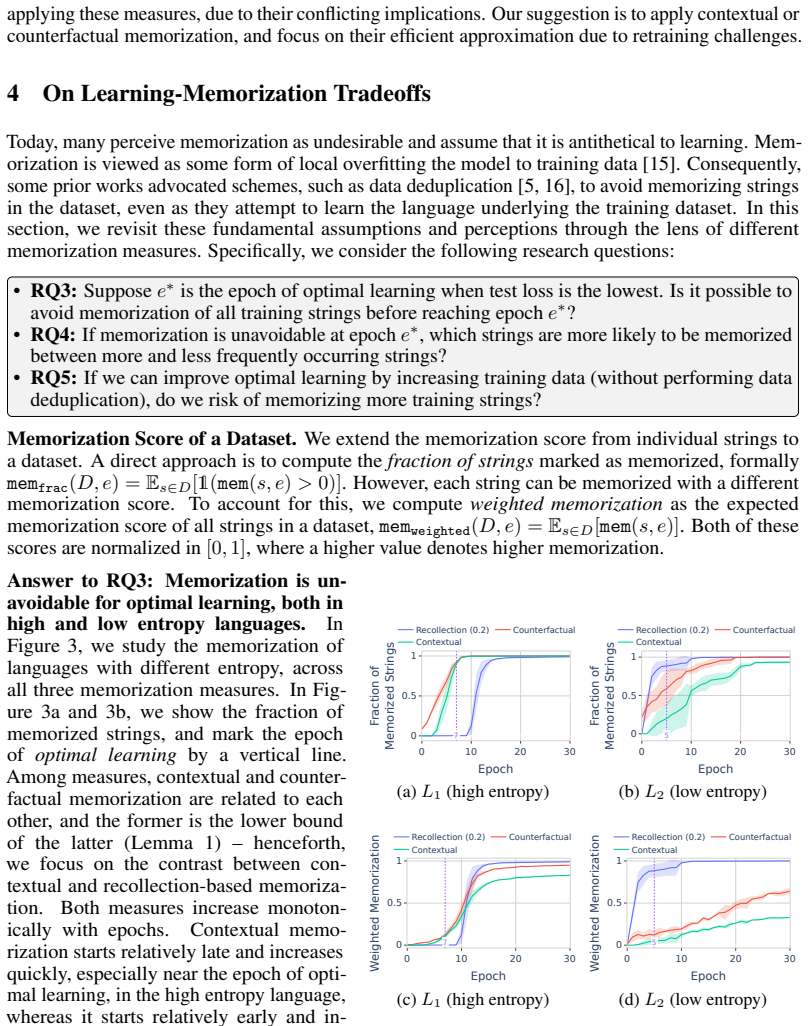
- [Section 4, Answer to RQ3, Figure 3, Appendix C] The claim that 'Memorization is unavoidable for optimal learning, both in high and low entropy languages' is stated as a universal impossibility, but the evidence is a finite set of runs: 50 epochs, one learning-rate schedule, no regularization or early-stopping search, dataset sizes 16 to 1024, and eight small hierarchical PCFGs. The paper never searches for a memorization-free optimal configuration, for example with weight decay, different optimizers, larger datasets, or different initializations. Figure 5, in fact, shows weighted contextual memorization decreasing monotonically with dataset size, so the data are consistent with memorization vanishing in the large-data limit; no asymptotic argument rules that out. The conclusion should be weakened to 'in the training configurations we tested' or supported by a theoretical impossibility result that does not depend on the particular training setup.
- [Appendix B, Lemma 1] The proof of Lemma 1 relies on the assumption that at any epoch the training loss of a string is no higher than the counterfactual test loss of the same string when the string is excluded from training. This inequality is asserted as 'a feasible assumption in practice' but is not verified empirically on any of the 18 models or 8 languages used in the paper. The assumption is load-bearing: it drives both the conclusion that contextual memorization starts no earlier than counterfactual memorization and the bound on scores. In real training, the training loss can exceed the held-out loss on a specific string, particularly at early epochs or after learning-rate warm-up, and this would break the inequality chain. The authors should either verify the assumption across their runs or state Lemma 1 as conditional on this property, with a discussion of when it may fail.
- [Section 2 and Appendix C] The generalization from fine-tuning pretrained LLMs on eight synthetic formal languages to natural language learning is unvalidated. The paper asserts that the controlled setup ensures 'learning and memorization are unaffected by prior training,' but the experiments begin from pretrained checkpoints, so the models already have substantial knowledge of the token stream and training dynamics from their original pretraining corpora. It is not shown that fine-tuning on small hierarchical PCFGs reproduces the learning-versus-memorization dynamics of large-scale natural language pretraining. The abstract and conclusions speak of 'learning a language' without qualification; the scope should be restricted to the tested formal-language fine-tuning regime, or an additional experiment closer to naturalistic distributions should be included.
- [Section 3.1 and Section 4] The impossibility result is operationalized through the paper's own contextual memorization measure, which declares a string memorized as soon as its training loss drops below the minimum counterfactual test loss. The universal claim is therefore partly a property of this operationalization rather than an independent fact about learning. The paper does report nonzero counterfactual memorization as well, but the recollection-based measure is threshold-dependent and shows the opposite pattern in some conditions. To support the strong statement, the authors should analyze sensitivity: how the 'unavoidable' conclusion changes with the definition of the contextual threshold, with alternative thresholds for recollection, or when the three measures disagree at the optimal epoch. Without such analysis, the headline claim risks overstating what the new measure alone establishes.
minor comments (4)
- [Section 3.2] In the sentence describing Figure 2a, the epochs are given as '(erec s1 = 10, erec s1 = 12)'; the second should presumably refer to s2, not s1.
- [Section 5 and Table 1] The phrase 'upper bound (UB) of the optimal contextual accuracy' is confusing: a reference model's higher accuracy is evidence that a string is easy to recollect from context, not an upper bound on the optimal contextual accuracy in the usual sense. The terminology and the inference from OLMo-1B's accuracy to 'unlikely to be contextually memorized' should be clarified.
- [Appendix C] The learning-rate specification is inconsistent: 'Mistral, Opt, and Llama-2 families as 5 × 10⁻⁶, and Pythia family as 10−5' should state '1 × 10⁻⁵' for clarity.
- [Figure 22 caption] The label 'Llama-3.1-∗B' is ambiguous; the exact model size should be given, as is done for other families.
Circularity Check
No significant circularity: the impossibility claim is an empirical generalization, not an identity or a self-citation reduction.
full rationale
I walked the paper's derivation chain and found no step in which a claimed prediction or first-principles result is equivalent to its inputs by construction. The central claim, "Memorization is unavoidable for optimal learning" (Section 4, Answer to RQ3), is supported by measuring memctx and memcf at the epoch of lowest held-out test loss. The thresholds in Equations (1) and (3) come from separately retrained models on datasets excluding the target string; they are not fitted to the conclusion. The 'optimal contextual loss' min_e* loss(Me*(D'), s) and the global optimal-learning epoch argmin_e test loss are distinct quantities, so the positivity of memctx at e* is an empirical observation, not a definitional identity. Lemma 1 is a genuine theorem proved from the definitions and an explicit assumption, so it is not circular. The paper does cite two works with overlapping authorship ([52] and [63]), but neither is load-bearing: [63] appears only in a bracketed related-work citation about context-based recollection, and [52] supports a side comment about PII predictability in Section 5. The self-contained formal-language experiments, 18 LLMs, and external counterfactual baseline [14] give the central claim independent content. The 'unavoidable' phrasing is stronger than the finite set of runs (8 small PCFGs, 50 epochs, one LR schedule, dataset sizes 16-1024) and Figure 5 even shows contextual memorization decreasing with dataset size, so the universality conclusion may be under-supported; however, that is an evidence-strength and generalization concern, not circularity by construction.
Assumptions & free parameters
free parameters (1)
- Recollection threshold tau =
0.2
assumptions (4)
- domain assumption At any training epoch, the training loss of a string is not higher than the counterfactual test loss of the string when it is excluded from training.
- domain assumption Synthetic hierarchical probabilistic context-free grammars with tokens and controlled probabilities capture the recursive structure and learning dynamics of natural language.
- domain assumption Fine-tuning a pretrained LLM on formal-language strings measures memorization that is unaffected by the model's prior pretraining.
- domain assumption The reference model OLMo-1B, trained on Dolma, provides an upper bound on optimal contextual recollection for Pythia-1B-deduped memorized strings.
invented entities (1)
-
Contextual memorization and optimal contextual recollection
Cite this review
Pith. "Pith review of Rethinking Memorization Measures and their Implications in Large Language Models." pith.science (2026). https://pith.science/paper/CGLZE3G4
@misc{pith2026250714777,
  author       = {Pith},
  title        = {Pith review of: Rethinking Memorization Measures and their Implications in Large Language Models},
  year         = {2026},
  howpublished = {\url{https://pith.science/paper/CGLZE3G4}},
  note         = {Machine review of arXiv:2507.14777}
}
read the original abstract
Concerned with privacy threats, memorization in LLMs is often seen as undesirable, specifically for learning. In this paper, we study whether memorization can be avoided when optimally learning a language, and whether the privacy threat posed by memorization is exaggerated or not. To this end, we re-examine existing privacy-focused measures of memorization, namely recollection-based and counterfactual memorization, along with a newly proposed contextual memorization. Relating memorization to local over-fitting during learning, contextual memorization aims to disentangle memorization from the contextual learning ability of LLMs. Informally, a string is contextually memorized if its recollection due to training exceeds the optimal contextual recollection, a learned threshold denoting the best contextual learning without training. Conceptually, contextual recollection avoids the fallacy of recollection-based memorization, where any form of high recollection is a sign of memorization. Theoretically, contextual memorization relates to counterfactual memorization, but imposes stronger conditions. Memorization measures differ in outcomes and information requirements. Experimenting on 18 LLMs from 6 families and multiple formal languages of different entropy, we show that (a) memorization measures disagree on memorization order of varying frequent strings, (b) optimal learning of a language cannot avoid partial memorization of training strings, and (c) improved learning decreases contextual and counterfactual memorization but increases recollection-based memorization. Finally, (d) we revisit existing reports of memorized strings by recollection that neither pose a privacy threat nor are contextually or counterfactually memorized.
Figures


Figures from the paper (33 more)


Reference graph
Works this paper leans on
-
[1]
On the dangers of stochastic parrots: Can language models be too big? In Proceedings of the 2021 ACM conference on fairness, accountability, and transparency, pages 610–623, 2021
Emily M Bender, Timnit Gebru, Angelina McMillan-Major, and Shmargaret Shmitchell. On the dangers of stochastic parrots: Can language models be too big? In Proceedings of the 2021 ACM conference on fairness, accountability, and transparency, pages 610–623, 2021
2021
-
[2]
Sparks of artificial general intelligence: Early experiments with gpt-4
Sébastien Bubeck, Varun Chandrasekaran, Ronen Eldan, Johannes Gehrke, Eric Horvitz, Ece Kamar, Peter Lee, Yin Tat Lee, Yuanzhi Li, Scott Lundberg, et al. Sparks of artificial general intelligence: Early experiments with gpt-4. arXiv preprint arXiv:2303.12712, 2023
arXiv 2023
-
[3]
Avi Schwarzschild, Zhili Feng, Pratyush Maini, Zachary C Lipton, and J Zico Kolter. Rethinking llm memorization through the lens of adversarial compression.arXiv preprint arXiv:2404.15146, 2024
arXiv 2024
-
[4]
Emergent and predictable memorization in large language models
Stella Biderman, Usvsn Prashanth, Lintang Sutawika, Hailey Schoelkopf, Quentin Anthony, Shivanshu Purohit, and Edward Raff. Emergent and predictable memorization in large language models. Advances in Neural Information Processing Systems, 36, 2024
work page 2024
-
[5]
Deduplicating training data mitigates privacy risks in language models
Nikhil Kandpal, Eric Wallace, and Colin Raffel. Deduplicating training data mitigates privacy risks in language models. In International Conference on Machine Learning, pages 10697– 10707. PMLR, 2022
work page 2022
-
[6]
Extracting training data from large language models
Nicholas Carlini, Florian Tramer, Eric Wallace, Matthew Jagielski, Ariel Herbert-V oss, Kather- ine Lee, Adam Roberts, Tom Brown, Dawn Song, Ulfar Erlingsson, et al. Extracting training data from large language models. In 30th USENIX Security Symposium (USENIX Security 21), pages 2633–2650, 2021
2021
-
[7]
The secret sharer: Evaluating and testing unintended memorization in neural networks
Nicholas Carlini, Chang Liu, Úlfar Erlingsson, Jernej Kos, and Dawn Song. The secret sharer: Evaluating and testing unintended memorization in neural networks. In 28th USENIX Security Symposium (USENIX Security 19), pages 267–284, 2019
work page 2019
-
[8]
Memorization without overfitting: Analyzing the training dynamics of large language models
Kushal Tirumala, Aram Markosyan, Luke Zettlemoyer, and Armen Aghajanyan. Memorization without overfitting: Analyzing the training dynamics of large language models. Advances in Neural Information Processing Systems, 35:38274–38290, 2022
work page 2022
Show all 68 references
-
[9]
An empirical analysis of memorization in fine-tuned autoregressive language models
Fatemehsadat Mireshghallah, Archit Uniyal, Tianhao Wang, David K Evans, and Taylor Berg- Kirkpatrick. An empirical analysis of memorization in fine-tuned autoregressive language models. In Proceedings of the 2022 Conference on Empirical Methods in Natural Language Processing, ...
2022
-
[10]
Preventing verbatim memorization in language models gives a false sense of privacy
Daphne Ippolito, Florian Tramèr, Milad Nasr, Chiyuan Zhang, Matthew Jagielski, Katherine Lee, Christopher A Choquette-Choo, and Nicholas Carlini. Preventing verbatim memorization in language models gives a false sense of privacy. arXiv preprint arXiv:2210.17546, 2022
-
[11]
Near-duplicate sequence search at scale for large language model memorization evaluation
Zhencan Peng, Zhizhi Wang, and Dong Deng. Near-duplicate sequence search at scale for large language model memorization evaluation. Proceedings of the ACM on Management of Data, 1 (2):1–18, 2023
2023
-
[12]
Uncovering latent memories: Assessing data leakage and memorization patterns in large language models
Sunny Duan, Mikail Khona, Abhiram Iyer, Rylan Schaeffer, and Ila R Fiete. Uncovering latent memories: Assessing data leakage and memorization patterns in large language models. In ICML 2024 Workshop on LLMs and Cognition, 2024
2024
-
[13]
Quantifying and analyzing entity-level memorization in large language models
Zhenhong Zhou, Jiuyang Xiang, Chaomeng Chen, and Sen Su. Quantifying and analyzing entity-level memorization in large language models. In Proceedings of the AAAI Conference on Artificial Intelligence, volume 38, pages 19741–19749, 2024
2024
-
[14]
Counterfactual memorization in neural language models
Chiyuan Zhang, Daphne Ippolito, Katherine Lee, Matthew Jagielski, Florian Tramèr, and Nicholas Carlini. Counterfactual memorization in neural language models. ArXiv, abs/2112.12938, 2021. URL https://api.semanticscholar.org/CorpusID: 245502053
2021 arXiv
-
[15]
On memorization in probabilistic deep generative models
Gerrit van den Burg and Chris Williams. On memorization in probabilistic deep generative models. Advances in Neural Information Processing Systems, 34:27916–27928, 2021. 11
2021
-
[16]
Deduplicating training data makes language models better
Katherine Lee, Daphne Ippolito, Andrew Nystrom, Chiyuan Zhang, Douglas Eck, Chris Callison-Burch, and Nicholas Carlini. Deduplicating training data makes language models better. arXiv preprint arXiv:2107.06499, 2021
2021 arXiv
-
[17]
‘improving ratings’: audit in the british university system
Marilyn Strathern. ‘improving ratings’: audit in the british university system. Euro- pean Review , 5(3):305–321, July 1997. doi: 10.1002/(sici)1234-981x(199707)5:3<305:: aid-euro184>3.0.co;2-4. URL https://doi.org/10.1002/(sici)1234-981x(199707)5: 3<305::aid-euro184>3.0.co;2-4
1997 doi
-
[18]
Quantifying memorization across neural language models
Nicholas Carlini, Daphne Ippolito, Matthew Jagielski, Katherine Lee, Florian Tramer, and Chiyuan Zhang. Quantifying memorization across neural language models. arXiv preprint arXiv:2202.07646, 2022
2022 arXiv
-
[19]
What languages are easy to language-model? a perspective from learning probabilistic regular languages
Nadav Borenstein, Anej Svete, Robin Chan, Josef Valvoda, Franz Nowak, Isabelle Augen- stein, Eleanor Chodroff, and Ryan Cotterell. What languages are easy to language-model? a perspective from learning probabilistic regular languages. arXiv preprint arXiv:2406.04289, 2024
2024 arXiv
-
[20]
In-context language learning: Arhitectures and algorithms
Ekin Akyürek, Bailin Wang, Yoon Kim, and Jacob Andreas. In-context language learning: Arhitectures and algorithms. arXiv preprint arXiv:2401.12973, 2024
2024 arXiv
-
[21]
Transparency at the source: Evaluating and interpreting language models with access to the true distribution
Jaap Jumelet and Willem Zuidema. Transparency at the source: Evaluating and interpreting language models with access to the true distribution. arXiv preprint arXiv:2310.14840, 2023
2023 arXiv
-
[22]
Injecting structural hints: Using language models to study inductive biases in language learning
Isabel Papadimitriou and Dan Jurafsky. Injecting structural hints: Using language models to study inductive biases in language learning. arXiv preprint arXiv:2304.13060, 2023
2023 arXiv
-
[23]
Examining the inductive bias of neural language models with artificial languages
Jennifer C White and Ryan Cotterell. Examining the inductive bias of neural language models with artificial languages. arXiv preprint arXiv:2106.01044, 2021
2021 arXiv
-
[24]
Towards more natural artificial languages
Mark Hopkins. Towards more natural artificial languages. InProceedings of the 26th Conference on Computational Natural Language Learning (CoNLL), pages 85–94, 2022
2022
-
[25]
Physics of language models: Part 1, learning hierarchical language structures
Zeyuan Allen-Zhu and Yuanzhi Li. Physics of language models: Part 1, learning hierarchical language structures. ArXiv e-prints, abs/2305.13673, May, 2023
2023 arXiv
-
[26]
Transformer working memory enables regular language reasoning and natural language length extrapolation
Ta-Chung Chi, Ting-Han Fan, Alexander I Rudnicky, and Peter J Ramadge. Transformer working memory enables regular language reasoning and natural language length extrapolation. arXiv preprint arXiv:2305.03796, 2023
2023 arXiv
-
[27]
Char- acterizing intrinsic compositionality in transformers with tree projections
Shikhar Murty, Pratyusha Sharma, Jacob Andreas, and Christopher D Manning. Char- acterizing intrinsic compositionality in transformers with tree projections. arXiv preprint arXiv:2211.01288, 2022
2022 arXiv
-
[28]
Transformers learn shortcuts to automata
Bingbin Liu, Jordan T Ash, Surbhi Goel, Akshay Krishnamurthy, and Cyril Zhang. Transformers learn shortcuts to automata. arXiv preprint arXiv:2210.10749, 2022
2022 arXiv
-
[29]
Learning bounded context- free-grammar via lstm and the transformer: difference and the explanations
Hui Shi, Sicun Gao, Yuandong Tian, Xinyun Chen, and Jishen Zhao. Learning bounded context- free-grammar via lstm and the transformer: difference and the explanations. In Proceedings of the AAAI conference on artificial intelligence, volume 36, pages 8267–8276, 2022
2022
-
[30]
On the ability and limitations of trans- formers to recognize formal languages
Satwik Bhattamishra, Kabir Ahuja, and Navin Goyal. On the ability and limitations of trans- formers to recognize formal languages. arXiv preprint arXiv:2009.11264, 2020
2009 arXiv
-
[31]
Formal languages and the nlp black box
William Merrill. Formal languages and the nlp black box. In International Conference on Developments in Language Theory, pages 1–8. Springer, 2023
2023
-
[32]
Transformers as recognizers of formal languages: A survey on expressivity
Lena Strobl, William Merrill, Gail Weiss, David Chiang, and Dana Angluin. Transformers as recognizers of formal languages: A survey on expressivity. arXiv preprint arXiv:2311.00208, 2023
2023 arXiv
-
[33]
Theoretical limitations of self-attention in neural sequence models
Michael Hahn. Theoretical limitations of self-attention in neural sequence models. Transactions of the Association for Computational Linguistics, 8:156–171, 2020. 12
2020
-
[34]
Neural networks and the chomsky hierarchy
Grégoire Delétang, Anian Ruoss, Jordi Grau-Moya, Tim Genewein, Li Kevin Wenliang, Elliot Catt, Chris Cundy, Marcus Hutter, Shane Legg, Joel Veness, et al. Neural networks and the chomsky hierarchy. arXiv preprint arXiv:2207.02098, 2022
2022 arXiv
-
[35]
Why are sensitive functions hard for transformers? arXiv preprint arXiv:2402.09963, 2024
Michael Hahn and Mark Rofin. Why are sensitive functions hard for transformers? arXiv preprint arXiv:2402.09963, 2024
2024 arXiv
-
[36]
Are all languages equally hard to language-model? arXiv preprint arXiv:1806.03743, 2018
Ryan Cotterell, Sabrina J Mielke, Jason Eisner, and Brian Roark. Are all languages equally hard to language-model? arXiv preprint arXiv:1806.03743, 2018
2018 arXiv
-
[37]
What kind of language is hard to language-model? arXiv preprint arXiv:1906.04726, 2019
Sabrina J Mielke, Ryan Cotterell, Kyle Gorman, Brian Roark, and Jason Eisner. What kind of language is hard to language-model? arXiv preprint arXiv:1906.04726, 2019
1906 arXiv
-
[38]
Elements of information theory
Thomas M Cover. Elements of information theory. John Wiley & Sons, 1999
1999
-
[39]
Carrasco
Rafael C. Carrasco. Accurate computation of the relative entropy between stochastic regular grammars. RAIRO-Theoretical Informatics and Applications, 31(5):437–444, 1997
1997
-
[40]
Albert Q. Jiang, Alexandre Sablayrolles, Arthur Mensch, Chris Bamford, Devendra Singh Chaplot, Diego de las Casas, Florian Bressand, Gianna Lengyel, Guillaume Lample, Lucile Saulnier, Lélio Renard Lavaud, Marie-Anne Lachaux, Pierre Stock, Teven Le Scao, Thibaut Lavril, Thomas ...
2023 arXiv
-
[41]
The llama 3 herd of models
Abhimanyu Dubey, Abhinav Jauhri, Abhinav Pandey, Abhishek Kadian, Ahmad Al-Dahle, Aiesha Letman, Akhil Mathur, Alan Schelten, Amy Yang, Angela Fan, et al. The llama 3 herd of models. arXiv preprint arXiv:2407.21783, 2024
2024 arXiv
-
[42]
An Yang, Baosong Yang, Beichen Zhang, Binyuan Hui, Bo Zheng, Bowen Yu, Chengyuan Li, Dayiheng Liu, Fei Huang, Haoran Wei, et al. Qwen2. 5 technical report. arXiv preprint arXiv:2412.15115, 2024
2024 arXiv
-
[43]
Gemma Team, Thomas Mesnard, Cassidy Hardin, Robert Dadashi, Surya Bhupatiraju, Shreya Pathak, Laurent Sifre, Morgane Rivière, Mihir Sanjay Kale, Juliette Love, Pouya Tafti, Léonard Hussenot, Pier Giuseppe Sessa, Aakanksha Chowdhery, Adam Roberts, Aditya Barua, Alex Botev, Alex...
2024 arXiv
-
[44]
Pythia: A suite for analyzing large language models across training and scaling
Stella Biderman, Hailey Schoelkopf, Quentin Gregory Anthony, Herbie Bradley, Kyle O’Brien, Eric Hallahan, Mohammad Aflah Khan, Shivanshu Purohit, USVSN Sai Prashanth, Edward Raff, et al. Pythia: A suite for analyzing large language models across training and scaling. In Intern...
2023
-
[45]
Opt: Open pre-trained transformer language models
Susan Zhang, Stephen Roller, Naman Goyal, Mikel Artetxe, Moya Chen, Shuohui Chen, Christopher Dewan, Mona Diab, Xian Li, Xi Victoria Lin, et al. Opt: Open pre-trained transformer language models. arXiv preprint arXiv:2205.01068, 2022. 13
2022 arXiv
-
[46]
Cross-entropy loss functions: Theoretical analysis and applications
Anqi Mao, Mehryar Mohri, and Yutao Zhong. Cross-entropy loss functions: Theoretical analysis and applications. In International conference on Machine learning, pages 23803–23828. PMLR, 2023
2023
-
[47]
Are large pre-trained language models leaking your personal information? arXiv preprint arXiv:2205.12628, 2022
Jie Huang, Hanyin Shao, and Kevin Chen-Chuan Chang. Are large pre-trained language models leaking your personal information? arXiv preprint arXiv:2205.12628, 2022
2022 arXiv
-
[48]
Propile: Probing privacy leakage in large language models
Siwon Kim, Sangdoo Yun, Hwaran Lee, Martin Gubri, Sungroh Yoon, and Seong Joon Oh. Propile: Probing privacy leakage in large language models. Advances in Neural Information Processing Systems, 36:20750–20762, 2023
2023
-
[49]
Measuring forgetting of memorized training examples
Matthew Jagielski, Om Thakkar, Florian Tramer, Daphne Ippolito, Katherine Lee, Nicholas Carlini, Eric Wallace, Shuang Song, Abhradeep Thakurta, Nicolas Papernot, et al. Measuring forgetting of memorized training examples. arXiv preprint arXiv:2207.00099, 2022
2022 arXiv
-
[50]
The pile: An 800gb dataset of diverse text for language modeling
Leo Gao, Stella Biderman, Sid Black, Laurence Golding, Travis Hoppe, Charles Foster, Jason Phang, Horace He, Anish Thite, Noa Nabeshima, et al. The pile: An 800gb dataset of diverse text for language modeling. arXiv preprint arXiv:2101.00027, 2020
2020 arXiv
-
[51]
Olmo: Accelerating the science of language models
Dirk Groeneveld, Iz Beltagy, Pete Walsh, Akshita Bhagia, Rodney Kinney, Oyvind Tafjord, Ananya Harsh Jha, Hamish Ivison, Ian Magnusson, Yizhong Wang, et al. Olmo: Accelerating the science of language models. arXiv preprint arXiv:2402.00838, 2024
2024 arXiv
-
[52]
Revisiting privacy, utility, and efficiency trade-offs when fine-tuning large language models
Soumi Das, Camila Kolling, Mohammad Aflah Khan, Mahsa Amani, Bishwamittra Ghosh, Qinyuan Wu, Till Speicher, and Krishna P Gummadi. Revisiting privacy, utility, and efficiency trade-offs when fine-tuning large language models. arXiv preprint arXiv:2502.13313, 2025
2025
-
[53]
Foundation models and fair use
Peter Henderson, Xuechen Li, Dan Jurafsky, Tatsunori Hashimoto, Mark A Lemley, and Percy Liang. Foundation models and fair use. Journal of Machine Learning Research, 24(400):1–79, 2023
2023
-
[54]
Llms and memorization: On quality and specificity of copyright compliance
Felix B Mueller, Rebekka Görge, Anna K Bernzen, Janna C Pirk, and Maximilian Poretschkin. Llms and memorization: On quality and specificity of copyright compliance. In Proceedings of the AAAI/ACM Conference on AI, Ethics, and Society, volume 7, pages 984–996, 2024
2024
-
[55]
Exploring memorization and copyright violation in frontier llms: A study of the new york times v
Joshua Freeman, Chloe Rippe, Edoardo Debenedetti, and Maksym Andriushchenko. Exploring memorization and copyright violation in frontier llms: A study of the new york times v. openai 2023 lawsuit. arXiv preprint arXiv:2412.06370, 2024
2023 arXiv
-
[56]
Undesirable memorization in large language models: A survey
Ali Satvaty, Suzan Verberne, and Fatih Turkmen. Undesirable memorization in large language models: A survey. arXiv preprint arXiv:2410.02650, 2024
2024
-
[57]
Measuring memorization in rlhf for code completion
Aneesh Pappu, Billy Porter, Ilia Shumailov, and Jamie Hayes. Measuring memorization in rlhf for code completion. arXiv preprint arXiv:2406.11715, 2024
2024 arXiv
-
[58]
What neural networks memorize and why: Discovering the long tail via influence estimation
Vitaly Feldman and Chiyuan Zhang. What neural networks memorize and why: Discovering the long tail via influence estimation. Advances in Neural Information Processing Systems, 33: 2881–2891, 2020
2020
-
[59]
Under- standing transformer memorization recall through idioms
Adi Haviv, Ido Cohen, Jacob Gidron, Roei Schuster, Yoav Goldberg, and Mor Geva. Under- standing transformer memorization recall through idioms. arXiv preprint arXiv:2210.03588, 2022
2022 arXiv
-
[60]
Generalization vs memorization: Tracing language models’ capabilities back to pretraining data
Xinyi Wang, Antonis Antoniades, Yanai Elazar, Alfonso Amayuelas, Alon Albalak, Kexun Zhang, and William Yang Wang. Generalization vs memorization: Tracing language models’ capabilities back to pretraining data. arXiv preprint arXiv:2407.14985, 2024
2024 arXiv
-
[61]
Think or remember? detecting and directing llms towards memorization or generalization
Yi-Fu Fu, Yu-Chieh Tu, Tzu-Ling Cheng, Cheng-Yu Lin, Yi-Ting Yang, Heng-Yi Liu, Keng-Te Liao, Da-Cheng Juan, and Shou-De Lin. Think or remember? detecting and directing llms towards memorization or generalization. arXiv preprint arXiv:2412.18497, 2024
2024 arXiv
-
[62]
Mem- orize or generalize? evaluating llm code generation with evolved questions
Wentao Chen, Lizhe Zhang, Li Zhong, Letian Peng, Zilong Wang, and Jingbo Shang. Mem- orize or generalize? evaluating llm code generation with evolved questions. arXiv preprint arXiv:2503.02296, 2025. 14
2025
-
[63]
Rethinking memorization in llms: On learning by rote vs
Till Speicher, Bishwamittra Ghosh, Mohammad Aflah Khan, Qinyuan Wu, Vedant Nanda, Soumi Das, Krishna P Gummadi, and Evimaria Terzi. Rethinking memorization in llms: On learning by rote vs. with understanding
-
[64]
Generalization or memorization: Data contamination and trustworthy evaluation for large language models
Yihong Dong, Xue Jiang, Huanyu Liu, Zhi Jin, Bin Gu, Mengfei Yang, and Ge Li. Generalization or memorization: Data contamination and trustworthy evaluation for large language models. arXiv preprint arXiv:2402.15938, 2024
2024 arXiv
-
[65]
How much do language models copy from their training data? evaluating linguistic novelty in text generation using raven
R Thomas McCoy, Paul Smolensky, Tal Linzen, Jianfeng Gao, and Asli Celikyilmaz. How much do language models copy from their training data? evaluating linguistic novelty in text generation using raven. Transactions of the Association for Computational Linguistics , 11: 652–670, 2023
2023
-
[66]
Probabilistic context-free grammars (pcfgs)
Michael Collins. Probabilistic context-free grammars (pcfgs). Lecture Notes, 2013
2013
-
[67]
Three models for the description of language.IRE Transactions on information theory, 2(3):113–124, 1956
Noam Chomsky. Three models for the description of language.IRE Transactions on information theory, 2(3):113–124, 1956. 15 Table 2: Characteristics of memorization measures. Memorization Measure Motivation Memorization Threshold Ease of Operationalization Strictness of Measure ...
1956
-
[68]
start" or
consider training accuracy as the proxy of memorization: given a training string as a prompt, an LLM memorizes it if it recollects the next token in the string correctly. Carlini et al.[18] propose a relatively stringent measure by imposing an exact recollection of the next 50...
2014
Reviewed August 6, 2026 · model on record in the stance chip above.
Discussion (0). Sign in to comment.