REVIEW 2 major objections 4 minor 54 references
A Tuneable Magnetic Domain Wall Conduit Regulating Nanoparticle Diffusion
T0 review · 2 major / 4 minor · reviewed 2026-08-14 · deepseek-v4-flash
Pith's one-line read Pairs of movable Bloch walls in an epitaxial ferrite garnet film create an open one-dimensional magnetic conduit in which submicrometer colloids feel a parabolic confining potential whose stiffness is set continuously by the applied field.
desk verdict A solid, useful demonstration of tunable parabolic confinement for submicron magnetic colloids; the two independent stiffness measurements agree, but the field-tunability curve rests on an unverified drag coefficient and the 75 nm extrapolation is thin. read the letter →
The pith
A machine-rendered reading of the paper's core claim, the machinery that carries it, and where it could break.
The reading
What carries the argument
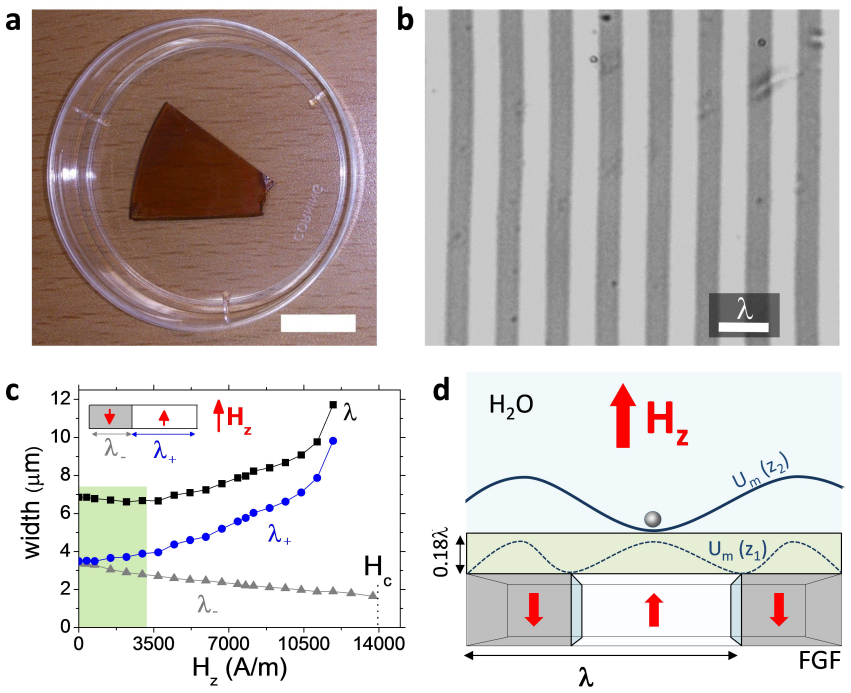
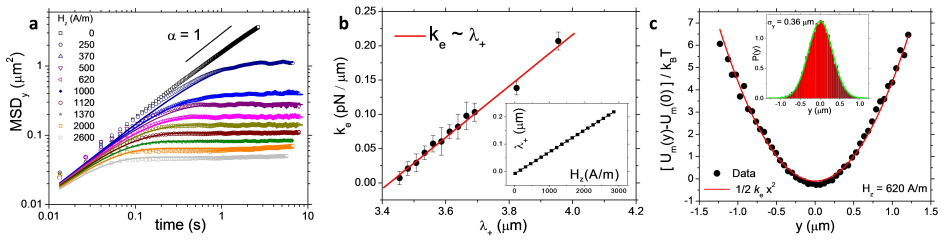
The central object is the magnetic conduit formed by a pair of 180° Bloch walls, narrow transition regions where the magnetization rotates between opposite domains. The load-bearing identity is the local harmonic approximation $U_m(y) \approx \frac{1}{2} k_e y^2$, whose validity is checked by comparing two independent extractions of $k_e$. The theoretical device converting measured trajectories into stiffness is the overdamped Langevin solution $\langle \Delta y^2 \rangle = \frac{k_B T}{k_e} [1 - \exp(-2 k_e t/\zeta)]$, whose plateau directly gives $k_e$, while the position histogram gives the potential shape through the Boltzmann relation. The linear calibration $k_e(\lambda_+)$, with $\lambda_+$ proportional to the applied field in the linear regime, is what turns the domain-wall pair into a tuneable conduit.
What would settle it
Track a 360 nm particle in the conduit at $H_z = 620$ A/m while measuring its height above the film with an independent optical technique, then recompute the magnetostatic curvature at that measured height; if the recomputed stiffness differs from the reported $k_e = 0.042$–$0.044$ pN/µm by more than a few percent, the fixed-elevation assumption and the quantitative parabolic-calibration claim would be falsified.
Extended reading notes
Core claim
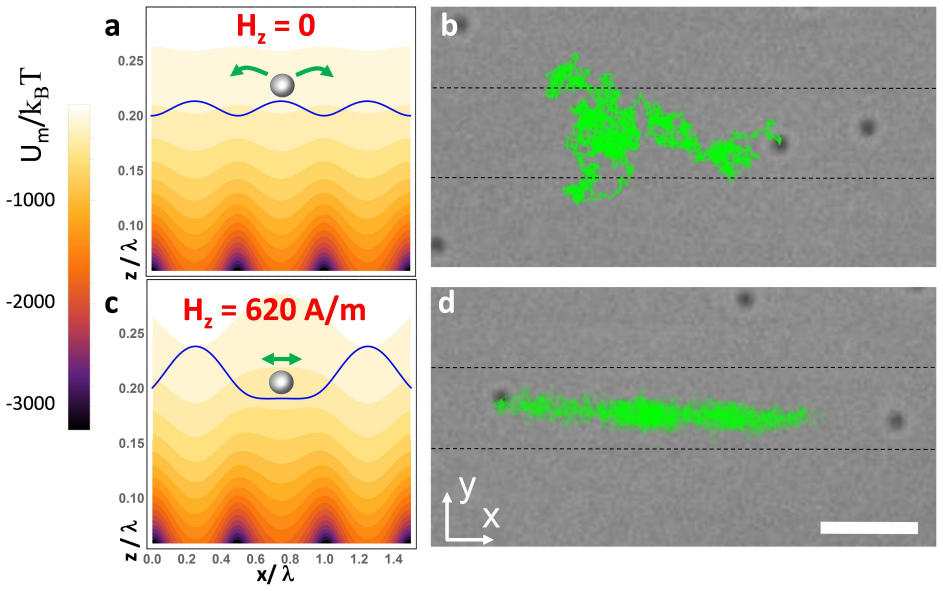
The paper claims that a ferrite garnet film with stripe domains, viewed at the elevation $z = h + d_p/2$ above the film, presents a magnetostatic potential whose minima lie under the centers of the majority domains and whose transverse profile is locally parabolic. A perpendicular field confines a particle to a narrow conduit between two Bloch walls, and the stiffness of the well can be extracted from the saturation of the transverse mean-squared displacement. The two independent determinations agree: $k_e = 0.042$ pN/µm from an overdamped Langevin fit and $k_e = 0.044$ pN/µm from Boltzmann-inverted position histograms, both at $H_z = 620$ A/m. The paper further establishes that $k_e$ grows linearly with the domain width $\lambda_+$, which is itself linear in $H_z$ over the working range, so the degree of confinement is set by one external control. This is presented as a general route to regulate the effective diffusive dimension of submicrometer colloids from two dimensions down to one.
Load-bearing premise
The load-bearing premise is that every particle levitates at a fixed height of about 80 nm above the polymer coating with a fixed effective magnetic susceptibility, because this height was inferred from diffusion-coefficient matching rather than measured directly and the reported spring constants would shift if the height changed with particle size or field.
Editorial extensions
If this is right
- A single external field amplitude sets the confinement strength, so one garnet film acts as a reconfigurable array of 1D channels whose width is adjustable in real time.
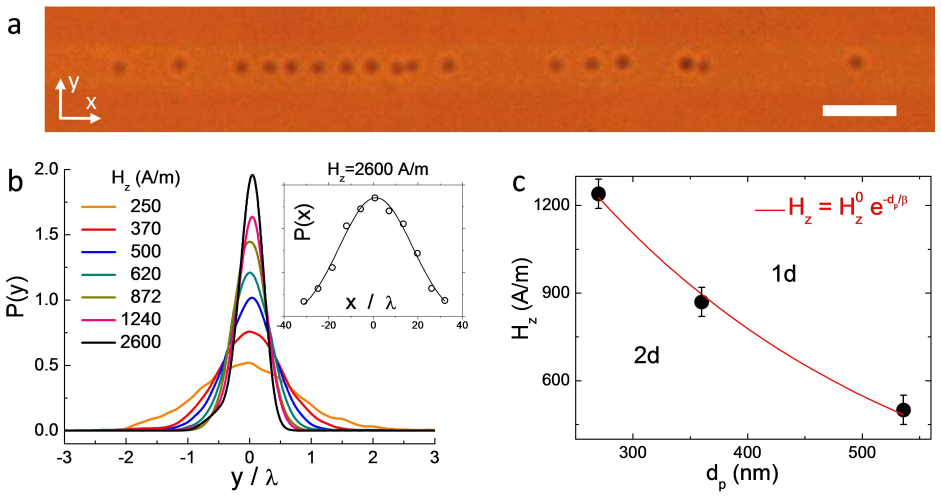
- At low linear density, strong enough fields force the colloids into non-passing single files; the 2D-to-1D crossover occurs at $H_z = 870$ A/m for 360 nm particles, with smaller particles needing stronger fields.
- The field required for one-dimensional confinement grows exponentially as particle diameter decreases, and the fitted curve implies 75 nm particles would enter the single-file regime at the maximum usable field before the stripe domains deform.
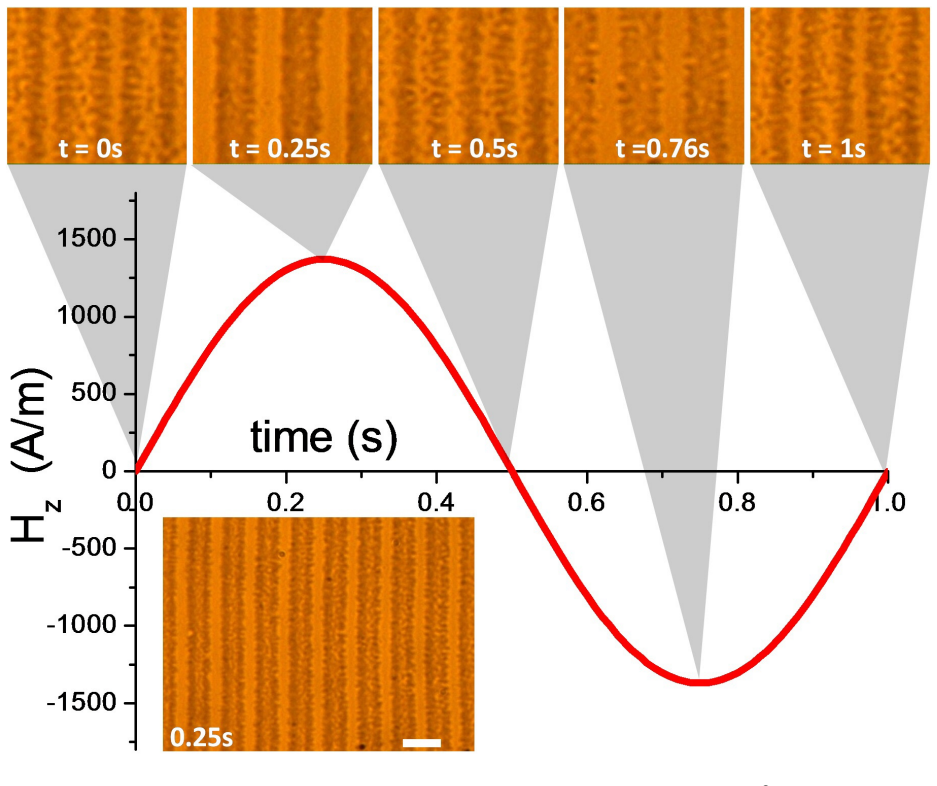
- An oscillating field periodically inverts the magnetic energy landscape, shuttling particles between neighboring domains and condensing them into parallel stripes whose solidified pattern can be stopped and reversed by controlling the field.
- Because the parabolic approximation is validated by two agreeing stiffness measurements, the system can serve as an experimental testbed for predictions about confined and single-file diffusion.
Reading between the lines
- Inference: The linear $k_e(\lambda_+)$ calibration means that measuring one MSD curve at a single field determines the trap stiffness everywhere in the linear regime, so users could skip per-field fitting.
- Inference: The potential shape at the particle plane depends on the elevation set by the polymer spacer, so changing the spacer thickness should tune the same film to confine particles smaller than 270 nm or shift the 2D-to-1D crossover without stronger fields.
- Inference: The exponential size–field extrapolation implies a practical floor near 75 nm for this film and field range; confining substantially smaller particles would likely require a thinner spacer, a higher-magnetization film, or lower temperature, none of which the paper tests.
Signed reviews
Editorial analysis
A structured set of objections, weighed in public.
Referee Report
Summary. The paper reports a method to confine submicrometer superparamagnetic particles in water using pairs of Bloch walls in a ferrite garnet film (FGF). The particles diffuse freely along the conduit and experience an approximately parabolic potential in the transverse direction, with a stiffness ke that is reported to increase linearly with the width of the majority magnetic domain λ+, which is in turn tuned by an applied perpendicular field Hz. The authors extract ke from fits of the overdamped Langevin MSD (Eq. 4) at several fields, and verify the parabolic shape and stiffness at one field (Hz = 620 A/m) by Boltzmann-inverting the position histogram, obtaining ke = 0.042 pN/µm (MSD) and ke = 0.044 pN/µm (histogram). They also demonstrate a 2D-to-1D crossover to single-file diffusion as the field increases, and show field-controlled condensation of particles into striped patterns. The central quantitative claim is that the stiffness is continuously tunable by the applied field.
Significance. If the central claim holds, this is a valuable and relatively simple platform for controlled 1D confinement of submicrometer colloids without topographic nanofabrication, with applications to diffusion studies and particle assembly. The paper has notable strengths: the spring constant is extracted from two independent observables (MSD plateau and position histogram) that agree within a few percent at one field, and the zero-field diffusion coefficients are consistent with Stokes-Einstein theory with a plausible wall correction. The use of an external field to tune the confinement in situ is a useful capability. However, the tunability curve ke(λ+) rests on an assumption about the constancy of the hydrodynamic drag coefficient across fields, which is not directly verified.
major comments (2)
- [Fig.3(a)-(b), Eq.(4)] The tunable-stiffness curve ke(λ+) is obtained by fitting Eq.(4) to the transverse MSDs while keeping ζ = 5.2×10^-3 pN·s/µm fixed at the zero-field value. This drag coefficient is measured from the zero-field diffusion coefficient D_FGF, and the particle elevation above the FGF is only inferred indirectly via a wall-correction factor that is referenced with an unresolved placeholder ('from the expression of f, ?'). The paper does not establish that the levitation height—and hence ζ—remains constant when Hz is varied, even though the magnetic force balance that sets the height changes with the applied field. If ζ varies with field, the extracted ke values in Fig.3(b) are systematically biased and the claimed linear ke(λ+) relation is not established. The position-histogram check at Hz = 620 A/m (Fig.3(c)) is ζ-independent, but it validates ke only at that single field. Please provide a ζ-independent determination of ke at several field values, or give a quantitative argument for the constancy of ζ across the field range.
- [Fig.4(b)-(c)] The crossover from 2D to 1D single-file motion is not defined operationally. The text states that 'by analyzing the particle distribution in Fig.4(b) we find that the crossover from 2d to 1d occurs for field amplitude Hz = 870A/m', but it does not specify the criterion (e.g., a threshold in the variance, the onset of non-passing behavior, or a change in the shape of P(y)). Without a precise definition, the crossover fields reported in Fig.4(c) for the three particle sizes are difficult to interpret. Furthermore, the exponential fit Hz = H0_z exp(−dp/β) uses only three data points (dp = 270, 360, 540 nm) with two adjustable parameters, so the extrapolated minimum particle size of 75 nm is fragile and should be presented with uncertainty estimates or supported by additional particle sizes.
minor comments (4)
- [Size dependence paragraph] The phrase 'linear dependence of the potential stiffness with the applied field, Fig.2(b)' appears to reference the wrong figure; the stiffness-versus-field data is shown in Fig.3(b).
- [Table 1 and wall-correction paragraph] The citation for the wall-correction expression is incomplete: 'from the expression of f, ?' contains an unresolved placeholder. Please provide the correct reference or a full derivation so that the 80 nm elevation estimate is reproducible.
- [Text near Fig.4(b) inset] The sentence 'We also shown that the particle distribution P(x) along the channel...' should read 'We also show...'.
- [Abstract] The abstract describes 'size tunable magnetic channels', but the channel width is tuned by the applied field rather than by particle size; consider rewording to 'field-tunable magnetic channels'.
Circularity Check
No significant circularity: the parabolic-confinement claim is supported by independent MSD and position-histogram fits, and the tunable stiffness is measured, not derived from its own inputs.
full rationale
The paper's central claim is experimental: that submicrometer particles in a Bloch-wall conduit experience a local parabolic potential whose stiffness ke can be tuned with the applied field. The stiffness is extracted from two independent observables. First, transverse MSD curves are fit to Eq. (4), the exact overdamped-Langevin result for a harmonic well, with ke as a free parameter and a fixed drag coefficient zeta = 5.2e-3 pN·s/um. Second, at Hz = 620 A/m the position histogram is Boltzmann-inverted to recover the local potential, and a parabolic fit gives ke = 0.044 pN/um, close to the MSD-derived value ke = 0.042 pN/um. This agreement is genuine cross-validation: the histogram method does not use zeta or the MSD fit, so the parabolic-well interpretation is not forced by construction. The fixed zeta value does depend on an inferred 80 nm levitation height obtained from measured zero-field diffusion coefficients and a wall-correction factor, and the citation for that factor appears as an unresolved placeholder in the text; this is a missing-reference and potential-robustness issue, but it is not circular because the inferred height is a calibration input, not the quantity being predicted. The linear ke(lambda+) relation in Fig. 3(b) is a fit to measured values, and the exponential crossover fit in Fig. 4(c) is likewise empirical; neither is presented as a derived prediction from the fitted inputs. Self-citations to earlier ferrite-garnet-film work support the experimental platform and the stray-field model, but they do not supply the measured ke values or the parabolic-potential evidence. No uniqueness theorem or prior-result invocation is used to forbid alternatives. The paper therefore does not reduce its central claim to its own assumptions or rename a fitted parameter as a prediction.
Assumptions & free parameters
free parameters (3)
- Transverse spring constant ke of the parabolic conduit =
ke = 0.042 pN/µm (MSD fit) and 0.044 pN/µm (histogram fit) at Hz = 620 A/m
- Exponential fit parameters H0_z and beta for the 2D-to-1D crossover field =
H0_z = 3158 A/m, beta = 285 nm
- Average particle-surface elevation above the polymer-coated FGF =
80 nm
assumptions (5)
- domain assumption The total magnetic field at a particle is the linear superposition of the applied field and the FGF stray field, and the induced dipole moment is m = V chi H_tot with effective volume susceptibility chi about 2.
- domain assumption The transverse trapping potential is locally parabolic, Um(y) = (1/2) ke y^2.
- standard math The overdamped Langevin equations (1)-(2) with white noise satisfying the fluctuation-dissipation relation describe the particle motion.
- domain assumption Particles remain at a fixed elevation above the film, z = h + dp/2 (about 80 nm above the polymer layer), with negligible out-of-plane motion.
- domain assumption In the field range used (below 3 kA/m) the domain widths lambda+ and lambda- vary linearly with Hz and the total stripe period lambda stays constant.
Cite this review
Pith. "Pith review of A Tuneable Magnetic Domain Wall Conduit Regulating Nanoparticle Diffusion." pith.science (2026). https://pith.science/paper/CGTCVP6S
@misc{pith2026190805039,
  author       = {Pith},
  title        = {Pith review of: A Tuneable Magnetic Domain Wall Conduit Regulating Nanoparticle Diffusion},
  year         = {2026},
  howpublished = {\url{https://pith.science/paper/CGTCVP6S}},
  note         = {Machine review of arXiv:1908.05039}
}
read the original abstract
We demonstrate a general and robust method to confine on a plane strongly diffusing submicrometer particles in water by using size tunable magnetic channels. These virtual conduits are realized with pairs of movable Bloch walls (BWs) located within an epitaxially grown ferrite garnet film. We show that, once inside the magnetic conduit, the particles experience an effective local parabolic potential in the transverse direction, while freely diffusing along the conduit. The stiffness of the magnetic potential is determined as a function of field amplitude which varies the width of the magnetic channel, and precise control of the degree of confinement is demonstrated by tuning the applied field. The magnetic conduit is then used to realize single files of non-passing particles and to induce periodic condensation of an ensemble of particles into parallel stripes in a completely controllable and reversible manner.
Figures
Figures from the paper (2 more)
Reference graph
Works this paper leans on
-
[1]
Valencia, P. M.; Farokhzad, O. C.; Karnik, R.; Langer, R. Nat. Nanotechnol. 2012, 7, 623--629
work page 2012
-
[2]
Grier, D. G. Nature 2003, 424, 810--816
work page 2003
- [3]
-
[4]
Ashkin, A. Phys. Rev. Lett. 1970, 24, 156--159
work page 1970
-
[5]
Cheng, Z.; Chaikin, P. M.; Mason, T. G. Phys. Rev. Lett. 2002, 89, 108303
work page 2002
-
[6]
Faucheux, L. P.; Bourdieu, L. S.; Kaplan, P. D.; Libchaber, A. J. Phys. Rev. Lett. 1995, 74, 1504
work page 1995
-
[7]
Hoogenboom, J. P.; Vossen, D. L. J.; Faivre-Moskalenko, C.; Dogterom, M.; van Blaaderen, A. Appl. Phys. Lett. 2002, 80, 4828--4830
work page 2002
-
[8]
Padgett, M.; Leonardo, R. D. Lab Chip 2011, 11, 1196--1205
work page 2011
Show all 54 references
-
[9]
M.; Jones, P
Marag\`o, O. M.; Jones, P. H.; Gucciardi, P. G.; Volpe, G.; Ferrari, A. C. Nat. Nanotechnol. 2013, 8, 807–819
2013
-
[10]
ACS Nano 2015, 9, 3453--3469
Lehmuskero, A.; Johansson, P.; Rubinsztein-Dunlop, H.; Tong, L.; Kall, M. ACS Nano 2015, 9, 3453--3469
2015
-
[11]
Svoboda, K.; Block, S. M. Opt. Lett. 1994, 19, 930--932
1994
-
[12]
M.; Bhatia, V
Hansen, P. M.; Bhatia, V. K.; Harrit, N.; Oddershede, L. Nano Lett. 2005, 5, 1937–1942
2005
-
[13]
M.; Oddershede, L
Bosanac, L.; Aabo, T.; Bendix, P. M.; Oddershede, L. B. Nano Lett. 2008, 8, 1486–1491
2008
-
[14]
Nature 2010, 467, 692--695
Krishnan, M.; Mojarad, N.; Kukura, P.; Sandoghdar, V. Nature 2010, 467, 692--695
2010
-
[15]
Cui, B.; Diamant, H.; Lin, B.; Rice, S. A. Phys. Rev. Lett. 2004, 92, 258301
2004
-
[16]
A.; Prieve, D
Bevan, M. A.; Prieve, D. C. Langmuir 2000, 16, 9274–9281
2000
-
[17]
C.; Sellmyer, D
Das, B.; Balasubramanian, B.; Manchanda, P.; Mukherjee, P.; Skomski, R.; Hadjipanayis, G. C.; Sellmyer, D. J. Nano Lett. 2016, 16, 1132--1137
2016
-
[18]
Nanoscale Res
Akbarzadeh, A.; Samiei, M.; Davaran, S. Nanoscale Res. Lett. 2012, 7, 144
2012
-
[19]
Banobre-Lopez, M.; Teijeiro, A.; Rivas, J. Rep. Prac. Oncol. Radiother. 2013, 18, 397--400
2013
-
[20]
M.; Weig, C.; Oswald, P.; Frey, E.; Fischer, P.; Liedl, T
Maier, A. M.; Weig, C.; Oswald, P.; Frey, E.; Fischer, P.; Liedl, T. Nano Lett. 2016, 16, 1132–1137
2016
-
[21]
Yellen, B.; Hovorka, O.; Friedman, G. Proc. Natl. Acad. Sci. U.S.A. 2005, 102, 8860–8864
2005
-
[22]
E.; Felton, S.; Pihl, J.; Svedlindh, P.; Berner, S.; Lidbaum, H.; Oscarsson, S
Gunnarsson, K.; Roy, P. E.; Felton, S.; Pihl, J.; Svedlindh, P.; Berner, S.; Lidbaum, H.; Oscarsson, S. Adv. Mater. 2005, 17, 1730–1734
2005
-
[23]
F.; Metlushko, V.; Ilic, B.; Cantoni, M.; Petti, D.; Brivio, S.; Bertacco, R
Donolato, M.; Gobbi, M.; Vavassori, P.; Deryabina, M.; Hansen, M. F.; Metlushko, V.; Ilic, B.; Cantoni, M.; Petti, D.; Brivio, S.; Bertacco, R. Adv. Mater. 2010, 22, 2706–2710
2010
-
[24]
Ehresmann, A.; Lengemann, D.; Weis, T.; Albrecht, A.; Langfahl-Klabes, J.; Gollner, F.; Engel, D. Adv. Mater. 2011, 23, 5568–5573
2011
-
[25]
Rapoport, E.; Montana, D.; Beach, G. S. Lab Chip 2012, 12, 4433--4440
2012
-
[26]
F.; Pillai, P
Demir\"ors, A. F.; Pillai, P. P.; Kowalczyk, B.; Grzybowski, B. A. Nature 2013, 503, 99–103
2013
-
[27]
H.; van IJzendoorn, L
van Ommering, K.; Nieuwenhuis, J. H.; van IJzendoorn, L. J.; Koopmans, B.; Prins, M. W. J. Appl. Phys. Lett. 2006, 89, 142511
2006
-
[28]
S.; Laczkowski, P.; Nguyen, V
Torres, W. S.; Laczkowski, P.; Nguyen, V. D.; Sanchez, J. C. R.; Vila, L.; Marty, A.; Jamet, M.; Attan\'e, J. P. Nano Lett. 2014, 14, 4016--4022
2014
-
[29]
H.; Swagten, H
Franken, J. H.; Swagten, H. J. M.; Koopmans, B. Nature Nanotech. 2012, 7, 499--503
2012
-
[30]
Nano Lett
Phung, T.; Pushp, A.; Thomas, L.; Rettner, C.; Yang, S.-H.; Ryu, K.-S.; Baglin, J.; Hughes, B.; Parkin, S. Nano Lett. 2015, 15, 835--841
2015
-
[31]
Nano Lett
Gu, Q.; Falk, A.; Wu, J.; Ouyang, L.; Park, H. Nano Lett. 2007, 7, 363--366
2007
-
[32]
Jiang, X.; Thomas, L.; Moriya, R.; Parkin, S. S. P. Nano Lett. 2011, 11, 96--100
2011
-
[33]
D.; Weatherill, K
West, A. D.; Weatherill, K. J.; Hayward, T. J.; Fry, P. W.; Schrefl, T.; Gibbs, M. R. J.; Adams, C. S.; Allwood, D. A.; Hughes, I. G. Nano Lett. 2012, 12, 4065--4069
2012
-
[34]
M.; Johansen, T
Helseth, L.; Fischer, T. M.; Johansen, T. H. Phys. Rev. E 2003, 67, 042401
2003
-
[35]
H.; Fischer, T
Tierno, P.; Sagues, F.; Johansen, T. H.; Fischer, T. M. Phys. Chem. Chem. Phys. 2009, 11, 9615--9625
2009
-
[36]
H.; Pan, A
Johansen, T. H.; Pan, A. V.; Galperin, Y. M. Phys. Rev. B 2013, 87, 060402
2013
-
[37]
V.; Tierno, P
Straube, A. V.; Tierno, P. Europhys. Lett. 2013, 103, 28001
2013
-
[38]
Low Reynolds Number Hydrodynamics; Noordhoff International Publishing: Leyden, The Netherlands, 1973
Happel, J.; Brenner, H. Low Reynolds Number Hydrodynamics; Noordhoff International Publishing: Leyden, The Netherlands, 1973
1973
-
[39]
C.; Uhlenbeck, G
Wang, M. C.; Uhlenbeck, G. E. Rev. Mod. Phys. 1945, 17, 323--342
1945
-
[40]
Diffusion in zeolites and other microporous solids; Wiley: New York, 1992
K\"arger, J., Ruthven, D., Eds. Diffusion in zeolites and other microporous solids; Wiley: New York, 1992
1992
-
[41]
L.; Keynes, R
Hodgkin, A. L.; Keynes, R. D. J. Physiol. 1955, 128, 28--60
1955
-
[42]
Dvoyashkin, M.; Bhase, H.; Mirnazari, N.; Vasenkov, S.; Bowers, C. R. Anal. Chem. 2014, 86, 2200--2204
2014
-
[43]
R.; Sekar, P.; Dvoyashkin, M.; Bowers, C
Dutta, A. R.; Sekar, P.; Dvoyashkin, M.; Bowers, C. R.; Ziegler, K. J.; Vasenkov, S. Chem. Commun. 2015, 51, 13346--13349
2015
-
[44]
Das, A.; Jayanthi, S.; Deepak, H. S. M. V.; Ramanathan, K. V.; Kumar, A.; Dasgupta, C.; Sood, A. K. ACS Nano 2010, 4, 1687
2010
-
[45]
Science 2000, 287, 625--627
Wei, Q.-H.; Bechinger, C.; Leiderer, P. Science 2000, 287, 625--627
2000
-
[46]
Lutz, C.; Kollmann, M.; Bechinger, C. Phys. Rev. Lett. 2004, 93, 026001
2004
-
[47]
V.; Nelissen, K.; Misko, V
Lucena, D.; Tkachenko, D. V.; Nelissen, K.; Misko, V. R.; Ferreira, W. P.; Farias, G. A.; Peeters, F. M. Phys. Rev. E 2012, 85, 031147
2012
-
[48]
Siems, U.; Kreuter, C.; Erbe, A.; Schwierz, N.; Sengupta, S.; Leiderer, P.; Nielaba, P. Sci. Rep. 2012, 2, 1015
2012
-
[49]
K\"arger, J. Phys. Rev. A 1992, 45, 4173--4174
1992
-
[50]
K\"arger, J. Phys. Rev. E 1993, 47, 1427--1428
1993
-
[51]
Helseth, L. E. Appl. Phys. Lett. 2007, 90, 093501
2007
-
[52]
D., Tom H., Ed
Johansen, S. D., Tom H., Ed. Magneto-Optical Imaging; Springer: Netherlands, 2004
2004
-
[53]
Klein, T.; Dorroh, D.; Li, Y.; Wang, J. P. J. Appl. Phys. 2011, 109, 07D506
2011
-
[54]
single file
Helseth, L. E.; Fischer, T. M.; Johansen, T. H. Phys. Rev. Lett. 2003, 91, 208302 mcitethebibliography Version.tex0000664000000000000000000007415113524751702011743 0ustar rootroot [journal=nalefd,manuscript=article] achemso [version=3] mhchem bm color xcolor red blue * [1] #1 ...
2003
Reviewed August 14, 2026 · model on record in the stance chip above.
Discussion (0). Continue with ORCID to comment.