REVIEW 2 major objections 4 minor 4 cited by
A Future Percent-Level Measurement of the Hubble Expansion at Redshift 0.8 With Advanced LIGO
T0 review · 2 major / 4 minor · reviewed 2026-08-14 · deepseek-v4-flash
Pith's one-line read Merging binary black holes can measure the expansion rate of the universe at redshift 0.8 to 2.9% after five years of Advanced LIGO/Virgo observations, using only the pair-instability supernova mass scale to break the mass-redshift…
desk verdict A clean, well-documented forecast of a new standard-siren route to H(z) at z~0.8 via the PISN mass cutoff, but the headline precision is hostage to an unquantified 1–2 solar mass redshift drift in that cutoff. read the letter →
The pith
A machine-rendered reading of the paper's core claim, the machinery that carries it, and where it could break.
The reading
What carries the argument
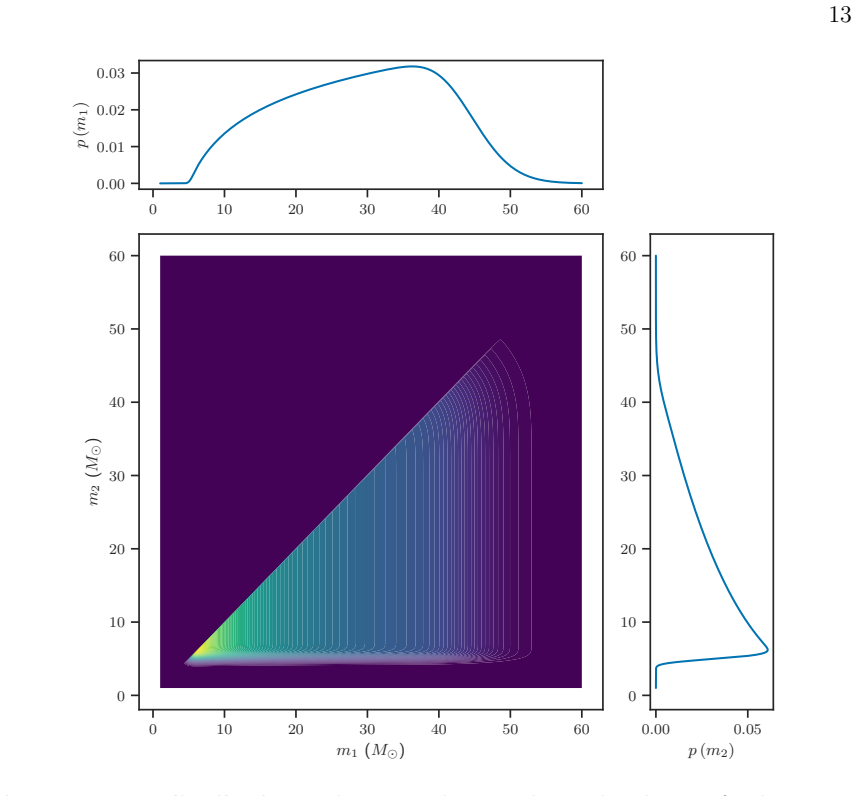
The machinery is the pair-instability supernova (PISN) mass cutoff used as a redshift calibrator. In the detector frame a black hole's measured mass is $m_{\rm det} = (1+z) m_{\rm source}$, so a source-frame cutoff that is fixed across cosmic time appears as a sharp diagonal edge in the detector-frame mass-distance plane; matching that edge to a single source-frame mass converts each event's measured distance into a redshift. The quantitative engine is a censored Poisson-process hierarchical model whose population distribution tapers smoothly to zero above $m_h \simeq 45\,M_\odot$ (Equations A1-A2) and whose likelihood incorporates per-event measurement uncertainties and the $\rho>8$ detection threshold; the posterior over $H_0$, $\Omega_M$, and $w$ is obtained after marginalizing over event-level masses, distances, and orientations.
What would settle it
Take a future sample of black hole mergers with independently known redshifts, for example events with electromagnetic counterparts or host-galaxy identifications, and measure the source-frame upper edge of the primary mass distribution as a function of redshift; if that edge shifts by more than about 2 solar masses between $z=0$ and $z=1.5$, the PISN-inferred $H(z)$ measurement is biased by more than the quoted 2.9% uncertainty.
Extended reading notes
Core claim
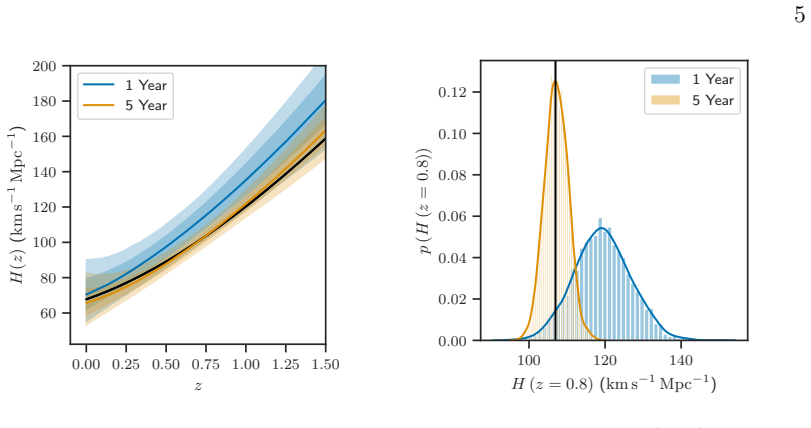
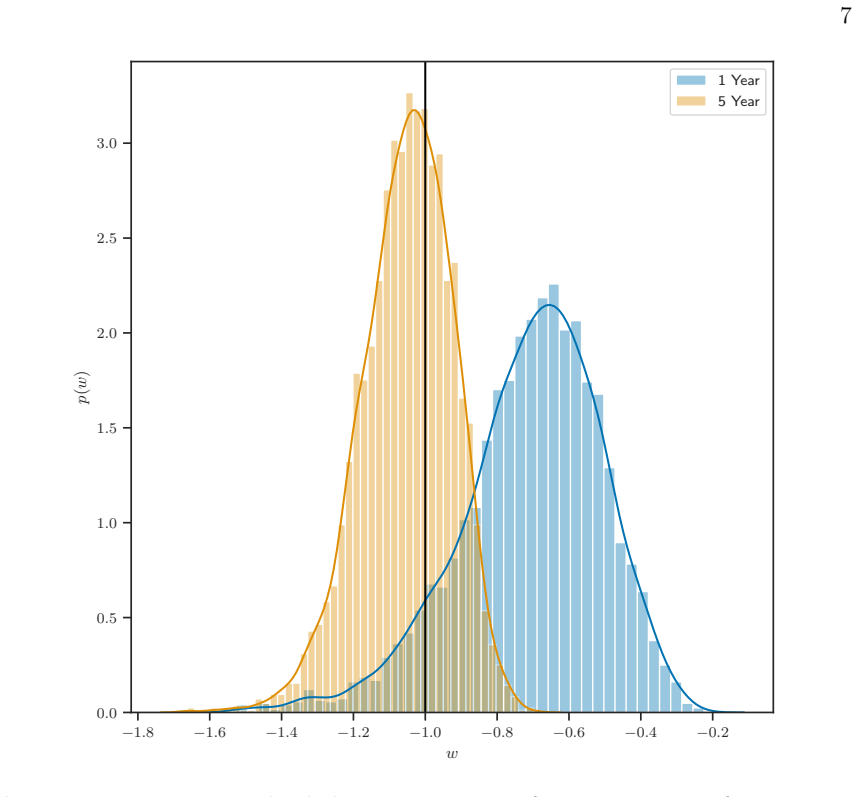
On the paper's own terms, the central discovery is that the population of merging binary black holes is a cosmological probe without a distance ladder: because general relativity is scale-free, the only thing linking measured gravitational-wave distances to redshifts is a mass scale, and the pair-instability supernova cutoff supplies exactly that scale. Treating the cutoff as a smooth taper around $m_h \simeq 45\,M_\odot$ in a hierarchical model that simultaneously fits the mass distribution, redshift evolution, selection effects, and a flat $w$CDM cosmology to synthetic catalogs, the paper finds the BBH population constrains $H(z)$ to 6.1% (68% credible interval) at the pivot redshift $z\simeq0.8$ after one year and 2.9% after five years at design sensitivity. The analysis also recovers the mass scale to $44.64^{+0.76}_{-0.81}\,M_\odot$ after five years, and interprets the measurement as an absolute distance scale at $z\simeq0.8$ that can calibrate Type Ia supernovae and the baryon acoustic oscillation sound horizon without external distance information. With informative priors on $H_0$ and matter density, the same population constrains the dark energy equation of state to 19% after one year and 12% after five years.
Load-bearing premise
The measurement depends on the assumption that the pair-instability cutoff mass near 45 solar masses is essentially constant across cosmic time out to $z\sim1.5$, or can be calibrated to better than the 1-2 solar mass drift that stellar models allow; if the cutoff moves with redshift, inferred redshifts and hence $H(z)$ are biased.
Editorial extensions
If this is right
- After one year of Advanced LIGO/Virgo at design sensitivity, the BBH population alone measures $H(z)$ to 6.1% at $z\simeq0.8$; after five years the constraint tightens to 2.9%.
- The measurement is independent of the cosmic distance ladder and of any assumed cosmological model, relying only on general relativity and a mass scale that is fixed or calibrated across cosmic time.
- Combining the absolute distance scale at $z\simeq0.8$ with Type Ia supernova or baryon acoustic oscillation data independently calibrates those standard candles and rulers, corresponding to an $H_0$ uncertainty of $\pm2.0\,\mathrm{km\,s^{-1}\,Mpc^{-1}}$ if mapped to $z=0$.
- A sharper PISN cutoff than the smooth taper assumed here reduces the quoted uncertainties by roughly a factor of two.
- Third-generation detectors, which see roughly 15,000 BBH mergers per month to $z\gtrsim10$, would yield sub-percent cosmography to $z\gtrsim4$ within one month of observation, provided the PISN mass scale is calibrated.
Reading between the lines
- This reading suggests that any sharp, approximately redshift-invariant feature in the compact-object mass distribution, not only the PISN cutoff, could serve as a redshift calibrator; a future detection of a pile-up near the maximum mass, or a neutron-star maximum-mass feature, would provide additional independent scales.
- Because the pivot redshift $z\simeq0.8$ sits near matter-dark-energy equality, the same population could be combined with a CMB-based high-redshift distance to constrain dark energy without relying on supernova standardization.
- A testable extension is to split detected events into distance bins and verify that the inferred source-frame cutoff is constant; a drift of more than a few solar masses would indicate either metallicity-driven evolution or a breakdown of the assumption, and could itself be modeled and calibrated.
- The method treats the PISN cutoff as a standardizable ruler, which suggests that redshift evolution of the mass scale could be measured jointly with cosmology rather than assumed, at the cost of some precision.
Signed reviews
Editorial analysis
A structured set of objections, weighed in public.
Referee Report
Summary. The paper proposes a new method to measure the cosmic expansion history at redshift z≈0.8 using binary black hole (BBH) mergers as standard sirens without electromagnetic counterparts. The key idea is that the pair-instability supernova (PISN) process imprints a sharp upper mass scale m_h≈45 M⊙ on the source-frame black hole mass distribution; because the observed waveform depends on the detector-frame mass m_det=m(1+z), the measured detector-frame cutoff can serve as a redshift indicator. The authors simulate one and five years of Advanced LIGO/Virgo observations at design sensitivity using a population model with a smooth PISN taper (Eq. A1–A2), a simplified measurement and selection model (Appendix B), and a full hierarchical Bayesian analysis (Eq. C17) that jointly fits population and cosmological parameters (H0, ΩM, w). They find 6.1% and 2.9% uncertainty on H(z=0.8) after one and five years, respectively, and 19% and 12% on w when external H0 and ΩM priors are imposed. The paper explicitly acknowledges that the PISN mass scale may evolve by 1–2 M⊙ out to z≈1.5 and states that this 'must be calibrated,' but it does not propagate this systematic into the quoted precision.
Significance. If the forecast holds, the method would provide a genuinely new cosmological probe: an absolute distance-scale measurement at z≈0.8 that is independent of the cosmic distance ladder and of electromagnetic counterparts. The paper is significant because it identifies a concrete mechanism by which the PISN mass scale can break the mass–redshift degeneracy, and it backs this with an end-to-end simulation rather than a back-of-the-envelope estimate. Strengths include the full hierarchical analysis with selection effects, the forward-modeling anchored to GWTC-1 population constraints and to Vitale et al. measurement uncertainties, and the public availability of the code and data. The stress-test concern about the PISN mass-scale drift is valid and lands: the 6.1% and 2.9% numbers are purely statistical and are conditional on an uncalibrated 1–2 M⊙ astrophysical systematic that is of order the five-year statistical error. The paper should be revised to quantify this systematic before the headline precision can be accepted as stated.
major comments (2)
- [Main text, p. 6–7 ('Our simplistic analysis…'); Appendix A, Eq. (A1)–(A2); Eq. (C17)] The central result, 2.9% on H(z=0.8) after five years, is a purely statistical uncertainty computed from a simulated catalog generated with a constant m_h=45 M⊙. The paper explicitly acknowledges that the PISN mass scale may evolve by 1–2 M⊙ by z≈1.5 and that changes at that level 'are a systematic that must be calibrated,' but no term for this drift or its calibration uncertainty enters the model in Eq. (C17) or the quoted error budget. Because the redshift assignment is essentially m_h→m_det/(1+z), an unaccounted drift δm_h(z) maps to a fractional bias in (1+z) of order δm_h/m_h; for a linear drift reaching 1–2 M⊙ at z=1.5, the bias at the pivot z=0.8 is roughly 1–2.5%, i.e. of the same order as the 2.9% statistical error, and larger at higher redshift or for nonlinear drift. The five-year posterior on m_h is 44.64^{+0.76}_{-0.81} M⊙, so the admitted 1–2 M⊙ systematic is considerably larger than the internal statistical error on the mass scale. The authors should either add a redshift-dependent m_h(z) to the population model with a prior informed by stellar-evolution calculations and report how the H(z) uncertainty degrades, or specify the required calibration accuracy on m_h(z) and demonstrate that it can be met. Without this, the headline precision is conditional in a way that the abstract does not fully convey.
- [Appendix B and Fig. 1; §4 (precision claims)] The quoted 6.1% and 2.9% uncertainties are computed with a simplified measurement model in which the single-event likelihood is approximated by Gaussian uncertainties on chirp mass, symmetric mass ratio, and the angular amplitude factor, tuned to reproduce Vitale et al. (2017). The text states that this model reproduces the correlated mass measurements and typical distance uncertainties, but no direct comparison is shown. Because the statistical precision scales roughly as the inverse square root of the number of events that usefully constrain the mass cutoff, a mismatch between the approximate likelihood and full parameter estimation could change the forecast by a factor of order unity. Please provide a quantitative validation of the approximation (for example, a comparison of mass and distance uncertainties for a set of synthetic signals under this model versus a full parameter-estimation pipeline) and state how the headline numbers would change if the distance or mass uncertainties were, say, 20% larger or smaller.
minor comments (4)
- [Appendix B, Eqs. (B14)–(B16)] The notation says quantities are 'measured with uncertainty' followed by a Gaussian width, but it is not explicitly stated whether these widths are the standard deviations used directly in the likelihood; please state this explicitly.
- [Fig. 1 caption] The caption says 'Dots denote the mean and bars the 1σ width of the likelihood for each event,' but a likelihood has no mean without a prior; please clarify that the points are posterior means from a single-event analysis with a reference prior.
- [Main text, p. 6 (w constraint)] The sentence 'We do not obtain any meaningful constraint on the evolution of wDE with redshift when this parameter is allowed to vary' would be more informative if accompanied by the posterior width of the evolution parameter, so the reader can judge how much information is lost.
- [Appendix A, Eq. (A2) and main text, p. 2] The text says the taper acts over a characteristic scale of about 5 M⊙, while Eq. (A2) sets σ_h=0.1 in log mass; at m_h=45 M⊙, σ_h=0.1 in natural log corresponds to about 4.5 M⊙, so the '5 M⊙' is approximate; please align the wording and equation.
Circularity Check
No significant circularity: the forecast is a forward simulation against external population and measurement models, not a derivation that reduces to its own inputs.
full rationale
The paper does not claim to derive cosmology from the PISN mass scale; it simulates a catalog from an assumed population (Eq. A1–A2) with external parameters (GWTC-1, Vitale et al. 2017, Planck) and then fits a hierarchical model to the simulated data. The target H(z) is not an input to the population model, and the mass-scale parameter m_h is fitted jointly with cosmology from the mock observations, with broad priors; recovering the injected cosmology is a self-consistency check rather than a circular reduction. Self-citations to Fishbach & Holz (2017) and Fishbach et al. (2018) supply empirical population inputs, not an unverified uniqueness theorem, and they do not by themselves force the result. The acknowledged 1–2 M⊙ redshift dependence of the PISN scale is a systematic uncertainty that must be calibrated externally; this limits the realism of the quoted precision but does not make the derivation circular.
Assumptions & free parameters
free parameters (7)
- BBH local merger rate R30 =
64.4 Gpc^-3 yr^-1 (assumed input)
- Primary mass power-law slope alpha =
0.75 (assumed input)
- Mass ratio slope beta =
0.0 (assumed input)
- Redshift evolution exponent gamma =
3.0 (assumed input)
- PISN cutoff mass m_h and taper width sigma_h =
45 M_sun, 0.1 (assumed input)
- Lower mass cutoff m_l and sigma_l =
5 M_sun, 0.1 (assumed input)
- Cosmological parameters H0, Omega_M, w =
Planck 2016 values (used to generate mock data)
assumptions (4)
- domain assumption The mass distribution of merging BBHs has a cutoff around m_h = 45 M_sun due to the PISN process (Eq. A1-A2).
- domain assumption The PISN mass scale is approximately constant with redshift (within 1 to 2 M_sun for z less than about 1.5).
- domain assumption The simplified measurement model in Appendix B (Gaussian uncertainties on log chirp mass, symmetric mass ratio, and amplitude, with SNR-dependent widths) reproduces the accuracy of full parameter estimation.
- domain assumption The detection selection function is approximated as a threshold on single-detector SNR rho greater than 8 (Eq. B11).
Cite this review
Pith. "Pith review of A Future Percent-Level Measurement of the Hubble Expansion at Redshift 0.8 With Advanced LIGO." pith.science (2026). https://pith.science/paper/CGZHLFA3
@misc{pith2026190809084,
  author       = {Pith},
  title        = {Pith review of: A Future Percent-Level Measurement of the Hubble Expansion at Redshift 0.8 With Advanced LIGO},
  year         = {2026},
  howpublished = {\url{https://pith.science/paper/CGZHLFA3}},
  note         = {Machine review of arXiv:1908.09084}
}
abstract
Simultaneous measurements of distance and redshift can be used to constrain the expansion history of the universe and associated cosmological parameters. Merging binary black hole (BBH) systems are standard sirens---their gravitational waveform provides direct information about the luminosity distance to the source. Because gravity is scale-free, there is a perfect degeneracy between the source masses and redshift; some non-gravitational information is necessary to break the degeneracy and determine the redshift of the source. Here we suggest that the pair instability supernova (PISN) process, thought to be the source of the observed upper-limit on the black hole (BH) mass in merging BBH systems at $\sim 45 \, M_\odot$, imprints a mass scale in the population of BBH mergers and permits a measurement of the redshift-luminosity-distance relation with these sources. We simulate five years of BBH detections in the Advanced LIGO and Virgo detectors with realistic assumptions about the BBH merger rate, a mass distribution incorporating a smooth PISN cutoff, and measurement uncertainty. We show that after one year of operation at design sensitivity (circa 2021) the BBH population can constrain $H(z)$ to $6.1\%$ at a pivot redshift $z \simeq 0.8$. After five years (circa 2025) the constraint improves to $2.9\%$. This measurement relies only on general relativity and the presence of a cutoff mass scale that is approximately fixed or calibrated across cosmic time; it is independent of any distance ladder or cosmological model. Observations by future ``third-generation'' gravitational wave detectors, which can see BBH mergers throughout the universe, would permit sub-percent cosmographical measurements to $z \gtrsim 4$ within one month of observation.
Figures


Figures from the paper (2 more)
Forward citations
Cited by 4 Pith papers
-
The fault in our sirens: Hierarchical diagnosis of waveform systematics in Hubble-Lema\^itre constant measurements
A 5% subpopulation of high-mass, spin-precessing black hole binaries, poorly modeled by current waveforms, makes future dark-siren Hubble constant measurements unreliable, and a hierarchical variance diagnostic can de...
-
Detectability and Parameter Estimation for Einstein Telescope Configurations with GWJulia
A new open-source Julia tool forecasts Einstein Telescope parameter-estimation accuracy, finding the 2L45 design marginally best for single parameters but comparable to other layouts when joint precision is required.
-
Cosmological Inference using Gravitational Wave Standard Sirens: A Mock Data Challenge
A mock data challenge shows that gravitational wave standard sirens can recover an unbiased Hubble constant with galaxy catalogs as incomplete as 25%, using the gwcosmo Bayesian pipeline.
-
A robust cosmic standard ruler from the cross-correlations of galaxies and dark sirens
Cross-correlating dark siren distances with galaxy redshifts, the 'Peak Sirens' method traces the Hubble diagram, forecasting 7% H0 precision for LVK O5 and sub-percent for next-generation detectors.
Reference graph
Works this paper leans on
-
[1]
, " * write output.state after.block = add.period write newline
ENTRY address archivePrefix author booktitle chapter doi edition editor eprint howpublished institution journal key month number organization pages publisher school series title misctitle type volume year version url label extra.label sort.label short.list INTEGERS output.state before.all mid.sentence after.sentence after.block FUNCTION init.state.consts ...
-
[2]
write newline
" write newline "" before.all 'output.state := FUNCTION format.url url empty "" new.block "" url * "" * if FUNCTION format.eprint eprint empty "" archivePrefix empty "" archivePrefix "arXiv" = new.block " " eprint * " " * new.block " " eprint * " " * if if if FUNCTION format.doi doi empty "" " " doi * " " * if FUNCTION format.pid doi empty eprint empty ""...
-
[3]
- [1] #1 = = ^ ^ ^ .\!\!^ d .\!\!^ h .\!\!^ m .\!\!^ s .\!\!^ @mss
thebibliography [1] 20pt to REFERENCES 6pt =0pt 10pt plus 3pt =0pt =0pt =1pt plus 1pt =0pt =0pt -12pt =13pt plus 1pt =20pt =13pt plus 1pt \@M =10000 =-1.0em =0pt =0pt 0pt =0pt =1.0em @enumiv\@empty 10000 10000 `\.\@m \@noitemerr \@latex@warning Empty `thebibliography' environment \@ifnextchar \@reference \@latexerr Missing key on reference command Each re...
2017
-
[4]
Abbott , B. P., Abbott , R., Abbott , T. D., et al. 2016 a , , 833, L1, 10.3847/2041-8205/833/1/L1
-
[5]
2016 b , The Astrophysical Journal Supplement Series, 227, 14, 10.3847/0067-0049/227/2/14
---. 2016 b , The Astrophysical Journal Supplement Series, 227, 14, 10.3847/0067-0049/227/2/14
-
[6]
2018, Living Reviews in Relativity, 21, 3, 10.1007/s41114-018-0012-9
---. 2018, Living Reviews in Relativity, 21, 3, 10.1007/s41114-018-0012-9
-
[7]
Abbott , T. M. C., Alarcon , A., Allam , S., et al. 2019, Physical Review Letters, 122, 171301, 10.1103/PhysRevLett.122.171301
-
[8]
Astropy Collaboration , Robitaille , T. P., Tollerud , E. J., et al. 2013, , 558, A33, 10.1051/0004-6361/201322068
Show all 63 references
-
[9]
E., et al
Aubourg , \'E ., Bailey , S., Bautista , J. E., et al. 2015, , 92, 123516, 10.1103/PhysRevD.92.123516
2015 doi
-
[10]
2019, , 874, 4, 10.3847/1538-4357/ab0898
Aylor , K., Joy , M., Knox , L., et al. 2019, , 874, 4, 10.3847/1538-4357/ab0898
2019 doi
-
[11]
2016, , 594, A97, 10.1051/0004-6361/201628980
Belczynski , K., Heger , A., Gladysz , W., et al. 2016, , 594, A97, 10.1051/0004-6361/201628980
2016 doi
-
[12]
2017, , 95, 044028, 10.1103/PhysRevD.95.044028
Boh \'e , A., Shao , L., Taracchini , A., et al. 2017, , 95, 044028, 10.1103/PhysRevD.95.044028
2017 doi
-
[13]
R., Arnett , W
Bond , J. R., Arnett , W. D., & Carr , B. J. 1984, , 280, 825, 10.1086/162057
1984 doi
-
[14]
2017, Journal of Statistical Software, Articles, 76, 1, 10.18637/jss.v076.i01
Carpenter, B., Gelman, A., Hoffman, M., et al. 2017, Journal of Statistical Software, Articles, 76, 1, 10.18637/jss.v076.i01
2017 doi
-
[15]
2017, , 95, 104004, 10.1103/PhysRevD.95.104004
Chatziioannou , K., Klein , A., Yunes , N., & Cornish , N. 2017, , 95, 104004, 10.1103/PhysRevD.95.104004
2017 doi
-
[16]
Chen , H.-Y., Fishbach , M., & Holz , D. E. 2017, ArXiv e-prints, arXiv:1712.06531. 1712.06531
2017 arXiv
-
[17]
J., Verde , L., Riess , A., & Jimenez , R
Cuesta , A. J., Verde , L., Riess , A., & Jimenez , R. 2015, , 448, 3463, 10.1093/mnras/stv261
2015 doi
-
[18]
2016, arXiv e-prints, arXiv:1611.00036
DESI Collaboration , Aghamousa , A., Aguilar , J., et al. 2016, arXiv e-prints, arXiv:1611.00036. 1611.00036
2016 arXiv
-
[19]
E., Melchiorri , A
Di Valentino , E., Holz , D. E., Melchiorri , A. r., & Renzi , F. 2018, Physical Review D, 98, 083523, 10.1103/PhysRevD.98.083523
2018 doi
-
[20]
Farr , W. M. 2019, Research Notes of the American Astronomical Society, 3, 66, 10.3847/2515-5172/ab1d5f
2019 doi
-
[21]
M., Peiris , H
Feeney , S. M., Peiris , H. V., Williamson , A. R., et al. 2019, , 122, 061105, 10.1103/PhysRevLett.122.061105
2019 doi
-
[22]
S., & Chernoff , D
Finn , L. S., & Chernoff , D. F. 1993, , 47, 2198, 10.1103/PhysRevD.47.2198
1993 doi
-
[23]
Fishbach , M., & Holz , D. E. 2017, , 851, L25, 10.3847/2041-8213/aa9bf6
2017 doi
-
[24]
E., & Farr , B
Fishbach , M., Holz , D. E., & Farr , B. 2017, The Astrophysical Journal, 840, L24, 10.3847/2041-8213/aa7045
2017 doi
-
[25]
E., & Farr , W
Fishbach , M., Holz , D. E., & Farr , W. M. 2018, ArXiv e-prints, arXiv:1805.10270. 1805.10270
2018 arXiv
- [26]
-
[27]
Gelman , A., & Rubin , D. B. 1992, Statistical Science, 7, 457, 10.1214/ss/1177011136
1992
-
[28]
2014, , 113, 151101, 10.1103/PhysRevLett.113.151101
Hannam , M., Schmidt , P., Boh \'e , A., et al. 2014, , 113, 151101, 10.1103/PhysRevLett.113.151101
2014 doi
-
[29]
Heger , A., & Woosley , S. E. 2002, , 567, 532, 10.1086/338487
2002 doi
-
[30]
Hogg , D. W. 1999, ArXiv e-prints, astro. astro-ph/9905116
1999 arXiv
-
[31]
W., Myers , A
Hogg , D. W., Myers , A. D., & Bovy , J. 2010, , 725, 2166, 10.1088/0004-637X/725/2/2166
2010 doi
- [32]
-
[33]
Hunter , J. D. 2007, Computing in Science and Engineering, 9, 90, 10.1109/MCSE.2007.55
2007 doi
-
[34]
2001--, SciPy : Open source scientific tools for Python
Jones, E., Oliphant, T., Peterson, P., et al. 2001--, SciPy : Open source scientific tools for Python . http://www.scipy.org/
2001
-
[35]
2016, , 93, 044007, 10.1103/PhysRevD.93.044007
Khan , S., Husa , S., Hannam , M., et al. 2016, , 93, 044007, 10.1103/PhysRevD.93.044007
2016 doi
-
[36]
Kumar, R., Carroll, C., Hartikainen, A., & Martin, O. A. 2019, The Journal of Open Source Software, 10.21105/joss.01143
2019 doi
-
[37]
2019, arXiv e-prints, arXiv:1901.11136
Leung , S.-C., Nomoto , K., & Blinnikov , S. 2019, arXiv e-prints, arXiv:1901.11136. 1901.11136
2019 arXiv
-
[38]
Loredo , T. J. 2004, in American Institute of Physics Conference Series, Vol. 735, American Institute of Physics Conference Series, ed. R. Fischer , R. Preuss , & U. V. Toussaint , 195--206
2004
-
[39]
2010, , 81, 084029, 10.1103/PhysRevD.81.084029
Mandel , I. 2010, , 81, 084029, 10.1103/PhysRevD.81.084029
2010 doi
-
[40]
M., & Gair , J
Mandel , I., Farr , W. M., & Gair , J. R. 2019, , 486, 1086, 10.1093/mnras/stz896
2019 doi
-
[41]
2017, , 472, 2422, 10.1093/mnras/stx2123
Mapelli , M., Giacobbo , N., Ripamonti , E., & Spera , M. 2017, , 472, 2422, 10.1093/mnras/stx2123
2017 doi
-
[42]
2018, arXiv e-prints, arXiv:1810.13412
Marchant , P., Renzo , M., Farmer , R., et al. 2018, arXiv e-prints, arXiv:1810.13412. 1810.13412
2018 arXiv
-
[43]
J., Feeney , S
Mortlock , D. J., Feeney , S. M., Peiris , H. V., Williamson , A. R., & Nissanke , S. M. 2018, arXiv e-prints, arXiv:1811.11723. 1811.11723
2018 arXiv
-
[44]
2012, arXiv e-prints, arXiv:1201.0490
Pedregosa , F., Varoquaux , G., Gramfort , A., et al. 2012, arXiv e-prints, arXiv:1201.0490. 1201.0490
2012 arXiv
-
[45]
Planck Collaboration , Ade , P. A. R., Aghanim , N., et al. 2016, , 594, A13, 10.1051/0004-6361/201525830
2016 doi
-
[46]
M., Sip o cz , B
Price-Whelan , A. M., Sip o cz , B. M., G \"u nther , H. M., et al. 2018, , 156, 123, 10.3847/1538-3881/aabc4f
2018 doi
-
[47]
Pérez, F., & Granger, B. E. 2007, Computing in Science & Engineering, 9, 21, 10.1109/MCSE.2007.53
2007 doi
-
[48]
1967, , 150, 131, 10.1086/149318
Rakavy , G., Shaviv , G., & Zinamon , Z. 1967, , 150, 131, 10.1086/149318
1967 doi
-
[49]
L., Zevin , M., Amaro-Seoane , P., et al
Rodriguez , C. L., Zevin , M., Amaro-Seoane , P., et al. 2019, arXiv e-prints, arXiv:1906.10260. 1906.10260
2019 arXiv
-
[50]
Schutz , B. F. 1986, , 323, 310, 10.1038/323310a0
1986 doi
-
[51]
M., Jones , D
Scolnic , D. M., Jones , D. O., Rest , A., et al. 2018, , 859, 101, 10.3847/1538-4357/aab9bb
2018 doi
-
[52]
2017, , 470, 4739, 10.1093/mnras/stx1576
Spera , M., & Mapelli , M. 2017, , 470, 4739, 10.1093/mnras/stx1576
2017 doi
-
[53]
2018, PyStan: The Python Interface to Stan
Stan Development Team . 2018, PyStan: The Python Interface to Stan. http://mc-stan.org
2018
-
[54]
2018, , 856, 173, 10.3847/1538-4357/aab34c
Talbot , C., & Thrane , E. 2018, , 856, 173, 10.3847/1538-4357/aab34c
2018 doi
-
[55]
2014, , 89, 061502, 10.1103/PhysRevD.89.061502
Taracchini , A., Buonanno , A., Pan , Y., et al. 2014, , 89, 061502, 10.1103/PhysRevD.89.061502
2014 doi
-
[56]
P., et al
The LIGO Scientific Collaboration , the Virgo Collaboration , Abbott , B. P., et al. 2018 a , arXiv e-prints, arXiv:1811.12907. 1811.12907
2018 arXiv
-
[57]
2018 b , arXiv e-prints, arXiv:1811.12940
---. 2018 b , arXiv e-prints, arXiv:1811.12940. 1811.12940
2018 arXiv
-
[58]
2015, , 91, 042003, 10.1103/PhysRevD.91.042003
Veitch , J., Raymond , V., Farr , B., et al. 2015, , 91, 042003, 10.1103/PhysRevD.91.042003
2015 doi
-
[59]
Vitale , S., & Farr , W. M. 2018, arXiv e-prints, arXiv:1808.00901. 1808.00901
2018 arXiv
-
[60]
2017, , 95, 064053, 10.1103/PhysRevD.95.064053
Vitale , S., Lynch , R., Raymond , V., et al. 2017, , 95, 064053, 10.1103/PhysRevD.95.064053
2017 doi
-
[61]
Walt, S. v. d., Colbert, S. C., & Varoquaux, G. 2011, Computing in Science & Engineering, 13, 22, 10.1109/MCSE.2011.37
2011 doi
-
[62]
2018, mwaskom/seaborn: v0.9.0 (July 2018), 10.5281/zenodo.1313201
Waskom, M., Botvinnik, O., O'Kane, D., et al. 2018, mwaskom/seaborn: v0.9.0 (July 2018), 10.5281/zenodo.1313201 . https://doi.org/10.5281/zenodo.1313201
2018 doi
-
[63]
Woosley , S. E. 2017, , 836, 244, 10.3847/1538-4357/836/2/244
2017 doi
Reviewed August 14, 2026 · model on record in the stance chip above.
Discussion (0). Continue with ORCID to comment.