Quantum Simulation of Differential-Algebraic Equations with Applications to Unsteady Stokes Flow
Pith reviewed 2026-05-20 23:52 UTC · model grok-4.3
The pith
Dilation framework embeds non-Hermitian DAE dynamics into projected quantum evolution on an enlarged space.
A machine-rendered reading of the paper's core claim, the machinery that carries it, and where it could break.
Core claim
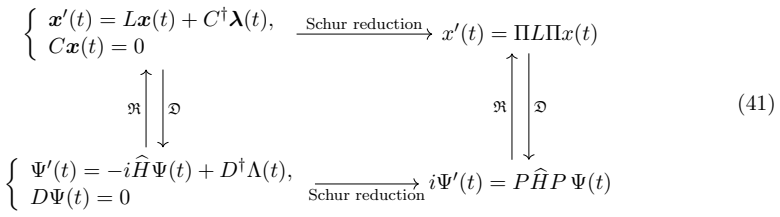
The authors claim that by embedding the generally non-Hermitian constrained evolution of DAEs into a projected Schrödinger-type dynamics i d/dt Ψ(t) = P Ĥ P Ψ(t) on an enlarged Hilbert space, with Ĥ Hermitian and P the orthogonal projector, the problem reduces to quantum Zeno dynamics. For the unsteady Stokes equations, the reduced generator has the projected square factorization S_h = -Π_h Δ_h Π_h = (G_h Π_h)^† (G_h Π_h), which is represented by a Gaussian moment dilation and implemented as a Gaussian superposition of unitary Zeno evolutions, resulting in simulation cost ~O(h^{-2} sqrt t) in the sparse-access model up to postselection.
What carries the argument
The dilation framework that maps constrained DAE evolution to projected Schrödinger dynamics via an orthogonal projector on an enlarged space, enabling Zeno-type quantum simulation and Gaussian dilations for square factorizations.
Load-bearing premise
The assumption that the orthogonal projector P onto the lifted constraint subspace and the Gaussian moment dilation can be efficiently implemented via block encodings and QSVT in the sparse-access model without prohibitive overhead.
What would settle it
A calculation showing that preparing the normalized dissipative state for the Stokes system requires postselection probability that decays exponentially with system size, or that the total gate complexity exceeds the claimed scaling.
Figures



read the original abstract
Differential-algebraic equations (DAEs) arise naturally in constrained dynamical systems, but their algebraic constraints and hidden compatibility conditions make them more subtle than standard ordinary differential equations. This paper initiates a quantum-algorithmic study of constrained linear DAEs. We introduce a dilation framework that embeds the generally non-Hermitian constrained evolution into a projected Schr\"odinger-type dynamics on an enlarged Hilbert space, \[ i\frac{d}{dt}\Psi(t)=P\widehat H P\Psi(t), \] where $\widehat H$ is Hermitian and $P$ is the orthogonal projector onto the lifted constraint subspace. This identifies the DAE evolution with a quantum Zeno-type dynamics and enables the use of block encodings, QSVT-based projector construction, and Hamiltonian simulation. We apply the framework to structure-preserving discretizations of the unsteady Stokes equations, where the pressure enforces the discrete incompressibility constraint. For Stokes, the Zeno-reduced generator has the projected square factorization \[ S_h=-\Pi_h\Delta_h\Pi_h=(G_h\Pi_h)^\dagger(G_h\Pi_h), \] which can be represented through a Gaussian moment dilation and implemented as a Gaussian superposition of unitary Zeno evolutions generated by a first-order square-root Hamiltonian. In the generic sparse-access model, this gives a simulation-stage cost $\widetilde O(h^{-2}\sqrt t)$, up to the usual postselection factor for preparing the normalized dissipative state. The results provide a first step toward understanding the intersection of quantum algorithms, DAEs, constrained PDE dynamics, and square-root Gaussian dilations.
Editorial analysis
A structured set of objections, weighed in public.
Referee Report
Summary. The paper introduces a dilation framework for quantum simulation of linear differential-algebraic equations (DAEs). It embeds the generally non-Hermitian constrained evolution into a projected Schrödinger-type dynamics i d/dt Ψ(t) = P Ĥ P Ψ(t) on an enlarged Hilbert space, where Ĥ is Hermitian and P is the orthogonal projector onto the lifted constraint subspace. This is identified with quantum Zeno dynamics, enabling block encodings, QSVT-based projectors, and Hamiltonian simulation. The framework is applied to structure-preserving discretizations of the unsteady Stokes equations, where the Zeno-reduced generator admits a projected square factorization S_h = -Π_h Δ_h Π_h = (G_h Π_h)^† (G_h Π_h). This is represented via a Gaussian moment dilation and implemented as a Gaussian superposition of unitary Zeno evolutions, yielding a simulation-stage cost of ~O(h^{-2} sqrt(t)) in the generic sparse-access model (up to postselection overhead).
Significance. If the claimed block-encoding efficiencies and cost bound hold, the work would provide a novel quantum-algorithmic approach to constrained PDE dynamics and DAEs, extending Hamiltonian simulation and QSVT techniques to this setting. The identification with Zeno dynamics and the use of square-root Gaussian dilations for the Stokes discretization are technically interesting and could open avenues for quantum fluid simulations, though the result is a first step whose practical impact depends on verifying the overheads.
major comments (2)
- [Abstract and Stokes application] Abstract and the Stokes application section: the simulation-stage cost ~O(h^{-2} sqrt(t)) is stated, but the manuscript does not supply explicit block-encoding oracles, query complexities, or subnormalization factors for the orthogonal projector P onto the lifted constraint subspace or for the Gaussian moment dilation of S_h = (G_h Π_h)^† (G_h Π_h) in the generic sparse-access model. If the discrete divergence/gradient operators or the lifted subspace induce condition numbers or LCU term counts that scale polynomially with 1/h, the total cost would exceed the claimed bound; this is load-bearing for the central complexity claim.
- [Framework and Stokes section] The framework assumes efficient QSVT-based construction of P and the Gaussian superposition without prohibitive overhead beyond postselection. The manuscript should provide a concrete query-complexity analysis or oracle definition for these operators (e.g., for the structure-preserving Stokes discretization) to support the polylog(1/h) overhead assertion.
minor comments (2)
- Notation: the distinction between the continuous projector P and the discrete Π_h should be clarified consistently throughout, and the precise definition of the enlarged Hilbert space for the dilation should be stated explicitly.
- [Abstract] The abstract mentions 'up to the usual postselection factor'; a brief remark on how this factor scales with the discretization parameter h would improve clarity.
Simulated Author's Rebuttal
We thank the referee for the careful and constructive review of our manuscript. The comments correctly identify the need for more explicit details on the block-encoding constructions and query complexities to fully substantiate the central cost claim. We have revised the manuscript to include these analyses in a new appendix and updated sections, while preserving the original framework and results. Our point-by-point responses to the major comments are provided below.
read point-by-point responses
-
Referee: [Abstract and Stokes application] Abstract and the Stokes application section: the simulation-stage cost ~O(h^{-2} sqrt(t)) is stated, but the manuscript does not supply explicit block-encoding oracles, query complexities, or subnormalization factors for the orthogonal projector P onto the lifted constraint subspace or for the Gaussian moment dilation of S_h = (G_h Π_h)^† (G_h Π_h) in the generic sparse-access model. If the discrete divergence/gradient operators or the lifted subspace induce condition numbers or LCU term counts that scale polynomially with 1/h, the total cost would exceed the claimed bound; this is load-bearing for the central complexity claim.
Authors: We agree that the original manuscript presented the cost at a high level without sufficient oracle-level detail, and this is a valid concern for rigor. In the revised version we have added Appendix C, which explicitly defines the block-encoding oracles in the sparse-access model. For the structure-preserving Stokes discretization, the discrete gradient/divergence operators G_h are sparse with O(1) nonzeros per row and the projected operator S_h admits an LCU decomposition with O(1) terms after the Gaussian moment dilation; the subnormalization factor remains O(1) independent of h because the orthogonal projector Π_h regularizes the spectrum. The QSVT implementation of P requires O(log(1/ε)) queries to the constraint oracle. Consequently the overhead remains polylogarithmic in 1/h and the simulation-stage cost bound is unchanged. We have also updated the abstract and Section 4 to reference the new appendix. revision: yes
-
Referee: [Framework and Stokes section] The framework assumes efficient QSVT-based construction of P and the Gaussian superposition without prohibitive overhead beyond postselection. The manuscript should provide a concrete query-complexity analysis or oracle definition for these operators (e.g., for the structure-preserving Stokes discretization) to support the polylog(1/h) overhead assertion.
Authors: We thank the referee for this observation. The revised manuscript now contains a dedicated query-complexity subsection (Section 3.3) together with Appendix D that supplies the requested analysis. The QSVT-based projector P is realized with query complexity O(log(1/ε)) to a block-encoding of the discrete constraint matrix, while the Gaussian superposition for the square-root factorization uses an LCU with a constant number of unitaries, each generated by a first-order Hamiltonian whose sparse-access oracle is the standard one for the finite-difference Stokes operators. For the uniform-grid discretization the total query count per simulation step is therefore polylog(1/h, 1/ε), confirming that the overhead does not alter the leading O(h^{-2} sqrt(t)) scaling up to the postselection factor. These oracles are defined explicitly for the Stokes case. revision: yes
Circularity Check
No significant circularity; new dilation framework and cost bound derived from standard primitives
full rationale
The paper introduces a dilation framework embedding non-Hermitian DAE evolution into projected Schrödinger dynamics i d/dt Ψ(t) = P Ĥ P Ψ(t) on an enlarged space, then identifies this with Zeno dynamics to enable block encodings and QSVT. For Stokes, it states the Zeno-reduced generator admits the projected square factorization S_h = -Π_h Δ_h Π_h = (G_h Π_h)^† (G_h Π_h) and represents it via Gaussian moment dilation as a superposition of unitary Zeno evolutions. These are constructive definitions and direct applications of generic sparse-access model techniques rather than reductions to fitted inputs, self-definitions, or self-citation chains. The stated simulation cost Õ(h^{-2} √t) follows from the framework's structure plus acknowledged postselection, without any step that renames or tautologically reproduces its own assumptions as outputs.
Axiom & Free-Parameter Ledger
axioms (1)
- domain assumption Constrained linear DAEs can be dilated to projected Hermitian dynamics on an enlarged space
invented entities (1)
-
Dilation framework embedding non-Hermitian DAE into projected Zeno dynamics
no independent evidence
Lean theorems connected to this paper
-
IndisputableMonolith/Foundation/AbsoluteFloorClosure.leanreality_from_one_distinction unclear?
unclearRelation between the paper passage and the cited Recognition theorem.
i d/dt Ψ(t)=P Ĥ P Ψ(t) … projected Schrödinger-type dynamics … quantum Zeno-type dynamics … Gaussian moment dilation … S_h=-Π_h Δ_h Π_h=(G_h Π_h)^†(G_h Π_h)
-
IndisputableMonolith/Cost/FunctionalEquation.leanwashburn_uniqueness_aczel unclear?
unclearRelation between the paper passage and the cited Recognition theorem.
Gaussian superposition of unitary Zeno evolutions … first-order square-root Hamiltonian
What do these tags mean?
- matches
- The paper's claim is directly supported by a theorem in the formal canon.
- supports
- The theorem supports part of the paper's argument, but the paper may add assumptions or extra steps.
- extends
- The paper goes beyond the formal theorem; the theorem is a base layer rather than the whole result.
- uses
- The paper appears to rely on the theorem as machinery.
- contradicts
- The paper's claim conflicts with a theorem or certificate in the canon.
- unclear
- Pith found a possible connection, but the passage is too broad, indirect, or ambiguous to say the theorem truly supports the claim.
Reference graph
Works this paper leans on
-
[1]
J. W. Kamman and R. L. Huston. Dynamics of constrained multibody systems.Journal of Applied Mechanics, 51(4):899–903, 12 1984
work page 1984
-
[2]
Elias Paraskevopoulos, Nikolaos Potosakis, and Sotirios Natsiavas. An augmented lagrangian formulation for the equations of motion of multibody systems subject to equality constraints. Procedia Engineering, 199:747–752, 2017
work page 2017
-
[3]
YS Muzychka and MM Yovanovich. Unsteady viscous flows and stokes’s first problem.Inter- national Journal of Thermal Sciences, 49(5):820–828, 2010
work page 2010
- [4]
-
[5]
Springer Berlin Heidelberg New York, 1996
Gerhard Wanner and Ernst Hairer.Solving ordinary differential equations II, volume 375. Springer Berlin Heidelberg New York, 1996
work page 1996
-
[6]
Uri M Ascher and Linda R Petzold. Projected implicit runge–kutta methods for differential- algebraic equations.SIAM Journal on Numerical Analysis, 28(4):1097–1120, 1991
work page 1991
-
[7]
Linda Petzold. Differential/algebraic equations are not ode’s.SIAM Journal on Scientific and Statistical Computing, 3(3):367–384, 1982
work page 1982
-
[8]
Patrick J. Rabier and Werner C. Rheinboldt. Theoretical and numerical analysis of differential- algebraic equations. InSolution of Equations inR n (Part 4), Techniques of Scientific Com- puting (Part4), Numerical Methods for Fluids (Part 2), volume 8 ofHandbook of Numerical Analysis, pages 183–540. Elsevier, 2002. 29
work page 2002
-
[9]
Charles Gear. Simultaneous numerical solution of differential-algebraic equations.IEEE trans- actions on circuit theory, 18(1):89–95, 1971
work page 1971
-
[10]
Charles William Gear. Differential algebraic equations, indices, and integral algebraic equa- tions.SIAM Journal on Numerical Analysis, 27(6):1527–1534, 1990
work page 1990
-
[11]
Hamiltonian Simulation Using Linear Combinations of Unitary Operations
Andrew M Childs and Nathan Wiebe. Hamiltonian simulation using linear combinations of unitary operations.arXiv preprint arXiv:1202.5822, 2012
work page internal anchor Pith review Pith/arXiv arXiv 2012
-
[12]
Exponential improvement in precision for simulating sparse Hamiltonians
Dominic W Berry, Andrew M Childs, Richard Cleve, Robin Kothari, and Rolando D Somma. Exponential improvement in precision for simulating sparse Hamiltonians. InProceedings of the forty-sixth annual ACM symposium on Theory of computing, pages 283–292, 2014
work page 2014
-
[13]
Andr´ as Gily´ en, Yuan Su, Guang Hao Low, and Nathan Wiebe. Quantum singular value transformation and beyond: exponential improvements for quantum matrix arithmetics. In Proceedings of the 51st annual ACM SIGACT symposium on theory of computing, pages 193– 204, 2019
work page 2019
-
[14]
Theory of trotter error with commutator scaling.Physical Review X, 11(1):011020, 2021
Andrew M Childs, Yuan Su, Minh C Tran, Nathan Wiebe, and Shuchen Zhu. Theory of trotter error with commutator scaling.Physical Review X, 11(1):011020, 2021
work page 2021
-
[15]
Time-dependent unbounded hamiltonian simulation with vector norm scaling.Quantum, 5:459, 2021
Dong An, Di Fang, and Lin Lin. Time-dependent unbounded hamiltonian simulation with vector norm scaling.Quantum, 5:459, 2021
work page 2021
-
[16]
Dong An, Jin-Peng Liu, and Lin Lin. Linear combination of Hamiltonian simulation for nonuni- tary dynamics with optimal state preparation cost.Physical Review Letters, 131(15):150603, 2023
work page 2023
-
[17]
Hamiltonian simulation in zeno subspaces.arXiv preprint arXiv:2405.13589, 2024
Kasra Rajabzadeh Dizaji, Ariq Haqq, Alicia B Magann, and Christian Arenz. Hamiltonian simulation in zeno subspaces.arXiv preprint arXiv:2405.13589, 2024
-
[18]
Quantum signal processing.IEEE Signal Processing Magazine, 19(6):12–32, 2002
Yonina C Eldar and Alan V Oppenheim. Quantum signal processing.IEEE Signal Processing Magazine, 19(6):12–32, 2002
work page 2002
-
[19]
Quantum algorithm for linear systems of equations.Physical review letters, 103(15):150502, 2009
Aram W Harrow, Avinatan Hassidim, and Seth Lloyd. Quantum algorithm for linear systems of equations.Physical review letters, 103(15):150502, 2009
work page 2009
-
[20]
Near-term quantum algorithms for linear systems of equations,
Hsin-Yuan Huang, Kishor Bharti, and Patrick Rebentrost. Near-term quantum algorithms for linear systems of equations.arXiv preprint arXiv:1909.07344, 2019
-
[21]
Jian Pan, Yudong Cao, Xiwei Yao, Zhaokai Li, Chenyong Ju, Hongwei Chen, Xinhua Peng, Sabre Kais, and Jiangfeng Du. Experimental realization of quantum algorithm for solving linear systems of equations.Physical Review A, 89(2):022313, 2014
work page 2014
-
[22]
Quantum linear systems algorithms: a primer
Danial Dervovic, Mark Herbster, Peter Mountney, Simone Severini, Na¨Iri Usher, and Leonard Wossnig. Quantum linear systems algorithms: a primer.arXiv preprint arXiv:1802.08227, 2018
work page internal anchor Pith review Pith/arXiv arXiv 2018
-
[23]
Preconditioned quantum linear system algorithm.Physical review letters, 110(25):250504, 2013
B David Clader, Bryan C Jacobs, and Chad R Sprouse. Preconditioned quantum linear system algorithm.Physical review letters, 110(25):250504, 2013. 30
work page 2013
-
[24]
Quantum spectral methods for differential equations
Andrew M Childs and Jin-Peng Liu. Quantum spectral methods for differential equations. Communications in Mathematical Physics, 375(2):1427–1457, 2020
work page 2020
-
[25]
Efficient quantum algorithm for dissipative nonlinear differential equations
Jin-Peng Liu, Herman Øie Kolden, Hari K Krovi, Nuno F Loureiro, Konstantina Trivisa, and Andrew M Childs. Efficient quantum algorithm for dissipative nonlinear differential equations. Proceedings of the National Academy of Sciences, 118(35):e2026805118, 2021
work page 2021
-
[26]
Ilon Joseph. Koopman–von neumann approach to quantum simulation of nonlinear classical dynamics.Physical Review Research, 2(4):043102, 2020
work page 2020
-
[27]
Dominic W. Berry. High-order quantum algorithm for solving linear differential equations. Journal of Physics A: Mathematical and Theoretical, 47(10):105301, 2014
work page 2014
-
[28]
Quantum machine learning.Nature, 549(7671):195–202, 2017
Jacob Biamonte, Peter Wittek, Nicola Pancotti, Patrick Rebentrost, Nathan Wiebe, and Seth Lloyd. Quantum machine learning.Nature, 549(7671):195–202, 2017
work page 2017
-
[29]
An introduction to quantum machine learning.Contemporary Physics, 56(2):172–185, 2015
Maria Schuld, Ilya Sinayskiy, and Francesco Petruccione. An introduction to quantum machine learning.Contemporary Physics, 56(2):172–185, 2015
work page 2015
-
[30]
Marco Cerezo, Guillaume Verdon, Hsin-Yuan Huang, Lukasz Cincio, and Patrick J Coles. Challenges and opportunities in quantum machine learning.Nature computational science, 2(9):567–576, 2022
work page 2022
-
[31]
Power of data in quantum machine learning.Nature communications, 12(1):2631, 2021
Hsin-Yuan Huang, Michael Broughton, Masoud Mohseni, Ryan Babbush, Sergio Boixo, Hart- mut Neven, and Jarrod R McClean. Power of data in quantum machine learning.Nature communications, 12(1):2631, 2021
work page 2021
-
[32]
Petr Ivashkov, Po-Wei Huang, Kelvin Koor, Lirand¨ e Pira, and Patrick Rebentrost. Qkan: quantum kolmogorov-arnold networks with applications in machine learning and multivariate state preparation.npj Quantum Information, 2026
work page 2026
-
[33]
Xiantao Li. From linear differential equations to unitaries: A moment-matching dilation frame- work with near-optimal quantum algorithms.arXiv preprint arXiv:2507.10285, 2025
-
[34]
Shi Jin, Nai-Hui Liu, and Hongyu Yu. Schr¨ odingerisation for quantum simulation of classical dynamics.Physical Review A, 108:032603, 2023
work page 2023
-
[35]
Quantum simulation of partial differential equations via Schr¨ odingerization.Phys
Shi Jin, Nana Liu, and Yue Yu. Quantum simulation of partial differential equations via Schr¨ odingerization.Phys. Rev. Lett., 133:230602, Dec 2024
work page 2024
-
[36]
Paolo Facchi and Saverino Pascazio. Quantum zeno dynamics: mathematical and physical aspects.Journal of Physics A: Mathematical and Theoretical, 41(49):493001, 2008
work page 2008
-
[37]
Alexander Hahn, Daniel Burgarth, and Kazuya Yuasa. Unification of random dynamical decoupling and the quantum zeno effect.New Journal of Physics, 24(6):063027, 2022
work page 2022
-
[38]
Quantum zeno effect.Physical Review A, 41(5):2295, 1990
Wayne M Itano, Daniel J Heinzen, John J Bollinger, and David J Wineland. Quantum zeno effect.Physical Review A, 41(5):2295, 1990
work page 1990
-
[39]
Dynamical quantum zeno effect.Physical Review A, 50(6):4582, 1994
Saverio Pascazio and Mikio Namiki. Dynamical quantum zeno effect.Physical Review A, 50(6):4582, 1994. 31
work page 1994
-
[40]
Quantum zeno effect by general measurements.Physics reports, 412(4):191–275, 2005
Kazuki Koshino and Akira Shimizu. Quantum zeno effect by general measurements.Physics reports, 412(4):191–275, 2005
work page 2005
-
[41]
Tyler Kharazi, Ahmad M Alkadri, Kranthi K Mandadapu, and K Birgitta Whaley. A sublinear- time quantum algorithm for high-dimensional reaction rates.arXiv preprint arXiv:2601.15523, 2026
-
[42]
Shi Jin, Chuwen Ma, and Enrique Zuazua. Transmutation based quantum simulation for non-unitary dynamics.arXiv preprint arXiv:2601.03616, 2026
-
[43]
Simulating dynamics of rlc circuits with a quantum differential-algebraic equations solver, 2026
Arkopal Dutt, Anirban Chowdhury, Kristan Temme, and Hari Krovi. Simulating dynamics of rlc circuits with a quantum differential-algebraic equations solver, 2026
work page 2026
-
[44]
Hamiltonian simulation by qubitization.Quantum, 3:163, 2019
Guang Hao Low and Isaac L Chuang. Hamiltonian simulation by qubitization.Quantum, 3:163, 2019
work page 2019
-
[45]
Experimental realization of quantum zeno dynam- ics.Nature Communications, 5:3194, 2014
Florian Sch¨ afer, Ivette Herrera, Sujit Cherukattil, Chiara Lovecchio, Francesco Saverio Catal- iotti, Filippo Caruso, and Augusto Smerzi. Experimental realization of quantum zeno dynam- ics.Nature Communications, 5:3194, 2014
work page 2014
-
[46]
Norbert Kalb, Andreas A. Reiserer, Peter C. Humphreys, Jacob J. W. Bakermans, Sten J. Kamerling, Naomi H. Nickerson, Simon C. Benjamin, Daniel J. Twitchen, Matthew Markham, and Ronald Hanson. Experimental creation of quantum zeno subspaces by repeated multi-spin projections in diamond.Nature Communications, 7:13111, 2016
work page 2016
-
[47]
P. M. Harrington, J. T. Monroe, and K. W. Murch. Quantum zeno effects from measurement controlled qubit-bath interactions.Physical Review Letters, 118:240401, 2017
work page 2017
-
[48]
J. J. W. H. Sørensen and Klaus Mølmer. Quantum control with measurements and quantum zeno dynamics.Physical Review A, 98:062317, 2018
work page 2018
-
[49]
A quantum spectral frame- work for solving pdes, 2026
Chih-Kang Huang, Giacomo Antonioli, and Fr´ ed´ eric Barbaresco. A quantum spectral frame- work for solving pdes, 2026
work page 2026
-
[50]
Chung-Wen Ho, Albert E. Ruehli, and Pierce A. Brennan. The modified nodal approach to network analysis.IEEE Transactions on Circuits and Systems, 22(6):504–509, 1975
work page 1975
-
[51]
World Scientific, Singapore, 2008
Ricardo Riaza.Differential-Algebraic Systems: Analytical Aspects and Circuit Applications. World Scientific, Singapore, 2008
work page 2008
-
[52]
Francis H. Harlow and J. Eddie Welch. Numerical calculation of time-dependent viscous incompressible flow of fluid with free surface.The Physics of Fluids, 8(12):2182–2189, 1965
work page 1965
-
[53]
Alexandre J. Chorin. Numerical solution of the navier–stokes equations.Mathematics of Computation, 22(104):745–762, 1968
work page 1968
-
[54]
Finite element approximation of the nonstationary navier–stokes problem
John G Heywood and Rolf Rannacher. Finite element approximation of the nonstationary navier–stokes problem. i. regularity of solutions and second-order error estimates for spatial discretization.SIAM Journal on Numerical Analysis, 19(2):275–311, 1982. 32
work page 1982
-
[55]
Finite-element approximation of the nonstationary navier–stokes problem
John G Heywood and Rolf Rannacher. Finite-element approximation of the nonstationary navier–stokes problem. part iv: error analysis for second-order time discretization.SIAM Journal on Numerical Analysis, 27(2):353–384, 1990
work page 1990
-
[56]
American Mathematical Society, 2024
Roger Temam.Navier–Stokes equations: theory and numerical analysis, volume 343. American Mathematical Society, 2024
work page 2024
-
[57]
Vivette Girault and Pierre-Arnaud Raviart.Finite Element Methods for Navier–Stokes Equa- tions: Theory and Algorithms. Springer, Berlin, 1986
work page 1986
-
[58]
Jean-Luc Guermond, Peter Minev, and Jie Shen. An overview of projection methods for incom- pressible flows.Computer Methods in Applied Mechanics and Engineering, 195(44–47):6011– 6045, 2006
work page 2006
-
[59]
LS Hou. Error estimates for semidiscrete finite element approximations of the stokes equations under minimal regularity assumptions.Journal of scientific computing, 16(3):287–317, 2001
work page 2001
-
[60]
LONG Chen. Finite difference method for stokes equations: Mac scheme.University of California, Irvine https://www. math. uci. edu/chenlong/226/MACStokes. pdf, 2016
work page 2016
-
[61]
Jean-Luc Guermond, Peter Minev, and Jie Shen. An overview of projection methods for in- compressible flows.Computer methods in applied mechanics and engineering, 195(44-47):6011– 6045, 2006
work page 2006
-
[62]
Houde Han and Xiaonan Wu. A new mixed finite element formulation and the mac method for the stokes equations.SIAM Journal on Numerical Analysis, 35(2):560–571, 1998
work page 1998
-
[63]
Hamiltonian Simulation by Uniform Spectral Amplification
Guang Hao Low and Isaac L Chuang. Hamiltonian simulation by uniform spectral amplifica- tion.arXiv preprint arXiv:1707.05391, 2017
work page internal anchor Pith review Pith/arXiv arXiv 2017
-
[64]
Hamiltonian simulation for low-energy states with optimal time dependence.Quantum, 8:1449, 2024
Alexander Zlokapa and Rolando D Somma. Hamiltonian simulation for low-energy states with optimal time dependence.Quantum, 8:1449, 2024
work page 2024
-
[65]
Francis H Harlow, J Eddie Welch, et al. Numerical calculation of time-dependent viscous incompressible flow of fluid with free surface.Physics of fluids, 8(12):2182, 1965
work page 1965
-
[66]
The mac method.Computers & Fluids, 37(8):907–930, 2008
Sean McKee, Murilo F Tom´ e, Valdemir G Ferreira, Jos´ e A Cuminato, Antonio Castelo, FS Sousa, and Norberto Mangiavacchi. The mac method.Computers & Fluids, 37(8):907–930, 2008
work page 2008
-
[67]
Hongxing Rui and Xiaoli Li. Stability and superconvergence of mac scheme for stokes equations on nonuniform grids.SIAM Journal on Numerical Analysis, 55(3):1135–1158, 2017
work page 2017
-
[68]
Xiaoli Li and Jie Shen. Error analysis of a fully discrete consistent splitting mac scheme for time dependent stokes equations.Journal of Computational and Applied Mathematics, 421:114892, 2023. 33
work page 2023
discussion (0)
Sign in with ORCID, Apple, or X to comment. Anyone can read and Pith papers without signing in.