REVIEW 5 major objections 5 minor 42 references
Task-Assisted Domain Adaptation with Anchor Tasks
T0 review · 5 major / 5 minor · reviewed 2026-08-14 · deepseek-v4-flash
Pith's one-line read The paper claims that a cheap anchor task labeled on both synthetic source and real target can carry domain adaptation for pixel-labeling tasks, so that a frozen-head multitask model matches a specialized face-normal estimator without its…
desk verdict A simple, generalizable recipe for using cheap anchor-task labels in pixel-level domain adaptation, but the headline numbers are weakened by target-label tuning and missing variance. read the letter →
The pith
A machine-rendered reading of the paper's core claim, the machinery that carries it, and where it could break.
The reading
What carries the argument
The load-bearing object is the network's final predictor stack, the head, after source-domain multitask training. At that point the head has learned a mapping from shared features to the joint label space of the main and anchor tasks, and it has only seen coherent output pairs, so it encodes what the authors call cross-task guidance: spatial and contextual constraints such as aligned object edges and physically plausible normals. HEAD FREEZE freezes those final layers and retrains only the backbone features with the anchor task supervised on both domains, forcing the target-domain main task to be decoded through the same coherent joint space. The anchor task does two jobs: it supplies free per-pixel supervision that gives the features a cross-domain correspondence, and it activates the frozen head's guidance for the target main task.
What would settle it
Run the same face-normal experiment but reinitialize the frozen head's main-task branch while keeping the anchor branch frozen; if target main-task error does not rise, the cross-task guidance stored in the frozen head is not what is driving the gains.
Extended reading notes
Core claim
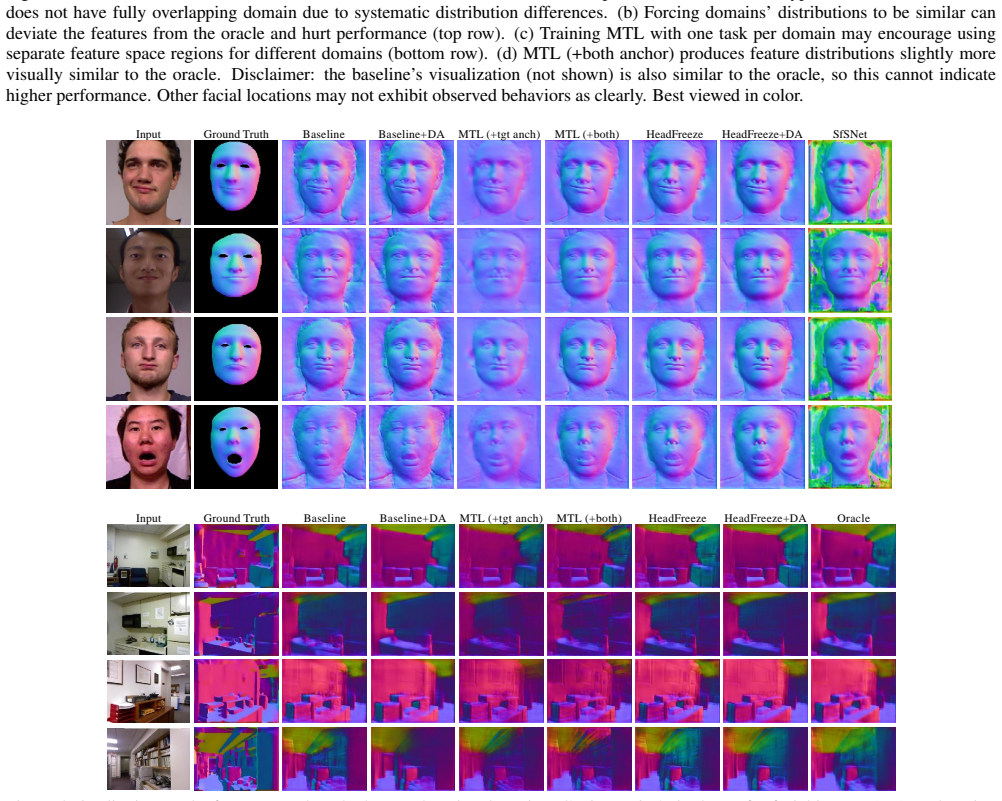
The paper's central claim is that cross-task coherency, the tendency of a multitask network's final layers to output spatially and contextually consistent main-and-anchor prediction pairs, can be learned on a synthetic source domain and preserved to guide predictions on a real target domain. The authors operationalize this with HEAD FREEZE: first train the main task, surface normal estimation, and the anchor task, 3D facial landmarks or semantic segmentation, on synthetic data; then freeze the final layers, the heads, and train only the feature layers on the source main task plus the anchor task on both source and target. Because the frozen heads continue to reject incoherent output pairs, such as flat noses, vertical ceilings, or misaligned edges, training the target anchor task also pulls the main-task predictions toward the coherent joint label space. The paper reports that this outperforms the single-task baseline, multitask variants that use the anchor on only one domain, and adversarial domain-adaptation baselines, and that it reaches facial surface-normal accuracy close to SfSNet, a specialized method with an additional illumination model. The paper also argues that when source and target label distributions differ systematically, standard distribution-matching adaptation can hurt, while HEAD FREEZE is less sensitive to such mismatches.
Load-bearing premise
HEAD FREEZE only helps if the final layers learned on the source domain carry a transferable sense of which main-task and anchor-task outputs fit together, and if that fitting rule is still valid in the target domain.
Editorial extensions
If this is right
- If the central claim holds, geometric vision tasks with scarce real-world ground truth, such as depth, normals, or pose, can be adapted from synthetic data using anchor tasks whose labels already exist or can be auto-generated, such as landmarks or segmentation.
- The approach does not require a hand-crafted relationship between the main and anchor tasks; the same HEAD FREEZE procedure is applied to surface normal estimation with two very different anchors, 3D facial landmarks and semantic segmentation.
- Anchor labels are worth collecting on both source and target; the ablations show that using the anchor on only one domain can underperform or even hurt the main task, while the both-anchor variant is better behaved.
- When source and target have systematically different ground-truth distributions, such as different head pose, adversarial distribution matching can degrade performance, and HEAD FREEZE is less affected by the mismatch.
- Adding adversarial adaptation on top of HEAD FREEZE helps when the domain label distributions are similar, for example with frontal faces, so the two mechanisms can complement each other.
Reading between the lines
- A testable extension the paper leaves implicit: the value of a frozen head should depend on how well the source domain's main-anchor coherency statistics transfer; measuring those statistics in source and target could predict when HEAD FREEZE helps and when it propagates source-specific constraints.
- The paper evaluates surface normals as the main task; applying the same freezing schedule to other pixel-labeling pairs, such as depth with segmentation or pose with keypoints, would show whether the gains generalize and which anchor-task properties, boundary alignment, geometric constraints, or label cost, drive the benefit.
- Because the anchor labels here come from a pretrained landmark detector, a natural next experiment would be to corrupt those labels with varying noise levels; the paper does not quantify how quickly the frozen-head benefit degrades as anchor supervision becomes unreliable.
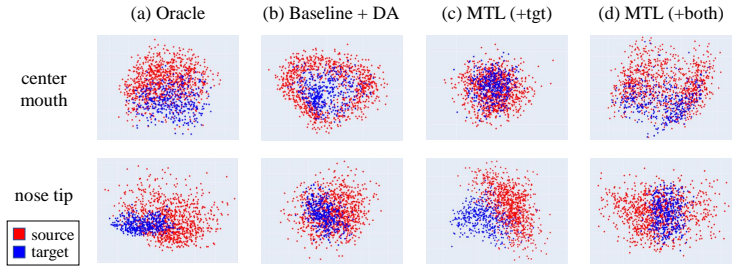
- The feature visualizations for one-task-per-domain training hint that freezing may be most valuable when the target anchor task is strong enough to train lower layers without allowing the head to drift; comparing very weak and very strong anchor tasks would test that boundary.
Signed reviews
Editorial analysis
A structured set of objections, weighed in public.
Referee Report
Summary. The paper proposes Task-Assisted Domain Adaptation (TADA): when the main task (e.g., surface normal estimation) lacks target-domain labels, an auxiliary 'anchor task' with labels available on both source and target domains is trained jointly, and a HEAD FREEZE procedure is applied that freezes the final network layers after source-only training to preserve what the authors call 'cross-task guidance'. The method is evaluated on synthetic-to-real adaptation for facial surface normals (with facial keypoints as anchor) and indoor surface normals (with semantic segmentation as anchor), comparing against single-task baselines, multitask baselines, adversarial domain adaptation, and the specialized SfSNet method. The paper reports that anchor labels on both domains are important, that HEAD FREEZE outperforms competing approaches on faces, and that it is robust to label-distribution differences that can hurt distribution-matching domain adaptation.
Significance. If the reported effects survive a clean evaluation protocol, the paper has practical value: it offers a simple recipe for improving synthetic-to-real transfer in pixel-labeling tasks without expensive target main-task labels and without task-specific relationship engineering. The paper is clearly written, the ablation design in Table 2 is instructive, and the diagnostic in Table 3 (matching source and target head-pose distributions) is a good example of using a controlled distribution change to explain when adversarial adaptation helps or hurts. The comparison with SfSNet, which uses extra illumination-model domain knowledge, is informative even though not fully controlled. The main reservations concern the evaluation protocol: the use of target main-task ground truth for model selection, the absence of reported variance or significance values, and the selective reporting of adversarial baseline configurations.
major comments (5)
- [§4.4] The evaluation protocol for the headline results uses target-domain main-task ground truth for model selection. The text states: "Although by evaluating against available ground truth we can tune most hyperparameters (e.g. stop criteria, learning rate, layers to freeze)..." Since the number of frozen layers is the defining design choice of HEAD FREEZE, the gains in Table 2 (e.g., <11.25° 0.519 vs. 0.492 and RMSE 15.8 vs. 16.0) may reflect selection bias rather than the method itself; with only three runs and no variance reported, selection bias of this magnitude is plausible. Please either provide a target-label-free selection criterion (e.g., using anchor-task validation performance) or demonstrate that the reported conclusions are insensitive to the frozen-layer choice and to other tuned hyperparameters.
- [Tables 1 and 2] The captions assert "Statistical significance computed from 3 runs" but no variances, p-values, or confidence intervals appear in the paper, and several key face-task gaps are small relative to typical run-to-run variation for deep networks (e.g., Table 1 HEADFREEZE vs. SfSNet RMSE 15.8 vs. 15.2; Table 2 HEADFREEZE vs. MTL(+both anchor) <11.25° 0.519 vs. 0.492). Please report per-run results and a suitable significance test, and adjust claims such as "outperforms" to match the statistical evidence.
- [§4.3] The description of the adversarial baselines states: "We implement our own version and perform hyperparameter tuning, and omit some of the underperforming combinations." This selective reporting makes the later claim that "domain adaptation may hurt performance" difficult to evaluate, because the reader cannot tell whether omitted configurations would have changed the comparison. Please include all tried configurations or specify an a-priori selection rule, and make the supplemental material consistent with the main text.
- [§5] The abstract claims HEAD FREEZE "outperforms competing approaches," but the indoor-scene section states "it is inconclusive whether HEAD FREEZE outperforms domain adaptation [34]." This overstates the experimental support. Please qualify the summary claim to match the indoor results, e.g., "outperforms competing methods on facial images and is comparable or better on indoor scenes."
- [§3.2] The mechanism claim that the frozen layers encode "cross-task guidance" is asserted but not directly tested. The diagnostic in Table 3 shows that matching source and target head-pose distributions changes when adversarial domain adaptation helps, which is informative about distribution matching, but it does not establish that the benefit of HEAD FREEZE comes from frozen final-layer coherency rather than from restricting the optimization of the lower layers. An ablation that freezes a randomly initialized head, or a head trained on the source main task only, would test the proposed mechanism.
minor comments (5)
- [§4.1] The sentence "3D keypoints can inform surface information" should likely be "3D keypoints can inform surface normal estimation"; please clarify.
- [§4.4] The description of λ selection ("We choose λ so losses from different domains and tasks have similar magnitudes") does not state the actual value or its sensitivity; please provide the values used and, if possible, a small sensitivity analysis.
- [Table 1] The SfSNet row is not marked in the supervision columns (ySm, ySa, yTm, yTa), and the table footnote is ambiguous; please add a clear note that SfSNet is an uncontrolled reference method rather than an ablation.
- [Figure 3] The caption states that the baseline's visualization (not shown) is also similar to the oracle, which undermines the caption's implication that the visualization indicates method quality; please revise the caption or add a quantitative association between feature similarity and performance.
- [Table 3] This table uses one source split and no significance measures, even though it supports a central diagnostic conclusion; please report multiple runs or at least error bars.
Circularity Check
No significant circularity: the method is an empirical training recipe, not a derivation that reduces to its inputs.
full rationale
The paper's central claims — that MTL with anchor labels on both domains helps adaptation, and that HEAD FREEZE improves over MTL (+both anchor) — are supported by experiments, not by equations that implicitly encode the result. The losses in Eqs. (1)–(6) are standard supervised losses; HEAD FREEZE is a training procedure that freezes the final layers after source training and retrains lower layers with Eq. (6). No step defines the target main-task prediction in terms of the anchor-task fit, and no fitted parameter is renamed as a prediction. The 'cross-task guidance' construct is an explicit assumption (Section 3.2: 'We assume that the final layers can incorporate this coherency knowledge'), so interpreting improved accuracy as support for that assumption is a hypothesis-testing loop, not a tautology. Section 4.4 discloses that hyperparameters, including layers to freeze, were tuned against target-domain ground truth; this is a real selection-bias concern for the headline comparison, but it is a validity issue, not a circular reduction. The only self-citation is the NYUv2 dataset reference [29] shared with coauthor Hoiem, which is not load-bearing. Overall, the derivation chain is self-contained against external benchmarks, and the empirical claims have independent content.
Assumptions & free parameters
free parameters (3)
- Anchor loss weight lambda =
chosen by hand; no value reported
- Frozen head depth =
layers after the second upsampling layer, including skip connections
- Adversarial DA hyperparameters =
tuned per dataset, exact values not reported
assumptions (3)
- domain assumption Anchor task labels exist and are reliable on both source and target domains.
- ad hoc to paper Freezing final layers preserves cross-task guidance and does not prevent lower layers from adapting to the target domain.
- domain assumption A shared feature extractor can serve both main and anchor tasks in both domains.
invented entities (1)
-
Cross-task guidance
Cite this review
Pith. "Pith review of Task-Assisted Domain Adaptation with Anchor Tasks." pith.science (2026). https://pith.science/paper/CHJKKE5N
@misc{pith2026190806079,
  author       = {Pith},
  title        = {Pith review of: Task-Assisted Domain Adaptation with Anchor Tasks},
  year         = {2026},
  howpublished = {\url{https://pith.science/paper/CHJKKE5N}},
  note         = {Machine review of arXiv:1908.06079}
}
read the original abstract
Some tasks, such as surface normals or single-view depth estimation, require per-pixel ground truth that is difficult to obtain on real images but easy to obtain on synthetic. However, models learned on synthetic images often do not generalize well to real images due to the domain shift. Our key idea to improve domain adaptation is to introduce a separate anchor task (such as facial landmarks) whose annotations can be obtained at no cost or are already available on both synthetic and real datasets. To further leverage the implicit relationship between the anchor and main tasks, we apply our \freeze technique that learns the cross-task guidance on the source domain with the final network layers, and use it on the target domain. We evaluate our methods on surface normal estimation on two pairs of datasets (indoor scenes and faces) with two kinds of anchor tasks (semantic segmentation and facial landmarks). We show that blindly applying domain adaptation or training the auxiliary task on only one domain may hurt performance, while using anchor tasks on both domains is better behaved. Our \freeze technique outperforms competing approaches, reaching performance in facial images on par with a recently popular surface normal estimation method using shape from shading domain knowledge.
Figures


Figures from the paper (3 more)
Reference graph
Works this paper leans on
-
[34]
Learning to adapt structured output space for se- mantic segmentation
Yi-Hsuan Tsai, Wei-Chih Hung, Samuel Schulter, Kihyuk Sohn, Ming-Hsuan Yang, and Manmohan Krishna Chan- draker. Learning to adapt structured output space for se- mantic segmentation. Proceedings of the IEEE Conference on Computer Vision and Pattern Recognition , pages 7472– 7481, 2018
work page 2018
-
[1]
A morphable model for the synthesis of 3d faces
V olker Blanz and Thomas Vetter. A morphable model for the synthesis of 3d faces. In SIGGRAPH, 1999
work page 1999
-
[2]
How far are we from solving the 2d & 3d face alignment problem? (and a dataset of 230,000 3d facial landmarks)
Adrian Bulat and Georgios Tzimiropoulos. How far are we from solving the 2d & 3d face alignment problem? (and a dataset of 230,000 3d facial landmarks). In International Conference on Computer Vision, 2017
2017
-
[3]
Facewarehouse: A 3d facial expression database for visual computing
Chen Cao, Yanlin Weng, Shun Zhou, Yiying Tong, and Kun Zhou. Facewarehouse: A 3d facial expression database for visual computing. IEEE Transactions on Visualization and Computer Graphics, 20:413–425, 2014
work page 2014
-
[4]
Rich Caruana. Multitask learning. Machine Learning , 28(1):41–75, Jul 1997
work page 1997
-
[5]
Learning aligned cross-modal representations from weakly aligned data
Lluis Castrejon, Yusuf Aytar, Carl V ondrick, Hamed Pirsi- avash, and Antonio Torralba. Learning aligned cross-modal representations from weakly aligned data. In Proceedings of the IEEE Conference on Computer Vision and Pattern Recognition, pages 2940–2949, 2016
work page 2016
-
[6]
Multi-task domain adap- tation for deep learning of instance grasping from simula- tion
Kuan Fang, Yunfei Bai, Stefan Hinterstoißer, Silvio Savarese, and Mrinal Kalakrishnan. Multi-task domain adap- tation for deep learning of instance grasping from simula- tion. 2018 IEEE International Conference on Robotics and Automation (ICRA), pages 3516–3523, 2018
work page 2018
-
[7]
Model- agnostic meta-learning for fast adaptation of deep networks
Chelsea Finn, Pieter Abbeel, and Sergey Levine. Model- agnostic meta-learning for fast adaptation of deep networks. In ICML, 2017
work page 2017
Show all 42 references
-
[8]
Multi-task, multi-domain learning: Application to se- mantic segmentation and pose regression
Damien Fourure, R ´emi Emonet, ´Elisa Fromont, Damien Muselet, Natalia Neverova, Alain Tr ´emeau, and Christian Wolf. Multi-task, multi-domain learning: Application to se- mantic segmentation and pose regression. Neurocomputing, 251:68–80, 2017
2017
-
[9]
Unsupervised domain adaptation by backpropagation
Yaroslav Ganin and Victor Lempitsky. Unsupervised domain adaptation by backpropagation. In International Conference on Machine Learning, pages 1180–1189, 2015
2015
-
[10]
Fine-grained recognition in the wild: A multi-task domain adaptation ap- proach
Timnit Gebru, Judy Hoffman, and Li Fei-Fei. Fine-grained recognition in the wild: A multi-task domain adaptation ap- proach. Proceedings of International Conference on Com- puter Vision (ICCV), pages 1358–1367, 2017
2017
-
[11]
Deep residual learning for image recognition
Kaiming He, Xiangyu Zhang, Shaoqing Ren, and Jian Sun. Deep residual learning for image recognition. Proceedings of the IEEE Conference on Computer Vision and Pattern Recognition, pages 770–778, 2016
2016
-
[12]
Efros, and Trevor Dar- rell
Judy Hoffman, Eric Tzeng, Taesung Park, Jun-Yan Zhu, Phillip Isola, Kate Saenko, Alexei A. Efros, and Trevor Dar- rell. Cycada: Cycle consistent adversarial domain adap- tation. In International Conference on Machine Learning (ICML), 2018
2018
-
[13]
Girshick
Ronghang Hu, Piotr Doll ´ar, Kaiming He, Trevor Darrell, and Ross B. Girshick. Learning to segment every thing.Proceed- ings of the IEEE Conference on Computer Vision and Pattern Recognition, pages 4233–4241, 2018
2018
-
[14]
Cross-domain weakly-supervised object de- tection through progressive domain adaptation
Naoto Inoue, Ryosuke Furuta, Toshihiko Yamasaki, and Kiy- oharu Aizawa. Cross-domain weakly-supervised object de- tection through progressive domain adaptation. Proceedings of the IEEE Conference on Computer Vision and Pattern Recognition, pages 5001–5009, 2018
2018
-
[15]
Ubernet: Training a universal convolu- tional neural network for low-, mid-, and high-level vision using diverse datasets and limited memory
Iasonas Kokkinos. Ubernet: Training a universal convolu- tional neural network for low-, mid-, and high-level vision using diverse datasets and limited memory. Proceedings of the IEEE Conference on Computer Vision and Pattern Recognition, pages 5454–5463, 2017
2017
-
[16]
Dis- criminatively trained dense surface normal estimation
Lubor Ladicky, Bernhard Zeisl, and Marc Pollefeys. Dis- criminatively trained dense surface normal estimation. In ECCV, 2014
2014
-
[17]
Weakly supervised image classification with coarse and fine labels
Jie Lei, Zhenyu Guo, and Yang Wang. Weakly supervised image classification with coarse and fine labels. 2017 14th Conference on Computer and Robot Vision (CRV) , pages 240–247, 2017
2017
-
[18]
Girshick, Kaiming He, Bharath Hariharan, and Serge J
Tsung-Yi Lin, Piotr Doll ´ar, Ross B. Girshick, Kaiming He, Bharath Hariharan, and Serge J. Belongie. Feature pyramid networks for object detection. Proceedings of the IEEE Con- ference on Computer Vision and Pattern Recognition, pages 936–944, 2017
2017
-
[19]
Representation learning using multi- task deep neural networks for semantic classification and in- formation retrieval
Xiaodong Liu, Jianfeng Gao, Xiaodong He, Li Deng, Kevin Duh, and Ye-Yi Wang. Representation learning using multi- task deep neural networks for semantic classification and in- formation retrieval. In HLT-NAACL, 2015
2015
-
[20]
Deep learning face attributes in the wild
Ziwei Liu, Ping Luo, Xiaogang Wang, and Xiaoou Tang. Deep learning face attributes in the wild. In Proceedings of International Conference on Computer Vision (ICCV), 2015
2015
-
[21]
Mingsheng Long, Zhangjie Cao, Jianmin Wang, and Philip S. Yu. Learning multiple tasks with multilinear re- lationship networks. In NIPS, 2017
2017
-
[22]
Regularizing deep networks by modeling and predicting label structure
Mohammadreza Mostajabi, Michael Maire, and Gregory Shakhnarovich. Regularizing deep networks by modeling and predicting label structure. Proceedings of the IEEE Con- ference on Computer Vision and Pattern Recognition, pages 5629–5638, 2018
2018
-
[23]
Automatic dif- ferentiation in PyTorch
Adam Paszke, Sam Gross, Soumith Chintala, Gregory Chanan, Edward Yang, Zachary DeVito, Zeming Lin, Alban Desmaison, Luca Antiga, and Adam Lerer. Automatic dif- ferentiation in PyTorch. In NIPS Autodiff Workshop, 2017
2017
-
[24]
Berg, and Li Fei-Fei
Olga Russakovsky, Jia Deng, Hao Su, Jonathan Krause, San- jeev Satheesh, Sean Ma, Zhiheng Huang, Andrej Karpathy, Aditya Khosla, Michael Bernstein, Alexander C. Berg, and Li Fei-Fei. ImageNet Large Scale Visual Recognition Chal- lenge. International Journal of Computer Vision ...
2015
-
[25]
Maximum classifier discrepancy for unsuper- vised domain adaptation
Kuniaki Saito, Kohei Watanabe, Yoshitaka Ushiku, and Tat- suya Harada. Maximum classifier discrepancy for unsuper- vised domain adaptation. In Proceedings of the IEEE Con- ference on Computer Vision and Pattern Recognition, pages 3723–3732, 2018
2018
-
[26]
Learning from synthetic data: Addressing domain shift for semantic segmentation
Swami Sankaranarayanan, Yogesh Balaji, Arpit Jain, Ser Nam Lim, and Rama Chellappa. Learning from synthetic data: Addressing domain shift for semantic segmentation. In Proceedings of the IEEE Conference on Computer Vision and Pattern Recognition, pages 3752–3761, 2018
2018
-
[27]
Sfsnet: Learning shape, reflectance and illuminance of facesin the wild’
Soumyadip Sengupta, Angjoo Kanazawa, Carlos D Castillo, and David W Jacobs. Sfsnet: Learning shape, reflectance and illuminance of facesin the wild’. In Proceedings of the IEEE Conference on Computer Vision and Pattern Recogni- tion, pages 6296–6305, 2018
2018
-
[28]
Learning from simulated and unsupervised images through adversarial training
Ashish Shrivastava, Tomas Pfister, Oncel Tuzel, Josh Susskind, Wenda Wang, and Russell Webb. Learning from simulated and unsupervised images through adversarial training. Proceedings of the IEEE Conference on Computer Vision and Pattern Recognition, pages 2242–2251, 2017. 9
2017
-
[29]
Indoor segmentation and support inference from rgbd images
Nathan Silberman, Derek Hoiem, Pushmeet Kohli, and Rob Fergus. Indoor segmentation and support inference from rgbd images. In ECCV, 2012
2012
-
[30]
Semantic scene comple- tion from a single depth image
Shuran Song, Fisher Yu, Andy Zeng, Angel X Chang, Mano- lis Savva, and Thomas Funkhouser. Semantic scene comple- tion from a single depth image. Proceedings of the IEEE Conference on Computer Vision and Pattern Recognition , 2017
2017
-
[31]
Chang, Manolis Savva, and Thomas A
Shuran Song, Fisher Yu, Andy Zeng, Angel X. Chang, Manolis Savva, and Thomas A. Funkhouser. Semantic scene completion from a single depth image. Proceedings of the IEEE Conference on Computer Vision and Pattern Recogni- tion, pages 190–198, 2017
2017
-
[32]
Training deep networks with synthetic data: Bridging the reality gap by domain randomization
Jonathan Tremblay, Aayush Prakash, David Acuna, Mark Brophy, Varun Jampani, Cem Anil, Thang To, Eric Camer- acci, Shaad Boochoon, and Stan Birchfield. Training deep networks with synthetic data: Bridging the reality gap by domain randomization. In Proceedings of the IEEE Con- f...
2018
-
[33]
Zafeiriou
George Trigeorgis, Patrick Snape, Iasonas Kokkinos, and Stefanos P. Zafeiriou. Face normals ”in-the-wild” using fully convolutional networks. Proceedings of the IEEE Confer- ence on Computer Vision and Pattern Recognition , pages 340–349, 2017
2017
-
[35]
Domain adaptation for struc- tured output via discriminative patch representations
Yi-Hsuan Tsai, Kihyuk Sohn, Samuel Schulter, and Man- mohan Krishna Chandraker. Domain adaptation for struc- tured output via discriminative patch representations. CoRR, abs/1901.05427, 2019
1901 arXiv
-
[36]
Simultaneous deep transfer across domains and tasks
Eric Tzeng, Judy Hoffman, Trevor Darrell, and Kate Saenko. Simultaneous deep transfer across domains and tasks. In Proceedings of International Conference on Computer Vi- sion (ICCV), 2015
2015
-
[37]
Black, Ivan Laptev, and Cordelia Schmid
G ¨ul Varol, Javier Romero, Xavier Martin, Naureen Mah- mood, Michael J. Black, Ivan Laptev, and Cordelia Schmid. Learning from synthetic humans. In CVPR, 2017
2017
-
[38]
Pad-net: Multi-tasks guided prediction-and-distillation net- work for simultaneous depth estimation and scene parsing
Dong Xu, Wanli Ouyang, Xiaogang Wang, and Nicu Sebe. Pad-net: Multi-tasks guided prediction-and-distillation net- work for simultaneous depth estimation and scene parsing. Proceedings of the IEEE Conference on Computer Vision and Pattern Recognition, pages 675–684, 2018
2018
-
[39]
Wei Yang, Wanli Ouyang, Xiaolong Wang, Jimmy S. J. Ren, Hongsheng Li, and Xiaogang Wang. 3d human pose estima- tion in the wild by adversarial learning. Proceedings of the IEEE Conference on Computer Vision and Pattern Recogni- tion, pages 5255–5264, 2018
2018
-
[40]
Shen, Leonidas J
Amir Roshan Zamir, Alexander Sax, William B. Shen, Leonidas J. Guibas, Jitendra Malik, and Silvio Savarese. Taskonomy: Disentangling task transfer learning. Proceed- ings of the IEEE Conference on Computer Vision and Pattern Recognition, pages 3712–3722, 2018
2018
-
[41]
Funkhouser
Yinda Zhang, Shuran Song, Ersin Yumer, Manolis Savva, Joon-Young Lee, Hailin Jin, and Thomas A. Funkhouser. Physically-based rendering for indoor scene understanding using convolutional neural networks. Proceedings of the IEEE Conference on Computer Vision and Pattern Recog- n...
2017
-
[42]
A brief introduction to weakly supervised learning
Zhi-Hua Zhou. A brief introduction to weakly supervised learning. National Science Review, 5, 08 2017. 10
2017
Reviewed August 14, 2026 · model on record in the stance chip above.
Discussion (0). Continue with ORCID to comment.