REVIEW 4 major objections 5 minor 43 references
Graphene-based spinmechatronic valve
T0 review · 4 major / 5 minor · reviewed 2026-08-14 · deepseek-v4-flash
Pith's one-line read Twisting a graphene layer in a stack changes conductance by over a thousand percent.
desk verdict A plausible twist-controlled vertical graphene junction with first-principles numbers that are under-sampled and under-converged; worth refereeing, not worth quoting yet. read the letter →
The pith
A machine-rendered reading of the paper's core claim, the machinery that carries it, and where it could break.
The reading
What carries the argument
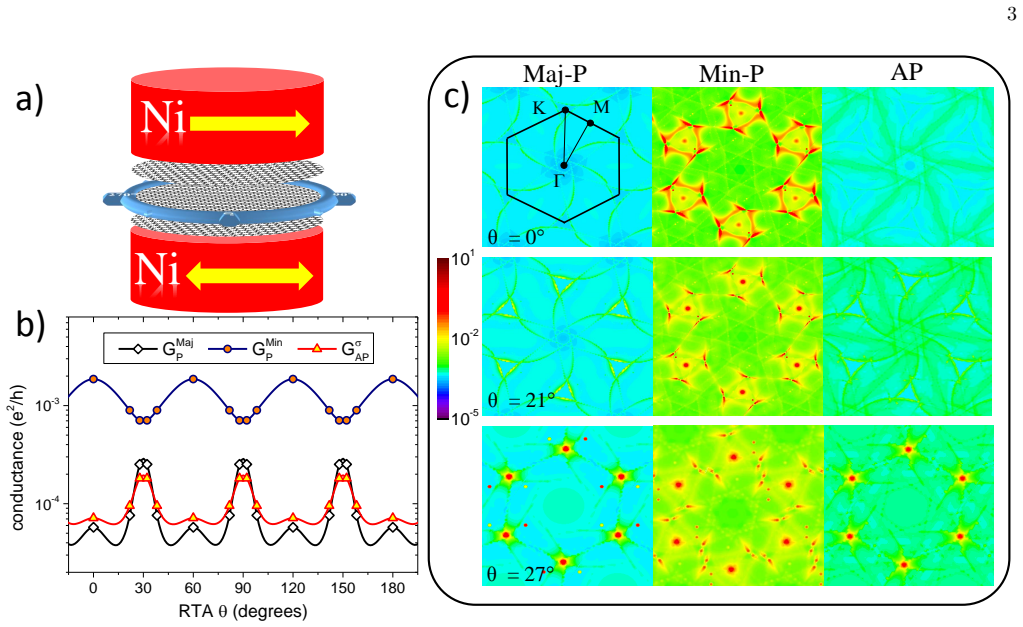
The central object is the commensurate twisted trilayer graphene (TTLG) spacer, in which the middle layer is rotated by $21.787^\circ$ ($\sqrt{7}\times\sqrt{7}$ unit cell) or $27.8^\circ$ ($\sqrt{13}\times\sqrt{13}$ unit cell). The argument is carried by spin-resolved transmission maps across the Brillouin zone computed with non-equilibrium Green's function transport. These maps show where in reciprocal space current can flow and how rotation displaces the middle layer's Dirac states relative to the copper or nickel transmission states. This momentum-space overlap is the mechanism behind the large conductance changes.
What would settle it
A third data point would settle it: compute or measure the vertical conductance for a twist angle outside the two used here, such as $30^\circ$ or a small-angle moiré stack with lattice relaxation; if the twisting resistance does not appear at the reported scale, the proposed mechanism is incomplete.
Extended reading notes
Core claim
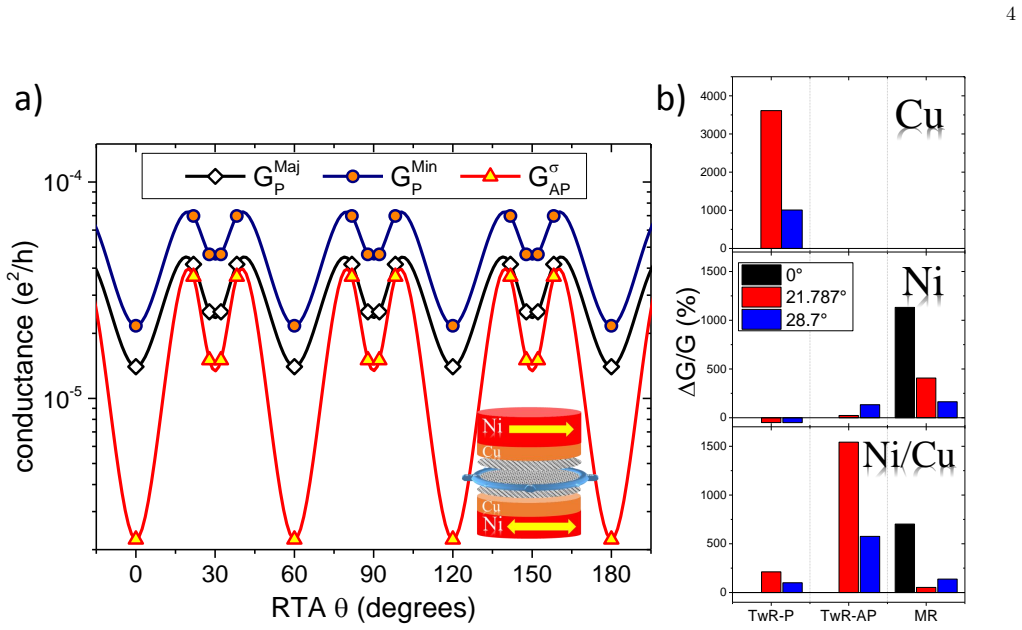
The central claim is that the relative rotation angle (RTA) of the middle graphene layer in a trilayer spacer controls vertical conductance and magnetoresistance between metallic leads. The paper quantifies this with a twisting resistance, $\mathrm{TwR} = (G(\theta)-G(\theta'))/G(\theta')$, and reports values above 1000% for Cu/TTLG/Cu, about $-40$% and up to 130% for Ni/TTLG/Ni in parallel and antiparallel configurations, and about 200% and 1600% for Ni/Cu/TTLG/Cu/Ni. The mechanism is momentum alignment: at zero twist, graphene's available states near the $K$ point do not overlap the metal transmission states, while twisting the middle layer moves populated states near the $M$ point into play and shifts the Dirac states relative to the lead states. In the nickel case the twist also increases the majority-spin conductance and reduces the minority-spin conductance.
Load-bearing premise
The load-bearing premise is that the two commensurate twist angles studied, $21.787^\circ$ and $27.8^\circ$, represent the full twist-angle behavior; the paper itself says computational limits allowed only those two smallest unit cells.
Editorial extensions
If this is right
- Twisting the middle graphene layer by $21.787^\circ$ raises the vertical conductance of Cu/TTLG/Cu by roughly two orders of magnitude relative to the untwisted stack.
- In Ni/TTLG/Ni, the spin-filtering effect is angle-dependent: minority-spin conductance falls while majority-spin conductance rises as the twist angle increases.
- The magnetoresistance of the Ni junction drops from about 1000% at zero twist to about 163% at $27.8^\circ$.
- A three-monolayer copper insertion at each Ni/graphene interface changes the parallel twisting resistance from negative to about 200% and raises the antiparallel value to roughly 1600%.
- Mechanical rotation becomes a control parameter for both charge and spin transport in vertical graphene junctions, alongside magnetic and electric control.
Reading between the lines
- If the momentum-overlap mechanism is generic, the effect should be tunable at other rotation angles too, and a full angle sweep including lattice relaxation might show an even sharper peak.
- The same twist-valve logic could extend to other layered spacers, such as hexagonal boron nitride or transition-metal dichalcogenides.
- Practical devices will need a faster way to rotate the layer than the AFM-tip method cited here, so optical or torque-based actuation is a natural next test for this valve.
Signed reviews
Editorial analysis
A structured set of objections, weighed in public.
Referee Report
Summary. The manuscript uses first-principles NEGF transport calculations (SIESTA/TranSIESTA) to study vertical conductance through tri-layer graphene in which the middle layer is rotated by 21.787° or 27.8° relative to the outer layers, sandwiched between Cu, Ni, or Ni/Cu leads. It defines a 'twisting resistance' TwR as the relative change in conductance between twisted and untwisted spacers, and reports TwR values above 1000% for Cu/TTLG/Cu, about -40% to 130% for Ni/TTLG/Ni depending on magnetization alignment, and up to about 200% (parallel) and 1600% (anti-parallel) for Ni/Cu/TTLG/Cu/Ni. The proposed mechanism is that twisting moves the middle graphene layer's Dirac states relative to the metal Fermi-surface transmission channels near the K and M points, thereby opening or closing vertical current paths.
Significance. If the claimed magnitudes hold, this would be an interesting and potentially useful mechanical-control mechanism for vertical spin transport: a rotationally actuated 'spinmechatronic' valve with large conductance switching and strong interplay with magnetoresistance. The study is genuinely predictive rather than fitting: the TwR percentages are computed directly from NEGF conductances with no parameter tuned to reproduce them, and the calculations build on established structural inputs from Karpan et al. The main limitation, however, is that the quantitative predictions rest on a very small number of computational geometries and on a minimal basis set; the central percentages should therefore be read as point estimates awaiting convergence and angle-sampling checks.
major comments (4)
- [Device setup and Fig. 1(d)] The central quantitative claims (abstract: TwR 'more than 1000%' for Cu/TTLG/Cu and 'up to 1600%' for Ni/Cu/TTLG/Cu/Ni anti-parallel; main text: TwR of 3600% and 1000% for the two angles) are computed at only two commensurate angles, 21.787° and 27.8°, selected solely because they have the smallest possible unit cells. The text explicitly states: 'Due to computational limitation we can only study two relative rotation angles.' With only three points (θ=0°, 21.787°, 27.8°), Fig. 1(d) cannot establish the claimed smooth RTA dependence or locate the maximum of TwR; the proposed mechanism (Dirac-state alignment near K/M) does not by itself rule out non-monotonic behavior at intermediate angles. Please supply additional angle points (e.g., 13.17°, 9.43°, or an approximate rigid-band model) or explicitly reframe the conclusions as point values rather than as a full RTA dependence.
- [Computational methods (basis set and convergence)] The transport calculations use a single-zeta (SZ) numerical atomic-orbital basis for all species, and no convergence tests with respect to basis size or transmission k-grid are reported. The manuscript's quantitative claims depend on absolute conductances that span several orders of magnitude (down to 10^-5 e2/h in Fig. 1(d)); single-zeta bases are known to be inadequate for accurately describing graphene's π bands and exponential tunneling decay. Please provide at least one basis-set convergence check (e.g., DZP for the θ=0° and θ=21.787° Cu junctions) and corresponding transmission-k-grid convergence, to demonstrate that the reported TwR values are not artifacts of basis-set incompleteness.
- [Results, Cu/TTLG/Cu and TwR definition] The text in the Cu/TTLG/Cu paragraph states that the conductance 'increases of almost two order of magnitude' for θ=21.787° relative to the untwisted case, but then quotes TwR of about 3600% and 1000% for the two angles; those percentages correspond to conductance ratios of roughly 37 and 11, not factors near 100. This is internally inconsistent, and it matters because the abstract and conclusion advertise 'more than 1000%' and '1600%' as the headline effect. Please correct the statement or the values and ensure the TwR definition (ΔG/G) is applied consistently in Figs. 1(d), 2(b), and 3(a).
- [Atomic structure and relaxation] The calculations use unrelaxed structures: the in-plane lattice constant and interlayer distances are taken from ref. [6], with no relaxation described for the twisted interfaces. For twist angles with significant moiré registry variation, interlayer distances and local hybridization can change, and the vertical conductance is typically very sensitive to such changes. At minimum, please test the sensitivity of the reported conductance and TwR to a ±1-2% variation of the interlayer distance at one representative angle.
minor comments (5)
- [Throughout] Typos and grammatical errors: 'herterostructure' (Intro), 'starttofeel' and 'anitparallel' (main text), 'difference ,called' (Abstract), 'Fm/graphite/FM' (Intro), 'magento-resistance' (Fig. 3 paragraph), and 'TTGL spacer' (magnetic case) should be 'TTLG'. A careful proofread is needed.
- [Results, Cu/TTLG/Cu paragraph] The angle label is inconsistent: the main text quotes TwR for 'RTA of 21.787 and 28.7' while all other instances use 27.8°; also Fig. 1(d) caption writes 'θ = 21°' and 'θ = 27°' where the text gives 21.787° and 27.8°.
- [TwR definition and Figs. 2-3] The displayed definition of TwR uses G_α(θ) and G_α′(θ′), but the subsequent definitions of MR(θ) mix magnetization configuration and angle arguments; please make the notation for spin channels and angle arguments uniform across the equations, the figures, and the text.
- [Methods and Fig. 1(d) caption] The caption of Fig. 1(d) states 'Quantum conductance at room temperature' but the Methods section does not specify how temperature broadening is included in the NEGF/TBTrans conductance; please clarify the temperature treatment.
- [References] Several references are incomplete (e.g., refs. 20, 23, 26, 31 lack journal/volume/page details); please update them to the standard citation format.
Circularity Check
No significant circularity: the TwR values are direct outputs of first-principles NEGF transport calculations, not fitted inputs or self-citation-derived predictions.
full rationale
The paper's central quantities are the conductances G(θ) computed with SIESTA/TranSIESTA for Cu/TTLG/Cu and Ni/TTLG/Ni junctions at RTA = 0°, 21.787°, and 27.8°. The twisting resistance is then defined as TwR = (G(θ) - G(θ'))/G(θ'), a ratio of two independently computed conductances. No parameter is fitted to reproduce the reported percentages, and no equation in the paper reduces to its own input by construction. The structural input taken from Karpan et al. (ref. 6) is an external calculation, not a self-citation, and it supplies only lattice constants and interlayer distances; the transport results are not forced by that input. The manuscript's own statement, 'Due to computational limitation we can only study two relative rotation angles,' is a genuine scope limitation on how completely the continuous RTA dependence is sampled, but it is not circularity: the three computed points are ab initio outputs rather than quantities assumed as premises. The self-citations in the reference list (e.g., ref. 12 on interface anisotropy) are not load-bearing for the conductance or TwR claims. The mechanistic explanation via transmission maps around K and M is a post-hoc interpretation of the calculated transmission, not an ansatz smuggled in to produce the result. Accordingly, no circular step meeting the required evidentiary standard was found.
Assumptions & free parameters
free parameters (1)
- Commensurate twist angle sampling (theta = 21.787 degrees, 27.8 degrees) =
not fitted; two discrete commensurate values
assumptions (4)
- domain assumption PBE-DFT with a single-zeta numerical basis and Troullier-Martins pseudopotentials gives quantitatively reliable transmission for Cu/graphene/Ni and twisted graphene interfaces.
- domain assumption Landauer/NEGF coherent transport at zero bias describes the conductance of these junctions at room temperature.
- ad hoc to paper The two commensurate twist angles 21.787 degrees and 27.8 degrees are representative enough to infer the RTA dependence of conductance and magnetoresistance.
- domain assumption Interface geometry, including in-plane lattice constant and interlayer distances from Karpan et al. [6], remains valid for the twisted configurations.
Cite this review
Pith. "Pith review of Graphene-based spinmechatronic valve." pith.science (2026). https://pith.science/paper/CI2RK2EO
@misc{pith2026190804076,
  author       = {Pith},
  title        = {Pith review of: Graphene-based spinmechatronic valve},
  year         = {2026},
  howpublished = {\url{https://pith.science/paper/CI2RK2EO}},
  note         = {Machine review of arXiv:1908.04076}
}
read the original abstract
Interlayer twist between van der Waals graphene crystals led to the discovery of superconducting and insulating states near the magic angle. In this work, we exploit this mechanical degree of freedom by twisting the graphene middle layer in a trilayer graphene spacer between two metallic lead (Magnetic and nonmagnetic). A large difference in conductance is found depending on the angle of twist between the middle layer graphene and the ones at the interface this difference, called twisting resistance, reach more than 1000% in the non-magnetic Cu case. For the magnetic Ni case, the magneto-resistance decreases and the difference in conductance between twisted and not twisted depends strongly on the relative magnetization configuration. For the parallel configuration, the twisting resistance is about -40%, while for the anti-parallel configuration it can reach up to 130%. Furthermore, we show that the twisting resistance can be enhanced by inserting a thin Cu layer at the interface of Ni/graphene where it reaches a value of 200% and 1600% for parallel and antiparallel configurations, respectively. These finding could pave the way toward the integration of 2D materials on novel spinmechatronics based devices.
Figures

Reference graph
Works this paper leans on
-
[6]
V. M. Karpan, G. Giovannetti, P. A. Khomyakov, M. Talanana, A. A. Starikov, M. Zwierzycki, J. van den Brink, G. Brocks, and P. J. Kelly, Phys. Rev. Lett.99, 176602 (2007)
work page 2007
- [1]
-
[2]
A. K. Singh and J. Eom, ACS Applied Materials & Interfaces 6, 2493 (2014), pMID: 24495123
work page 2014
-
[3]
E. D. Cobas, O. M. J. van’t Erve, S.-F. Cheng, J. C. Culbertson, G. G. Jernigan, K. Bussman, and B. T. Jonker, ACS Nano10, 10357 (2016), pMID: 27806204
work page 2016
-
[4]
Y. Hu, M. Ji, J. Peng, W. Qiu, M. Pan, J. Zhao, Y. Yao, C. Han, J. Hu, L. Pan, W. Tian, D. Chen, Q. Zhang, and P. Li, Journal of Magnetism and Magnetic Materials 487, 165317 (2019)
work page 2019
-
[5]
M. Piquemal-Banci, R. Galceran, F. Godel, S. Caneva, M.-B. Martin, R. S. Weatherup, P. R. Kidambi, K. Bouzehouane, S. Xavier, A. Anane, F. Petroff, A. Fert, S. M.-M. Dubois, J.-C. Charlier, J. Robertson, S. Hofmann, B. Dlubak, and P. Seneor, ACS Nano12, 4712 (2018), pMID: 29697954
work page 2018
-
[7]
K. K. Saha, A. Blom, K. S. Thygesen, and B. K. Nikolić, Phys. Rev. B85, 184426 (2012)
work page 2012
-
[8]
W. Qiu, J. Peng, M. Pan, Y. Hu, M. Ji, J. Hu, W. Tian, D. Chen, Q. Zhang, and P. Li, Journal of Magnetism and Magnetic Materials476, 622 (2019)
work page 2019
Show all 43 references
-
[9]
Vo-Van, Z
C. Vo-Van, Z. Kassir-Bodon, H. Yang, J. Coraux, J. Vogel, S. Pizzini, P. Bayle-Guillemaud, M. Chshiev, L. Ranno, V. Guisset, P. David, V. Salvador, and O. Fruchart, New Journal of Physics12, 103040 (2010)
2010
-
[10]
Rougemaille, A
N. Rougemaille, A. T. N’Diaye, J. Coraux, C. Vo-Van, O. Fruchart, and A. K. Schmid, Applied Physics Letters 101, 142403 (2012), https://doi.org/10.1063/1.4749818
2012 doi
-
[11]
Coraux, A
J. Coraux, A. T. N’Diaye, N. Rougemaille, C. Vo-Van, A. Kimouche, H.-X. Yang, M. Chshiev, N. Bendiab, O. Fruchart, and A. K. Schmid, The Journal of Physical Chemistry Letters 3, 2059 (2012)
2012
-
[12]
H. Yang, A. D. Vu, A. Hallal, N. Rougemaille, J. Coraux, G. Chen, A. K. Schmid, and M. Chshiev, Nano Letters 16, 145 (2016), pMID: 26641927
2016
-
[13]
H. Yang, G. Chen, A. A. C. Cotta, A. T. N’Diaye, S. A. Nikolaev, E. A. Soares, W. A. A. Macedo, K. Liu, A. K. Schmid, A. Fert, and M. Chshiev, Nature materials17, 605 (2018)
2018
-
[14]
Ajejas, A
F. Ajejas, A. Gudín, R. Guerrero, A. Anadón Barcelona, J. M. Diez, L. de Melo Costa, P. Olleros, M. A. Niño, S. Pizzini, J. Vogel, M. Valvidares, P. Gargiani, M. Cabero, M. Varela, J. Camarero, R. Miranda, and P.Perna,NanoLetters 18,5364(2018),pMID:30052462
2018
-
[15]
A. K. Chaurasiya, A. Kumar, R. Gupta, S. Chaudhary, P. K. Muduli, and A. Barman, Phys. Rev. B99, 035402 (2019)
2019
-
[16]
Barla, V
A. Barla, V. Bellini, S. Rusponi, P. Ferriani, M. Pivetta, F. Donati, F. Patthey, L. Persichetti, S. K. Mahatha, M. Papagno, C. Piamonteze, S. Fichtner, S. Heinze, P. Gambardella, H. Brune, and C. Carbone, ACS Nano 10, 1101 (2016), pMID: 26588469
2016
-
[17]
Gargiani, R
P. Gargiani, R. Cuadrado, H. B. Vasili, M. Pruneda, and M. Valvidares, Nature Communications8, 699 (2017)
2017
-
[18]
Y. Cao, V. Fatemi, S. Fang, K. Watanabe, T. Taniguchi, E. Kaxiras, and P. Jarillo-Herrero, Nature 556, 43 (2018), 1803.02342 [cond-mat.mes-hall]. 6
2018 arXiv
-
[19]
Kerelsky, L
A. Kerelsky, L. J. McGilly, D. M. Kennes, L. Xian, M. Yankowitz, S. Chen, K. Watanabe, T. Taniguchi, J. Hone, C. Dean, A. Rubio, and A. N. Pasupathy, Nature 572, 95 (2019)
2019
-
[20]
G. Chen, A. L. Sharpe, P. Gallagher, I. T. Rosen, E. J. Fox, L. Jiang, B. Lyu, H. Li, T. Watanabe, K. andTaniguchi, J. Jung, Z. Shi, D. Goldhaber-Gordon, Y. Zhang, and F. Wang, Nature (2019)
2019
-
[21]
Isobe, N
H. Isobe, N. F. Q. Yuan, and L. Fu, Phys. Rev. X8, 041041 (2018)
2018
-
[22]
Y. Cao, V. Fatemi, A. Demir, S. Fang, S. L. Tomarken, J. Y. Luo, J. D. Sanchez-Yamagishi, K. Watanabe, T. Taniguchi, E. Kaxiras, R. C. Ashoori, and P. Jarillo- Herrero, Nature 556, 80 (2018), 1802.00553
2018 arXiv
-
[23]
Y. Xie, B. Lian, B. Jack, X. Liu, C.-L. Chiu, K. Watanabe, T. Taniguchi, B. A. Bernevig, and A. Yazdani, Nature572, 101 (2019)
2019
-
[24]
Kang and O
J. Kang and O. Vafek, Phys. Rev. X8, 031088 (2018)
2018
-
[25]
Koshino, N
M. Koshino, N. F. Q. Yuan, T. Koretsune, M. Ochi, K. Kuroki, and L. Fu, Phys. Rev. X8, 031087 (2018)
2018
-
[26]
A. L. Sharpe, E. J. Fox, A. W. Barnard, J. Finney, K. Watanabe, T. Taniguchi, M. A. Kastner, and D. Goldhaber-Gordon, Science (2019), 10.1126/science.aaw3780
2019 doi
-
[27]
J. Liu, Z. Ma, J. Gao, and X. Dai, Phys. Rev. X 9, 031021 (2019)
2019
-
[28]
Ribeiro-Palau, C
R. Ribeiro-Palau, C. Zhang, K. Watanabe, T. Taniguchi, J. Hone, and C. R. Dean, Science361, 690 (2018)
2018
-
[29]
Anđelković, L
M. Anđelković, L. Covaci, and F. M. Peeters, Phys. Rev. Materials 2, 034004 (2018)
2018
-
[30]
Chung, Y
T.-F. Chung, Y. Xu, and Y. P. Chen, Phys. Rev. B98, 035425 (2018)
2018
-
[31]
E. H. Hwang and S. D. Sarma, arxiv:1907.02856 (2019)
2019 arXiv
-
[32]
Brandimarte, M
P. Brandimarte, M. Engelund, N. Papior, A. Garcia- Lekue, T. Frederiksen, and D. Sánchez-Portal, The Journal of Chemical Physics146, 092318 (2017)
2017
-
[33]
W. Yao, E. Wang, C. Bao, Y. Zhang, K. Zhang, K. Bao, C. K. Chan, C. Chen, J. Avila, M. C. Asensio, J. Zhu, and S. Zhou, Proceedings of the National Academy of Sciences 115, 6928 (2018)
2018
-
[34]
Suárez Morell, M
E. Suárez Morell, M. Pacheco, L. Chico, and L. Brey, Phys. Rev. B87, 125414 (2013)
2013
-
[35]
Artacho, D
E. Artacho, D. Sánchez-Portal, P. Ordejón, A. García, and J. M. Soler, physica status solidi (b)215, 809 (1999)
1999
-
[36]
J. M. Soler, E. Artacho, J. D. Gale, A. García, J. Junquera, P. Ordejón, and D. Sánchez-Portal, Journal of Physics: Condensed Matter14, 2745 (2002)
2002
-
[37]
J. P. Perdew, K. Burke, and M. Ernzerhof, Phys. Rev. Lett. 77, 3865 (1996)
1996
-
[38]
Brandbyge, J.-L
M. Brandbyge, J.-L. Mozos, P. Ordejón, J. Taylor, and K. Stokbro, Phys. Rev. B65, 165401 (2002)
2002
-
[39]
Papior, N
N. Papior, N. Lorente, T. Frederiksen, A. García, and M. Brandbyge, Computer Physics Communications212, 8 (2017)
2017
-
[40]
M. B. Lim, R. G. Felsted, X. Zhou, B. E. Smith, and P. J. Pauzauskie, Applied Physics Letters113, 031106 (2018)
2018
-
[41]
K. Wang, E. Schonbrun, P. Steinvurzel, and K. B. Crozier, Nature Communications2, 469 (2011)
2011
-
[42]
O. M. Maragò, P. H. Jones, P. G. Gucciardi, G. Volpe, and A. C. Ferrari, Nature Nanotechnology8, 807 (2013)
2013
-
[43]
M. F. Maghrebi, A. V. Gorshkov, and J. D. Sau, Phys. Rev. Lett. 123, 055901 (2019)
2019
Reviewed August 14, 2026 · model on record in the stance chip above.
Discussion (0). Continue with ORCID to comment.