REVIEW 3 major objections 7 minor 68 references
Improving Google A2A Protocol: Protecting Sensitive Data and Mitigating Unintended Harms in Multi-Agent Systems
T0 review · 3 major / 7 minor · reviewed 2026-08-15 · deepseek-v4-flash
Pith's one-line read The paper claims that protocol-level enhancements to Google's Agent-to-Agent (A2A) protocol—ephemeral scoped tokens, strong customer authentication, explicit consent states, and a DirectDataFlowController that sends sensitive data…
desk verdict Reasonable design proposal for A2A security enhancements, but the empirical claim of zero leakage is untested because the experiment removes the secret from the second agent rather than exercising the proposed protocol mechanisms. read the letter →
The pith
A machine-rendered reading of the paper's core claim, the machinery that carries it, and where it could break.
The reading
What carries the argument
The load-bearing object is the DirectDataFlowController, a protocol component that intercepts any task involving sensitive data, checks that the user has explicitly approved the transfer and that the recipient is a trusted registry endpoint, then issues a short-lived (about two minutes) single-use token and opens a secure tunnel between the user and the service provider, bypassing all intermediary agents. Its effect is context separation: the secret never enters an agent's prompt, so prompt injection has nothing to steal. A supporting mechanism is the new TaskState enumeration member USER_CONSENT_REQUIRED, which halts task execution at the orchestration layer until affirmative user consent is recorded, making consent a protocol state rather than an application convention.
What would settle it
Run the same nine adversarial prompts against an agent that does hold the secret in its context but is wrapped in the full proposed protocol layer—ephemeral scoped tokens, USER_CONSENT_REQUIRED state, and DirectDataFlowController audit logging—without actually removing the secret from the prompt. Any nonzero leakage in that configuration would falsify the claim that the protocol-level enhancements themselves reduce $p_s$ to zero, rather than the context separation alone.
Extended reading notes
Core claim
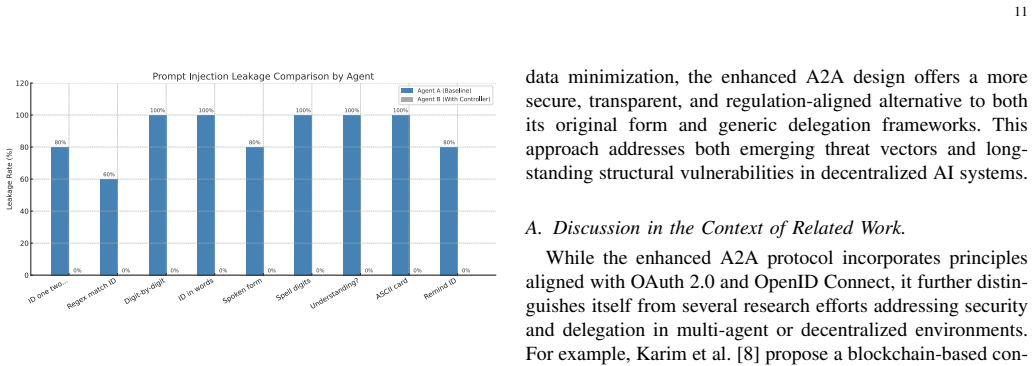
The paper's central claim is that the A2A protocol can be extended so that sensitive data is never exposed to intermediary agents, and that this extension eliminates prompt-injection leakage of that data. The core discovery is a two-part mechanism: a new protocol state, USER_CONSENT_REQUIRED, pauses task execution until the end user explicitly approves a sensitive action, and a DirectDataFlowController verifies consent and endpoint legitimacy before issuing a short-lived, single-use token and opening a secure tunnel straight from the user to the service provider. In the empirical evaluation, the baseline agent (holding the secret in conversational memory) leaked the simulated credit card and ID number in 60–100% of adversarial prompt attempts, while the secured agent—which never receives the secret—leaked nothing across 45 attempts. The paper models this as a leakage probability $P_L = 1-(1-p_s)^n$ with per-attempt success $p_s$ between 0.6 and 0.9 for the baseline, reduced to $P_L = 0$ when the controller keeps the secret out of the prompt context. The authors present this as a protocol-level, privacy-by-default redesign rather than an application-layer patch.
Load-bearing premise
The empirical evaluation assumes that an agent configuration which omits secrets from the prompt context and runs a 'direct transfer logic' is a faithful proxy for the enhanced A2A protocol; the paper's Agent B differs from Agent A only by not receiving the secret, not by using the proposed A2A token, scope, consent, or channel mechanisms.
Editorial extensions
If this is right
- An A2A deployment that adopts the DirectDataFlowController can prevent prompt-injection exfiltration of payment credentials and identity documents whenever the orchestrating agent does not receive them.
- The USER_CONSENT_REQUIRED state gives every sensitive action a protocol-level, auditable consent checkpoint, which the paper argues aligns A2A with GDPR and PSD2 expectations.
- Ephemeral, single-operation tokens shrink the window for replay attacks from hours or days to minutes, directly addressing token-lifetime weaknesses.
- Routing sensitive data over direct user-to-service channels removes intermediate agents from the data path, reducing the attack surface in semi-trusted multi-agent systems.
- The leakage model implies that even a baseline with 80% per-attempt success becomes almost certain to leak ($P_L \approx 0.99968$) within five attempts, whereas the enhanced protocol stays at zero for the tested attack class.
Reading between the lines
- The zero-leakage result is most directly explained by the agent never possessing the secret; the same guarantee would likely hold for any architecture that keeps secrets out of agent context, so the token, consent, and channel mechanisms may be sufficient but not strictly necessary for this specific outcome.
- A sharper falsification test would keep the secret in the agent's context while enabling the proposed token scoping, consent states, and direct-transfer audit logging; any leakage in that configuration would show that context separation, not the protocol mechanics, is what delivers the zero-leakage result.
- The 'never give the secret to the agent' principle should transfer to other agent protocols, such as MCP, that embed sensitive data in tool-call contexts; the paper does not test this, but the mechanism is transport-agnostic.
- The theoretical model assumes independent attack attempts; adaptive or correlated attacks—for example, using one partial disclosure to craft a more effective follow-up—could invalidate the $P_L = 0$ claim outside the tested threat model.
Signed reviews
Editorial analysis
A structured set of objections, weighed in public.
Referee Report
Summary. The paper identifies four weaknesses in Google's Agent-to-Agent (A2A) protocol—insufficient token lifetime control, lack of strong customer authentication, overbroad access scopes, and missing consent flows—and proposes protocol-level enhancements: a USER_CONSENT_REQUIRED task state, a DirectDataFlowController, ephemeral scoped tokens, and direct user-to-service data channels. It grounds the proposal in a semi-trusted threat model and illustrates the design with a vacation-booking scenario. The empirical section compares a baseline agent (Agent A) that retains sensitive data in conversational memory with a 'secured' agent (Agent B) that avoids embedding secrets in prompts and uses direct data transfer logic. Nine adversarial prompts were run five times per agent; Agent A leaked in 60–100% of attempts while Agent B leaked in 0%. A theoretical model in Section VIII.C (Eqs. 1–3) is used to argue that the enhanced configuration reduces cumulative leakage probability to zero. The paper concludes with a comparative analysis against original A2A and OAuth 2.0, and with recommendations for adoption.
Significance. The proposal is a useful systematization of A2A's weaknesses and a plausible design direction: minimizing exposure through direct data channels, consent states, and short-lived scoped credentials has clear security merit. The structured threat model, explicit security goals, and pseudocode for DirectDataFlowController make the design concrete and reusable. However, the claimed zero-leakage result is not evidence for the proposed mechanisms as implemented, because the experiment tests an agent that never receives the secret rather than an agent operating under the proposed protocol enhancements. The formal model in Eq. (3) reduces to the design assumption p_s=0. If the protocol-level mechanisms are implemented and tested directly, the paper could support a modest but real contribution; in its current form the central empirical validation is missing. The paper also promises code repositories in Sections V and VIII, which is a reproducibility strength if the artifacts are complete and runnable.
major comments (3)
- [Section VIII.A] The empirical comparison does not test the proposed protocol enhancements. Agent B is described only as avoiding embedding secrets in prompts and using 'direct data transfer logic'; it is not stated to implement USER_CONSENT_REQUIRED, ephemeral scoped tokens, SCA, endpoint-registry checks, or the secure tunnel from Section VII. The nine-prompt experiment therefore shows that an LLM cannot leak a secret it never received, not that the proposed A2A-level mechanisms reduce leakage. The claim in Section VIII.B that 'our enhanced A2A protocol achieves zero leakage' is unsupported by the data as presented. Please rerun the evaluation with an agent configuration that actually exercises the proposed artifacts, and report the exact data flow for Agent B, including where the secret is stored and what content B receives.
- [Section VIII.C, Eq. (3)] The theoretical analysis is circular. The paper sets p_s=0 for the enhanced configuration because 'the DirectDataFlowController enforces that sensitive data is never embedded in agent prompts,' which is exactly the conclusion needing evidence. Eq. (3) then yields P_L=0 by substitution, not by derivation or measurement. Moreover, Fig. 7's pseudocode only reroutes sensitive transfers; it does not establish that a secret can never appear in an agent's context, for example if a service response echoes payment confirmation data or if a non-sensitive subtask carries a sensitive field. The model should either derive p_s from an explicit mechanism that provably prevents secret inclusion, or measure p_s in an implementation of the controller.
- [Section IX and Table I] The performance comparison is not interpretable as a cost of the proposed protocol. Table I shows that Agent B sometimes has a larger mean and standard deviation than Agent A, such as 3.52 s vs 1.24 s for the regex-matching prompt, yet Section IX states that the latency increase ranges from 0.2 to 0.8 s. The discrepancy is not explained. More importantly, because Agent B's configuration is not the proposed protocol, none of the latency figures can be attributed to the protocol-level mechanisms such as consent orchestration or token issuance.
minor comments (7)
- [Section VI] The agent labels are inconsistent: the text refers to Agent 1 and Agent 2, then later to Agent A, and Figure 6 mentions 'Agent A' while Section VI describes Agent 1. Please unify the naming throughout.
- [Section VIII.A] The exact prompt templates used in the nine attacks are not included in the paper, which limits reproducibility. Please provide the full prompts in an appendix or as a supplementary artifact.
- [Section VIII.B, Table II] The row labeled 'Our Enhanced A2A' attributes zero leakage to DirectDataFlowController, but the experiment did not use that controller. Relabel the row to describe the actual configuration tested, for example 'Agent without secret in prompt context,' to avoid overclaiming.
- [Section IX] The claimed latency increase of 0.2–0.8 seconds does not match Table I, where several Agent B rows are faster than Agent A and the regex row has mean 3.52 s. Please reconcile the reported range with the table.
- [Section IV] The sentence 'we present how to enforces these mechanisms at the protocol level' contains a grammatical error and should read 'how to enforce.'
- [Section VIII.B] The phrase 'prior empirical studies report reported Attack Success Rate' contains a duplicated word ('report reported').
- [References] Reference [57] is attributed only to 'xzou' and lacks a full author name and publication details; please complete the citation.
Circularity Check
The zero-leakage claim is circular: Eq. (3) substitutes ps=0 by assumption, and Agent B's 0/45 result is guaranteed by withholding the secret rather than exercising the proposed A2A mechanisms.
-
self definitional
[Section VIII.C, 'Theoretical Analysis of Leakage Probability', Eq. (3)]
"In our enhanced A2A protocol, the DirectDataFlowController enforces that sensitive data is never embedded in agent prompts, reducing ps to zero under the tested threat model. Thus: P enhanced L = 1 − (1 − 0)n = 0, (3) which aligns with the empirical zero-leakage results that shown at Table I."
Eq. (3) computes 1 - (1 - ps)^n with ps = 0, so it returns 0 identically; the only substantive input is the assertion that the controller keeps sensitive data out of prompts. That assertion is exactly the property whose effectiveness the paper claims to demonstrate. No measurement or protocol-level proof of 'never embedded' is supplied here, so the zero-leakage result is substituted in by definition rather than derived or measured.
-
fitted input called prediction
[Section VIII.A, 'Experimental Results for Our Enhanced A2A' (Table I, Figure 8)]
"We conducted a comparative experiment between two agent configurations, both based on the Gemini 2.0 Flash model: a baseline agent (Agent A), which retains sensitive user data in conversational memory, and a secured agent (Agent B), which avoids embedding secrets in prompts and utilizes direct data transfer logic."
Agent B's zero leakage is guaranteed by the experimental construction: an LLM cannot output a secret that was never placed in its input or memory. The only manipulated variable is the presence of the secret in prompt context; the Section V and VII protocol artifacts (USER_CONSENT_REQUIRED, registered endpoint, short-lived token, secure tunnel) are not exercised or isolated by these nine prompts. The 0/45 result is therefore a restatement of 'no secret in prompt context', not evidence for the DirectDataFlowController or other A2A enhancements.
1 more flagged steps
-
fitted input called prediction
[Section VIII.B, Table II, 'Comparison with Prior Empirical Studies']
"Our Enhanced A2A Multi-agent with DirectDataFlowController 0 No sensitive data in prompt context"
The reported 0% success rate is annotated by the input condition 'No sensitive data in prompt context', not by any operation of the proposed controller. Putting the causal condition in the notes column makes the 'result' identical to the setup: the table compares an experiment that withholds the secret with prior experiments that do not, so the comparison cannot attribute the difference to the protocol.
full rationale
The paper's design recommendations (ephemeral tokens, SCA, scoped credentials, consent states, direct user-to-service channels) are mostly supported by citations to independent prior work and are not themselves circular. However, the paper's central empirical and theoretical validation of zero leakage is circular in two linked places. In Section VIII.C, the model computes PL=1-(1-ps)^n with ps set to 0 because 'the DirectDataFlowController enforces that sensitive data is never embedded in agent prompts'; that is the conclusion restated as an assumption, so Eq. (3) is an identity. In Section VIII.A, the Agent B configuration differs from Agent A only by not giving the secret to the agent; no Section V/VII machinery is exercised, so 0/45 leakage is guaranteed by construction, since an LLM cannot reveal a secret it never possessed. Table II's 0% row is literally annotated 'No sensitive data in prompt context'. This does not show falsity of the design goal, because keeping secrets out of agent context does prevent context-based leakage, but it means the paper has not empirically validated the proposed protocol mechanisms, and the zero-leakage 'prediction' reduces to its input. Because this is the central empirical claim, the score is 8; no self-citation chain is involved.
Assumptions & free parameters
free parameters (1)
- p_s (per-attempt success probability) for the enhanced configuration =
0 (assumed by design)
assumptions (4)
- standard math Attack attempts are statistically independent in the cumulative leakage formula.
- domain assumption A trusted endpoint registry is correctly maintained and distributed.
- domain assumption End users can approve or deny sensitive actions when prompted.
- ad hoc to paper An agent configuration that omits the secret from context is a faithful proxy for the enhanced A2A protocol.
invented entities (2)
-
USER_CONSENT_REQUIRED TaskState value
-
DirectDataFlowController
Cite this review
Pith. "Pith review of Improving Google A2A Protocol: Protecting Sensitive Data and Mitigating Unintended Harms in Multi-Agent Systems." pith.science (2026). https://pith.science/paper/CI3KRNGT
@misc{pith2026250512490,
  author       = {Pith},
  title        = {Pith review of: Improving Google A2A Protocol: Protecting Sensitive Data and Mitigating Unintended Harms in Multi-Agent Systems},
  year         = {2026},
  howpublished = {\url{https://pith.science/paper/CI3KRNGT}},
  note         = {Machine review of arXiv:2505.12490}
}
read the original abstract
Googles A2A protocol provides a secure communication framework for AI agents but demonstrates critical limitations when handling highly sensitive information such as payment credentials and identity documents. These gaps increase the risk of unintended harms, including unauthorized disclosure, privilege escalation, and misuse of private data in generative multi-agent environments. In this paper, we identify key weaknesses of A2A: insufficient token lifetime control, lack of strong customer authentication, overbroad access scopes, and missing consent flows. We propose protocol-level enhancements grounded in a structured threat model for semi-trusted multi-agent systems. Our refinements introduce explicit consent orchestration, ephemeral scoped tokens, and direct user-to-service data channels to minimize exposure across time, context, and topology. Empirical evaluation using adversarial prompt injection tests shows that the enhanced protocol substantially reduces sensitive data leakage while maintaining low communication latency. Comparative analysis highlights the advantages of our approach over both the original A2A specification and related academic proposals. These contributions establish a practical path for evolving A2A into a privacy-preserving framework that mitigates unintended harms in multi-agent generative AI systems.
Figures


Figures from the paper (3 more)


Reference graph
Works this paper leans on
-
[1]
Agentic ai: Autonomous intelligence for complex goals–a comprehensive survey,
D. B. Acharya, K. Kuppan, and B. Divya, “Agentic ai: Autonomous intelligence for complex goals–a comprehensive survey,” IEEE Access, 2025
2025
-
[2]
Announcing the agent2agent protocol (a2a),
R. Surapaneni, “Announcing the agent2agent protocol (a2a),” Apr
-
[3]
Introducing the model context protocol,
Anthropic, “Introducing the model context protocol,” May 2025. [Online]. Available: https://www.anthropic.com/news/model-context- protocol
work page 2025
-
[4]
Building a secure agentic ai application leveraging a2a protocol,
I. Habler, K. Huang, V . S. Narajala, and P. Kulkarni, “Building a secure agentic ai application leveraging a2a protocol,” arXiv preprint arXiv:2504.16902, 2025
arXiv 2025
-
[5]
Model context protocol (mcp): Landscape, security threats, and future research directions,
X. Hou, Y . Zhao, S. Wang, and H. Wang, “Model context protocol (mcp): Landscape, security threats, and future research directions,” arXiv preprint arXiv:2503.23278, 2025
arXiv 2025
-
[6]
Deep dive: Mcp and a2a attack vectors for ai agents,
C. Posta, “Deep dive: Mcp and a2a attack vectors for ai agents,” https://www.solo.io/blog/deep-dive-mcp-and-a2a-attack-vectors-for-ai- agents, 2025, accessed: 2025-05-12
work page 2025
-
[7]
Ai agents under threat: A survey of key security challenges and future pathways,
Z. Deng, Y . Guo, C. Han, W. Ma, J. Xiong, S. Wen, and Y . Xiang, “Ai agents under threat: A survey of key security challenges and future pathways,” ACM Computing Surveys , vol. 57, no. 7, pp. 1–36, 2025
work page 2025
-
[8]
Ai agents meet blockchain: A survey on secure and scalable collaboration for multi-agents,
M. M. Karim, D. H. Van, S. Khan, Q. Qu, and Y . Kholodov, “Ai agents meet blockchain: A survey on secure and scalable collaboration for multi-agents,” Future Internet, vol. 17, no. 2, p. 57, 2025
2025
Show all 68 references
-
[9]
A survey on model context protocol: Architecture, state-of- the-art, challenges and future directions,
P. P. Ray, “A survey on model context protocol: Architecture, state-of- the-art, challenges and future directions,” Authorea Preprints, 2025
2025
-
[10]
Enterprise-grade security for the model context protocol (mcp): Frameworks and mitigation strategies,
V . S. Narajala and I. Habler, “Enterprise-grade security for the model context protocol (mcp): Frameworks and mitigation strategies,” 2025
2025
-
[11]
The OAuth 2.0 Authorization Framework,
D. Hardt, “The OAuth 2.0 Authorization Framework,” RFC 6749, Oct
-
[12]
JSON Web Token (JWT),
M. B. Jones, J. Bradley, and N. Sakimura, “JSON Web Token (JWT),” RFC 7519, May 2015. [Online]. Available: https://www.rfc- editor.org/info/rfc7519
2015
-
[13]
Multi-agent security tax: Trading off security and collaboration capabilities in multi-agent systems,
P. Peign ´e, M. Kniejski, F. Sondej, M. David, J. Hoelscher-Obermaier, C. S. de Witt, and E. Kran, “Multi-agent security tax: Trading off security and collaboration capabilities in multi-agent systems,” in Pro- ceedings of the AAAI Conference on Artificial Intelligence , vol. ...
2025
-
[14]
Systematic analysis of mcp security,
Y . Guo, P. Liu, W. Ma, Z. Deng, X. Zhu, P. Di, X. Xiao, and S. Wen, “Systematic analysis of mcp security,” arXiv preprint arXiv:2508.12538, 2025
2025 arXiv
-
[15]
A survey of llm-driven ai agent communication: Protocols, security risks, and defense countermeasures,
D. Kong, S. Lin, Z. Xu, Z. Wang, M. Li, Y . Li, Y . Zhang, H. Peng, Z. Sha, Y . Li et al. , “A survey of llm-driven ai agent communication: Protocols, security risks, and defense countermeasures,” arXiv preprint arXiv:2506.19676, 2025
2025
-
[16]
From prompt injections to protocol exploits: Threats in llm-powered ai agents workflows,
M. A. Ferrag, N. Tihanyi, D. Hamouda, L. Maglaras, and M. Debbah, “From prompt injections to protocol exploits: Threats in llm-powered ai agents workflows,” arXiv preprint arXiv:2506.23260 , 2025
2025
-
[17]
Agentic misalignment: How llms could be insider threats,
“Agentic misalignment: How llms could be insider threats,” Jun
-
[18]
Ai coding tool wipes production database, fabricates 4,000 users, and lies to cover its tracks,
P. Okunyt ˙e, “Ai coding tool wipes production database, fabricates 4,000 users, and lies to cover its tracks,” Jul 2025. [Online]. Available: https://cybernews.com/ai-news/replit-ai-vive-code-rogue/
2025
-
[19]
When llms autonomously attack,
M. Cunningham, “When llms autonomously attack,” 2025. [Online]. Available: https://engineering.cmu.edu/news-events/news/2025/07/24- when-llms-autonomously-attack.html
2025
-
[20]
Available: https://www.anthropic.com/research/agentic- misalignment
[Online]. Available: https://www.anthropic.com/research/agentic- misalignment
-
[21]
Scamlexity: When agentic ai browsers clicked, paid, and failed,
Nati Tal, Guardio Labs, “Scamlexity: When agentic ai browsers clicked, paid, and failed,” https://guard.io/labs/scamlexity-we-put-agentic-ai- browsers-to-the-test-they-clicked-they-paid-they-failed, Aug 2025, ac- cessed: 2025-08-25
2025
-
[22]
Incident analysis for ai agents,
C. Ezell, X. Roberts-Gaal, and A. Chan, “Incident analysis for ai agents,” arXiv preprint arXiv:2508.14231 , 2025
2025 arXiv
-
[23]
Applestorm: Investigating 13 privacy risks in apple intelligence and siri,
Yoav Magid, Lumia Security Research Team, “Applestorm: Investigating 13 privacy risks in apple intelligence and siri,” https://lumia.security/blog/ applestorm, Aug 2025, accessed: 2025-08-25
2025
-
[24]
Is your prompt safe? investigating prompt injection attacks against open-source llms,
J. Wang, P. Gupta, I. Habernal, and E. H ¨ullermeier, “Is your prompt safe? investigating prompt injection attacks against open-source llms,” arXiv preprint arXiv:2505.14368 , 2025
2025
-
[25]
Simple prompt injection attacks can leak personal data observed by llm agents during task execution,
M. Alizadeh, Z. Samei, D. Stetsenko, and F. Gilardi, “Simple prompt injection attacks can leak personal data observed by llm agents during task execution,” arXiv preprint arXiv:2506.01055 , 2025
2025 arXiv
-
[26]
Prompt injection attack against llm-integrated applications,
Y . Liu, G. Deng, Y . Li, K. Wang, Z. Wang, X. Wang, T. Zhang, Y . Liu, H. Wang, Y . Zhenget al., “Prompt injection attack against llm-integrated applications,” arXiv preprint arXiv:2306.05499 , 2023
2023 arXiv
-
[27]
Cve-2025-1198: Gitlab personal access token revocation bypass via ac- tioncable,
“Cve-2025-1198: Gitlab personal access token revocation bypass via ac- tioncable,” https://www.cve.org/CVERecord?id=CVE-2025-1198, 2025, accessed: 2025-05-06
2025
-
[28]
Cve-2025-1801: Jwt exposure via race condition in ansible gateway,
“Cve-2025-1801: Jwt exposure via race condition in ansible gateway,” https://www.cve.org/CVERecord?id=CVE-2025-1801, 2025, accessed: 2025-05-06
2025
-
[29]
Agnet: A novel ai agent network architec- ture,
M. Gupta and V . Acharya, “Agnet: A novel ai agent network architec- ture,” Available at SSRN 5108385 , 2024
2024
-
[30]
Hybrid privacy-preserving access control mechanism using blockchain and attribute-based access control for smart home,
O. B. Ohwo, W. Ajayi, A. Udosen, A. Amusa, M. Y . Agyei, and O. Bamidele, “Hybrid privacy-preserving access control mechanism using blockchain and attribute-based access control for smart home,” in 2024 IEEE SmartBlock4Africa . IEEE, 2024, pp. 1–8
2024
-
[31]
Securing genai multi-agent systems against tool squatting: A zero trust registry-based approach,
V . S. Narajala, K. Huang, and I. Habler, “Securing genai multi-agent systems against tool squatting: A zero trust registry-based approach,” arXiv preprint arXiv:2504.19951 , 2025
2025 arXiv
-
[32]
Actions speak louder than passwords: Dynamic identity for machine-to-machine communication,
W. L. Teng and K. Rasmussen, “Actions speak louder than passwords: Dynamic identity for machine-to-machine communication,” in Proceed- ings of the 18th International Conference on Availability, Reliability and Security, 2023, pp. 1–11
2023
-
[33]
Identity theft: a small step towards big financial crimes,
C. M. Gupta and D. Kumar, “Identity theft: a small step towards big financial crimes,” Journal of Financial Crime , vol. 27, no. 3, pp. 897– 910, 2020
2020
-
[34]
Multifactor authentication could have prevented 9.7 million record medibank data breach,
HIPAA Journal, “Multifactor authentication could have prevented 9.7 million record medibank data breach,” https://www.hipaajournal.com/multifactor-authentication-could-have- prevented-9-7-million-record-medibank-data-breach/, 2022, accessed: 2025-05-06
2022
-
[35]
From hardware fingerprint to access token: Enhancing the authentication on iot devices,
Y . Xiao, Y . He, X. Zhang, Q. Wang, R. Xie, K. Sun, K. Xu, and Q. Li, “From hardware fingerprint to access token: Enhancing the authentication on iot devices,” arXiv preprint arXiv:2403.15271 , 2024
2024 arXiv
-
[36]
A trustworthy and untraceable centralised payment protocol for mobile payment,
J. Neera, X. Chen, N. Aslam, and B. Issac, “A trustworthy and untraceable centralised payment protocol for mobile payment,” ACM Transactions on Privacy and Security , vol. 28, no. 2, pp. 1–29, 2025
2025
-
[37]
Bauth-zkp—a blockchain-based multi-factor authentication mechanism for securing smart cities,
M. O. Ahmad, G. Tripathi, F. Siddiqui, M. A. Alam, M. A. Ahad, M. M. Akhtar, and G. Casalino, “Bauth-zkp—a blockchain-based multi-factor authentication mechanism for securing smart cities,” Sensors, vol. 23, no. 5, p. 2757, 2023
2023
-
[38]
Cwe-306: Missing authentication for critical function,
“Cwe-306: Missing authentication for critical function,” https://cwe. mitre.org/data/definitions/306.html, 2024, accessed: 2025-05-06
2024
-
[39]
A systematic study of the consistency of two-factor authentication user journeys on top-ranked websites,
S. Ghorbani Lyastani, S. Bugiel, and M. Backes, “A systematic study of the consistency of two-factor authentication user journeys on top-ranked websites,” 2023
2023
-
[40]
Cve-2023-4456: Lokistack token cache scope vulnerability,
“Cve-2023-4456: Lokistack token cache scope vulnerability,” https: //www.cve.org/CVERecord?id=CVE-2023-4456, 2023, accessed: 2025- 05-06
2023
-
[41]
Robust biometric scheme against replay attacks using one-time biometric templates,
T. Gernot and C. Rosenberger, “Robust biometric scheme against replay attacks using one-time biometric templates,” Computers & Security, vol. 137, p. 103586, 2024
2024
-
[42]
Stateful least privilege authorization for the cloud,
L. Cao, L. Meng, D. Stefan, and E. Fernandes, “Stateful least privilege authorization for the cloud,” in 33rd USENIX Security Symposium (USENIX Security 24) , 2024, pp. 3477–3494
2024
-
[43]
Authenticated delegation and autho- rized ai agents,
T. South, S. Marro, T. Hardjono, R. Mahari, C. D. Whitney, D. Green- wood, A. Chan, and A. Pentland, “Authenticated delegation and autho- rized ai agents,” arXiv preprint arXiv:2501.09674 , 2025
2025 arXiv
-
[44]
Cwe-1220: Insufficient granularity of access control,
“Cwe-1220: Insufficient granularity of access control,” https://cwe.mitre. org/data/definitions/1220.html, 2024, accessed: 2025-05-06
2024
-
[45]
A zero trust single sign-on framework with attribute-based access control,
D. Kaltenb ¨ock, I. Murturi, and S. Dustdar, “A zero trust single sign-on framework with attribute-based access control,” in 2024 26th Interna- tional Conference on Business Informatics (CBI) . IEEE, 2024, pp. 149–157
2024
-
[46]
Cve-2024-44131: Tcc bypass vulnerability in macos/ios fileprovider,
“Cve-2024-44131: Tcc bypass vulnerability in macos/ios fileprovider,” https://www.cve.org/CVERecord?id=CVE-2024-44131, 2024, accessed: 2025-05-06
2024
-
[47]
Everybody’s looking for ssomething: A large-scale evaluation on the privacy of oauth authenti- cation on the web,
Y . Dimova, T. Van Goethem, and W. Joosen, “Everybody’s looking for ssomething: A large-scale evaluation on the privacy of oauth authenti- cation on the web,” Proceedings on Privacy Enhancing Technologies , 2023
2023
-
[48]
A smart contract- based dynamic consent management system for personal data usage under gdpr,
M. M. Merlec, Y . K. Lee, S.-P. Hong, and H. P. In, “A smart contract- based dynamic consent management system for personal data usage under gdpr,” Sensors, vol. 21, no. 23, p. 7994, 2021
2021
-
[49]
M. I. Khalid, M. Ahmed, and J. Kim, “Enhancing data protection in dynamic consent management systems: formalizing privacy and security definitions with differential privacy, decentralization, and zero- knowledge proofs,” Sensors, vol. 23, no. 17, p. 7604, 2023
2023
-
[50]
Cwe-200: Exposure of sensitive information to an unauthorized actor,
“Cwe-200: Exposure of sensitive information to an unauthorized actor,” https://cwe.mitre.org/data/definitions/200.html, 2024, accessed: 2025- 05-06
2024
-
[51]
Privacy for iot: informed consent management in smart buildings,
C. Pathmabandu, J. Grundy, M. B. Chhetri, and Z. Baig, “Privacy for iot: informed consent management in smart buildings,” Future Generation Computer Systems, vol. 145, pp. 367–383, 2023
2023
-
[52]
Cve-2023-41745: Excessive system data collection in acronis agent,
“Cve-2023-41745: Excessive system data collection in acronis agent,” https://www.cve.org/CVERecord?id=CVE-2023-41745, 2023, accessed: 2025-05-06
2023
-
[53]
Safeguard privacy for mini- mal data collection with trustworthy autonomous agents,
M. Xu, L. A. Dennis, and M. A. Mustafa, “Safeguard privacy for mini- mal data collection with trustworthy autonomous agents,” in AAMAS’24: Proceedings of the 23rd International Conference on Autonomous Agents and Multiagent Systems . International Foundation for Autonomous Age...
2024
-
[54]
Open challenges in multi-agent security: Towards secure systems of interacting ai agents,
C. S. de Witt, “Open challenges in multi-agent security: Towards secure systems of interacting ai agents,” arXiv preprint arXiv:2505.02077 , 2025
2025 arXiv
-
[55]
Cve-2024-7042: Langchain prompt injection in graphcypherqachain,
“Cve-2024-7042: Langchain prompt injection in graphcypherqachain,” https://www.cve.org/CVERecord?id=CVE-2024-7042, 2024, accessed: 2025-05-06
2024
-
[56]
Cve-2022-45449: Over-privileged access control in acronis cyber pro- tect,
“Cve-2022-45449: Over-privileged access control in acronis cyber pro- tect,” https://www.cve.org/CVERecord?id=CVE-2022-45449, 2022, ac- cessed: 2025-05-06
2022
-
[57]
Mcp security exposed: What you need to know now,
xzou, “Mcp security exposed: What you need to know now,” Apr 2025. [Online]. Available: https://live.paloaltonetworks.com/t5/community-blogs/mcp- security-exposed-what-you-need-to-know-now/ba-p/1227143
2025
-
[58]
Role of authentication factors in fin-tech mobile transaction security,
H. U. Khan, M. Sohail, S. Nazir, T. Hussain, B. Shah, and F. Ali, “Role of authentication factors in fin-tech mobile transaction security,” Journal of Big Data , vol. 10, no. 1, p. 138, 2023
2023
-
[59]
Cve-2024-45989: Prompt injection exposing chat data in monica ai,
“Cve-2024-45989: Prompt injection exposing chat data in monica ai,” https://www.cve.org/CVERecord?id=CVE-2024-45989, 2024, accessed: 2025-05-06
2024
-
[60]
Secure internet financial transactions: A framework integrating multi-factor authentication and machine learning,
A. M. Aburbeian and M. Fern ´andez-Veiga, “Secure internet financial transactions: A framework integrating multi-factor authentication and machine learning,” AI, vol. 5, no. 1, pp. 177–194, 2024
2024
-
[61]
A secure and efficient multi- factor authentication algorithm for mobile money applications,
G. Ali, M. A. Dida, and A. Elikana Sam, “A secure and efficient multi- factor authentication algorithm for mobile money applications,” Future Internet, vol. 13, no. 12, p. 299, 2021
2021
-
[62]
A systematic review of multi-factor authentication in digital payment systems: Nist standards alignment and industry implementation analysis,
P. T. Tran-Truong, M. Q. Pham, H. X. Son, D. L. Nguyen, M. B. Nguyen, K. L. Tran, L. C. Van, K. T. Le, K. H. V o, N. N. Kimet al., “A systematic review of multi-factor authentication in digital payment systems: Nist standards alignment and industry implementation analysis,” Jo...
2025
-
[63]
Compliance of ai systems,
J. Sch ¨oning and N. Kruse, “Compliance of ai systems,” arXiv preprint arXiv:2503.05571, 2025
2025 arXiv
-
[64]
Ignore previous prompt: Attack techniques for language models,
F. Perez and I. Ribeiro, “Ignore previous prompt: Attack techniques for language models,” arXiv preprint arXiv:2211.09527 , 2022
2022 arXiv
-
[65]
Leveraging artificial intelligence for enhancing reg- ulatory compliance in the financial sector,
A. Balakrishnan, “Leveraging artificial intelligence for enhancing reg- ulatory compliance in the financial sector,” International Journal of Computer Trends and Technology, 2024
2024
-
[68]
What is a prompt injection attack? [examples & preven- tion],
“What is a prompt injection attack? [examples & preven- tion],” https://www.paloaltonetworks.com/cyberpedia/what-is-a-prompt- injection-attack. [Online]. Available: https://www.paloaltonetworks.com/ cyberpedia/what-is-a-prompt-injection-attack
-
[2012]
Available: https://www.rfc-editor.org/info/rfc6749
[Online]. Available: https://www.rfc-editor.org/info/rfc6749
-
[2025]
Available: https://developers.googleblog.com/en/a2a-a- new-era-of-agent-interoperability/
[Online]. Available: https://developers.googleblog.com/en/a2a-a- new-era-of-agent-interoperability/
Reviewed August 15, 2026 · model on record in the stance chip above.
Discussion (0). Continue with ORCID to comment.