REVIEW 3 major objections 5 minor 20 references
Constructing Quantum Spin Liquids Using Combinatorial Gauge Symmetry
T0 review · 3 major / 5 minor · reviewed 2026-08-14 · deepseek-v4-flash
Pith's one-line read A two-body spin Hamiltonian with a Hadamard coupling matrix carries an exact local Z2 gauge symmetry, and in a large-field limit reduces exactly to the Z2 lattice gauge theory with a topological phase.
desk verdict A genuinely new construction principle for exact local Z2 gauge symmetries from two-body interactions; the full-lattice spin liquid phase is plausible but not proven. read the letter →
The pith
A machine-rendered reading of the paper's core claim, the machinery that carries it, and where it could break.
The reading
What carries the argument
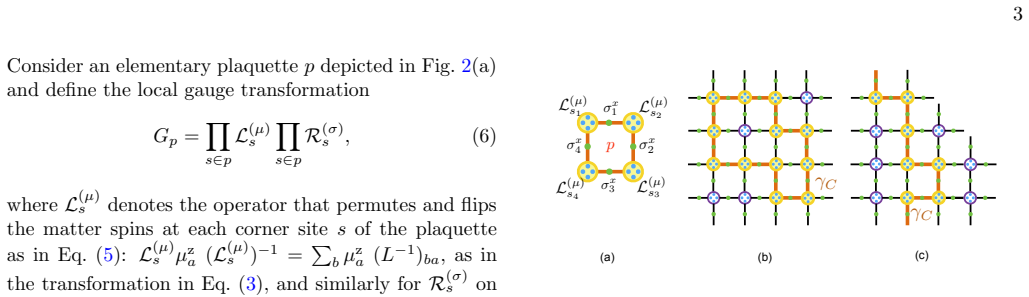
The central object is combinatorial gauge symmetry: a local transformation composed of single-spin rotations and permutations of spins, represented by monomial matrices, that preserves all spin commutation and anticommutation relations. The load-bearing identity is the automorphism condition $L^{-1}WR=W$, where $W$ is the Hadamard coupling matrix and $L,R$ are monomial matrices. This identity makes the two-body Ising term invariant under the plaquette operator $G_p = \prod_{s\in p} L_s^{(\mu)} \prod_{s\in p} R_s^{(\sigma)}$, which flips gauge spins on a plaquette and correspondingly flips and permutes matter spins at its corners, giving an exact local $\mathbb{Z}_2$ symmetry for all values of $J$, $\Gamma$, and $\tilde{\Gamma}$. A separate exact algebraic step shows that a single matter spin in the field of four gauge spins has low-energy levels described by the four-spin term $-\lambda \sigma_1^z \sigma_2^z \sigma_3^z \sigma_4^z$, and this is what maps the model onto the $\mathbb{Z}_2$ lattice gauge theory in the large-$|\Gamma|$ limit.
What would settle it
Exactly diagonalize the full gauge–matter Hamiltonian (2) on a small periodic lattice, say a $4\times 4$ arrangement of stars on a torus, at values of $\tilde{\Gamma}/\lambda$ inside the nominal topological phase, and compare the low-energy spectrum with the effective model (10). The claim predicts a fourfold-degenerate ground-state sector up to finite-size splitting and no matter-excitation levels below the $2|\Gamma|$ gap; finding extra levels intruding into that gap, or a broken fourfold degeneracy, would refute the transfer of the phase diagram to the two-body model.
Extended reading notes
Core claim
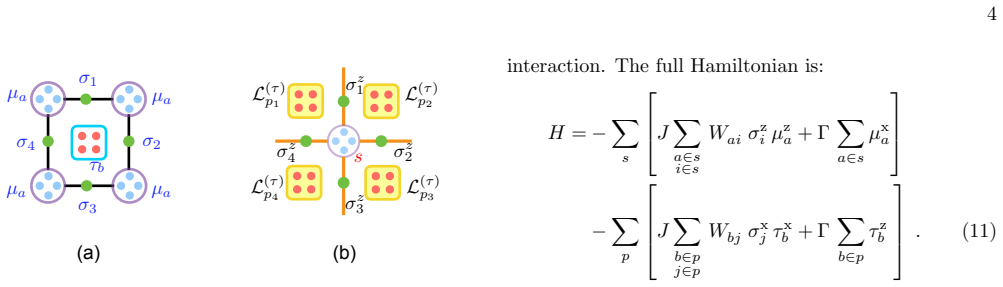
The central claim is that exact local $\mathbb{Z}_2$ gauge symmetry does not require multi-spin interaction terms: a two-body Ising model $H = -\sum_s [J \sum_{a\in s,i\in s} W_{ai} \sigma_i^z \mu_a^z + \Gamma \sum_a \mu_a^x] - \tilde{\Gamma} \sum_i \sigma_i^x$ has the plaquette operators $G_p$ of Eq. (6) as commuting symmetries whenever $W$ is a $4\times 4$ Hadamard matrix, because $W$ is invariant under automorphisms $L^{-1}WR=W$ by monomial matrices. The automorphism pairs a $\mathbb{Z}_2$ flip of the four gauge spins on a star's links with a combined flip-and-permutation of the four matter spins; the transverse fields commute with these 180-degree rotations and are permutation invariant. Because the symmetry is exact, it holds for all parameter values. In the $|\Gamma|\to\infty$ limit the low-energy sector of each star is exactly a single four-spin term $-\lambda \sigma_1^z \sigma_2^z \sigma_3^z \sigma_4^z$, reducing the full Hamiltonian to $H_{\rm eff} = -\lambda \sum_s \prod_{i\in s} \sigma_i^z - \tilde{\Gamma} \sum_i \sigma_i^x$, the standard $\mathbb{Z}_2$ lattice gauge theory with a topological phase. The identical machinery realizes the two-dimensional and three-dimensional toric code and the X-cube fracton model.
Load-bearing premise
The load-bearing premise is that the phase behavior of the effective four-spin gauge theory transfers to the original two-body Hamiltonian on the whole lattice, because the numerical checks only cover one star and one plaquette, and the authors themselves call the single-star symmetry necessary but not sufficient.
Editorial extensions
If this is right
- The two-body Hamiltonian (2) has an exact local $\mathbb{Z}_2$ gauge symmetry for all values of $J$, $\Gamma$, and $\tilde{\Gamma}$, not just in the effective limit.
- In the $|\Gamma|\to\infty$ limit, the low-energy physics is exactly the $\mathbb{Z}_2$ lattice gauge theory of Eq. (10), so the known topological phase for small $\tilde{\Gamma}/\lambda$ is accessible through two-body terms alone.
- Adding dual-lattice $\tau$ spins gives commuting star and plaquette operators, reproducing the toric-code algebra in two and three dimensions while keeping only two-body interactions.
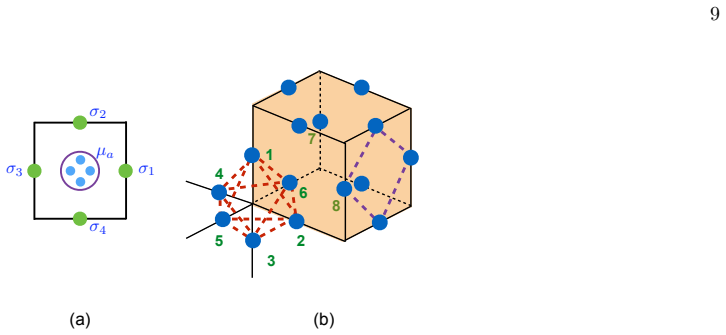
- The same scheme constructs the X-cube fracton model on the cubic lattice, with its three star operators and the cube operator emerging from the two-body Hamiltonian.
Reading between the lines
- The paper checks only single-star and single-plaquette clusters; a direct full-lattice numerical test on a torus is the natural next step, and the equal-weight superposition results suggest it would find the topological degeneracy of the effective model.
- The construction may extend to stars with more than four gauge spins by using larger Hadamard matrices, provided the automorphism condition admits a diagonal $R$; this would broaden the family of two-body spin liquids beyond the square and cubic lattices considered here.
- If the exact gauge symmetry persists at finite $\Gamma$, it could protect the topological phase against certain local perturbations without fine-tuning, but the paper's reduction is proven only in the asymptotic limit; whether that protection survives finite-$\Gamma$ corrections is left open.
Signed reviews
Editorial analysis
A structured set of objections, weighed in public.
Referee Report
Summary. The paper introduces the notion of combinatorial gauge symmetry, in which transformations that combine single-spin rotations by angle π with permutations of spins preserve the spin algebra. It shows that a two-body Ising Hamiltonian with coupling matrix W and transverse fields on gauge and matter spins possesses an exact local Z2 gauge symmetry when W is a Hadamard matrix, because such matrices admit monomial automorphisms. For a star geometry with four gauge spins and four matter spins, the author's derive an exact single-star reduction in which the matter ground-state energy depends only on the star parity operator σ1σ2σ3σ4, with coefficients γ and λ explicit functions of J and Γ. They then assert that for |Γ| ≫ J the full-lattice Hamiltonian reduces to the standard Z2 lattice gauge theory of Eq. (10), and by the same mechanism construct the toric code in two and three dimensions and the X-cube fracton model. Numerical evidence is provided from exact diagonalization of a single star and a single plaquette with fixed external legs, with degeneracies confirmed to machine precision.
Significance. If the full-lattice reduction were established, this would be a significant contribution: it would provide a physical route to topologically ordered and fracton phases using only two-body Ising couplings and transverse fields, with an exact local symmetry that is not imposed by hand. The algebraic identification of Hadamard matrices with monomial automorphisms is elegant, and the exact single-star four-spin reduction appears correct and parameter-free, with γ and λ given explicitly by Eq. (15). The machine-precision degeneracy checks on small clusters are a genuine strength. The significance is therefore substantially conditional on the full-lattice projection, which is currently inferred from the known phase diagram of the effective Z2 gauge theory rather than proven for the microscopic model.
major comments (3)
- [Special case: Z2 gauge theory, Eq. (10); Supplemental Material, Numerical study] The reduction from the microscopic two-body Hamiltonian (2) to the lattice Z2 gauge theory (10) is asserted, not derived. Equations (7)-(9) are exact for a single star at fixed gauge configuration, but on the full lattice the transverse field ~Γ connects gauge configurations, and the matter ground state depends on σ. When the local field h_a(σ)=Σ_i W_ai σ_i^z vanishes, flipping a shared gauge link leaves the old matter ground state with O(1) overlap with the new ground state; the relevant energy denominator is then controlled by the change in matter ground-state energy, of order J^2/|Γ|, rather than by the stated 2|Γ| gap. The paper provides no estimate of the amplitude of such processes and no proof that they generate only the terms appearing in Eq. (10). The Supplemental Material explicitly states that 'Symmetry of the ground state of the molecule is necessary, but not sufficient, for symmetry in the lattice,' yet no full-lattice derivation, gap bound, or finite-lattice simulation is given. This is load-bearing because the topological spin-liquid claim is inherited from the known phase diagram of Eq. (10).
- [Supplemental Material, X-cube model, Eqs. (18)-(19)] The same full-lattice gap is present in the fracton construction. The effective X-cube Hamiltonian (19) is obtained by combining single-vertex star reductions, but the global projection onto the matter ground-state manifold of the 12 matter spins per vertex is not analyzed; in particular, the authors state that they were unable to perform a single-cube exact diagonalization with fixed external legs. Since the X-cube ground-state degeneracy and subdimensional excitations rely on the exact form of the three star operators and their commutation with the cube operator, a dressed transverse-field term or additional gauge-invariant couplings could change the phase. The fracton claim is therefore conditional on the same missing full-lattice projection.
- [Main text, paragraph following Eq. (10)] The statement that in the limit |Γ|→∞ with λ fixed 'the matter fields μ can be integrated out to obtain the exact four-spin effective Hamiltonian' overstates what is shown. The four-spin star term is exact for a single star, but the full-lattice effective Hamiltonian includes the ~Γ transverse term, whose projection onto the matter ground-state manifold acquires a σ-dependent normalization factor; the paper neither computes this factor nor bounds the resulting corrections. A controlled Schrieffer-Wolff or equivalent derivation, or full-lattice numerical evidence, is needed to justify Eq. (10).
minor comments (5)
- [Introduction, reference [5]] The citation of Ref. [5] (Castelnovo, Chamon, Sherrington, Phys. Rev. B 81, 184303 (2010)) for the X-cube model appears inappropriate; the X-cube model is introduced in Ref. [6], and Ref. [5] is about quantum glass transitions. Please correct or clarify the citation.
- [Combinatorial gauge symmetry section] The sentence 'Hadamard matrices [7] satisfy these conditions' could be misread as claiming that every Hadamard matrix admits the required monomial automorphism for arbitrary diagonal R; for the construction only the specific W in Eq. (4) and its monomial equivalents are needed. Please make the scope of the statement explicit, especially because Hadamard equivalence classes are nontrivial for larger orders.
- [Supplemental Material, Large J limit, Eq. (13)] In Eq. (13) the first term, -Σ_s J Σ W_ai σ_i^z μ_a^z, is constant on the classical ground-state manifold, and the sentence describing the Hamiltonian as composed of a star and a plaquette term could be clarified by stating that the star term is a constant energy offset in the manifold of interest.
- [Supplemental Material, Numerical study, Fig. 4(d)] The statement that the environment-independence of the single-plaquette energies is 'compelling evidence' for a spin liquid is somewhat overinterpreted: it shows absence of ordering preferences at the single-plaquette level, but does not test multi-plaquette correlations. The authors already acknowledge this in the 'necessary, but not sufficient' sentence, but the wording in the Results paragraph could be softened.
- [General presentation] The notation 's∈p' in Eq. (6) is not defined; please state explicitly that the product runs over the four corner sites of plaquette p. Similarly, the inset labels in Fig. 4 and Fig. 6 are not fully legible in the text version; please ensure the final figures are readable.
Circularity Check
No significant circularity: the central derivation is self-contained exact algebra, and the phase conclusion is inherited from standard external results.
full rationale
The paper's main derivation maps the two-body Hamiltonian (2) to the effective Z2 gauge theory (10) through exact single-star identities, not through fitted parameters. The star-level effective Hamiltonian (9) follows from the identity between Eqs. (7) and (8), which is exact because the binary polynomial terminates, and the coefficients gamma and lambda are given explicitly in Eq. (15) of the Supplemental Material. No parameter is tuned to reproduce a target spectrum or phase; the numerical checks compare the full Hamiltonian to the effective Hamiltonian on small clusters as verification, not as a fit. The topological phase of the effective Z2 gauge theory is cited to standard literature (Wegner, Kogut, Fradkin-Susskind), and the order of the plaquette term is also cited externally, so the load-bearing external inputs are independent of this paper's authors. The self-citations that appear (Refs. [5], [13]) are in the introductory discussion of fracton models and are not used to justify the central construction. The paper explicitly concedes in the Supplemental Material that single-star symmetry is necessary but not sufficient for symmetry in the lattice, which identifies a gap in the full-lattice reduction; however, an unproven assumption or an incompletely justified limit is a correctness risk, not circularity, because no result is assumed by definition or reduced to a fitted input. The derivation is therefore self-contained against standard benchmarks, and no circular step can be quoted from the paper.
Assumptions & free parameters
assumptions (3)
- domain assumption The Z2 lattice gauge theory (Wegner model) supports a deconfined/topological phase for small transverse field ~Γ/λ.
- domain assumption In the Z2 gauge theory, the lowest-order term that survives in perturbation theory in ~Γ/λ is the plaquette operator that flips all four spins around a plaquette (Refs. 10-12).
- standard math All Hadamard matrices of order 4 are equivalent under monomial transformations (Kantor, Ref. 7), so the explicit choice in Eq. (4) is representative.
Cite this review
Pith. "Pith review of Constructing Quantum Spin Liquids Using Combinatorial Gauge Symmetry." pith.science (2026). https://pith.science/paper/CI3ZFEQH
@misc{pith2026190804791,
  author       = {Pith},
  title        = {Pith review of: Constructing Quantum Spin Liquids Using Combinatorial Gauge Symmetry},
  year         = {2026},
  howpublished = {\url{https://pith.science/paper/CI3ZFEQH}},
  note         = {Machine review of arXiv:1908.04791}
}
read the original abstract
We introduce the notion of combinatorial gauge symmetry -- a local transformation that includes single spin rotations plus permutations of spins (or swaps of their quantum states) -- that preserve the commutation and anti-commutation relations among the spins. We show that Hamiltonians with simple two-body interactions contain this symmetry if the coupling matrix is a Hadamard matrix, with the combinatorial gauge symmetry being associated to the automorphism of these matrices with respect to monomial transformations. Armed with this symmetry, we address the physical problem of how to build quantum spin liquids with physically accessible interactions. In addition to its intrinsic physical significance, the problem is also tied to that of how to build topological qubits.
Figures

Figures from the paper (3 more)


Reference graph
Works this paper leans on
-
[1]
Spin liquids in frustrated magnets,
L. Balents, “Spin liquids in frustrated magnets,” Nature 464, 199–208 (2010)
2010
-
[2]
Topological Orders in Rigid States,
X. G. Wen, “Topological Orders in Rigid States,” In- ternational Journal of Modern Physics B 04, 239–271 (1990)
work page 1990
-
[3]
Fault-tolerant quantum computation by anyons,
A. Y. Kitaev, “Fault-tolerant quantum computation by anyons,” Ann. Phys. 303, 2–30 (2003)
work page 2003
-
[4]
=± J2 ( 4∑ i=1 Wai σz i )2 + Γ2 1/2 . (7) The expression in Eq. (7) can be written, for any value of Γ and J, as E (±) a =±C0±C2 4∑ i⁄=j WaiWaj σz iσz j ±C4 Wa1Wa2Wa3Wa4 σz 1σz 2σz 3σz 4 , (8) whereC0,C2 andC4 are constants that depend onJ and Γ. This expression follows from expanding the square root in Eq. (7) in powers of the σz i and using (σz i...
-
[5]
Anyons in an exactly solved model and be- yond,
A. Kitaev, “Anyons in an exactly solved model and be- yond,” Ann. Phys. 321, 2–111 (2006)
work page 2006
-
[6]
Quan- tum mechanical and information theoretic view on clas- sical glass transitions,
C. Castelnovo, C. Chamon, and D. Sherrington, “Quan- tum mechanical and information theoretic view on clas- sical glass transitions,” Phys. Rev. B 81, 184303 (2010)
work page 2010
-
[7]
Fracton topological order, generalized lattice gauge theory, and duality,
S. Vijay, J. Haah, and L. Fu, “Fracton topological order, generalized lattice gauge theory, and duality,” Phys. Rev. B 94, 235157 (2016)
work page 2016
-
[8]
Automorphism groups of Hadamard matri- ces,
W. Kantor, “Automorphism groups of Hadamard matri- ces,” Journal of Combinatorial Theory 6, 279 (1969)
work page 1969
Show all 20 references
-
[9]
Duality in generalized Ising models and phase transitions without local order parameters,
F. J. Wegner, “Duality in generalized Ising models and phase transitions without local order parameters,” J. Math. Phys. 12, 2259–2272 (1971)
1971
-
[10]
An introduction to lattice gauge theory and spin systems,
J. B. Kogut, “An introduction to lattice gauge theory and spin systems,” Rev. Mod. Phys. 51, 659–713 (1979)
1979
-
[11]
Order and disorder in gauge systems and magnets,
E. Fradkin and L. Susskind, “Order and disorder in gauge systems and magnets,” Phys. Rev. D 17, 2637– 2658 (1978)
1978
-
[12]
Fradkin, Field theories of condensed matter physics (Cambridge University Press, 2013)
E. Fradkin, Field theories of condensed matter physics (Cambridge University Press, 2013)
2013
-
[13]
Lecture notes: Z2 gauge theory,
S. Sachdev, “Lecture notes: Z2 gauge theory,” (2018)
2018
-
[14]
Quantum glassiness in strongly correlated clean systems: An example of topological overprotec- tion,
C. Chamon, “Quantum glassiness in strongly correlated clean systems: An example of topological overprotec- tion,” Phys. Rev. Lett. 94, 040402 (2005)
2005
-
[15]
Topological order in an exactly solvable 3D spin model,
S. Bravyi, B. Leemhuis, and B. M. Terhal, “Topological order in an exactly solvable 3D spin model,” Annals of Physics 326, 839 – 866 (2011)
2011
-
[16]
Local stabilizer codes in three dimensions with- out string logical operators,
J. Haah, “Local stabilizer codes in three dimensions with- out string logical operators,” Phys. Rev. A 83, 042330 (2011)
2011
-
[17]
Fractons,
R. M. Nandkishore and M. Hermele, “Fractons,” Annu. Rev. Condens. Matter Phys. 10, 295–313 (2019)
2019
-
[18]
Subdimensional particle structure of higher ranku(1) spin liquids,
M. Pretko, “Subdimensional particle structure of higher ranku(1) spin liquids,” Phys. Rev. B 95, 115139 (2017)
2017
-
[19]
Majorana quantum Lego, a route towards fracton matter,
Y. You and F. von Oppen, “Majorana quantum Lego, a route towards fracton matter,” arXiv preprint arXiv:1812.06091 (2018). 6 SUPPLEMENT AL MA TERIAL FOR ”CONSTRUCTING QUANTUM SPIN LIQUIDS USING COMBINA TORIAL GAUGE SYMMETR Y” In this Supplemental Material, we discuss: (1) large...
2018 arXiv
-
[20]
(b)&(c) Eigenenergy spectrum of a single vertex in the X-cube model as a function of the transverse field ~Γ acting on the gauge spins
The cube operator is the product of σx around an elementary cube c: Ac = ∏ n∈∂cσx n. (b)&(c) Eigenenergy spectrum of a single vertex in the X-cube model as a function of the transverse field ~Γ acting on the gauge spins. Only the levels in the ground state sector where all thre...
Reviewed August 14, 2026 · model on record in the stance chip above.
Discussion (0). Continue with ORCID to comment.