Less Is More: Training-Free Acceleration Framework of 3D Diffusion Models for Low-Count PET Denoising via Global-Local Trajectory Reduction
Pith reviewed 2026-06-27 18:49 UTC · model grok-4.3
The pith
A training-free skipping strategy accelerates 3D diffusion PET denoising by over ten times while maintaining or improving quality.
A machine-rendered reading of the paper's core claim, the machinery that carries it, and where it could break.
Core claim
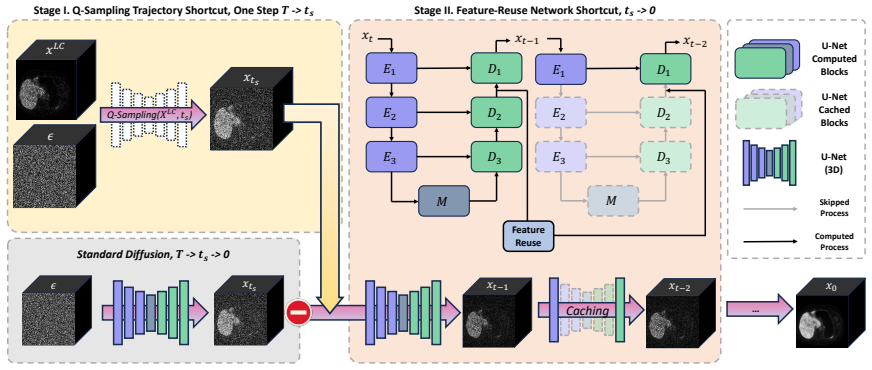
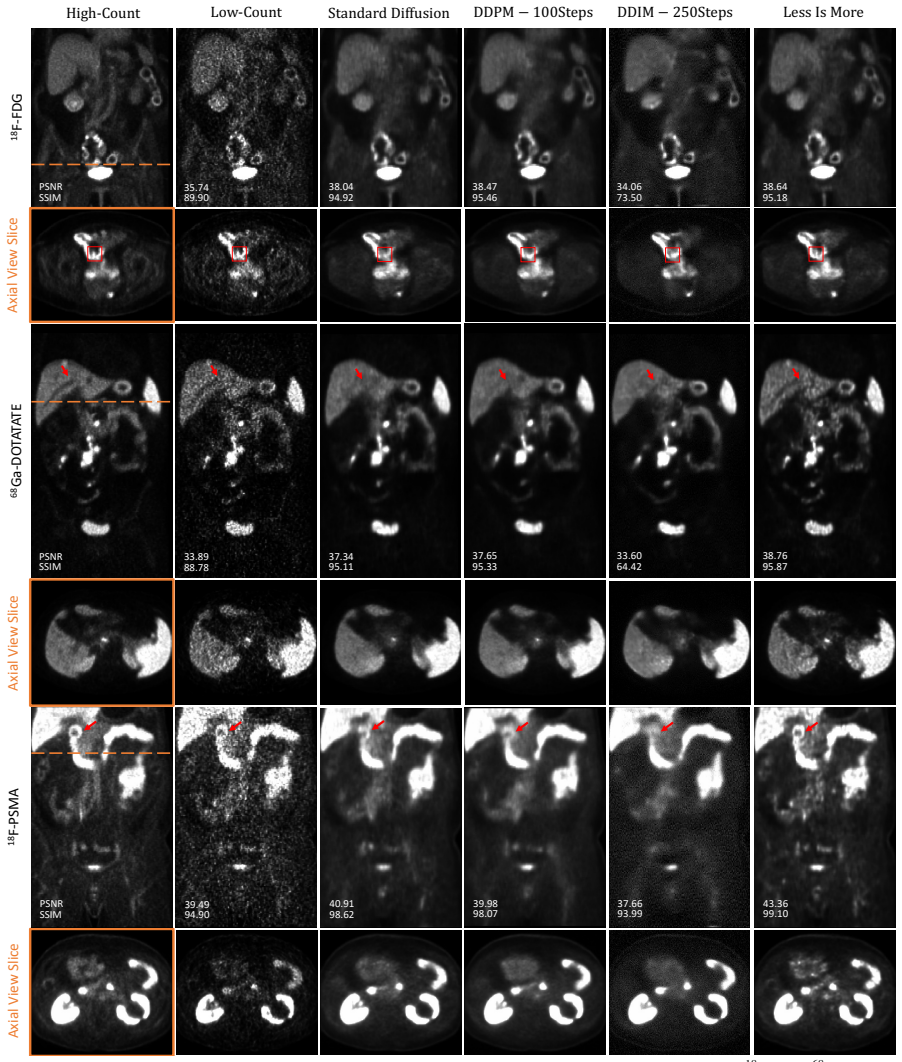
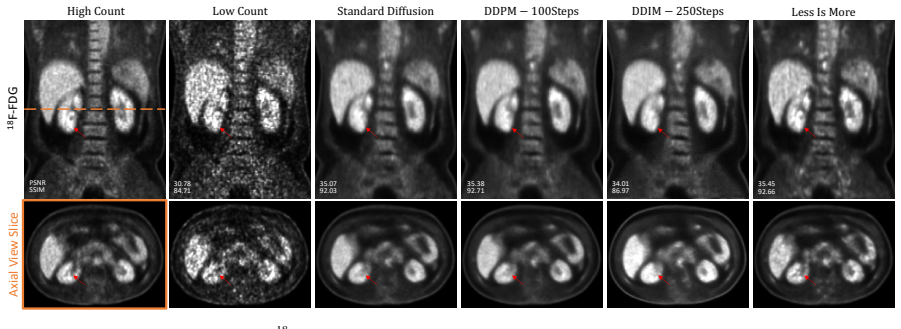
The central claim is that the Global-Local Skipping Strategy accelerates diffusion model-based 3D PET denoising by more than an order of magnitude while improving or maintaining reconstruction quality. It does so by initializing the reverse diffusion process from an intermediate denoising step via a noise-consistent transformation of the low-count input and by reusing slowly-varying high-level U-Net features across neighboring steps. The method is plug-and-play on pre-trained models and was shown to deliver consistent gains on 18F-FDG, 68Ga-DOTATATE, and 18F-PSMA PET data from in-house and public sources, with blinded reader studies confirming higher clinical confidence.
What carries the argument
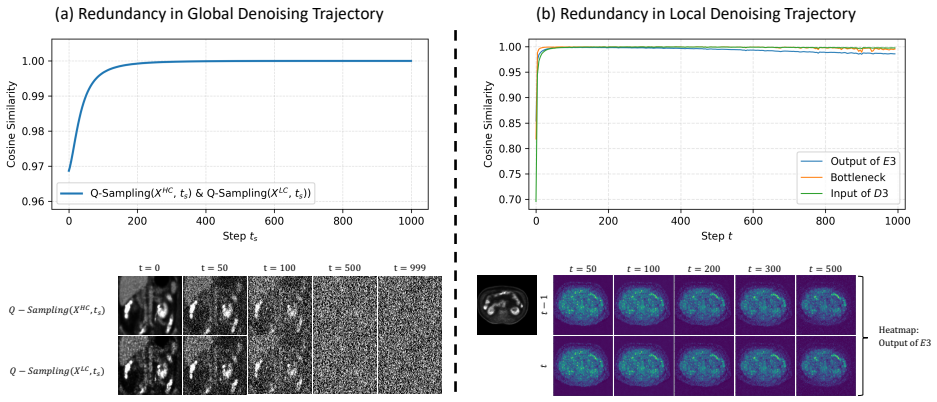
Global-Local Skipping Strategy: global step skipping that initializes reverse diffusion at an intermediate noise level using a transformed low-count input, combined with local reuse of high-level U-Net features across steps.
If this is right
- The method applies directly to existing pre-trained diffusion models without any retraining or architectural changes.
- Acceleration exceeds an order of magnitude while reconstruction quality stays the same or improves across multiple PET tracers.
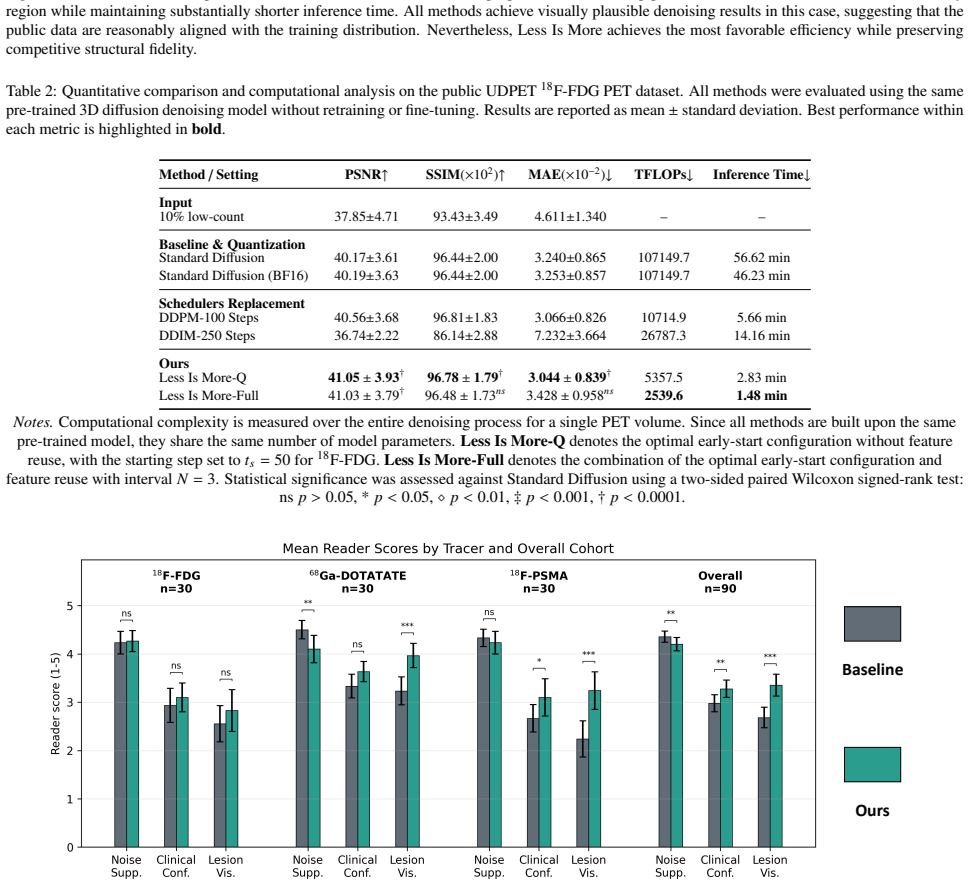
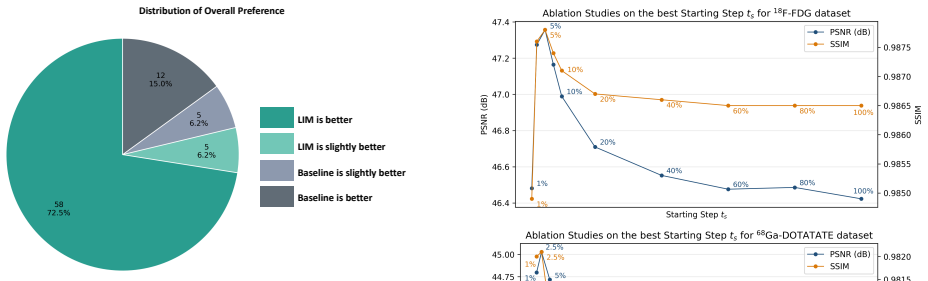
- Blinded reader studies indicate higher diagnostic confidence with the accelerated outputs.
- Inference latency drops enough to support practical clinical deployment of diffusion-based low-count PET restoration.
Where Pith is reading between the lines
- The same skipping logic could be tested on diffusion models for other 3D medical volumes such as low-dose CT or MRI denoising.
- Feature reuse might reduce energy use when running these models at scale in hospital computing environments.
- The approach suggests a general pattern for cutting diffusion steps in any reverse-process task where early features change slowly.
Load-bearing premise
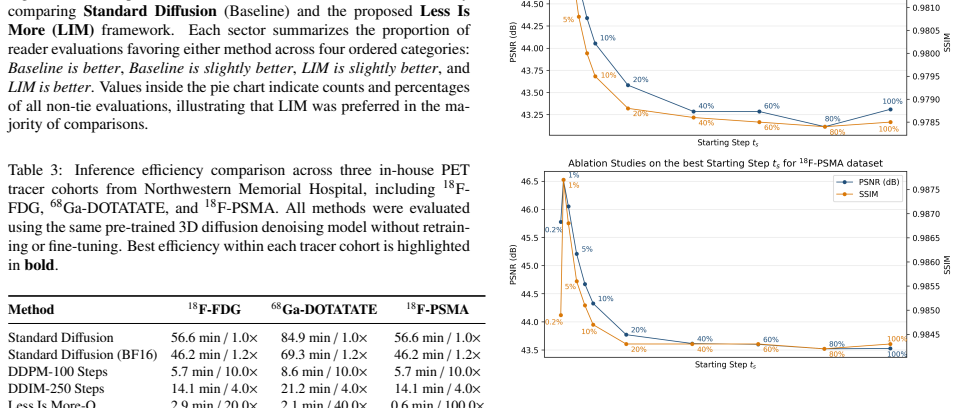
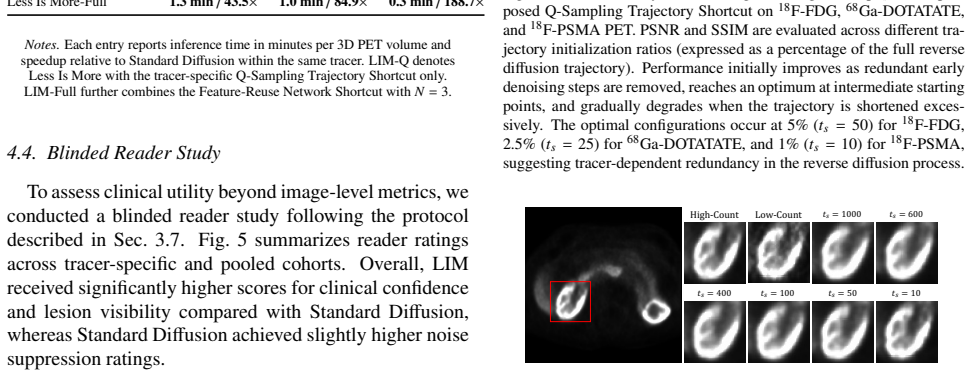
A noise-consistent transformation of the low-count input can safely initialize the reverse diffusion process at an intermediate step without introducing artifacts or losing critical uptake information needed for accurate final reconstruction.
What would settle it
A direct comparison on a low-count PET test set in which the accelerated outputs show measurably higher quantitative error or visible structural artifacts relative to the full-step diffusion baseline on the same model.
Figures
read the original abstract
Accurate quantification and uptake measurement in PET are critical for assessing disease progression and supporting clinical decision-making. While high-count PET provides reliable image quality, the associated radiation dose and prolonged acquisition remain significant clinical concerns, motivating the adoption of low-count protocols. Diffusion-model-based methods have demonstrated strong potential for restoring low-count PET to near high-count quality, but their iterative sampling procedure becomes prohibitively expensive when applied to high-resolution 3D PET volumes, introducing substantial inference latency that limits practical clinical deployment. To address these challenges, we propose a training-free Global-Local Skipping Strategy that accelerates diffusion model-based 3D PET denoising while simultaneously improving reconstruction quality. The proposed method is plug-and-play and directly applicable to pre-trained diffusion models without retraining or architectural modification. Specifically, we introduce: (i) a global denoising step skipping strategy that initializes the reverse diffusion process from an intermediate denoising step using a noise-consistent transformation of the low-count input, substantially reducing the number of required denoising steps; and (ii) a local feature reuse shortcut that reuses slowly-varying high-level U-Net features across neighboring denoising steps, further reducing per-step computation while preserving image fidelity. We evaluate the proposed approach on multiple PET tracers from in-house and public datasets, including 18F-FDG PET, 68Ga-DOTATATE PET, and 18F-PSMA PET, demonstrating consistent acceleration of over an order of magnitude alongside improved or comparable reconstruction performance relative to the full-step baseline. Blinded reader studies further confirm enhanced clinical confidence and perceived diagnostic quality.
Editorial analysis
A structured set of objections, weighed in public.
Referee Report
Summary. The paper claims to introduce a training-free Global-Local Skipping Strategy for accelerating 3D diffusion models in low-count PET denoising. By initializing the reverse process at an intermediate timestep using a noise-consistent transformation of the low-count input and reusing U-Net features locally, it achieves over an order of magnitude speedup while maintaining or improving quality across FDG, DOTATATE, and PSMA tracers, as confirmed by blinded reader studies.
Significance. If the results hold, this method could substantially facilitate the clinical adoption of diffusion-based denoising for low-count PET by reducing computational costs without retraining, addressing a major practical limitation in high-resolution 3D imaging applications. The plug-and-play design is a notable strength.
major comments (1)
- Abstract: The abstract states the central claims of 'consistent acceleration of over an order of magnitude' and 'improved or comparable reconstruction performance' but provides no quantitative metrics, error bars, dataset sizes, or exclusion criteria. This prevents verification of whether the data supports the reported performance improvements and is load-bearing for the central claim.
Simulated Author's Rebuttal
We thank the referee for their positive evaluation of the work's significance and for identifying a clear opportunity to strengthen the abstract. We address the single major comment below.
read point-by-point responses
-
Referee: Abstract: The abstract states the central claims of 'consistent acceleration of over an order of magnitude' and 'improved or comparable reconstruction performance' but provides no quantitative metrics, error bars, dataset sizes, or exclusion criteria. This prevents verification of whether the data supports the reported performance improvements and is load-bearing for the central claim.
Authors: We agree that the abstract should contain concrete quantitative support for its central claims. In the revised version we will expand the final sentence of the abstract to report the measured speedup (e.g., 12.4 ± 1.2×), representative image-quality deltas (PSNR/SSIM with standard deviations across the three tracers), the total number of volumes and patients per tracer, and a brief reference to the inclusion/exclusion criteria already detailed in Section 4.1. These additions will be drawn directly from the results tables and methods without altering the paper’s technical content. revision: yes
Circularity Check
No significant circularity; method is heuristic and empirically validated
full rationale
The paper presents a training-free heuristic acceleration strategy (global step skipping via noise-consistent initialization plus local U-Net feature reuse) applied to pre-trained diffusion models. No equations, fitted parameters, or self-citations are shown that reduce the reported acceleration or quality gains to quantities defined by the method itself. The central claims rest on empirical results across multiple tracers and reader studies rather than any derivation that collapses to its inputs by construction. This is the expected non-finding for a plug-and-play engineering contribution.
Axiom & Free-Parameter Ledger
axioms (1)
- domain assumption Diffusion reverse processes can be initialized from intermediate timesteps using a noise-consistent transformation without loss of critical information
Reference graph
Works this paper leans on
-
[1]
European Journal of Nuclear Medicine and Molecular Imaging , volume=
Robust whole-body PET image denoising using 3D diffusion models: evaluation across various scanners, tracers, and dose levels , author=. European Journal of Nuclear Medicine and Molecular Imaging , volume=. 2025 , publisher=
2025
-
[2]
International Conference on Medical Image Computing and Computer-Assisted Intervention , pages=
Pet image denoising based on 3d denoising diffusion probabilistic model: Evaluations on total-body datasets , author=. International Conference on Medical Image Computing and Computer-Assisted Intervention , pages=. 2024 , organization=
2024
-
[3]
Denoising
Ho, Jonathan and Jain, Ajay and Abbeel, Pieter , editor =. Denoising. Advances in. 2020 , pages =
2020
-
[4]
2022 , eprint=
Denoising Diffusion Implicit Models , author=. 2022 , eprint=
2022
-
[5]
2026 , eprint=
Back to Basics: Let Denoising Generative Models Denoise , author=. 2026 , eprint=
2026
-
[6]
and Liu, Chi and Zhou, Bo , journal=
Chen, Tianqi and Hou, Jun and Zhou, Yinchi and Xie, Huidong and Chen, Xiongchao and Liu, Qiong and Guo, Xueqi and Xia, Menghua and Duncan, James S. and Liu, Chi and Zhou, Bo , journal=. 2.5D Multi-View Averaging Diffusion Model for 3D Medical Image Translation: Application to Low-Count PET Reconstruction With CT-Less Attenuation Correction , year=
-
[7]
U-Net: Convolutional Networks for Biomedical Image Segmentation
Ronneberger, Olaf and Fischer, Philipp and Brox, Thomas. U-Net: Convolutional Networks for Biomedical Image Segmentation. Medical Image Computing and Computer-Assisted Intervention -- MICCAI 2015. 2015
2015
-
[8]
2014 , eprint=
Generative Adversarial Networks , author=. 2014 , eprint=
2014
-
[9]
Artificial Intelligence Review , author =
Lightweight diffusion models: a survey , volume =. Artificial Intelligence Review , author =. 2024 , pages =. doi:10.1007/s10462-024-10800-8 , language =
-
[10]
2021 , eprint=
Towards Efficient Post-training Quantization of Pre-trained Language Models , author=. 2021 , eprint=
2021
-
[11]
Chung, Hyungjin and Sim, Byeongsu and Ye, Jong Chul , month = jun, year =. Come-. 2022. doi:10.1109/CVPR52688.2022.01209 , urldate =
-
[12]
2023 , eprint=
DeepCache: Accelerating Diffusion Models for Free , author=. 2023 , eprint=
2023
-
[13]
Proceedings of the IEEE/CVF International Conference on Computer Vision (ICCV) , month =
Peebles, William and Xie, Saining , title =. Proceedings of the IEEE/CVF International Conference on Computer Vision (ICCV) , month =. 2023 , pages =
2023
-
[14]
2023 , eprint=
Attention Is All You Need , author=. 2023 , eprint=
2023
-
[15]
2021 , eprint=
High-Resolution Image Synthesis with Latent Diffusion Models , author=. 2021 , eprint=
2021
-
[16]
2021 , eprint=
LoRA: Low-Rank Adaptation of Large Language Models , author=. 2021 , eprint=
2021
-
[17]
2024 , eprint=
PTQ4DiT: Post-training Quantization for Diffusion Transformers , author=. 2024 , eprint=
2024
-
[19]
doi:10.48550/arXiv.2412.13059 , urldate =
Wang, Haoshen and Liu, Zhentao and Sun, Kaicong and Wang, Xiaodong and Shen, Dinggang and Cui, Zhiming , month = nov, year =. doi:10.48550/arXiv.2412.13059 , urldate =
-
[20]
Liu, Xuan and Xie, Yaoqin and Cheng, Jun and Diao, Songhui and Tan, Shan and Liang, Xiaokun , month = jul, year =. Diffusion. doi:10.48550/arXiv.2305.15887 , urldate =
-
[21]
IEEE Journal of Biomedical and Health Informatics , author =
Fast-. IEEE Journal of Biomedical and Health Informatics , author =. 2025 , pages =. doi:10.1109/JBHI.2025.3565183 , number =
-
[22]
MICCAI 2025 - Open Access , author =
Parameter-. MICCAI 2025 - Open Access , author =
2025
-
[23]
Score-based diffusion models for accelerated
Chung, Hyungjin and Ye, Jong Chul , month = jul, year =. Score-based diffusion models for accelerated. doi:10.48550/arXiv.2110.05243 , urldate =
-
[24]
2022 , eprint=
Progressive Distillation for Fast Sampling of Diffusion Models , author=. 2022 , eprint=
2022
-
[25]
2022 , eprint=
DPM-Solver: A Fast ODE Solver for Diffusion Probabilistic Model Sampling in Around 10 Steps , author=. 2022 , eprint=
2022
-
[26]
DPM-Solver++: Fast Solver for Guided Sampling of Diffusion Probabilistic Models , volume=
Lu, Cheng and Zhou, Yuhao and Bao, Fan and Chen, Jianfei and Li, Chongxuan and Zhu, Jun , year=. DPM-Solver++: Fast Solver for Guided Sampling of Diffusion Probabilistic Models , volume=. Machine Intelligence Research , publisher=. doi:10.1007/s11633-025-1562-4 , number=
-
[27]
2024 , eprint=
FORA: Fast-Forward Caching in Diffusion Transformer Acceleration , author=. 2024 , eprint=
2024
-
[28]
2025 , eprint=
Accelerating Diffusion Transformers with Token-wise Feature Caching , author=. 2025 , eprint=
2025
-
[29]
arXiv preprint arXiv:2505.16864 , year=
Training-Free Efficient Video Generation via Dynamic Token Carving , author=. arXiv preprint arXiv:2505.16864 , year=
-
[30]
2024 , eprint=
Parameter-Efficient Fine-Tuning for Large Models: A Comprehensive Survey , author=. 2024 , eprint=
2024
-
[31]
2025 , eprint=
Wan: Open and Advanced Large-Scale Video Generative Models , author=. 2025 , eprint=
2025
-
[32]
2025 , eprint=
FLUX.1 Kontext: Flow Matching for In-Context Image Generation and Editing in Latent Space , author=. 2025 , eprint=
2025
-
[33]
arXiv preprint arXiv:2412.20404 , year=
Open-sora: Democratizing efficient video production for all , author=. arXiv preprint arXiv:2412.20404 , year=
-
[34]
2022 , eprint=
High-Resolution Image Synthesis with Latent Diffusion Models , author=. 2022 , eprint=
2022
-
[35]
European Journal of Nuclear Medicine and Molecular Imaging , author =
A cross-scanner and cross-tracer deep learning method for the recovery of standard-dose imaging quality from low-dose. European Journal of Nuclear Medicine and Molecular Imaging , author =. 2022 , pages =. doi:10.1007/s00259-021-05644-1 , language =
-
[36]
Computerized Medical Imaging and Graphics , volume=
Image reconstruction using UNET-transformer network for fast and low-dose PET scans , author=. Computerized Medical Imaging and Graphics , volume=. 2023 , publisher=
2023
-
[37]
ICASSP 2023-2023 IEEE International Conference on Acoustics, Speech and Signal Processing (ICASSP) , pages=
Unext: a low-dose ct denoising unet model with the modified convnext block , author=. ICASSP 2023-2023 IEEE International Conference on Acoustics, Speech and Signal Processing (ICASSP) , pages=. 2023 , organization=
2023
-
[38]
International Workshop on Computational Methods for Molecular Imaging , pages=
Synthesis of positron emission tomography (PET) images via multi-channel generative adversarial networks (GANs) , author=. International Workshop on Computational Methods for Molecular Imaging , pages=. 2017 , organization=
2017
-
[39]
Supervised learning with cyclegan for low-dose FDG PET image denoising , journal =. 2020 , issn =. doi:https://doi.org/10.1016/j.media.2020.101770 , url =
-
[40]
, booktitle=
Isola, Phillip and Zhu, Jun-Yan and Zhou, Tinghui and Efros, Alexei A. , booktitle=. Image-to-Image Translation with Conditional Adversarial Networks , year=
-
[41]
3D conditional generative adversarial networks for high-quality PET image estimation at low dose , journal =. 2018 , issn =. doi:https://doi.org/10.1016/j.neuroimage.2018.03.045 , url =
-
[42]
Parameter-Transferred Wasserstein Generative Adversarial Network (PT-WGAN) for Low-Dose PET Image Denoising , year=
Gong, Yu and Shan, Hongming and Teng, Yueyang and Tu, Ning and Li, Ming and Liang, Guodong and Wang, Ge and Wang, Shanshan , journal=. Parameter-Transferred Wasserstein Generative Adversarial Network (PT-WGAN) for Low-Dose PET Image Denoising , year=
-
[43]
Journal of digital imaging , volume=
Full-dose PET image estimation from low-dose PET image using deep learning: a pilot study , author=. Journal of digital imaging , volume=. 2019 , publisher=
2019
-
[44]
IEEE transactions on radiation and plasma medical sciences , volume=
Parameter-transferred Wasserstein generative adversarial network (PT-WGAN) for low-dose PET image denoising , author=. IEEE transactions on radiation and plasma medical sciences , volume=. 2020 , publisher=
2020
-
[45]
Neurocomputing , volume=
Deep auto-context convolutional neural networks for standard-dose PET image estimation from low-dose PET/MRI , author=. Neurocomputing , volume=. 2017 , publisher=
2017
-
[46]
Radiology , volume=
Ultra--low-dose 18F-florbetaben amyloid PET imaging using deep learning with multi-contrast MRI inputs , author=. Radiology , volume=. 2019 , publisher=
2019
-
[47]
MR Image Denoising and Super-Resolution Using Regularized Reverse Diffusion , year=
Chung, Hyungjin and Lee, Eun Sun and Ye, Jong Chul , journal=. MR Image Denoising and Super-Resolution Using Regularized Reverse Diffusion , year=
-
[48]
2025 , eprint=
Timestep Embedding Tells: It's Time to Cache for Video Diffusion Model , author=. 2025 , eprint=
2025
-
[49]
2026 , eprint=
SeaCache: Spectral-Evolution-Aware Cache for Accelerating Diffusion Models , author=. 2026 , eprint=
2026
-
[50]
Journal of Digital Imaging , author =
Full-. Journal of Digital Imaging , author =. 2019 , pages =. doi:10.1007/s10278-018-0150-3 , language =
-
[51]
UDPET: Ultra-low Dose PET Imaging Challenge Dataset
Xue, Song and Wang, Hanzhong and Chen, Yizhou and Liu, Fanxuan and Zhu, Hong and Viscione, Marco and Guo, Rui and Rominger, Axel and Li, Biao and Shi, Kuangyu. UDPET: Ultra-low Dose PET Imaging Challenge Dataset. Medical Image Computing and Computer Assisted Intervention -- MICCAI 2025. 2026
2025
-
[52]
2024 , eprint=
Hash3D: Training-free Acceleration for 3D Generation , author=. 2024 , eprint=
2024
-
[53]
2024 IEEE International Symposium on Biomedical Imaging (ISBI) , pages=
DiffGEPCI: 3D MRI synthesis from mGRE signals using 2.5 D diffusion model , author=. 2024 IEEE International Symposium on Biomedical Imaging (ISBI) , pages=. 2024 , organization=
2024
-
[54]
Huidong Xie and Weijie Gan and Reimund Bayerlein and Bo Zhou and Ming-Kai Chen and Michal Kulon and Annemarie Boustani and Kuan-Yin Ko and Der-Shiun Wang and Benjamin A. Spencer and Wei Ji and Xiongchao Chen and Qiong Liu and Xueqi Guo and Menghua Xia and Yinchi Zhou and Hui Liu and Liang Guo and Hongyu An and Ulugbek S. Kamilov and Hanzhong Wang and Biao...
discussion (0)
Sign in with ORCID, Apple, or X to comment. Anyone can read and Pith papers without signing in.