REVIEW 4 major objections 4 minor 6 cited by
Generative Multimodal Pretraining with Discrete Diffusion Timestep Tokens
T0 review · 4 major / 4 minor · reviewed 2026-08-16 · deepseek-v4-flash
Pith's one-line read The paper claims that ordering visual tokens by diffusion timesteps instead of spatial position gives multimodal LLMs a recursive visual language that makes unified comprehension and generation work.
desk verdict Novel diffusion-timestep tokenization with strong but under-verified results; the recursivity claim needs a decisive ordering ablation. read the letter →
The pith
A machine-rendered reading of the paper's core claim, the machinery that carries it, and where it could break.
The reading
What carries the argument
The load-bearing object is the DDT tokenizer: a transformer encoder with $T=480$ learnable query tokens, a vector-quantization codebook of 65,536 entries, and an MMDiT diffusion decoder. During training, the noised image is sampled by Rectified Flow interpolation, $x_t = t\epsilon + (1-t)x_0$; the decoder receives $x_t$, the timestep $t$, and only the first $t$ quantized tokens, and is trained to return $x_0$. This expanding-prefix reconstruction loss is what forces each new token to carry the information removed by the extra noise. The paper also uses an order-perturbation experiment, borrowed from the impossible-language test, to show that DDT sequences lose predictive performance when shuffled, while spatial token sequences are nearly order-insensitive.
What would settle it
Take a complete DDT token sequence and decode it after shuffling the token order, then compare reconstruction quality with the ordered case: if the recursion claim holds, shuffled tokens should reconstruct the image substantially worse, whereas if the tokens just encode the image redundantly, a shuffled but complete set would still reconstruct well. A second check is to train the tokenizer with a reversed timestep order under the same loss and see whether the editing and generation advantages disappear.
Extended reading notes
Core claim
The central claim is that images can be tokenized into a discrete, recursive visual language by aligning token order with diffusion timesteps. For a clean image $x_0$, the encoder $f$ produces a sequence $(V_1,\ldots,V_T)$; at timestep $t$, the first $t$ tokens together with the noised image $x_t = t\epsilon + (1-t)x_0$ are enough for the diffusion decoder to reconstruct $x_0$. Because each appended token accounts for the attributes destroyed by the additional noise, the sequence satisfies $f_t(x_0) = (f_{t-1}(x_0), V_t)$, which gives the token stream a language-like recursive structure. The paper supports this with three kinds of evidence: autoregressive training curves that degrade when DDT token order is perturbed, as human language does; counterfactual interpolation in which swapping a subset of tokens changes only the corresponding attributes instead of cutting and mixing image regions; and progressive decoding in which the earliest tokens fix fine details while later tokens build contours and color. With this tokenizer, the MLLM learns to translate between text and DDT tokens under a single next-token prediction objective, and the same diffusion decoder serves both generation and comprehension.
Load-bearing premise
The load-bearing premise is that a single fixed ordering of tokens along diffusion timesteps induces a consistent, semantically meaningful attribute hierarchy across all images, so that the first $t$ tokens together with the noised image suffice to reconstruct the original image.
Editorial extensions
If this is right
- An MLLM can be built without a pretrained CLIP-style vision encoder and still match or beat comprehension-specialized models on captioning, VQA, and MLLM benchmarks.
- Zero-shot instruction-based image editing improves because editing becomes a matter of changing the specific tokens that carry the modified attributes; DDT-LLaMA outperforms both generalist and specialist editors on EVR, MA5K, and MagicBrush.
- Counterfactual interpolation with DDT tokens changes only the substituted attributes, whereas spatial tokenizers behave like CutMix, producing a patch-wise blend rather than a semantic one.
- Scaling the LLM backbone from 2B to 8B parameters and increasing training compute improves visual quality, consistent with scaling laws for the DDT-based formulation.
- The paper's stated limitation is that tokenizer reconstruction quality, not token ordering, is the bottleneck: a tokenizer trained only on ImageNet at 256x256 restricts aesthetic quality for open-domain generation, so scaling tokenizer data is the clear next step.
Reading between the lines
- Any signal with a natural degradation process—video, audio, or 3D scenes under corruption—could be tokenized along its own timestep ordering; the design principle of recovering lost attributes with expanding discrete prefixes is not image-specific.
- The learned attribute hierarchy is encouraged by the reconstruction loss rather than enforced by a structural constraint, so a direct test of the visual-language claim would measure how well the ordering transfers to out-of-domain images, where the paper reports strong results but does not quantify attribute disentanglement.
- A testable extension is to train the tokenizer with reversed or shuffled timestep order under the same loss: if the advantages in editing and generation persist, recursion is not the active ingredient; if they vanish, the diffusion-timestep ordering is doing the work.
- Because editing quality improves when the backbone grows from 2B to 8B, the DDT formulation may offer a direct path to attribute-level controllable generation at scale, since token-level interventions become semantically meaningful.
Signed reviews
Editorial analysis
A structured set of objections, weighed in public.
Referee Report
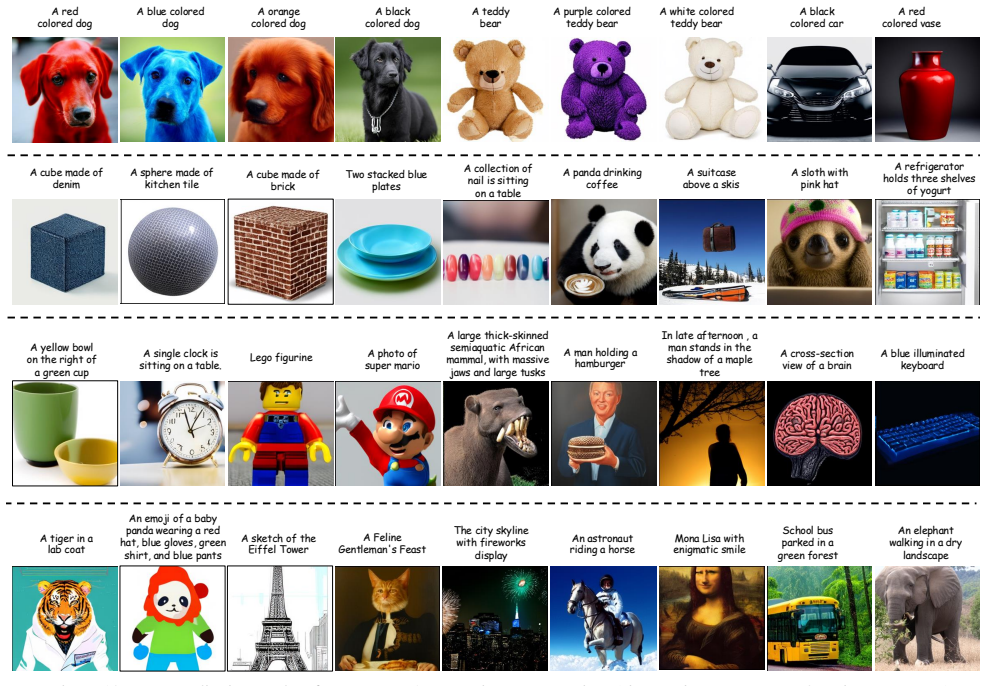
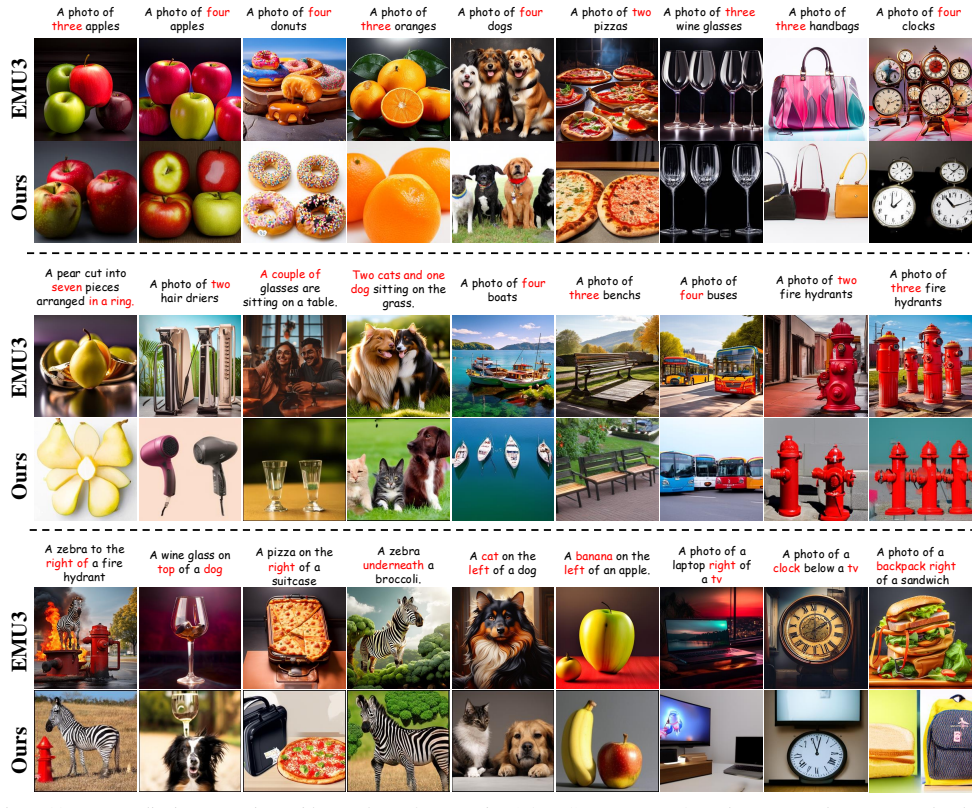
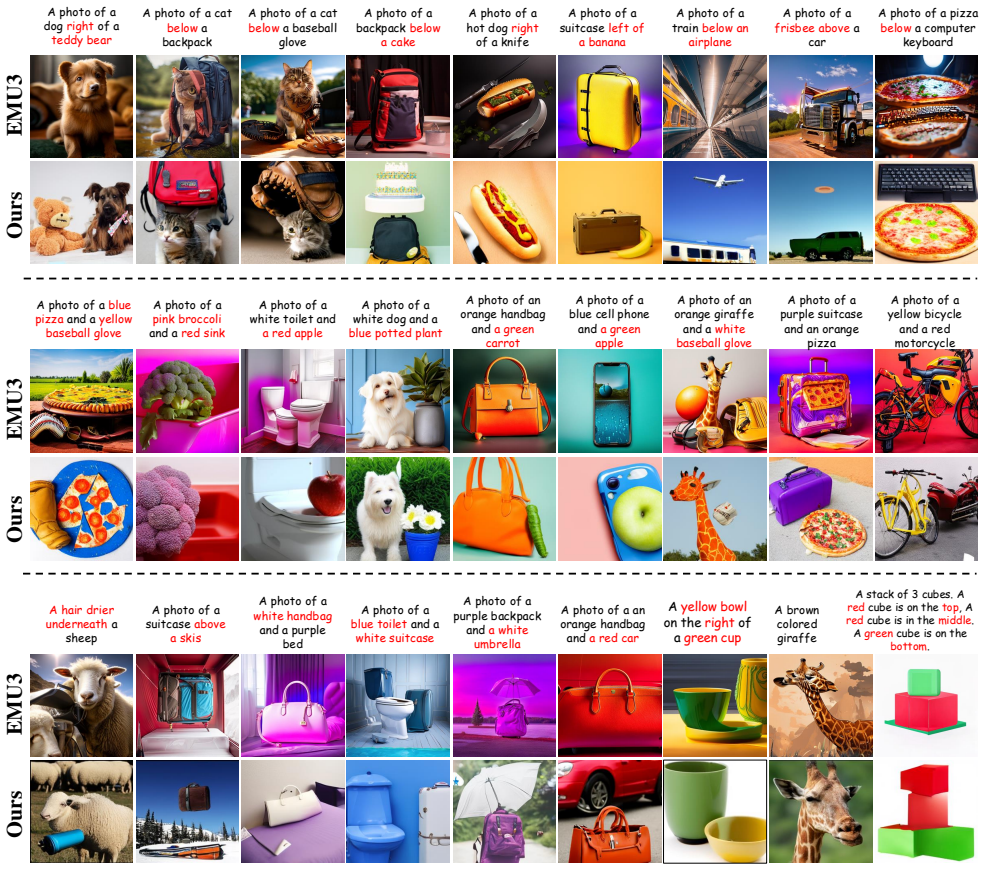
Summary. The paper proposes Discrete Diffusion Timestep (DDT) tokens: an image tokenizer that encodes an image into a sequence of discrete codes, one per diffusion timestep, trained so that the first t tokens together with the noised image x_t reconstruct x_0 (Eq. 1). The authors argue that this yields a recursive visual language whose tokens progressively compensate for attribute loss as the timestep increases, in contrast to spatial tokens that form an 'impossible language' for LLMs. They integrate these tokens into an 8B LLaMA-3-based MLLM trained on 200M image-text pairs and report improved results over other MLLMs on text-to-image generation (GenEval, T2I-CompBench, DrawBench), instruction-based image editing (EVR, MA5K, MagicBrush), and vision-language comprehension benchmarks, despite a tokenizer trained only on ImageNet at 256x256. Additional analyses cover class-conditional ImageNet generation, counterfactual interpolation, progressive decoding with token subsets, a perplexity comparison, an A/B editing test with a 2B Gemma backbone, and preliminary scaling observations.
Significance. If the central claim holds, the paper makes a useful conceptual contribution: replacing spatial token order with a diffusion-timestep order that is claimed to be recursive and semantically structured, while keeping a single next-token-prediction objective for both text and image. The breadth of benchmarks is a strength, and the reported results are generally strong for an MLLM generalist. The paper also presents a controlled A/B comparison (DDT-Gemma vs. MoVQ-Gemma) and an ImageNet class-conditional FID comparison, which are helpful evidence beyond the headline tables. However, the load-bearing property—that the learned token order is genuinely recursive and semantically consistent across images—is currently supported mainly by qualitative demonstrations and by an order-perturbation experiment on the LLM, not by a direct ablation of the tokenizer's ordering. The single-run point estimates in Tables 1-3 and the use of previously published baseline numbers also weaken the confidence in the claimed superiority. The idea is timely and potentially impactful, but the evidence as presented is not yet decisive.
major comments (4)
- [Section 3, Eq. (1); Section 5.4.2] The recursion claim f_{t+1}(x0) = (f_t(x0), V_{t+1}) is not entailed by the training objective in Eq. (1). The loss only requires that the decoder map (x_t, t, V_1, ..., V_t) to x0; since x_t itself preserves most information for small t, the objective can be satisfied by late tokens that are redundant or that encode image-specific statistics rather than the incremental attribute loss between t and t+1. The counterfactual interpolation and progressive-decoding figures are consistent with the claimed hierarchy, but they are also consistent with the decoder exploiting the known noise level t and a few coarse tokens. To make the central claim load-bearing, the authors should provide a decisive ordering ablation: train the tokenizer with (i) the proposed order, (ii) the reversed order, and (iii) a fixed random permutation of timestep indices, holding architecture and data fixed, and then compare reconstruction PSNR and the downstream editing A/B test. If ordering has little effect, the 'recursive visual language' interpretation is a training artifact; if it has a large effect, the size and direction of that effect should be quantified.
- [Tables 1-3 in Sections 5.1-5.3] The headline comparisons are based on single-run point estimates without error bars, confidence intervals, or significance tests, and many baseline numbers are taken from published papers rather than rerun in an identical setup. This matters because several headline margins are small, for example GenEval Overall 0.66 vs. Transfusion 0.63 and DrawBench Clip-T 0.267 tied with LaVIT and Lumina-mGPT. The authors should either provide multiple runs (at least for a smaller controlled setting) or state clearly that the differences are not statistically assessed; without this, the claim of systematic superiority over other MLLMs is not fully supported.
- [Section 5.4.2 and Figure 1] The 'impossible language' argument and the recursion interpretation rely on Figure 1, which shows LLM training loss under different perturbation types for DDT tokens and spatial tokens. The figure lacks experimental detail such as the number of seeds, architecture, training length, and the magnitude of the perturbation; more importantly, order sensitivity of the LLM does not establish that the token order corresponds to a semantically meaningful attribute hierarchy. An LLM can be sensitive to arbitrary positional statistics without the tokens encoding recursive, disentangled attributes. The authors should report quantitative order-sensitivity measures (e.g., final loss gaps averaged over seeds) and connect them to the downstream editing and counterfactual results.
- [Section 5.4.4 and Figure 9(b)] The A/B test on image editing is potentially the strongest evidence for the claimed advantage, but the description is incomplete. The paper does not report the number of human raters, the exact instructions, whether ties were allowed, how the test cases were selected, or the total number of cases. The text states that DDT-Gemma outperforms MoVQ-Gemma in 65 editing cases and that MoVQ-Gemma surpasses DDT-Gemma in only 10, but without a total and a protocol the reader cannot judge significance or bias. This should be documented, together with inter-annotator agreement if multiple raters were used.
minor comments (4)
- [Appendix A.1 and B.1] There are typos: 'two weaks' should read 'two weeks' (appears twice), and the reference 'Coyo [ ? ]' in Appendix B.1 is incomplete.
- [Section 5.1 and 5.4.2] Main-text figure references are inconsistent with the numbering: Section 5.1 refers to 'Figure 10' for qualitative T2I examples, and Section 5.4.2 refers to 'Figure 16' and 'Figure 17' for counterfactual interpolation and subset decoding, while the corresponding main-paper figures are numbered 3, 6, and 8.
- [Appendix B.2] In the GenEval subtask list, 'single object (TwoObj)' should be 'single object (SingObj) and two objects (TwoObj)'.
- [Figure 12 captions] The captions contain article errors: 'an blue cell phone' and 'an purple suitcase' should be 'a blue cell phone' and 'a purple suitcase'.
Circularity Check
The recursive-token claim is largely built into Eq. (1), while the downstream MLLM results rest on external benchmarks and are not circular.
-
self definitional
[Section 3, Training (Eq. 1); Section 5.4.2, DDT Tokens are Recursive]
"Hence we use an expanding set of tokens (V1,..., Vt) as the input to the decoder d, and train everything end-to-end with the reconstruction loss: L = E t,x0,ϵ [ || d (tϵ + (1−t)x0,t, (V1,..., Vt))− x0||2 ] ... As shown in Figure 17, with the number of tokens increasing, the image’s attributes are progressively recovered. ... This finding further demonstrates that DDT tokens are recursive, and DDT-LLaMA effectively disentangles visual attributes."
Eq. (1) is exactly an expanding-prefix reconstruction objective: at every timestep t the decoder receives (V1,...,Vt) and the noised image xt and must reconstruct x0. Therefore the Section 5.4.2 observation that decoding with the first t tokens progressively recovers the image is a direct consequence of the training loss, not an independent discovery of recursivity. The abstract's phrase 'tokens recursively compensate for the progressive attribute loss' restates this same training objective. The additional claim of a semantically meaningful attribute hierarchy (fine details first, coarse attributes later) is not forced by Eq. (1), but the load-bearing recursive-prefix property is true by construction, making the evidence partly self-definitional.
full rationale
The central empirical result of the paper—DDT-LLaMA outperforming other MLLM generalists on GenEval, image editing, and VQA/captioning—is evaluated on external benchmarks and does not reduce to the tokenizer loss. The A/B test against MoVQ-Gemma and the perplexity comparison also provide independent, non-circular evidence. However, the paper's structural claim that DDT tokens are 'recursive' is largely built into the method: Section 3 defines ft+1(x0) = (ft(x0), Vt+1) and Eq. (1) trains the decoder to reconstruct x0 from every prefix (V1,...,Vt) at every timestep. Consequently, Section 5.4.2's progressive-decoding demonstration that an expanding subset of tokens reconstructs the image is a consequence of the training objective rather than an independent confirmation. The counterfactual interpolation experiment offers some non-forced evidence for attribute disentanglement, and the decoder's dependence on the noise level t could explain progressive reconstruction without a semantically ordered token hierarchy, so the circularity is partial rather than total. No load-bearing self-citation or imported uniqueness theorem was found; the cited 'impossible language' evaluation [34] is re-run by the authors on their own tokens and spatial baselines, so it does not create a circularity chain.
Assumptions & free parameters
free parameters (5)
- Number of timestep tokens T =
480
- Visual codebook size |C| =
65,536
- VQ projection dimension m =
16
- Inference sampling hyperparameters =
topk=4096, topp=0.9, CFG scale=8.0
- Pretraining data recipe ratios =
60% long caption, 40% short caption, 10% caption dropout, 10% text data
assumptions (3)
- domain assumption The order-perturbation test from Kallini et al. [34] is a valid diagnostic for whether a token sequence is a learnable "language" for an LLM.
- domain assumption There exists a single consistent attribute hierarchy ordered by diffusion timestep that the encoder can approximate.
- standard math Rectified flow interpolation x_t = t*epsilon + (1-t)*x0 is a valid noising schedule for learning the token-to-attribute mapping.
Cite this review
Pith. "Pith review of Generative Multimodal Pretraining with Discrete Diffusion Timestep Tokens." pith.science (2026). https://pith.science/paper/CIC6WCA2
@misc{pith2026250414666,
  author       = {Pith},
  title        = {Pith review of: Generative Multimodal Pretraining with Discrete Diffusion Timestep Tokens},
  year         = {2026},
  howpublished = {\url{https://pith.science/paper/CIC6WCA2}},
  note         = {Machine review of arXiv:2504.14666}
}
read the original abstract
Recent endeavors in Multimodal Large Language Models (MLLMs) aim to unify visual comprehension and generation by combining LLM and diffusion models, the state-of-the-art in each task, respectively. Existing approaches rely on spatial visual tokens, where image patches are encoded and arranged according to a spatial order (e.g., raster scan). However, we show that spatial tokens lack the recursive structure inherent to languages, hence form an impossible language for LLM to master. In this paper, we build a proper visual language by leveraging diffusion timesteps to learn discrete, recursive visual tokens. Our proposed tokens recursively compensate for the progressive attribute loss in noisy images as timesteps increase, enabling the diffusion model to reconstruct the original image at any timestep. This approach allows us to effectively integrate the strengths of LLMs in autoregressive reasoning and diffusion models in precise image generation, achieving seamless multimodal comprehension and generation within a unified framework. Extensive experiments show that we achieve superior performance for multimodal comprehension and generation simultaneously compared with other MLLMs. Project Page: https://DDT-LLaMA.github.io/.
Figures


Figures from the paper (13 more)




Forward citations
Cited by 6 Pith papers
-
FocusDiff: Advancing Fine-Grained Text-Image Alignment for Autoregressive Visual Generation through RL
FocusDiff improves autoregressive text-to-image generation by training on paired similar prompts with a modified GRPO objective, achieving state-of-the-art alignment on PairComp and gains on GenEval and T2I-CompBench.
-
D-AR: Diffusion via Autoregressive Models
D-AR recasts pixel-space diffusion as vanilla autoregressive next-token prediction using a diffusion-ordered discrete tokenizer, reaching 2.09 FID on ImageNet 256x256 with a 775M Llama backbone.
-
Towards Meta-Cognitive Knowledge Editing for Multimodal LLMs
CogEdit and MIND shift multimodal knowledge editing toward evaluating and enabling meta-cognitive skills: self-awareness, boundary monitoring, and noise robustness.
-
What Limits Virtual Agent Application? OmniBench: A Scalable Multi-Dimensional Benchmark for Essential Virtual Agent Capabilities
A self-generating graph benchmark produces 36k GUI agent tasks with controllable complexity and ten capability scores, and fine-tuning on its trajectories gives small gains on AndroidControl and OmniAct.
-
FUDOKI: Discrete Flow-based Unified Understanding and Generation via Kinetic-Optimal Velocities
A 1.5B unified multimodal model trained with discrete flow matching and metric-induced probability paths matches autoregressive baselines of similar size on generation and understanding benchmarks.
-
KRIS-Bench: Benchmarking Next-Level Intelligent Image Editing Models
A new benchmark, KRIS-Bench, evaluates image editing models on knowledge-grounded reasoning across factual, conceptual, and procedural tasks, and finds large performance gaps in current models.
Reference graph
Works this paper leans on
-
[1]
Nocaps: Novel object captioning at scale
Harsh Agrawal, Karan Desai, Yufei Wang, Xinlei Chen, Rishabh Jain, Mark Johnson, Dhruv Batra, Devi Parikh, Stefan Lee, and Peter Anderson. Nocaps: Novel object captioning at scale. In Proceedings of the IEEE/CVF inter- national conference on computer vision, pages 8948–8957,
-
[2]
Vqa: Visual question answering
Stanislaw Antol, Aishwarya Agrawal, Jiasen Lu, Margaret Mitchell, Dhruv Batra, C Lawrence Zitnick, and Devi Parikh. Vqa: Visual question answering. In Proceedings of the IEEE international conference on computer vision , pages 2425–2433, 2015. 6
2015
-
[3]
Jinze Bai, Shuai Bai, Shusheng Yang, Shijie Wang, Sinan Tan, Peng Wang, Junyang Lin, Chang Zhou, and Jingren Zhou. Qwen-vl: A versatile vision-language model for un- derstanding, localization, text reading, and beyond. arXiv preprint arXiv:2308.12966, 2023. 7, 17
arXiv 2023
-
[4]
Improving image generation with better captions
James Betker, Gabriel Goh, Li Jing, Tim Brooks, Jianfeng Wang, Linjie Li, Long Ouyang, Juntang Zhuang, Joyce Lee, Yufei Guo, et al. Improving image generation with better captions. Computer Science. https://cdn. openai. com/papers/dall-e-3. pdf, 2(3):8, 2023. 4, 16
2023
-
[5]
Vizwiz: nearly real-time answers to visual questions
Jeffrey P Bigham, Chandrika Jayant, Hanjie Ji, Greg Lit- tle, Andrew Miller, Robert C Miller, Robin Miller, Aubrey Tatarowicz, Brandyn White, Samual White, et al. Vizwiz: nearly real-time answers to visual questions. In Proceed- ings of the 23nd annual ACM symposium on User interface software and technology, pages 333–342, 2010. 19
2010
-
[6]
In- structpix2pix: Learning to follow image editing instruc- tions
Tim Brooks, Aleksander Holynski, and Alexei A Efros. In- structpix2pix: Learning to follow image editing instruc- tions. In Proceedings of the IEEE/CVF Conference on Computer Vision and Pattern Recognition , pages 18392– 18402, 2023. 4, 6, 16, 17
2023
-
[7]
Coyo-700m: Image-text pair dataset
Minwoo Byeon, Beomhee Park, Haecheon Kim, Sungjun Lee, Woonhyuk Baek, and Saehoon Kim. Coyo-700m: Image-text pair dataset. https : / / github . com / kakaobrain/coyo-dataset, 2022. 2, 4
2022
-
[8]
Allava: Harness- ing gpt4v-synthesized data for a lite vision-language model
Guiming Hardy Chen, Shunian Chen, Ruifei Zhang, Juny- ing Chen, Xiangbo Wu, Zhiyi Zhang, Zhihong Chen, Jian- quan Li, Xiang Wan, and Benyou Wang. Allava: Harness- ing gpt4v-synthesized data for a lite vision-language model. arXiv preprint arXiv:2402.11684, 2024. 16
arXiv 2024
Show all 101 references
-
[9]
Pixart- α: Fast train- ing of diffusion transformer for photorealistic text-to-image synthesis, 2023
Junsong Chen, Jincheng Yu, Chongjian Ge, Lewei Yao, Enze Xie, Yue Wu, Zhongdao Wang, James Kwok, Ping Luo, Huchuan Lu, and Zhenguo Li. Pixart- α: Fast train- ing of diffusion transformer for photorealistic text-to-image synthesis, 2023. 4, 16
2023
-
[10]
Sharegpt4v: Improving large multi-modal models with better captions
Lin Chen, Jinsong Li, Xiaoyi Dong, Pan Zhang, Conghui He, Jiaqi Wang, Feng Zhao, and Dahua Lin. Sharegpt4v: Improving large multi-modal models with better captions. arXiv preprint arXiv:2311.12793, 2023. 7, 15, 16, 17
2023 arXiv
-
[11]
Janus- pro: Unified multimodal understanding and generation with data and model scaling
Xiaokang Chen, Zhiyu Wu, Xingchao Liu, Zizheng Pan, Wen Liu, Zhenda Xie, Xingkai Yu, and Chong Ruan. Janus- pro: Unified multimodal understanding and generation with data and model scaling. arXiv preprint arXiv:2501.17811,
-
[12]
Palm: Scaling language modeling with pathways
Aakanksha Chowdhery, Sharan Narang, Jacob Devlin, Maarten Bosma, Gaurav Mishra, Adam Roberts, Paul Barham, Hyung Won Chung, Charles Sutton, Sebastian Gehrmann, et al. Palm: Scaling language modeling with pathways. Journal of Machine Learning Research, 24(240): 1–113, 2023. 15
2023
-
[13]
Instructblip: Towards general- purpose vision-language models with instruction tuning,
Wenliang Dai, Junnan Li, Dongxu Li, Anthony Meng Huat Tiong, Junqi Zhao, Weisheng Wang, Boyang Li, Pascale Fung, and Steven Hoi. Instructblip: Towards general- purpose vision-language models with instruction tuning,
-
[14]
Imagenet: A large-scale hierarchical im- age database
Jia Deng, Wei Dong, Richard Socher, Li-Jia Li, Kai Li, and Li Fei-Fei. Imagenet: A large-scale hierarchical im- age database. In 2009 IEEE conference on computer vision and pattern recognition, pages 248–255. Ieee, 2009. 2, 15, 21
2009
-
[15]
Dreamllm: Synergistic multimodal com- prehension and creation
Runpei Dong, Chunrui Han, Yuang Peng, Zekun Qi, Zheng Ge, Jinrong Yang, Liang Zhao, Jianjian Sun, Hongyu Zhou, Haoran Wei, et al. Dreamllm: Synergistic multimodal com- prehension and creation. arXiv preprint arXiv:2309.11499,
-
[16]
An image is worth 16x16 words: Transformers for image recognition at scale
Alexey Dosovitskiy. An image is worth 16x16 words: Transformers for image recognition at scale. arXiv preprint arXiv:2010.11929, 2020. 3
2010 arXiv
-
[17]
The llama 3 herd of models
Abhimanyu Dubey, Abhinav Jauhri, Abhinav Pandey, Ab- hishek Kadian, Ahmad Al-Dahle, Aiesha Letman, Akhil Mathur, Alan Schelten, Amy Yang, Angela Fan, et al. The llama 3 herd of models. arXiv preprint arXiv:2407.21783,
-
[18]
Taming transformers for high-resolution image synthesis
Patrick Esser, Robin Rombach, and Bjorn Ommer. Taming transformers for high-resolution image synthesis. In Pro- ceedings of the IEEE/CVF conference on computer vision and pattern recognition, pages 12873–12883, 2021. 1, 7, 21
2021
-
[19]
Scaling rectified flow transformers for high-resolution image synthesis
Patrick Esser, Sumith Kulal, Andreas Blattmann, Rahim Entezari, Jonas M ¨uller, Harry Saini, Yam Levi, Dominik Lorenz, Axel Sauer, Frederic Boesel, et al. Scaling rectified flow transformers for high-resolution image synthesis. In Forty-first International Conference on Machin...
-
[20]
Mme: A comprehensive evaluation benchmark for multimodal large language models, 2024
Chaoyou Fu, Peixian Chen, Yunhang Shen, Yulei Qin, Mengdan Zhang, Xu Lin, Jinrui Yang, Xiawu Zheng, Ke Li, Xing Sun, Yunsheng Wu, and Rongrong Ji. Mme: A comprehensive evaluation benchmark for multimodal large language models, 2024. 6, 19
2024
-
[21]
Guiding instruction-based im- 9 age editing via multimodal large language models
Tsu-Jui Fu, Wenze Hu, Xianzhi Du, William Yang Wang, Yinfei Yang, and Zhe Gan. Guiding instruction-based im- 9 age editing via multimodal large language models. arXiv preprint arXiv:2309.17102, 2023. 4, 5, 6, 17, 18
2023 arXiv
-
[22]
The pile: An 800gb dataset of diverse text for language modeling
Leo Gao, Stella Biderman, Sid Black, Laurence Golding, Travis Hoppe, Charles Foster, Jason Phang, Horace He, An- ish Thite, Noa Nabeshima, et al. The pile: An 800gb dataset of diverse text for language modeling. arXiv preprint arXiv:2101.00027, 2020. 15
2020 arXiv
-
[23]
Making llama see and draw with seed tokenizer
Yuying Ge, Sijie Zhao, Ziyun Zeng, Yixiao Ge, Chen Li, Xintao Wang, and Ying Shan. Making llama see and draw with seed tokenizer. arXiv preprint arXiv:2310.01218 ,
-
[24]
Seed-x: Multimodal models with unified multi-granularity compre- hension and generation
Yuying Ge, Sijie Zhao, Jinguo Zhu, Yixiao Ge, Kun Yi, Lin Song, Chen Li, Xiaohan Ding, and Ying Shan. Seed-x: Multimodal models with unified multi-granularity compre- hension and generation. arXiv preprint arXiv:2404.14396,
-
[25]
Geneval: An object-focused framework for evaluating text- to-image alignment
Dhruba Ghosh, Hannaneh Hajishirzi, and Ludwig Schmidt. Geneval: An object-focused framework for evaluating text- to-image alignment. Advances in Neural Information Pro- cessing Systems, 36, 2024. 4, 17, 18
2024
-
[26]
Making the v in vqa matter: El- evating the role of image understanding in visual ques- tion answering
Yash Goyal, Tejas Khot, Douglas Summers-Stay, Dhruv Batra, and Devi Parikh. Making the v in vqa matter: El- evating the role of image understanding in visual ques- tion answering. In Proceedings of the IEEE conference on computer vision and pattern recognition, pages 6904–6913,
-
[27]
Vizwiz grand challenge: Answering visual questions from blind people
Danna Gurari, Qing Li, Abigale J Stangl, Anhong Guo, Chi Lin, Kristen Grauman, Jiebo Luo, and Jeffrey P Bigham. Vizwiz grand challenge: Answering visual questions from blind people. In Proceedings of the IEEE conference on computer vision and pattern recognition, pages 3608–3617,
-
[28]
Mea- suring massive multitask language understanding, 2021
Dan Hendrycks, Collin Burns, Steven Basart, Andy Zou, Mantas Mazeika, Dawn Song, and Jacob Steinhardt. Mea- suring massive multitask language understanding, 2021. 21
2021
-
[29]
Clipscore: A reference-free evalu- ation metric for image captioning, 2022
Jack Hessel, Ari Holtzman, Maxwell Forbes, Ronan Le Bras, and Yejin Choi. Clipscore: A reference-free evalu- ation metric for image captioning, 2022. 18
2022
-
[30]
T2i-compbench: A comprehensive benchmark for open-world compositional text-to-image generation
Kaiyi Huang, Kaiyue Sun, Enze Xie, Zhenguo Li, and Xi- hui Liu. T2i-compbench: A comprehensive benchmark for open-world compositional text-to-image generation. arXiv preprint arXiv:2307.06350, 2023. 4, 17, 18
2023 arXiv
-
[31]
Vbench: Comprehensive benchmark suite for video generative mod- els, 2023
Ziqi Huang, Yinan He, Jiashuo Yu, Fan Zhang, Chenyang Si, Yuming Jiang, Yuanhan Zhang, Tianxing Wu, Qingyang Jin, Nattapol Chanpaisit, Yaohui Wang, Xinyuan Chen, Limin Wang, Dahua Lin, Yu Qiao, and Ziwei Liu. Vbench: Comprehensive benchmark suite for video generative mod- els,...
2023
-
[32]
Gqa: A new dataset for real-world visual reasoning and compositional question answering
Drew A Hudson and Christopher D Manning. Gqa: A new dataset for real-world visual reasoning and compositional question answering. In Proceedings of the IEEE/CVF con- ference on computer vision and pattern recognition , pages 6700–6709, 2019. 6, 19
2019
-
[33]
Unified language-vision pre- training in llm with dynamic discrete visual tokenization
Yang Jin, Kun Xu, Kun Xu, Liwei Chen, Chao Liao, Jian- chao Tan, Yadong Mu, et al. Unified language-vision pre- training in llm with dynamic discrete visual tokenization. In International Conference on Learning Representations ,
-
[34]
Mission: Impossible language models
Julie Kallini, Isabel Papadimitriou, Richard Futrell, Kyle Mahowald, and Christopher Potts. Mission: Impossible language models. arXiv preprint arXiv:2401.06416, 2024. 1
2024 arXiv
-
[35]
Gen- erating images with multimodal language models
Jing Yu Koh, Daniel Fried, and Russ R Salakhutdinov. Gen- erating images with multimodal language models. Ad- vances in Neural Information Processing Systems , 36,
-
[36]
Autoregressive image generation using residual quantization
Doyup Lee, Chiheon Kim, Saehoon Kim, Minsu Cho, and Wook-Shin Han. Autoregressive image generation using residual quantization. In Proceedings of the IEEE/CVF Conference on Computer Vision and Pattern Recognition , pages 11523–11532, 2022. 1, 7
2022
-
[37]
Seed-bench: Benchmarking multi- modal llms with generative comprehension
Bohao Li, Rui Wang, Guangzhi Wang, Yuying Ge, Yix- iao Ge, and Ying Shan. Seed-bench: Benchmarking multi- modal llms with generative comprehension. arXiv preprint arXiv:2307.16125, 2023. 19
2023 arXiv
-
[38]
Seed-bench: Bench- marking multimodal large language models
Bohao Li, Yuying Ge, Yixiao Ge, Guangzhi Wang, Rui Wang, Ruimao Zhang, and Ying Shan. Seed-bench: Bench- marking multimodal large language models. In Proceed- ings of the IEEE/CVF Conference on Computer Vision and Pattern Recognition, pages 13299–13308, 2024. 6
2024
-
[39]
Blip: Bootstrapping language-image pre-training for uni- fied vision-language understanding and generation, 2022
Junnan Li, Dongxu Li, Caiming Xiong, and Steven Hoi. Blip: Bootstrapping language-image pre-training for uni- fied vision-language understanding and generation, 2022. 18
2022
-
[40]
Fine-tuning multimodal llms to follow zero-shot demonstrative instructions
Juncheng Li, Kaihang Pan, Zhiqi Ge, Minghe Gao, Wei Ji, Wenqiao Zhang, Tat-Seng Chua, Siliang Tang, Han- wang Zhang, and Yueting Zhuang. Fine-tuning multimodal llms to follow zero-shot demonstrative instructions. arXiv preprint arXiv:2308.04152, 2023. 21
2023 arXiv
-
[41]
Variational cross-graph reasoning and adaptive structured semantics learning for compositional temporal grounding
Juncheng Li, Siliang Tang, Linchao Zhu, Wenqiao Zhang, Yi Yang, Tat-Seng Chua, Fei Wu, and Yueting Zhuang. Variational cross-graph reasoning and adaptive structured semantics learning for compositional temporal grounding. IEEE Transactions on Pattern Analysis and Machine Intel...
2023
-
[42]
Evaluating object hallucina- tion in large vision-language models
Yifan Li, Yifan Du, Kun Zhou, Jinpeng Wang, Wayne Xin Zhao, and Ji-Rong Wen. Evaluating object hallucina- tion in large vision-language models. arXiv preprint arXiv:2305.10355, 2023. 6
2023 arXiv
-
[43]
Evaluating object hallucination in large vision-language models, 2023
Yifan Li, Yifan Du, Kun Zhou, Jinpeng Wang, Wayne Xin Zhao, and Ji-Rong Wen. Evaluating object hallucination in large vision-language models, 2023. 19
2023
-
[44]
Vila: On pre-training for visual language models, 2023
Ji Lin, Hongxu Yin, Wei Ping, Yao Lu, Pavlo Molchanov, Andrew Tao, Huizi Mao, Jan Kautz, Mohammad Shoeybi, and Song Han. Vila: On pre-training for visual language models, 2023. 7, 17
2023
-
[45]
Action imitation in common action space for customized action image synthesis
Wang Lin, Jingyuan Chen, Jiaxin Shi, Zirun Guo, Yichen Zhu, Zehan Wang, Tao Jin, Zhou Zhao, Fei Wu, Y AN Shuicheng, et al. Action imitation in common action space for customized action image synthesis. InThe Thirty-eighth Annual Conference on Neural Information Processing Sys-...
-
[46]
Tavt: Towards transferable audio-visual text generation
Wang Lin, Tao Jin, Wenwen Pan, Linjun Li, Xize Cheng, Ye Wang, and Zhou Zhao. Tavt: Towards transferable audio-visual text generation. In Proceedings of the 61st An- 10 nual Meeting of the Association for Computational Linguis- tics (Volume 1: Long Papers), pages 14983–14999, 2023
2023
-
[47]
Exploring group video captioning with efficient relational approximation
Wang Lin, Tao Jin, Ye Wang, Wenwen Pan, Linjun Li, Xize Cheng, and Zhou Zhao. Exploring group video captioning with efficient relational approximation. In Proceedings of the IEEE/CVF International Conference on Computer Vi- sion, pages 15281–15290, 2023
2023
-
[48]
Non-confusing generation of cus- tomized concepts in diffusion models
Wang Lin, Jingyuan Chen, Jiaxin Shi, Yichen Zhu, Chen Liang, Junzhong Miao, Tao Jin, Zhou Zhao, Fei Wu, Shuicheng Yan, et al. Non-confusing generation of cus- tomized concepts in diffusion models. arXiv preprint arXiv:2405.06914, 2024. 21
2024 arXiv
-
[49]
Lumina-mgpt: Il- luminate flexible photorealistic text-to-image generation with multimodal generative pretraining
Dongyang Liu, Shitian Zhao, Le Zhuo, Weifeng Lin, Yu Qiao, Hongsheng Li, and Peng Gao. Lumina-mgpt: Il- luminate flexible photorealistic text-to-image generation with multimodal generative pretraining. arXiv preprint arXiv:2408.02657, 2024. 2, 4, 16
2024 arXiv
-
[50]
Improved baselines with visual instruction tuning
Haotian Liu, Chunyuan Li, Yuheng Li, and Yong Jae Lee. Improved baselines with visual instruction tuning. In Pro- ceedings of the IEEE/CVF Conference on Computer Vision and Pattern Recognition, pages 26296–26306, 2024. 7, 17
2024
-
[51]
Llava-next: Im- proved reasoning, ocr, and world knowledge, 2024
Haotian Liu, Chunyuan Li, Yuheng Li, Bo Li, Yuanhan Zhang, Sheng Shen, and Yong Jae Lee. Llava-next: Im- proved reasoning, ocr, and world knowledge, 2024. 2, 7, 17
2024
-
[52]
World model on million-length video and language with ringattention
Hao Liu, Wilson Yan, Matei Zaharia, and Pieter Abbeel. World model on million-length video and language with ringattention. arXiv e-prints, pages arXiv–2402, 2024. 14
2024
-
[53]
Llava-plus: Learning to use tools for creating multi- modal agents
Shilong Liu, Hao Cheng, Haotian Liu, Hao Zhang, Feng Li, Tianhe Ren, Xueyan Zou, Jianwei Yang, Hang Su, Jun Zhu, et al. Llava-plus: Learning to use tools for creating multi- modal agents. arXiv preprint arXiv:2311.05437, 2023. 1, 7
2023 arXiv
-
[54]
Flow straight and fast: Learning to generate and transfer data with rectified flow.arXiv preprint arXiv:2209.03003, 2022
Xingchao Liu, Chengyue Gong, and Qiang Liu. Flow straight and fast: Learning to generate and transfer data with rectified flow.arXiv preprint arXiv:2209.03003, 2022. 3
2022 arXiv
-
[55]
Ok-vqa: A visual question answering benchmark requiring external knowledge
Kenneth Marino, Mohammad Rastegari, Ali Farhadi, and Roozbeh Mottaghi. Ok-vqa: A visual question answering benchmark requiring external knowledge. In Proceedings of the IEEE/cvf conference on computer vision and pattern recognition, pages 3195–3204, 2019. 6, 19
2019
-
[56]
OpenAI. Chatgpt. https://chat.openai.com ,
-
[57]
Self-supervised meta- prompt learning with meta-gradient regularization for few- shot generalization
Kaihang Pan, Juncheng Li, Hongye Song, Jun Lin, Xi- aozhong Liu, and Siliang Tang. Self-supervised meta- prompt learning with meta-gradient regularization for few- shot generalization. arXiv preprint arXiv:2303.12314 ,
-
[58]
Towards unified multimodal editing with enhanced knowledge collaboration
Kaihang Pan, Zhaoyu Fan, Juncheng Li, Qifan Yu, Hao Fei, Siliang Tang, Richang Hong, Hanwang Zhang, and Qianru Sun. Towards unified multimodal editing with enhanced knowledge collaboration. Advances in Neural Information Processing Systems, 37:110290–110314, 2024. 21
2024
-
[59]
I3: I ntent-i ntrospective retrieval conditioned on i nstructions
Kaihang Pan, Juncheng Li, Wenjie Wang, Hao Fei, Hongye Song, Wei Ji, Jun Lin, Xiaozhong Liu, Tat-Seng Chua, and Siliang Tang. I3: I ntent-i ntrospective retrieval conditioned on i nstructions. In Proceedings of the 47th International ACM SIGIR Conference on Research and Develo...
2024
-
[60]
Auto-encoding morph-tokens for multimodal llm
Kaihang Pan, Siliang Tang, Juncheng Li, Zhaoyu Fan, Wei Chow, Shuicheng Yan, Tat-Seng Chua, Yueting Zhuang, and Hanwang Zhang. Auto-encoding morph-tokens for multimodal llm. arXiv preprint arXiv:2405.01926 , 2024. 2
2024 arXiv
-
[61]
Flickr30k entities: Collecting region-to-phrase corre- spondences for richer image-to-sentence models
Bryan A Plummer, Liwei Wang, Chris M Cervantes, Juan C Caicedo, Julia Hockenmaier, and Svetlana Lazeb- nik. Flickr30k entities: Collecting region-to-phrase corre- spondences for richer image-to-sentence models. In Pro- ceedings of the IEEE international conference on computer ...
2015
-
[62]
Sdxl: Improving latent diffusion mod- els for high-resolution image synthesis
Dustin Podell, Zion English, Kyle Lacey, Andreas Blattmann, Tim Dockhorn, Jonas M ¨uller, Joe Penna, and Robin Rombach. Sdxl: Improving latent diffusion mod- els for high-resolution image synthesis. arXiv preprint arXiv:2307.01952, 2023. 2, 4, 16
2023 arXiv
-
[63]
Step: Enhancing video-llms’ compositional reasoning by spatio-temporal graph-guided self-training
Haiyi Qiu, Minghe Gao, Long Qian, Kaihang Pan, Qi- fan Yu, Juncheng Li, Wenjie Wang, Siliang Tang, Yueting Zhuang, and Tat-Seng Chua. Step: Enhancing video-llms’ compositional reasoning by spatio-temporal graph-guided self-training. arXiv preprint arXiv:2412.00161, 2024. 21
2024 arXiv
-
[64]
Learn- ing transferable visual models from natural language super- vision
Alec Radford, Jong Wook Kim, Chris Hallacy, Aditya Ramesh, Gabriel Goh, Sandhini Agarwal, Girish Sastry, Amanda Askell, Pamela Mishkin, Jack Clark, et al. Learn- ing transferable visual models from natural language super- vision. In International conference on machine learning...
2021
-
[65]
Hierarchical text-conditional image generation with clip latents
Aditya Ramesh, Prafulla Dhariwal, Alex Nichol, Casey Chu, and Mark Chen. Hierarchical text-conditional image generation with clip latents. arXiv preprint arXiv:2204.06125, 1(2):3, 2022. 4, 16
2022 arXiv
-
[66]
High-resolution image synthesis with latent diffusion models
Robin Rombach, Andreas Blattmann, Dominik Lorenz, Patrick Esser, and Bj ¨orn Ommer. High-resolution image synthesis with latent diffusion models. In Proceedings of the IEEE/CVF conference on computer vision and pattern recognition, pages 10684–10695, 2022. 4, 16
2022
-
[67]
Photorealistic text-to-image diffusion models with deep language understanding
Chitwan Saharia, William Chan, Saurabh Saxena, Lala Li, Jay Whang, Emily L Denton, Kamyar Ghasemipour, Raphael Gontijo Lopes, Burcu Karagol Ayan, Tim Sali- mans, et al. Photorealistic text-to-image diffusion models with deep language understanding. Advances in neural in- forma...
2022
-
[68]
Laion-5b: An open large-scale dataset for train- ing next generation image-text models
Christoph Schuhmann, Romain Beaumont, Richard Vencu, Cade Gordon, Ross Wightman, Mehdi Cherti, Theo Coombes, Aarush Katta, Clayton Mullis, Mitchell Worts- man, et al. Laion-5b: An open large-scale dataset for train- ing next generation image-text models. Advances in Neural Inf...
2022
-
[69]
Learning by planning: Language-guided global image editing
Jing Shi, Ning Xu, Yihang Xu, Trung Bui, Franck Der- noncourt, and Chenliang Xu. Learning by planning: Language-guided global image editing. In Proceedings of the IEEE/CVF Conference on Computer Vision and Pattern Recognition, pages 13590–13599, 2021. 5, 18 11
2021
-
[70]
Eva-clip: Improved training techniques for clip at scale
Quan Sun, Yuxin Fang, Ledell Wu, Xinlong Wang, and Yue Cao. Eva-clip: Improved training techniques for clip at scale. arXiv preprint arXiv:2303.15389, 2023. 2
2023 arXiv
-
[71]
Generative multimodal models are in-context learners
Quan Sun, Yufeng Cui, Xiaosong Zhang, Fan Zhang, Qiy- ing Yu, Yueze Wang, Yongming Rao, Jingjing Liu, Tiejun Huang, and Xinlong Wang. Generative multimodal models are in-context learners. In Proceedings of the IEEE/CVF Conference on Computer Vision and Pattern Recognition , pa...
2024
-
[72]
Expressing visual relationships via language
Hao Tan, Franck Dernoncourt, Zhe Lin, Trung Bui, and Mohit Bansal. Expressing visual relationships via language. arXiv preprint arXiv:1906.07689, 2019. 5, 18
1906 arXiv
-
[73]
Chameleon: Mixed-modal early-fusion foundation models
Chameleon Team. Chameleon: Mixed-modal early-fusion foundation models. arXiv preprint arXiv:2405.09818 ,
-
[74]
Gemma 2: Improving open language models at a practical size
Gemma Team, Morgane Riviere, Shreya Pathak, Pier Giuseppe Sessa, Cassidy Hardin, Surya Bhu- patiraju, L ´eonard Hussenot, Thomas Mesnard, Bobak Shahriari, Alexandre Ram ´e, et al. Gemma 2: Improving open language models at a practical size. arXiv preprint arXiv:2408.00118, 2024. 8, 20
2024 arXiv
-
[75]
Llama 2: Open foundation and fine-tuned chat models
Hugo Touvron, Louis Martin, Kevin Stone, Peter Albert, Amjad Almahairi, Yasmine Babaei, Nikolay Bashlykov, Soumya Batra, Prajjwal Bhargava, Shruti Bhosale, et al. Llama 2: Open foundation and fine-tuned chat models. arXiv preprint arXiv:2307.09288, 2023. 1, 2
2023 arXiv
-
[76]
Neural discrete representation learning
Aaron Van Den Oord, Oriol Vinyals, et al. Neural discrete representation learning. Advances in neural information processing systems, 30, 2017. 3
2017
-
[77]
Emu3: Next-token prediction is all you need
Xinlong Wang, Xiaosong Zhang, Zhengxiong Luo, Quan Sun, Yufeng Cui, Jinsheng Wang, Fan Zhang, Yueze Wang, Zhen Li, Qiying Yu, et al. Emu3: Next-token prediction is all you need. arXiv preprint arXiv:2409.18869, 2024. 1, 2, 4, 7, 14, 16, 17
2024 arXiv
-
[78]
Internvid: A large-scale video-text dataset for multimodal understanding and generation, 2024
Yi Wang, Yinan He, Yizhuo Li, Kunchang Li, Jiashuo Yu, Xin Ma, Xinhao Li, Guo Chen, Xinyuan Chen, Yaohui Wang, Conghui He, Ping Luo, Ziwei Liu, Yali Wang, Limin Wang, and Yu Qiao. Internvid: A large-scale video-text dataset for multimodal understanding and generation, 2024. 21
2024
-
[79]
Mmlu-pro: A more robust and challenging multi- task language understanding benchmark, 2024
Yubo Wang, Xueguang Ma, Ge Zhang, Yuansheng Ni, Abhranil Chandra, Shiguang Guo, Weiming Ren, Aaran Arulraj, Xuan He, Ziyan Jiang, Tianle Li, Max Ku, Kai Wang, Alex Zhuang, Rongqi Fan, Xiang Yue, and Wenhu Chen. Mmlu-pro: A more robust and challenging multi- task language under...
2024
-
[80]
Janus: Decoupling visual encoding for unified multimodal understanding and generation.arXiv preprint arXiv:2410.13848, 2024
Chengyue Wu, Xiaokang Chen, Zhiyu Wu, Yiyang Ma, Xingchao Liu, Zizheng Pan, Wen Liu, Zhenda Xie, Xingkai Yu, Chong Ruan, et al. Janus: Decoupling visual encoding for unified multimodal understanding and generation.arXiv preprint arXiv:2410.13848, 2024. 2
-
[81]
Vila-u: a unified foundation model inte- grating visual understanding and generation
Yecheng Wu, Zhuoyang Zhang, Junyu Chen, Haotian Tang, Dacheng Li, Yunhao Fang, Ligeng Zhu, Enze Xie, Hongxu Yin, Li Yi, et al. Vila-u: a unified foundation model inte- grating visual understanding and generation. arXiv preprint arXiv:2409.04429, 2024. 2, 4, 7, 16, 17
2024 arXiv
-
[82]
Show-o: One single transformer to unify multimodal under- standing and generation
Jinheng Xie, Weijia Mao, Zechen Bai, David Junhao Zhang, Weihao Wang, Kevin Qinghong Lin, Yuchao Gu, Zhijie Chen, Zhenheng Yang, and Mike Zheng Shou. Show-o: One single transformer to unify multimodal under- standing and generation. arXiv preprint arXiv:2408.12528,
-
[83]
mplug-owl2: Revolutionizing multi-modal large language model with modality collaboration
Qinghao Ye, Haiyang Xu, Jiabo Ye, Ming Yan, Anwen Hu, Haowei Liu, Qi Qian, Ji Zhang, and Fei Huang. mplug-owl2: Revolutionizing multi-modal large language model with modality collaboration. In Proceedings of the IEEE/CVF Conference on Computer Vision and Pattern Recognition, p...
2024
-
[84]
Vector-quantized image modeling with improved vqgan
Jiahui Yu, Xin Li, Jing Yu Koh, Han Zhang, Ruoming Pang, James Qin, Alexander Ku, Yuanzhong Xu, Jason Baldridge, and Yonghui Wu. Vector-quantized image modeling with improved vqgan. arXiv preprint arXiv:2110.04627, 2021. 1, 3, 14
2021 arXiv
-
[85]
Visually-prompted language model for fine-grained scene graph generation in an open world
Qifan Yu, Juncheng Li, Yu Wu, Siliang Tang, Wei Ji, and Yueting Zhuang. Visually-prompted language model for fine-grained scene graph generation in an open world. In Proceedings of the IEEE/CVF International Conference on Computer Vision (ICCV), pages 21560–21571, 2023. 21
2023
-
[86]
Anyedit: Mastering unified high-quality image editing for any idea
Qifan Yu, Wei Chow, Zhongqi Yue, Kaihang Pan, Yang Wu, Xiaoyang Wan, Juncheng Li, Siliang Tang, Hanwang Zhang, and Yueting Zhuang. Anyedit: Mastering unified high-quality image editing for any idea. arXiv preprint arXiv:2411.15738, 2024
2024 arXiv
-
[87]
Hallucidoctor: Mitigating hallucinatory toxicity in visual instruction data
Qifan Yu, Juncheng Li, Longhui Wei, Liang Pang, Wen- tao Ye, Bosheng Qin, Siliang Tang, Qi Tian, and Yueting Zhuang. Hallucidoctor: Mitigating hallucinatory toxicity in visual instruction data. In Proceedings of the IEEE/CVF Conference on Computer Vision and Pattern Recognitio...
2024
-
[88]
Cutmix: Regu- larization strategy to train strong classifiers with localizable features
Sangdoo Yun, Dongyoon Han, Seong Joon Oh, Sanghyuk Chun, Junsuk Choe, and Youngjoon Yoo. Cutmix: Regu- larization strategy to train strong classifiers with localizable features. In Proceedings of the IEEE/CVF international conference on computer vision, pages 6023–6032, 2019. 7
2019
-
[89]
Soundstream: An end- to-end neural audio codec
Neil Zeghidour, Alejandro Luebs, Ahmed Omran, Jan Skoglund, and Marco Tagliasacchi. Soundstream: An end- to-end neural audio codec. IEEE/ACM Transactions on Au- dio, Speech, and Language Processing, 30:495–507, 2021. 3
2021
-
[90]
Magicbrush: A manually annotated dataset for instruction-guided image editing
Kai Zhang, Lingbo Mo, Wenhu Chen, Huan Sun, and Yu Su. Magicbrush: A manually annotated dataset for instruction-guided image editing. Advances in Neural In- formation Processing Systems, 36:31428–31449, 2023. 5, 18
2023
-
[91]
The unreasonable effectiveness of deep features as a perceptual metric
Richard Zhang, Phillip Isola, Alexei A Efros, Eli Shecht- man, and Oliver Wang. The unreasonable effectiveness of deep features as a perceptual metric. In Proceedings of the IEEE conference on computer vision and pattern recogni- tion, pages 586–595, 2018. 5, 18
2018
-
[92]
Hive: Harnessing human feed- back for instructional visual editing
Shu Zhang, Xinyi Yang, Yihao Feng, Can Qin, Chia-Chih Chen, Ning Yu, Zeyuan Chen, Huan Wang, Silvio Savarese, Stefano Ermon, et al. Hive: Harnessing human feed- back for instructional visual editing. In Proceedings of the IEEE/CVF Conference on Computer Vision and Pattern Reco...
2024
-
[93]
Ultraedit: Instruction-based fine-grained image editing at scale
Haozhe Zhao, Xiaojian Ma, Liang Chen, Shuzheng Si, Ru- jie Wu, Kaikai An, Peiyu Yu, Minjia Zhang, Qing Li, and Baobao Chang. Ultraedit: Instruction-based fine-grained image editing at scale. arXiv preprint arXiv:2407.05282 ,
-
[94]
Movq: Modulating quantized vectors for high- fidelity image generation
Chuanxia Zheng, Tung-Long Vuong, Jianfei Cai, and Dinh Phung. Movq: Modulating quantized vectors for high- fidelity image generation. Advances in Neural Information Processing Systems, 35:23412–23425, 2022. 1, 7, 21
2022
-
[95]
Transfusion: Pre- dict the next token and diffuse images with one multi-modal model
Chunting Zhou, Lili Yu, Arun Babu, Kushal Tirumala, Michihiro Yasunaga, Leonid Shamis, Jacob Kahn, Xuezhe Ma, Luke Zettlemoyer, and Omer Levy. Transfusion: Pre- dict the next token and diffuse images with one multi-modal model. arXiv preprint arXiv:2408.11039, 2024. 1, 2, 4
2024 arXiv
-
[96]
Simple multi-dataset detection, 2022
Xingyi Zhou, Vladlen Koltun, and Philipp Kr ¨ahenb¨uhl. Simple multi-dataset detection, 2022. 18
2022
-
[97]
Scaling the codebook size of vqgan to 100,000 with a utilization rate of 99%
Lei Zhu, Fangyun Wei, Yanye Lu, and Dong Chen. Scaling the codebook size of vqgan to 100,000 with a utilization rate of 99%. arXiv preprint arXiv:2406.11837, 2024. 1, 7
2024 arXiv
-
[98]
Rosa: A robust self-aligned framework for node-node graph con- trastive learning
Yun Zhu, Jianhao Guo, Fei Wu, and Siliang Tang. Rosa: A robust self-aligned framework for node-node graph con- trastive learning. arXiv preprint arXiv:2204.13846, 2022. 21
2022 arXiv
-
[99]
Graphclip: Enhancing transferability in graph foun- dation models for text-attributed graphs
Yun Zhu, Haizhou Shi, Xiaotang Wang, Yongchao Liu, Yaoke Wang, Boci Peng, Chuntao Hong, and Siliang Tang. Graphclip: Enhancing transferability in graph foun- dation models for text-attributed graphs. arXiv preprint arXiv:2410.10329, 2024. 21
-
[100]
MLLM-pt” de- notes the pretraining of DDT-LLaMA, “MLLM-ft
Xianwei Zhuang, Yuxin Xie, Yufan Deng, Liming Liang, Jinghan Ru, Yuguo Yin, and Yuexian Zou. Vargpt: Uni- fied understanding and generation in a visual autoregres- sive multimodal large language model. arXiv preprint arXiv:2501.12327, 2025. 2 13 Generative Multimodal Pretraini...
2025 arXiv
-
[2024]
1, 2, 4, 6, 7, 16, 17
Reviewed August 16, 2026 · model on record in the stance chip above.
Discussion (0). Continue with ORCID to comment.