REVIEW 3 major objections 8 minor 90 references
Learnable Kernel Density Estimation for Graphs and Its Application to Graph-Level Anomaly Detection
T0 review · 3 major / 8 minor · reviewed 2026-08-07 · deepseek-v4-flash
Pith's one-line read LGKDE learns a probability density over graphs by training a multi-scale kernel density estimator on a GNN-learned MMD metric, with density contrast against perturbed copies providing consistency guarantees and strong anomaly detection.
desk verdict Genuinely strong empirical anomaly detection and a sound engineering combination, but the consistency theorems rest on an unproven dint=1 assumption and a fixed-parameter analysis that never connects to the training objective. read the letter →
The pith
A machine-rendered reading of the paper's core claim, the machinery that carries it, and where it could break.
The reading
What carries the argument
The load-bearing machinery is a multi-scale kernel density estimator defined on a learned maximum mean discrepancy metric between graphs, together with a density-contrasting training objective. Each graph is encoded as a bag of GNN node embeddings; the MMD distance $d_{MMD}$ takes a supremum over a family of Gaussian kernels on those embeddings, giving a differentiable, permutation-invariant geometry. The KDE components use a Gaussian profile with normalization constant $C_{d_{\mathrm{int}}}=(2\pi)^{d_{\mathrm{int}}/2}$, where the paper sets $d_{\mathrm{int}}=1$ because each kernel acts on the scalar MMD distance. The objective $-\sum_i (\hat{f}_{KDE}(G_i)-\hat{f}_{KDE}(\tilde{G}_i^{(j)}))/\hat{f}_{KDE}(G_i)$, with perturbed copies $\tilde{G}$ generated by node-feature shuffling and energy-based spectral modification, drives the learned metric and bandwidth weights to assign high density only inside the normal region. The theoretical results—$L^1$ consistency, the MISE rate, Lipschitz stability of the density under metric and graph perturbations, and the generalization bound—all depend on this learned geometry.
What would settle it
Train LGKDE on synthetic graphs with a known density and estimate the intrinsic dimension of the learned MMD distance matrix (for example, by PCA on the distance Gram matrix or by fitting local covariance ranks). If that dimension is greater than one, the normalization constant $C_{d_{\mathrm{int}}}$ used in Eq. (8) is wrong and the claimed $L^1$ consistency and $O(N^{-0.8})$ MISE rate cannot hold; a complementary check is whether the learned density's peaks match the true mixture weights on a two-mode synthetic graph distribution.
Extended reading notes
Core claim
The central claim is that a proper density over graphs can be formed by a mixture of Gaussian KDE components evaluated on a learned MMD distance, with the density explicitly trained to place normal graphs above their perturbed counterparts. In the authors' framing, the estimator $\hat{f}_{KDE}(G)=\sum_{k=1}^{M}\pi_k(\alpha)\frac{1}{N}\sum_{i=1}^{N}K_{KDE}(d_{MMD}(G,G_i),h_k)$, with learnable softmax weights $\pi_k$, is statistically consistent when the bandwidths shrink appropriately, converges in mean integrated squared error at rate $O(N^{-4/(4+d_{\mathrm{int}})})$, and reaches $O(N^{-0.8})$ when the intrinsic dimension $d_{\mathrm{int}}=1$. The anomaly score is simply the negative density, with a threshold set by a percentile of reference-set densities. Empirically, LGKDE recovers the Beta(2,2) generative density of synthetic Erdős–Rényi graphs and achieves an average AUROC of 79.37% over twelve graph classification benchmarks.
Load-bearing premise
The proofs assume the learned graph metric behaves locally like a one-dimensional space, so the kernel normalizes with $\sqrt{2\pi}$ and the rate is $O(N^{-0.8})$, and they assume the optimal parameters are fixed; if the true intrinsic dimension is greater than one or the contrastive objective does not track the true density, the stated consistency and convergence guarantees fail.
Editorial extensions
If this is right
- Graph-level anomaly detection becomes direct density thresholding: any query graph is scored by $\hat{f}_{KDE}$ and flagged anomalous when its score falls below the reference percentile $\tau$.
- The $L^1$ consistency theorem implies that adding more normal graphs drives the learned density toward the true graph distribution, so the detector inherits standard statistical guarantees rather than relying on a hypersphere or cluster assumption.
- The stability bounds imply that small perturbations of a normal graph change its density only slightly, which the authors use to argue for low false-positive rates and for tolerance to moderate training contamination (performance in the paper holds up to 10% contamination).
- Because the metric and the KDE mixture weights are learned jointly, two-stage pipelines that first embed graphs and then fit a KDE are dominated by LGKDE; on MUTAG the paper reports 91.63% AUROC for LGKDE versus 81.94% for GAE followed by KDE.
- The $O(N^{-0.8})$ rate means that, under the paper's one-dimensional assumption, the estimator is minimax-optimal in sample complexity and does not degrade with ambient node-feature dimension.
Reading between the lines
- If the learned MMD metric's intrinsic dimension on a given dataset exceeds one, the $\sqrt{2\pi}$ normalization and the $O(N^{-0.8})$ rate are not justified; a practical user should estimate the local dimensionality of the learned distance matrix before relying on the stated guarantees.
- The density-contrast objective treats perturbed graphs as soft negative evidence rather than as labeled anomalies, which suggests a natural extension to continually shifting distributions by resampling perturbations near the current decision boundary.
- The learned metric itself is a reusable artifact: the same MMD distances could support out-of-distribution detection, clustering, or visualization on domains where annotated anomalies are unavailable.
- The quadratic cost in the reference set is the main scaling bottleneck; the paper's own sampling experiments indicate that density-stratified or importance sampling of reference graphs could extend the method to much larger graph corpora with little performance loss.
Editorial analysis
A structured set of objections, weighed in public.
Referee Report
Summary. The paper proposes LGKDE, an unsupervised learnable kernel density estimator for graphs. Graphs are embedded by a GNN into node-embedding distributions, pairwise distances are computed with the deep MMD metric of Sun and Fan (2024), and a multi-scale KDE with learnable softmax mixture weights is evaluated on those distances. Training maximizes, for each graph, the density of the original graph relative to the densities of its perturbed counterparts, where perturbations randomly permute node features and modify the adjacency spectrum via SVD-based edge addition/removal. The authors claim consistency (Theorem 4.1), a minimax-optimal MISE rate O(N^{-4/(4+dint)}) with O(N^{-0.8}) when dint = 1 (Theorem 4.2), Lipschitz robustness to metric and graph perturbations (Theorems 4.3-4.4, Corollary 4.5), and a generalization bound (Theorem 4.6). Empirically, the paper reports density-recovery experiments on synthetic ER/BA/WS/SBM graphs and anomaly detection on 12 TU benchmark datasets, where LGKDE obtains the best average AUROC (79.37%) and average rank (1.67) over five seeds, supported by ablations, a contamination-robustness analysis, and runtime comparisons.
Significance. If the theoretical claims were valid, the paper would make a useful contribution by connecting deep metric learning with classical KDE for a non-Euclidean domain and by providing formal guarantees for a graph-level density estimator. The empirical package is a genuine strength: twelve benchmark datasets, three metrics, five seeds, extensive ablations, a training-contamination analysis, a runtime study, and a falsifiable rate claim O(N^{-0.8}) are reported, and the best-average-AUROC result is credible. However, as explained in the major comments, the headline consistency and rate results are not established by the manuscript: the dimension entering the kernel normalization is asserted rather than derived or measured, and the proofs concern a fixed-parameter estimator rather than the contrastively trained one. The theoretical section therefore cannot be credited as support for the empirical results, and the contribution reduces to the algorithmic proposal plus its empirical evaluation, which is substantial but weaker than the paper's advertised guarantees.
major comments (3)
- [§3.3.3, Eq. (8); Appendices F.2-F.3] The central theoretical claim rests on the assertion that dint = 1 for the learned MMD metric, but the paper never establishes that the local volume-growth dimension of the base measure equals one. The normalization of a KDE kernel must match the local dimension D of the measure μ in the metric space: on a D-dimensional manifold, the integral of (1/(√(2π)h)) K0(d(G,G')²/h²) with respect to dμ(G') scales as O(h^{D-1}), because the μ-volume of a metric ball of radius h is O(h^D). Hence, if D > 1, the estimator's expectation tends to 0, so Theorem 4.1's L1 consistency fails and the claimed rate in Theorem 4.2 is not N^{-0.8}. The justification in Appendix F.3 ('the kernel mass concentrates along the single distance dimension') confuses the dimension of the kernel's argument with the dimension of the underlying measure; a radial kernel in R^D has a scalar argument but requires h^{-D} normalization. The proof of Theorem 4.1 in Appendix F.2 simultaneously uses ∫ K_h(G,G') dμ(G') → 1 and a Riemannian Taylor expansion with a Laplace-Beltrami operator, which is internally consistent only if the manifold dimension equals dint = 1. The t-SNE visualizations in Figure 5 and the synthetic experiments do not measure the metric dimension, so Theorems 4.1 and 4.2 are unsupported as stated.
- [§3.3.3, Eq. (9); Appendix F.2] The consistency and MISE proofs in Appendices F.2-F.3 analyze the estimator at fixed 'optimal' parameters (θ*, α*), but no result connects solutions of the contrastive objective in Eq. (9) to θ*, α*, or to the true density f*. The objective is self-referential: it trains the KDE to assign higher density to each training graph than to that graph's own perturbed copies, a property the model can satisfy by concentrating mass on the training set without approximating the data-generating measure P*. Therefore the guarantees proven for the fixed-parameter family do not apply to the estimator deployed in Algorithm 3, and the statement in §5.2.2 that the empirical AUROC results 'naturally align' with Theorems 4.1-4.2 is not supported by the manuscript. A theorem establishing, or at least characterizing, the identifiability and consistency of the density learned by Eq. (9) is needed for the paper's central claim.
- [Theorem 4.6, Eq. (15); Appendix F.5, Eq. (33)] The displayed generalization bound is dimensionally inconsistent as printed. The second term in Eq. (15) (and in Eq. (33) of the appendix), '8√(en)π c_h²', has no denominator, whereas the Rademacher derivation in Eqs. (25)-(27) of Appendix F.5 produces terms such as 4/N and quantities of the form (8 + 24abL_f √ln(2d²) ln N)/N. As printed, the term grows with the graph size n and the minimal bandwidth c_h, contradicting both the proof and the paper's claim that 'the graph node number n has little impact on the bound'. This is a concrete error in a theorem displayed in the main text; the second term presumably should be a constant divided by N, with the factor (√e n π c_h²)^{-1} carried by the Lipschitz constant L_f.
minor comments (8)
- [§3.3.3 and Appendix E.3] The anomaly threshold parameter is reported inconsistently: §3.3.3 and §5.2.1 state γTH = 0.1, while Appendix E.3 says 'we set γTH = 10'; please reconcile.
- [Theorem 4.3 proof, Eq. (20)] In Eq. (20) of Appendix F.4.1, the last line has a subscript typo: dMMD(G1, Gj) should be dMMD(G1, G2).
- [§3.3.1 and Algorithm 1] The perturbation scheme defines a fraction ppert of singular values to be modified, but Algorithm 1 neither takes ppert as an input nor uses it, and Eq. (4) modifies entire groups Sh or Sl; please clarify how ppert is intended to interact with the adaptive ratio r.
- [Appendix E.4.1] The break-even argument for the complexity comparison states that 'most benchmark graphs have more than 25 nodes', which is contradicted by Table 3 (MUTAG 17.93, AIDS 15.69, IMDB-B 19.77 average nodes); the comparison with SIGNET should be revisited with dataset-specific node counts.
- [§5.1 and Table 7] The synthetic density-recovery evidence is only qualitative: the average estimated densities in Table 7 are not normalized (they do not integrate to a constant over p), and no quantitative fit statistic such as KL divergence or correlation is reported; the qualitative peak near p = 0.5 is encouraging but is weaker evidence than the phrase 'successfully recovered the underlying distribution' suggests.
- [References] Several references need correction: the Beckman and Cook entry is corrupted ('Outlier. . . . . . . . . . s.Technometrics'), and the MMD paper by Gretton et al. is cited as a NIPS contribution although the canonical citation is JMLR 12 (2012).
- [Appendix E.3 and Listing 1] The code is withheld until acceptance ('Code will be public and open source after paper acceptance'), which is a limitation for a heavily empirical paper; releasing the full repository rather than only a snippet would substantially strengthen reproducibility.
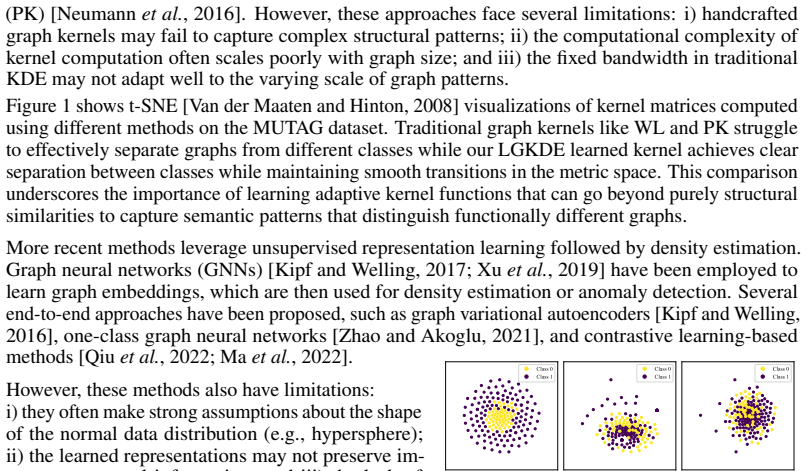
- [Figure 2 and Appendix F.5] The caption of Figure 2 contains fragments of algorithm pseudocode and is garbled, and Appendix F.5 contains the typo 'it si 1-Lipschitz'; both should be fixed in revision.
Circularity Check
No significant circularity: the theoretical results are conditional standard KDE statements, the empirical evaluations are out-of-sample on fixed benchmarks, and the overlapping-author citation supplies independent support rather than a self-referential reduction.
full rationale
I walked the derivation chain and found no step in which a prediction or first-principles result reduces by construction to its inputs. The density estimator in Eqs. (7)-(8) is a standard multi-scale KDE defined on a learned MMD metric; Theorems 4.1 and 4.2 are proved in Appendix F under explicit bandwidth conditions and Assumption F.1 (bounded GNN weights and smooth true density), not under fitted values or under the contrastive objective itself. The rate O(N^{-0.8}) follows from the stated dint = 1 specialization; the claim that dint = 1 is an unsupported geometric assertion in Appendix F.3, but that is an assumption whose failure would invalidate the theorem, not a circular reduction of the theorem to its own conclusion. The training objective Eq. (9) maximizes the density of normal graphs relative to self-generated perturbations, but the anomaly detection results are measured on held-out minority-class graphs from standard benchmarks, so the reported AUROC is not statistically forced by the fit. The synthetic density experiments similarly check that the learned density tracks the known generating parameter; they are not a fitted quantity renamed as a prediction. The only load-bearing citation to overlapping-author work is Proposition F.5 from Sun and Fan (2024), used in the proof of Theorem 4.4; it is a parameter-free perturbation bound with stated assumptions that do not include the present paper's target results, and it is not invoked as a uniqueness theorem to exclude alternatives. Accordingly, the paper is self-contained against external benchmarks and no circular step is exhibited.
Assumptions & free parameters
free parameters (4)
- GNN parameters theta =
learned on training data
- KDE mixture weights alpha =
learned via softmax over M=5 bandwidths
- Bandwidth set HKDE =
10^-2, 10^-1, 10^0, 10^1, 10^2
- Perturbation hyperparameters =
rswap, ppert, tau1=0.5, tau2=0.75, rmax=10, gamma_TH=0.1
assumptions (4)
- domain assumption Bounded GNN weights and smoothness of the true density f* (Assumption F.1)
- ad hoc to paper The scalar MMD distance induces a one-dimensional intrinsic manifold (dint=1)
- domain assumption Perturbed versions of normal graphs have lower density under the true distribution
- standard math The MMD kernel family Kemb is characteristic and yields a valid metric
Cite this review
Pith. "Pith review of Learnable Kernel Density Estimation for Graphs and Its Application to Graph-Level Anomaly Detection." pith.science (2026). https://pith.science/paper/CIN7UBEM
@misc{pith2026250521285,
  author       = {Pith},
  title        = {Pith review of: Learnable Kernel Density Estimation for Graphs and Its Application to Graph-Level Anomaly Detection},
  year         = {2026},
  howpublished = {\url{https://pith.science/paper/CIN7UBEM}},
  note         = {Machine review of arXiv:2505.21285}
}
read the original abstract
This work proposes a framework LGKDE that learns kernel density estimation for graphs. The key challenge in graph density estimation lies in effectively capturing both structural patterns and semantic variations while maintaining theoretical guarantees. Combining graph kernels and kernel density estimation (KDE) is a standard approach to graph density estimation, but has unsatisfactory performance due to the handcrafted and fixed features of kernels. Our method LGKDE leverages graph neural networks to represent each graph as a discrete distribution and utilizes maximum mean discrepancy to learn the graph metric for multi-scale KDE, where all parameters are learned by maximizing the density of graphs relative to the density of their well-designed perturbed counterparts. The perturbations are conducted on both node features and graph spectra, which helps better characterize the boundary of normal density regions. Theoretically, we establish consistency and convergence guarantees for LGKDE, including bounds on the mean integrated squared error, robustness, and generalization. We validate LGKDE by demonstrating its effectiveness in recovering the underlying density of synthetic graph distributions and applying it to graph anomaly detection across diverse benchmark datasets. Extensive empirical evaluation shows that LGKDE demonstrates superior performance compared to state-of-the-art baselines on most benchmark datasets.
Figures


Figures from the paper (9 more)


Reference graph
Works this paper leans on
-
[1]
Graph based anomaly detection and description: a survey
Leman Akoglu, Hanghang Tong, and Danai Koutra. Graph based anomaly detection and description: a survey. Data mining and knowledge discovery , 29(3):626--688, 2015
2015
-
[2]
Enhancing one-class support vector machines for unsupervised anomaly detection
Mennatallah Amer, Markus Goldstein, and Slim Abdennadher. Enhancing one-class support vector machines for unsupervised anomaly detection. In Proceedings of the ACM SIGKDD workshop on outlier detection and description , pages 8--15, 2013
2013
-
[3]
Theoretical numerical analysis , volume 39
Kendall Atkinson and Weimin Han. Theoretical numerical analysis , volume 39. Springer, 2005
2005
-
[4]
Emergence of scaling in random networks
Albert-L \'a szl \'o Barab \'a si and R \'e ka Albert. Emergence of scaling in random networks. science , 286(5439):509--512, 1999
1999
-
[5]
Outliers in statistical data , volume 3
Vic Barnett, Toby Lewis, et al. Outliers in statistical data , volume 3. Wiley New York, 1994
1994
-
[6]
Spectrally-normalized margin bounds for neural networks
Peter L Bartlett, Dylan J Foster, and Matus J Telgarsky. Spectrally-normalized margin bounds for neural networks. Advances in neural information processing systems , 30, 2017
2017
-
[7]
Outlier………
Richard J Beckman and R Dennis Cook. Outlier………. s. Technometrics , 25(2):119--149, 1983
1983
-
[8]
Shortest-path kernels on graphs
Karsten M Borgwardt and Hans-Peter Kriegel. Shortest-path kernels on graphs. In Fifth IEEE international conference on data mining , pages 74--81, 2005
2005
Show all 90 references
-
[9]
Lof: identifying density-based local outliers
Markus M Breunig, Hans-Peter Kriegel, Raymond T Ng, and J \"o rg Sander. Lof: identifying density-based local outliers. In Proceedings of the 2000 ACM SIGMOD international conference on Management of data , pages 93--104, 2000
2000
-
[10]
Lg-fgad: An effective federated graph anomaly detection framework
Jinyu Cai, Yunhe Zhang, Jicong Fan, and See-Kiong Ng. Lg-fgad: An effective federated graph anomaly detection framework. In Proceedings of the International Joint Conference on Artificial Intelligence , 2024
2024
-
[11]
Hyperbolic graph convolutional neural networks
Ines Chami, Zhitao Ying, Christopher R \'e , and Jure Leskovec. Hyperbolic graph convolutional neural networks. Advances in neural information processing systems , 32, 2019
2019
-
[12]
Sampling techniques
William Gemmell Cochran. Sampling techniques . john wiley & sons, 1977
1977
-
[13]
Deep anomaly detection on attributed networks
Kaize Ding, Jundong Li, Rohit Bhanushali, and Huan Liu. Deep anomaly detection on attributed networks. In Proceedings of the 2019 SIAM International Conference on Data Mining , pages 594--602, 2019
2019
-
[14]
Uniform central limit theorems , volume 142
Richard M Dudley. Uniform central limit theorems , volume 142. Cambridge university press, 2014
2014
-
[15]
Graph mixture density networks
Federico Errica, Davide Bacciu, and Alessio Micheli. Graph mixture density networks. ArXiv , abs/2012.03085, 2020
2012 arXiv
-
[16]
Fast graph representation learning with pytorch geometric
Matthias Fey and Jan Eric Lenssen. Fast graph representation learning with pytorch geometric. arXiv preprint arXiv:1903.02428 , 2019
1903 arXiv
-
[17]
Neural message passing for quantum chemistry
Justin Gilmer, Samuel S Schoenholz, Patrick F Riley, Oriol Vinyals, and George E Dahl. Neural message passing for quantum chemistry. In International conference on machine learning , pages 1263--1272, 2017
2017
-
[18]
a tsch, Alexander J Smola, and Bernhard Sch \
Arthur Gretton, Karsten M Borgwardt, Gunnar R \"a tsch, Alexander J Smola, and Bernhard Sch \"o lkopf. A kernel two-sample test. In Advances in neural information processing systems , pages 1299--1307, 2012
2012
-
[19]
node2vec: Scalable feature learning for networks
Aditya Grover and Jure Leskovec. node2vec: Scalable feature learning for networks. In Proceedings of the 22nd ACM SIGKDD international conference on Knowledge discovery and data mining , pages 855--864, 2016
2016
-
[20]
Spectro-riemannian graph neural networks
Karish Grover, Haiyang Yu, Xiang Song, Qi Zhu, Han Xie, Vassilis N Ioannidis, and Christos Faloutsos. Spectro-riemannian graph neural networks. arXiv preprint arXiv:2502.00401 , 2025
2025 arXiv
-
[21]
Graphmore: Mitigating topological heterogeneity via mixture of riemannian experts
Zihao Guo, Qingyun Sun, Haonan Yuan, Xingcheng Fu, Min Zhou, Yisen Gao, and Jianxin Li. Graphmore: Mitigating topological heterogeneity via mixture of riemannian experts. In Proceedings of the AAAI Conference on Artificial Intelligence , volume 39, pages 11754--11762, 2025
2025
-
[22]
Exploring network structure, dynamics, and function using networkx
Aric Hagberg, Pieter J Swart, and Daniel A Schult. Exploring network structure, dynamics, and function using networkx. Technical report, Los Alamos National Laboratory (LANL), Los Alamos, NM (United States), 2008
2008
-
[23]
Inductive representation learning on large graphs
Will Hamilton, Zhitao Ying, and Jure Leskovec. Inductive representation learning on large graphs. In Advances in neural information processing systems , volume 30, 2017
2017
-
[24]
Graph representation learning
William L Hamilton. Graph representation learning . Morgan & Claypool Publishers, 2020
2020
-
[25]
Stochastic blockmodels: First steps
Paul W Holland, Kathryn Blackmond Laskey, and Samuel Leinhardt. Stochastic blockmodels: First steps. Social networks , 5(2):109--137, 1983
1983
-
[26]
Anemone: Graph anomaly detection with multi-scale contrastive learning
Ming Jin, Yixin Liu, Yu Zheng, Lianhua Chi, Yuan-Fang Li, and Shirui Pan. Anemone: Graph anomaly detection with multi-scale contrastive learning. In Proceedings of the 30th ACM international conference on information & knowledge management , pages 3122--3126, 2021
2021
-
[27]
Wei Jin, Yao Ma, Yiqi Wang, Xiaorui Liu, Jiliang Tang, Yukuo Cen, Jie Tang, Chuan Shi, Yanfang Ye, Jiawei Zhang, and Philip S. Yu. Graph representation learning: Foundations, methods, applications and systems. Proceedings of the 27th ACM SIGKDD Conference on Knowledge Discover...
2021
-
[28]
Methods of reducing sample size in monte carlo computations
Herman Kahn and Andy W Marshall. Methods of reducing sample size in monte carlo computations. Journal of the Operations Research Society of America , 1(5):263--278, 1953
1953
-
[29]
Advances and open problems in federated learning
Peter Kairouz, H Brendan McMahan, Brendan Avent, Aur \'e lien Bellet, Mehdi Bennis, Arjun Nitin Bhagoji, Kallista Bonawitz, Zachary Charles, Graham Cormode, Rachel Cummings, et al. Advances and open problems in federated learning. Foundations and Trends in Machine Learning , 1...
2021
-
[30]
Marginalized kernels between labeled graphs
Hisashi Kashima, Koji Tsuda, and Akihiro Inokuchi. Marginalized kernels between labeled graphs. In Proceedings of the 20th international conference on machine learning (ICML-03) , pages 321--328, 2003
2003
-
[31]
Robust kernel density estimation
JooSeuk Kim and Clayton D Scott. Robust kernel density estimation. The Journal of Machine Learning Research , 13(1):2529--2565, 2012
2012
-
[32]
Rethinking reconstruction-based graph-level anomaly detection: limitations and a simple remedy
Sunwoo Kim, Soo Yong Lee, Fanchen Bu, Shinhwan Kang, Kyungho Kim, Jaemin Yoo, and Kijung Shin. Rethinking reconstruction-based graph-level anomaly detection: limitations and a simple remedy. Advances in Neural Information Processing Systems , 37:95931--95962, 2024
2024
-
[33]
Variational graph auto-encoders
Thomas N Kipf and Max Welling. Variational graph auto-encoders. arXiv preprint arXiv:1611.07308 , 2016
2016 arXiv
-
[34]
Semi-supervised classification with graph convolutional networks
Thomas N Kipf and Max Welling. Semi-supervised classification with graph convolutional networks. In International Conference on Learning Representations , 2017
2017
-
[35]
Explainable classification of brain networks via contrast subgraphs
Tommaso Lanciano, Francesco Bonchi, and Aristides Gionis. Explainable classification of brain networks via contrast subgraphs. In Proceedings of the 26th ACM SIGKDD International Conference on Knowledge Discovery & Data Mining , pages 3308--3318, 2020
2020
-
[36]
Graphde: A generative framework for debiased learning and out-of-distribution detection on graphs
Zenan Li, Qitian Wu, Fan Nie, and Junchi Yan. Graphde: A generative framework for debiased learning and out-of-distribution detection on graphs. Advances in Neural Information Processing Systems , 35:30277--30290, 2022
2022
-
[37]
Cvtgad: Simplified transformer with cross-view attention for unsupervised graph-level anomaly detection
Jindong Li, Qianli Xing, Qi Wang, and Yi Chang. Cvtgad: Simplified transformer with cross-view attention for unsupervised graph-level anomaly detection. In Joint European Conference on Machine Learning and Knowledge Discovery in Databases , pages 185--200. Springer, 2023
2023
-
[38]
Isolation forest
Fei Tony Liu, Kai Ming Ting, and Zhi-Hua Zhou. Isolation forest. In 2008 eighth ieee international conference on data mining , pages 413--422. IEEE, 2008
2008
-
[39]
Graph normalizing flows
Jenny Liu, Aviral Kumar, Jimmy Ba, Jamie Kiros, and Kevin Swersky. Graph normalizing flows. In Advances in neural information processing systems , pages 13578--13588, 2019
2019
-
[40]
Energy-based models for atomic-resolution protein conformations
Bowen Liu, Yutao Liu, Bozitao Liu, and Xiaolin Wang. Energy-based models for atomic-resolution protein conformations. In International Conference on Learning Representations , 2020
2020
-
[41]
Good-d: On unsupervised graph out-of-distribution detection
Yixin Liu, Kaize Ding, Huan Liu, and Shirui Pan. Good-d: On unsupervised graph out-of-distribution detection. In Proceedings of the 16th ACM International Conference on Web Search and Data Mining , pages 339--347, 2023
2023
-
[42]
Towards self-interpretable graph-level anomaly detection
Yixin Liu, Kaize Ding, Qinghua Lu, Fuyi Li, Leo Yu Zhang, and Shirui Pan. Towards self-interpretable graph-level anomaly detection. Advances in Neural Information Processing Systems , 36, 2023
2023
-
[43]
Deep graph level anomaly detection with contrastive learning
Xuexiong Luo, Jia Wu, Jian Yang, Shan Xue, Hao Peng, Chuan Zhou, Hongyang Chen, Zhao Li, and Quan Z Sheng. Deep graph level anomaly detection with contrastive learning. Scientific Reports , 12(1):19867, 2022
2022
-
[44]
A comprehensive survey on graph anomaly detection with deep learning
Xiaoxiao Ma, Jia Wu, Shan Xue, Jian Yang, Chuan Zhou, Quan Z Sheng, Hui Xiong, and Leman Akoglu. A comprehensive survey on graph anomaly detection with deep learning. IEEE Transactions on Knowledge and Data Engineering , 2021
2021
-
[45]
Deep graph-level anomaly detection by glocal knowledge distillation
Rongrong Ma, Guansong Pang, Ling Chen, and Anton van den Hengel. Deep graph-level anomaly detection by glocal knowledge distillation. In Proceedings of the Fifteenth ACM International Conference on Web Search and Data Mining , pages 704--714, 2022
2022
-
[46]
Tudataset: A collection of benchmark datasets for learning with graphs
Christopher Morris, Nils M Kriege, Franka Bause, Kristian Kersting, Petra Mutzel, and Marion Neumann. Tudataset: A collection of benchmark datasets for learning with graphs. arXiv preprint arXiv:2007.08663 , 2020
2007 arXiv
-
[47]
Biological network analysis with deep learning
Giulia Muzio, Leslie O’Bray, and Karsten Borgwardt. Biological network analysis with deep learning. Briefings in Bioinformatics , 22:1515--1530, 2020
2020
-
[48]
Nachman and D
B. Nachman and D. Shih. Anomaly detection with density estimation. Physical Review D , 101:075042, 2020
2020
-
[49]
Propagation kernels: efficient graph kernels from propagated information
Marion Neumann, Roman Garnett, Christian Bauckhage, and Kristian Kersting. Propagation kernels: efficient graph kernels from propagated information. Machine Learning , 102:209--245, 2016
2016
-
[50]
Deep learning for anomaly detection: A review
Guansong Pang, Chunhua Shen, Longbing Cao, and Anton Van Den Hengel. Deep learning for anomaly detection: A review. ACM computing surveys (CSUR) , 54(2):1--38, 2021
2021
-
[51]
On estimation of a probability density function and mode
Emanuel Parzen. On estimation of a probability density function and mode. The annals of mathematical statistics , 33(3):1065--1076, 1962
1962
-
[52]
Deepwalk: Online learning of social representations
Bryan Perozzi, Rami Al-Rfou, and Steven Skiena. Deepwalk: Online learning of social representations. In Proceedings of the 20th ACM SIGKDD international conference on Knowledge discovery and data mining , pages 701--710, 2014
2014
-
[53]
Deep graph anomaly detection: A survey and new perspectives
Hezhe Qiao, Hanghang Tong, Bo An, Irwin King, Charu Aggarwal, and Guansong Pang. Deep graph anomaly detection: A survey and new perspectives. arXiv preprint arXiv:2409.09957 , 2024
2024 arXiv
-
[54]
Raising the bar in graph-level anomaly detection
Chen Qiu, Marius Kloft, Stephan Mandt, and Maja Rudolph. Raising the bar in graph-level anomaly detection. In Proceedings of the Thirty-First International Joint Conference on Artificial Intelligence , pages 2196--2203, 2022
2022
-
[55]
Rong, Tingyang Xu, Junzhou Huang, Wen bing Huang, Hong Cheng, Yao Ma, Yiqi Wang, Tyler Derr, Lingfei Wu, and Tengfei Ma
Y. Rong, Tingyang Xu, Junzhou Huang, Wen bing Huang, Hong Cheng, Yao Ma, Yiqi Wang, Tyler Derr, Lingfei Wu, and Tengfei Ma. Deep graph learning: Foundations, advances and applications. Proceedings of the 26th ACM SIGKDD International Conference on Knowledge Discovery & Data Mi...
2020
-
[56]
Temporal graph networks for deep learning on dynamic graphs
Emanuele Rossi, Ben Chamberlain, Fabrizio Frasca, Davide Eynard, Federico Monti, and Michael Bronstein. Temporal graph networks for deep learning on dynamic graphs. arXiv preprint arXiv:2006.10637 , 2020
2006 arXiv
-
[57]
Estimating the support of a high-dimensional distribution
Bernhard Sch \"o lkopf, John C Platt, John Shawe-Taylor, Alex J Smola, and Robert C Williamson. Estimating the support of a high-dimensional distribution. Neural computation , 13(7):1443--1471, 2001
2001
-
[58]
Optimizing ood detection in molecular graphs: A novel approach with diffusion models
Xu Shen, Yili Wang, Kaixiong Zhou, Shirui Pan, and Xin Wang. Optimizing ood detection in molecular graphs: A novel approach with diffusion models. In Proceedings of the 30th ACM SIGKDD Conference on Knowledge Discovery and Data Mining , pages 2640--2650, 2024
2024
-
[59]
Weisfeiler-lehman graph kernels
Nino Shervashidze, Pascal Schweitzer, Erik Jan Van Leeuwen, Kurt Mehlhorn, and Karsten M Borgwardt. Weisfeiler-lehman graph kernels. Journal of Machine Learning Research , 12(Sep):2539--2561, 2011
2011
-
[60]
Grakel: A graph kernel library in python, 2020
Giannis Siglidis, Giannis Nikolentzos, Stratis Limnios, Christos Giatsidis, Konstantinos Skianis, and Michalis Vazirgiannis. Grakel: A graph kernel library in python, 2020
2020
-
[61]
Uniform: Towards unified framework for anomaly detection on graphs
Chuancheng Song, Xixun Lin, Hanyang Shen, Yanmin Shang, and Yanan Cao. Uniform: Towards unified framework for anomaly detection on graphs. In Proceedings of the AAAI Conference on Artificial Intelligence , volume 39, pages 12559--12567, 2025
2025
-
[62]
Spectral sparsification of graphs
Daniel A Spielman and Shang-Hua Teng. Spectral sparsification of graphs. SIAM Journal on Computing , 40(4):981--1025, 2011
2011
-
[63]
Mmd graph kernel: Effective metric learning for graphs via maximum mean discrepancy
Yan Sun and Jicong Fan. Mmd graph kernel: Effective metric learning for graphs via maximum mean discrepancy. In The Twelfth International Conference on Learning Representations , 2024
2024
-
[64]
Infograph: Unsupervised and semi-supervised graph-level representation learning via mutual information maximization
Fan-Yun Sun, Jordan Hoffmann, Vikas Verma, and Jian Tang. Infograph: Unsupervised and semi-supervised graph-level representation learning via mutual information maximization. arXiv preprint arXiv:1908.01000 , 2019
1908 arXiv
-
[65]
Graph convolutional networks for computational drug development and discovery
Mengying Sun, Sendong Zhao, Coryandar Gilvary, Olivier Elemento, Jiayu Zhou, and Fei Wang. Graph convolutional networks for computational drug development and discovery. Briefings in Bioinformatics , 2019
2019
-
[66]
Learning graph representation via graph entropy maximization
Ziheng Sun, Xudong Wang, Chris Ding, and Jicong Fan. Learning graph representation via graph entropy maximization. In Ruslan Salakhutdinov, Zico Kolter, Katherine Heller, Adrian Weller, Nuria Oliver, Jonathan Scarlett, and Felix Berkenkamp, editors, Proceedings of the 41st Int...
2024
-
[67]
Introduction to Nonparametric Estimation
Alexandre B Tsybakov. Introduction to Nonparametric Estimation . Springer, New York, NY, 2009
2009
-
[68]
Visualizing data using t-sne
Laurens Van der Maaten and Geoffrey Hinton. Visualizing data using t-sne. Journal of machine learning research , 9(11), 2008
2008
-
[69]
Deep graph infomax
Petar Velickovic, William Fedus, William L Hamilton, Pietro Li \`o , Yoshua Bengio, and R Devon Hjelm. Deep graph infomax. ICLR (Poster) , 2(3):4, 2019
2019
-
[70]
Graph kernels
S Vichy N Vishwanathan, Nicol N Schraudolph, Risi Kondor, and Karsten M Borgwardt. Graph kernels. Journal of Machine Learning Research , 11(Apr):1201--1242, 2010
2010
-
[71]
Learning low-dimensional latent graph structures: A density estimation approach
Li Wang and Ren-Cang Li. Learning low-dimensional latent graph structures: A density estimation approach. IEEE Transactions on Neural Networks and Learning Systems , 31:1098--1112, 2020
2020
-
[72]
Relational graph attention network for aspect-based sentiment analysis
Kai Wang, Weizhou Shen, Yunyi Yang, Xiaojun Quan, and Rui Wang. Relational graph attention network for aspect-based sentiment analysis. In Dan Jurafsky, Joyce Chai, Natalie Schluter, and Joel Tetreault, editors, Proceedings of the 58th Annual Meeting of the Association for Com...
2020
-
[73]
Graph neural networks for molecules
Yuyang Wang, Zijie Li, and Amir Farimani. Graph neural networks for molecules. ArXiv , abs/2209.05582, 2022
2022 arXiv
-
[74]
Unifying unsupervised graph-level anomaly detection and out-of-distribution detection: A benchmark
Yili Wang, Yixin Liu, Xu Shen, Chenyu Li, Kaize Ding, Rui Miao, Ying Wang, Shirui Pan, and Xin Wang. Unifying unsupervised graph-level anomaly detection and out-of-distribution detection: A benchmark. arXiv preprint arXiv:2406.15523 , 2024
2024 arXiv
-
[75]
Adaptive riemannian graph neural networks
Xudong Wang, Tongxin Li, Chris Ding, and Jicong Fan. Adaptive riemannian graph neural networks. arXiv preprint arXiv:2508.02600 , 2025
2025
-
[76]
Explainable graph representation learning via graph pattern analysis
Xudong Wang, Ziheng Sun, Chris Ding, and Jicong Fan. Explainable graph representation learning via graph pattern analysis. In James Kwok, editor, Proceedings of the Thirty-Fourth International Joint Conference on Artificial Intelligence, IJCAI-25 , pages 3426--3434. Internatio...
2025
-
[77]
Deep graph library: Towards efficient and scalable deep learning on graphs
Minjie Yu Wang. Deep graph library: Towards efficient and scalable deep learning on graphs. In ICLR workshop on representation learning on graphs and manifolds , 2019
2019
-
[78]
All of nonparametric statistics
Larry Wasserman. All of nonparametric statistics . Springer Science & Business Media, 2006
2006
-
[79]
Collective dynamics of ‘small-world’networks
Duncan J Watts and Steven H Strogatz. Collective dynamics of ‘small-world’networks. nature , 393(6684):440--442, 1998
1998
-
[80]
Using the nystr \"o m method to speed up kernel machines
Christopher Williams and Matthias Seeger. Using the nystr \"o m method to speed up kernel machines. Advances in neural information processing systems , 13, 2000
2000
-
[81]
A comprehensive survey on graph neural networks
Zonghan Wu, Shirui Pan, Fengwen Chen, Guodong Long, Chengqi Zhang, and S Yu Philip. A comprehensive survey on graph neural networks. IEEE transactions on neural networks and learning systems , 32(1):4--24, 2020
2020
-
[82]
Rethinking explaining graph neural networks via non-parametric subgraph matching
Fang Wu, Siyuan Li, Xurui Jin, Yinghui Jiang, Dragomir Radev, Zhangming Niu, and Stan Z Li. Rethinking explaining graph neural networks via non-parametric subgraph matching. In International conference on machine learning , pages 37511--37523. PMLR, 2023
2023
-
[83]
Federated graph classification over non-iid graphs
Han Xie, Jing Ma, Li Xiong, and Carl Yang. Federated graph classification over non-iid graphs. Advances in Neural Information Processing Systems , 34:18839--18852, 2021
2021
-
[84]
How powerful are graph neural networks? In International Conference on Learning Representations , 2019
Keyulu Xu, Weihua Hu, Jure Leskovec, and Stefanie Jegelka. How powerful are graph neural networks? In International Conference on Learning Representations , 2019
2019
-
[85]
Infogcl: Information-aware graph contrastive learning
Dongkuan Xu, Wei Cheng, Dongsheng Luo, Haifeng Chen, and Xiang Zhang. Infogcl: Information-aware graph contrastive learning. Advances in Neural Information Processing Systems , 34:30414--30425, 2021
2021
-
[86]
Gnnexplainer: Generating explanations for graph neural networks
Zhitao Ying, Dylan Bourgeois, Jiaxuan You, Marinka Zitnik, and Jure Leskovec. Gnnexplainer: Generating explanations for graph neural networks. Advances in neural information processing systems , 32, 2019
2019
-
[87]
Graph contrastive learning with augmentations
Yuning You, Tianlong Chen, Yongduo Sui, Ting Chen, Zhangyang Wang, and Yang Shen. Graph contrastive learning with augmentations. Advances in neural information processing systems , 33:5812--5823, 2020
2020
-
[88]
Dual-discriminative graph neural network for imbalanced graph-level anomaly detection
Ge Zhang, Zhenyu Yang, Jia Wu, Jian Yang, Shan Xue, Hao Peng, Jianlin Su, Chuan Zhou, Quan Z Sheng, Leman Akoglu, et al. Dual-discriminative graph neural network for imbalanced graph-level anomaly detection. Advances in Neural Information Processing Systems , 35:24144--24157, 2022
2022
-
[89]
Using classification datasets to evaluate graph outlier detection: Peculiar observations and new insights
Lingxiao Zhao and Leman Akoglu. Using classification datasets to evaluate graph outlier detection: Peculiar observations and new insights. Big Data , 2021
2021
-
[90]
write newline
" write newline "" before.all 'output.state := FUNCTION fin.entry add.period write newline FUNCTION new.block output.state before.all = 'skip after.block 'output.state := if FUNCTION new.sentence output.state after.block = 'skip output.state before.all = 'skip after.sentence '...
Reviewed August 7, 2026 · model on record in the stance chip above.
Discussion (0). Sign in to comment.