REVIEW 3 major objections 5 minor 78 references
Compliance while resisting: a shear-thickening fluid controller for physical human-robot interaction
T0 review · 3 major / 5 minor · reviewed 2026-08-09 · deepseek-v4-flash
Pith's one-line read A power-law damping law lets one fixed admittance controller comply with gentle pulls near 5 N while cutting velocity jumps from 40--70 N impacts to a third or half of linear alternatives.
desk verdict A practical power-law admittance law for pHRI with promising impact resistance, but the mobile-manipulator stability bound is miscomputed and the Appendix C proof is wrong as written. read the letter →
The pith
A machine-rendered reading of the paper's core claim, the machinery that carries it, and where it could break.
The reading
What carries the argument
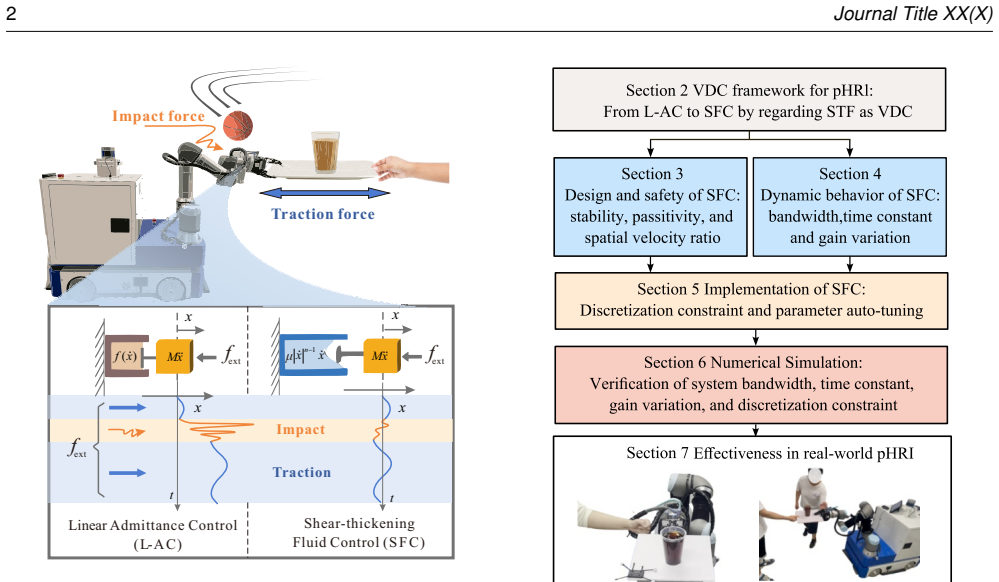
The central object is the shear-thickening admittance law of Eq. (11), $m\ddot{x} + \mu|\dot{x}|^{n-1}\dot{x} = f_{\mathrm{ext}}$, whose damping term is copied from the power-law constitutive equation of shear-thickening fluids. Its defining property is that the damping-to-velocity ratio $\mu|\dot{x}|^{n-1}$ grows without bound as speed rises: at crawling speeds the robot feels nearly undamped and follows the human's pull, while at impact-driven speeds the damping overwhelms the force and caps the velocity jump. The argument is carried by three supporting constructions: the nonlinear spatial velocity ratio $R_{\mathrm{sv}} = -(\mu/m)|x_2|^{n-1}$ describing phase-plane convergence in free motion; the inverse describing function $N(B,\omega)$ that converts an assumed sinusoidal output velocity into the required input amplitude and yields closed-form bandwidth, time-constant, and gain-variation formulas; and the discrete recursion constraint on $\Delta T$ that bounds the Euler-integration step against acceleration oscillation.
What would settle it
Re-run the arithmetic and the experiment: substituting $m=1$, $\mu=20$, $n=3$, and $|f_{\mathrm{ext,max}}|=70$ N into Eq. (21) gives $\Delta T \approx 0.014$ s, not the 0.023 s the text reports, so driving the Euler-discretized SFC with the mobile manipulator's $\Delta T = 0.02$ s under repeated 70 N impulses and watching whether acceleration diverges would settle whether the claimed stability region holds; a comparison run at $\Delta T = 0.014$ s would show the predicted boundary. A second check: because Theorem 3 assumes constant external force, feeding a 70 N half-sine pulse rather than a step and recording whether the oscillation boundary in Fig. 12 shifts would test the assumption where it is weakest.
Extended reading notes
Core claim
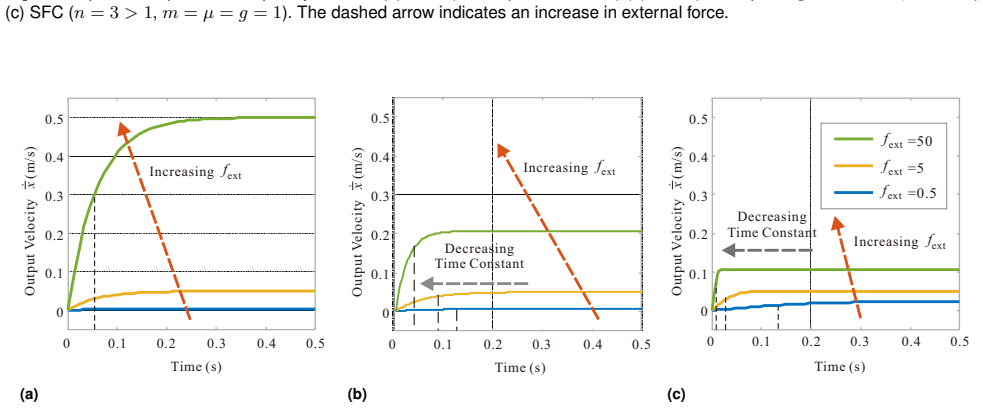
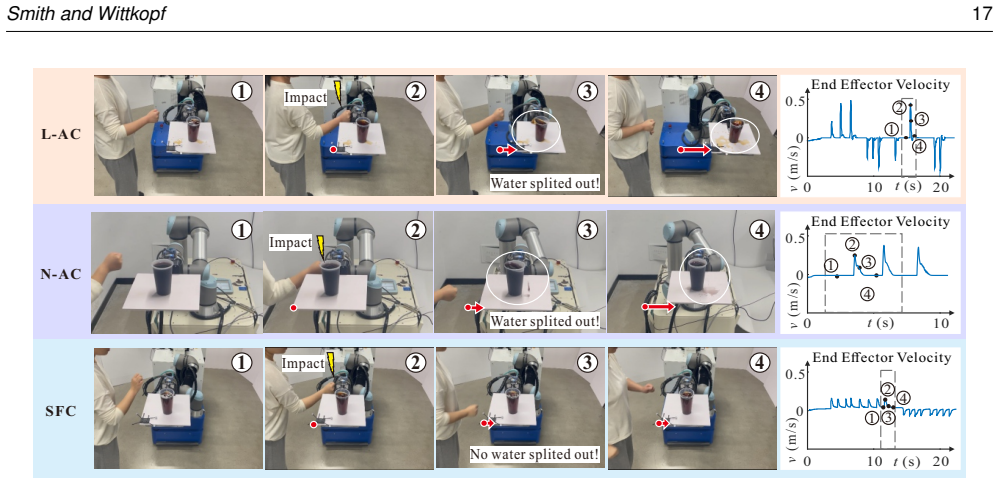
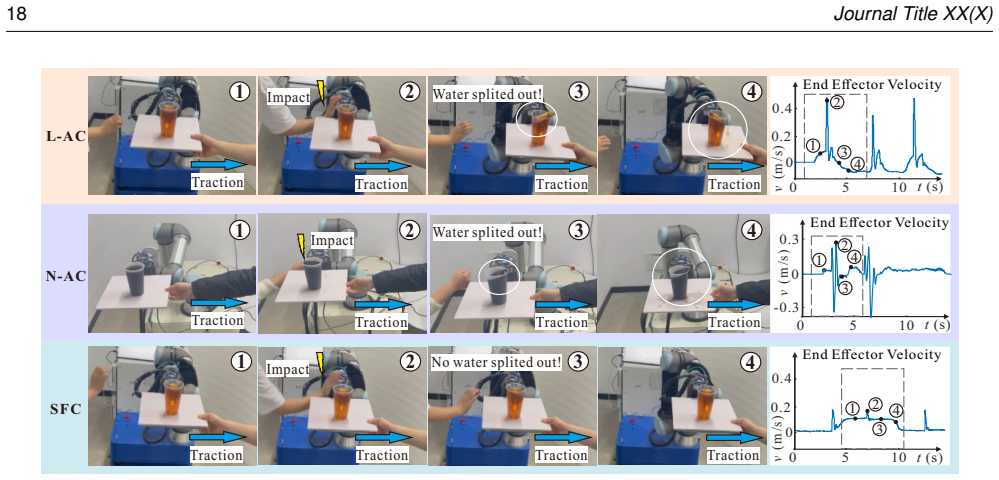
On the paper's own terms, the discovery is that shear-thickening rheology, abstracted as power-law damping $D(\dot{x}) = \mu|\dot{x}|^{n-1}\dot{x}$ with $n > 1$, is a viable virtual dynamics for admittance-controlled robots: globally asymptotically stable under constant loads, passive under arbitrary external forces, and provably convergent in free motion, so it qualifies as a safe interaction law. The frequency-domain analysis via an inverse describing function yields three design handles---bandwidth that narrows as input amplitude falls, a time constant that shrinks as force grows, and a gain attenuation of $20w(1-n)/n$ dB per $10^w$-fold amplitude increase---which together explain and tune the traction/impact dichotomy. The paper further claims that the Euler-discretized controller remains stable when the sample time obeys $\Delta T < 2m\mu^{-1/n} n^{-1} |f_{\mathrm{ext,max}}|^{(1-n)/n}$, and that with parameters set by its auto-tuning algorithm, SFC reproduces linear admittance control's responsiveness at traction levels near 5 N while holding end-effector velocity jumps during 40--70 N impacts to roughly one-third to one-half of those of linear or saturating-nonlinear alternatives.
Load-bearing premise
The discrete-time stability guarantee is derived under a zero-or-constant external force assumption, even though the controller is meant to handle impulsive impacts, and the paper's stated 0.023 s bound for the mobile manipulator appears to be a miscalculation of its own Eq. (21), which at the stated parameters ($m=1$, $\mu=20$, $n=3$, $|f_{\mathrm{ext,max}}|=70$ N) gives roughly 0.014 s rather than 0.023 s.
Editorial extensions
If this is right
- A single fixed SFC parameter set replaces any impact-detection, thresholding, or mode-switching layer: the controller separates traction from impact purely through its amplitude-dependent gain.
- On robots with low control rates, such as the 50 Hz mobile manipulator, SFC with parameters chosen under the discrete bound still suppresses impact energy above about 1 Hz, where linear and saturating-nonlinear admittance controllers let it through.
- Because SFC's damping depends only on the velocity state, the controller retains high damping after an impact ends and returns to steady state faster than force-dependent nonlinear admittance controllers, which lose damping the moment the force drops.
- The auto-tuning algorithm converts task-level requirements (traction force, impact force, desired traction speed, bandwidth, sample time) directly into the controller parameters $\mu$, $n$, $g$, with an explicit condition for when the feasible bandwidth must be reduced.
- The paper expects the same law to carry over to exoskeletons, teleoperated robots, and other non-Newtonian rheologies, where traction-compliant yet impact-resistant behavior would protect wearers and operators.
Reading between the lines
- Because the describing-function analysis treats the controller as a bijection between output velocity and input force, the amplitude-stratification argument should extend to multi-axis motion; a strong impact along one axis would raise the effective damping seen by the other axes, an effect the current experiments only glimpse in the orthogonal-direction test.
- A direct substitution suggests the mobile-manipulator sample time may lie outside the stated stability region, which would mean the 50 Hz viability claim currently rests on the experiments rather than on Theorem 3.
- A testable corollary of state-dependent damping is that SFC's post-impact settling time stays short even when the impact force vanishes abruptly, whereas a force-dependent N-AC lags; this could be measured as a settling-time metric in a repeat-impulse protocol.
Editorial analysis
A structured set of objections, weighed in public.
Referee Report
Summary. The paper proposes a shear-thickening-fluid-inspired nonlinear admittance controller, SFC (Eq. 11): m x_ddot + mu |x_dot|^{n-1} x_dot = f_ext with n > 1, intended to make a robot simultaneously compliant to low-amplitude human traction (near 5 N) and resistive to high-amplitude impulsive impacts (40-70 N) using a single fixed nonlinear law. The authors provide a stability/passivity/phase-trajectory analysis (Appendix C), an inverse describing-function frequency-domain analysis (Theorem 2), bandwidth/time-constant/gain-variation corollaries, a discrete-time sample-time constraint (Theorem 3), a coupled-stability condition (Theorem 4), and an auto-tuning algorithm (Algorithm 1). The results are supported by Simulink verification (Tables 3-5) and by real-world experiments on a fixed manipulator (UR16e, 500 Hz) and a mobile manipulator (50 Hz), plus a qualitative factory case study. The central empirical claim, that SFC limits velocity jumps under 40-70 N impacts to about one-third to one-half the jumps of L-AC and N-AC while preserving a similar traction response near 5 N, is plausible and, for the fixed manipulator, well illustrated.
Significance. The central idea is simple and appealing: a single, fixed nonlinear admittance law that behaves softly for small forces and stiffly for large forces, without mode switching or explicit force classification. If the results hold, the contribution is practically relevant for walk-through programming and collaborative handling, and the analytical package - the inverse describing function, the bandwidth and time-constant scaling rules, and an auto-tuning procedure with explicit design inputs - is a genuine step beyond ad hoc nonlinear admittance tuning. The paper deserves credit for checking analytical predictions against simulation rather than fitting them post hoc, for testing the fixed manipulator across traction-only, impact-only, and simultaneous traction/impact conditions, and for demonstrating operation on a low-bandwidth 50 Hz mobile platform. The auto-tuning algorithm gives falsifiable parameter recipes from user requirements. However, the theoretical load-bearing claims currently contain three specific errors (Appendices C, D, and E), and the paper's own stability computation does not support the mobile-manipulator sample-time choice.
major comments (3)
- [Appendix C, Eq. (34)] The equilibrium shift is incorrect. With s = x_dot - x_dot*, where x_dot* = |f_ext/mu|^{1/n} sign(f_ext), substitution into Eq. (11) gives m s_dot + mu(|x_dot* + s|^{n-1}(x_dot* + s) - |x_dot*|^{n-1} x_dot*) = 0, not m s_dot + mu |s|^{n-1} s = 0. The cross terms in s are omitted, so the Lyapunov argument in Property 2 proves stability only of a different system and, as written, is invalid. The conclusion is salvageable: the damping function eta(s) = mu |x_dot* + s|^{n-1}(x_dot* + s) is strictly increasing in s, so with V = s^2 one obtains V_dot = -2 s (eta(s) - eta(0))/m < 0 for s != 0, giving global asymptotic stability. The corrected proof should be presented, since Property 2 is one of the three safety guarantees claimed in Theorem 1.
- [Appendix E, Eq. (74) and Section 7.1.2] Theorem 3's sample-time bound is derived under the explicit assumption, stated immediately before Eq. (74), that the external force is zero or constant (f_ext(t) - f_ext(t+1) = 0). The controller's intended operating regime is impulsive 40-70 N impacts, for which the force difference across one sample is large; precisely there the derivation drops the term m^{-1}(f_ext(t) - f_ext(t+1)) and the bound does not follow. In addition, the application of the bound in Section 7.1.2 is arithmetically wrong: with m = 1, mu = 20, n = 3, and f_ext,max = 70 N, Eq. (21) gives Delta T < 2 * 1 * 20^{-1/3} * 3^{-1} * 70^{-2/3} = 0.0145 s, not 0.023 s. The implemented 0.02 s sample time therefore violates the paper's own stated stability region, contradicting the sentence that the sample time 'met this requirement and assured the stability of the system under discrete control'. The claim that SFC is validated for low control frequencies needs either a re-derivation of the bound for time-varying forces, a re-tuning that satisfies the corrected bound, or an explicit statement that the bound is only sufficient and the 50 Hz results are empirical.
- [Appendix D, Eqs. (13)-(17) and Tables 3-4] The describing-function coefficient Psi(n) = 2 sqrt(pi) Gamma(1 + n/2)/Gamma((3 + n)/2) in Eq. (13) is a factor pi too large. Computing the fundamental Fourier coefficient of D(x_dot) = mu |x_dot|^{n-1} x_dot under x_dot = B sin(omega t) gives b_1 = (2/sqrt(pi)) mu B^n Gamma(1 + n/2)/Gamma((3 + n)/2); the paper's Psi differs by exactly pi. A direct consistency check is the linear case: n = 1 must reproduce m x_ddot + mu x_dot = f_ext, whose response amplitude is 1/sqrt((m omega)^2 + mu^2), whereas Eq. (14) with Psi(1) = pi gives 1/sqrt((m omega)^2 + (mu pi)^2). The error propagates into the bandwidth formula (16), the time constant (17), the coupled-stability quantity Q in Theorem 4, and Step 4 of Algorithm 1, where mu is computed pi times too small, so the realized bandwidth is pi^{-1/n} lower than designed (about 32% lower for n = 3). Because Tables 3-4 report 0-10% agreement between the formulas and the 'numerical' simulations, and a direct simulation of Eq. (11) with the corrected coefficient would differ by pi^{1/n} = 1.46 for n = 3, the verification pipeline appears to reproduce the same factor error; the authors should recompute Psi, rerun the verification against Eq. (11), and re-derive the tuning formulas.
minor comments (5)
- [Table 3 / Section 6.3.1] The bandwidth values (1.05, 4.90, 22.75) are computed from Eq. (16), which yields rad/s, and Fig. 13 uses rad/s, but Table 3 labels the column 'Hz'; the unit should be corrected.
- [Sections 7.2.4 and 7.3] The self-excited oscillations of N-AC are attributed to a possible limit cycle, but no phase portrait, spectrum, or supporting analysis is provided, and the quantitative comparisons in Table 6 and Figs. 17-22 appear to come from single trials without repeated runs or error bars; the claims would be stronger with repeated measurements or with explicit single-trial reporting.
- [Theorem 2 and Corollaries 1-3] The theorems and corollaries state n > 0, but the shear-thickening behavior and the claimed traction/impact differentiation depend on n > 1; the domain n > 1 should be used consistently in all statements that feed the design algorithm.
- [Appendix F / Algorithm 1] In Step 1, Eq. (84) involves ratios of logarithms of quantities that are both less than 1 for the intended requirements, so the inequality direction and sign handling should be spelled out; line 3 of the algorithm should also state explicitly which form of the bandwidth constraint (including the force-ratio factor of Eq. (22)) is being checked.
- [Sections 3-7] The paper alternates between 'sample time', 'sampling time', and 'control frequency' for Delta T; the terminology should be unified, and the role of g (set to 1 in the analysis but non-unit in Table 2) should be clarified in the time-constant and gain-variation simulations.
Circularity Check
No significant circularity: the impact-resistance and traction-compliance behaviors are by-construction consequences of the n>1 power-law damping term, and the supporting stability, passivity, and frequency-domain analyses are self-contained rather than derived from the paper's conclusions.
full rationale
The paper proposes a specific nonlinear admittance law, m x_ddot + mu |x_dot|^(n-1) x_dot = f_ext (Eq. 11), and its central claims about compliance and impact resistance follow directly from the chosen power-law damping rather than from fitting or from assuming the conclusion. The auto-tuning algorithm (Algorithm 1) maps user-specified force and velocity requirements into the parameters n, mu, and g using the controller's own low-frequency gain expression; this is a design or calibration procedure, not a prediction made after fitting to the outcome data. The analytical corollaries on bandwidth, time constant, and gain variation are derived from a describing-function approximation and then checked against independent Simulink integration, with errors under 10% reported; no fitted parameter is renamed as a predicted result. The stability and passivity proofs in Appendix C are self-contained Lyapunov and power-balance arguments, and the coupled-stability condition in Appendix I is derived from the interconnection of passive blocks rather than from an appeal to the authors' prior work. No load-bearing self-citation chain is present: the paper's theorems are proved in the appendices, and the STF inspiration is presented as an analogy, not as an external uniqueness theorem. The principal weaknesses of the paper are correctness and validity concerns rather than circularity: the discrete-time stability bound in Theorem 3 is derived under an explicit constant-or-zero f_ext assumption (Appendix E), which is violated in the intended impulsive-impact regime; the numerical application of Eq. (21) to the mobile manipulator parameters appears inconsistent (giving about 0.0145 s rather than the stated 0.023 s); and the shifted-damping equation in Appendix C's stability proof is algebraically incorrect as written, although the result is likely salvageable by monotonicity. These are substantive technical issues, but they do not make the derivation equivalent to its inputs, and they do not constitute circular reasoning. Overall, the derivation chain is self-contained and the score is 0.
Assumptions & free parameters
free parameters (5)
- n (power-law exponent) =
3 (fixed and mobile experiments)
- mu (apparent damping coefficient) =
393 N (fixed), 20 N (mobile)
- m (virtual inertia) =
1 (normalized)
- g (output gain) =
0.21 (fixed), 0.04 (mobile)
- force classification thresholds (fth, epsilon+, epsilon-) =
traction: 10 N / 10 Hz; impact: 60 N / 300 Hz
assumptions (5)
- domain assumption External forces can be partitioned into traction and impact sets by amplitude and frequency thresholds (Eqs. 7-10).
- domain assumption Human operator is a passive mass-damper impedance Zh(s)=1/(m_h s + b_h) (Eq. 93).
- domain assumption The inner-loop velocity controller tracks the virtual-dynamics velocity command accurately (Section 2.2).
- standard math Describing-function approximation: output x_dot is a single sinusoid and higher harmonics are negligible (Appendix D).
- ad hoc to paper External force is zero or constant during the discrete-time stability derivation (Appendix E, before Eq. 74).
Cite this review
Pith. "Pith review of Compliance while resisting: a shear-thickening fluid controller for physical human-robot interaction." pith.science (2026). https://pith.science/paper/CINULKUO
@misc{pith2026250201376,
  author       = {Pith},
  title        = {Pith review of: Compliance while resisting: a shear-thickening fluid controller for physical human-robot interaction},
  year         = {2026},
  howpublished = {\url{https://pith.science/paper/CINULKUO}},
  note         = {Machine review of arXiv:2502.01376}
}
read the original abstract
Physical human-robot interaction (pHRI) is widely needed in many fields, such as industrial manipulation, home services, and medical rehabilitation, and puts higher demands on the safety of robots. Due to the uncertainty of the working environment, the pHRI may receive unexpected impact interference, which affects the safety and smoothness of the task execution. The commonly used linear admittance control (L-AC) can cope well with high-frequency small-amplitude noise, but for medium-frequency high-intensity impact, the effect is not as good. Inspired by the solid-liquid phase change nature of shear-thickening fluid, we propose a Shear-thickening Fluid Control (SFC) that can achieve both an easy human-robot collaboration and resistance to impact interference. The SFC's stability, passivity, and phase trajectory are analyzed in detail, the frequency and time domain properties are quantified, and parameter constraints in discrete control and coupled stability conditions are provided. We conducted simulations to compare the frequency and time domain characteristics of L-AC, nonlinear admittance controller (N-AC), and SFC, and validated their dynamic properties. In real-world experiments, we compared the performance of L-AC, N-AC, and SFC in both fixed and mobile manipulators. L-AC exhibits weak resistance to impact. N-AC can resist moderate impacts but not high-intensity ones, and may exhibit self-excited oscillations. In contrast, SFC demonstrated superior impact resistance and maintained stable collaboration, enhancing comfort in cooperative water delivery tasks. Additionally, a case study was conducted in a factory setting, further affirming the SFC's capability in facilitating human-robot collaborative manipulation and underscoring its potential in industrial applications.
Figures


Figures from the paper (23 more)







Reference graph
Works this paper leans on
-
[1]
, " * write output.state after.block = add.period write newline
ENTRY address author booktitle chapter doi edition editor eid howpublished institution isbn journal key month note number organization pages publisher school series title type url volume year label extra.label sort.label short.list INTEGERS output.state before.all mid.sentence after.sentence after.block FUNCTION init.state.consts #0 'before.all := #1 'mid...
-
[2]
write newline
" write newline "" before.all 'output.state := FUNCTION n.dashify 't := "" t empty not t #1 #1 substring "-" = t #1 #2 substring "--" = not "--" * t #2 global.max substring 't := t #1 #1 substring "-" = "-" * t #2 global.max substring 't := while if t #1 #1 substring * t #2 global.max substring 't := if while FUNCTION word.in bbl.in capitalize ":" * " " *...
-
[3]
IEEE Transactions on Robotics and Automation 15(3): 465--474
Adams RJ and Hannaford B (1999) Stable haptic interaction with virtual environments. IEEE Transactions on Robotics and Automation 15(3): 465--474
work page 1999
-
[4]
Applied Bionics and Biomechanics 2018
Al-Shuka HF, Leonhardt S, Zhu WH, Song R, Ding C and Li Y (2018) Active impedance control of bioinspired motion robotic manipulators: An overview. Applied Bionics and Biomechanics 2018
work page 2018
-
[5]
In: Proceedings of the International Conference on Robotics and Automation (ICRA)
Albu-Schaffer A and Hirzinger G (2002) Cartesian impedance control techniques for torque controlled light-weight robots. In: Proceedings of the International Conference on Robotics and Automation (ICRA). Washington, DC, USA: IEEE, pp. 657--663
work page 2002
-
[6]
In: Proceeding of the 20th International Conference on Humanoid Robots (Humanoids)
Arduengo M, Arduengo A, Colom \'e A, Lobo-Prat J and Torras C (2021) Human to robot whole-body motion transfer. In: Proceeding of the 20th International Conference on Humanoid Robots (Humanoids). IEEE, pp. 299--305
work page 2021
-
[7]
Transactions of the Institute of Measurement and Control 43(8): 1760--1773
Aydin Y, Sirintuna D and Basdogan C (2021) Towards collaborative drilling with a cobot using admittance controller. Transactions of the Institute of Measurement and Control 43(8): 1760--1773
work page 2021
-
[8]
IEEE Transactions on Haptics 11(3): 464--475
Aydin Y, Tokatli O, Patoglu V and Basdogan C (2018) Stable physical human-robot interaction using fractional order admittance control. IEEE Transactions on Haptics 11(3): 464--475
work page 2018
Show all 78 references
-
[9]
Applied Sciences 10(11): 3810
Ayoubi Y, Laribi MA, Arsicault M and Zeghloul S (2020) Safe pHRI via the variable stiffness safety-oriented mechanism (V2SOM) : Simulation and experimental validations. Applied Sciences 10(11): 3810
2020
-
[10]
Robotics and Computer-Integrated Manufacturing 57: 197--212
Bascetta L and Ferretti G (2019) Ensuring safety in hands-on control through stability analysis of the human-robot interaction. Robotics and Computer-Integrated Manufacturing 57: 197--212
2019
-
[11]
IEEE Access 8: 145661--145671
Chen G, Guo S, Hou B and Wang J (2020) Compliance control and analysis for equivalent hydraulic legs. IEEE Access 8: 145661--145671
2020
-
[12]
Mechatronics 84: 102802
Chen J and Ro PI (2022) Human intention-oriented variable admittance control with power envelope regulation in physical human-robot interaction. Mechatronics 84: 102802
2022
-
[13]
In: Rheology of complex fluids
Chhabra RP (2010) Non-newtonian fluids: an introduction. In: Rheology of complex fluids. Springer, pp. 3--34
2010
-
[14]
The International Journal of Robotics Research 17(12): 1302--1309
Chung JH, Velinsky SA and Hess RA (1998) Interaction control of a redundant mobile manipulator. The International Journal of Robotics Research 17(12): 1302--1309
1998
-
[15]
International Journal of Control 48(1): 65--88
Colgate JE and Hogan N (1988) Robust control of dynamically interacting systems. International Journal of Control 48(1): 65--88
1988
-
[16]
Journal of Robotic Systems 14(1): 37--47
Colgate JE and Schenkel GG (1997) Passivity of a class of sampled-data systems: Application to haptic interfaces. Journal of Robotic Systems 14(1): 37--47
1997
-
[17]
The International Journal of Robotics Research 35(9): 1103--1120
Colonnese N and Okamura A (2016) Stability and quantization-error analysis of haptic rendering of virtual stiffness and damping. The International Journal of Robotics Research 35(9): 1103--1120
2016
-
[18]
In: Proceedings of the 4th International Conference on Biomedical Robotics and Biomechatronics (BioRob)
De Luca A and Flacco F (2012) Integrated control for pHRI : Collision avoidance, detection, reaction and collaboration. In: Proceedings of the 4th International Conference on Biomedical Robotics and Biomechatronics (BioRob). Rome, Italy: IEEE, pp. 288--295
2012
-
[19]
In: Proceedings of the International Conference on Intelligent Robots and Systems (IROS)
De Stefano M, Artigas J and Secchi C (2017) A passive integration strategy for rendering rotational rigid-body dynamics on a robotic simulator. In: Proceedings of the International Conference on Intelligent Robots and Systems (IROS). Vancouver, BC, Canada: IEEE, pp. 2806--2812
2017
-
[20]
IEEE Transactions on Haptics 9(2): 267--278
Dimeas F and Aspragathos N (2016) Online stability in human-robot cooperation with admittance control. IEEE Transactions on Haptics 9(2): 267--278
2016
-
[21]
Philosophical Transactions of the Royal Society A: Mathematical, Physical and Engineering Sciences 373(2051): 20140402
Elliott S, Tehrani MG and Langley R (2015) Nonlinear damping and quasi-linear modelling. Philosophical Transactions of the Royal Society A: Mathematical, Physical and Engineering Sciences 373(2051): 20140402
2015
-
[22]
IEEE Transactions on Robotics 31(5): 1073--1088
Ferraguti F, Preda N, Manurung A, Bonfe M, Lambercy O, Gassert R, Muradore R, Fiorini P and Secchi C (2015) An energy tank-based interactive control architecture for autonomous and teleoperated robotic surgery. IEEE Transactions on Robotics 31(5): 1073--1088
2015
-
[23]
The International Journal of Robotics Research 38(6): 747--765
Ferraguti F, Talignani Landi C, Sabattini L, Bonfe M, Fantuzzi C and Secchi C (2019) A variable admittance control strategy for stable physical human--robot interaction. The International Journal of Robotics Research 38(6): 747--765
2019
-
[24]
Journal of Non-Newtonian Fluid Mechanics 175: 76--88
Ferr \'a s L, N \'o brega J and Pinho F (2012) Analytical solutions for newtonian and inelastic non-newtonian flows with wall slip. Journal of Non-Newtonian Fluid Mechanics 175: 76--88
2012
-
[25]
IEEE Transactions on Robotics 33(6): 1292--1312
Haddadin S, De Luca A and Albu-Sch \"a ffer A (2017) Robot collisions: A survey on detection, isolation, and identification. IEEE Transactions on Robotics 33(6): 1292--1312
2017
-
[26]
IEEE Robotics and Automation Letters 6(2): 3025--3032
Hamid E, Herzig N, Abad SA and Nanayakkara T (2021) A state-dependent damping method to reduce collision force and its variability. IEEE Robotics and Automation Letters 6(2): 3025--3032
2021
-
[27]
In: Proceedings of the American Control Conference (ACC)
Hogan N (1984) Impedance control: An approach to manipulation. In: Proceedings of the American Control Conference (ACC). San Diego, CA, USA: IEEE, pp. 304--313
1984
-
[28]
IEEE/ASME Transactions on Mechatronics 22(5): 2141--2152
Jin M, Kang SH, Chang PH and Lee J (2017) Robust control of robot manipulators using inclusive and enhanced time delay control. IEEE/ASME Transactions on Mechatronics 22(5): 2141--2152
2017
-
[29]
IEEE Transactions on Industrial Electronics 60(8): 3304--3317
Jin Y, Chang PH, Jin M and Gweon DG (2013) Stability guaranteed time-delay control of manipulators using nonlinear damping and terminal sliding mode. IEEE Transactions on Industrial Electronics 60(8): 3304--3317
2013
-
[30]
IEEE/ASME Transactions on Mechatronics 24(3): 1023--1032
Kang G, Oh HS, Seo JK, Kim U and Choi HR (2019) Variable admittance control of robot manipulators based on human intention. IEEE/ASME Transactions on Mechatronics 24(3): 1023--1032
2019
-
[31]
The International Journal of Robotics Research 37(11): 1421--1444
Keemink AQ, van der Kooij H and Stienen AH (2018) Admittance control for physical human--robot interaction. The International Journal of Robotics Research 37(11): 1421--1444
2018
-
[32]
International Journal of Humanoid Robotics 11(03): 1430001
Khan SG, Herrmann G, Al Grafi M, Pipe T and Melhuish C (2014) Compliance control and human--robot interaction: Part 1— Survey . International Journal of Humanoid Robotics 11(03): 1430001
2014
-
[33]
Sensors 13(10): 12852--12902
Khusainov R, Azzi D, Achumba IE and Bersch SD (2013) Real-time human ambulation, activity, and physiological monitoring: Taxonomy of issues, techniques, applications, challenges and limitations. Sensors 13(10): 12852--12902
2013
-
[34]
In: Proceedings of the International Conference of the IEEE Engineering in Medicine and Biology Society (EMBC)
Kim H, Miller LM, Li Z, Roldan JR and Rosen J (2012) Admittance control of an upper limb exoskeleton-reduction of energy exchange. In: Proceedings of the International Conference of the IEEE Engineering in Medicine and Biology Society (EMBC). San Diego, CA, USA: IEEE, pp. 6467--6470
2012
-
[35]
IEEE/ASME Transactions on Mechatronics 24(4): 1473--1484
Kim MJ, Lee W, Choi JY, Chung G, Han KL, Choi IS, Ott C and Chung WK (2019) A passivity-based nonlinear admittance control with application to powered upper-limb control under unknown environmental interactions. IEEE/ASME Transactions on Mechatronics 24(4): 1473--1484
2019
-
[36]
The International Journal of Robotics Research 40(8-9): 968--985
Lachner J, Allmendinger F, Hobert E, Hogan N and Stramigioli S (2021) Energy budgets for coordinate invariant robot control in physical human--robot interaction. The International Journal of Robotics Research 40(8-9): 968--985
2021
-
[37]
The International Journal of Robotics Research 39(4): 514--539
Laghi M, Ajoudani A, Catalano MG and Bicchi A (2020) Unifying bilateral teleoperation and tele-impedance for enhanced user experience. The International Journal of Robotics Research 39(4): 514--539
2020
-
[38]
In: Proceedings of the International Conference on Advanced Intelligent Mechatronics
Lai CY (2014) Improving the transient performance in robotics force control using nonlinear damping. In: Proceedings of the International Conference on Advanced Intelligent Mechatronics. Besacon, France: IEEE, pp. 892--897
2014
-
[39]
FCS Control Systems 13
Lammertse P (2004) Admittance control and impedance control-a dual. FCS Control Systems 13
2004
-
[40]
In: Procedings of the 42nd Annual Conference of the IEEE Industrial Electronics Society (IECON)
Landi CT, Ferraguti F, Secchi C and Fantuzzi C (2016) Tool compensation in walk-through programming for admittance-controlled robots. In: Procedings of the 42nd Annual Conference of the IEEE Industrial Electronics Society (IECON). Florence, Italy: IEEE, pp. 5335--5340
2016
-
[41]
IEEE Transactions on Industrial Electronics 61(12): 6975--6985
Lee JY, Jin M and Chang PH (2014) Variable pid gain tuning method using backstepping control with time-delay estimation and nonlinear damping. IEEE Transactions on Industrial Electronics 61(12): 6975--6985
2014
-
[42]
Journal of materials science 38(13): 2825--2833
Lee YS, Wetzel ED and Wagner NJ (2003) The ballistic impact characteristics of kevlar woven fabrics impregnated with a colloidal shear thickening fluid. Journal of materials science 38(13): 2825--2833
2003
-
[43]
IEEE Robotics and Automation Letters 3(3): 2493--2500
Li HY, Paranawithana I, Yang L, Lim TSK, Foong S, Ng FC and Tan UX (2018) Stable and compliant motion of physical human--robot interaction coupled with a moving environment using variable admittance and adaptive control. IEEE Robotics and Automation Letters 3(3): 2493--2500
2018
-
[44]
Springer
Liberzon D (2003) Switching in systems and control, volume 190. Springer
2003
-
[45]
IEEE Access 9: 50917--50925
Lin G, Yu J and Liu J (2021) Adaptive fuzzy finite-time command filtered impedance control for robotic manipulators. IEEE Access 9: 50917--50925
2021
-
[46]
Cambridge University Press
Lynch KM and Park FC (2017) Modern robotics. Cambridge University Press
2017
-
[47]
IEEE Transactions on Systems, Man, and Cybernetics - Part A: Systems and Humans 29(6): 566--572
Marhefka D and Orin D (1999) A compliant contact model with nonlinear damping for simulation of robotic systems. IEEE Transactions on Systems, Man, and Cybernetics - Part A: Systems and Humans 29(6): 566--572
1999
-
[48]
IEEE Transactions on Automatic Control 65(5): 2139--2146
Marx S, Chitour Y and Prieur C (2019) Stability analysis of dissipative systems subject to nonlinear damping via Lyapunov techniques. IEEE Transactions on Automatic Control 65(5): 2139--2146
2019
-
[49]
IEEE Transactions on Control Systems Technology 22(2): 745--752
Morbi A, Ahmadi M, Chan AD and Langlois R (2013) Stability-guaranteed assist-as-needed controller for powered orthoses. IEEE Transactions on Control Systems Technology 22(2): 745--752
2013
-
[50]
In: Proceedings of the International Design Engineering Technical Conferences and Computers and Information in Engineering Conference, volume 59230
Mu \ n oz Osorio JD, Casta \ n eda F, Allmendinger F and Zimmermann UE (2019) Time invariant motion controller for physical human robot interaction. In: Proceedings of the International Design Engineering Technical Conferences and Computers and Information in Engineering Confe...
2019
-
[51]
The International Journal of Robotics Research 10(5): 481--491
Mussa-Ivaldi FA and Hogan N (1991) Integrable solutions of kinematic redundancy via impedance control. The International Journal of Robotics Research 10(5): 481--491
1991
-
[52]
In: Proceedings of the International Conference on Robotics and Automation (ICRA)
Navarro B, Cherubini A, Fonte A, Passama R, Poisson G and Fraisse P (2016) An iso10218-compliant adaptive damping controller for safe physical human-robot interaction. In: Proceedings of the International Conference on Robotics and Automation (ICRA). Stockholm, Sweden: IEEE, p...
2016
-
[53]
The International Journal of Robotics Research 34(3): 256--269
Niehues TD, Rao P and Deshpande AD (2015) Compliance in parallel to actuators for improving stability of robotic hands during grasping and manipulation. The International Journal of Robotics Research 34(3): 256--269
2015
-
[54]
Automatica 53: 416--423
Ott C, Dietrich A and Albu-Sch \"a ffer A (2015) Prioritized multi-task compliance control of redundant manipulators. Automatica 53: 416--423
2015
-
[55]
Routledge
Painter PC and Coleman MM (2019) Fundamentals of polymer science: an introductory text. Routledge
2019
-
[56]
Materials Science Forum 770: 396--401
Peng Y, Lv B, Yuan J, Ji H, Sun L and Dong C (2013) Application and prospect of the non-newtonian fluid in industrial field. Materials Science Forum 770: 396--401
2013
-
[57]
Journal of Non-Newtonian Fluid Mechanics 216: 13--21
Perl \'a cov \'a T and Pru V (2015) Tensorial implicit constitutive relations in mechanics of incompressible non-newtonian fluids. Journal of Non-Newtonian Fluid Mechanics 216: 13--21
2015
-
[58]
Obesity Reviews 14(6): 451--462
Plasqui G, Bonomi AG and Westerterp KR (2013) Daily physical activity assessment with accelerometers: new insights and validation studies. Obesity Reviews 14(6): 451--462
2013
-
[59]
IEEE Robotics and Automation Letters 3(2): 1237--1244
Raiola G, Cardenas CA, Tadele TS, De Vries T and Stramigioli S (2018) Development of a safety-and energy-aware impedance controller for collaborative robots. IEEE Robotics and Automation Letters 3(2): 1237--1244
2018
-
[60]
IEEE Access 9: 108557--108578
Rodr \' guez-Guerra D, Sorrosal G, Cabanes I and Calleja C (2021) Human-robot interaction review: Challenges and solutions for modern industrial environments. IEEE Access 9: 108557--108578
2021
-
[61]
Journal of the Franklin Institute 358(8): 4292--4302
Ruderman M (2021) Optimal nonlinear damping control of second-order systems. Journal of the Franklin Institute 358(8): 4292--4302
2021
-
[62]
Journal of Mechanical Design 142(6)
She Y, Song S, Su HJ and Wang J (2020) A comparative study on the effect of mechanical compliance for a safe physical human--robot interaction. Journal of Mechanical Design 142(6)
2020
-
[63]
Springer
Siciliano B, Khatib O and Kr \"o ger T (2008) Springer handbook of robotics, volume 200. Springer
2008
-
[64]
In: Proceedings of the International Conference on Robotics and Automation (ICRA)
Sirintuna D, Aydin Y, Caldiran O, Tokatli O, Patoglu V and Basdogan C (2020) A variable-fractional order admittance controller for phri. In: Proceedings of the International Conference on Robotics and Automation (ICRA). Paris, France: IEEE, pp. 10162--10168
2020
-
[65]
Prentice hall Englewood Cliffs, NJ
Slotine JJE and Li W (1991) Applied nonlinear control, volume 199. Prentice hall Englewood Cliffs, NJ
1991
-
[66]
IEEE/ASME Transactions on Mechatronics 25(5): 2342--2353
Spyrakos-Papastavridis E, Childs PR and Dai JS (2019) Passivity preservation for variable impedance control of compliant robots. IEEE/ASME Transactions on Mechatronics 25(5): 2342--2353
2019
-
[67]
IEEE Transactions on Systems, Man, and Cybernetics: Systems 51(7): 4193--4200
Sun T, Peng L, Cheng L, Hou ZG and Pan Y (2019) Stability-guaranteed variable impedance control of robots based on approximate dynamic inversion. IEEE Transactions on Systems, Man, and Cybernetics: Systems 51(7): 4193--4200
2019
-
[68]
In: Springer handbook of robotics
Villani L and De Schutter J (2016) Force control. In: Springer handbook of robotics. Springer, pp. 195--220
2016
-
[69]
IEEE Transactions on Automatic Control 62(2): 620--635
Xia M, Antsaklis PJ, Gupta V and Zhu F (2016) Passivity and dissipativity analysis of a system and its approximation. IEEE Transactions on Automatic Control 62(2): 620--635
2016
-
[70]
IEEE Sensors Journal 22(18): 17625--17634
Yu Y, Shi R and Lou Y (2021) Bias estimation and gravity compensation for wrist-mounted force/torque sensor. IEEE Sensors Journal 22(18): 17625--17634
2021
-
[71]
IEEE Transactions on Human-Machine Systems 51(5): 504--513
Zahedi F, Arnold J, Phillips C and Lee H (2021) Variable damping control for phri: Considering stability, agility, and human effort in controlling human interactive robots. IEEE Transactions on Human-Machine Systems 51(5): 504--513
2021
-
[72]
IEEE Robotics and Automation Letters 7(2): 2724--2731
Zahedi F, Chang D and Lee H (2022) User-adaptive variable damping control using bayesian optimization to enhance physical human-robot interaction. IEEE Robotics and Automation Letters 7(2): 2724--2731
2022
-
[73]
Journal of Non-Newtonian Fluid Mechanics 165(11-12): 592--595
Zatloukal M (2010) A simple phenomenological non-newtonian fluid model. Journal of Non-Newtonian Fluid Mechanics 165(11-12): 592--595
2010
-
[74]
Physics of Fluids 32(9): 091705
Zatloukal M (2020) Frame-invariant formulation of novel generalized newtonian fluid constitutive equation for polymer melts. Physics of Fluids 32(9): 091705
2020
-
[75]
International Journal of Intelligent Robotics and Applications 5: 89--100
Zhan H, Huang D and Yang C (2021) Adaptive dynamic programming enhanced admittance control for robots with environment interaction and actuator saturation. International Journal of Intelligent Robotics and Applications 5: 89--100
2021
-
[76]
IEEE Transactions on Automatic Control 35(12): 1320--1329
Zhang W (1990) The spectral density of the nonlinear damping model: single dof case. IEEE Transactions on Automatic Control 35(12): 1320--1329
1990
-
[77]
, " * write output.state after.block = add.periodwrite write newline
ENTRY address archive author booktitle chapter doi edition editor eid eprint howpublished institution isbn journal key month note number organization pages publisher school series title type url volume year label INTEGERS output.state before.all mid.sentence after.sentence aft...
-
[78]
write newline
" write newline "" before.all 'output.state := FUNCTION n.dashify 't := "" t empty not t #1 #1 substring "-" = t #1 #2 substring "--" = not "--" * t #2 global.max substring 't := t #1 #1 substring "-" = "-" * t #2 global.max substring 't := while if t #1 #1 substring * t #2 gl...
Reviewed August 9, 2026 · model on record in the stance chip above.
Discussion (0). Continue with ORCID to comment.