REVIEW 4 major objections 5 minor 24 references
Proving the outstanding capabilities of IACTs in high time resolution optical astronomy
T0 review · 4 major / 5 minor · reviewed 2026-08-14 · deepseek-v4-flash
Pith's one-line read This paper argues that asteroid-occultation shadows observed by IACT-class telescopes can become a routine source of direct stellar diameter measurements down to 13th magnitude, increasing the number of measured K-star radii by 50 percent.
desk verdict A plausible but under-derived feasibility projection: the one-per-week rate and the 50%-vs-double K-star claim don't follow from the plotted forecast, though the technique is real and the paper is honest about its limits. read the letter →
The pith
A machine-rendered reading of the paper's core claim, the machinery that carries it, and where it could break.
The reading
What carries the argument
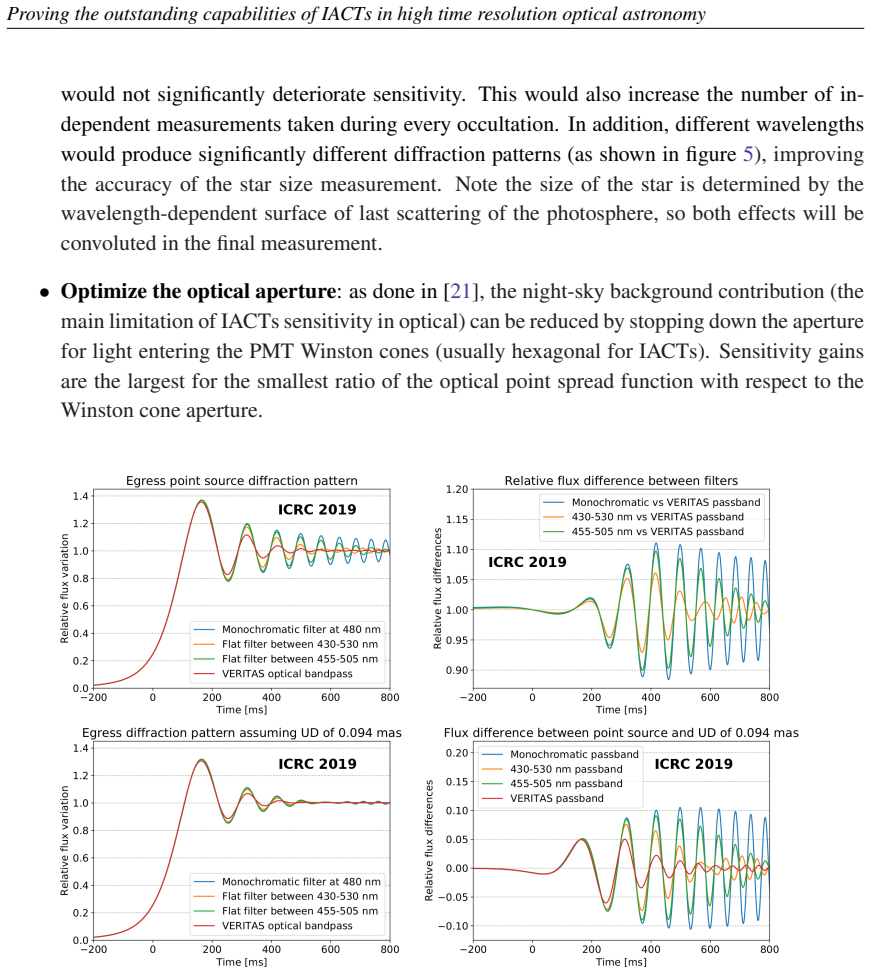
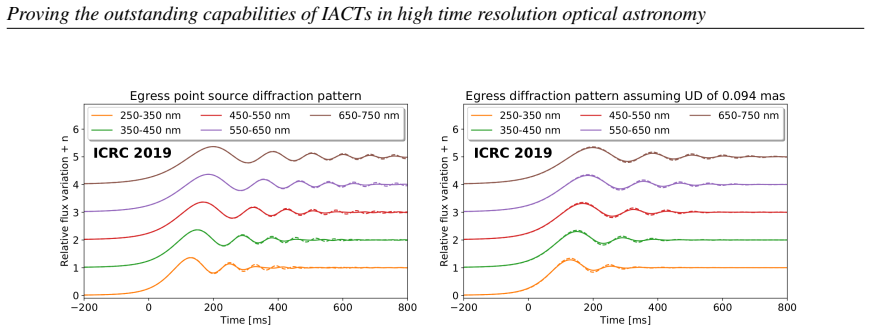
The load-bearing object is the asteroid-occultation diffraction pattern: when an asteroid's shadow crosses the telescope, the recorded ingress and egress light curves encode the star's angular diameter as a modulation of the diffraction pattern, which is fit to a point-source versus uniform-disk model to recover the stellar radius. Two supporting mechanisms carry the argument: a PMT current-monitoring photometer that records the DC light level at up to 4,800 Hz, turning each IACT into a millisecond high-speed photometer with roughly 20 times lower scintillation noise than a standard 50 cm occultation telescope, and an event-rate forecast from the Occult software and the Gaia DR2 catalogue that determines how many occultations per year are visible from a fixed site as a function of star magnitude. The contrast of the diffraction pattern is what limits sensitivity, and the paper shows it can be increased with a narrower optical bandpass.
What would settle it
Run a year-long monitoring campaign at a fixed site with a photometer that reaches 13th magnitude in millisecond integrations, attempt diffraction fits on every predicted high-probability occultation, and compare the recovered angular diameters with interferometric diameters for the few stars measured by both methods. A realized rate well below one usable event per week, or systematic disagreement in the recovered diameters, would falsify the central projection.
Extended reading notes
Core claim
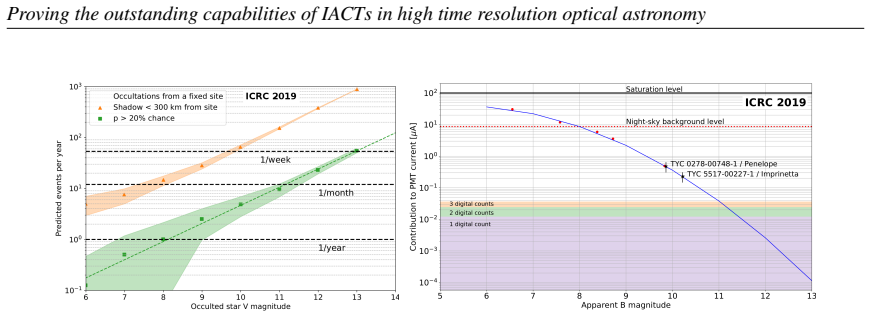
The paper claims that asteroid occultations are a practical, routine method for directly measuring stellar angular diameters, with the first IACT detections already producing the highest angular resolution visible-band stellar diameter measurements ever taken. Using the Occult prediction software with the Gaia DR2 catalogue, the paper forecasts that a single fixed observatory with a 13th-magnitude high-speed photometer should detect about one usable occultation per week. Since 12% of those occultations are expected to involve K-type stars, a few years of sparse observations would increase the census of directly measured K-star radii by 50%. The paper also shows that the current VERITAS readout is limited to roughly 11th to 12th magnitude by datalogger resolution and night-sky background, and proposes hardware changes—narrow filters, beam splitting, and aperture stops—to reach the needed sensitivity and precision.
Load-bearing premise
The projected expansion of K-star radii rests on the forecast that a fixed site will actually detect about one usable 13th-magnitude asteroid occultation per week; if weather, prediction uncertainties, or faint-star signal-to-noise bring the realized rate down, the 50% increase disappears.
Editorial extensions
If this is right
- A fixed-site 13th-magnitude high-speed photometer would deliver about one directly measured stellar diameter per week, using only minutes of observing time per event.
- Because 12% of predicted occultations involve K-type stars, a few years of monitoring would raise the number of directly measured K-star radii by roughly 50%.
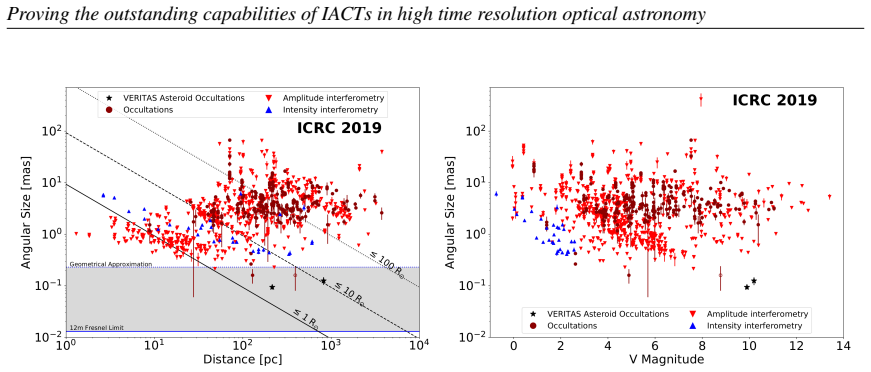
- The technique extends direct diameter measurements to stars far below the magnitude limits of interferometry, at sub-milliarcsecond resolution.
- Narrow-band filters and multi-wavelength beam splitting increase diffraction-pattern contrast by 5-7%, which should help bring relative diameter errors below 10% and toward the sub-3% level needed for exoplanet host-star work.
- Predicted events let observatories schedule only high-probability occultations, so the program competes for almost none of the night.
Reading between the lines
- The paper leaves implicit that its yield estimate is a lower bound: as Gaia astrometry sharpens asteroid ephemerides, more occultations, especially by smaller asteroids, become predictable, so the 50% K-star increase should grow.
- A natural extension of the proposed multi-band beam splitter is to fit the wavelength-dependent diffraction patterns simultaneously, separating the stellar photosphere radius from limb-darkening rather than treating them as convolved.
- If the sub-3% relative-error target is met, the same few-minutes-per-week program could anchor host-star radii for transiting exoplanet surveys, turning a niche technique into a calibration product.
Editorial analysis
A structured set of objections, weighed in public.
Referee Report
Summary. This conference proceedings paper argues that Imaging Atmospheric Cherenkov Telescopes (IACTs), specifically VERITAS, can serve as high-speed optical photometers and that asteroid occultation observations with these telescopes can directly measure stellar angular diameters with sub-milliarcsecond resolution. The authors summarize the recent VERITAS detection of two asteroid occultations, describe the diffraction-fitting technique, characterize the current VERITAS photometric sensitivity, and propose hardware upgrades (narrowband filters, multiwavelength beam splitting, and aperture optimization). The central projection is that a single fixed-site telescope with a high-speed visible-band photometer reaching about the 13th magnitude could substantially increase the number of directly measured K-star diameters, stated as a 50% increase in the abstract and as a doubling in the conclusions. The paper also lists the limitations of the technique, including the need to demonstrate relative errors below 10%.
Significance. If the event-rate forecast and the projected K-star fraction are reliable, this technique would open a new, relatively inexpensive path to direct stellar-radius measurements for faint (V ~ 11-13) stars, a regime largely inaccessible to optical interferometry. The resulting sample could test stellar evolution models and improve the accuracy of transiting exoplanet radius measurements. The paper's strengths include the physically sound diffraction-fitting framework, the use of measured VERITAS sensitivity rather than purely simulated performance, and the honest acknowledgement that sub-10% relative diameter errors remain to be demonstrated. The prior detection is published in a peer-reviewed venue, and no fitted parameter from that work is recycled into the forward projection, so the central feasibility argument is not circular. The main weakness is that the headline yield rests on an incompletely specified event-rate forecast and an unquantified spectral-type fraction.
major comments (4)
- [Abstract and Section 5] The abstract states that a 13th-magnitude photometer 'could increase the number of directly measured K stars diameters by 50%,' while Section 5 concludes that such a telescope 'could double the amount of K stars with directly measured stellar diameters in a few years.' These are quantitatively different claims (50% vs. 100% increase). Since this is the headline result, the authors must reconcile the two numbers and show the arithmetic connecting the event rate, the K-star fraction, and the current sample size of directly measured K-star diameters.
- [Section 5 and Figure 3 (left)] The 'one measurement per week' rate is not derived from the plotted event rates in Figure 3 (left). The figure shows events per year for two selection criteria, but the text does not quote the plotted counts, nor does it explain how the plot translates to approximately 52 usable events per year. The text explicitly excludes weather and Moon duty cycle, and it equates 'detectable' (path probability >20%) with a successful measurement, ignoring scheduling constraints and prediction errors. Because the projected K-star yield is directly proportional to this rate, the authors should provide a step-by-step derivation of the weekly rate, including assumed duty cycle, weather fraction, and success probability, with uncertainties.
- [Section 5] The statement that 'for stars brighter than 14th magV, 12% of the expected asteroid occultations will be on K-type stars' is given without a source, a calculation, or a definition of the K-type selection. This fraction is load-bearing because it converts the total event rate into the K-star yield. The selection is made in V-band magnitude while the IACT sensitivity is discussed in the B band, which could bias the effective K-star fraction given that K-type stars are red. The authors should derive this 12% from the same Gaia-based catalogue used in Figure 3 and state the spectral-type classification criteria.
- [Section 5] The paper acknowledges that relative errors better than 10% 'need still to be demonstrated' and that <3% errors are required for impact on exoplanet radii. Given that the abstract describes the measurements as 'usable for population studies,' the feasibility claim requires more than a detection-rate forecast. The authors should provide a quantitative signal-to-noise estimate for a typical 13th-magnitude occultation event, including the expected diffraction-pattern amplitude, sampling rate, and background noise, or explicitly reframe the central claim as a projection of detections rather than of usable diameter measurements.
minor comments (5)
- [Abstract] There is a typo: 'mainly emitte' should be 'mainly emitted.'
- [Figure 3 caption] The caption does not specify the processing steps applied to the Occult software output (e.g., minimum asteroid diameter, minimum star brightness, or the exact path-probability threshold) or the uncertainties on the plotted rates. Adding this information would make the forecast reproducible.
- [Figure 2 caption] The caption says 'Errors for this work are the 68% confidence level,' but the text does not describe how these confidence intervals were computed for the VERITAS points. Please state the method (e.g., chi-square or Markov-chain Monte Carlo).
- [Section 5] The claim that 'about only 10 stars accessible to the current generation of interferometers over reasonable observation times' lacks a citation. A reference or a quantitative basis for this number would strengthen the comparison.
- [Section 4] The phrase 'the size of the star is determined by the wavelength-dependent surface of last scattering of the photosphere' is vague; clarifying whether this refers to limb darkening or a wavelength-dependent stellar radius would help the reader understand the multiwavelength proposal.
Circularity Check
No significant circularity: the projected K-star yield combines external Gaia/Occult forecasts and a peer-reviewed prior VERITAS detection; unsupported premises are correctness issues, not circularity.
full rationale
The paper's derivation chain is empirical and forecast-based rather than definitional or self-referential. The feasibility argument starts from the measured VERITAS occultation light curves (Figure 1, from ref. [6]) and the measured current-monitor limiting magnitude (Figure 3, right), then combines an external occultation-rate forecast computed with the Occult software and the Gaia DR2 catalogue (Figure 3, left) with two stated assumptions: 'one measurement per week during the night time' and '12% of the expected asteroid occultations will be on K-type stars.' No parameter in the headline projection is fitted to the quantity that is then predicted; the '13th magnitude' sensitivity is a proposed upgraded capability, not a value recycled from the data used to forecast occultation rates. The only load-bearing self-citation is ref. [6], the VERITAS Nature Astronomy detection of two asteroid occultations; that is a peer-reviewed, externally validated measurement with published light curves and diffraction fits, so it supplies independent evidence rather than a self-referential premise. Several premises are asserted rather than demonstrated, notably the 12% K-type fraction and the derivation of the weekly rate from Figure 3 (left), and the abstract's 'increase by 50%' conflicts with the conclusion's 'double the amount of K stars.' These are transparency and internal-consistency weaknesses, not circularity: none of the paper's central claims reduces by construction to its inputs, and no fitted parameter is renamed as a prediction. The paper also explicitly flags that 'relative errors better than 10% need still to be demonstrated,' further showing that its own feasibility claim is not presented as already proven by its inputs.
Assumptions & free parameters
assumptions (3)
- domain assumption Occult software predictions using Gaia DR2 provide an accurate forecast of observable asteroid occultation rates from a fixed site.
- standard math The diffraction pattern of a uniform disk is an adequate model for extracting stellar angular diameters at the reported precision.
- domain assumption Scintillation noise scales as D^{-2/3}/sqrt(t), making 12-m IACTs about 20 times quieter than 50-cm occultation telescopes.
Cite this review
Pith. "Pith review of Proving the outstanding capabilities of IACTs in high time resolution optical astronomy." pith.science (2026). https://pith.science/paper/CIQFAZNF
@misc{pith2026190803393,
  author       = {Pith},
  title        = {Pith review of: Proving the outstanding capabilities of IACTs in high time resolution optical astronomy},
  year         = {2026},
  howpublished = {\url{https://pith.science/paper/CIQFAZNF}},
  note         = {Machine review of arXiv:1908.03393}
}
abstract
Imaging Atmospheric Cherenkov Telescopes (IACTs) are very-large telescopes designed to detect the nanosecond-timescale flashes produced within extended air showers. Because IACTs are sensitive to the Cherenkov light (UV/blue) and use photodetectors with extremely fast time responses, they are also able to perform simultaneous optical observations. The large reflecting areas of these telescopes (larger than 100 m$^2$) makes them well-suited to studying fast optical transient phenomena with timescales ranging from seconds to milliseconds to nanoseconds, and the unique optical design provides a wide field of view monitoring capability with a modest point spread function. VERITAS, with its recently upgraded PMT current monitoring instrumentation, was able to provide the first detection of asteroid occultations with an IACT, resulting in the highest angular resolution measurements for stellar diameters ever taken in the visible band range. Here we explore the feasibility of using this technique to significantly expand the number of stars with directly measured stellar radii, usable for population studies to test stellar evolution modelling or transiting exoplanet radius measurements. A single observatory with a high-speed visible-band photometer with a sensitivity reaching the 13$^{th}$ magnitude could increase the number of directly measured K stars diameters by 50%.
Figures

Figures from the paper (2 more)
Reference graph
Works this paper leans on
-
[1]
Weekes, T. C. 1996, Space Science Reviews, 75, 1
work page 1996
-
[2]
Focal Plane Instrumentation of VERITAS
VERITAS Collaboration: T. Nagai, McKay, R., Sleege, G., et al. 2007, arXiv e-prints, arXiv:0709.4517
work page Pith review arXiv 2007
-
[3]
Lacki, B. C. 2011, Monthly Notices of the RAS, 416, 3075
work page 2011
-
[4]
Lucarelli, F., Barrio, J. A., Antoranz, P., et al. 2008, Nuclear Instruments and Methods in Physics Research A, 589, 415
work page 2008
-
[5]
2017, International Cosmic Ray Conference, 301, 807
Hassan, T., Hoang, J., López Moya, M., et al. 2017, International Cosmic Ray Conference, 301, 807
work page 2017
-
[6]
2019, Nature Astronomy, 3, 511
Benbow, W., Bird, R., Brill, A., et al. 2019, Nature Astronomy, 3, 511
work page 2019
-
[7]
2016, VizieR Online Data Catalog, 2345,
Duvert, G. 2016, VizieR Online Data Catalog, 2345,
work page 2016
- [8]
Show all 24 references
-
[9]
D., ten Brummelaar, T., & Thureau, N
Pedretti, E., Monnier, J. D., ten Brummelaar, T., & Thureau, N. D. 2009, New Astronomy Review, 53, 353
2009
-
[10]
Hanbury Brown, R., Davis, J., & Allen, L. R. 1974, Monthly Notices of the RAS, 167, 121
1974
-
[11]
Matthews, N., these proceedings
-
[12]
S., Agudo, I., et al
Cherenkov Telescope Array Consortium, Acharya, B. S., Agudo, I., et al. 2019, Science with the Cherenkov Telescope Array, 9789813270091
2019
-
[13]
W., Badran, H
Holder, J., Atkins, R. W., Badran, H. M., et al. 2006, Astroparticle Physics, 25, 391
2006
-
[14]
Dravins, D., Lindegren, L., Mezey, E., & Young, A. T. 1998, Publications of the ASP, 110, 610
1998
-
[15]
https://commons.wikimedia.org/wiki/File: Comparison_optical_telescope_primary_mirrors.svg
CMG Lee. https://commons.wikimedia.org/wiki/File: Comparison_optical_telescope_primary_mirrors.svg. CC-BY-SA-3.0
-
[16]
2007, Astronomy and Astrophysics, 474, 1015
Tanga, P., & Delbo, M. 2007, Astronomy and Astrophysics, 474, 1015
2007
-
[17]
L., Santos-Sanz, P., Sicardy, B., et al
Ortiz, J. L., Santos-Sanz, P., Sicardy, B., et al. 2017, Nature, 550, 219
2017
-
[18]
http://www.lunar-occultations.com/iota/occult4.htm
Occult v4.6.0. http://www.lunar-occultations.com/iota/occult4.htm
-
[19]
Gaia Collaboration, Brown, A. G. A., Vallenari, A., et al. 2018, Astronomy and Astrophysics, 616, A1
2018
-
[20]
S., Marsh, T
Dhillon, V . S., Marsh, T. R., Bezawada, N., et al. 2016, Ground-based and Airborne Instrumentation for Astronomy VI, 99080Y
2016
-
[21]
2009, Astroparticle Physics, 31, 156
Deil, C., Domainko, W., Hermann, G., et al. 2009, Astroparticle Physics, 31, 156
2009
-
[22]
T., Hindsley, R
Mozurkewich, D., Armstrong, J. T., Hindsley, R. B., et al. 2003, Astronomical Journal, 126, 2502
2003
-
[23]
2013, Astrophysical Journal, 776, 87
Spada, F., et al. 2013, Astrophysical Journal, 776, 87
2013
-
[24]
S., van Belle, G
von Braun, K., Boyajian, T. S., van Belle, G. T., et al. 2014, Monthly Notices of the RAS, 438, 2413 7
2014
Reviewed August 14, 2026 · model on record in the stance chip above.
Discussion (0). Continue with ORCID to comment.