REVIEW 1 major objections 1 minor 54 references
Discovering Divergent Representations between Text-to-Image Models
T0 review · 1 major / 1 minor · reviewed 2026-08-04 · deepseek-v4-flash
Pith's one-line read CompCon discovers when two text-to-image models diverge on the same prompt, finding the visual attribute one model adds and the prompt concepts that trigger it.
desk verdict CompCon is a genuinely new, honestly-reported method for discovering prompt-dependent visual differences between T2I models; the main caveats are the synthetic benchmark and a CLIP-based scorer that the authors themselves show can misfire. read the letter →
The pith
A machine-rendered reading of the paper's core claim, the machinery that carries it, and where it could break.
The reading
What carries the argument
The divergence score z(a,I1(p),I2(p)) = [s(a,I1)>t] × [s(a,I1)−s(a,I2)>δ] — a CLIP cosine-similarity test that the attribute is present above threshold t in one model’s images and exceeds the other model’s by margin δ. This score classifies prompts as diverging or non-diverging; the evolutionary search’s prompt bank H and LLM mutation loop maximizes the expected score over newly generated prompts. The central mechanism is this classifier-in-the-loop search that couples visual attribute discovery with prompt-description refinement.
What would settle it
Take any discovered divergence and ask humans to classify 100 new prompts from the description: if the attribute is not present in a clear majority of one model’s images and absent from the other’s, the divergence score is not tracking real visual content. The paper’s own Figure 13 already shows examples where CLIP mislabels prompts as diverging when both or neither image contains the attribute.
Extended reading notes
Core claim
CompCon models the task as learning a mapping F from text prompts to diverging visual attributes for a given model pair. It first uses a vision-language model to surface candidate attributes from image grids, ranks them with a CLIP-based divergence score requiring one model’s image set to contain the attribute and the other’s not, then runs an evolutionary search: an LLM writes a description of diverging vs. non-diverging prompts, new prompts are generated or retrieved from that description, and the description that maximizes the fraction of confirmed diverging prompts is kept. The authors claim this finds input-dependent differences such as PixArt rendering emotion prompts with flames while
Load-bearing premise
The CLIP-based divergence score—requiring attribute presence above a threshold in one model’s images and a margin over the other—correctly identifies when a generated image really contains the attribute, so that prompts labeled diverging are genuinely diverging.
Editorial extensions
If this is right
- CompCon can be applied to any pair of text-to-image models to produce interpretable, natural-language descriptions of where they differ, not just aggregate quality scores.
- Discovered divergences can reveal biases—e.g., SD3.5 generating African American people for media professions, PixArt showing old men for traditional trades—giving developers a targeted list to audit.
- The iterative search improves divergence hit-rate substantially (e.g., wet streets from 8% to 52% of generated prompts), so the method is tunable in cost vs. precision.
- The ID2 benchmark and LLM-as-judge evaluation (human-validated with comparable kappa) provide a reusable standard for future divergence-discovery methods.
- Because the pipeline works with smaller open-source VLMs/LLMs (still beating baselines), it is reproducible without proprietary models.
Reading between the lines
- The same search loop could be adapted to compare video generators, audio generators, or any conditional generative model pair where a CLIP-like scorer exists, not just images.
- Discovered divergences could serve as a debugging signal during training: if a new checkpoint diverges from its predecessor on a known attribute, that points to a data or architecture change to inspect.
- The method could be turned around to generate prompts that intentionally split models—useful for building ‘trap’ prompts to stress-test alignment or for watermarking model outputs.
- If the Platonic representation hypothesis is right, the set of divergences between two models might shrink as both improve; CompCon’s outputs could serve as a direct empirical measure of representational convergence.
Editorial analysis
A structured set of objections, weighed in public.
Referee Report
Summary. The paper introduces CompCon, an evolutionary search algorithm that, given a pair of text-to-image models, discovers pairs of a diverging visual attribute (e.g., 'flames') and a diverging prompt description (e.g., 'prompts with strong emotions') such that prompts following the description cause one model to depict the attribute while the other does not. The pipeline first uses a VLM to propose candidate visual attributes, ranks them with a CLIP-based divergence score (Eq. 2), then iteratively refines a natural-language prompt description by generating candidate prompts, classifying them as diverging/non-diverging with the same CLIP score, and returning the description with the highest diverging-prompt proportion. The authors introduce ID2, a simulated benchmark of 60 input-dependent differences, and evaluate CompCon against LLM-only, TF-IDF, and VisDiff baselines on attribute and description scores. They also present qualitative comparisons of PixArt vs. SDXL-Lightning, including discoveries such as 'wet streets' and bias-related attributes such as 'African American people' for media-profession prompts.
Significance. If the reported results hold, the paper makes a useful contribution: it defines a concrete discovery task for input-dependent representational differences between generative models, ships a benchmark (ID2), and provides an end-to-end method with human validation of both the benchmark and the LLM judge. The appendices are unusually thorough (hyperparameters, prompts, open-model variants, error-sensitivity experiments), and the code is released. The human validation of ID2 and the LLM judge, plus the open-model variant in Table 4, are real strengths. The central claim, however, is that CompCon outperforms the baselines on ID2; that claim is currently supported by a single run of scores whose statistical reliability and benchmark-referee independence are not established.
major comments (1)
- [§5.1] The thresholds t and δ in Eq. 2 are free hyperparameters whose values are not derived. For the qualitative model comparison, the paper states the authors 'manually inspect prompts labeled as diverging to set thresholds t and δ' per discovered representation. This means the reported discoveries (e.g., 'flames', 'wet streets') may reflect thresholds adjusted after seeing the outputs of a specific run, undermining the predictive claim of the method. Please report a sensitivity analysis over t and δ, or use a pre-registered thresholding rule, for the qualitative experiments.
minor comments (1)
- [§C.3] Early stopping at max-average-divergence 0.1 within 5 iterations is an additional free parameter; please clarify whether this threshold was fixed before the eval runs or tuned on ID2.
Circularity Check
No significant circularity: the discovery algorithm and benchmark evaluation are not equivalent to the algorithm's inputs.
full rationale
CompCon's core derivation is self-contained. The diverging visual attributes are proposed by a VLM from image grids and then ranked by the CLIP-based divergence score z in Eq. (2); the prompt-description search maximizes the expectation of z in Eq. (3). Nothing in these equations is fitted to the ID2 ground-truth labels, and the reported attribute/description scores are computed by an LLM judge against independently created ground-truth tuples, not by the CLIP scorer used in the search. The hand-set thresholds t and delta and the documented CLIP misclassifications (Fig. 13) are empirical reliability limitations, not circular reductions. The use of GPT-4o for both generation and judging is a benchmark-design concern, but it is not a derivation that reduces to its own inputs; moreover, the paper includes human validation (weighted kappa 0.635 vs. inter-human 0.667) and open-model results. Self-citation of VisDiff (Dunlap et al.) is only as a baseline and does not carry any load-bearing premise. No equation or selection rule is equivalent by construction to the claimed discoveries, so the circularity score is 0.
Assumptions & free parameters
free parameters (5)
- divergence threshold t =
0 for discovery, 0.2 for benchmark, manually tuned for qualitative runs
- margin threshold delta =
0.05
- k candidate prompts per iteration =
25
- B sampled prompts =
25
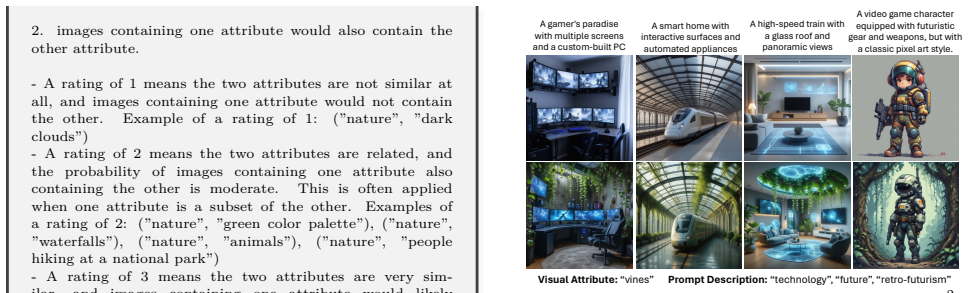
- early stopping threshold =
0.1 within 5 iterations
assumptions (4)
- domain assumption CLIP cosine similarity between attribute text and image is a valid indicator of attribute presence.
- domain assumption ID2's simulated differences via a single model with injected attributes represent real model divergences.
- domain assumption GPT-4o as LLM judge yields scores that match human judgment.
- domain assumption Off-the-shelf VLM reliably lists visual attributes from image grids.
Cite this review
Pith. "Pith review of Discovering Divergent Representations between Text-to-Image Models." pith.science (2026). https://pith.science/paper/CIQZBRW3
@misc{pith2026250908940,
  author       = {Pith},
  title        = {Pith review of: Discovering Divergent Representations between Text-to-Image Models},
  year         = {2026},
  howpublished = {\url{https://pith.science/paper/CIQZBRW3}},
  note         = {Machine review of arXiv:2509.08940}
}
read the original abstract
In this paper, we investigate when and how visual representations learned by two different generative models diverge. Given two text-to-image models, our goal is to discover visual attributes that appear in images generated by one model but not the other, along with the types of prompts that trigger these attribute differences. For example, "flames" might appear in one model's outputs when given prompts expressing strong emotions, while the other model does not produce this attribute given the same prompts. We introduce CompCon (Comparing Concepts), an evolutionary search algorithm that discovers visual attributes more prevalent in one model's output than the other, and uncovers the prompt concepts linked to these visual differences. To evaluate CompCon's ability to find diverging representations, we create an automated data generation pipeline to produce ID2, a dataset of 60 input-dependent differences, and compare our approach to several LLM- and VLM-powered baselines. Finally, we use CompCon to compare popular text-to-image models, finding divergent representations such as how PixArt depicts prompts mentioning loneliness with wet streets and Stable Diffusion 3.5 depicts African American people in media professions. Code at: https://github.com/adobe-research/CompCon
Figures


Figures from the paper (11 more)




Reference graph
Works this paper leans on
-
[1]
Introducing stable diffusion 3.5.https: //stability.ai/news/introducing- stable- diffusion-3-5, 2024
Stability AI. Introducing stable diffusion 3.5.https: //stability.ai/news/introducing- stable- diffusion-3-5, 2024. Stable Diffusion 3.5 Large, Large Turbo, and Medium models. 5, 7
2024
-
[2]
Llama 3 model card
AI@Meta. Llama 3 model card. 2024. 2
2024
-
[3]
Claude 3.5 sonnet, 2024
Anthropic. Claude 3.5 sonnet, 2024. 5
2024
-
[4]
D. Bau, B. Zhou, A. Khosla, A. Oliva, and A. Torralba. Network dissection: Quantifying interpretability of deep vi- sual representations. InProceedings of the IEEE Conference on Computer Vision and Pattern Recognition (CVPR), pages 6541–6549, 2017. 2
2017
-
[5]
Easily acces- sible text-to-image generation amplifies demographic stereo- types at large scale
Federico Bianchi, Pratyusha Kalluri, Esin Durmus, Faisal Ladhak, Myra Cheng, Debora Nozza, Tatsunori Hashimoto, Dan Jurafsky, James Zou, and Aylin Caliskan. Easily acces- sible text-to-image generation amplifies demographic stereo- types at large scale. InProceedings of the 2023 ACM Confer- ence on Fairness, Accountability, and Transparency (FAccT),
2023
-
[6]
Pixart-α: Fast training of dif- fusion transformer for photorealistic text-to-image synthesis,
Junsong Chen, Jincheng Yu, Chongjian Ge, Lewei Yao, Enze Xie, Yue Wu, Zhongdao Wang, James Kwok, Ping Luo, Huchuan Lu, and Zhenguo Li. Pixart-α: Fast training of dif- fusion transformer for photorealistic text-to-image synthesis,
-
[7]
Reproducible scal- ing laws for contrastive language-image learning
Mehdi Cherti, Romain Beaumont, Ross Wightman, Mitchell Wortsman, Gabriel Ilharco, Cade Gordon, Christoph Schuh- mann, Ludwig Schmidt, and Jenia Jitsev. Reproducible scal- ing laws for contrastive language-image learning. InPro- ceedings of the IEEE/CVF Conference on Computer Vision and Pattern Recognition, pages 2818–2829, 2023. 6
2023
-
[8]
Tibet: Identifying and evaluating biases in text-to-image generative models, 2023
Aditya Chinchure, Pushkar Shukla, Gaurav Bhatt, Kiri Salij, Kartik Hosanagar, Leonid Sigal, and Matthew Turk. Tibet: Identifying and evaluating biases in text-to-image generative models, 2023. 2
2023
Show all 54 references
-
[9]
Evolving interpretable visual classifiers with large language models
Mia Chiquier, Utkarsh Mall, and Carl V ondrick. Evolving interpretable visual classifiers with large language models. InECCV, 2024. 2
2024
-
[10]
Dall-eval: Probing the reasoning skills and social biases of text-to-image generative transformers.arXiv preprint arXiv:2202.04053, 2022
Jaemin Cho, Maarten Sap, Mark Yatskar, Yejin Choi, and Dan Schwartz. Dall-eval: Probing the reasoning skills and social biases of text-to-image generative transformers.arXiv preprint arXiv:2202.04053, 2022. 2
2022 arXiv
-
[11]
J. Cho, A. Zala, and M. Bansal. Dall-eval: Probing the reasoning skills and social biases of text-to-image genera- tion models. InProceedings of the IEEE/CVF International Conference on Computer Vision (ICCV), pages 3043–3054,
-
[12]
Weighted kappa: Nominal scale agreement provision for scaled disagreement or partial credit.Psycho- logical Bulletin, 70(4):213–220, 1968
Jacob Cohen. Weighted kappa: Nominal scale agreement provision for scaled disagreement or partial credit.Psycho- logical Bulletin, 70(4):213–220, 1968. 6
1968
-
[13]
Openbias: Open-set bias detection in text-to-image generative models
Moreno D’Inc `a, Elia Peruzzo, Massimiliano Mancini, Dejia Xu, Vidit Goel, Xingqian Xu, Zhangyang Wang, Humphrey Shi, and Nicu Sebe. Openbias: Open-set bias detection in text-to-image generative models. InProceedings of the IEEE/CVF Conference on Computer Vision and Pattern Re...
2024
-
[14]
Gradbias: Un- veiling word influence on bias in text-to-image generative models, 2024
Moreno D’Inc `a, Elia Peruzzo, Massimiliano Mancini, Xingqian Xu, Humphrey Shi, and Nicu Sebe. Gradbias: Un- veiling word influence on bias in text-to-image generative models, 2024. 2
2024
-
[15]
Efros, and Assaf Shocher
Amil Dravid, Yossi Gandelsman, Alexei A. Efros, and Assaf Shocher. Rosetta neurons: Mining the common units in a model zoo. InProceedings of the IEEE/CVF International Conference on Computer Vision (ICCV), pages 1934–1943,
1934
-
[16]
Dreamlike photoreal 2.0.https:// huggingface.co/dreamlike- art/dreamlike- photoreal-2.0, 2023
Dreamlike Art. Dreamlike photoreal 2.0.https:// huggingface.co/dreamlike- art/dreamlike- photoreal-2.0, 2023. A photorealistic Stable Diffusion 1.5–based model trained on 768×768 images. 1
2023
-
[17]
Gonzalez, and Serena Yeung-Levy
Lisa Dunlap, Yuhui Zhang, Xiaohan Wang, Ruiqi Zhong, Trevor Darrell, Jacob Steinhardt, Joseph E. Gonzalez, and Serena Yeung-Levy. Describing differences in image sets with natural language. InConference on Computer Vision and Pattern Recognition (CVPR), 2024. 2, 7
2024
-
[18]
Friedrich, P
F. Friedrich, P. Schramowski, M. Brack, L. Struppek, D. Hin- tersdorf, S. Luccioni, and K. Kersting. Fair diffusion: In- structing text-to-image generation models on fairness.arXiv preprint arXiv:2302.10893, 2023. 2
2023 arXiv
-
[19]
Efros, and Jacob Steinhardt
Yossi Gandelsman, Alexei A. Efros, and Jacob Steinhardt. Interpreting clip’s image representation via text-based de- composition, 2023. 2
2023
-
[20]
Efros, and Jacob Steinhardt
Yossi Gandelsman, Alexei A. Efros, and Jacob Steinhardt. Interpreting the second-order effects of neurons in clip, 2024. 2
2024
-
[21]
Ghosh and A
S. Ghosh and A. Caliskan. Person==light-skinned, western man, and sexualization of women of color: Stereotypes in stable diffusion. InFindings of the Association for Compu- tational Linguistics: EMNLP 2023, pages 6971–6985, 2023. 2
2023
-
[22]
Tiam - a metric for evaluating alignment in text- to-image generation
Paul Grimal, Herv ´e Le Borgne, Olivier Ferret, and Julien Tourille. Tiam - a metric for evaluating alignment in text- to-image generation. InProceedings of the IEEE/CVF Win- ter Conference on Applications of Computer Vision (WACV), pages 2890–2899, 2024. 2
2024
-
[23]
Hamidieh, H
K. Hamidieh, H. Zhang, T. Hartvigsen, and M. Ghassemi. Identifying implicit social biases in vision-language models. arXiv preprint arXiv:2411.00997, 2023. 2
2023 arXiv
-
[24]
Hessel, A
J. Hessel, A. Holtzman, M. Forbes, R.L. Bras, and Y . Choi. Clipscore: A reference-free evaluation metric for image cap- tioning.arXiv preprint arXiv:2104.08718, 2021. 2
2021 arXiv
-
[25]
Gans trained by a two time-scale update rule converge to a local nash equilib- rium
Martin Heusel, Hubert Ramsauer, Thomas Unterthiner, Bernhard Nessler, and Sepp Hochreiter. Gans trained by a two time-scale update rule converge to a local nash equilib- rium. InAdvances in Neural Information Processing Systems (NeurIPS), pages 6626–6637, 2017. 2
2017
-
[26]
Tifa: Accurate and interpretable text-to-image faithfulness evaluation with question answering.arXiv preprint arXiv:2303.11897, 2023
Yushi Hu, Benlin Liu, Jungo Kasai, Yizhong Wang, Mari Os- tendorf, Ranjay Krishna, and Noah A Smith. Tifa: Accurate and interpretable text-to-image faithfulness evaluation with question answering.arXiv preprint arXiv:2303.11897, 2023. 2
2023 arXiv
-
[27]
The platonic representation hypothesis
Minyoung Huh, Brian Cheung, Tongzhou Wang, and Phillip Isola. The platonic representation hypothesis. InICML,
-
[28]
Open- clip, 2021
Gabriel Ilharco, Mitchell Wortsman, Ross Wightman, Cade Gordon, Nicholas Carlini, Rohan Taori, Achal Dave, 9 Vaishaal Shankar, Hongseok Namkoong, John Miller, Han- naneh Hajishirzi, Ali Farhadi, and Ludwig Schmidt. Open- clip, 2021. If you use this software, please cite it as below. 6
2021
-
[29]
Building and better understanding vision- language models: insights and future directions., 2024
Hugo Laurenc ¸on, Andr´es Marafioti, Victor Sanh, and L ´eo Tronchon. Building and better understanding vision- language models: insights and future directions., 2024. 8, 2
2024
-
[30]
Holis- tic evaluation of text-to-image models
Tony Lee, Michihiro Yasunaga, Chenlin Meng, Yifan Mai, Joon Sung Park, Agrim Gupta, Yunzhi Zhang, Deepak Narayanan, Hannah Benita Teufel, Marco Bellagente, Min- guk Kang, Taesung Park, Jure Leskovec, Jun-Yan Zhu, Li Fei-Fei, Jiajun Wu, Stefano Ermon, and Percy Liang. Holis- ti...
2023
-
[31]
Playground v2.5: Three insights towards enhancing aesthetic quality in text-to-image genera- tion, 2024
Daiqing Li, Aleks Kamko, Ehsan Akhgari, Ali Sabet, Lin- miao Xu, and Suhail Doshi. Playground v2.5: Three insights towards enhancing aesthetic quality in text-to-image genera- tion, 2024. 7, 1
2024
-
[32]
Sdxl- lightning: Progressive adversarial diffusion distillation,
Shanchuan Lin, Anran Wang, and Xiao Yang. Sdxl- lightning: Progressive adversarial diffusion distillation,
-
[33]
Visual instruction tuning
Haotian Liu, Chunyuan Li, Qingyang Wu, and Yong Jae Lee. Visual instruction tuning. InNeurIPS, 2023. 7
2023
-
[34]
Organizing unstructured im- age collections using natural language.arXiv preprint arXiv:2410.05217, 2024
Mingxuan Liu, Zhun Zhong, Jun Li, Gianni Franchi, Sub- hankar Roy, and Elisa Ricci. Organizing unstructured im- age collections using natural language.arXiv preprint arXiv:2410.05217, 2024. 2
2024 arXiv
-
[35]
Stable bias: Analyzing soci- etal representations in diffusion models
Alexandra Sasha Luccioni, Cynthia Akiki, Margaret Mitchell, and Yacine Jernite. Stable bias: Analyzing soci- etal representations in diffusion models. InProceedings of the 37th Conference on Neural Information Processing Sys- tems (NeurIPS), 2023. 8, 1
2023
-
[36]
Hello gpt-4o.https : / / openai
OpenAI. Hello gpt-4o.https : / / openai . com / index / hello - gpt - 4o/, 2024. (Accessed on 06/05/2024). 6
2024
-
[37]
Benchmark for compositional text- to-image synthesis
Dong Huk Park, Samaneh Azadi, Xihui Liu, Trevor Dar- rell, and Anna Rohrbach. Benchmark for compositional text- to-image synthesis. InProceedings of the Neural Informa- tion Processing Systems (NeurIPS). University of California, Berkeley, 2024. 2
2024
-
[38]
Learning transferable visual models from natural language supervision
Alec Radford, Jong Wook Kim, Chris Hallacy, Aditya Ramesh, Gabriel Goh, Sandhini Agarwal, Girish Sastry, Amanda Askell, Pamela Mishkin, Jack Clark, Gretchen Krueger, and Ilya Sutskever. Learning transferable visual models from natural language supervision. InProceedings of the...
2021
-
[39]
Photorealistic text-to-image diffusion models with deep language understanding.arXiv preprint arXiv:2205.11487, 2022
Chitwan Saharia, William Chan, Saurabh Saxena, Lala Li, Jay Whang, Emily Denton, Seyed Kamyar Seyed Ghasemipour, Burcu Karagol Ayan, S Sara Mahdavi, Rapha Gontijo Lopes, et al. Photorealistic text-to-image diffusion models with deep language understanding.arXiv preprint arXiv:...
2022 arXiv
-
[40]
Improved techniques for training gans
Tim Salimans, Ian Goodfellow, Wojciech Zaremba, Vicki Cheung, Alec Radford, and Xi Chen. Improved techniques for training gans. InAdvances in Neural Information Pro- cessing Systems (NeurIPS), pages 2234–2242, 2016. 2
2016
-
[41]
LAION-5b: An open large-scale dataset for train- ing next generation image-text models
Christoph Schuhmann, Romain Beaumont, Richard Vencu, Cade W Gordon, Ross Wightman, Mehdi Cherti, Theo Coombes, Aarush Katta, Clayton Mullis, Mitchell Worts- man, Patrick Schramowski, Srivatsa R Kundurthy, Katherine Crowson, Ludwig Schmidt, Robert Kaczmarczyk, and Jenia Jitsev....
2022
-
[42]
A statistical interpretation of term specificity and its application in retrieval.Journal of Doc- umentation, 28(1):11–21, 1972
Karen Sp ¨arck Jones. A statistical interpretation of term specificity and its application in retrieval.Journal of Doc- umentation, 28(1):11–21, 1972. 6
1972
-
[43]
Smith, Luke Zettlemoyer, and Tao Yu
Hongjin Su, Weijia Shi, Jungo Kasai, Yizhong Wang, Yushi Hu, Mari Ostendorf, Wen-tau Yih, Noah A. Smith, Luke Zettlemoyer, and Tao Yu. One embedder, any task: Instruction-finetuned text embeddings. 2022. 6
2022
-
[44]
Mass- producing failures of multimodal systems with language models, 2023
Shengbang Tong, Erik Jones, and Jacob Steinhardt. Mass- producing failures of multimodal systems with language models, 2023. 2
2023
-
[45]
T2iat: Measuring valence and stereotypical biases in text-to-image generation, 2023
Jialu Wang, Xinyue Gabby Liu, Zonglin Di, Yang Liu, and Xin Eric Wang. T2iat: Measuring valence and stereotypical biases in text-to-image generation, 2023. 2
2023
-
[46]
To- wards fairness in visual recognition: Effective strategies for bias mitigation
Zeyu Wang, Klint Qinami, Ioannis Christos Karakozis, Kyle Genova, Prem Nair, Kenji Hata, and Olga Russakovsky. To- wards fairness in visual recognition: Effective strategies for bias mitigation. InProceedings of the IEEE/CVF Conference on Computer Vision and Pattern Recognitio...
2020
-
[47]
Menacing appearance
Jiahui Yu, Yuanzhong Xu, Jing Yu Koh, Thang Luong, Gun- jan Baid, Zirui Wang, Vijay Vasudevan, Alexander Ku, Yin- fei Yang, Burcu Karagol Ayan, et al. Scaling autoregres- sive models for content-rich text-to-image generation.arXiv preprint arXiv:2206.10789, 2022. 2 10 Discover...
2022 arXiv
-
[48]
PROMPT 2 ... C.2. Sampling As detailed in Section 3, we randomly sampleBdiverg- ing and non-diverging prompts from the prompt bank to create our diverging prompt description. In the initial it- eration (i= 0), this sampling is entirely random. For subsequent iterations (i+ 1),...
-
[49]
a person viewing the two attributes would find them to be related or a subset of them to be related. 5
-
[50]
- A rating of 1 means the two attributes are not similar at all, and images containing one attribute would not contain the other
images containing one attribute would also contain the other attribute. - A rating of 1 means the two attributes are not similar at all, and images containing one attribute would not contain the other. Example of a rating of 1: (”nature”, ”dark clouds”) - A rating of 2 means t...
-
[51]
a person viewing the two sets of concepts would find them to be related or a subset of them to be related
-
[52]
vines” Prompt Description: “technology
a caption that contains one set of concepts would also contain the other set of concepts. Here is a general guideline for each rating: - A rating of 1 means the two sets of concepts are not similar at all, and a caption containing one set of concepts would not contain the othe...
-
[53]
Visual Attribute: ’watercolor painting’ Semantic Attributes: [’sadness’, ’loneliness’, ’mellow’]
-
[54]
Menacing appear- ance
Visual Attribute: ’bright lights’ Semantic Attributes: [’wooden chest’, ’dresser’] Please adhere to the format above and provide a list of visual attributes and semantic attributes that are indicative of the visual attributes. F. Limitations and Failure Cases We outline a few ...
1990
Reviewed August 4, 2026 · model on record in the stance chip above.
Discussion (0). Sign in to comment.