REVIEW 1 major objections 5 minor 3 cited by
Long-term Timing Results of Ecliptic Pulsars Observed with I-LOFAR
T0 review · 1 major / 5 minor · reviewed 2026-08-15 · deepseek-v4-flash
Pith's one-line read This paper publishes a two-to-three-year low-frequency timing dataset for seven ecliptic pulsars observed with I-LOFAR, with dispersion-measure precision of order $10^{-4}$ pc cm$^{-3}$, and argues that the measured DM variations track…
desk verdict A solid I-LOFAR data release with genuinely useful DM time series, but the solar wind interpretation needs a quantitative fit or softer language. read the letter →
The pith
A machine-rendered reading of the paper's core claim, the machinery that carries it, and where it could break.
The reading
What carries the argument
The load-bearing objects are the seven pulsars' dispersion-measure time series, built with the 'epoch-wise' method: for each observing epoch, times of arrival across ten frequency sub-bands are fit to the dispersive delay relation $\Delta t = \mathrm{DM}/(K_D \nu^2)$, yielding one DM measurement per observation. Coherent dedispersion with the DSPSR package and timing fits with tempo2 carry the analysis, and each pulsar's ecliptic latitude is the geometric handle that ties observed DM excursions to the solar wind.
What would settle it
Fit a quantitative solar-wind electron-density model to the published DM time series and check whether large residuals remain near conjunction; or compare the same pulsar's DM at low and high radio frequencies across a conjunction and check whether the excess is frequency-dependent in the way dispersion requires. If a high-ecliptic-latitude pulsar shows DM excursions of comparable size, the solar-wind attribution would not hold.
Extended reading notes
Core claim
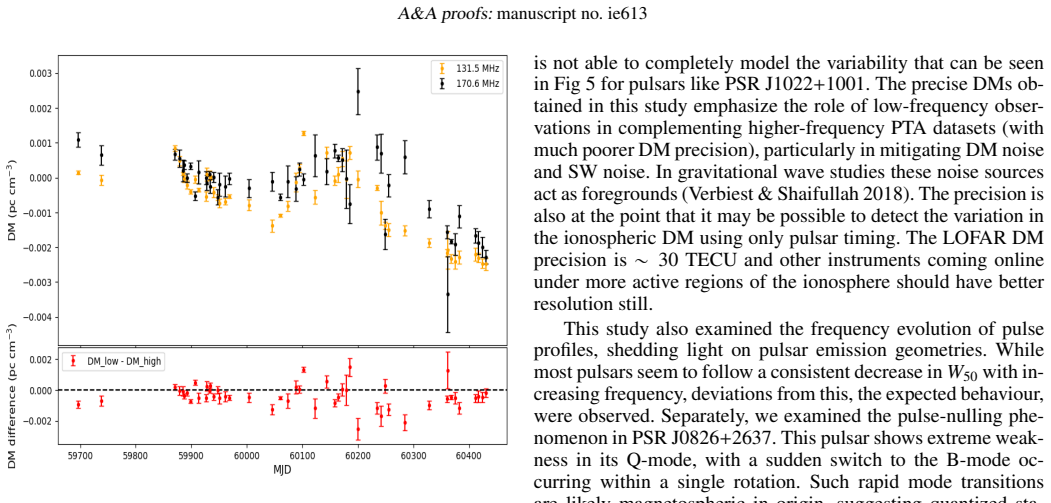
The central claim is that seven ecliptic pulsars, observed with I-LOFAR between roughly 102 and 198 MHz for two to three years, show dispersion-measure variations that depend on their ecliptic latitudes, with the largest fluctuations occurring when the line of sight passes within 45 degrees of the Sun. These excursions are interpreted as the solar wind's effect on low-frequency pulse arrival times, while slower DM trends in some pulsars are attributed to the interstellar medium. The paper further reports that some pulse profiles narrow with increasing frequency, as expected from radius-to-frequency mapping, while others show absorption-like deviations or remain stable, and that PSR J2145-0750's DM precision (median uncertainty $8\times10^{-5}$ pc cm$^{-3}$) is high enough that the ionosphere's DM contribution should be resolvable.
Load-bearing premise
The paper interprets the DM excursions seen within 45 degrees of the Sun as the solar wind's effect, but it does not fit a quantitative solar-wind model that would rule out intrinsic interstellar variations or changing pulse-template shapes as the cause.
Editorial extensions
If this is right
- The public data release provides the pulsar-timing community with a low-frequency DM dataset for seven ecliptic pulsars, useful for mitigating dispersion-measure noise in gravitational-wave searches.
- Four pulsars show DM variations that track solar conjunctions, making them good targets for daily-cadence monitoring around conjunction to probe solar-wind structure.
- With median DM uncertainties as low as $8\times10^{-5}$ pc cm$^{-3}$, pulsar timing alone may resolve the ionospheric DM contribution, especially for telescopes located under higher ionospheric electron content.
- The tentative DM chromaticity in PSR J1645-0317 implies that frequency-dependent dispersion can appear in low-frequency data, with implications for multi-band timing analyses.
- Measured pulse-width evolution and absorption-like features in the 100-200 MHz band constrain pulsar emission geometry and radiation models at these wavelengths.
Reading between the lines
- If the solar-wind interpretation is right, simultaneous observations of the same ecliptic pulsars from multiple widely separated stations could map the heliosphere's electron-density structure in three dimensions rather than along individual lines of sight.
- The per-epoch DM precision achieved by a single station suggests that a network of similar standalone stations could act as a distributed ionospheric monitor, converting pulsar DM time series into total-electron-content maps over continental scales.
- The tentative chromaticity in PSR J1645-0317 could be tested directly by comparing simultaneous low-frequency and higher-frequency observations across a solar conjunction; if the DM offset between bands disappears when the solar wind is not along the line of sight, the effect is likely interstellar rather than solar.
- A dedicated daily-cadence campaign on PSR J0034-0534 around conjunction would test the reported asymmetry in solar-wind-induced DM and help distinguish slow from fast solar-wind regions.
Signed reviews
Editorial analysis
A structured set of objections, weighed in public.
Referee Report
Summary. This paper reports on a two-to-three year I-LOFAR observing campaign of seven pulsars with ecliptic latitude within 20 degrees of the Sun's path. The authors describe the telescope setup, data reduction, template construction, and timing analysis, and they release TOAs, timing solutions, templates, and DM time series on Zenodo. Using these data, they study DM variability and its relation to solar conjunctions, pulse-profile frequency evolution through W50 and W10 measurements, pulse nulling in PSR J0826+2637, and possible DM chromaticity in PSR J1645-0317. The central claim is that the DM time series reveal the impact of the solar wind through variations that correlate with ecliptic latitude and proximity to the Sun, and that the achieved DM precision (median uncertainties of order 1e-4 pc/cm3) opens the possibility of detecting ionospheric DM with pulsar timing.
Significance. If the data products are as described, this is a valuable public low-frequency dataset for seven ecliptic pulsars, with DM precision that complements higher-frequency PTA datasets and enables studies of the ionosphere, the interstellar medium, and the solar wind. The methodology is standard and transparent: coherent dedispersion, DSPSR and PSRCHIVE-based processing, tempo2 timing fits, and the epoch-wise DM method following Tiburzi et al. (2019) and Donner et al. (2020). The decision to exclude epochs within 45 degrees of the Sun from template construction is a sensible safeguard. The profile-evolution, nulling, and chromaticity analyses are descriptive and useful context. The main weakness is that the solar-wind attribution rests on visual coincidence rather than a quantitative model fit, so the dataset itself is more secure than the interpretive claim made in the abstract and conclusions.
major comments (1)
- [Section 4.1 and Section 5 (Conclusions)] The central result that the DM time series 'reveal the impact of the solar wind' is supported only by the visual alignment of red points (epochs within 45 degrees of the Sun) with DM excesses in Fig. 3. No solar-wind electron-density model is fitted to the DM data, and no quantitative comparison is made against the alternative that the variations are intrinsic IISM fluctuations (turbulence, scattering, or profile evolution) that happen to be modulated by the annual conjunction geometry. The Conclusions state that a spherically symmetric model 'is not able to completely model the variability' for pulsars like PSR J1022+1001, but that model, its parameters, and its residuals are not presented anywhere in the paper. I recommend adding a quantitative solar-wind model fit (for example, a simple spherically symmetric or two-component model fitted to each conjunction, with a goodness-of-fit statistic or comparison to an intrinsic-ISM model), or alternatively softening the abstract and conclusions to say that the DM variations are 'consistent with' solar-wind influence. As written, the attribution is an interpretation rather than a demonstrated result.
minor comments (5)
- [Section 5] The Conclusions refer to variability 'that can be seen in Fig 5' when discussing the failure of a spherical solar-wind model; Fig. 5 shows timing residuals, not the DM time series, so the cross-reference should be to Fig. 3.
- [Section 4.2 and Fig. 4] The power-law fits W50 = f^alpha shown in Fig. 4 are not accompanied by the fitted values of alpha or their uncertainties, and the identification of points as 'absorption features' below the fit has no stated significance threshold; reporting these parameters and a goodness-of-fit statistic would make the profile-evolution results reproducible.
- [Table 1 and Sections 4.3--4.9] The DM values in Table 1 are quoted to fewer decimal places and without uncertainties than the values reported in the per-pulsar sections (for example, J0034-0534 appears as 13.7650 in Table 1 and as 13.764996 +/- 0.000015 in Section 4.3); these should be unified.
- [Section 4.8 and Fig. 8] The DM chromaticity analysis for PSR J1645-0317 uses templates and sub-bands derived from the same observations, so frequency-dependent profile evolution could mimic a chromatic DM offset; the authors appropriately call the evidence tentative, but a brief discussion of how such systematics were checked would strengthen the claim.
- [Figure 1 caption] The caption contains a typo: 'Aito ff projection' should be 'Aitoff projection'.
Circularity Check
No significant circularity: DM time series are measured from ToAs via standard pulsar-timing fits and are not derived from the solar-wind interpretation they support.
full rationale
The paper's central product is an observational data release. DM values at each epoch are obtained by fitting topocentric ToAs across frequency channels to the dispersion delay (Eq. 2) using tempo2; templates are built from the same data but explicitly exclude epochs within 45 degrees of the Sun, so the subsequent DM measurements at conjunction are not defined by the template. No parameter is fitted to the DM time series and then renamed a prediction; the W50 power-law fits are descriptive only. The claim that DM variations 'reveal the impact of the solar wind' is an interpretation supported by visual correlation with solar angle, not by a fitted solar-wind model. That is a quantitative-evidence weakness rather than circularity, since the measurements are independent of the interpretation. Self-citations to Tiburzi et al. (2019, 2021), Donner et al. (2020), and Susarla et al. (2024) are methodological precedents or comparisons; none carries a load-bearing derivation. The data products are publicly released, so the central measurements are externally checkable. No circular step can be exhibited from the paper's text.
Assumptions & free parameters
free parameters (1)
- W50 power-law index alpha (per pulsar) =
not tabulated
assumptions (4)
- domain assumption Dispersion delay relation Δt = DM / (KD ν^2) with KD fixed at 2.41e-4 MHz^-2 pc cm^-3 s^-1.
- domain assumption Pulse profiles are stable over the observing span, allowing cross-correlation with a single template.
- domain assumption Within a single observing epoch, the DM is constant (epoch-wise method).
- domain assumption DM variations when the line of sight is within 45 degrees of the Sun are attributed to the solar wind.
Cite this review
Pith. "Pith review of Long-term Timing Results of Ecliptic Pulsars Observed with I-LOFAR." pith.science (2026). https://pith.science/paper/CIZUSCCQ
@misc{pith2026250509549,
  author       = {Pith},
  title        = {Pith review of: Long-term Timing Results of Ecliptic Pulsars Observed with I-LOFAR},
  year         = {2026},
  howpublished = {\url{https://pith.science/paper/CIZUSCCQ}},
  note         = {Machine review of arXiv:2505.09549}
}
read the original abstract
Pulsar timing at low frequencies offers a powerful tool for studying the interstellar medium. Additionally, pulsar observations in the ecliptic enables us to study the effects of the solar wind which becomes much more prominent at low radio frequencies. The Irish station of the LOw Frequency ARray (I-LOFAR) is a sensitive low-frequency radio telescope, capable of delivering high-precision data for pulsar studies. We present a comprehensive dataset of times-of-arrival, timing solutions and dispersion measure (DM) time series for seven ecliptic pulsars observed over two-to-three years with I-LOFAR. The primary objectives are to investigate time-dependent dispersion effects and provide high-precision timing data for pulsar timing experiments. We measure DM variations through pulsar timing and analysed these across different ecliptic latitudes to assess the impact of the solar wind on each pulsar. We model the intrinsic pulse-profile variability as a function of frequency. The high-precision DM time series for all seven pulsars exhibit clear variations dependent on their ecliptic latitudes, revealing the impact of the solar wind. Some pulsars show significant changes in their pulse widths across the frequency band, while others remain stable. We examine and quantify the pulse-nulling present in PSR J0826+2637, we report evidence for DM chromaticity in PSR J1645-0317, and we describe how PSR J2145-0750's DM precision is such that it could resolve the ionospheric DM contribution. This makes it a target of interest for telescopes in areas of the globe where the ionospheric electron density is higher, e.g. the Murchison Radio Observatory in Australia. This data release underscores the potential of I-LOFAR, or any standalone international LOFAR station, for advancing low-frequency pulsar studies, particularly in analyses of dispersion in the interstellar medium, the solar wind and the ionosphere.
Figures


Figures from the paper (5 more)


Forward citations
Cited by 3 Pith papers
-
Characterising the response of an International LOFAR Station
International LOFAR stations are 20–45% more sensitive to sources on the rising side of the sky than the setting side, an asymmetry observed in all 11 tracked pulsars and across three stations.
-
The Southern-sky MWA Rapid Two-metre (SMART) pulsar survey--IV. Survey update and an atlas of 205 non-recycled southern pulsars
Atlas of 205 non-recycled southern pulsars at 140–170 MHz from MWA SMART data, with profiles, DMs, RMs, fluxes and public data products for SKA-Low.
-
RRAT-like behaviour of PSR B0656+14 observed with I-LOFAR
PSR B0656+14 shows random, memory-less bright pulses at 110-190 MHz, requiring over 47,500 pulses to build a stable profile, resembling rotating radio transients.
Reference graph
Works this paper leans on
-
[1]
Agazie, G., et al., Anumarlapudi, A., Archibald, A. M. 2024, ApJ, 966, 105
work page 2024
-
[2]
Agazie, G., et al., Archibald, A. M., Arzoumanian, Z. 2023, ApJ, 951, L8
work page 2023
-
[3]
C., et al., Heiles, C., Davis, M
Backer, D. C., et al., Heiles, C., Davis, M. M. 1982, Nature, 300, 615
work page 1982
- [4]
-
[5]
2019, arXiv e-prints, arXiv:1912.12699
Braun, R., et al., Bourke, T., Keane, E. 2019, arXiv e-prints, arXiv:1912.12699
arXiv 2019
-
[6]
2015, Astroparticle Physics, 65, 22
Bray, J., et al., Roberts, P., Reynolds, J. 2015, Astroparticle Physics, 65, 22
work page 2015
-
[7]
1999, ApJ, 511, 351
Contopoulos, I., Kazanas, D., & Fendt, C. 1999, ApJ, 511, 351
1999
-
[8]
Cordes, J. M. 2013, ApJ, 775, 47
work page 2013
Show all 57 references
-
[9]
M., Shannon, R
Cordes, J. M., Shannon, R. M., & Stinebring, D. R. 2016, The Astrophysical Journal, 817, 16
2016
-
[10]
D., Lovelace, R
Craft, H. D., Lovelace, R. V . E., & Sutton, J. M. 1968, IAU Circ., 2100, 1 Donner, et al., Tiburzi, C., Osłowski, S. 2020, A&A, 644, A153
1968
-
[11]
Y ., et al., Tiburzi, C., Osłowski, S
Donner, J. Y ., et al., Tiburzi, C., Osłowski, S. 2019, A&A, 624, A22
2019
-
[12]
T., Hobbs, G
Edwards, R. T., Hobbs, G. B., & Manchester, R. N. 2006, MNRAS, 372, 1549
2006
-
[13]
1968, Nature, 218, 731
Gold, T. 1968, Nature, 218, 731
1968
-
[14]
P., Bregman, J
Hamaker, J. P., Bregman, J. D., & Sault, R. J. 1996, A&AS, 117, 137
1996
-
[15]
Hankins, T. H. & Rankin, J. M. 2010, AJ, 139, 168
2010
-
[16]
Hankins, T. H. & Rickett, B. J. 1975, Methods in Computational Physics, 14, 55
1975
-
[17]
E., et al., Weltevrede, P., Hessels, J
Hassall, T. E., et al., Weltevrede, P., Hessels, J. W. T. 2013, A&A, 552, A61
2013
-
[18]
J., Manchester, R
Helfand, D. J., Manchester, R. N., & Taylor, J. H. 1975, ApJ, 198, 661
1975
-
[19]
Hellings, R. W. & Downs, G. S. 1983, ApJ, 265, L39
1983
-
[20]
B., Edwards, R
Hobbs, G. B., Edwards, R. T., & Manchester, R. N. 2006, MNRAS, 369, 655
2006
-
[21]
W., van Straten, W., & Manchester, R
Hotan, A. W., van Straten, W., & Manchester, R. N. 2004, PASA, 21, 302
2004
-
[22]
Iraci, F., et al., Tiburzi, C., Verbiest, J. P. W. 2024, arXiv e-prints, Accepted in A&A, arXiv:2410.22170
2024 arXiv
-
[23]
Jones, R. C. 1941, Journal of the Optical Society of America (1917-1983), 31, 488
1941
-
[24]
Kazantsev, N. A. & Potapov, V . A. 2015, Astronomicheskij Tsirkulyar, 1628, 1
2015
-
[25]
Keane, E. F. 2013, in IAU Symposium, V ol. 291, Neutron Stars and Pulsars: Challenges and Opportunities after 80 years, ed. J. van Leeuwen, 295–300
2013
-
[26]
& Berdermann, J
Kriegel, M. & Berdermann, J. 2020, in 2020 European Navigation Conference (ENC), 1–10
2020
-
[27]
Lazarus, P., et al., Graikou, E., Caballero, R. N. 2016, MNRAS, 458, 868
2016
-
[28]
J., Kramer, M
Liu, K., et al., Lee, K. J., Kramer, M. 2012, MNRAS, 420, 361 LOFAR Collaboration. 2023, LOFAR2.0 White Paper v2023.1, accessed: 2024- 12-02
2012
-
[29]
Lorimer, D. R. 2011, SIGPROC: Pulsar Signal Processing Programs, Astro- physics Source Code Library, record ascl:1107.016
2011
-
[30]
Lorimer, D. R. & Kramer, M. 2004, Handbook of Pulsar Astronomy (Cambridge University Press)
2004
-
[31]
2010, Science, 329, 408
Lyne, A., et al., Kramer, M., Stairs, I. 2010, Science, 329, 408
2010
-
[32]
Lyne, A. G. & Manchester, R. N. 1988, MNRAS, 234, 477
1988
-
[33]
J., Keane, E
McKenna, D. J., Keane, E. F., Gallagher, P. T., & McCauley, J. 2023, arXiv e- prints, arXiv:2309.03228
2023 arXiv
-
[34]
Michel, F. C. & Li, H. 1999, Phys. Rep., 318, 227
1999
-
[35]
& Deshpande, A
Mitra, D. & Deshpande, A. A. 1999, A&A, 346, 906
1999
-
[36]
C., et al., McCauley, J., McKenna, D
Murphy, P. C., et al., McCauley, J., McKenna, D. J. 2021, A&A, 655, A16
2021
-
[37]
2019, MNRAS, 489, 310
Oswald, L., Karastergiou, A., & Johnston, S. 2019, MNRAS, 489, 310
2019
-
[38]
Perera, B. B. P., et al., Demorest, P. B., Kerr, M. 2019, MNRAS, 490, 4666
2019
-
[39]
A., Spitkovsky, A., & Cerutti, B
Philippov, A. A., Spitkovsky, A., & Cerutti, B. 2015, ApJ, 801, L19
2015
-
[40]
M., Olszanski, T
Rankin, J. M., Olszanski, T. E. E., & Wright, G. A. E. 2020, ApJ, 890, 151
2020
-
[41]
J., et al., Shannon, R
Reardon, D. J., et al., Shannon, R. M., Hobbs, G. B. 2023, ApJ, 951, L6
2023
-
[42]
Ruderman, M. A. & Sutherland, P. G. 1975, ApJ, 196, 51
1975
-
[43]
Sobey, C., et al., Hessels, J. W. T., Weltevrede, P. 2015, MNRAS, 451, 2493
2015
-
[44]
Stairs, I. H. 2003, Living Reviews in Relativity, 6, 5
2003
-
[45]
Susarla, S. C. 2025, Irish-Low Frequency Array (IE613) observatory ecliptic pulsar data release
2025
-
[46]
C., et al., Tiburzi, C., Keane, E
Susarla, S. C., et al., Tiburzi, C., Keane, E. F. 2024, A&A, 692, A18
2024
-
[47]
Taylor, J. H. 1992, Philosophical Transactions of the Royal Society of London Series A, 341, 117
1992
-
[48]
G., Zucca, P
Tiburzi, C., et al., Bassa, C. G., Zucca, P. 2021, A&A, 647, A84
2021
-
[49]
M., Janssen, G
Tiburzi, C., et al., Shaifullah, G. M., Janssen, G. H. 2019, MNRAS, 487, 394
2019
-
[50]
Timokhin, A. N. 2010, MNRAS, 408, L41 van Haarlem, M. P., et al., Gunst, A. W., Heald, G. 2013, A&A, 556, A2 van Straten, W. & Bailes, M. 2011, PASA, 28, 1 van Straten, W., Demorest, P., & Oslowski, S. 2012, Astronomical Research and Technology, 9, 237
2010
-
[51]
Verbiest, J. P. W., et al., Coles, W. A., Hobbs, G. B. 2009, MNRAS, 400, 951
2009
-
[52]
Verbiest, J. P. W., et al., Hobbs, G., van Haasteren, R. 2016, MNRAS, 458, 1267
2016
-
[53]
Verbiest, J. P. W. & Shaifullah, G. M. 2018, Classical and Quantum Gravity, 35, 133001
2018
-
[54]
Verbiest, J. P. W., et al., Porayko, N. K., Chen, S. 2024, Results in Physics, 61, 107719
2024
-
[55]
& Frail, D
Wolszczan, A. & Frail, D. 1992, Nature, 355, 145
1992
-
[56]
2023, Research in Astronomy and Astrophysics, 23, 075024
Xu, H., et al., Guo, Y ., Jiang, J. 2023, Research in Astronomy and Astrophysics, 23, 075024
2023
-
[57]
J., Qiao, G
Xu, X., et al., Zhi, Q. J., Qiao, G. J. 2021, ApJ, 917, 108 1 Physics, School of Natural Sciences & Center for Astronomy, Col- lege of Science and Engineering, University of Galway, University
2021
Reviewed August 15, 2026 · model on record in the stance chip above.
Discussion (0). Continue with ORCID to comment.