REVIEW 2 major objections 5 minor 1 cited by
Non-Gravitational Forces in Planetary Systems
T0 review · 2 major / 5 minor · reviewed 2026-08-12 · deepseek-v4-flash
Pith's one-line read This review argues that simple order-of-magnitude formulas, each calibrated by a single empirical constant, capture the dominant non-gravitational forces acting on asteroids, comets, and dust.
desk verdict Useful order-of-magnitude review with solid Yarkovsky and PR sections, but the YORP calibration in Eq. 37 does not match the paper's own Table 1 and the 10-14 km influence claim is unsupported. read the letter →
The pith
A machine-rendered reading of the paper's core claim, the machinery that carries it, and where it could break.
The reading
What carries the argument
The carrying object is a set of dimensionless coefficients that turn a physical picture into one number: $k_R$ for the recoil efficiency of sublimating gas, $k_Y$ for the fraction of radiation pressure acting along the orbit in the diurnal Yarkovsky effect, $k_T$ for the fraction of outflow momentum that torques a comet nucleus, and $k'_T$ for the net moment arm of infrared radiation on an asteroid. Supported by the thermal skin depth, $\ell = (\kappa P)^{1/2}$, and the thermal parameter $\Theta = \rho c_p/(\sigma T^3)(\kappa/P)^{1/2}$, these coefficients convert flux, size, density, and rotation period into an acceleration or a timescale. Each empirical constant is the degree of freedom that absorbs everything the simple spherical, circular-orbit model leaves out.
What would settle it
Measure Yarkovsky drift rates for a few hundred main-belt asteroids with known sizes and spins; if a $k_Y$ near 0.05 does not reproduce the observed drift rates (a systematic offset beyond the 0.02–0.13 range fitted to near-Earth objects), the extrapolation would collapse.
Extended reading notes
Core claim
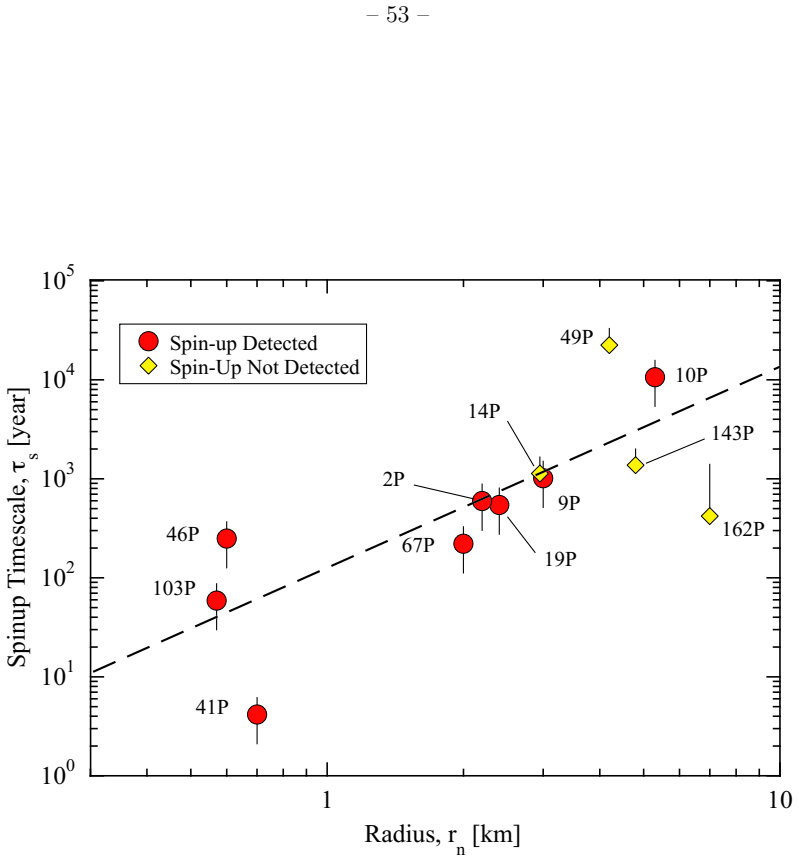
On the paper's own terms, each non-gravitational effect can be written as a simple scaling law: sublimation recoil gives $\alpha_S \propto Q_g V_{th}/(\rho a^3)$; radiation pressure gives $\beta_{rad} = 0.6/a_\mu$; Poynting-Robertson drag gives $\tau_{PR} \sim 4\rho a c^2/(3Q_{pr}) \cdot 4\pi r_H^2/L_\odot$; Yarkovsky drift gives $d r_H/dt \sim 3k_Y L_\odot/(16\pi\rho a c (GM_\odot r_H)^{1/2})$; and the YORP torque gives $\tau_{YORP} \sim 16\pi\rho a^2 c/(15 k'_T P) \cdot r_{au}^2/S_\odot$. These are not exact laws but calibrated scalings: $k_Y \sim 0.05$ is fit to 58 near-Earth asteroid drift rates, the YORP coefficient in Eq. 37 is fit to about 10 asteroids, and $k_T \sim 0.007$ is a median over measured comets. With these constants, the paper derives concrete timescales: a 1 km asteroid at 1 au drifts about $2\times10^{-4}$ au/Myr in semimajor axis, small comet nuclei spin up on timescales of about $100 a^2$ years, and YORP can spin up main-belt asteroids up to roughly 10–14 km in radius over 4.5 Gyr. The paper's central claim is that, despite the crudeness, these scalings correctly identify the dominant processes and their rates across the solar system.
Load-bearing premise
The representative constants fitted to small samples of near-Earth asteroids and comets—$k_Y = 0.05$ from 58 drift rates, the YORP coefficient from about 10 spin-rate changes, and $k_T = 0.007$ from a small comet sample—are assumed to apply to the entire population of small bodies.
Editorial extensions
If this is right
- Yarkovsky drift spreads asteroid families into the observed V-shape in semimajor axis versus 1/a and accounts for family ages of order 70–100 Myr, as illustrated for the Erigone family.
- YORP spin-up sets the about 2.4-hour spin barrier for asteroids larger than about 0.2 km and drives rotational breakup, reshaping, and the formation of asteroid pairs and binaries.
- Sublimation torques, with measured $\tau_s \sim 100 a^2$ years, destroy sub-kilometer comet nuclei on short timescales, explaining the deficit of small comets near the Sun.
- Poynting-Robertson drag removes all primordial material smaller than about 1.5 m within 4.5 Gyr and sustains the zodiacal dust complex with a production rate of $10^3$ to $10^4$ kg/s.
- Around more luminous stars, radiation pressure ejects larger particles, so debris disks such as Vega's show structure and lifetimes set by the same scaling laws.
Reading between the lines
- If the YORP coefficient were shown to vary with asteroid rock abundance, as the tangential YORP discussion implies, then population-level predictions of the spin barrier would need a stochastic rather than deterministic treatment; the observed exponent $1.87\pm0.04$, slightly below the predicted 2, is a hint in that direction.
- The same scalings applied to white dwarf pollution would predict that Yarkovsky and YORP amplification during the red-giant phase is what feeds metal-rich debris to the degenerate star; this could be tested by correlating white dwarf accretion rates with the masses of surviving planetary systems.
- The 2.3:1 retrograde excess in near-Earth asteroid drift rates, if explained by inward drift feeding the $\nu_6$ resonance, predicts a compensating prograde excess among small main-belt asteroids at comparable sizes; that is a checkable prediction using spin-vector catalogs.
Signed reviews
Editorial analysis
A structured set of objections, weighed in public.
Referee Report
Summary. This manuscript is a review-style paper that derives order-of-magnitude expressions for non-gravitational forces acting on small bodies: sublimation recoil (Section 2), radiation pressure (Section 3), Poynting-Robertson drag (Section 4), tidal and internal dissipation (Section 5), the Yarkovsky force (Section 6), the Lorentz force (Section 7), and sublimation/YORP torques (Section 8). It applies the resulting scalings to comets, near-Earth and main-belt asteroids, interplanetary dust, debris disks, and white-dwarf pollution. The paper's central claim is that, despite poorly known material properties, simple dimensional formulas with a handful of empirically calibrated dimensionless coefficients capture the dominant orbital and spin evolution of small bodies. The manuscript is explicitly pedagogical, adopts spherical bodies and circular orbits throughout, and is accompanied by several data compilations, including Figures 8, 13, 15 and Table 1.
Significance. If the calibrations were robust, this would be a useful and accessible reference for non-specialists. The dimensional derivations are internally consistent: spot checks of beta = 0.6/a_micron, the Poynting-Robertson timescale, Equation (27), Equation (34), and Equation (36) reproduce the published numbers, and the manuscript is transparent about which coefficients are empirical. The main weakness is that several quantitative, population-level conclusions rest on fitted constants with unquantified extrapolation error, and one of the central fits -- the YORP law in Section 8.2 -- is not supported by the paper's own Table 1. Because the YORP calibration is used to infer the main-belt spin-influence radius and to motivate the spin-barrier and pair-formation arguments, the central claim needs revision or careful caveating before publication.
major comments (2)
- [Section 8.2, Eq. (37), Table 1, Fig. 15] The a^2 YORP scaling in Eq. (37) is internally inconsistent with the sub-kilometer detections in Table 1. Using a = D/2 and r_au ~ 1, Eq. (37) predicts tau = 0.014 Myr for 54509 YORP (a = 0.055 km) whereas Table 1 gives 0.59 Myr; for 138852 (a = 0.15 km) it predicts 0.10 Myr versus 1.7 Myr; for Bennu (a = 0.245 km) 0.27 Myr versus 1.5 Myr; and for Itokawa (a = 0.16 km) 0.115 Myr versus 1.0 Myr. The five smallest detections have tau between 0.59 and 1.7 Myr while a spans 0.055 to 0.245 km, so tau is nearly flat in a over this range. A weighted least-squares regression using the uncertainties in Table 1 yields a log-log slope of roughly 0.8, not the stated 1.87 +/- 0.04. The 1.87 exponent appears to be driven by the few kilometer-sized objects, and Eq. (37) overpredicts YORP strength for the small asteroids that drive the spin-barrier and pair-formation arguments. The inference that YORP can influence main-belt spins up to roughly 10-14 km by setting tau = 4.5 Gyr in Eq. (37) is therefore not supported by the calibration data. Please refit the relation, report the scatter, and either restrict Eq. (37) to the calibrated size range or present the 10-14 km threshold as an upper limit with a quantitative sensitivity estimate.
- [Sections 6.1 and 8.1, Eqs. (27) and (35)] Several population-level conclusions rest on dimensionless coefficients fitted to small, observability-biased samples without propagated uncertainty. The Yarkovsky efficiency k_Y = 0.05 is calibrated to 58 near-Earth asteroids with SNR > 10 (Fig. 8), yet it is applied in Section 6.1 to date the Erigone family and to discuss resonant delivery of meteorites. Similarly, the cometary spin-up relation Eq. (35) is based on a median torque coefficient from a small number of comets and is then used to argue for a paucity of sub-kilometer comet nuclei. If these coefficients vary with size, thermal inertia, spin state, or activity level, the quantitative claims could shift by orders of magnitude. The manuscript acknowledges the underlying unknowns, but it does not quantify the extrapolation error. I request a sensitivity statement for each fitted coefficient, or a rephrasing of the population-level conclusions as order-of-magnitude illustrations rather than quantitative predictions.
minor comments (5)
- [Section 7] The heading and text use "Lorenz force" where "Lorentz force" is the standard term; this occurs at least three times.
- [Section 2.1] There is a typo, "perpedicular," in the discussion of acceleration component A3.
- [Section 5.1] The word "surpringly" should be "surprisingly" in the Phobos paragraph.
- [Section 8.2] The sentence introducing Table 1 appears to have a missing table label; it reads "from the compilation by Durech et al. (2024) ... Table" and should reference Table 1 explicitly.
- [Equation (33)] The symbol tau is used both for the critical spin period in Eq. (33) and for general timescales elsewhere; consider renaming the critical period P_crit for clarity.
Circularity Check
No significant circularity: the force and torque scalings are self-contained dimensional analyses with openly empirical, externally fitted coefficients.
full rationale
The paper is a deliberately simplified tutorial. Each force or torque law is first derived from basic physics (solar flux, photon momentum, energy balance, Kepler speed, angular momentum), and only then is a dimensionless coefficient calibrated to external data: the Yarkovsky coefficient kY is fit to 58 near-Earth asteroid drift rates from Fenucci et al. (2024) after Equation 27 is derived independently; the YORP coefficient in Equation 37 is fit to Durech et al. (2024) timescales after Equation 36 is derived; kT = 0.007 and Equation 35 are empirical results from Jewitt (2021) based on measured comet spin changes; kR ~ 1/2 comes from 67P measurements reported in Jewitt et al. (2020) and is also the geometric expectation for uniform dayside sublimation. None of these coefficients is defined in terms of the quantity the paper claims to derive, and the derived scalings (1/a drift, a^2 YORP, a^2 sublimation spin-up) do not require the target population values as inputs. The 10-14 km main-belt YORP influence boundary is an algebraic inversion of the calibrated Equation 37, not an independent prediction, but the paper presents it as an application and additionally supports it with the observed spin barrier in Figure 16. The skeptic's objection that Figure 15 and Table 1 do not cleanly support the a^2 law for sub-kilometer objects is an internal-consistency or extrapolation concern, not circularity: the paper explicitly acknowledges the fitted slope (1.87 +/- 0.04) differs from 2 and attributes this to systematic errors. Self-citations are to measured, externally falsifiable data and are not load-bearing in a circular sense. Accordingly, no step satisfies the quote-and-reduction standard required to establish circularity.
Assumptions & free parameters
free parameters (9)
- k_Y (Yarkovsky efficiency) =
0.05 (range 0.02-0.13)
- k_T (sublimation torque moment arm) =
0.007 (median)
- tau_YORP coefficient (Eq 37) =
4.5 Myr km^-2 au^-2
- tau_s coefficient (Eq 35) =
100 yr km^-2
- k_R (recoil collimation factor) =
0.5
- A (internal dissipation multiplier, Eq 22) =
30
- Assumed binary ages for muQ (Fig 4) =
10^7 yr, 10^9 yr, 4.5 Gyr
- V_th (outgas speed) =
500 m/s
- U (dust charging potential) =
10 V
assumptions (5)
- domain assumption Small bodies are approximated as homogeneous spheres with density rho and radius a, and all orbits are circular (r_H = semimajor axis).
- domain assumption Surface energy balance for sublimating ice (Eq 4) with neglected heat conduction, A = 0, epsilon = 0.9, and Clausius-Clapeyron vapor pressures.
- domain assumption Dust grains are homogeneous spheres with size-independent optical efficiency Qpr in the geometric limit, with Mie theory otherwise.
- standard math Standard mechanics and thermodynamics: Newtonian gravity, Kepler's law, Maxwell-Boltzmann thermal speed, Stefan-Boltzmann radiation, and the Lorentz force.
- domain assumption Dimensional analysis yields the correct functional form of tidal and internal dissipation timescales up to a multiplier like A or Q.
Cite this review
Pith. "Pith review of Non-Gravitational Forces in Planetary Systems." pith.science (2026). https://pith.science/paper/CJ3OQVAD
@misc{pith2026241110923,
  author       = {Pith},
  title        = {Pith review of: Non-Gravitational Forces in Planetary Systems},
  year         = {2026},
  howpublished = {\url{https://pith.science/paper/CJ3OQVAD}},
  note         = {Machine review of arXiv:2411.10923}
}
read the original abstract
Non-gravitational forces play surprising and, sometimes, centrally important roles in shaping the motions and properties of small planetary bodies. In the solar system, the morphologies of comets, the delivery of meteorites and the shapes and dynamics of asteroids are all affected by non-gravitational forces. In exoplanetary systems and debris disks, non-gravitational forces affect the lifetimes of circumstellar particles and feed refractory debris to the photospheres of the central stars. Unlike the gravitational force, which is a simple function of the well known separations and masses of bodies, the non-gravitational forces are frequently functions of poorly known or even unmeasurable physical properties. Here, we present order-of-magnitude descriptions of non-gravitational forces, with examples of their application.
Figures


Figures from the paper (16 more)




Forward citations
Cited by 1 Pith paper
-
The discovery and characterization of minimoon 2024 PT$_5$
2024 PT5 is a newly discovered ~5 m minimoon captured by Earth for about 60 days, with colors and density resembling lunar rock and S-type asteroids.
Reference graph
Works this paper leans on
-
[1]
Attree, N., Jorda, L., Groussin, O., et al. 2023, A&A, 670, A170. doi:10.1051/0004- 6361/202245243 Bach, Y. P. & Ishiguro, M. 2021, A&A, 654, A113. doi:10.1051/0004-6361/202040151 Balogh, A. & Erd˜ os, G. 2013, Space Sci. Rev., 176,
doi:10.1051/0004- 2023
-
[2]
doi:10.1006/icar.2000.6485 Samarasinha, N. H. & A’Hearn, M. F. 1991, Icarus, 93,
arXiv 2000
-
[5]
doi:10.1023/A:1021599915018 Black, B. A. & Mittal, T. 2015, Nature Geoscience, 8,
-
[10]
T., Morbidelli, A., & Walsh, K
doi:10.1016/0019-1035(79)90050-2 Bolin, B. T., Morbidelli, A., & Walsh, K. J. 2018, A&A, 611, A82. doi:10.1051/0004- 6361/201732079 – 73 – ´Cuk, M. & Burns, J. A. 2005, Icarus, 176,
-
[11]
doi:10.1007/s11214- 018-0577-3 – 79 – Spencer, J. R., Lebofsky, L. A., & Sykes, M. V. 1989, Icarus, 78,
doi:10.1007/s11214- 1989
-
[29]
2024, Philosophical Transactions of the Royal Society of London Series A, 382, 20230197
doi:10.3847/PSJ/acb25b Feige, J., Airo, A., Berger, D., et al. 2024, Philosophical Transactions of the Royal Society of London Series A, 382, 20230197. doi:10.1098/rsta.2023.0197 Fenucci, M., Micheli, M., Gianotto, F., et al. 2024, A&A, 682, A29. doi:10.1051/0004- 6361/202347820 Ferrari, C. 2018, Space Sci. Rev., 214,
arXiv 2024
-
[35]
doi:10.3847/PSJ/acb697 Sharma, I., Burns, J. A., & Hui, C.-Y. 2005, MNRAS, 359,
-
[39]
doi:10.1038/nature03218 Klavetter, J. J. 1989, AJ, 97,
Show all 86 references
-
[46]
1994, A&A, 291, 1011 Mann, I
doi:10.3847/PSJ/ac1591 Mann, I., Okamoto, H., Mukai, T., et al. 1994, A&A, 291, 1011 Mann, I. & Czechowski, A. 2021, A&A, 650, A29. doi:10.1051/0004-6361/202039362 Marsden, B. G., Sekanina, Z., & Yeomans, D. K. 1973, AJ, 78,
1994 doi
-
[48]
2018, Nature Geosci., 16, 567–569
doi:10.1038/s41586- 018-0254-4 Mitchell, R., Kirscher, U. 2018, Nature Geosci., 16, 567–569. doi:10.1038/s41561-023-01202-6 – 77 – Mommert, M., Farnocchia, D., Hora, J. L., et al. 2014, ApJ, 789, L22. doi:10.1088/2041- 8205/789/1/L22 Moro-Mart ´ ın, A. & Malhotra, R. 2003, AJ, 125,
2018 doi
-
[49]
A., Soderblom, L., Beebe, R
doi:10.1038/nature00993 Smith, B. A., Soderblom, L., Beebe, R. F., et al. 1981, Science, 212,
1981 doi
-
[52]
V., Kuchner, M
doi:10.12942/lrsp- 2013-5 Pokorn´ y, P., Moorhead, A. V., Kuchner, M. J., et al. 2024, PSJ., 5,
2013 doi
-
[55]
J., Altobelli, N., Kempf, S., et al
doi:10.1088/0004-6256/141/2/55 Sterken, V. J., Altobelli, N., Kempf, S., et al. 2013, A&A, 552, A130. doi:10.1051/0004- 6361/201219609 Su, K. Y. L., Rieke, G. H., Misselt, K. A., et al. 2005, ApJ, 628,
2013 doi
-
[65]
doi:10.1016/j.icarus.2014.09.017 Scheeres, D. J. 2018, Icarus, 304,
2014 doi
-
[66]
2013, ApJ, 778, L21
doi:10.1088/0004-6256/143/3/66 Jewitt, D., Agarwal, J., Weaver, H., et al. 2013, ApJ, 778, L21. doi:10.1088/2041- 8205/778/1/L21 Jewitt, D., Mutchler, M., Weaver, H., et al. 2016, ApJ, 829, L8. doi:10.3847/2041- 8205/829/1/L8 Jewitt, D., Agarwal, J., Li, J., et al. 2017, AJ, 153,
2013 doi
-
[77]
doi:10.1007/978-3-642-27543-2 5 Hudson, R. S. & Ostro, S. J. 1995, Science, 270,
1995 doi
-
[79]
& Draine, B
doi:10.1111/j.1365- 2966.2005.08864.x Silsbee, K. & Draine, B. T. 2016, ApJ, 818,
2005
-
[82]
doi:10.3847/PSJ/ad2de8 Poppe, A. R. 2016, Icarus, 264,
2016 doi
-
[84]
M., Duchˆ ene, G., & Matthews, B
doi:10.1126/science.270.5233.84 – 75 – Hughes, A. M., Duchˆ ene, G., & Matthews, B. C. 2018, ARA&A, 56,
2018 doi
-
[87]
– 80 – Wiegert, P. A. 2015, Icarus, 252,
2015
- [88]
-
[91]
– 81 – Table
doi:10.1016/0032-0633(75)90078- 1 This manuscript was prepared with the AAS LATEX macros v5.2. – 81 – Table
-
[92]
A., Fechtig, H., et al
doi:10.3847/1538- 3881/ab62a3 Grun, E., Zook, H. A., Fechtig, H., et al. 1985, Icarus, 62,
1985 doi
-
[93]
(2024) bDiameter in km cRotation period in hours dRate of change of the angular frequency ×10−8 [radian day −1]
YORP Timescales a Object Db P c dω/dtd τ e (1620) Geographos 2.56 5.22 1.14 ±0.03 6.9 ±0.2 (1685) Toro 3.5 10.20 0.33 ±0.03 12.3 ±1.0 (1862) Apollo 1.55 3.07 4.94 ±0.09 2.7 ±0.05 (2100) Ra-Shalom 2.30 19.82 <0.6 >3.5 (3103) Eger 1.78 5.71 <1.5 >4.8 (10115) 1992 SK 1.0 7.32 8.3...
2024
-
[103]
2020, ApJ, 896, L39
doi:10.3847/1538-3881/aafe05 Jewitt, D., Kim, Y., Mutchler, M., et al. 2020, ApJ, 896, L39. doi:10.3847/2041-8213/ab99cb Jewitt, D., Li, J., & Kim, Y. 2021, AJ, 162,
2020 doi
-
[108]
2019, Icarus, 333,
doi:10.1016/j.icarus.2004.07.021 Pravec, P., Fatka, P., Vokrouhlick´ y, D., et al. 2019, Icarus, 333,
2004 doi
-
[111]
doi:10.1007/s11214-018-0546-x – 74 – Finson, M. J. & Probstein, R. F. 1968, ApJ, 154,
1968 doi
-
[122]
doi:10.3847/1538-3881/acb53b Keller, L. P. & Flynn, G. J. 2022, Nature Astronomy, 6,
2022 doi
-
[129]
& Matsuyama, I
doi:10.1088/0004- 637X/743/2/129 Nimmo, F. & Matsuyama, I. 2019, Icarus, 321,
2019 doi
-
[131]
doi:10.3847/PSJ/ad445f Scheeres, D. J. 2015, Icarus, 247,
2015 doi
-
[133]
doi:10.3847/0004-637X/818/2/133 Slivan, S. M. 2002, Nature, 419,
2002 doi
-
[134]
doi:10.1016/j.icarus.2009.02.003 (updated 2023 October
2009 doi
-
[136]
2004, Nature, 428,
doi:10.1016/j.icarus.2014.03.033 La Spina, A., Paolicchi, P., Kryszczy´ nska, A., et al. 2004, Nature, 428,
2014 doi
-
[137]
doi:10.1016/0019- 1035(84)90032-0 Wyatt, S. P. 1969, Planet. Space Sci., 17,
1969 doi
-
[147]
F., Chesley, S
doi:10.1038/nature01948 Vokrouhlick´ y, D., Bottke, W. F., Chesley, S. R., et al. 2015, Asteroids IV,
2015 doi
-
[155]
2024, ApJ, 968, L3
doi:10.1016/0032-0633(69)90034-8 Zhou, W.-H., Vokrouhlick´ y, D., Kanamaru, M., et al. 2024, ApJ, 968, L3. doi:10.3847/2041- 8213/ad4f7f Zook, H. A. & Berg, O. E. 1975, Planet. Space Sci., 23,
2024 doi
-
[157]
F., Vokrouhlick´ y, D., Walsh, K
doi:10.1146/annurev.earth.34.031405.125154 Bottke, W. F., Vokrouhlick´ y, D., Walsh, K. J., et al. 2015, Icarus, 247,
2015
- [161]
-
[162]
doi:10.3847/1538-3881/ab0e09 Jacobson, S. A. & Scheeres, D. J. 2011, Icarus, 214,
2011 doi
-
[163]
2019, Space Sci
doi:10.1126/science.212.4491.163 Spahn, F., Sachse, M., Seiß, M., et al. 2019, Space Sci. Rev., 215,
2019 doi
-
[177]
2022, PASJ, 74,
doi:10.1007/s11214-011-9835-3 Beniyama, J., Sako, S., Ohsawa, R., et al. 2022, PASJ, 74,
2022 doi
-
[183]
Z., Farnocchia, D., Micheli, M., et al
doi:10.1016/j.icarus.2017.05.029 Seligman, D. Z., Farnocchia, D., Micheli, M., et al. 2023, Plan Sci J., 4,
2017 doi
-
[185]
doi:10.3847/PSJ/abf928 Taylor, P. A. & Margot, J.-L. 2011, Icarus, 212,
2011 doi
-
[191]
F., Ness, N
doi:10.1016/j.icarus.2014.09.046 Burlaga, L. F., Ness, N. F., Berdichevsky, D. B., et al. 2022, ApJ, 932,
2014 doi
-
[194]
A., Reddy, V., Thirouin, A., et al
doi:10.1016/0019-1035(91)90208- B Sanchez, J. A., Reddy, V., Thirouin, A., et al. 2024, Plan Sci J., 5,
2024 doi
-
[211]
J., & Elliott, G
doi:10.1086/111402 Micheli, M., Tholen, D. J., & Elliott, G. T. 2014, ApJ, 788, L1. doi:10.1088/2041- 8205/788/1/L1 Micheli, M., Farnocchia, D., Meech, K. J., et al. 2018, Nature, 559,
2014 doi
-
[223]
2019, AJ, 157,
doi:10.3847/1538-3881/aa6a57 Jewitt, D., Kim, Y., Luu, J., et al. 2019, AJ, 157,
2019 doi
-
[261]
2023, AJ, 165,
doi:10.3847/1538-3881/abf09c Jewitt, D., Kim, Y., Mattiazzo, M., et al. 2023, AJ, 165,
2023 doi
- [268]
-
[269]
2010, ApJ, 714,
doi:10.1046/j.1365-8711.2000.03036.x Farihi, J., Jura, M., Lee, J.-E., et al. 2010, ApJ, 714,
2000
-
[289]
2012, Nanodust in the Solar System: Discoveries and Interpretations, 385,
doi:10.1016/j.icarus.2014.10.031 Hsu, H.-W., Kr¨ uger, H., & Postberg, F. 2012, Nanodust in the Solar System: Discoveries and Interpretations, 385,
2014 doi
- [313]
-
[327]
2024, Space Sci
doi:10.1086/149761 Fuller, J., Guillot, T., Mathis, S., et al. 2024, Space Sci. Rev., 220,
2024 doi
-
[369]
doi:10.1016/j.icarus.2015.10.001 Porco, C. A. & Danielson, G. E. 1982, AJ, 87,
2015 doi
-
[375]
& Krugly, Y
doi:10.1016/0019-1035(66)90051-0 Golubov, O. & Krugly, Y. N. 2012, ApJ, 752, L11. doi:10.1088/2041-8205/752/1/L11 Golubov, O., Unukovych, V., & Scheeres, D. J. 2021, AJ, 162,
2012 doi
-
[378]
A., Taylor, S., Treffkorn, J., et al
doi:10.1006/icar.1997.5872 Farley, K. A., Taylor, S., Treffkorn, J., et al. 2021, Meteoritics and Planetary Science, 56,
1997
-
[400]
doi:10.1038/nature02411 Landgraf, M. 2000, J. Geophys. Res., 105, 10303. doi:10.1029/1999JA900243 Lee, H.-J., ˇDurech, J., Kim, M.-J., et al. 2020, A&A, 635, A137. doi:10.1051/0004- 6361/201936808 Love, S. G. & Brownlee, D. E. 1993, Science, 262,
2000 doi
-
[403]
A., Lamy, P
doi:10.1093/mnras/165.4.403 Burns, J. A., Lamy, P. L., & Soter, S. 1979, Icarus, 40,
1979 doi
-
[407]
2024, A&A, 682, A93
doi:10.1038/s41550-018-0440-1 ˇDurech, J., Vokrouhlick´ y, D., Pravec, P., et al. 2024, A&A, 682, A93. doi:10.1051/0004- 6361/202348350 Efroimsky, M. & Lazarian, A. 2000, MNRAS, 311,
2024 doi
-
[418]
2024, ApJ, 961, L38
doi:10.1016/j.icarus.2005.02.001 Doner, A., Hor´ anyi, M., Bagenal, F., et al. 2024, ApJ, 961, L38. doi:10.3847/2041- 8213/ad18b0 Drahus, M., Guzik, P., Waniak, W., et al. 2018, Nature Astronomy, 2,
2005 doi
- [423]
-
[428]
2011, A&A, 530, A134
doi:10.1038/362428a0 Hanuˇ s, J.,ˇDurech, J., Broˇ z, M., et al. 2011, A&A, 530, A134. doi:10.1051/0004- 6361/201116738 Hor´ anyi, M., Hartquist, T. W., Havnes, O., et al. 2004, Reviews of Geophysics, 42, RG4002. doi:10.1029/2004RG000151 Hsieh, H. H., Denneau, L., Wainscoat, R...
2011 doi
-
[429]
doi:10.1016/j.icarus.2019.05.014 Rafikov, R. R. 2011, ApJ, 732, L3. doi:10.1088/2041-8205/732/1/L3 Rigley, J. K. & Wyatt, M. C. 2022, MNRAS, 510,
2019 doi
-
[487]
R., Pokorn´ y, P., Malaspina, D
doi:10.1086/430819 Szalay, J. R., Pokorn´ y, P., Malaspina, D. M., et al. 2021, PSJ, 2,
2021 doi
-
[502]
doi:10.1016/j.icarus.2009.03.003 Statler, T. S. 2015, Icarus, 248,
2009 doi
-
[509]
doi:10.2458/azu uapress 9780816532131-ch027 Walsh, K. J. 2018, ARA&A, 56,
2018 doi
-
[541]
2019, AJ, 157,
doi:10.1146/annurev-astro-081817-052035 Hui, M.-T., Farnocchia, D., & Micheli, M. 2019, AJ, 157,
2019 doi
-
[550]
X., Jewitt, D
doi:10.1126/science.262.5133.550 Luu, J. X., Jewitt, D. C., Mutchler, M., et al. 2021, ApJ, 910, L27. doi:10.3847/2041- 8213/abedbc MacLennan, E. M. & Emery, J. P. 2021, PSJ., 2,
2021 doi
-
[570]
doi:10.1086/115006 Klavetter, J. J. 1989, AJ, 98,
1989 doi
-
[593]
D., Harris, A
doi:10.1146/annurev-astro-081817-052013 Warner, B. D., Harris, A. W., & Pravec, P. 2009, Icarus, 202,
2009 doi
-
[641]
A., & G¨ ansicke, B
doi:10.1086/173033 Veras, D., Jacobson, S. A., & G¨ ansicke, B. T. 2014, MNRAS, 445,
2014 doi
- [661]
-
[708]
doi:10.1093/mnras/stz421 Vokrouhlick´ y, D., Nesvorn´ y, D., & Bottke, W. F. 2003, Nature, 425,
2003 doi
-
[715]
doi:10.1016/j.icarus.2018.12.012 Owens, M. J. & Forsyth, R. J. 2013, Living Reviews in Solar Physics, 10,
2018 doi
-
[731]
2005, Nature, 433,
doi:10.1038/s41550-022-01647-6 Kempf, S., Srama, R., Hor´ anyi, M., et al. 2005, Nature, 433,
2005 doi
-
[826]
W., & Michalowski, T
doi:10.1086/113162 Pravec, P., Harris, A. W., & Michalowski, T. 2002, in Asteroids III, W. F. Bottke Jr., A. Cellino, P. Paolicchi, and R. P. Binzel (eds), University of Arizona Press, Tucson, p.113-122 Pravec, P., Harris, A. W., Scheirich, P., et al. 2005, Icarus, 173,
2002 doi
-
[834]
doi:10.1093/mnras/stab3482 – 78 – Robertson, H. P. 1937, MNRAS, 97,
1937 doi
-
[877]
2002, Earth Moon and Planets, 90,
doi:10.1093/pasj/psac043 Biver, N., Bockel´ ee-Morvan, D., Colom, P., et al. 2002, Earth Moon and Planets, 90,
2002 doi
-
[913]
doi:10.1038/ngeo2583 Bohren, C. F. & Huffman, D. R. 1983, Absorption and Scattering of Light by Small Particles. New York: Wiley, 1983 Bottke, W. F., Vokrouhlick´ y, D., Rubincam, D. P., et al. 2006, Annual Review of Earth and Planetary Sciences, 34,
1983 doi
-
[1376]
doi:10.1093/mnras/sts723 Rubincam, D. P. 1995, J. Geophys. Res., 100,
1995 doi
-
[1585]
doi:10.1029/94JE02411 Rubincam, D. P. 2000, Icarus, 148,
2000 doi
-
[1855]
2018, MNRAS, 479,
doi:10.1086/115264 – 76 – Kokotanekova, R., Snodgrass, C., Lacerda, P., et al. 2018, MNRAS, 479,
2018 doi
-
[1988]
2023, Plan Sci J., 4,
doi:10.1111/maps.13759 Farnocchia, D., Seligman, D., Granvik, M., et al. 2023, Plan Sci J., 4,
2023 doi
-
[2255]
2011, ApJ, 743,
doi:10.1086/368237 Nesvorn´ y, D., Janches, D., Vokrouhlick´ y, D., et al. 2011, ApJ, 743,
2011 doi
-
[2794]
2019, MNRAS, 485,
doi:10.1093/mnras/stu1926 Veras, D., Higuchi, A., & Ida, S. 2019, MNRAS, 485,
2019 doi
-
[4665]
A., Fernandez, Y
doi:10.1093/mnras/sty1529 Kramer, E. A., Fernandez, Y. R., Lisse, C. M., et al. 2014, Icarus, 236,
2014 doi
Reviewed August 12, 2026 · model on record in the stance chip above.
Discussion (0). Continue with ORCID to comment.