REVIEW 3 major objections 5 minor 70 references
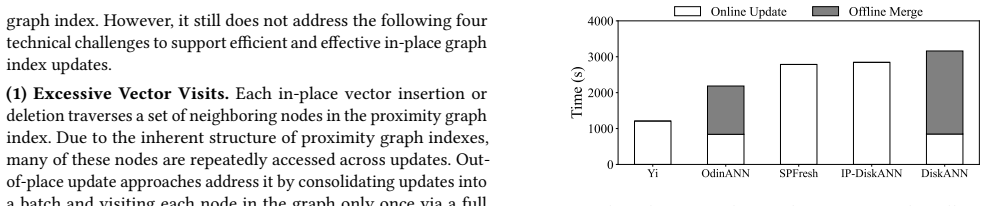
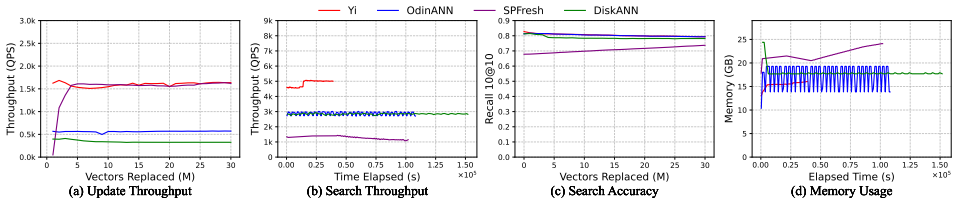
Yi shows that graph-based ANN indexes on disk can be updated in place — 1.75x faster update throughput and 1.8x faster concurrent search than prior systems on 800M vectors, with 73% of the peak memory.
Reviewed by Pith at T0; open to challenge. T0 means a machine referee read the full paper against a public rubric. the ladder, T0–T4 →
T0 review · deepseek-v4-flash
2026-08-01 22:52 UTC pith:CJ7MIU7I
load-bearing objection Real new mechanism and credible 800M results, but the deletion-repair guarantee is an unproven heuristic; deserves serious review with artifacts or analysis. the 3 major comments →
Efficient and Effective In-place Graph-based Vector Index Updates
The pith
A machine-rendered reading of the paper's core claim, the machinery that carries it, and where it could break.
Core claim
The load-bearing discovery is that the connection-establishment procedures of insert and delete share the same two steps — expand a given vector's outgoing neighbor list by the new/deleted vector and its neighbors, then prune to the maximum out-degree — so they can be unified into a single 'connect task' per affected vector. Yi keeps deleted vectors in a fixed-size LRU delete list rather than removing them immediately, and populates a connect list from the search results of inserted vectors (plus random sampling when inserts are rare); each connect task then repairs one vector's neighbor list for all pending updates at once. The paper argues that this consolidation eliminates the redundant v
What carries the argument
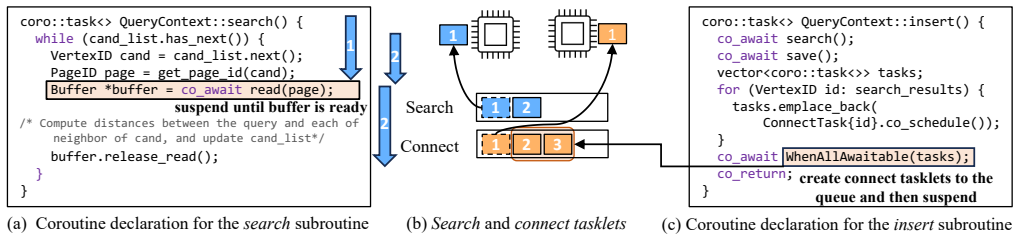
The central mechanism is the vector-level connect task: it merges the expand-and-prune logic of insert and delete into one operation per vector, so each affected vector's outgoing neighbor list is repaired once regardless of how many updates touch it. This is supported by the LRU delete list, which keeps deleted vectors accessible long enough for in-neighbors to be visited, and a connect list fed by insert searches and, in delete-only workloads, random sampling. Around this, the tasklet-based execution engine (C++20 coroutines that suspend on page I/O and conflicts), the asynchronous buffer manager (ref-counted buffers with copy-on-write commit), and the vector file system (separate navigati
Load-bearing premise
The premise that a deleted vector kept in the fixed-size LRU list will stay accessible long enough for all its in-neighbors to be visited is asserted as 'almost certain' without a formal guarantee; if the LRU is too small or visit patterns miss some in-neighbors, recall degrades after deletions (the paper's own data shows 2% LRU underperforms a full scan).
What would settle it
Run a deletion-only workload on an index with highly skewed in-degrees and measure recall as LRU size varies: if recall falls below full-scan recall for any LRU size that still achieves the claimed throughput, the central heuristic fails. More directly, instrument Yi to count, for each evicted deleted vector, the fraction of its original in-neighbors that actually visited it while it was in the LRU; if that fraction is not close to 1 for realistic workloads, the 'almost certain' rationale is empirically false.
If this is right
- If the claims hold, streaming insert and delete can run continuously at billion scale without the offline merge phase that dominates update cost in existing systems.
- Update throughput no longer depends on a user-tuned batch size; the system applies each update immediately and instead depends on the fixed LRU delete-list size.
- Memory usage becomes bounded by the fixed 4GB buffer plus the LRU delete list, eliminating the memory spikes of merge operations.
- Search throughput during updates becomes stable rather than oscillating between online and offline phases, because CPU and I/O are not periodically consumed by merges.
- Deletion-only workloads can maintain recall comparable to a full-scan approach, provided the LRU delete list is large enough (4% of the index in the paper's tests).
Where Pith is reading between the lines
- The 'almost certain' assumption about LRU retention could be replaced by a probabilistic guarantee if in-neighbor visit rates were modeled; the paper gives no bound, only an experiment showing 4% LRU matches full-scan recall on 1M vectors.
- The principle of deferring and consolidating repair work per vector may generalize beyond ANN graphs to other singly-linked dynamic structures where deletions require knowing incoming edges.
- A testable extension: measure recall under delete-only workloads on datasets with skewed in-degree distributions; if the LRU size must grow with maximum in-degree rather than with the number of vectors, the fixed-percentage sizing rule will fail.
- The layout insight — that update phases can run on compressed navigation data while search needs raw vectors — suggests an optimized storage tiering where raw vectors are kept on slower media without hurting update throughput.
Editorial analysis
A structured set of objections, weighed in public.
Referee Report
Summary. The paper proposes Yi, a disk-resident graph-based ANN index update system that supports in-place insertions and deletions. The core idea is a vector-level update mechanism that unifies the expand/prune steps of insert and delete into fine-grained connect tasks. This is implemented through three components: a tasklet-based execution engine (C++20 coroutines), an asynchronous buffer manager with suspend-on-conflict page access, and a vector file system that separates graph topology from raw vector data. The central empirical claim is that Yi sustains stable, high update throughput and search throughput while preserving recall on 100M and 800M datasets, outperforming OdinANN, DiskANN, and SPFresh with lower memory and fewer CPU threads. The paper also includes component-wise breakdown and targeted scenarios (100% replacement, deletion-only, spatial locality).
Significance. If the claims hold, the contribution is substantial: Yi would be the first practical system to combine in-place insert and delete on billion-scale disk-resident graph ANN indexes with stable throughput and recall. The decomposition insight is elegant, and the 100M/800M comparisons show large, consistent throughput and memory advantages over strong baselines. The strengths are the detailed system description and the broad evaluation. However, the 'good search result quality' half of the central claim rests on a delete-repair heuristic that is not formally analyzed and is only partially evaluated: the paper provides no billion-scale delete-only or deletion-heavy recall experiments, no formal bound for the LRU delete-list guarantee, and no code/artifact release or repeated runs with error bars. These gaps are load-bearing because the headline claim is empirical and because delete repair directly affects recall.
major comments (3)
- [Section 3 and Section 5.3] The delete-repair guarantee is not established. The rationale in Section 3 states that keeping a deleted vector in the fixed-size LRU 'almost certain[ly]' causes all its in-neighbors to be visited, but no bound or adversarial analysis is given. In deletion-only workloads the connect list is filled by randomly sampling on-disk vectors; with out-degree R=96 and N=1M, a random sample of size R contains roughly R^2/N ~ 0.009 in-neighbors of a given deleted vector under a uniform model. Consequently most in-neighbor repairs may never happen before eviction, and an evicted vector's disk slot can be reused, leaving stale references in unrepaired neighbor lists. The paper's own Figure 15 shows LRU-2% below FullScan and LRU-4% only comparable at 1M scale; no billion-scale delete-only recall result is reported. Since recall under deletions is half of the central claim, this needs either a quantita
- [Section 5.1] The main performance claims are empirical and are presented as single curves without error bars or multiple runs. The paper also does not state any code or data artifact availability. The IP-DiskANN baseline in Section 5.3 is re-implemented by the authors using Yi's components, which can bias the comparison. Because the headline claims ('1.75x update throughput', '1.8x concurrent search throughput', 'comparable recall') are entirely empirical, the paper should provide the artifact, report variance over repeated runs, and clarify the exact IP-DiskANN configuration and implementation status.
- [Section 4.3] The concurrency-control protocol is described operationally, but its correctness is only asserted: 'Based on the above mechanisms, we resolve all pairwise conflicts in Table 2.' No invariant-based argument or exhaustive interleaving analysis is given for the COW/update_ready protocol, and no stress test with adversarial read/write interleavings is reported. Since the system permits concurrent search, updates, and asynchronous writeback, a lost update or a stale read could silently corrupt search results. A formal or at least systematic argument for the protocol's correctness is needed to support the claim that Yi is a dependable in-place update system.
minor comments (5)
- [Abstract and Introduction] The throughput numbers are inconsistent across the abstract ('1.8x'), the introduction ('1.76x'), and Figure 1's caption ('1.81x'). Please harmonize these values.
- [Figure 11 caption] The caption contains repeated '(a) Update Throughput(a) Update Throughput...' text; this appears to be a formatting artifact and should be fixed.
- [Section 5.1] The naming convention defines DEEP100M but not DEEP1M/SIFT1M; please define the 1M-scale variants used in Section 5.3.
- [Figure 10] The sub-figure labels seem inconsistently ordered ('(a) Schema block' vs 'PQ Block'); please align the labels with the referenced block types.
- [Section 5.3] When describing the IP-DiskANN comparison, clarify whether IP-DiskANN is the official implementation or a re-implementation from the paper, and list which parameters were used for its search-based in-neighbor identification.
Circularity Check
No significant circularity: central throughput/recall claims are empirical; the only self-citation (Tao tasklets) is not load-bearing.
full rationale
This is an empirical systems paper. The headline results (1.75x update throughput, 1.8x concurrent search throughput, 73% peak memory) are measured against external baselines on DEEP100M and SIFT800M; no headline quantity is derived algebraically from an input assumption. The vector-level update mechanism is an engineering consolidation of the shared Expand/Prune steps of Insert and Delete, and its benefit is validated by the paper's own ablation (+Tasklet 4.02x, +Buffer 1.33x, +Layout 1.04x) and by recall comparisons against full-scan merges. The delete-repair guarantee is explicitly heuristic: Section 3 says keeping a deleted vector in the LRU 'makes it almost certain that all of its in-neighbors will eventually be visited,' and Figure 15 shows LRU-2% below FullScan under delete-only workloads. That is an unproven correctness assumption and a genuine threat to the 'good search result quality' claim under delete-heavy workloads, but it is not circular: recall is not defined in terms of the LRU size, and the 4% setting is an empirical choice, not a fitted predictor. The only overlapping self-citation is [39] (Tao), used for the tasklet naming and the 'decomposition simplifies scheduling' principle; it is not load-bearing because the tasklet engine's benefit is demonstrated by the paper's own breakdown, and no uniqueness theorem or forced ansatz is imported from the authors' prior work. I find no step where a prediction reduces by construction to its inputs.
Axiom & Free-Parameter Ledger
free parameters (4)
- delete-list LRU size =
4% of initial index size (2% variant tested)
- in-memory buffer pool size =
4GB
- maximum out-degree R =
96
- random connect-list sampling size =
equal to graph out-degree in experiments
axioms (4)
- domain assumption A bounded-degree proximity graph with beam search produces acceptable approximate NN search quality.
- ad hoc to paper Retaining deleted vectors in the LRU cache long enough exposes almost all in-neighbors.
- domain assumption Raw vector data is not needed during updates, only compressed PQ data and graph topology.
- ad hoc to paper The asynchronous buffer manager's suspend-on-conflict protocol resolves all page access conflicts without deadlock or starvation, and preserves search/update correctness.
read the original abstract
In the era of Large Language Models (LLMs), efficient vector updates are critical for capturing real-time information from rapidly evolving data. However, it is not trivial to process frequent vector insert and delete updates and maintain a high recall of the search results simultaneously. Specifically, the cluster-based vector indexing methods have high update throughput but low search result quality. Existing out-of-place graph-based vector indexing update approaches suffer from poor update throughput due to the need to periodically merge update batches into the underlying graph index. Building a vector data system that supports efficient and effective in-place updates is inherently challenging. In this work, we propose Yi to achieve it. In particular, Yi supports in-place graph-based vector indexing updates with consistently high update throughput and good search result quality. The key idea of Yi is decomposition facilitates consolidation. In particular, we introduce a vector-level update mechanism and architect Yi with three core components: (i) a tasklet-based execution engine, (ii) an asynchronous buffer manager, and (iii) a vector file system. Experimental results demonstrate that Yi achieves 1.75x higher update throughput and 1.8x higher concurrent search throughput than the state-of-the-art systems on the 800M dataset, while using only 73% of the peak memory and fewer CPU cores.
Figures







Reference graph
Works this paper leans on
-
[1]
http://corpus-texmex
2011.Datasets for approximate nearest neighbor search. http://corpus-texmex. irisa.fr/
2011
-
[2]
https://www.openstd.org/jtc1/sc22/wg21/docs/papers/2017/n4649.pdf
2017.Working Draft, Technical Specification for C++ Extensions for Coroutines. https://www.openstd.org/jtc1/sc22/wg21/docs/papers/2017/n4649.pdf
2017
-
[3]
https://big-ann-benchmarks.com/ neurips21.html
2021.NeurIPS’23 Competition Track: Big-ANN. https://big-ann-benchmarks.com/ neurips21.html
2021
-
[4]
https://github.com/intellistream/IP-DiskANN
2025.IP-DiskANN. https://github.com/intellistream/IP-DiskANN
2025
-
[5]
https://github.com/pgvector/pgvector
2025.pgvector. https://github.com/pgvector/pgvector
2025
-
[6]
https://github.com/SPFresh/SPFresh
2025.SPFresh. https://github.com/SPFresh/SPFresh
2025
-
[7]
Sunil Arya, David M Mount, Nathan S Netanyahu, Ruth Silverman, and Angela Y Wu. 1998. An optimal algorithm for approximate nearest neighbor searching fixed dimensions.JACM45, 6 (1998), 891–923
1998
-
[8]
Martin Aumüller, Erik Bernhardsson, and Alexander Faithfull. 2020. ANN- Benchmarks: A benchmarking tool for approximate nearest neighbor algorithms. Information Systems87 (2020), 101374
2020
-
[9]
Ilias Azizi, Karima Echihabi, and Themis Palpanas. 2025. Graph-Based Vector Search: An Experimental Evaluation of the State-of-the-Art.SIGMOD3, 1 (2025), 1–31
2025
-
[10]
Artem Babenko and Victor Lempitsky. 2014. The inverted multi-index.TPAMI 37, 6 (2014), 1247–1260
2014
-
[11]
Artem Babenko and Victor Lempitsky. 2017. Product split trees. InCVPR. 6214– 6222
2017
-
[12]
Dmitry Baranchuk, Artem Babenko, and Yury Malkov. 2018. Revisiting the inverted indices for billion-scale approximate nearest neighbors. InECCV. 202– 216
2018
-
[13]
Jeffrey S Beis and David G Lowe. 1997. Shape indexing using approximate nearest- neighbour search in high-dimensional spaces. InCVPR. IEEE, 1000–1006
1997
-
[14]
Jon Louis Bentley. 1975. Multidimensional binary search trees used for associative searching.Commun. ACM18, 9 (1975), 509–517
1975
-
[15]
Cheng Chen, Chenzhe Jin, Yunan Zhang, Sasha Podolsky, Chun Wu, Szu- Po Wang, Eric Hanson, Zhou Sun, Robert Walzer, and Jianguo Wang. 2024. SingleStore-V: An Integrated Vector Database System in SingleStore.PVLDB17, 12 (2024), 3772–3785
2024
-
[16]
Qi Chen, Haidong Wang, Mingqin Li, Gang Ren, Scarlett Li, Jeffery Zhu, Jason Li, Chuanjie Liu, Lintao Zhang, and Jingdong Wang. 2018. SPTAG: A library for 12 fast approximate nearest neighbor search. https://github.com/Microsoft/SPTAG
2018
-
[17]
Sanjoy Dasgupta and Yoav Freund. 2008. Random projection trees and low dimensional manifolds. InSTOC. 537–546
2008
-
[18]
Mayur Datar, Nicole Immorlica, Piotr Indyk, and Vahab S Mirrokni. 2004. Locality- sensitive hashing scheme based on p-stable distributions. InSCG. 253–262
2004
-
[19]
Blelloch, and Julian Shun
Laxman Dhulipala, Guy E. Blelloch, and Julian Shun. 2020. Aspen: A Framework for Dynamic Graphs. InProceedings of the 41st ACM SIGPLAN Conference on Programming Language Design and Implementation. 576–589
2020
-
[20]
Wei Dong, Charikar Moses, and Kai Li. 2011. Efficient k-nearest neighbor graph construction for generic similarity measures. InWWW. 577–586
2011
-
[21]
Jerome H Friedman, Jon Louis Bentley, and Raphael Ari Finkel. 1977. An algo- rithm for finding best matches in logarithmic expected time.TOMS3, 3 (1977), 209–226
1977
-
[22]
Cong Fu, Chao Xiang, Changxu Wang, and Deng Cai. 2019. Fast approximate nearest neighbor search with the navigating spreading-out graph.PVLDB12, 5 (2019), 461–474
2019
-
[23]
Yutong Gou, Jianyang Gao, Yuexuan Xu, and Cheng Long. 2025. SymphonyQG: Towards Symphonious Integration of Quantization and Graph for Approximate Nearest Neighbor Search.SIGMOD3, 1 (2025), 1–26
2025
-
[24]
Hao Guo and Youyou Lu. 2025. Achieving low-latency graph-based vector search via aligning best-first search algorithm with SSD. InProceedings of the 19th USENIX Conference on Operating Systems Design and Implementation(Boston, MA, USA)(OSDI ’25). USENIX Association, USA, Article 10, 16 pages
2025
-
[25]
Hao Guo and Youyou Lu. 2025. OdinANN: Direct Insert for Consistently Stable Performance in Billion-Scale Graph-Based Vector Search. InFAST. https:// storage.cs.tsinghua.edu.cn/papers/fast26-odinann.pdf
2025
-
[26]
Kiana Hajebi, Yasin Abbasi-Yadkori, Hossein Shahbazi, and Hong Zhang. 2011. Fast approximate nearest-neighbor search with k-nearest neighbor graph. In AAAI
2011
-
[27]
Junfeng He, Wei Liu, and Shih-Fu Chang. 2010. Scalable similarity search with optimized kernel hashing. InSIGKDD. 1129–1138
2010
-
[28]
Yongjun He, Jiacheng Lu, and Tianzheng Wang. 2020. CoroBase: coroutine- oriented main-memory database engine.PVLDB14, 3 (2020), 431–444
2020
-
[29]
Masajiro Iwasaki. 2016. Pruned bi-directed k-nearest neighbor graph for prox- imity search. InSISAP. Springer, 20–33
2016
-
[30]
Suhas Jayaram Subramanya, Fnu Devvrit, Harsha Vardhan Simhadri, Ravishankar Krishnawamy, and Rohan Kadekodi. 2019. Diskann: Fast accurate billion-point nearest neighbor search on a single node.NIPS32 (2019)
2019
-
[31]
Hervé Jégou, Romain Tavenard, Matthijs Douze, and Laurent Amsaleg. 2011. Searching in one billion vectors: re-rank with source coding. InICASSP. IEEE, 861–864
2011
-
[32]
killer nanoseconds
Christopher Jonathan, Umar Farooq Minhas, James Hunter, Justin Levandoski, and Gor Nishanov. 2018. Exploiting coroutines to attack the" killer nanoseconds". PVLDB11, 11 (2018), 1702–1714
2018
-
[33]
Zuhair Khayyat, Karim Awara, Amani Alonazi, Hani Jamjoom, Dan Williams, and Panos Kalnis. 2017. GraphOne: A Data Store for Real-Time Analytics on Evolving Graphs.FAST17 (2017), 249–263
2017
-
[34]
1975.Queueing Systems, Volume 1: Theory
Leonard Kleinrock. 1975.Queueing Systems, Volume 1: Theory. Wiley-Interscience, New York. The classic, foundational text on queueing theory
1975
-
[35]
Brian Kulis and Kristen Grauman. 2009. Kernelized locality-sensitive hashing for scalable image search. InICCV. IEEE, 2130–2137
2009
-
[36]
Viktor Leis, Peter Boncz, Alfons Kemper, and Thomas Neumann. 2014. Morsel- driven parallelism: a NUMA-aware query evaluation framework for the many- core age. InSIGMOD. 743–754
2014
-
[37]
Sen Li, Fuyu Lv, Taiwei Jin, Guli Lin, Keping Yang, Xiaoyi Zeng, Xiao-Ming Wu, and Qianli Ma. 2021. Embedding-based product retrieval in taobao search. In SIGKDD. 3181–3189
2021
-
[38]
Di Liu, Meng Chen, Baotong Lu, Huiqiang Jiang, Zhenhua Han, Qianxi Zhang, Qi Chen, Chengruidong Zhang, Bailu Ding, Kai Zhang, Chen Chen, Fan Yang, Yuqing Yang, and Lili Qiu. 2024. RetrievalAttention: Accelerating Long-Context LLM Inference via Vector Retrieval. InarXiv
2024
-
[39]
Haotian Liu, Runzhong Li, Ziyang Zhang, and Bo Tang. 2024. Tao: Improv- ing Resource Utilization while Guaranteeing SLO in Multi-tenant Relational Database-as-a-Service.SIGMOD2, 4, Article 205 (Sept. 2024), 26 pages. https: //doi.org/10.1145/3677141
-
[40]
Marathe, Daniel W
Peter Macko, Virendra J. Marathe, Daniel W. Margo, and Margo I. Seltzer. 2015. LLAMA: Efficient Graph Analytics Using Large Multiversioned Arrays. In2015 IEEE 31st International Conference on Data Engineering (ICDE). IEEE, 363–374
2015
-
[41]
Yu A Malkov and Dmitry A Yashunin. 2018. Efficient and robust approximate nearest neighbor search using hierarchical navigable small world graphs.TPAMI 42, 4 (2018), 824–836
2018
-
[42]
Andrew W Moore. 2000. The Anchors Hierarchy: Using the Triangle Inequality to Survive High Dimensional Data. InUAI. 397–405
2000
-
[43]
Yadong Mu and Shuicheng Yan. 2010. Non-metric locality-sensitive hashing. In AAAI, Vol. 24. 539–544
2010
-
[44]
Marius Muja and David G Lowe. 2014. Scalable nearest neighbor algorithms for high dimensional data.TPAMI36, 11 (2014), 2227–2240
2014
-
[45]
David Nister and Henrik Stewenius. 2006. Scalable recognition with a vocabulary tree. InCVPR, Vol. 2. Ieee, 2161–2168
2006
-
[46]
Maxim Raginsky and Svetlana Lazebnik. 2009. Locality-sensitive binary codes from shift-invariant kernels.NIPS22 (2009)
2009
-
[47]
Zhenyuan Ruan, Seo Jin Park, Marcos K Aguilera, Adam Belay, and Malte Schwarzkopf. 2023. Nu: Achieving Microsecond-Scale resource fungibility with logical processes. InNSDI. 1409–1427
2023
-
[48]
Abraham Silberschatz, Henry F Korth, and Shashank Sudarshan. 2011. Database system concepts. (2011)
2011
-
[49]
Aditi Singh, Suhas Jayaram Subramanya, Ravishankar Krishnaswamy, and Har- sha Vardhan Simhadri. 2021. Freshdiskann: A fast and accurate graph-based ann index for streaming similarity search.arXiv preprint arXiv:2105.09613(2021)
Pith/arXiv arXiv 2021
-
[50]
Jingkuan Song, Yi Yang, Zi Huang, Heng Tao Shen, and Richang Hong. 2011. Multiple feature hashing for real-time large scale near-duplicate video retrieval. InMM. 423–432
2011
-
[51]
Robert F Sproull. 1991. Refinements to nearest-neighbor searching in k- dimensional trees.Algorithmica6 (1991), 579–589
1991
-
[52]
Yongye Su, Yinqi Sun, Minjia Zhang, and Jianguo Wang. 2024. Vexless: A Server- less Vector Data Management System Using Cloud Functions.Proc. ACM Manag. Data2, 3, Article 187 (2024)
2024
-
[53]
Godfried T Toussaint. 1980. The relative neighbourhood graph of a finite planar set.Pattern recognition12, 4 (1980), 261–268
1980
-
[54]
Jun Wang, Sanjiv Kumar, and Shih-Fu Chang. 2012. Semi-supervised hashing for large-scale search.TPAMI34, 12 (2012), 2393–2406
2012
-
[55]
Jingdong Wang and Shipeng Li. 2012. Query-driven iterated neighborhood graph search for large scale indexing. InMM. 179–188
2012
-
[56]
Jing Wang, Jingdong Wang, Gang Zeng, Zhuowen Tu, Rui Gan, and Shipeng Li. 2012. Scalable k-nn graph construction for visual descriptors. In2012 IEEE Conference on Computer Vision and Pattern Recognition. IEEE, 1106–1113
2012
-
[57]
Jingdong Wang, Naiyan Wang, You Jia, Jian Li, Gang Zeng, Hongbin Zha, and Xian-Sheng Hua. 2013. Trinary-projection trees for approximate nearest neighbor search.TPAMI36, 2 (2013), 388–403
2013
-
[58]
Jianguo Wang, Xiaomeng Yi, Rentong Guo, Hai Jin, Peng Xu, Shengjun Li, Xi- angyu Wang, Xiangzhou Guo, Chengming Li, Xiaohai Xu, Kun Yu, Yuxing Yuan, Yinghao Zou, Jiquan Long, Yudong Cai, Zhenxiang Li, Zhifeng Zhang, Yihua Mo, Jun Gu, Ruiyi Jiang, Yi Wei, and Charles Xie. 2021. Milvus: A Purpose-Built Vector Data Management System. InSIGMOD. 2614–2627
2021
-
[59]
Mengzhao Wang, Weizhi Xu, Xiaomeng Yi, Songlin Wu, Zhangyang Peng, Xi- angyu Ke, Yunjun Gao, Xiaoliang Xu, Rentong Guo, and Charles Xie. 2024. Starling: An I/O-Efficient Disk-Resident Graph Index Framework for High- Dimensional Vector Similarity Search on Data Segment.SIGMOD2, 1 (2024), 1–27
2024
-
[60]
Mengzhao Wang, Xiaoliang Xu, Qiang Yue, and Yuxiang Wang. 2021. A com- prehensive survey and experimental comparison of graph-based approximate nearest neighbor search.PVLDB14, 11 (2021), 1964–1978
2021
-
[61]
Chuangxian Wei, Bin Wu, Sheng Wang, Renjie Lou, Chaoqun Zhan, Feifei Li, and Yuanzhe Cai. 2020. AnalyticDB-V: a hybrid analytical engine towards query fusion for structured and unstructured data.PVLDB13, 12 (2020), 3152–3165
2020
-
[62]
Yair Weiss, Antonio Torralba, and Rob Fergus. 2008. Spectral hashing.NIPS21 (2008)
2008
-
[63]
Long Xiang, Bo Tang, and Chuan Yang. 2019. Accelerating exact inner product retrieval by cpu-gpu systems. InSIGIR. 1277–1280
2019
-
[64]
Chaojun Xiao, Pengle Zhang, Xu Han, Guangxuan Xiao, Yankai Lin, Zhengyan Zhang, Zhiyuan Liu, and Maosong Sun. 2024. InfLLM: Training-Free Long- Context Extrapolation for LLMs with an Efficient Context Memory. InarXiv
2024
-
[65]
Haike Xu, Magdalen Dobson Manohar, Philip A Bernstein, Badrish Chandramouli, Richard Wen, and Harsha Vardhan Simhadri. 2025. In-Place Updates of a Graph Index for Streaming Approximate Nearest Neighbor Search.arXiv preprint arXiv:2502.13826(2025)
Pith/arXiv arXiv 2025
-
[66]
Hao Xu, Jingdong Wang, Zhu Li, Gang Zeng, Shipeng Li, and Nenghai Yu. 2011. Complementary hashing for approximate nearest neighbor search. InICCV. IEEE, 1631–1638
2011
-
[67]
Yuming Xu, Hengyu Liang, Jin Li, Shuotao Xu, Qi Chen, Qianxi Zhang, Cheng Li, Ziyue Yang, Fan Yang, Yuqing Yang, et al. 2023. SPFresh: Incremental In-Place Update for Billion-Scale Vector Search. InSOSP. 545–561
2023
-
[68]
Wen Yang, Tao Li, Gai Fang, and Hong Wei. 2020. PASE: PostgreSQL Ultra-High- Dimensional Approximate Nearest Neighbor Search Extension. InSIGMOD. 2241–2253
2020
-
[69]
Song Yu, Shengyuan Lin, Shufeng Gong, Yongqing Xie, Ruicheng Liu, Yijie Zhou, Ji Sun, Yanfeng Zhang, Guoliang Li, and Ge Yu. 2025. A Topology-Aware Localized Update Strategy for Graph-Based ANN Index.arXiv e-prints(2025), arXiv–2503
2025
-
[70]
Minjia Zhang and Yuxiong He. 2019. Grip: Multi-store capacity-optimized high- performance nearest neighbor search for vector search engine. InCIKM. 1673– 1682. 13
2019
discussion (0)
Sign in with ORCID, Apple, or X to comment. Anyone can read and Pith papers without signing in.