Charge Symmetry Beyond Wyckoff Equivalence
Pith reviewed 2026-05-20 04:55 UTC · model grok-4.3
The pith
Crystallographically equivalent sites can become charge-inequivalent under compression while inequivalent sites can stay equivalent due to hidden symmetry.
A machine-rendered reading of the paper's core claim, the machinery that carries it, and where it could break.
Core claim
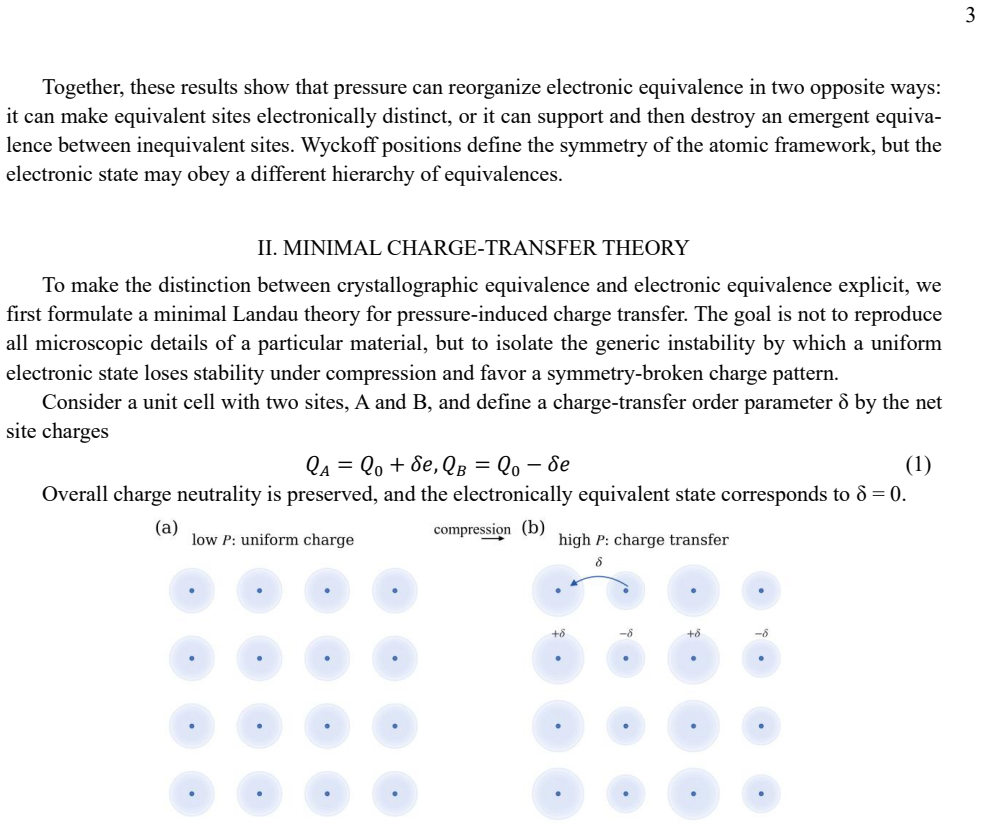
The central claim is that pressure-induced charge transfer destabilizes charge-equivalent states when intersite Coulomb gains exceed onsite costs, as described by a minimal Landau theory. In BCC Na this produces an electronically symmetry-broken CsCl-type state on an unchanged BCC framework, while in hP4 Na an emergent gauge equivalence keeps distinct Wyckoff sites charge-equivalent at low pressure until compression splits near-Fermi doublets and drives a metal-insulator transition. These cases show lattice symmetry constrains but does not fix the electronic equivalence structure.
What carries the argument
Minimal Landau theory of pressure-induced charge transfer, in which compression increases the intersite Coulomb energy gained by redistribution until it overcomes the onsite charging cost.
If this is right
- In BCC Na, compression drives charge transfer between neighboring sites to produce an electronically symmetry-broken CsCl-type state on the BCC ionic framework.
- In hP4 Na, compression breaks the emergent hidden equivalence, splits near-Fermi doublets, and induces a metal-insulator transition.
- Electronic equivalence can fall below or rise above what Wyckoff positions suggest.
- Lattice symmetry constrains but does not uniquely determine the equivalence structure of the electronic state.
Where Pith is reading between the lines
- Similar pressure-driven charge redistributions could appear in other compressed alkali metals or compounds.
- Charge-density maps from high-pressure experiments on sodium would directly test for the predicted site differences.
- The mechanism offers a route to pressure-tunable electronic states in materials where crystallographic analysis alone appears insufficient.
Load-bearing premise
Compression enhances the intersite Coulomb energy from charge redistribution until it overcomes the onsite charging cost and destabilizes the charge-equivalent state.
What would settle it
Observation or calculation of no charge difference developing between neighboring sites in compressed BCC sodium, or no splitting of near-Fermi doublets and no metal-insulator transition in compressed hP4 sodium.
Figures


read the original abstract
Crystallographic symmetry is usually taken as a guide to electronic equivalence in crystals: atoms on the same Wyckoff position are expected to have the same charge, whereas atoms on different Wyckoff positions are expected to be electronically distinct. Here we show that both expectations can fail in oppo-site ways: crystallographically equivalent sites can become charge-inequivalent under compression, whereas crystallographically inequivalent sites can remain charge-equivalent at low pressure because of an emergent hidden symmetry. We develop a minimal Landau theory of pressure-induced charge transfer, in which compression enhances the intersite Coulomb energy gained by charge redistribution until it overcomes the onsite charging cost and destabilizes the charge-equivalent state. In BCC Na, all sites are charge-equivalent at low pressure, but compression drives charge transfer between neighboring sites, pro-ducing an electronically symmetry-broken CsCl-type state on an unchanged BCC ionic framework. In hP4 Na, the opposite anomaly occurs: two Na sites occupy distinct Wyckoff positions, yet remain charge-equivalent at low pressure because of an emergent gauge equivalence in the low-energy manifold, giving rise to near-Fermi doublets that appear accidental in conventional space-group analysis. Upon compres-sion, pressure-induced charge transfer breaks this hidden equivalence, splits the near-Fermi doublets, and drives a metal-insulator transition. These two complementary cases establish pressure-induced charge transfer as a mechanism by which electronic equivalence can either fall below or rise above what Wyckoff positions alone would suggest, showing that lattice symmetry constrains but does not uniquely determine the equivalence structure of the electronic state.
Editorial analysis
A structured set of objections, weighed in public.
Referee Report
Summary. The manuscript claims that crystallographic Wyckoff positions do not uniquely determine electronic charge equivalence in crystals. Using a minimal Landau theory of pressure-induced charge transfer, it shows two complementary anomalies in sodium: in BCC Na, compression destabilizes the charge-equivalent state and drives charge transfer between neighboring sites, producing an electronically symmetry-broken CsCl-type state on an unchanged BCC framework; in hP4 Na, distinct Wyckoff sites remain charge-equivalent at low pressure due to an emergent hidden gauge symmetry that produces near-Fermi doublets, but compression breaks this equivalence, splits the doublets, and induces a metal-insulator transition. The theory posits that decreasing volume enhances the intersite Coulomb energy gain relative to the onsite charging cost until the uniform-charge state is destabilized.
Significance. If the central claims hold, the work is significant for understanding high-pressure phases of simple metals. It demonstrates that electronic equivalence can fall below or rise above Wyckoff expectations via pressure-induced charge transfer and hidden symmetries, offering a mechanism for anomalies in alkali metals and a phenomenological framework that could inform DFT studies or experiments on metal-insulator transitions. The complementary BCC and hP4 cases provide falsifiable predictions about charge ordering and band splitting under compression.
major comments (1)
- [§3] §3 (minimal Landau theory): The central assumption that the intersite Coulomb coefficient grows faster with decreasing volume than the onsite charging penalty is introduced phenomenologically without an explicit microscopic derivation or volume-dependent mapping from hopping integrals, Madelung sums, or DFT parameters for Na. This volume dependence is load-bearing for both the BCC charge-symmetry breaking and the hP4 hidden-symmetry breaking claims, yet remains unvalidated.
minor comments (2)
- [Abstract] Abstract: hyphenation artifacts such as 'oppo-site' and 'pro-ducing' should be corrected for readability.
- The manuscript would benefit from a brief comparison to existing literature on charge ordering or hidden symmetries in compressed alkali metals to clarify novelty.
Simulated Author's Rebuttal
We thank the referee for their thoughtful review and positive evaluation of the significance of our manuscript. We address the major comment on the minimal Landau theory below.
read point-by-point responses
-
Referee: [§3] §3 (minimal Landau theory): The central assumption that the intersite Coulomb coefficient grows faster with decreasing volume than the onsite charging penalty is introduced phenomenologically without an explicit microscopic derivation or volume-dependent mapping from hopping integrals, Madelung sums, or DFT parameters for Na. This volume dependence is load-bearing for both the BCC charge-symmetry breaking and the hP4 hidden-symmetry breaking claims, yet remains unvalidated.
Authors: We appreciate the referee's emphasis on this foundational aspect of our approach. Our minimal Landau theory is constructed to be phenomenological by design, capturing the essential competition between onsite charging costs and intersite Coulomb gains under compression without relying on a full ab initio parameterization. The volume dependence—specifically that the intersite term strengthens more rapidly—is motivated by general physical considerations: as volume decreases, the lattice contracts, enhancing the relative importance of interatomic Coulomb interactions (which scale with inverse interatomic distances in Madelung sums) compared to more localized onsite terms. This is consistent with trends observed in high-pressure studies of simple metals. Nevertheless, we agree that a more explicit connection to microscopic parameters would be valuable. In the revised version, we have expanded §3 to include a brief discussion of this motivation, referencing relevant literature on volume-dependent effective interactions in alkali metals, and we have clarified that the functional form is illustrative of the generic instability rather than a quantitative fit to Na. We believe this addresses the concern while preserving the minimal character of the theory. Full microscopic validation would require extensive DFT-based mapping, which lies beyond the scope of the present work but could be pursued in follow-up studies. revision: partial
Circularity Check
Minimal Landau theory postulates volume-dependent intersite Coulomb dominance without microscopic derivation, rendering charge-transfer predictions equivalent to the input ansatz.
specific steps
-
self definitional
[Abstract]
"We develop a minimal Landau theory of pressure-induced charge transfer, in which compression enhances the intersite Coulomb energy gained by charge redistribution until it overcomes the onsite charging cost and destabilizes the charge-equivalent state."
The model is constructed by fiat with the premise that compression strengthens the intersite gain relative to the onsite penalty; the subsequent claims of pressure-driven charge transfer and symmetry breaking are therefore true by the definition of the free-energy functional rather than derived from more fundamental electronic-structure inputs.
full rationale
The paper introduces a phenomenological model whose central volume dependence (intersite term growing faster than onsite under compression) is stated as part of the theory definition rather than obtained from hopping, Madelung sums, or DFT parameters. Consequently the predicted destabilization of the charge-equivalent state in BCC Na and the breaking of hidden gauge equivalence in hP4 Na follow directly from that postulate. No self-citations or data-fitting steps appear in the supplied text, but the absence of an independent mapping from microscopic quantities to the Landau coefficients produces moderate circularity in the derivation chain.
Axiom & Free-Parameter Ledger
free parameters (1)
- onsite charging cost
axioms (1)
- domain assumption Compression enhances intersite Coulomb energy until it exceeds onsite charging cost
Lean theorems connected to this paper
-
IndisputableMonolith/Cost/FunctionalEquation.leanwashburn_uniqueness_aczel unclear?
unclearRelation between the paper passage and the cited Recognition theorem.
minimal Landau theory of pressure-induced charge transfer, in which compression enhances the intersite Coulomb energy gained by charge redistribution until it overcomes the onsite charging cost
-
IndisputableMonolith/Foundation/AlexanderDuality.leanalexander_duality_circle_linking unclear?
unclearRelation between the paper passage and the cited Recognition theorem.
Madelung lattice sum … Meff(P)/r(P)
What do these tags mean?
- matches
- The paper's claim is directly supported by a theorem in the formal canon.
- supports
- The theorem supports part of the paper's argument, but the paper may add assumptions or extra steps.
- extends
- The paper goes beyond the formal theorem; the theorem is a base layer rather than the whole result.
- uses
- The paper appears to rely on the theorem as machinery.
- contradicts
- The paper's claim conflicts with a theorem or certificate in the canon.
- unclear
- Pith found a possible connection, but the passage is too broad, indirect, or ambiguous to say the theorem truly supports the claim.
Reference graph
Works this paper leans on
-
[1]
F. Siringo, R. Pucci, and G. G. N. Angilella, Are light alkali metals still metals under high pressure?, in Correlations in Condensed Matter under Extreme Conditions: A Tribute to Renato Pucci on the Occasion of His 70th Birthday (Springer International Publishing, Cham, 2017), pp. 257-265
work page 2017
-
[2]
H. T. Hall, L. Merrill, and J. D. Barnett, High pressure polymorphism in cesium, Science 146, 1297 (1964)
work page 1964
-
[3]
H. Olijnyk and W. Holzapfel, Phase transitions in K and Rb under pressure, Phys. Lett. A 99, 381 (1983)
work page 1983
-
[4]
B. Olinger and J. W. Shaner, Lithium, compression and high-pressure structure, Science 219, 1071 (1983)
work page 1983
-
[5]
M. Hanfland, I. Loa, and K. Syassen, Sodium under pressure: bcc to fcc structural transition and pressure-volume relation to 100 GPa, Phys. Rev. B 65, 184109 (2002)
work page 2002
-
[6]
A. F. Goncharov, V . V . Struzhkin, H.-K. Mao, and R. J. Hemley, Spectroscopic evidence for broken- symmetry transitions in dense lithium up to megabar pressures, Phys. Rev. B 71, 184114 (2005)
work page 2005
- [7]
-
[8]
M. Marques, M. I. McMahon, E. Gregoryanz, M. Hanfland, C. L. Guillaume, C. J. Pickard, G. J. Ackland, and R. J. Nelmes, Crystal structures of dense lithium: A metal -semiconductor-metal transition, Phys. Rev. Lett. 106, 095502 (2011)
work page 2011
-
[9]
Y . Ma, M. I. Eremets, A. R. Oganov, Y . Xie, I. A. Trojan, S. A. Medvedev, A. O. Lyakhov, M. Valle, and V . B. Prakapenka, Transparent dense sodium, Nature 458, 182 (2009)
work page 2009
-
[10]
E. He, C. M. Wilson, and R. Ganesh, Metallic bonding in close-packed structures: Structural frus- tration from a hidden gauge symmetry, Phys. Rev. Lett. 133, 256401 (2024)
work page 2024
- [11]
-
[12]
H.-A. Yang, H.-Y . Wei, and B.-Y . Cao, Symmetry-enforced planar nodal-chain phonons in non- symmorphic materials, J. Appl. Phys. 132, 224401 (2022)
work page 2022
-
[13]
A. Lazicki, A. F. Goncharov, V . V . Struzhkin, R. E. Cohen, Z. Liu, E. Gregoryanz, C. Guillaume, H.-K. Mao, and R. J. Hemley, Anomalous optical and electronic properties of dense sodium, Proc. Natl. Acad. Sci. U.S.A. 106, 6525 (2009)
work page 2009
-
[14]
P. Pyykko and M. Atsumi, Molecular single-bond covalent radii for elements 1-118, Chem. Eur. J. 15, 186 (2009). 18
work page 2009
-
[15]
B. Cordero, V . Gomez, A. E. Platero-Prats, M. Reves, J. Echeverria, E. Cremades, F. Barragan, and S. Alvarez, Covalent radii revisited, Dalton Trans., 2832 (2008)
work page 2008
-
[16]
Kittel, Introduction to Solid State Physics, 8th ed
C. Kittel, Introduction to Solid State Physics, 8th ed. (Wiley, New York, 2005)
work page 2005
- [17]
- [18]
-
[19]
Birch, Finite elastic strain of cubic crystals, Phys
F. Birch, Finite elastic strain of cubic crystals, Phys. Rev. 71, 809 (1947)
work page 1947
-
[20]
T. Katsura and Y . Tange, A simple derivation of the Birch-Murnaghan equations of state (EOSs) and comparison with EOSs derived from other definitions of finite strain, Minerals 9, 745 (2019)
work page 2019
-
[21]
J. B. Neaton and N. W. Ashcroft, On the constitution of sodium at higher densities, Phys. Rev. Lett. 86, 2830 (2001)
work page 2001
-
[22]
E. Gregoryanz, L. F. Lundegaard, M. I. McMahon, C. Guillaume, R. J. Nelmes, and M. Mezouar, Structural diversity of sodium, Science 320, 1054 (2008)
work page 2008
- [23]
-
[24]
S. Racioppi, C. V . Storm, M. I. McMahon, and E. Zurek, On the electride nature of Na-hP4, Angew. Chem. Int. Ed. 62, e202310802 (2023)
work page 2023
-
[25]
C. V . Storm, S. Racioppi, M. J. Duff, J. D. McHardy, E. Zurek, and M. I. McMahon, Experimental signatures of interstitial electron density in transparent dense sodium, Commun. Mater. 6, 201 (2025)
work page 2025
-
[26]
P. P. Ewald, Die Berechnung optischer und elektrostatischer Gitterpotentiale, Ann. Phys. 369, 253 (1921)
work page 1921
-
[27]
W. A. Harrison, Simple calculation of Madelung constants, Phys. Rev. B 73, 212103 (2006)
work page 2006
-
[28]
Hagg, Some notes on MX2 layer lattices with close-packed X atoms, Ark
G. Hagg, Some notes on MX2 layer lattices with close-packed X atoms, Ark. Kemi Mineral. Geol. 16B, 1 (1943)
work page 1943
-
[29]
M. I. McMahon and R. J. Nelmes, High-pressure structures and phase transformations in elemental metals, Chem. Soc. Rev. 35, 943 (2006)
work page 2006
-
[30]
A. R. Oganov, J. Chen, C. Gatti, Y . Ma, Y . Ma, C. W. Glass, Z. Liu, T. Yu, O. O. Kurakevych, and V . L. Solozhenko, Ionic high-pressure form of elemental boron, Nature 457, 863 (2009)
work page 2009
-
[31]
P. W. Anderson, More is different: Broken symmetry and the nature of the hierarchical structure of science, Science 177, 393 (1972)
work page 1972
-
[32]
A. W. Overhauser, Spin density waves in an electron gas, Phys. Rev. 128, 1437 (1962)
work page 1962
discussion (0)
Sign in with ORCID, Apple, or X to comment. Anyone can read and Pith papers without signing in.