REVIEW 4 major objections 5 minor 39 references
Joint Task Offloading and Resource Allocation in Low-Altitude MEC via Graph Attention Diffusion
T0 review · 4 major / 5 minor · reviewed 2026-08-06 · deepseek-v4-flash
Pith's one-line read A graph attention diffusion model jointly generates offloading decisions and resource allocations for three-layer low-altitude MEC networks, claiming near-optimal cost and cross-scale generalization.
desk verdict A credible GAT-vs-GCN upgrade that is a step forward for diffusion-based MEC solvers, but the headline near-optimality claim rests on a benchmark whose own labels are conceded to be non-optimal. read the letter →
The pith
A machine-rendered reading of the paper's core claim, the machinery that carries it, and where it could break.
The reading
What carries the argument
The load-bearing object is the graph-diffusion generator: the MEC problem is encoded as a heterogeneous graph whose nodes are HAPs, ground servers, aerial users, and ground users, and whose edges carry cost and deadline features. A GAT encoder with edge padding, gated filtering, and multi-head attention produces graph embeddings that condition two diffusion processes, a categorical diffusion over the binary offloading decisions and a Gaussian diffusion over the continuous resource-allocation ratios, trained jointly by cross-entropy plus noise-prediction loss, with DDIM used to cut inference to a few denoising steps. This combined mechanism is what lets the model output feasible offloading and allocation solutions directly from a graph input.
What would settle it
Solve every instance in one small test set, such as gs2 gu4 au2, to proven optimality by exhaustive enumeration of all offloading combinations plus convex resource allocation, then recompute GADSG's average cost ratio against those true optima; a ratio meaningfully above 1.0 would refute the near-optimality claim.
Extended reading notes
Core claim
The central claim is that swapping the graph convolutional encoder of the GDSG diffusion solver for a multi-head graph attention encoder yields better solutions without changing the training dynamics. On the eight test datasets, GADSG achieves average cost ratios from 1.08 down to 0.96, while GDSG ranges from 1.23 to 1.10; on the three largest datasets GADSG reaches a 100% cost accuracy rate (cost ratio below 1.1), and it keeps average cost ratios between roughly 0.95 and 1.13 when trained on one scale and tested on others. The paper attributes the gain to attention's ability to assign learnable weights to edges and nodes, selectively emphasizing critical offloading links in heterogeneous, dynamic topologies.
Load-bearing premise
The reported results assume that the brute-force-searched MCMF labels are genuinely optimal; if those labels are only approximate, then cost ratios near or below 1.0 do not by themselves establish near-optimal performance.
Editorial extensions
If this is right
- A single GADSG model trained on smaller LAENet topologies can be applied at larger scales with cost ratios staying near 1, which is exactly what dynamic low-altitude networks need.
- At inference the model needs only five diffusion steps, so offloading decisions can be made fast enough for real-time task scheduling in changing topologies.
- The gap between GDSG and GADSG isolates the attention mechanism as the cause of the improvement, making attention a promising component for other graph-based network optimizers.
- Because the formulation is graph-based, the same method could be applied to any MEC or edge-computing problem expressible as cost-bearing offloading edges, not only LAENet scenarios.
Reading between the lines
- The sub-1.0 cost ratios imply that the brute-force-searched MCMF labels are not true optima on those datasets, so the reported accuracy numbers are relative to a heuristic reference rather than to provable optimality.
- An exact-solver benchmark on small instances would give a true optimality gap; if it stays near 1, the method is genuinely near-optimal, and if not, the gains over baselines may be partly an artifact of weak references.
- The attention weights learned over edges could be inspected to identify which user-server links dominate cost, potentially serving as an interpretability tool for network operators.
- Combining GADSG with an online admission or queueing controller could turn single-shot near-optimal solutions into a dynamic scheduler for time-varying task arrivals.
Editorial analysis
A structured set of objections, weighed in public.
Referee Report
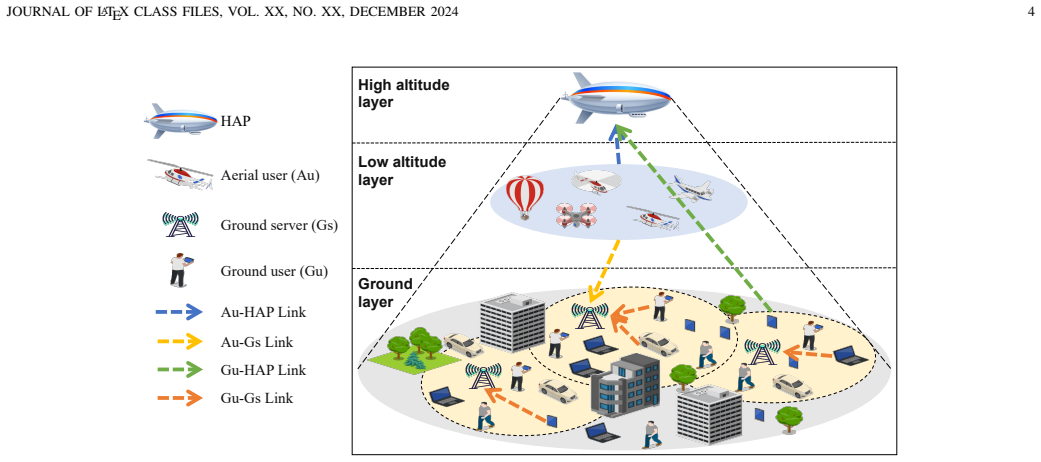
Summary. This paper studies joint task offloading and resource allocation in a three-layer low-altitude economy MEC network with HAPs, aerial users, ground users, and ground servers. The authors formulate a mixed-integer nonlinear program for weighted delay-energy cost, abstract it as a graph optimization problem, and propose GADSG, a diffusion-based solution generator whose encoder is a graph attention network and whose diffusion process jointly models binary offloading decisions and continuous resource allocation. Experiments on eight synthetically generated datasets compare GADSG with random execution, alternating optimization, GRLO, and the GCN-based GDSG, including cross-scale generalization tests. The main reported results are that GADSG achieves the lowest average cost ratio and highest cost accuracy rate, with ratios below 1 on the largest datasets and 100% cost accuracy in complex scenarios, which the authors attribute to the attention mechanism.
Significance. The modeling contribution is useful: the graph abstraction with typed nodes and edge features is natural for heterogeneous MEC, and the idea of using graph attention instead of GCN inside a diffusion solution generator is a plausible and testable improvement over the authors' prior GDSG. If the empirical comparisons are valid, GADSG is clearly a practical improvement over the heuristics and over GDSG, and the cross-scale generalization experiments strengthen the paper. However, the benchmark against 'optimal' labels is not valid as reported, and no uncertainty quantification is provided, so the near-optimality and attention-benefit claims are not yet supported. The paper does not ship code, but the algorithmic details are mostly clear. The significance is moderate: an incremental architectural improvement applied to a new scenario, with a promising but currently unverified performance claim.
major comments (4)
- [Section V-A2, V-B1, V-B3; Tables IV and V] The evaluation framework does not support the near-optimality claim because the reference labels are not established as optimal. Section V-A2 states that test labels are produced by a modified Minimum Cost Maximum Flow heuristic with brute-force search, yet Section V-B1 concedes that the ratio can fall below 1 because the test set does not exhaustively cover the solution space, and Section V-B3 repeats that GADSG can approximate the optimal solution more closely than the test labels. Since Table IV reports GADSG ratios of 0.99, 0.97, 0.96, and 0.98, the denominators of these ratios cannot be true optimal costs; otherwise no feasible solution could beat them. The average cost ratio and cost accuracy rate therefore measure distance to a heuristic reference, not to an optimum, and the central claims of near-optimal performance and of GAT being responsible for the improvement are not established by the experiments as reported. Please verify optimality on a representative subset of instances via exact enumeration or an off-the-shelf MINLP solver, and report optimality gaps with respect to verified optima or valid lower bounds.
- [Section V-B1] The cost accuracy rate, defined as the proportion of test samples with cost ratio below 1.1, is not a meaningful accuracy metric once the reference is heuristic. A solution whose cost is 1.05 times a heuristic cost is counted as accurate even if it is far from optimal, and the 100% values in Table V are therefore not evidence of optimality. Please replace this metric with exact-match rates on verified small instances, or with quantiles of the cost distribution relative to a lower bound, and report absolute system costs alongside ratios.
- [Tables IV and V, Section V-B] No measures of uncertainty are reported: the tables contain single point estimates, and the convergence and cost-ratio curves in Figs. 4 and 5 do not show error bars or multiple seeds. Since the claimed advantage of GADSG over GDSG is often small (for example 1.11 vs. 0.99 on gs6 gu14 au10), the reader cannot tell whether the improvement is statistically significant. Please report standard deviations or 95% confidence intervals over at least five independent training runs and across test samples, and state how many random seeds were used.
- [Section IV-C, Algorithms 1 and 2] The inference procedure for the discrete offloading variables is underspecified. Algorithm 2 contains only the Gaussian DDPM update for continuous variables; there is no pseudocode for the categorical reverse sampling described in Section IV-C1, and no description of how the final discrete decisions are extracted from the latent representation or how constraints C3-C5 are enforced during sampling. Without this, the joint discrete/continuous generation claim is not reproducible. Please provide the discrete sampling equations and a constraint-handling procedure (projection, masking, or penalty).
minor comments (5)
- [Table IV vs. Table II] Table IV lists a dataset 'gs3 gu3 au4gt' but Table II defines 'gs3 gu6 au4'; please reconcile the naming and ensure the scale labels match the generated datasets.
- [Figures 4-6] The axis labels and legends in Figures 4-6 appear garbled in the manuscript source (e.g., '/uni...' tokens); please regenerate the figures with legible text.
- [Equation (22)] Equation (22) uses α in the numerator without defining it; presumably it is the number of CPU cycles per bit, but it should be introduced explicitly and distinguished from the diffusion noise-schedule notation.
- [Section IV-C and Algorithm 1] Algorithm 1 uses a noise schedule {α_t}, while Section IV-C defines β_t and cumulative factors; the notation should be unified to avoid confusion.
- [Section V-B1] The interpretation of 'cost accuracy rate' as an accuracy measure is misleading once ratios below 1 are explicitly allowed; at minimum, rename this metric or clarify that it is a heuristic-reference proximity measure.
Circularity Check
Benchmark-circular optimality: the 'optimal' test labels come from the same MCMF heuristic family used to create training labels, and the paper concedes those labels are not optimal; ratios below 1 and the 100% cost accuracy claim therefore measure distance to a heuristic, not to the true optimum.
-
self definitional
[Section V-A2 (Dataset Construction), V-B1 (metrics), V-B3 (results discussion)]
"We modified the heuristic MCMF algorithm to generate test data for our model by significantly increasing the number of heuristically generated weight combinations and applying brute-force search over the solution space to obtain optimal results. ... Note that the ratio may occasionally fall below 1 because the test set does not exhaustively cover the solution space ... the trained GADSG model can approximate the optimal solution more closely than the test labels."
Average cost ratio divides predicted cost by 'the optimal cost across all test samples,' and those test labels are produced by the modified MCMF heuristic. Training labels are likewise generated by a heuristic-based MCMF algorithm. So the model is trained to imitate one MCMF-family solver and evaluated against another MCMF-family output relabeled 'optimal.' Table IV's ratios below 1 (0.99, 0.97, 0.96, 0.98) are impossible for a true optimum; the paper concedes the test set 'does not exhaustively cover the solution space' and that GADSG 'can approximate the optimal solution more closely than the test labels.' Hence the '100% cost accuracy rate' and near-optimality claims reduce to reproducing or beating heuristic labels, not to approaching the true optimum of problem P.
-
self citation load bearing
[Section II-C (Related Work) and Section IV-C3; reference [29] is GDSG by overlapping authors]
"Thanks to their ability to generalize beyond the training data, GDMs have been verified to train on suboptimal data samples and generate high-quality solutions through parallel sampling [29]."
This sentence is the paper's justification for using MCMF-generated suboptimal labels as training targets while claiming the output solutions are high-quality or near-optimal. The verification is cited to [29], the GDSG paper by Liang, Yang, Cao, Yu, Debbah, and Yuen, which overlaps with the present author list; no independent proof or external benchmark is supplied here. The same [29] is also invoked for the 'inter-task gradient orthogonality principle' that licenses joint training, and it supplies the GCN-based baseline. Thus a load-bearing premise of the method—diffusion trained on heuristic labels generalizes to better solutions—rests on the authors' own prior work rather than on a theorem or dataset external to this line of work.
full rationale
The core quantitative evidence for the central claim is the average cost ratio and cost accuracy rate relative to test labels. Section V-A2 states those labels were produced by a modified MCMF heuristic 'to obtain optimal results,' yet Section V-B1 allows ratios below 1 because the test set does not exhaust the solution space, and Section V-B3 says GADSG can beat the test labels. A true optimal reference cannot be beaten, so the denominator is not the optimum; it is an MCMF heuristic output. Because the training data were also generated by an MCMF-family algorithm, the model is essentially trained to imitate the heuristic, and its 'near-optimality' is measured against that same heuristic family. The head-to-head comparison with GDSG retains some informative value because both models face the same labels, and the cross-scale experiment is an internal generalization test; however, the headline claims of near-optimal performance and 100% cost accuracy are not established by this benchmark. The additional reliance on the authors' prior GDSG work [29] for the premise that diffusion models trained on suboptimal labels generalize to high-quality solutions makes the interpretive chain partly self-referential. Overall, the main optimization-performance claim reduces, in part, to reproduction of a heuristic reference, warranting a partial circularity score.
Assumptions & free parameters
free parameters (3)
- Diffusion noise schedule beta_t =
linear schedule over 200 training steps
- Virtual-edge penalty magnitudes (Jloc-m, Jtr-m, Jexe-m) =
maximum observed costs within the training dataset
- Inference diffusion steps =
5 DDIM steps vs 200 training steps
assumptions (5)
- domain assumption The uplink uses OMA, so all user-server links are interference-free and Shannon rate R = B log2(1 + Pg/sigma2) applies independently per link.
- domain assumption The graph edge features (Jloc, Jtr, Jexe, lambda, mu) together with node features are a sufficient statistic for the optimization objective and constraints.
- standard math The diffusion theory and training losses from DDPM/DDIM and the categorical diffusion posterior of [29] are correct and applicable to this graph-conditioned generation.
- ad hoc to paper Inter-task gradient orthogonality for the joint discrete/continuous diffusion objective holds as established in [29].
- ad hoc to paper The modified MCMF-plus-brute-force procedure produces genuinely optimal solutions for the test instances.
Cite this review
Pith. "Pith review of Joint Task Offloading and Resource Allocation in Low-Altitude MEC via Graph Attention Diffusion." pith.science (2026). https://pith.science/paper/CJIX2GMA
@misc{pith2026250621933,
  author       = {Pith},
  title        = {Pith review of: Joint Task Offloading and Resource Allocation in Low-Altitude MEC via Graph Attention Diffusion},
  year         = {2026},
  howpublished = {\url{https://pith.science/paper/CJIX2GMA}},
  note         = {Machine review of arXiv:2506.21933}
}
read the original abstract
With the rapid development of the low-altitude economy, air-ground integrated multi-access edge computing (MEC) systems are facing increasing demands for real-time and intelligent task scheduling. In such systems, task offloading and resource allocation encounter multiple challenges, including node heterogeneity, unstable communication links, and dynamic task variations. To address these issues, this paper constructs a three-layer heterogeneous MEC system architecture for low-altitude economic networks, encompassing aerial and ground users as well as edge servers. The system is systematically modeled from the perspectives of communication channels, computational costs, and constraint conditions, and the joint optimization problem of offloading decisions and resource allocation is uniformly abstracted into a graph-structured modeling task. On this basis, we propose a graph attention diffusion-based solution generator (GADSG). This method integrates the contextual awareness of graph attention networks with the solution distribution learning capability of diffusion models, enabling joint modeling and optimization of discrete offloading variables and continuous resource allocation variables within a high-dimensional latent space. We construct multiple simulation datasets with varying scales and topologies. Extensive experiments demonstrate that the proposed GADSG model significantly outperforms existing baseline methods in terms of optimization performance, robustness, and generalization across task structures, showing strong potential for efficient task scheduling in dynamic and complex low-altitude economic network environments.
Figures


Figures from the paper (3 more)


Reference graph
Works this paper leans on
-
[1]
Generative AI-enabled Wireless Communications for Robust Low-Altitude Economy Networking,
C. Zhao, J. Wang, R. Zhang, D. Niyato, G. Sun, H. Du, D. I. Kim, and A. Jamalipour, “Generative AI-enabled Wireless Communications for Robust Low-Altitude Economy Networking,” 2025. [Online]. Available: https://arxiv.org/abs/2502.18118
arXiv 2025
-
[2]
X. Zheng, G. Sun, J. Li, J. Wang, Q. Wu, D. Niyato, and A. Jamalipour, “UA V Swarm-enabled Collaborative Post-disaster Communications in Low Altitude Economy via a Two-stage Optimization Approach,” 2025. [Online]. Available: https://arxiv.org/abs/2501.05742
arXiv 2025
-
[3]
C. He, W. Jiang, X. Wang, W. Wang, J. Wang, and X. Xie, “Deep Rein- forcement Learning and Nash Equilibrium Game-Based Task Offloading Optimization Strategy for the IoV,” IEEE Sensors Journal , vol. 25, no. 10, pp. 18 384–18 393, 2025
work page 2025
-
[4]
X. Cao, B. Yang, K. Wang, X. Li, Z. Yu, C. Yuen, Y . Zhang, and Z. Han, “AI-Empowered Multiple Access for 6G: A Survey of Spectrum Sensing, Protocol Designs, and Optimizations,” Proceedings of the IEEE, vol. 112, no. 9, pp. 1264–1302, 2024
work page 2024
-
[5]
Multi-Agent Deep Reinforcement Learning for Task Offloading in UA V-Assisted Mobile Edge Computing,
N. Zhao, Z. Ye, Y . Pei, Y .-C. Liang, and D. Niyato, “Multi-Agent Deep Reinforcement Learning for Task Offloading in UA V-Assisted Mobile Edge Computing,” IEEE Transactions on Wireless Communications , vol. 21, no. 9, pp. 6949–6960, 2022
work page 2022
-
[6]
Y . Chen, K. Li, Y . Wu, J. Huang, and L. Zhao, “Energy Efficient Task Offloading and Resource Allocation in Air-Ground Integrated MEC Systems: A Distributed Online Approach,” IEEE Transactions on Mobile Computing, vol. 23, no. 8, pp. 8129–8142, 2024
work page 2024
-
[7]
TJCCT: A Two-Timescale Approach for UA V-Assisted Mobile Edge Computing,
Z. Sun, G. Sun, Q. Wu, L. He, S. Liang, H. Pan, D. Niyato, C. Yuen, and V . C. M. Leung, “TJCCT: A Two-Timescale Approach for UA V-Assisted Mobile Edge Computing,” IEEE Transactions on Mobile Computing , vol. 24, no. 4, pp. 3130–3147, 2025. JOURNAL OF LATEX CLASS FILES, VOL. XX, NO. XX, DECEMBER 2024 15
work page 2025
-
[8]
Y . Chen, H. Kang, J. Li, G. Sun, B. Wang, J. Wang, C. Liang, S. Liang, and D. Niyato, “Joint Resource Management for Energy-efficient UA V- Assisted SWIPT-MEC: A Deep Reinforcement Learning Approach,” IEEE Internet of Things Journal , pp. 1–1, 2025
work page 2025
Show all 39 references
-
[9]
Multi-Objective Optimization for Multi-UA V-Assisted Mobile Edge Computing,
G. Sun, Y . Wang, Z. Sun, Q. Wu, J. Kang, D. Niyato, and V . C. M. Leung, “Multi-Objective Optimization for Multi-UA V-Assisted Mobile Edge Computing,” IEEE Transactions on Mobile Computing , vol. 23, no. 12, pp. 14 803–14 820, 2024
2024
-
[10]
UA V-Assisted Joint Mobile Edge Computing and Data Collection via Matching-Enabled Deep Reinforcement Learning,
B. Wang, H. Kang, J. Li, G. Sun, Z. Sun, J. Wang, and D. Niyato, “UA V-Assisted Joint Mobile Edge Computing and Data Collection via Matching-Enabled Deep Reinforcement Learning,” IEEE Internet of Things Journal, pp. 1–1, 2025
2025
-
[11]
Joint Data Collection and Transmission in 6G Aerial Access Networks,
Z. Jia, M. Sheng, J. Li, D. Zhou, and Z. Han, “Joint Data Collection and Transmission in 6G Aerial Access Networks,” in Proceedings of 2021 IEEE Global Communications Conference (GLOBECOM) , 2021, pp. 1–6
2021
-
[12]
Joint Task Offloading and Resource Allocation in Aerial- Terrestrial UA V Networks With Edge and Fog Computing for Post- Disaster Rescue,
G. Sun, L. He, Z. Sun, Q. Wu, S. Liang, J. Li, D. Niyato, and V . C. M. Leung, “Joint Task Offloading and Resource Allocation in Aerial- Terrestrial UA V Networks With Edge and Fog Computing for Post- Disaster Rescue,” IEEE Transactions on Mobile Computing , vol. 23, no. 9, pp...
2024
-
[13]
Intelligent Computation Offloading and Trajectory Planning for 3-D Target Search in Low-Altitude Economy Scenarios,
H. Yang, M. Zheng, Z. Shao, Y . Jiang, and Z. Xiong, “Intelligent Computation Offloading and Trajectory Planning for 3-D Target Search in Low-Altitude Economy Scenarios,” IEEE Wireless Communications Letters, vol. 14, no. 4, pp. 949–953, 2025
2025
-
[14]
Task Delay and Energy Consumption Minimization for Low-altitude MEC via Evolutionary Multi-objective Deep Reinforcement Learning,
G. Sun, W. Ma, J. Li, Z. Sun, J. Wang, D. Niyato, and S. Mao, “Task Delay and Energy Consumption Minimization for Low-altitude MEC via Evolutionary Multi-objective Deep Reinforcement Learning,” 2025. [Online]. Available: https://arxiv.org/abs/2501.06410
2025 arXiv
-
[15]
Generative AI for Lyapunov Optimization Theory in UA V- based Low-Altitude Economy Networking,
Z. Liu, D. Niyato, J. Wang, G. Sun, L. Huang, Z. Gao, and X. Wang, “Generative AI for Lyapunov Optimization Theory in UA V- based Low-Altitude Economy Networking,” 2025. [Online]. Available: https://arxiv.org/abs/2501.15928
2025 arXiv
-
[16]
Online Learning Aided Decentralized Multi-User Task Offloading for Mobile Edge Computing,
X. Wang, J. Ye, and J. C. Lui, “Online Learning Aided Decentralized Multi-User Task Offloading for Mobile Edge Computing,” IEEE Trans- actions on Mobile Computing , vol. 23, no. 4, pp. 3328–3342, 2024
2024
-
[17]
Hierarchical Task Offloading for Vehicular Fog Computing Based on Multi-Agent Deep Reinforcement Learning,
Y . Hou, Z. Wei, R. Zhang, X. Cheng, and L. Yang, “Hierarchical Task Offloading for Vehicular Fog Computing Based on Multi-Agent Deep Reinforcement Learning,” IEEE Transactions on Wireless Communica- tions, vol. 23, no. 4, pp. 3074–3085, 2024
2024
-
[18]
Multi-UA V Cooperative Task Offloading and Resource Allocation in 5G Advanced and Beyond,
H. Guo, Y . Wang, J. Liu, and C. Liu, “Multi-UA V Cooperative Task Offloading and Resource Allocation in 5G Advanced and Beyond,”IEEE Transactions on Wireless Communications, vol. 23, no. 1, pp. 347–359, 2024
2024
-
[19]
UA V-Assisted Task Offloading in Vehicular Edge Computing Networks,
X. Dai, Z. Xiao, H. Jiang, and J. C. S. Lui, “UA V-Assisted Task Offloading in Vehicular Edge Computing Networks,” IEEE Transactions on Mobile Computing , vol. 23, no. 4, pp. 2520–2534, 2024
2024
-
[20]
Joint Offloading Decision, User Association, and Resource Allocation in Hierarchical Aerial Computing: Collaboration of UA Vs and HAP,
A. Nabi and S. Moh, “Joint Offloading Decision, User Association, and Resource Allocation in Hierarchical Aerial Computing: Collaboration of UA Vs and HAP,” IEEE Transactions on Mobile Computing , pp. 1–17, 2025
2025
-
[21]
Edge-Assisted Multi-Layer Offloading Optimization of LEO Satellite-Terrestrial Integrated Networks,
X. Cao, B. Yang, Y . Shen, C. Yuen, Y . Zhang, Z. Han, H. V . Poor, and L. Hanzo, “Edge-Assisted Multi-Layer Offloading Optimization of LEO Satellite-Terrestrial Integrated Networks,” IEEE Journal on Selected Areas in Communications , vol. 41, no. 2, pp. 381–398, 2023
2023
-
[22]
Cluster-Based Multi- Agent Task Scheduling for Space-Air-Ground Integrated Networks,
Z. Wang, G. Sun, Y . Wang, f. Yu, and D. Niyato, “Cluster-Based Multi- Agent Task Scheduling for Space-Air-Ground Integrated Networks,” IEEE Transactions on Cognitive Communications and Networking , pp. 1–1, 2025
2025
-
[23]
Energy Consumption Minimization in UA V-Assisted Mobile-Edge Computing Systems: Joint Resource Allocation and Trajectory Design,
J. Ji, K. Zhu, C. Yi, and D. Niyato, “Energy Consumption Minimization in UA V-Assisted Mobile-Edge Computing Systems: Joint Resource Allocation and Trajectory Design,” IEEE Internet of Things Journal , vol. 8, no. 10, pp. 8570–8584, 2021
2021
-
[24]
Computation Offloading and Service Caching in Heterogeneous MEC Wireless Networks,
Y . Zhang, M. A. Kishk, and M.-S. Alouini, “Computation Offloading and Service Caching in Heterogeneous MEC Wireless Networks,” IEEE Transactions on Mobile Computing, vol. 22, no. 6, pp. 3241–3256, 2023
2023
-
[25]
Proactive Traffic Offloading in Dynamic Integrated Multisatellite Terrestrial Net- works,
W. Abderrahim, O. Amin, M.-S. Alouini, and B. Shihada, “Proactive Traffic Offloading in Dynamic Integrated Multisatellite Terrestrial Net- works,” IEEE Transactions on Communications , vol. 70, no. 7, pp. 4671–4686, 2022
2022
-
[26]
MADDPG-Based Joint Service Placement and Task Offloading in MEC Empowered Air–Ground Integrated Networks,
J. Du, Z. Kong, A. Sun, J. Kang, D. Niyato, X. Chu, and F. R. Yu, “MADDPG-Based Joint Service Placement and Task Offloading in MEC Empowered Air–Ground Integrated Networks,” IEEE Internet of Things Journal, vol. 11, no. 6, pp. 10 600–10 615, 2024
2024
-
[27]
DiffSG: A Generative Solver for Network Optimization with Diffusion Model,
R. Liang, B. Yang, Z. Yu, B. Guo, X. Cao, M. Debbah, H. V . Poor, and C. Yuen, “DiffSG: A Generative Solver for Network Optimization with Diffusion Model,” IEEE Communications Magazine , vol. 63, no. 6, pp. 16–24, 2025
2025
-
[28]
Diffusion Models as Network Optimizers: Explorations and Analysis,
R. Liang, B. Yang, P. Chen, X. Li, Y . Xue, Z. Yu, X. Cao, Y . Zhang, M. Debbah, H. Vincent Poor, and C. Yuen, “Diffusion Models as Network Optimizers: Explorations and Analysis,” IEEE Internet of Things Journal, vol. 12, no. 10, pp. 13 183–13 193, 2025
2025
-
[29]
GDSG: Graph Diffusion-based Solution Generator for Optimization Problems in MEC Networks,
R. Liang, B. Yang, P. Chen, X. Cao, Z. Yu, M. Debbah, D. Niyato, H. V . Poor, and C. Yuen, “GDSG: Graph Diffusion-based Solution Generator for Optimization Problems in MEC Networks,” IEEE Transactions on Mobile Computing, pp. 1–14, 2025
2025
-
[30]
Computation Offloading in Multi-Access Edge Computing: A Multi-Task Learning Approach,
B. Yang, X. Cao, J. Bassey, X. Li, and L. Qian, “Computation Offloading in Multi-Access Edge Computing: A Multi-Task Learning Approach,” IEEE Transactions on Mobile Computing, vol. 20, no. 9, pp. 2745–2762, 2021
2021
-
[31]
Cross-Problem Solving for Network Optimization: Is Problem-Aware Learning the Key?
R. Liang, B. Yang, P. Chen, X. Cao, Z. Yu, H. V . Poor, and C. Yuen, “Cross-Problem Solving for Network Optimization: Is Problem-Aware Learning the Key?” 2025. [Online]. Available: https://arxiv.org/abs/2505.05067
2025
-
[32]
DNN Partitioning, Task Offloading, and Resource Allocation in Dynamic Vehicular Networks: A Lyapunov-Guided Diffusion-Based Reinforcement Learning Approach,
Z. Liu, H. Du, J. Lin, Z. Gao, L. Huang, S. Hosseinalipour, and D. Niyato, “DNN Partitioning, Task Offloading, and Resource Allocation in Dynamic Vehicular Networks: A Lyapunov-Guided Diffusion-Based Reinforcement Learning Approach,” IEEE Transactions on Mobile Com- puting, vo...
1945
-
[33]
A Survey on Uplink Resource Allocation in OFDMA Wireless Networks,
E. Yaacoub and Z. Dawy, “A Survey on Uplink Resource Allocation in OFDMA Wireless Networks,” IEEE Communications Surveys & Tutorials, vol. 14, no. 2, pp. 322–337, 2012
2012
-
[34]
Enhancing AIoT Device Association With Task Offloading in Aerial MEC Networks,
J. Chen, P. Yang, S. Ren, Z. Zhao, X. Cao, and D. Wu, “Enhancing AIoT Device Association With Task Offloading in Aerial MEC Networks,” IEEE Internet of Things Journal , vol. 11, no. 1, pp. 174–187, 2024
2024
-
[35]
Secure Communications for UA V-Enabled Mobile Edge Computing Systems,
Y . Zhou, C. Pan, P. L. Yeoh, K. Wang, M. Elkashlan, B. Vucetic, and Y . Li, “Secure Communications for UA V-Enabled Mobile Edge Computing Systems,” IEEE Transactions on Communications , vol. 68, no. 1, pp. 376–388, 2020
2020
-
[36]
Graph Attention Networks,
P. Veli ˇckovi´c, G. Cucurull, A. Casanova, A. Romero, P. Li `o, and Y . Bengio, “Graph Attention Networks,” 2018. [Online]. Available: https://arxiv.org/abs/1710.10903
2018 arXiv
-
[37]
Denoising Diffusion Probabilistic Models,
J. Ho, A. Jain, and P. Abbeel, “Denoising Diffusion Probabilistic Models,” in Proceedings of Neural Information Processing Systems , H. Larochelle, M. Ranzato, R. Hadsell, M. Balcan, and H. Lin, Eds., vol. 33. Curran Associates, Inc., 2020, pp. 6840–6851
2020
-
[38]
Denoising Diffusion Implicit Models,
J. Song, C. Meng, and S. Ermon, “Denoising Diffusion Implicit Models,” 2022. [Online]. Available: https://arxiv.org/abs/2010.02502
2022 arXiv
-
[39]
Graph-Reinforcement-Learning-Based Task Offloading for Multiaccess Edge Computing,
Z. Sun, Y . Mo, and C. Yu, “Graph-Reinforcement-Learning-Based Task Offloading for Multiaccess Edge Computing,” IEEE Internet of Things Journal, vol. 10, no. 4, pp. 3138–3150, 2023
2023
Reviewed August 6, 2026 · model on record in the stance chip above.
Discussion (0). Sign in to comment.