REVIEW 3 major objections 5 minor 23 references
Distinguishing Individual Red Pandas from Their Faces
T0 review · 3 major / 5 minor · reviewed 2026-08-14 · deepseek-v4-flash
Pith's one-line read Individual red pandas can be distinguished from photographs of their faces with 93.3% rank-1 accuracy using an automatic deep-learning pipeline.
desk verdict First face-based ID for red pandas with reasonable held-out accuracy, but the paper never tests its face detector, so the claimed fully automatic pipeline is not yet shown. read the letter →
The pith
A machine-rendered reading of the paper's core claim, the machinery that carries it, and where it could break.
The reading
What carries the argument
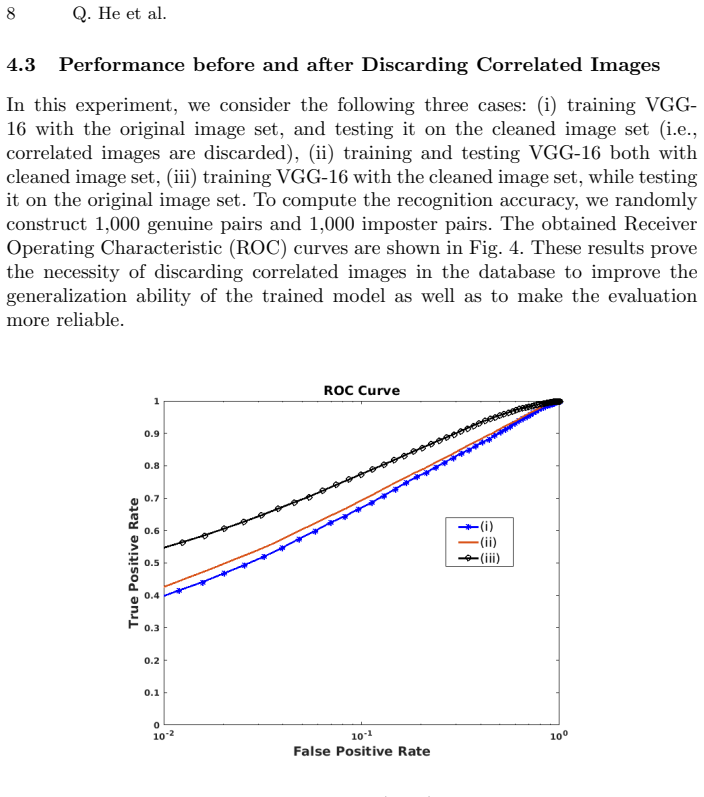
The load-bearing mechanism is landmark-based face normalization followed by learned feature matching. A U-Net produces binary masks for the two eye regions and the nose; taking the centroids of the eye masks gives eye centers, the face is rotated so the eye line is horizontal, and a fixed-proportion crop (eye distance d, with margins 1.3d above, 1.7d below, and 1.2d on each side) removes background and pose variation. Aligned faces are then embedded by a fine-tuned VGG-16, and identity is decided by maximum cosine similarity. The authors also use SSIM to remove near-duplicate video frames, which they argue is necessary for honest training and evaluation.
What would settle it
Apply the released model to a set of unconstrained red panda images (camera-trap or handheld photos with occlusions, blur, small faces, and varying pose) whose identities are known by microchip; compute end-to-end rank-1 accuracy including the detection step. If the detector misses or mis-crops enough faces to drop accuracy well below 93.3%, the automatic claim fails.
Extended reading notes
Core claim
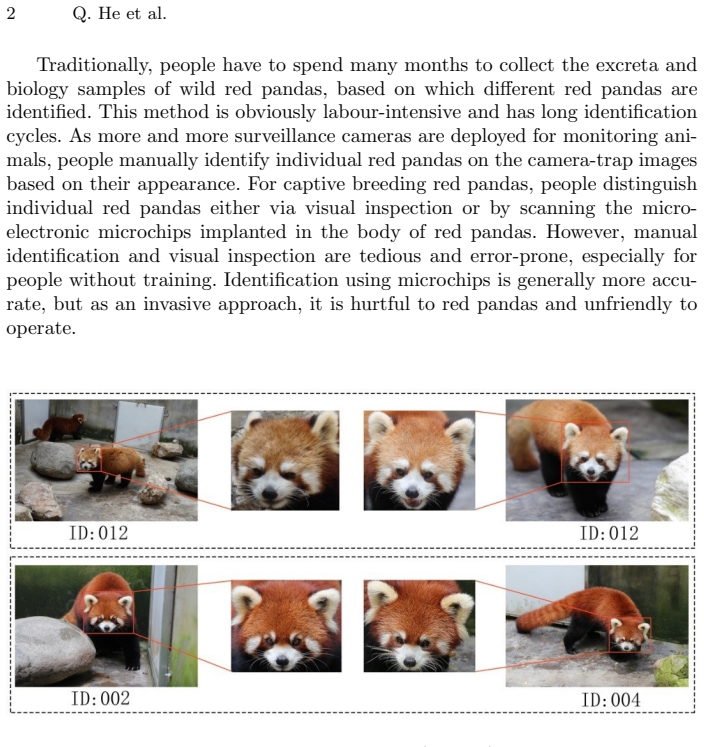
The central claim is that an individual red panda's face carries enough information to identify it, and that a pipeline of fine-tuned deep networks can extract that information. YOLOv2 detects the face; a U-Net segments the two eyes and the nose; the eye centers are used to rotate and crop the face into a canonical view; and a VGG-16 network extracts features compared by cosine similarity. On 2,877 images of 51 captive red pandas, with 17 held-out identities, automatic alignment reaches 93.3% rank-1 identification, nearly matching manually aligned faces at 93.5% and beating unaligned faces at 91.6%. The paper positions this as the first attempt at image-based automatic individual identification of red pandas.
Load-bearing premise
The accuracy claim is measured on face images that were manually selected and cropped, while the face detector that is supposed to make the pipeline fully automatic is never evaluated, so the end-to-end system's real-world accuracy depends on an unmeasured component.
Editorial extensions
If this is right
- Captive red panda monitoring could be done by camera and automatic matching instead of implanted microchips, reducing handling stress and labour.
- The released 2,877-image database gives other researchers a benchmark for red panda identification and a testbed for similar endangered-species face recognition.
- Automatic alignment is sufficient for high accuracy: at 93.3% rank-1 it nearly matches manual alignment, so users do not need to click landmarks by hand.
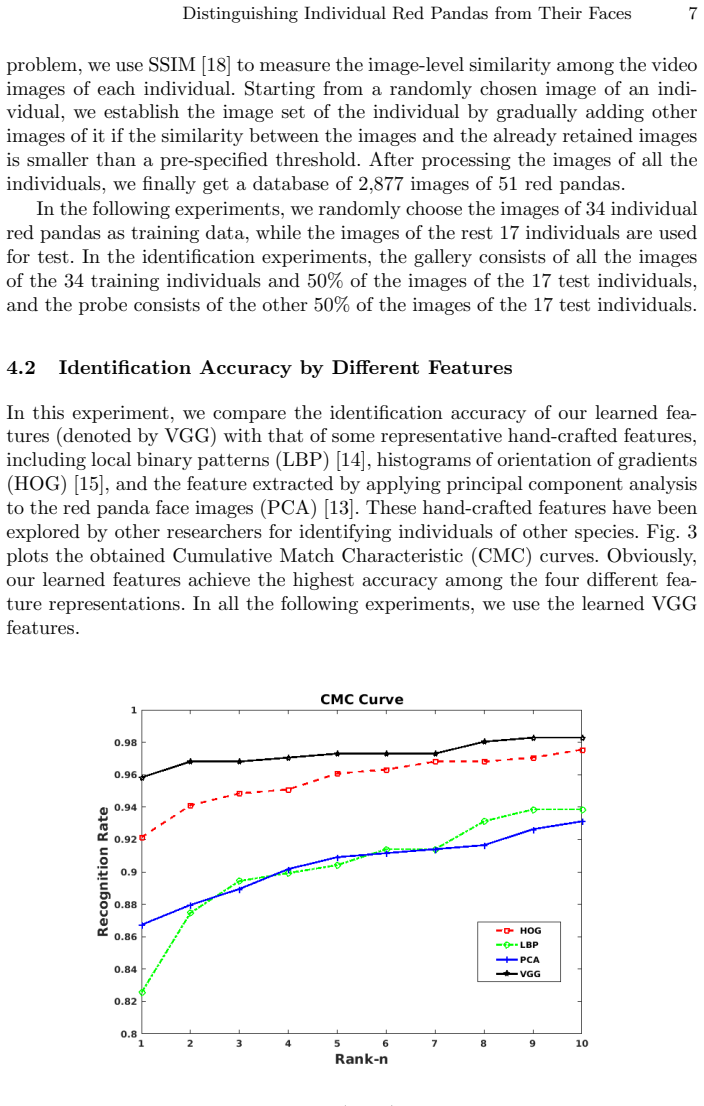
- Because learned features clearly outperform LBP, HOG, and PCA on this data, future systems for animals with subtle facial differences should start from fine-tuned deep networks rather than hand-crafted texture descriptors.
- The paper's proposed similarity threshold could flag unknown individuals, which is what an open population survey would need, although the paper does not evaluate that mode.
Reading between the lines
- The accuracy numbers come from manually cropped face images with both eyes visible; extending the identical pipeline to unconstrained camera-trap photos requires evidence about the face detector, which the paper does not evaluate, and an end-to-end test would likely lower accuracy.
- Because the database contains only frontal-like views with both eyes visible, the alignment step cannot be assumed to work under large pose, occlusion, or low illumination, which are exactly the conditions of wild camera traps.
- The closed-set 93.3% rank-1 result overstates what a wildlife manager would see in an open population, where many images belong to unknown individuals; threshold calibration, not just rank matching, is the missing piece.
- The same architecture could transfer to other species whose faces are marked by dark eye and nose patches, since the U-Net alignment is driven by appearance contrast rather than species-specific texture.
Signed reviews
Editorial analysis
A structured set of objections, weighed in public.
Referee Report
Summary. The paper proposes an automatic framework for identifying individual red pandas from face images, consisting of three modules: YOLOv2-based face detection, U-Net-based eye/nose localization and face alignment, and VGG-16-based feature extraction with cosine similarity matching. The authors constructed a new dataset of 51 captive red pandas (7,091 images, reduced to 2,877 after SSIM-based deduplication of correlated video frames) with identity labels obtained from microchips. Evaluation on a disjoint-identity split (34 training, 17 test individuals) shows that learned VGG features outperform LBP, HOG, and PCA features, and that automatic alignment achieves 93.3% ± 2.5% rank-1 identification accuracy, comparable to manual alignment. The paper claims to be the first image-based automatic individual identification method for red pandas and states that the database and model will be released.
Significance. If the results hold, this is a useful proof-of-concept for non-invasive individual identification of an endangered species. The main strengths are the construction of a new labeled dataset with verified identities, the use of a disjoint-identity train/test split, and a clear comparison of learned versus hand-crafted features. However, the central claim of a fully automatic pipeline is not substantiated because the face detection module is never evaluated; all identification experiments start from manually annotated face bounding boxes. This gap limits the current contribution to a feasibility study for identification from pre-cropped faces, pending a proper end-to-end evaluation.
major comments (3)
- [Sections 3.2, 4.1, and 4.4] The face detection module is never evaluated, which undermines the claimed fully automatic framework. Section 3.1 states that the input to the system is an image and the first step is face detection, and Section 3.2 describes fine-tuning YOLOv2 for this purpose. However, all experiments in Section 4 use the manually marked bounding boxes described in Section 4.1; no detection precision, recall, or end-to-end identification accuracy is reported. Table 3, which compares manually versus automatically aligned faces, still assumes the face has been correctly localized. The headline accuracy of 93.3% should therefore be interpreted as identification accuracy given a perfect face detector. Since the paper explicitly contrasts its method with prior work that uses pre-cropped images (Section 2), the missing detector evaluation is load-bearing for the paper's central claim. This should be addressed either by adding a detection experiment (including failure cases such as occlusion, blur, and small faces) or by revising the claims to describe a semi-automatic pipeline.
- [Section 3.4 and Section 4] The unknown-individual rejection threshold described in Section 3.4 is not evaluated. The paper states that if the highest similarity is below a threshold, the probe is declared to be a new individual, which is essential for practical deployment in population monitoring. No experiment reports the accuracy of this mechanism, the choice of threshold, or its ROC behavior for open-set identification. This is a missing component of the claimed automatic identification system and should be tested or explicitly deferred to future work.
- [Sections 4.1 and 4.4, Table 3] The cross-validation protocol is unclear. Section 4.1 describes a single random split into 34 training and 17 test individuals, with the gallery containing all training images and 50% of test images, and the probe set containing the other 50%. Table 3, however, is described as 'three-fold cross validation' results with mean ± standard deviation, which implies that the random split was repeated multiple times. The manuscript does not specify how many trials, how the random splits were generated, or whether the reported numbers average over different gallery/probe partitions. This ambiguity makes it difficult to assess the statistical reliability of the reported rank-1 accuracy. The authors should clarify the protocol and, ideally, report per-fold results.
minor comments (5)
- [Section 1] There is a typographical error in the first paragraph: 'see Fig. 1))' has an extra closing parenthesis.
- [Section 2, Table 1] In the title of Table 1, 'T able' should be 'Table'. Also, the table formatting is inconsistent across rows, with some entries missing or misaligned.
- [Section 4.2, Figure 3] The CMC curves in Figure 3 are shown without error bars or confidence intervals, even though later tables report variance. Adding spread or significance tests would strengthen the comparison of feature representations.
- [Reference list] Reference [13] contains a typo: 'Pincipal' should be 'Principal'.
- [Section 4.4, Table 2] The landmark localization error is reported as MSE in pixels on 224×224 images, but it is unclear whether this is a mean over all images or a per-image average; please specify the aggregation procedure.
Circularity Check
No circularity: identification accuracy is measured on held-out individuals, and no fitted parameter is re-branded as a prediction.
full rationale
The paper's central claim—that individual red pandas can be distinguished from their faces—is supported by an evaluation that uses 34 individuals for training and 17 held-out individuals for testing (Section 4.1), with gallery and probe split from the test individuals. The VGG-16 features are fine-tuned on the training identities and then tested on identities never seen during training, so the rank-1 identification rate is not forced by construction. The SSIM-based deduplication and the manual crop-ratio parameters (a=1.3, b=1.7, c=1.2) are set before evaluation and are not optimized against test accuracy; they affect image quality and may introduce bias, but do not make the reported accuracy equivalent to an input. The face alignment module is evaluated by comparing automatically aligned, manually aligned, and unaligned inputs (Table 3), and the comparison is an empirical measurement, not a definitional identity. The YOLOv2 face detector is described as part of the automatic pipeline (Section 3.2) but its accuracy is not separately measured, so the fully automatic end-to-end claim is not fully substantiated; this is a missing evaluation / correctness risk, not a circular derivation. Standard pre-trained models and datasets are cited from the literature ([16], [17], [19]-[21]) and are not self-citations, and no uniqueness theorem or prior result by the same authors is invoked to force the method. Therefore no step in the derivation chain reduces to its own inputs.
Assumptions & free parameters
free parameters (4)
- SSIM deduplication threshold =
not reported
- Face crop ratios (a, b, c) =
a=1.3, b=1.7, c=1.2
- Eye and nose region radii for U-Net masks =
7 pixels (eyes), 13 pixels (nose)
- Unknown-individual similarity threshold =
not reported
assumptions (4)
- domain assumption Pre-trained YOLOv2, VGG-Face, and U-Net models transfer to red panda images after fine-tuning.
- domain assumption Microchip-based identity labels are correct ground truth.
- domain assumption Both eyes visible is sufficient and necessary for identification.
- ad hoc to paper SSIM-based deduplication preserves identity-relevant variation.
Cite this review
Pith. "Pith review of Distinguishing Individual Red Pandas from Their Faces." pith.science (2026). https://pith.science/paper/CKI6BQHY
@misc{pith2026190803391,
  author       = {Pith},
  title        = {Pith review of: Distinguishing Individual Red Pandas from Their Faces},
  year         = {2026},
  howpublished = {\url{https://pith.science/paper/CKI6BQHY}},
  note         = {Machine review of arXiv:1908.03391}
}
read the original abstract
Individual identification is essential to animal behavior and ecology research and is of significant importance for protecting endangered species. Red pandas, among the world's rarest animals, are currently identified mainly by visual inspection and microelectronic chips, which are costly and inefficient. Motivated by recent advancement in computer-vision-based animal identification, in this paper, we propose an automatic framework for identifying individual red pandas based on their face images. We implement the framework by exploring well-established deep learning models with necessary adaptation for effectively dealing with red panda images. Based on a database of red panda images constructed by ourselves, we evaluate the effectiveness of the proposed automatic individual red panda identification method. The evaluation results show the promising potential of automatically recognizing individual red pandas from their faces. We are going to release our database and model in the public domain to promote the research on automatic animal identification and particularly on the technique for protecting red pandas.
Figures
Figures from the paper (1 more)
Reference graph
Works this paper leans on
-
[1]
Doctor, Yangzhou University (2015)
Yunfang X.: Genetic Diversity of the Captive Red Panda in China and Paternity. Doctor, Yangzhou University (2015)
work page 2015
-
[2]
UK.2015-4.RLTS.T714A45195924.en
The IUCN Red List of Threatened Species, http://dx.doi.org/10.2305/IUCN. UK.2015-4.RLTS.T714A45195924.en. last accessed 2019/4/18
-
[3]
In: Fifth International Penguin Conference, Ushuaia (2004)
Burghardt T, Thomas B, Barham P, et al.: Automated visual recognition of in- dividual African penguins. In: Fifth International Penguin Conference, Ushuaia (2004)
work page 2004
-
[4]
Doctor, Northeast Forestry University (2008)
Peng Z.: Study on Northeast Tiger Skin Texture Extraction and Recognition Based on BP Network. Doctor, Northeast Forestry University (2008)
work page 2008
-
[5]
Tharwat A , Gaber T , Hassanien A E , et al.: Cattle Identification Using Muzzle Print Images Based on Texture Features Approach. In: Proceedings of the Fifth International Conference on Innovations in Bio-Inspired Computing and Applica- tions IBICA 2014, pp. 217-227. Springer, Cham, (2014)
work page 2014
-
[6]
Crouse D, Jacobs R L, Richardson Z, et al.: LemurFaceID: a face recognition system to facilitate individual identification of lemurs. Bmc Zoology, 2(1), 2 (2017)
work page 2017
-
[7]
Computers and Electronics in Agriculture, 142, 622- 631 (2017)
Li W, Ji Z, Wang L, et al.: Automatic individual identification of Holstein dairy cows using tailhead images. Computers and Electronics in Agriculture, 142, 622- 631 (2017)
work page 2017
-
[8]
International Journal of Computer Vision, 122(3), 542-557 (2017)
Hughes B, Burghardt T.: Automated visual fin identification of individual great white shark. International Journal of Computer Vision, 122(3), 542-557 (2017)
work page 2017
Show all 23 references
-
[9]
ACTA Theriologica Sinicamode, 39(1), 43-51 (2019)
Houjin, Zheng Bochuan, et al.: Facial recognition of giant pandas based on develop- mental network recognition. ACTA Theriologica Sinicamode, 39(1), 43-51 (2019)
2019
-
[10]
K.: Face recognition: Primates in the wild
Deb, D., Wiper, S., Gong, S., Shi, Y., Tymoszek, C., Fletcher, A., and Jain, A. K.: Face recognition: Primates in the wild. In: IEEE 9th International Conference on Biometrics Theory, Applications and Systems (BTAS), pp. 1-10. IEEE (2019)
2019
-
[11]
Computers in Industry, 98, 145-152 (2018)
Hansen M F, Smith M L, Smith L N, et al.: Towards on-farm pig face recognition using convolutional neural networks. Computers in Industry, 98, 145-152 (2018)
2018
-
[12]
IET Computer Vision, 12(2), 146-152 (2018)
Chehrsimin T, Eerola T, Koivuniemi M, et al.: Automatic individual identification of Saimaa ringed seals. IET Computer Vision, 12(2), 146-152 (2018)
2018
-
[13]
Journal of Marketing Research, 25(4), 513 (2002)
Jolliffe I T.: Pincipal Component Analysis. Journal of Marketing Research, 25(4), 513 (2002). Distinguishing Individual Red Pandas from Their Faces 11
2002
-
[14]
In: International Conference on Biometrics, pp
Liao S, Zhu X, Lei Z, et al.: Learning multi-scale block local binary patterns for face recognition. In: International Conference on Biometrics, pp. 828-837. Springer, Berlin, Heidelberg (2007)
2007
-
[15]
In: Interna-tional Conference on Computer Vision and Pattern Recognition, pp
Dalal N, Triggs B.: Histograms of oriented gradients for human detection. In: Interna-tional Conference on Computer Vision and Pattern Recognition, pp. 886-
-
[16]
In: International Conference on Medical image computing and computer-assisted intervention, pp
Ronneberger O, Fischer P, Brox T.: U-net: Convolutional networks for biomedical im-age segmentation. In: International Conference on Medical image computing and computer-assisted intervention, pp. 234-241. Springer, Cham (2015)
2015
-
[17]
In: CoRR abs/1409.1556 (2015)
Simonyan K, Zisserman A.: Very Deep Convolutional Networks for Large-Scale Image Recognition. In: CoRR abs/1409.1556 (2015)
2015 arXiv
-
[18]
IEEE transactions on image processing, 13(4), 600-612 (2004)
Wang Z, Bovik A C, Sheikh H R, et al.: Image quality assessment: from error visibility to structural similarity. IEEE transactions on image processing, 13(4), 600-612 (2004)
2004
-
[19]
In: 2017 IEEE Con-ference on Computer Vision and Pattern Recognition (CVPR2017), pp.6517-
Joseph Redmon, Ali Farhadi.:YOLO9000: Better, Faster, Stronger. In: 2017 IEEE Con-ference on Computer Vision and Pattern Recognition (CVPR2017), pp.6517-
2017
-
[20]
Last accessed 2019/01/30
The pretrained YOLOv2 Model, https://pjreddie.com/darknet/yolov2/. Last accessed 2019/01/30
2019
-
[21]
Last accessed 2019/01/30
The pretrained VGG FACE.caffemodel, http://www.robots.ox.ac.uk/~vgg/ software/vgg_face/. Last accessed 2019/01/30
2019
-
[893]
IEEE, Computer Society (2005)
2005
-
[6525]
IEEE, Computer Society (2017)
2017
Reviewed August 14, 2026 · model on record in the stance chip above.
Discussion (0). Continue with ORCID to comment.