Pion and Kaon PDFs via Infrared-Safe Evolution augmented by J/psi Data Constraints
Pith reviewed 2026-06-29 03:25 UTC · model grok-4.3
The pith
Infrared-safe QCD evolution combined with J/ψ data constraints yields improved gluon distributions at moderate and large x for pion and kaon PDFs.
A machine-rendered reading of the paper's core claim, the machinery that carries it, and where it could break.
Core claim
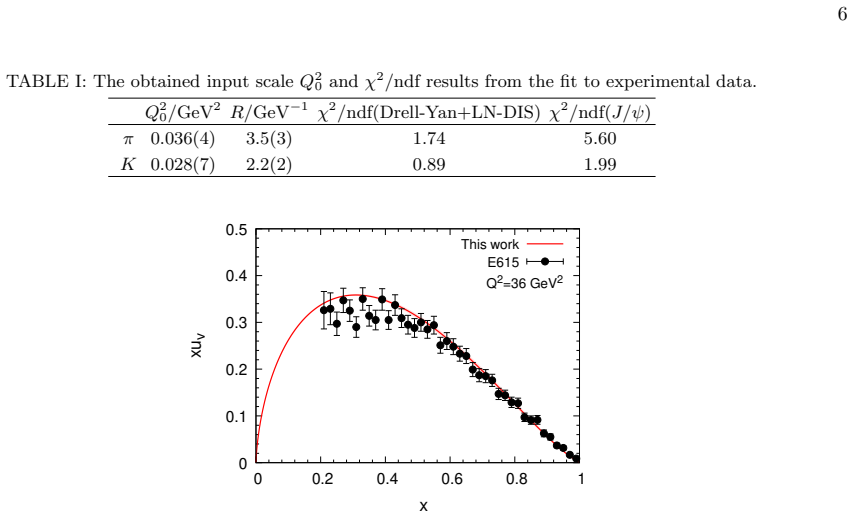
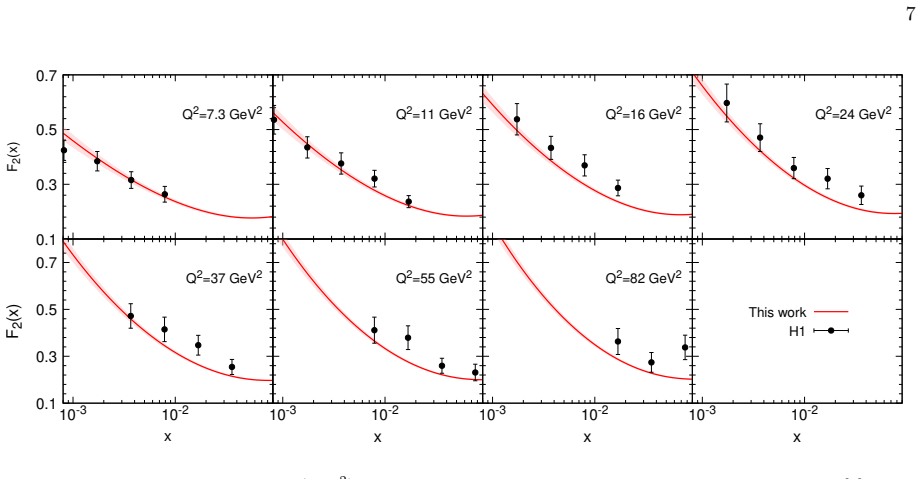
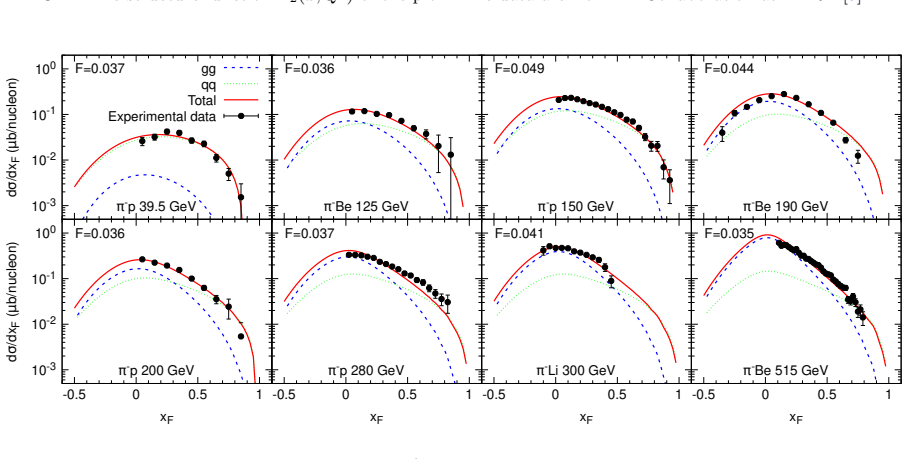
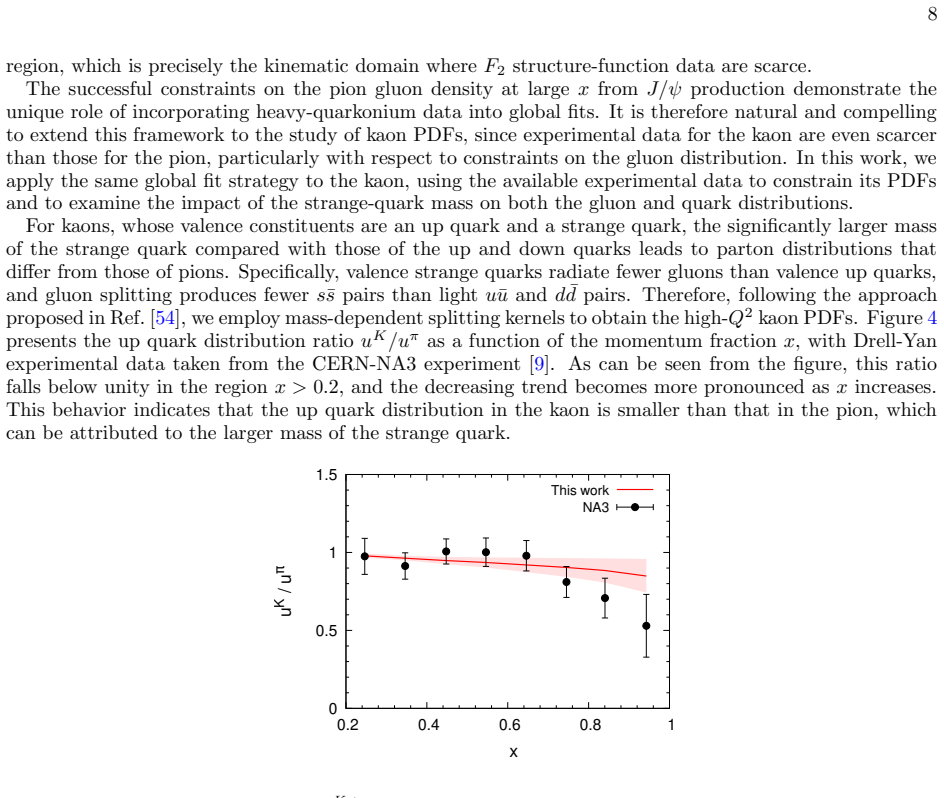
The central claim is that the infrared-safe QCD evolution scheme, when combined with pion- and kaon-induced J/ψ hadroproduction data as constraints inside the dynamical parton model and maximum entropy method framework, produces PDFs that describe existing Drell-Yan, F2, and J/ψ data well while delivering substantially improved constraints on the gluon distributions at moderate and large x in the pion and the kaon.
What carries the argument
The infrared-safe QCD evolution scheme that extends PDF evolution to low Q² near the hadronic scale, augmented by J/ψ hadroproduction data constraints.
If this is right
- The PDFs provide a good description of available Drell-Yan data, deep-inelastic scattering structure functions F2, and J/ψ production across energies and targets.
- Gluon distributions receive significantly improved constraints at moderate and large x for both the pion and the kaon.
- The method enables PDF evolution down to low Q² without uncontrolled uncertainties.
- The results offer a more complete picture of the internal partonic structure of the pion and kaon.
Where Pith is reading between the lines
- The same combination of infrared-safe evolution and specific production data could be tested on other light mesons where gluon information is also sparse.
- Tighter gluon constraints at moderate x may alter predictions for processes involving heavy-quark production in meson-nucleon collisions.
- If the low-scale reliability holds, similar schemes might reduce model dependence in fits that must bridge perturbative and non-perturbative regimes.
Load-bearing premise
The infrared-safe QCD evolution scheme allows reliable extension of the PDFs down to very low Q² approaching the hadronic scale without introducing uncontrolled uncertainties or model artifacts.
What would settle it
New precision data on J/ψ production or deep-inelastic scattering at low Q² that the evolved PDFs fail to describe would indicate the central claim does not hold.
Figures
read the original abstract
Probing the partonic structure of the pion and the kaon provides essential insights into the non-perturbative dynamics of QCD, yet their parton distribution functions (PDFs) remain poorly constrained due to the scarcity of high-precision experimental data, especially for the gluon distributions. We present an improved determination of pion and kaon PDFs within the dynamical parton model combined with the maximum entropy method (MEM) framework. Our analysis features two key advancements: firstly, we employ an infrared-safe QCD evolution scheme, allowing the evolution to be reliably extended down to very low $Q^2$, approaching the hadronic scale; secondly, we incorporate pion- and kaon-induced $J/\psi$ hadroproduction data as crucial constraints in the global fit. We find that our approach yields a good description of the available Drell-Yan data, deep-inelastic scattering structure functions ($F_2$), and $J/\psi$ production across various energies and targets. The results provide significantly improved constraints on the gluon distributions at moderate and large $x$ in both the pion and the kaon, offering a more complete picture of their internal structure.
Editorial analysis
A structured set of objections, weighed in public.
Referee Report
Summary. The manuscript presents a determination of the parton distribution functions (PDFs) for the pion and kaon using a dynamical parton model within the maximum entropy method (MEM) framework. The key advancements are an infrared-safe QCD evolution scheme that extends to low Q² near the hadronic scale and the inclusion of J/ψ hadroproduction data as additional constraints in the global fit. The authors report that this approach provides a good description of Drell-Yan, deep-inelastic scattering F2, and J/ψ production data, leading to significantly improved constraints on the gluon distributions at moderate and large x.
Significance. If the infrared-safe evolution is validated as reliable down to hadronic scales and the J/ψ constraints are shown to be independent and robust, the work would provide useful improvements to poorly constrained meson gluon PDFs. These are relevant for QCD phenomenology involving pion and kaon beams. The combination of MEM with new data channels addresses a recognized gap in meson PDF determinations.
major comments (2)
- [Abstract] Abstract: The central claim that the infrared-safe QCD evolution scheme allows reliable extension to very low Q² approaching the hadronic scale without uncontrolled uncertainties or model artifacts is load-bearing but unsupported by any explicit validation (e.g., no comparison to standard DGLAP results in the overlap region, no tests of momentum sum rules or valence number conservation at the lowest scales, and no confrontation with lattice inputs).
- [Abstract] Abstract: The assertion of a 'good description' of Drell-Yan, F2, and J/ψ data together with 'significantly improved constraints' on gluons lacks any quantitative details on fit quality, error bars, chi-squared values, or direct comparison to prior fits, preventing assessment of whether the J/ψ data genuinely tightens the gluon distributions beyond parametrization choices.
minor comments (1)
- The abstract would benefit from a brief statement of the lowest Q² reached and the specific data sets included in the global fit to allow readers to gauge the scope immediately.
Simulated Author's Rebuttal
We thank the referee for their careful reading of the manuscript and for the constructive comments. We respond to each major comment below and indicate the revisions we will make to the abstract.
read point-by-point responses
-
Referee: [Abstract] Abstract: The central claim that the infrared-safe QCD evolution scheme allows reliable extension to very low Q² approaching the hadronic scale without uncontrolled uncertainties or model artifacts is load-bearing but unsupported by any explicit validation (e.g., no comparison to standard DGLAP results in the overlap region, no tests of momentum sum rules or valence number conservation at the lowest scales, and no confrontation with lattice inputs).
Authors: We agree that the abstract, being concise, does not explicitly reference the supporting validations. The manuscript body contains direct comparisons of the infrared-safe evolution against standard DGLAP in the overlap region above 1 GeV², explicit checks that momentum sum rules and valence number conservation hold at the lowest evolution scales, and consistency checks against available lattice moments. To address the referee's concern, we will revise the abstract to include a brief statement referencing these validations. revision: yes
-
Referee: [Abstract] Abstract: The assertion of a 'good description' of Drell-Yan, F2, and J/ψ data together with 'significantly improved constraints' on gluons lacks any quantitative details on fit quality, error bars, chi-squared values, or direct comparison to prior fits, preventing assessment of whether the J/ψ data genuinely tightens the gluon distributions beyond parametrization choices.
Authors: We acknowledge that the abstract would benefit from quantitative indicators to allow immediate assessment. The full manuscript reports the global chi-squared per degree of freedom, shows the reduction in gluon uncertainties when J/ψ data are included versus excluded, and compares the resulting gluon distributions to earlier pion and kaon PDF sets. We will revise the abstract to incorporate key quantitative metrics on fit quality and the improvement in gluon constraints at moderate and large x. revision: yes
Circularity Check
No circularity: standard global PDF fit with independent method choice
full rationale
The paper performs a global fit of pion/kaon PDFs within the dynamical parton model + MEM framework, using Drell-Yan, DIS F2, and J/ψ data as inputs. The two 'key advancements' (IR-safe evolution to low Q² and inclusion of J/ψ constraints) are methodological choices whose outputs are the fitted distributions; the claim of 'good description' of the fitted data and 'improved gluon constraints' follows directly from the fit procedure without any self-referential reduction or renaming of inputs as predictions. No equations or sections in the abstract or described structure exhibit self-definition, fitted-input-called-prediction, or load-bearing self-citation chains. The derivation remains self-contained against external data benchmarks.
Axiom & Free-Parameter Ledger
free parameters (1)
- initial PDF parameters at hadronic scale
axioms (1)
- domain assumption Infrared-safe QCD evolution remains valid and accurate down to Q² near the hadronic scale
Reference graph
Works this paper leans on
-
[1]
The exponentB π governs the behavior at smallx (Regge limit), whileC π controls the fall-off at largex(threshold region)
=A πxBπ (1−x) Cπ .(1) Here,A π,B π andC π are undetermined parameters. The exponentB π governs the behavior at smallx (Regge limit), whileC π controls the fall-off at largex(threshold region). Furthermore, the normalization 3 constantA π ensures the satisfaction of the valence number sum rule 1Z 0 uv(x, Q2 0)dx= 1Z 0 ¯dv(x, Q2 0)dx= 1.(2) In addition, the...
-
[2]
However, by employing modified evolution equations, the evolution starting scaleQ 2 0 can be set at a very low point
+ ¯dv(x, Q2 0)]dx= 1.(3) It is worth noting that if initial gluon and sea quark components were included, the momentum fraction carried by valence quarks would be less than unity. However, by employing modified evolution equations, the evolution starting scaleQ 2 0 can be set at a very low point. This scale is low enough that dressed valence quarks can in...
-
[3]
ln(¯dv(x, Q2 0))]dx.(4) Using the maximum entropy principle and the constraints from Eqs.(2) and (3), we find that the non- perturbative inputs satisfy a uniform distribution uv(x, Q2
-
[4]
= 1.(5) Following the same procedure, the initial valence quark distribution functions and constraints for the kaon can also be obtained. The only difference lies in the valence quark flavor content of the pion and the kaon; namely, one only needs to replace the ¯dvalence quark in the pion by the ¯svalence quark in the kaon. Once the non-perturbative inpu...
-
[5]
Parton distributions at arbitrary scales are then obtained using an infrared-safe evolution scheme
SinceQ 2 0 is model dependent, it is treated as a free parameter. Parton distributions at arbitrary scales are then obtained using an infrared-safe evolution scheme. In the evolution equations,Rdenotes the correlation length between two overlapping partons; as an undetermined parameter, it is also treated as a free parameter. To comprehensively determine ...
-
[6]
Nambu, Phys
Y. Nambu, Phys. Rev.117, 648-663 (1960)
1960
-
[7]
Goldstone, A
J. Goldstone, A. Salam and S. Weinberg, Phys. Rev.127, 965-970 (1962)
1962
-
[8]
C. D. Roberts, D. G. Richards, T. Horn and L. Chang, Prog. Part. Nucl. Phys.120, 103883 (2021)
2021
-
[9]
Badieret al.[NA3], Z
J. Badieret al.[NA3], Z. Phys. C18, 281 (1983)
1983
-
[10]
Betevet al.[NA10], Z
B. Betevet al.[NA10], Z. Phys. C28, 9 (1985)
1985
-
[11]
J. S. Conway et al. [E615], Phys. Rev. D39, 92-122 (1989)
1989
-
[12]
F. D. Aaron et al. [H1], Eur. Phys. J. C68, 381-399 (2010)
2010
-
[13]
Chekanov et al
S. Chekanov et al. [ZEUS], Nucl. Phys. B637, 3-56 (2002)
2002
-
[14]
Badier et al
J. Badier et al. [NA3], Phys. Lett. B93, 354-356 (1980)
1980
-
[15]
Gl¨ uck, E
M. Gl¨ uck, E. Reya, and M. Stratmann, Eur. Phys. J. C2, 159 (1998)
1998
-
[16]
P. J. Sutton, A. D. Martin, R. G. Roberts, and W. J. Stirling, Phys. Rev. D45, 2349 (1992)
1992
-
[17]
P. C. Barry, N. Sato, W. Melnitchouk, and C.-R. Ji, Phys. Rev. Lett.121, 152001 (2018)
2018
-
[18]
Novikov et al
I. Novikov et al. [xFitter], Phys. Rev. D102, 014040 (2020)
2020
-
[19]
Z. F. Cui, M. Ding, F. Gao et al., Eur. Phys. J. C80, no.11, 1064 (2020)
2020
-
[20]
K. D. Bednar, I. C. Clo¨ et and P. C. Tandy, Phys. Rev. Lett.124, no.4, 042002 (2020)
2020
-
[21]
Miller, J
J. Miller, J. Torsiello, I. Andersonet et al., Phys. Rev. D113, no.11, 114506 (2026)
2026
-
[22]
X. Gao, L. Jin, C. Kallidonis et al., Phys. Rev. D102, 094513 (2020)
2020
-
[23]
G. F. de Teramondet al.[HLFHS], Phys. Rev. Lett.120, no.18, 182001 (2018)
2018
-
[24]
J. Lan, C. Mondal, S. Jia, X. Zhao and J. P. Vary, Phys. Rev. Lett.122, no.17, 172001 (2019)
2019
-
[25]
Watanabe, T
A. Watanabe, T. Sawada, and C. W. Kao, Phys. Rev. D97, 074015 (2018)
2018
-
[26]
C. Han, H. Xing, X. Wang et al., Phys. Lett. B800135066 (2020)
2020
-
[27]
C. Han, G. Xie, R. Wang et al., Eur. Phys. J. C81, no.4, 302 (2021)
2021
-
[28]
Zhang, X
S. Zhang, X. Wang, T. Lin and L. Chang, Chin. Phys. C48, no.3, 033106 (2024)
2024
-
[29]
W. C. Chang, J. C. Peng, S. Platchkov et al., Phys. Rev. D102, no.5, 054024 (2020)
2020
-
[30]
W. C. Chang, J. C. Peng, S. Platchkov and T. Sawada, Phys. Lett. B855, 138820 (2024)
2024
-
[31]
R. Wang, C. Han and X. Chen, Phys. Rev. D110, no.11, 114011 (2024)
2024
-
[32]
Abramowicz, I
H. Abramowicz, I. Abt, L. Adamczyk et al., Eur. Phys. J. C75, 580 (2015)
2015
-
[33]
Pumplin, D
J. Pumplin, D. R. Stump, J. Huston et al., JHEP07, 012 (2002)
2002
-
[34]
Wang and X
R. Wang and X. Chen, Phys. Rev. D91, 054026 (2015)
2015
-
[35]
J. Chen, X. Wang, Y. Cai et al., Chin. Phys. C50, no.1, 013103 (2026)
2026
-
[36]
S. M. Hu, A. S. Xiong, J. Xu et al., [arXiv:2508.05171 [hep-ph]]
work page internal anchor Pith review Pith/arXiv arXiv
-
[37]
Altarelli and G
G. Altarelli and G. Parisi, Nucl. Phys. B126298 (1977)
1977
-
[38]
V. N. Gribov and L. N. Lipatov, Sov. J. Nucl. Phys.15438 (1972)
1972
-
[39]
L. N. Lipatov, Yad. Fiz.20181 (1974)
1974
-
[40]
Y. L. Dokshitzer, Sov. Phys. JETP46641 (1977)
1977
-
[41]
A. H. Mueller and J. W. Qiu, Nucl. Phys. B268427 (1986)
1986
-
[42]
Zhu and J
W. Zhu and J. Ruan, Nucl. Phys. B559, 378 (1999)
1999
-
[43]
J. Ruan, Z. Shen, J. Yang et al., Nucl. Phys. B760128 (2007)
2007
-
[44]
Wang and X
R. Wang and X. Chen, Chin. Phys. C41053103 (2017)
2017
-
[45]
A. C. Aguilar, F. De Soto, M. N. Ferreira et al., Eur. Phys. J. C80, no.2, 154 (2020)
2020
-
[46]
Binosi, C
D. Binosi, C. Mezrag, J. Papavassiliou et al., Phys. Rev. D96, no.5, 054026 (2017)
2017
-
[47]
Z. F. Cui, J. L. Zhang, D. Binosi et al., Chin. Phys. C44, no.8, 083102 (2020)
2020
-
[48]
M. L. Mangano, P. Nason, and G. Ridolfi, Nucl. Phys. B405, 507 (1993)
1993
-
[49]
Nason, S
P. Nason, S. Dawson, and R. K. Ellis, Nucl. Phys. B327, 49 (1989)
1989
-
[50]
Nason, S
P. Nason, S. Dawson, and R. K. Ellis, Nucl. Phys. B303, 607 (1988)
1988
-
[51]
M. J. Corden, J. D. Dowell, J. Garvey et al., Phys. Lett. B98, 220-224 (1981)
1981
-
[52]
Tzamarias, S
S. Tzamarias, S. Katsanevas, C. Kourkoumelis et al., Phys. Rev. D48, 5067-5080 (1993)
1993
-
[53]
Badier et al
J. Badier et al. [NA3], Z. Phys. C20, 101 (1983)
1983
-
[54]
J. G. McEwen, B. Pietrzyk, R. Barate et al., Phys. Lett. B121, 198-202 (1983)
1983
-
[55]
Antoniazzi et al
L. Antoniazzi et al. [E705], Phys. Rev. D46, 4828-4835 (1992)
1992
-
[56]
Gribushin et al
A. Gribushin et al. [E672 and E706], Phys. Rev. D53, 4723-4733 (1996)
1996
-
[57]
Dulat, T
S. Dulat, T. J. Hou, J. Gao et al., Phys. Rev. D93, no.3, 033006 (2016)
2016
-
[58]
K. J. Eskola, P. Paakkinen, H. Paukkunen and C. A. Salgado, Eur. Phys. J. C77, no.3, 163 (2017)
2017
-
[59]
Z. F. Cui, M. Ding, F. Gao et al., Eur. Phys. J. A57, 5 (2021)
2021
-
[60]
M. J. Corden, J. D. Dowell, J. Garvey et al., Phys. Lett. B96, 411 (1980)
1980
discussion (0)
Sign in with ORCID, Apple, or X to comment. Anyone can read and Pith papers without signing in.