Efficient emulation of nuclear ground states with neural-network variational Monte Carlo and eigenvector continuation
Pith reviewed 2026-06-27 05:39 UTC · model grok-4.3
The pith
Leading-order pionless effective field theory cannot simultaneously match the ground-state energies of carbon-12 and oxygen-16.
A machine-rendered reading of the paper's core claim, the machinery that carries it, and where it could break.
Core claim
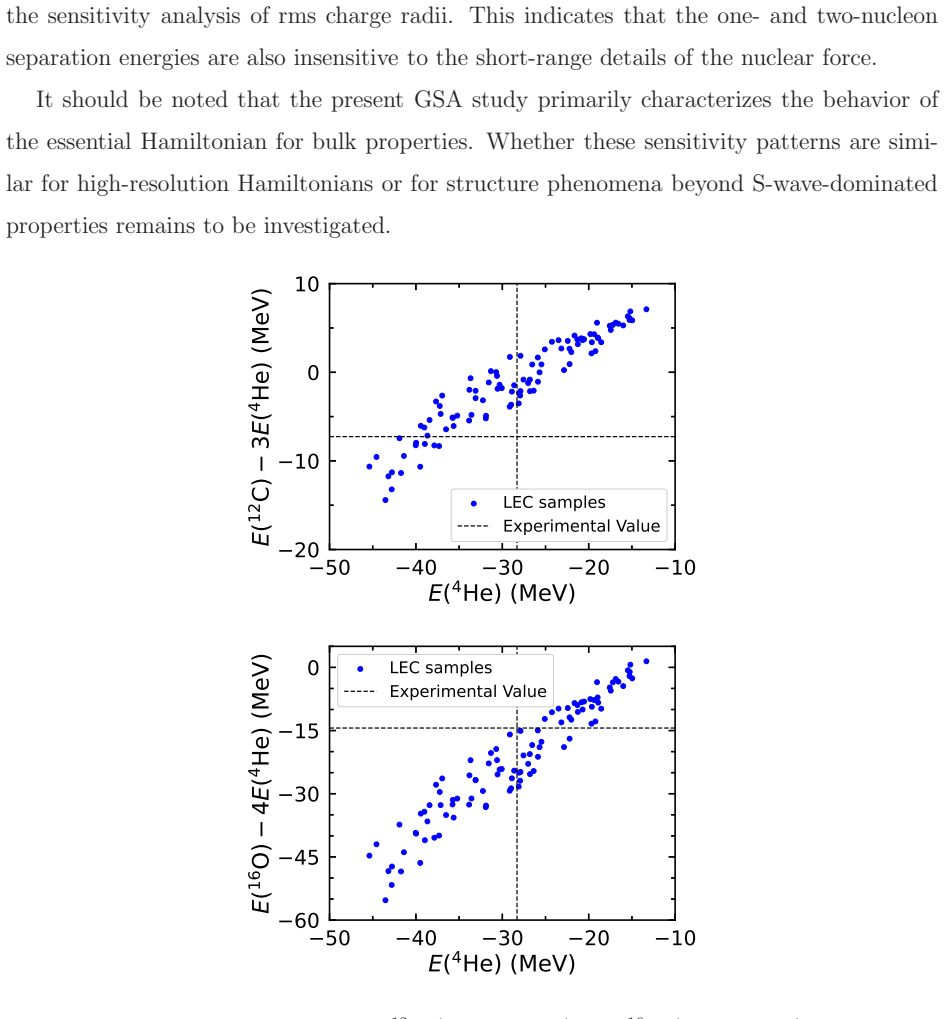
Varying the three low-energy constants inside the leading-order pionless Hamiltonian produces a family of calculated ground-state energies for helium-4, carbon-12, and oxygen-16 whose correlations show that the experimental values for carbon-12 and oxygen-16 lie outside any single point in that family. The analysis therefore concludes that additional physics beyond the leading-order two-body terms is required to describe these light nuclei.
What carries the argument
The combination of FeynmanNet neural-network variational Monte Carlo with eigenvector continuation, which supplies fast, accurate ground-state energies for new low-energy constant values.
If this is right
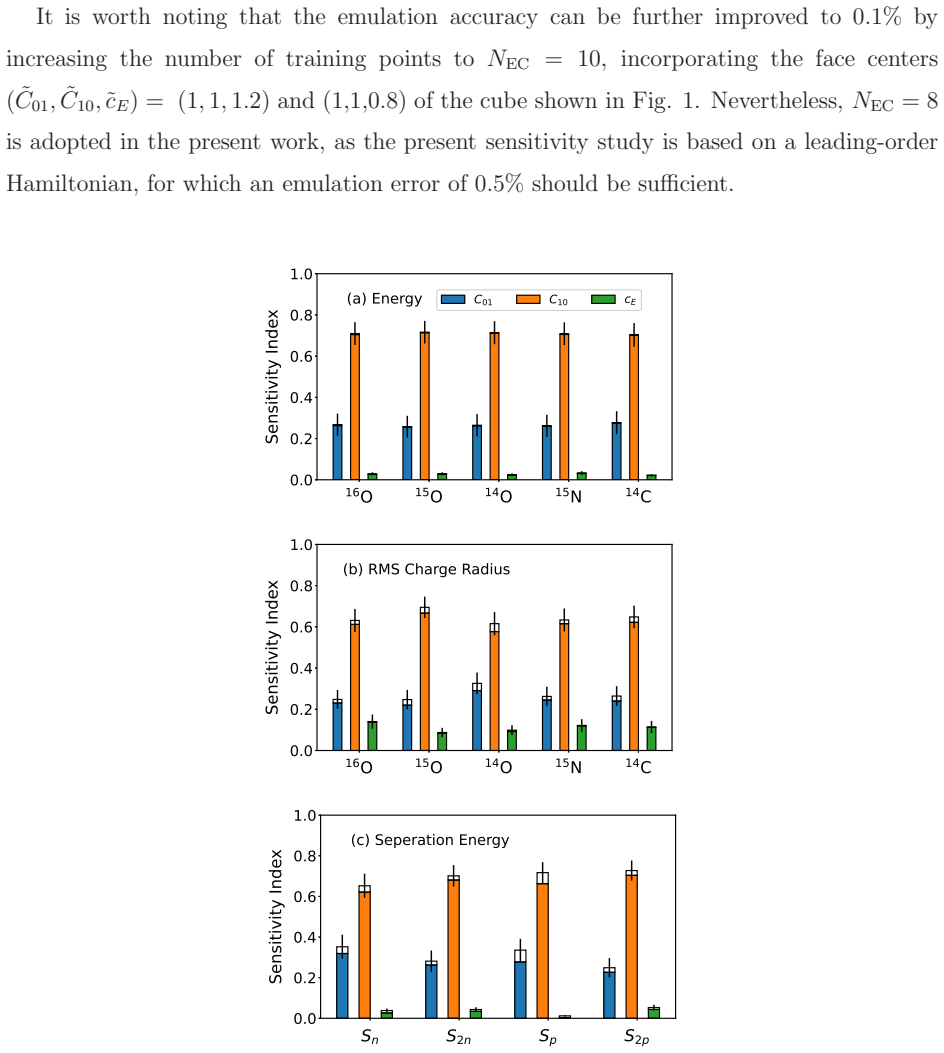
- The two-body low-energy constant in the triplet S-wave channel is the dominant driver of ground-state energies, charge radii, and separation energies across the studied nuclei.
- Global sensitivity analysis and uncertainty quantification become feasible for variational Monte Carlo calculations on light and medium-mass nuclei.
- The binding energies of helium-4, carbon-12, and oxygen-16 are strongly correlated once the low-energy constants are allowed to vary.
- The leading-order pionless Hamiltonian requires additional terms to describe the ground states of carbon-12 and oxygen-16 simultaneously.
Where Pith is reading between the lines
- Extending the emulator to include three-nucleon forces or next-to-leading-order terms could test whether those additions remove the incompatibility between the two nuclei.
- The same workflow could be applied to other observables such as electromagnetic moments or excitation spectra to map which quantities are most sensitive to missing physics.
- If the incompatibility persists at higher orders, it would point to a deeper limitation in the pionless formulation rather than a simple parameter-tuning issue.
Load-bearing premise
Eigenvector continuation reproduces the full FeynmanNet ground-state energies for new low-energy constant values to within 0.5 percent.
What would settle it
A full FeynmanNet calculation performed at a low-energy constant point where the emulator predicts both carbon-12 and oxygen-16 binding energies within a few hundred keV of experiment, if it instead yields an error larger than 0.5 percent or shows that the two nuclei still cannot be fit together.
Figures
read the original abstract
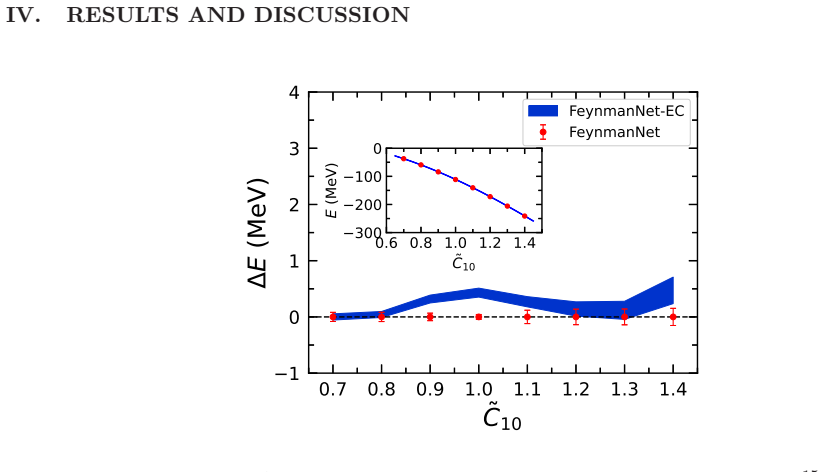
An efficient emulator for \emph{ab initio} calculations of nuclear ground-state properties is developed by integrating the neural-network variational Monte Carlo framework, FeynmanNet, with the eigenvector continuation. It enables the calculation of observables for different Hamiltonians with minimal computational cost, while delivering ground-state energies with errors below $0.5\%$ compared to the full FeynmanNet results. With this emulator, the ground-state energies and charge radii of ${}^{16}\mathrm{O}$, ${}^{15}\mathrm{O}$, ${}^{14}\mathrm{O}$, ${}^{15}\mathrm{N}$, and ${}^{14}\mathrm{C}$ are computed using a nuclear Hamiltonian derived from the leading-order pionless effective field theory, with a large number of different values of low-energy constants (LECs). Then, we perform a global sensitivity analysis of the ground-state energies, charge radii, separation energies of selected nuclei for the three LECs in the Hamiltonian, to identify how each LEC contributes to the variances of these observables. It shows that the two-body LEC in the $^3S_1$ channel is the most influential LEC governing these nuclear bulk properties. Finally, the correlations among the ground-state energies of $^4$He, $^{12}$C, and $^{16}$O are investigated by varying the LECs in the Hamiltonian. The analysis reveals that the experimental ground-state energies of $^{12}$C and $^{16}$O cannot be reproduced simultaneously by varying the LECs in the leading-order pionless Hamiltonian. This suggests that additional ingredients in the leading-order Hamiltonian are required to improve its description of light nuclei. The present work establishes an efficient framework for global sensitivity analysis and uncertainty quantification in the quantum Monte Carlo calculations for light and medium-mass nuclei.
Editorial analysis
A structured set of objections, weighed in public.
Referee Report
Summary. The paper develops an emulator integrating neural-network variational Monte Carlo (FeynmanNet) with eigenvector continuation to efficiently compute ground-state energies and charge radii of light nuclei for varying low-energy constants (LECs) in a leading-order pionless EFT Hamiltonian. It performs global sensitivity analysis showing the two-body LEC in the ^3S_1 channel is most influential, and concludes that experimental energies of ^{12}C and ^{16}O cannot be simultaneously reproduced by varying the three LECs, implying additional Hamiltonian ingredients are needed.
Significance. If the central numerical claims hold, the work provides an efficient framework for exploring LEC dependence and uncertainty quantification in ab initio nuclear calculations, while highlighting a concrete limitation of LO pionless EFT for A=12-16 nuclei. The combination of NN-VMC with eigenvector continuation is a methodological strength for reducing computational cost in parameter scans.
major comments (2)
- [Abstract] Abstract (emulator performance paragraph): the claim of errors below 0.5% relative to full FeynmanNet results is load-bearing for the conclusion that no LEC values simultaneously fit the experimental energies of ^{12}C and ^{16}O, yet the manuscript supplies no error bars, convergence diagnostics, validation dataset size, or checks for systematic bias in the ^{12}C–^{16}O energy difference; without these, the sampled points cannot be shown to rule out simultaneous reproduction.
- [Correlations among ground-state energies] Correlations section (final paragraph): the statement that experimental energies of ^{12}C and ^{16}O cannot be reproduced simultaneously rests on the emulator faithfully tracking the full variational energies across the sampled LEC space, but no quantitative test is given for whether emulator error correlates with the energy difference or exceeds the ~0.5% threshold in the relevant region.
minor comments (1)
- [Global sensitivity analysis] The global sensitivity analysis results would benefit from explicit reporting of the variance decomposition fractions or Sobol indices for each LEC and observable.
Simulated Author's Rebuttal
We thank the referee for the detailed and constructive report. We address each major comment below and will make revisions to strengthen the presentation of the emulator validation and its implications for the conclusions.
read point-by-point responses
-
Referee: [Abstract] Abstract (emulator performance paragraph): the claim of errors below 0.5% relative to full FeynmanNet results is load-bearing for the conclusion that no LEC values simultaneously fit the experimental energies of ^{12}C and ^{16}O, yet the manuscript supplies no error bars, convergence diagnostics, validation dataset size, or checks for systematic bias in the ^{12}C–^{16}O energy difference; without these, the sampled points cannot be shown to rule out simultaneous reproduction.
Authors: We agree that additional documentation of the validation process is needed to fully support the 0.5% error claim and its bearing on the conclusion. The error bound was determined from direct comparisons on a held-out set of LEC combinations, but these details were omitted for brevity. In the revised manuscript, we will expand the abstract if space allows and add a new paragraph in the results section providing the validation dataset size, convergence checks, and explicit verification that the emulator error on the ^{12}C–^{16}O difference does not permit simultaneous fits within the sampled space. This will include quantitative measures to rule out systematic bias affecting the key conclusion. revision: yes
-
Referee: [Correlations among ground-state energies] Correlations section (final paragraph): the statement that experimental energies of ^{12}C and ^{16}O cannot be reproduced simultaneously rests on the emulator faithfully tracking the full variational energies across the sampled LEC space, but no quantitative test is given for whether emulator error correlates with the energy difference or exceeds the ~0.5% threshold in the relevant region.
Authors: The correlations analysis relies on the emulator's accuracy across the LEC space, with the reported bound applying globally. However, we recognize the value of a targeted test for the energy difference in the physically relevant region. We will add such an analysis to the correlations section, including a quantitative assessment of emulator errors on the difference and confirmation that it remains below the threshold needed to alter the conclusion. This revision will directly address the concern about potential correlation of errors with the difference. revision: yes
Circularity Check
No circularity: emulator validated externally and LEC scan is direct sampling
full rationale
The paper builds an eigenvector-continuation emulator on top of FeynmanNet VMC, explicitly validates it by comparing emulator energies to independent full FeynmanNet runs (errors <0.5%), then uses the validated emulator to sample LEC space and compare resulting energies/radii directly to experimental values for 12C and 16O. No equation or claim reduces to a fitted quantity by construction, no self-citation is load-bearing for the central incompatibility result, and no ansatz or uniqueness theorem is smuggled in. The derivation chain is self-contained against external benchmarks.
Axiom & Free-Parameter Ledger
free parameters (1)
- Three low-energy constants (LECs) in the pionless EFT Hamiltonian
axioms (2)
- standard math Variational principle in quantum Monte Carlo yields upper bounds to ground-state energies
- domain assumption Eigenvector continuation provides accurate extrapolation for observables when the Hamiltonian varies smoothly with LECs
Reference graph
Works this paper leans on
-
[1]
64% for 15O, 0
19% for 16O, 0 . 64% for 15O, 0 . 63% for 14O, 0 . 85% for 15N, and 0 . 52% for 14C. On average, they account for only ∼ 0. 77% of the total variance. The present results reveal that the energy is almost additive in all LECs of the essential Hamiltonian, and n onlinear interactions in the energy between LECs are weak. The dominant contribution to the sens...
-
[2]
essential
27. The contribution from cE, however, is somewhat more pronounced than those in the energy sensitivity analysis, typically at the level of 0 . 09-0. 14. The above pattern for the GSA of rms charge radii from the “essential” Hamiltonian is also consisten t with that obtained from the realistic chiral EFT Hamiltonian [44]. This further corrobora tes the eff...
-
[3]
R. B. Wiringa, V. G. J. Stoks, and R. Schiavilla, Physical Review C: Nuclear Physics 51, 38 (1995)
1995
-
[4]
Machleidt, Physical Review C: Nuclear Physics 63, 024001 (2001)
R. Machleidt, Physical Review C: Nuclear Physics 63, 024001 (2001)
2001
-
[5]
Gezerlis, I
A. Gezerlis, I. Tews, E. Epelbaum, M. Freunek, S. Gandolfi , K. Hebeler, A. Nogga, and A. Schwenk, Physical Review C: Nuclear Physics 90, 054323 (2014)
2014
-
[6]
Piarulli, L
M. Piarulli, L. Girlanda, R. Schiavilla, A. Kievsky, A. L ovato, L. E. Marcucci, S. C. Pieper, M. Viviani, and R. B. Wiringa, Physical Review C: Nuclear Phy sics 94, 054007 (2016)
2016
-
[7]
D. R. Entem, R. Machleidt, and Y. Nosyk, Physical Review C : Nuclear Physics 96, 024004 (2017)
2017
-
[8]
Reinert, H
P. Reinert, H. Krebs, and E. Epelbaum, The European Physi cal Journal A: Hadrons and Nuclei 54, 86 (2018)
2018
-
[9]
B. S. Pudliner, V. R. Pandharipande, J. Carlson, S. C. Pie per, and R. B. Wiringa, Physical Review C: Nuclear Physics 56, 1720 (1997)
1997
-
[10]
S. C. Pieper, V. R. Pandharipande, R. B. Wiringa, and J. Ca rlson, Physical Review C: Nuclear Physics 64, 014001 (2001)
2001
-
[11]
Lonardoni, J
D. Lonardoni, J. Carlson, S. Gandolfi, J. E. Lynn, K. E. Sch midt, A. Schwenk, and X. B. Wang, Physical Review Letters 120, 122502 (2018)
2018
-
[12]
Piarulli, A
M. Piarulli, A. Baroni, L. Girlanda, A. Kievsky, A. Lova to, E. Lusk, L. E. Marcucci, S. C. Pieper, R. Schiavilla, M. Viviani, and R. B. W iringa, Physical Review Letters 120, 052503 (2018)
2018
-
[13]
G. B. King, L. Andreoli, S. Pastore, M. Piarulli, R. Schi avilla, R. B. Wiringa, J. Carlson, and S. Gandolfi, Physical Review C: Nuclear Physics 102, 025501 (2020)
2020
-
[14]
J. D. Martin, S. J. Novario, D. Lonardoni, J. Carlson, S. Gandolfi, and I. Tews, Physical Review C: Nuclear Physics 108, L031304 (2023)
2023
-
[15]
Chambers-Wall, A
G. Chambers-Wall, A. Gnech, G. B. King, S. Pastore, M. Pi arulli, R. Schiavilla, and R. B. Wiringa, Physical Review Letters 133, 212501 (2024)
2024
-
[16]
J. E. Lynn, I. Tews, J. Carlson, S. Gandolfi, A. Gezerlis, K. E. Schmidt, and A. Schwenk, 20 Physical Review Letters 116, 062501 (2016)
2016
-
[17]
A. R. Flores and K. M. Nollett, Physical Review C: Nuclea r Physics 108, 034001 (2023)
2023
-
[18]
J.-W. Chen, W. Detmold, J. E. Lynn, and A. Schwenk, Physical Review Letters 119, 262502 (2017)
2017
-
[19]
Cruz-Torres, D
R. Cruz-Torres, D. Lonardoni, R. Weiss, M. Piarulli, N. Barnea, D. W. Higin- botham, E. Piasetzky, A. Schmidt, L. B. Weinstein, R. B. Wiri nga, and O. Hen, Nature Physics 17, 306 (2021)
2021
-
[20]
B.-N. Lu, N. Li, S. Elhatisari, D. Lee, E. Epelbaum, and U .-G. Meißner, Physics Letters B 797, 134863 (2019)
2019
-
[21]
S. Shen, T. A. L¨ ahde, D. Lee, and U.-G. Meißner, The European Physical Journal A: Hadrons and Nuclei 57, 276 (2021)
2021
-
[22]
B.-N. Lu, N. Li, S. Elhatisari, Y.-Z. Ma, D. Lee, and U.-G . Meißner, Physical Review Letters 128, 242501 (2022)
2022
-
[23]
Z. Ren, S. Elhatisari, T. A. L¨ ahde, D. Lee, and U.-G. Mei ßner, Physics Letters B 850, 138463 (2024)
2024
-
[24]
H. Tong, S. Elhatisari, and U.-G. Meißner, The Astrophy sical Journal Letters 982, 164 (2025)
2025
-
[25]
Elhatisari, L
S. Elhatisari, L. Bovermann, Y.-Z. Ma, E. Epelbaum, D. F rame, F. Hildenbrand, M. Kim, Y. Kim, H. Krebs, T. A. L¨ ahde, D. Lee, N. Li, B.-N. Lu, U.-G. Me ißner, G. Rupak, S. Shen, Y.-H. Song, and G. Stellin, Nature 630, 59 (2024)
2024
-
[26]
Schiavilla, L
R. Schiavilla, L. Girlanda, A. Gnech, A. Kievsky, A. Lov ato, L. E. Marcucci, M. Piarulli, and M. Viviani, Physical Review C: Nuclear Physics 103, 054003 (2021)
2021
-
[27]
K¨ onig, H
S. K¨ onig, H. W. Grießhammer, H.-W. Hammer, and U. van Ko lck, Physical Review Letters 118, 202501 (2017)
2017
-
[28]
Kievsky, M
A. Kievsky, M. Viviani, D. Logoteta, I. Bombaci, and L. G irlanda, Physical Review Letters 121, 072701 (2018)
2018
-
[29]
D. Lee, S. Bogner, B. A. Brown, S. Elhatisari, E. Epelbau m, H. Hergert, M. Hjorth-Jensen, H. Krebs, N. Li, B.-N. Lu, and U.-G. Meißner, Physical Review Letters 127, 062501 (2021)
2021
-
[30]
Carleo and M
G. Carleo and M. Troyer, Science 355, 602 (2017)
2017
-
[31]
Adams, G
C. Adams, G. Carleo, A. Lovato, and N. Rocco, Physical Re view Letters 127, 022502 (2021)
2021
-
[32]
Yang and P
Y. Yang and P. Zhao, Physics Letters B 835, 137587 (2022)
2022
-
[33]
Gnech, C
A. Gnech, C. Adams, N. Brawand, G. Carleo, A. Lovato, and N. Rocco, 21 Few-Body Systems 63, 7 (2021)
2021
-
[34]
Lovato, C
A. Lovato, C. Adams, G. Carleo, and N. Rocco, Physical Re view Research 4, 043178 (2022)
2022
-
[35]
Yang and P
Y. Yang and P. Zhao, Physical Review C: Nuclear Physics 107, 034320 (2023)
2023
-
[36]
B. Fore, J. Kim, M. Hjorth-Jensen, and A. Lovato, Communications On Physics 8, 108 (2025)
2025
-
[37]
J. Kim, G. Pescia, B. Fore, J. Nys, G. Carleo, S. Gandolfi, M. Hjorth-Jensen, and A. Lovato, Commun.Phys. 7, 148 (2024)
2024
-
[38]
B. Fore, J. M. Kim, G. Carleo, M. Hjorth-Jensen, A. Lovat o, and M. Piarulli, Physical Review Research 5, 033062 (2023)
2023
- [39]
-
[40]
Gnech, B
A. Gnech, B. Fore, A. J. Tropiano, and A. Lovato, Physical Review Letters 133, 142501 (2024)
2024
-
[41]
Yang and P.-W
Y.-L. Yang and P.-W. Zhao, Chinese Physics Letters 42, 051201 (2025)
2025
-
[42]
Machleidt, in Advances in Nuclear Physics , edited by J
R. Machleidt, in Advances in Nuclear Physics , edited by J. W. Negele and E. Vogt (Springer US, Boston, MA, 1989) pp. 189–376
1989
-
[43]
Y. Yang, E. Epelbaum, J. Meng, L. Meng, and P. Zhao, Physical Review Letters 135, 172502 (2025)
2025
-
[44]
Zemach radii an d nuclear structure effects in hyperfine splitting of Lithium,
Y. Yang, E. Epelbaum, C. Ji, and P. Zhao, “Zemach radii an d nuclear structure effects in hyperfine splitting of Lithium,” (2025), arXiv:2509.01303 [nucl-th]
arXiv 2025
-
[45]
I. M. Sobol’, Mathematics and Computers in Simulation 55, 271 (2001)
2001
-
[46]
Ekstr¨ om and G
A. Ekstr¨ om and G. Hagen, Physical Review Letters 123, 252501 (2019)
2019
-
[47]
Z. H. Sun et al. , Physical Review X 15, 011028 (2025)
2025
-
[48]
R. J. Furnstahl, D. R. Phillips, and S. Wesolowski, Journal of Physics G: Nuclear and Particle Physics 42, 034028 (2015)
2015
-
[49]
C. Drischler, J. A. Mel´ endez, R. J. Furnstahl, A. J. Gar cia, and X. Zhang, Frontiers in Physics (2022), 10.3389/fphy.2022.1092931
-
[50]
Frame, R
D. Frame, R. He, I. Ipsen, D. Lee, D. Lee, and E. Rrapaj, Physical Review Letters 121, 032501 (2018)
2018
-
[51]
J. A. Mel´ endez, C. Drischler, R. J. Furnstahl, A. J. Gar cia, and X. Zhang, Journal of Physics G: Nuclear and Particle Physics 49, 102001 (2022). 22
2022
-
[52]
Sarkar and D
A. Sarkar and D. Lee, Physical Review Letters 126, 032501 (2021)
2021
-
[53]
S. K¨ onig, A. Ekstr¨ om, K. Hebeler, D. Lee, and A. Schwen k, Physics Letters B (2020), 10.1016/j.physletb.2020.13581 4
-
[54]
Demol, T
P. Demol, T. Duguet, A. Ekstr¨ om, M. Frosini, K. Hebeler , S. K¨ onig, D. Lee, A. Schwenk, V. Som` a, and A. Tichai, Physical Review C 101, 041302 (2020)
2020
-
[55]
Wesolowski, I
S. Wesolowski, I. Svensson, A. Ekstr¨ om, C. Forss´ en, R . J. Furnstahl, J. A. Melendez, and D. R. Phillips, Physical Review C 104, 064001 (2021)
2021
-
[56]
Dj¨ arv, A
T. Dj¨ arv, A. Ekstr¨ om, C. Forss´ en, and H. T. Johansson , Physical Review C 105, 014005 (2022)
2022
-
[57]
Yapa and S
N. Yapa and S. K¨ onig, Physical Review C 106, 014309 (2022)
2022
-
[58]
Companys Franzke, A
M. Companys Franzke, A. Tichai, K. Hebeler, and A. Schwe nk, Physical Review C 109, 024311 (2024)
2024
-
[59]
Yoshida and N
S. Yoshida and N. Shimizu, Progress of Theoretical and E xperimental Physics , ptac057 (2022)
2022
-
[60]
Companys Franzke, A
M. Companys Franzke, A. Tichai, K. Hebeler, and A. Schwe nk, Physics Letters B 830, 137101 (2022)
2022
-
[61]
K. S. Becker, K. D. Launey, A. Ekstr¨ om, and T. Dytrych, Frontiers in Physics 11, 1064601 (2023)
2023
-
[62]
W. G. Jiang, C. Forss´ en, T. Dj¨ arv, and G. Hagen, Physic al Review C 109, 064314 (2024)
2024
-
[63]
R. J. Furnstahl, A. J. Garcia, P. J. Millican, and X. Zhan g, Physics Letters B 809, 135719 (2020)
2020
-
[64]
J. A. Mel´ endez, C. Drischler, A. J. Garcia, R. J. Furnst ahl, and X. Zhang, Physics Letters B 821, 136608 (2021)
2021
-
[65]
Drischler, M
C. Drischler, M. Quinonez, P. G. Giuliani, A. E. Lovell, and F. M. Nunes, Physics Letters B 823, 136777 (2021)
2021
-
[66]
Bai and Z
D. Bai and Z. Ren, Physical Review C 103, 014612 (2021)
2021
-
[67]
N. Yapa, K. Fossez, and S. K¨ onig, Physical Review C 107, 064316 (2023)
2023
-
[68]
Beringer et al
J. Beringer et al. (Particle Data Group), Physical Review D: Particles and Fie lds 86, 010001 (2012)
2012
-
[69]
J. L. Friar, J. Martorell, and D. W. L. Sprung, Physical Review A: Atomic, Molecular, and Optical Physics 56, 4579 (1997)
1997
-
[70]
Sorella, Physical Review B 71, 241103 (2005)
S. Sorella, Physical Review B 71, 241103 (2005)
2005
-
[71]
Hammer, S
H.-W. Hammer, S. K¨ onig, and U. van Kolck, Reviews of Mod ern Physics 92, 025004 (2020). 23
2020
-
[72]
A. Belley, J. Pitcher, T. Miyagi, S. R. Stroberg, and J. D . Holt, “Correlation of neutrino- less double-beta decay nuclear matrix elements with nucleo n-nucleon phase shifts,” (2024), arXiv:2408.02169 [nucl-th]
arXiv 2024
-
[73]
Global framewo rk for emulation of nuclear calculations,
A. Belley, J. M. Munoz, and R. F. G. Ruiz, “Global framewo rk for emulation of nuclear calculations,” (2025), arXiv:2502.20363 [nucl-th]
arXiv 2025
-
[74]
S. A, T. S, and C. K, Technometrics : a journal of statisti cs for the physical, chemical, and engineering sciences 41, 39 (1999)
1999
-
[75]
Efron and R
B. Efron and R. J. Tibshirani, An Introduction to the Bootstrap (Chapman & Hall/CRC, New York, 1993)
1993
-
[76]
P. C. Hansen, BIT Numerical Mathematics 27, 534 (1987)
1987
-
[77]
Elhatisari, N
S. Elhatisari, N. Li, A. Rokash, J. M. Alarc´ on, D. Du, N. Klein, B.-n. Lu, U.- G. Meißner, E. Epelbaum, H. Krebs, T. A. L¨ ahde, D. Lee, and G. Rupak, Physical Review Letters 117, 132501 (2016)
2016
-
[78]
Sign-problem-free nuclear qua ntum monte carlo,
Z.-W. Niu and B.-N. Lu, “Sign-problem-free nuclear qua ntum monte carlo,” (2025), arXiv:2506.12874 [nucl-th]. 24
arXiv 2025
discussion (0)
Sign in with ORCID, Apple, or X to comment. Anyone can read and Pith papers without signing in.