REVIEW 3 major objections 4 minor 62 references
Real-Time Verification of Embodied Reasoning for Generative Skill Acquisition
T0 review · 3 major / 4 minor · reviewed 2026-08-15 · deepseek-v4-flash
Pith's one-line read VERGSA claims that a small process reward model, trained on automatically labeled subtask successes, can verify and rerank generated robot skill plans in simulation, raising average success by 24% on novel tasks and 36% on encountered…
desk verdict A useful integration of process reward models into generative skill acquisition, but the headline gains are only as solid as the policy-written success functions used for both labels and evaluation. read the letter →
The pith
A machine-rendered reading of the paper's core claim, the machinery that carries it, and where it could break.
The reading
What carries the argument
The load-bearing object is the Process Reward Model (PRM), a learned scoring function that estimates the probability that a prefix of subtask supervisions will lead to overall task success. It is trained on labels produced by Algorithm 1 (ARLET-MCTS): the policy LLM generates base solutions; for each subtask, an MCTS-style completion procedure produces alternate continuations; each completed solution is executed in the simulator; a subtask gets reward 1 only if its own generated success indicator says it succeeded and the whole task also succeeded. The PRM is then used with aggregation strategies — mean, geometric mean, minimum, maximum, and last-subtask score — to rerank candidate scene configurations and subtask plans before expensive policy training is committed.
What would settle it
Take a held-out set of tasks from the same simulator, run VERGSA's PRM-selected solutions and the unverified baseline, and have an independent oracle (human inspection or a separate hand-written success checker) score real task completion; if the PRM's gain disappears under the oracle while the generated success indicators still report improvements, the central claim is refuted. A cheaper probe is to instrument a few subtask labels such as 'success = check_grasped(...)' and verify whether later subtasks can still complete when that flag is false.
Extended reading notes
Core claim
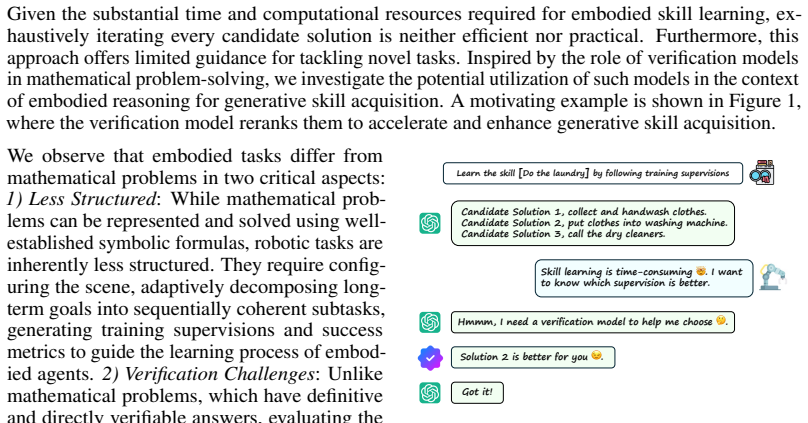
On the paper's own terms, the central claim is that sequential embodied reasoning steps — scene configuration, subtask decomposition, subtask training supervision, and success-indicator code — can be scored by a learned verifier trained without human labels. The paper constructs a dataset of 30 tasks, 150 solutions, and 287 subtasks by executing Monte Carlo Tree Search–completed traces in the simulator and labeling each subtask with its own success indicator plus the overall task success. Training a PRM on those labels lets the policy select better candidate solutions: under task-based splitting, using the final subtask's score lifts the average task success rate from 0.67 to 0.91 and the average subtask success rate from 0.67 to 0.91; under solution-based splitting, it lifts them from 0.56 and 0.62 to 0.92 and 0.97. The same PRM outperforms LLM-as-a-Judge baselines. In other words, the paper argues that a process verifier is a cheap proxy for exhaustive evaluation and that subtask-level labels, not whole-solution labels, are the right unit of verification.
Load-bearing premise
The load-bearing premise is that the success indicators the policy model writes in code actually detect true task completion; the same SUCCESS() functions produce the training labels and the evaluation metrics, so if they are wrong the reported gains show internal consistency rather than real skill acquisition.
Editorial extensions
If this is right
- Exhaustive evaluation of every candidate solution is unnecessary: a verified top-ranked solution can be selected before per-subtask policy training, and the exemplar pool alone cuts the average number of generated subtasks from 17.8 to 9.0.
- A small PRM can replace much larger general LLMs as the verification layer, since the trained verifier beats all tested LLM-as-a-Judge baselines under the same evaluation protocol.
- Automated reward labeling via MCTS can produce dense subtask-level labels without human annotation, which is what makes the first training dataset for verification-driven skill acquisition feasible.
- Both novel and previously encountered tasks benefit, but the gains differ (24% vs 36%), suggesting the verifier transfers across tasks while also refining solutions it has partly seen.
Reading between the lines
- Because the labels and the evaluation metrics both come from success-checking code written by the same policy model, a portion of the reported gains may reflect selecting solutions whose self-reports are internally consistent rather than solutions that are objectively more successful; separating the two requires an independent oracle.
- The exemplar pool is self-extending: every verified success is appended, so retrieval and PRM coverage should improve as the system runs; early pool composition could bias later task generation, so cold-start curation matters more than the fixed-size experiments show.
- The same MCTS labeling scheme should transfer to any policy model that emits executable reward and execution code, including multi-embodiment or real-robot settings, provided success metrics are anchored to external perception rather than simulator state.
Signed reviews
Editorial analysis
A structured set of objections, weighed in public.
Referee Report
Summary. The paper proposes VERGSA, a framework that adapts process reward models (PRMs) from mathematical reasoning to embodied skill acquisition. The approach consists of three components: (i) a dynamic exemplar task pool that retrieves similar previously solved tasks to guide generation of scene configurations and subtask supervisions; (ii) an automated reward labeling pipeline (ARLET-MCTS) that uses Monte Carlo Tree Search over LLM-generated solutions and success indicators to assign positive/negative labels to subtasks; and (iii) a PRM trained on these labels to verify and rerank candidate solutions generated by a policy model. Experiments in simulation report that the exemplar pool improves average task success rate by 21% for the base model, the PRM boosts success rates by 24% for novel tasks and 36% for encountered tasks, and the PRM outperforms several LLM-as-a-Judge baselines. The dataset of 30 tasks / 150 solutions / 287 subtasks is claimed to be the first verification-driven generative skill acquisition dataset.
Significance. If the reported results are externally valid, the paper makes a useful contribution: it extends the PRM paradigm to embodied reasoning, removes manual reward engineering, and provides a scalable labeling scheme. The pipeline is coherent, and the motivation (verification for embodied skill acquisition) is timely. Strengths include the explicit identification of scene configuration and subtask supervision as parts of the reasoning trace, the use of an evolving exemplar pool, and the proposed MCTS-based labeling algorithm. However, the central quantitative claims rest on success indicators that are generated by the same policy model that produces the candidate solutions, and the evaluation sample is small (30 tasks; many tasks with only 3 attempts) with no uncertainty quantification. The reported improvements may therefore measure internal consistency with the policy's own success criteria rather than true task completion. As a result, the significance is contingent on an independent validation of the generated success metrics.
major comments (3)
- [§4.4 (Algorithm 1) and §5.2] The training labels and the evaluation metrics are both derived from LLM-generated success functions. In Algorithm 1, line 13, the reward label for a subtask is set to 1 only if both SUCCESS(phi) and SUCCESS(Phi) hold, where these functions are part of the LLM-generated subtask supervision. In Section 5.2, ATSR and ASSR are computed from the same kind of generated success functions for the same task solutions. Thus the PRM is trained to predict, and is evaluated against, the policy model's own self-reported success. The claim in Section 4.4 that generated success metrics 'eliminate the concern of false positive reasoning traces' is valid only if those success functions are correct; the paper provides no independent check. A systematic error in the success functions (for example, terminating when the gripper is near an object rather than when the object state has changed) would make the reported 24% and 36% improvements internally consistent but externally vacuous. The manuscript should validate a subset of generated success functions against human judgment or physical ground truth, or explicitly reframe the results as measuring self-consistency rather than task completion.
- [Table 4 and Table 10] The headline improvements are point estimates on a small, manually curated sample with no error bars or significance tests. The evaluation uses 30 tasks and 150 solutions, and Table 10 shows that several tasks have only 3 attempts (e.g., Adjust Fan Speed 0/3, close the oven door 0/3, Open Lighter Lid 0/3, Open Stapler Lid 0/3, Press Button to Access Menu 0/3). With such small per-task counts, the difference between BaseModel ATSR 0.67 and BaseModel-PRM-last ATSR 0.91 under task-based splitting, and 0.56 vs 0.92 under solution-based splitting, could be within sampling noise. The authors should provide confidence intervals (e.g., bootstrap over tasks or solutions), per-task paired results, or a significance test. As written, the claimed 24% and 36% boosts are not statistically supported.
- [Table 5 and Appendix B] The comparison against LLM-as-a-Judge is not apples-to-apples. The LLM judges are asked only to check the subtask code for syntactic and API correctness against a list of allowed functions (Appendix B), without executing the code or observing the environment. The PRM, by contrast, is trained on execution-derived labels from the same simulation engine used in evaluation. This difference in available information could explain the PRM's higher scores regardless of its verification quality. The paper should either give the LLM judge access to execution outcomes or explicitly state that the comparison measures offline code-quality checking versus learned execution-based verification. In addition, no significance testing is provided for the differences in Table 5.
minor comments (4)
- [§4.3] The word 'walkaround' should be 'workaround'.
- [§5.3.3] The sentence 'one of its performance exceeds the PRM verifier' is unclear and appears to contain a typo; the intended meaning is likely that none of the LLM judges exceeds the PRM, but the wording should be corrected.
- [§5.2] The definition of ATSR and ASSR as proportions over all solutions/subtasks does not make clear how they are intended to relate to per-task averages, especially since Table 3 uses only five tasks while Table 4 uses a different set; this inconsistency should be clarified.
- [§4.5 and Algorithm 1] The notation in the PRM loss, where the golden label is written as the product y_m * y_hat, is confusing: y_m is described as the m-th subtask success indicator and y_hat as the overall task success indicator. The paper should define the combined label as a separate variable (e.g., l_m = y_m AND y_hat) and clarify the corresponding target in the binary cross-entropy loss.
Circularity Check
Headline success-rate gains are measured against success predicates generated by the same policy model whose solutions the PRM verifies; the evaluation metric is self-defined rather than externally grounded.
-
self definitional
[Algorithm 1 (ARLET-MCTS), reward-labeling loop; Section 4.4; Section 5.2]
"if SUCCESS(ϕ i,j,k,m)∧SUCCESS(Φ i,j,k) then R(ϕ i,j,k,m)←1 else R(ϕ i,j,k,m)←0. ... In embodied tasks, success metrics are generated for each subtask and the overall task, eliminating the concern of false positive reasoning traces. ... The ATSR measures the proportion of successful solutions: ATSR= |Successful_solutions|/|Total_solutions| while the ASSR measures the proportion of successful subtasks: ASSR= |Successful_subtasks|/|Total_subtasks|."
The PRM's training labels are defined by the policy model's generated SUCCESS() predicates inside each candidate solution (Algorithm 1), and the reported ATSR/ASSR metrics count 'successful' solutions and subtasks using the same class of generated success indicators. The verifier's optimization target and the evaluation metric are therefore the same quantity by construction: a solution whose self-generated success function is lax is labeled positive during training and counted as a success in the headline 24%/36% claim. No independent, externally validated ground-truth check for task completion is provided; human curation in Section 5.1 covers scene configurations and supervisions, not validation of the generated success functions.
full rationale
The circularity burden centers on the success definition. Algorithm 1 assigns reward R=1 exactly when the candidate solution's own generated SUCCESS() predicates fire for the subtask and the full trace, and Section 5.2 defines ATSR/ASSR from 'successful' solutions and subtasks without any independent success oracle. Consequently, the abstract's headline numbers (24% novel-task and 36% encountered-task improvements, and the Table 4 gains of 0.91-0.92 ATSR) are all relative to success predicates written by the same policy model family (Qwen2.5-Coder-32B-Instruct) whose solutions the PRM verifies. This is not a train/test leakage or a fitted-parameter-on-test-set issue; it is a self-referential target: the evaluation criterion is an output of the system being evaluated. The exemplar-pool improvement (21%) and the LLM-as-a-Judge comparisons inherit the same limitation, since all comparisons use the same generated success metrics. No same-author citation is load-bearing: the framework builds on external prior work (RoboGen, PRM literature) and the method is self-contained. If an independent success criterion (e.g., manually specified joint-angle thresholds or object-state checks) were used for both labeling and evaluation, the central claims would be non-circular; as written, the reported 'success rates' reduce by construction to the policy's generated success predicates, so the headline result is partially circular with respect to true task completion. Score 5 reflects a partial, not total, circularity: the PRM still performs real generalization on held-out tasks for the internal target, but the target itself is not externally validated.
Assumptions & free parameters
free parameters (3)
- PRM success threshold =
not reported
- MCTS sample counts (N=3, K=3) =
3 base solutions, 3 completed solutions per subtask
- Exemplar retrieval count (top-K=2) =
2
assumptions (4)
- ad hoc to paper The success metrics generated by the policy LLM correctly determine whether a subtask or task succeeded.
- ad hoc to paper Any subtask appearing in a successful complete solution is a positive training example.
- domain assumption Three MCTS completions per subtask are sufficient to estimate the contribution of a subtask to task success.
- domain assumption The SAPIEN, PartNetMobility, and RoboGen simulator pipeline is a faithful proxy for real embodied task success.
Cite this review
Pith. "Pith review of Real-Time Verification of Embodied Reasoning for Generative Skill Acquisition." pith.science (2026). https://pith.science/paper/CLKXUDOC
@misc{pith2026250511175,
  author       = {Pith},
  title        = {Pith review of: Real-Time Verification of Embodied Reasoning for Generative Skill Acquisition},
  year         = {2026},
  howpublished = {\url{https://pith.science/paper/CLKXUDOC}},
  note         = {Machine review of arXiv:2505.11175}
}
read the original abstract
Generative skill acquisition enables embodied agents to actively learn a scalable and evolving repertoire of control skills, crucial for the advancement of large decision models. While prior approaches often rely on supervision signals from generalist agents (e.g., LLMs), their effectiveness in complex 3D environments remains unclear; exhaustive evaluation incurs substantial computational costs, significantly hindering the efficiency of skill learning. Inspired by recent successes in verification models for mathematical reasoning, we propose VERGSA (Verifying Embodied Reasoning in Generative Skill Acquisition), a framework that systematically integrates real-time verification principles into embodied skill learning. VERGSA establishes 1) a seamless extension from verification of mathematical reasoning into embodied learning by dynamically incorporating contextually relevant tasks into prompts and defining success metrics for both subtasks and overall tasks, and 2) an automated, scalable reward labeling scheme that synthesizes dense reward signals by iteratively finalizing the contribution of scene configuration and subtask learning to overall skill acquisition. To the best of our knowledge, this approach constitutes the first comprehensive training dataset for verification-driven generative skill acquisition, eliminating arduous manual reward engineering. Experiments validate the efficacy of our approach: 1) the exemplar task pool improves the average task success rates by 21%, 2) our verification model boosts success rates by 24% for novel tasks and 36% for encountered tasks, and 3) outperforms LLM-as-a-Judge baselines in verification quality.
Figures


Figures from the paper (2 more)


Reference graph
Works this paper leans on
-
[1]
Challenges and applications of large language models,
J. Kaddour, J. Harris, M. Mozes, H. Bradley, R. Raileanu, and R. McHardy, “Challenges and applications of large language models,”arXiv preprint arXiv:2307.10169, 2023
arXiv 2023
-
[2]
Deepseekmath: Pushing the limits of mathematical reasoning in open language models,
Z. Shao, P. Wang, Q. Zhu, R. Xu, J. Song, X. Bi, H. Zhang, M. Zhang, Y . Li, Y . Wuet al., “Deepseekmath: Pushing the limits of mathematical reasoning in open language models,”arXiv preprint arXiv:2402.03300, 2024
arXiv 2024
-
[3]
A survey on vision-language-action models for embodied ai,
Y . Ma, Z. Song, Y . Zhuang, J. Hao, and I. King, “A survey on vision-language-action models for embodied ai,”arXiv preprint arXiv:2405.14093, 2024
arXiv 2024
-
[4]
A survey on large language models for recommendation,
L. Wu, Z. Zheng, Z. Qiu, H. Wang, H. Gu, T. Shen, C. Qin, C. Zhu, H. Zhu, Q. Liuet al., “A survey on large language models for recommendation,”World Wide Web (WWW), vol. 27, no. 5, p. 60, 2024
work page 2024
-
[5]
Towards reasoning in large language models: A survey,
J. Huang and K. C.-C. Chang, “Towards reasoning in large language models: A survey,”arXiv preprint arXiv:2212.10403, 2022
arXiv 2022
-
[6]
Training verifiers to solve math word problems,
K. Cobbe, V . Kosaraju, M. Bavarian, M. Chen, H. Jun, L. Kaiser, M. Plappert, J. Tworek, J. Hilton, R. Nakanoet al., “Training verifiers to solve math word problems,”arXiv preprint arXiv:2110.14168, 2021
arXiv 2021
-
[7]
Solving math word problems with process-and outcome-based feedback,
J. Uesato, N. Kushman, R. Kumar, F. Song, N. Siegel, L. Wang, A. Creswell, G. Irving, and I. Higgins, “Solving math word problems with process-and outcome-based feedback,”arXiv preprint arXiv:2211.14275, 2022
arXiv 2022
-
[8]
Making language models better reasoners with step-aware verifier,
Y . Li, Z. Lin, S. Zhang, Q. Fu, B. Chen, J.-G. Lou, and W. Chen, “Making language models better reasoners with step-aware verifier,” inProceedings of Annual Meeting of the Association for Computational Linguistics (ACL), 2023, pp. 5315–5333
work page 2023
Show all 62 references
-
[9]
Let’s verify step by step,
H. Lightman, V . Kosaraju, Y . Burda, H. Edwards, B. Baker, T. Lee, J. Leike, J. Schulman, I. Sutskever, and K. Cobbe, “Let’s verify step by step,” inInternational Conference on Learning Representations (ICLR), 2023
2023
-
[10]
Math-shepherd: Verify and reinforce llms step-by-step without human annotations,
P. Wang, L. Li, Z. Shao, R. Xu, D. Dai, Y . Li, D. Chen, Y . Wu, and Z. Sui, “Math-shepherd: Verify and reinforce llms step-by-step without human annotations,” inProceedings of the 62nd Annual Meeting of the Association for Computational Linguistics (Volume 1: Long Papers), 20...
2024
-
[11]
The lessons of developing process reward models in mathematical reasoning,
Z. Zhang, C. Zheng, Y . Wu, B. Zhang, R. Lin, B. Yu, D. Liu, J. Zhou, and J. Lin, “The lessons of developing process reward models in mathematical reasoning,”arXiv preprint arXiv:2501.07301, 2025
2025 arXiv
-
[12]
Rewarding progress: Scaling automated process verifiers for LLM reasoning,
A. Setlur, C. Nagpal, A. Fisch, X. Geng, J. Eisenstein, R. Agarwal, A. Agarwal, J. Berant, and A. Kumar, “Rewarding progress: Scaling automated process verifiers for LLM reasoning,” in International Conference on Learning Representations (ICLR), 2025
2025
-
[13]
Rest-mcts*: Llm self-training via process reward guided tree search,
D. Zhang, S. Zhoubian, Z. Hu, Y . Yue, Y . Dong, and J. Tang, “Rest-mcts*: Llm self-training via process reward guided tree search,”Advances in Neural Information Processing Systems, vol. 37, pp. 64 735–64 772, 2025
2025
-
[14]
Process reward model with q-value rankings,
W. Li and Y . Li, “Process reward model with q-value rankings,” inInternational Conference on Learning Representations (ICLR), 2025
2025
-
[15]
Bootstrap your own skills: Learning to solve new tasks with large language model guidance,
J. Zhang, J. Zhang, K. Pertsch, Z. Liu, X. Ren, M. Chang, S.-H. Sun, and J. J. Lim, “Bootstrap your own skills: Learning to solve new tasks with large language model guidance,”arXiv preprint arXiv:2310.10021, 2023
2023 arXiv
-
[16]
Guiding pretraining in reinforcement learning with large language models,
Y . Du, O. Watkins, Z. Wang, C. Colas, T. Darrell, P. Abbeel, A. Gupta, and J. Andreas, “Guiding pretraining in reinforcement learning with large language models,” inInternational Conference on Machine Learning (ICML), 2023, pp. 8657–8677
2023
-
[17]
Dreamfusion: Text-to-3d using 2d diffusion,
B. Poole, A. Jain, J. T. Barron, and B. Mildenhall, “Dreamfusion: Text-to-3d using 2d diffusion,” arXiv preprint arXiv:2209.14988, 2022. 11
2022 arXiv
-
[18]
Realfusion: 360deg reconstruction of any object from a single image,
L. Melas-Kyriazi, I. Laina, C. Rupprecht, and A. Vedaldi, “Realfusion: 360deg reconstruction of any object from a single image,” inProceedings of the IEEE/CVF Conference on Computer Vision and Pattern Recognition (CVPR), 2023, pp. 8446–8455
2023
-
[19]
Palm-e: An embodied multimodal language model,
D. Driess, F. Xia, M. S. Sajjadi, C. Lynch, A. Chowdhery, A. Wahid, J. Tompson, Q. Vuong, T. Yu, W. Huanget al., “Palm-e: An embodied multimodal language model,” 2023
2023
-
[20]
Gpt-4 technical report,
J. Achiam, S. Adler, S. Agarwal, L. Ahmad, I. Akkaya, F. L. Aleman, D. Almeida, J. Altenschmidt, S. Altman, S. Anadkatet al., “Gpt-4 technical report,”arXiv preprint arXiv:2303.08774, 2023
2023 arXiv
-
[21]
Llama: Open and efficient foundation language models,
H. Touvron, T. Lavril, G. Izacard, X. Martinet, M.-A. Lachaux, T. Lacroix, B. Rozière, N. Goyal, E. Hambro, F. Azharet al., “Llama: Open and efficient foundation language models,”arXiv preprint arXiv:2302.13971, 2023
2023 arXiv
-
[22]
Dall-e-bot: Introducing web-scale diffusion models to robotics,
I. Kapelyukh, V . V osylius, and E. Johns, “Dall-e-bot: Introducing web-scale diffusion models to robotics,”IEEE Robotics and Automation Letters (RAL), vol. 8, no. 7, pp. 3956–3963, 2023
2023
-
[23]
Vima: Robot manipulation with multimodal prompts,
Y . Jiang, A. Gupta, Z. Zhang, G. Wang, Y . Dou, Y . Chen, L. Fei-Fei, A. Anandkumar, Y . Zhu, and L. Fan, “Vima: Robot manipulation with multimodal prompts,” 2023
2023
-
[24]
Sapien: A simulated part-based interactive environment,
F. Xiang, Y . Qin, K. Mo, Y . Xia, H. Zhu, F. Liu, M. Liu, H. Jiang, Y . Yuan, H. Wanget al., “Sapien: A simulated part-based interactive environment,” inProceedings of the IEEE/CVF Conference on Computer Vision and Pattern Recognition (CVPR), 2020, pp. 11 097–11 107
2020
-
[25]
Rlbench: The robot learning benchmark & learning environment,
S. James, Z. Ma, D. R. Arrojo, and A. J. Davison, “Rlbench: The robot learning benchmark & learning environment,”IEEE Robotics and Automation Letters (RAL), vol. 5, no. 2, pp. 3019–3026, 2020
2020
-
[26]
Objaverse: A universe of annotated 3d objects,
M. Deitke, D. Schwenk, J. Salvador, L. Weihs, O. Michel, E. VanderBilt, L. Schmidt, K. Ehsani, A. Kembhavi, and A. Farhadi, “Objaverse: A universe of annotated 3d objects,” inProceedings of the IEEE/CVF Conference on Computer Vision and Pattern Recognition (CVPR), 2023, pp. 13...
2023
-
[27]
Zero-1-to-3: Zero-shot one image to 3d object,
R. Liu, R. Wu, B. Van Hoorick, P. Tokmakov, S. Zakharov, and C. V ondrick, “Zero-1-to-3: Zero-shot one image to 3d object,” inProceedings of the IEEE/CVF International Conference on Computer Vision (ICCV), 2023, pp. 9298–9309
2023
-
[28]
Do as i can, not as i say: Grounding language in robotic affordances,
M. Ahn, A. Brohan, N. Brown, Y . Chebotar, O. Cortes, B. David, C. Finn, K. Gopalakrishnan, K. Hausman, A. Herzoget al., “Do as i can, not as i say: Grounding language in robotic affordances,”arXiv preprint arXiv:2204.01691, 2022
2022 arXiv
-
[29]
Inner monologue: Embodied reasoning through planning with language models,
W. Huang, F. Xia, T. Xiao, H. Chan, J. Liang, P. Florence, A. Zeng, J. Tompson, I. Mordatch, Y . Chebotaret al., “Inner monologue: Embodied reasoning through planning with language models,”arXiv preprint arXiv:2207.05608, 2022
2022 arXiv
-
[30]
Text2motion: From natural language instructions to feasible plans,
K. Lin, C. Agia, T. Migimatsu, M. Pavone, and J. Bohg, “Text2motion: From natural language instructions to feasible plans,”Autonomous Robots, vol. 47, no. 8, pp. 1345–1365, 2023
2023
-
[31]
Scaling up and distilling down: Language-guided robot skill acquisition,
H. Ha, P. Florence, and S. Song, “Scaling up and distilling down: Language-guided robot skill acquisition,” inConference on Robot Learning (CoRL). PMLR, 2023, pp. 3766–3777
2023
-
[32]
Tidybot: Personalized robot assistance with large language models,
J. Wu, R. Antonova, A. Kan, M. Lepert, A. Zeng, S. Song, J. Bohg, S. Rusinkiewicz, and T. Funkhouser, “Tidybot: Personalized robot assistance with large language models,”Au- tonomous Robots, vol. 47, no. 8, pp. 1087–1102, 2023
2023
-
[33]
Code as policies: Language model programs for embodied control,
J. Liang, W. Huang, F. Xia, P. Xu, K. Hausman, B. Ichter, P. Florence, and A. Zeng, “Code as policies: Language model programs for embodied control,” in2023 IEEE International Conference on Robotics and Automation (ICRA). IEEE, 2023, pp. 9493–9500
2023
-
[34]
Language to rewards for robotic skill synthesis,
W. Yu, N. Gileadi, C. Fu, S. Kirmani, K.-H. Lee, M. G. Arenas, H.-T. L. Chiang, T. Erez, L. Hasenclever, J. Humpliket al., “Language to rewards for robotic skill synthesis,”arXiv preprint arXiv:2306.08647, 2023. 12
2023 arXiv
-
[35]
Eureka: Human-level reward design via coding large language models,
Y . J. Ma, W. Liang, G. Wang, D.-A. Huang, O. Bastani, D. Jayaraman, Y . Zhu, L. Fan, and A. Anandkumar, “Eureka: Human-level reward design via coding large language models,”arXiv preprint arXiv:2310.12931, 2023
2023 arXiv
-
[36]
Scaling robot learning with semantically imagined experience,
T. Yu, T. Xiao, A. Stone, J. Tompson, A. Brohan, S. Wang, J. Singh, C. Tan, J. Peralta, B. Ichteret al., “Scaling robot learning with semantically imagined experience,”arXiv preprint arXiv:2302.11550, 2023
2023 arXiv
-
[37]
Rt-2: Vision-language-action models transfer web knowledge to robotic control,
A. Brohan, N. Brown, J. Carbajal, Y . Chebotar, X. Chen, K. Choromanski, T. Ding, D. Driess, A. Dubey, C. Finnet al., “Rt-2: Vision-language-action models transfer web knowledge to robotic control,”arXiv preprint arXiv:2307.15818, 2023
2023 arXiv
-
[38]
Gensim: Generating robotic simulation tasks via large language models,
L. Wang, Y . Ling, Z. Yuan, M. Shridhar, C. Bao, Y . Qin, B. Wang, H. Xu, and X. Wang, “Gensim: Generating robotic simulation tasks via large language models,”arXiv preprint arXiv:2310.01361, 2023
2023 arXiv
-
[39]
Gen2sim: Scaling up robot learning in simulation with generative models,
P. Katara, Z. Xian, and K. Fragkiadaki, “Gen2sim: Scaling up robot learning in simulation with generative models,” in2024 IEEE International Conference on Robotics and Automation (ICRA). IEEE, 2024, pp. 6672–6679
2024
-
[40]
Robogen: Towards unleashing infinite data for automated robot learning via generative simulation,
Y . Wang, Z. Xian, F. Chen, T.-H. Wang, Y . Wang, K. Fragkiadaki, Z. Erickson, D. Held, and C. Gan, “Robogen: Towards unleashing infinite data for automated robot learning via generative simulation,” inInternational Conference on Machine Learning (ICML), 2024
2024
-
[41]
Generative skill chaining: Long-horizon skill planning with diffusion models,
U. A. Mishra, S. Xue, Y . Chen, and D. Xu, “Generative skill chaining: Long-horizon skill planning with diffusion models,” inAnnual Conference on Robot Learning (CoRL), 2023
2023
-
[42]
Proximal policy optimization algorithms,
J. Schulman, F. Wolski, P. Dhariwal, A. Radford, and O. Klimov, “Proximal policy optimization algorithms,”arXiv preprint arXiv:1707.06347, 2017
2017 arXiv
-
[43]
Soft actor-critic: Off-policy maximum entropy deep reinforcement learning with a stochastic actor,
T. Haarnoja, A. Zhou, P. Abbeel, and S. Levine, “Soft actor-critic: Off-policy maximum entropy deep reinforcement learning with a stochastic actor,” inInternational Conference on Machine Learning (ICML), 2018, pp. 1861–1870
2018
-
[44]
Sampling-based algorithms for optimal motion planning,
S. Karaman and E. Frazzoli, “Sampling-based algorithms for optimal motion planning,”The International Journal of Robotics Research (IJRR), vol. 30, no. 7, pp. 846–894, 2011
2011
-
[45]
Fluidlab: A differentiable environment for benchmarking complex fluid manipulation,
Z. Xian, B. Zhu, Z. Xu, H.-Y . Tung, A. Torralba, K. Fragkiadaki, and C. Gan, “Fluidlab: A differentiable environment for benchmarking complex fluid manipulation,” inInternational Conference on Learning Representations (ICLR), 2023
2023
-
[46]
Scalable differentiable physics for learning and control,
Y .-L. Qiao, J. Liang, V . Koltun, and M. C. Lin, “Scalable differentiable physics for learning and control,” inInternational Conference on Machine Learning (ICML), 2020
2020
-
[47]
Judging llm-as-a-judge with mt-bench and chatbot arena,
L. Zheng, W.-L. Chiang, Y . Sheng, S. Zhuang, Z. Wu, Y . Zhuang, Z. Lin, Z. Li, D. Li, E. Xinget al., “Judging llm-as-a-judge with mt-bench and chatbot arena,”Advances in Neural Information Processing Systems (NeurIPS), vol. 36, pp. 46 595–46 623, 2023
2023
-
[48]
A survey of meta-reinforcement learning,
J. Beck, R. Vuorio, E. Z. Liu, Z. Xiong, L. Zintgraf, C. Finn, and S. Whiteson, “A survey of meta-reinforcement learning,”arXiv preprint arXiv:2301.08028, 2023
2023 arXiv
-
[49]
Meta-reinforcement learning of structured exploration strategies,
A. Gupta, R. Mendonca, Y . Liu, P. Abbeel, and S. Levine, “Meta-reinforcement learning of structured exploration strategies,”Advances in Neural Information Processing Systems (NeurIPS), vol. 31, 2018
2018
-
[50]
Hierarchical reinforcement learning: A comprehensive survey,
S. Pateria, B. Subagdja, A.-h. Tan, and C. Quek, “Hierarchical reinforcement learning: A comprehensive survey,”ACM Computing Surveys (CSUR), vol. 54, no. 5, pp. 1–35, 2021
2021
-
[51]
Data-efficient hierarchical reinforcement learning,
O. Nachum, S. S. Gu, H. Lee, and S. Levine, “Data-efficient hierarchical reinforcement learning,” Advances in Neural Information Processing Systems (NeurIPS), vol. 31, 2018
2018
-
[52]
Domain randomization for transferring deep neural networks from simulation to the real world,
J. Tobin, R. Fong, A. Ray, J. Schneider, W. Zaremba, and P. Abbeel, “Domain randomization for transferring deep neural networks from simulation to the real world,” inIEEE/RSJ International Conference on Intelligent Robots and Systems (IROS). IEEE, 2017, pp. 23–30. 13
2017
-
[53]
Roboninja: Learning an adaptive cutting policy for multi-material objects,
Z. Xu, Z. Xian, X. Lin, C. Chi, Z. Huang, C. Gan, and S. Song, “Roboninja: Learning an adaptive cutting policy for multi-material objects,”arXiv preprint arXiv:2302.11553, 2023
2023 arXiv
-
[54]
Incremental potential contact: intersection-and inversion-free, large-deformation dynamics
M. Li, Z. Ferguson, T. Schneider, T. R. Langlois, D. Zorin, D. Panozzo, C. Jiang, and D. M. Kaufman, “Incremental potential contact: intersection-and inversion-free, large-deformation dynamics.”ACM Trans. Graph., vol. 39, no. 4, p. 49, 2020
2020
-
[55]
Genesis: A universal and generative physics engine for robotics and beyond,
G. Authors, “Genesis: A universal and generative physics engine for robotics and beyond,” December 2024. [Online]. Available: https://github.com/Genesis-Embodied-AI/Genesis
2024
-
[56]
Diffusebot: Breeding soft robots with physics-augmented generative diffusion models,
T.-H. J. Wang, J. Zheng, P. Ma, Y . Du, B. Kim, A. Spielberg, J. Tenenbaum, C. Gan, and D. Rus, “Diffusebot: Breeding soft robots with physics-augmented generative diffusion models,” Advances in Neural Information Processing Systems (NeurIPS), vol. 36, pp. 44 398–44 423, 2023
2023
-
[57]
Batch informed trees (bit*): Sampling-based optimal planning via the heuristically guided search of implicit random geometric graphs,
J. D. Gammell, S. S. Srinivasa, and T. D. Barfoot, “Batch informed trees (bit*): Sampling-based optimal planning via the heuristically guided search of implicit random geometric graphs,” inIEEE International Conference on Robotics and Automation (ICRA). IEEE, 2015, pp. 3067–3074
2015
-
[58]
The open motion planning library,
I. A. Sucan, M. Moll, and L. E. Kavraki, “The open motion planning library,”IEEE Robotics & Automation Magazine (RAM), vol. 19, no. 4, pp. 72–82, 2012. 14 Appendix A Additional Implementation Details In this paper, we ran experiments on a server with a total of 8 NVIDIA GeForc...
2012
-
[59]
for **Primitive Subtasks**: - Missing ‘rgbs, final_state‘ assignment - Missing ‘success‘ condition
-
[60]
for **Reward-Based Subtasks**: - Missing reward components - Missing success condition - Improperly weighted reward components
-
[61]
- Any grammatical or logical errors
**General Issues**: - Incorrect object/link/joint naming - Improper API usage or use functions not in the allowed APIs. - Any grammatical or logical errors
-
[62]
You do not have to: - check for the completness of the subtasks,since many subtasks are partial. --- ## Allowed APIs For Primitive Subtasks: - ‘grasp_object(self, object_name)‘ - ‘grasp_object_link(self, object_name, link_name)‘ - ‘release_grasp(self)‘ - ‘check_grasped(self, o...
Reviewed August 15, 2026 · model on record in the stance chip above.
Discussion (0). Continue with ORCID to comment.