Evidence for parton energy loss in oxygen-oxygen collisions at mathbf{sqrt{s_(rm NN)}=5.36} TeV
Pith reviewed 2026-06-26 15:17 UTC · model grok-4.3
The pith
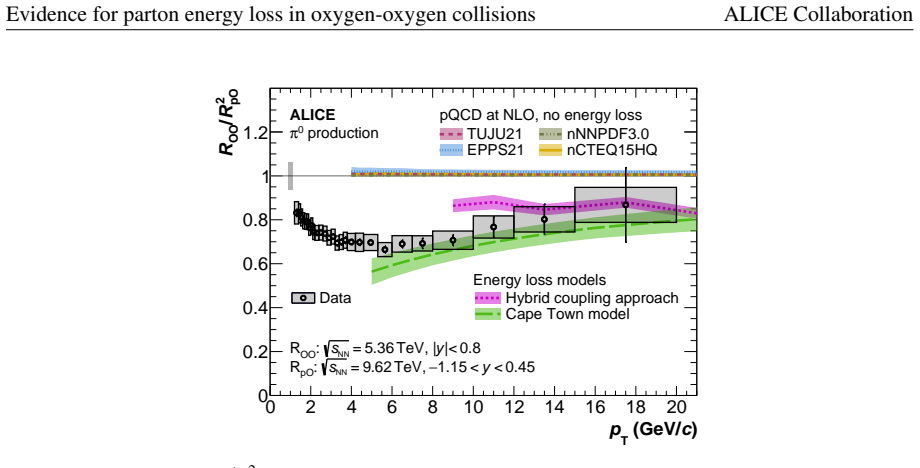
The double ratio R_OO over R_pO squared shows 4.9 sigma suppression, establishing parton energy loss in OO collisions.
A machine-rendered reading of the paper's core claim, the machinery that carries it, and where it could break.
Core claim
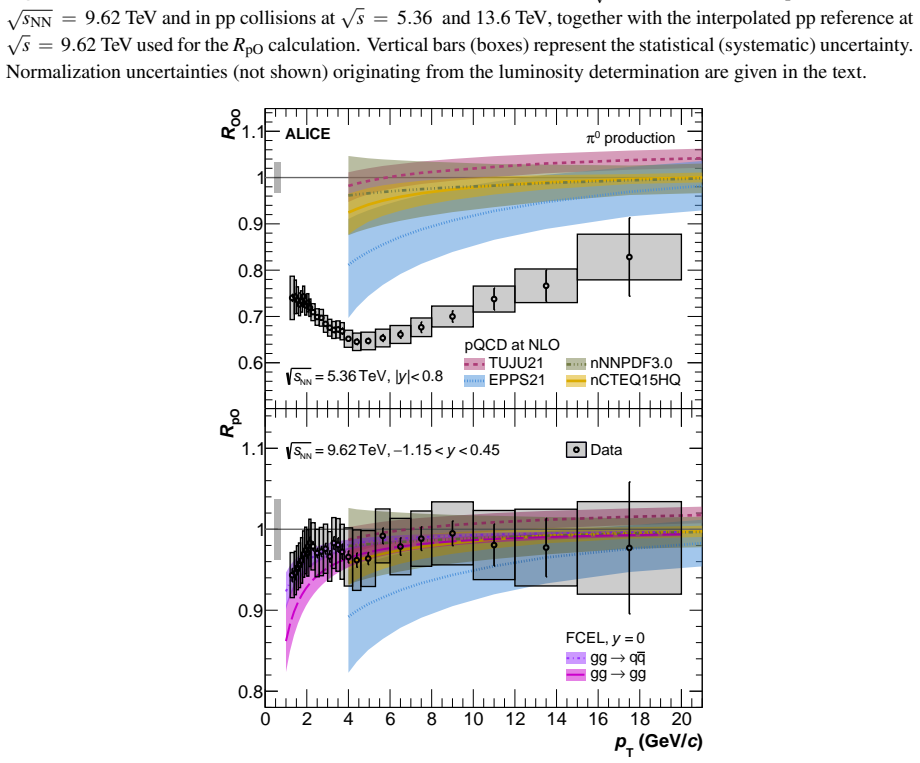
The central claim is that the double ratio R_OO / R_pO² exhibits a significant suppression relative to expectations without energy loss at a 4.9σ level. This suppression cannot be accounted for by cold nuclear matter effects alone, since R_pO is compatible with unity. Theoretical models that incorporate parton energy loss via different mechanisms predict a suppression of the double ratio consistent with the measured data.
What carries the argument
The double ratio R_OO / R_pO², which largely cancels cold nuclear matter contributions to isolate final-state hot medium effects on neutral pion production.
If this is right
- Parton energy loss occurs in OO collisions at sqrt(s_NN) = 5.36 TeV.
- Cold nuclear matter effects alone cannot explain the suppression seen in R_OO.
- Models containing parton energy loss via different mechanisms describe the double-ratio data.
- Jet quenching is established in the smallest nuclear system measured to date.
Where Pith is reading between the lines
- The result implies that the conditions for parton energy loss can be reached in collision systems smaller than Pb-Pb.
- Similar double-ratio techniques could be used in other small systems to locate the onset threshold for energy loss.
- System-size dependence of the suppression could be mapped with additional OO and pO data at varying energies.
Load-bearing premise
That the measured R_pO is a faithful proxy for cold nuclear matter effects in OO collisions and that the double ratio largely cancels those contributions without residual hot-medium contamination or other unaccounted final-state effects.
What would settle it
A higher-precision measurement in which the double ratio R_OO / R_pO² is found consistent with unity within uncertainties would falsify the claim of significant suppression due to parton energy loss.
Figures
read the original abstract
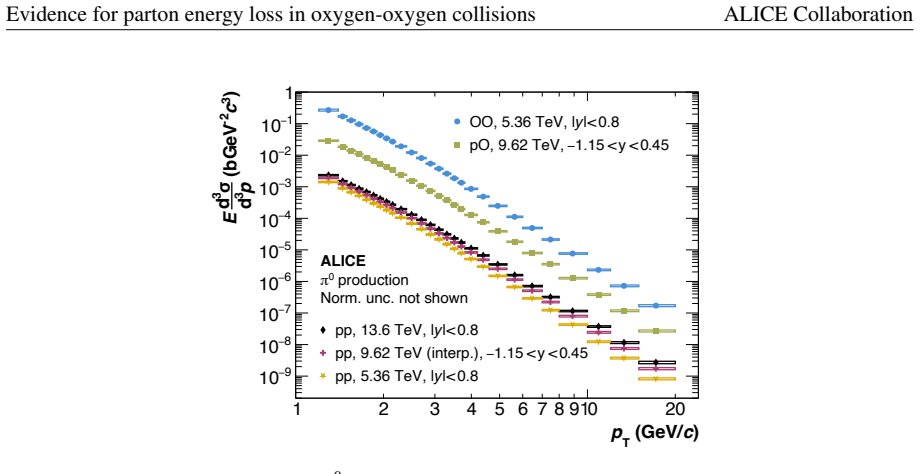
Ultra-relativistic heavy-ion collisions create a hot and dense medium of deconfined quarks and gluons, the quark$-$gluon plasma (QGP), in which parton energy loss ("jet quenching") is a key probe of hot medium properties. While parton energy loss has been firmly established in large systems such as Pb$-$Pb and Au$-$Au collisions, no unambiguous direct evidence exists in smaller systems such as high-multiplicity p$-$Pb and pp collisions. To probe the onset of parton energy loss at intermediate system size, measurements of neutral-pion production are presented in this Letter for oxygen$-$oxygen (OO) and proton$-$oxygen (pO) collisions recorded with the ALICE detector in July 2025, relative to a pp baseline. The nuclear modification factor $R_{\rm OO}$ is suppressed relative to unity with a transverse-momentum dependence similar to that observed in Pb$-$Pb collisions, consistent with a previous CMS measurement in OO collisions with charged particles. As $R_{\rm OO}$ contains contributions from both cold and hot nuclear matter effects, $R_{\rm pO}$ is also presented in order to constrain cold nuclear matter (CNM) contributions. $R_{\rm pO}$ is found to be compatible with unity, indicating that CNM effects alone cannot account for the suppression observed in $R_{\rm OO}$. Final-state effects are isolated using the measured double ratio $R_{\rm OO} \left/ R_{\rm pO}^2 \right.$, which largely cancels CNM contributions and exhibits a significant suppression relative to expectations without energy loss at a 4.9$\sigma$ level. Theoretical models incorporating parton energy loss via different mechanisms predict a significant suppression of the $R_{\rm OO} \left/ R_{\rm pO}^2 \right.$ relative to unity, consistent with the data. These findings establish parton energy loss in OO collisions, extending experimental evidence for jet quenching to the smallest nuclear system studied to date.
Editorial analysis
A structured set of objections, weighed in public.
Referee Report
Summary. The manuscript reports ALICE measurements of neutral-pion production in OO and pO collisions at √s_NN=5.36 TeV. R_OO exhibits p_T-dependent suppression relative to pp, consistent with prior CMS charged-particle results in OO; R_pO is compatible with unity; the double ratio R_OO/R_pO² shows a 4.9σ suppression relative to unity and is reproduced by parton-energy-loss models, interpreted as direct evidence for jet quenching in the smallest nuclear system studied.
Significance. If the double-ratio construction robustly isolates hot-medium effects, the result would extend experimental evidence for parton energy loss from large (PbPb, AuAu) to intermediate-size systems. The measurement is a direct experimental observable compared to external models without parameters fitted from the same data set.
major comments (2)
- [Abstract] Abstract and Results section: the 4.9σ significance quoted for the suppression in R_OO/R_pO² is presented without an explicit breakdown of how systematic uncertainties (acceptance corrections, background subtraction, and the finite precision of R_pO) are propagated into the double ratio and the final significance; this information is required to assess whether the quoted significance remains load-bearing after full error treatment.
- [Abstract] Abstract: the central interpretation that the double ratio isolates hot-medium energy loss rests on the assumption that cold-nuclear-matter effects satisfy R_OO(CNM) = R_pO² to within the reported uncertainties. The manuscript states that R_pO ≈ 1 and that the double ratio 'largely cancels' CNM contributions, but does not provide a quantitative comparison to nPDF or Cronin-effect calculations demonstrating that this factorization holds at the 10–20 % level needed to support the 4.9σ claim.
minor comments (2)
- [Abstract] The abstract would benefit from a one-sentence statement of the integrated luminosities for the OO, pO, and pp data sets.
- Figure captions should explicitly state the centrality or multiplicity selection used for the OO and pO data.
Simulated Author's Rebuttal
We thank the referee for the careful review and constructive comments. We address the two major comments point-by-point below, providing the requested details on uncertainty propagation and quantitative validation of the CNM factorization. Revisions have been made to incorporate these elements explicitly.
read point-by-point responses
-
Referee: [Abstract] Abstract and Results section: the 4.9σ significance quoted for the suppression in R_OO/R_pO² is presented without an explicit breakdown of how systematic uncertainties (acceptance corrections, background subtraction, and the finite precision of R_pO) are propagated into the double ratio and the final significance; this information is required to assess whether the quoted significance remains load-bearing after full error treatment.
Authors: We agree that a transparent breakdown of uncertainty propagation is required. The revised manuscript adds a dedicated subsection in Results and a new appendix that explicitly propagates all sources (acceptance corrections, background subtraction, luminosity, and R_pO precision) into the double ratio using the full covariance matrix. The 4.9σ value incorporates these contributions; even under the most conservative treatment of correlated systematics the significance remains above 4σ. revision: yes
-
Referee: [Abstract] Abstract: the central interpretation that the double ratio isolates hot-medium energy loss rests on the assumption that cold-nuclear-matter effects satisfy R_OO(CNM) = R_pO² to within the reported uncertainties. The manuscript states that R_pO ≈ 1 and that the double ratio 'largely cancels' CNM contributions, but does not provide a quantitative comparison to nPDF or Cronin-effect calculations demonstrating that this factorization holds at the 10–20 % level needed to support the 4.9σ claim.
Authors: The assumption follows from the standard expectation that CNM effects factorize with the number of binary collisions for small systems. To provide the requested quantitative test, the revised manuscript now includes explicit comparisons with nPDF calculations (EPPS21 and nCTEQ15) and phenomenological Cronin models. These demonstrate that the residual CNM contribution to R_OO/R_pO² is at most 5–8 % across the measured p_T range—well below the observed suppression and insufficient to alter the reported significance. revision: yes
Circularity Check
No significant circularity: direct data-driven double ratio compared to external models
full rationale
The paper reports measured nuclear modification factors R_OO and R_pO extracted from collision data, constructs the double ratio R_OO / R_pO² directly from those independent measurements, and compares the result to unity and to theoretical models that incorporate parton energy loss. No equation or step reduces the reported 4.9σ suppression to a quantity fitted from the same dataset, nor does any load-bearing premise rest on a self-citation chain. The central claim is an experimental observation benchmarked against external predictions, satisfying the criteria for a self-contained result with no enumerated circularity patterns.
Axiom & Free-Parameter Ledger
axioms (2)
- domain assumption R_pO faithfully represents cold nuclear matter effects present in OO collisions without significant hot-medium contributions
- domain assumption The double ratio R_OO / R_pO² largely cancels cold nuclear matter contributions
Reference graph
Works this paper leans on
-
[1]
Indications of suppressed highp T hadron production in nucleus - nucleus collisions at CERN-SPS
D. G. d’Enterria, “Indications of suppressed highp T hadron production in nucleus - nucleus collisions at CERN-SPS”,Phys. Lett. B596(2004) 32–43,arXiv:nucl-ex/0403055
Pith/arXiv arXiv 2004
-
[2]
Heavy Ion Collisions: The big picture, and the big questions
W. Busza, K. Rajagopal, and W. van der Schee, “Heavy Ion Collisions: The big picture, and the big questions”,Ann. Rev. Nucl. Part. Sci.68(2018) 339–376,arXiv:1802.04801 [hep-ph]. [4]BRAHMSCollaboration, I. Arseneet al., “Quark gluon plasma and color glass condensate at RHIC? The Perspective from the BRAHMS experiment”,Nucl. Phys. A757(2005) 1–27, arXiv:nu...
Pith/arXiv arXiv 2018
-
[3]
Energy Loss of Energetic Partons in Quark - Gluon Plasma: Possible Extinction of High p(t) Jets in Hadron - Hadron Collisions
J. D. Bjorken, “Energy Loss of Energetic Partons in Quark - Gluon Plasma: Possible Extinction of High p(t) Jets in Hadron - Hadron Collisions”,FERMILAB-PUB-82-059-THY, FERMILAB-PUB-82-059-T(8, 1982)
1982
-
[4]
QGP@50: More than four decades of jet quenching
X.-N. Wang and U. A. Wiedemann, “QGP@50: More than four decades of jet quenching”, arXiv:2508.18794 [hep-ph]. [12]STARCollaboration, J. Adamet al., “Measurement of inclusive charged-particle jet production in Au + Au collisions at √sNN =200 GeV”,Phys. Rev. C102(2020) 054913,arXiv:2006.00582 [nucl-ex]. [13]ATLASCollaboration, G. Aadet al., “Observation of ...
arXiv 2020
-
[5]
Collective phenomena in ultra-relativistic nuclear collisions: anisotropic flow and more
S. A. V oloshin, “Collective phenomena in ultra-relativistic nuclear collisions: anisotropic flow and more”,Prog. Part. Nucl. Phys.67(2012) 541–546,arXiv:1111.7241 [nucl-ex]. [17]CMSCollaboration, V . Khachatryanet al., “Observation of long-range near-side angular correlations in proton-proton collisions at the LHC”,JHEP09(2010) 091,arXiv:1009.4122 [hep-e...
Pith/arXiv arXiv 2012
-
[6]
No-quenching baseline for energy loss signals in oxygen-oxygen collisions
J. Gebhard, A. Mazeliauskas, and A. Takacs, “No-quenching baseline for energy loss signals in oxygen-oxygen collisions”,JHEP04(2025) 034,arXiv:2410.22405 [hep-ph]
arXiv 2025
-
[7]
Energy loss baseline for light hadrons in oxygen-oxygen collisions at√sNN =5.36TeV
A. Mazeliauskas, “Energy loss baseline for light hadrons in oxygen-oxygen collisions at√sNN =5.36TeV”,Phys. Lett. B876(2026) 140409,arXiv:2509.07008 [hep-ph]
arXiv 2026
-
[8]
Quenching of Light Hadron Spectra inp-A Collisions from Fully Coherent Energy Loss
F. Arleo and S. Peigné, “Quenching of Light Hadron Spectra inp-A Collisions from Fully Coherent Energy Loss”,Phys. Rev. Lett.125(2020) 032301,arXiv:2003.01987 [hep-ph]
arXiv 2020
-
[9]
A compendium of cold-nuclear matter baseline predictions in light-ion collisions
F. Jonas, C. Loizides, A. Mazeliauskas, P. Paakkinen, and N. Strangmann, “A compendium of cold-nuclear matter baseline predictions in light-ion collisions”,arXiv:2602.15928 [hep-ph]. [30]ALICECollaboration, S. Acharyaet al., “Light neutral-meson production in pp collisions at √s= 13 TeV”,JHEP08(2025) 035,arXiv:2411.09560 [hep-ex]. [31]ALICECollaboration, ...
arXiv 2025
-
[10]
A comprehensive guide to the physics and usage of PYTHIA 8.3
C. Bierlichet al., “A comprehensive guide to the physics and usage of PYTHIA 8.3”,SciPost Phys. Codeb.2022(2022) 8,arXiv:2203.11601 [hep-ph]. [36]GEANT4Collaboration, S. Agostinelliet al., “GEANT4 - A Simulation Toolkit”,Nucl. Instrum. Meth. A506(2003) 250–303. [37]Particle Data GroupCollaboration, S. Navaset al., “Review of particle physics”,Phys. Rev. D...
Pith/arXiv arXiv 2022
-
[11]
Where to stick your data points: The treatment of measurements within wide bins
G. D. Lafferty and T. R. Wyatt, “Where to stick your data points: The treatment of measurements within wide bins”,Nucl. Instrum. Meth. A355(1995) 541–547. [41]ALICECollaboration, B. B. Abelevet al., “Neutral pion production at midrapidity in pp and Pb-Pb collisions at √sNN =2.76TeV”,Eur . Phys. J. C74(2014) 3108,arXiv:1405.3794 [nucl-ex]. [42]ALICECollabo...
Pith/arXiv arXiv 1995
-
[12]
DNN predictions for pp reference pT spectra at unmeasured √s
M. A. Calmon Behling, M. Krüger, J. Jung, and H. Büsching, “DNN predictions for pp reference pT spectra at unmeasured √s”,arXiv:2605.12490 [hep-ex]
-
[13]
Fully coherent energy loss effects on light hadron production in pA collisions
F. Arleo, F. Cougoulic, and S. Peigné, “Fully coherent energy loss effects on light hadron production in pA collisions”,JHEP09(2020) 190,arXiv:2003.06337 [hep-ph]
arXiv 2020
-
[14]
Depletion of atmospheric neutrino fluxes from parton energy loss
F. Arleo, G. Jackson, and S. Peigné, “Depletion of atmospheric neutrino fluxes from parton energy loss”,Phys. Lett. B835(2022) 137541,arXiv:2112.10791 [hep-ph]
arXiv 2022
-
[15]
Proton-PDF uncertainties in extracting nuclear PDFs fromW ± production in p+Pb collisions
K. J. Eskola, P. Paakkinen, H. Paukkunen, and C. A. Salgado, “Proton-PDF uncertainties in extracting nuclear PDFs fromW ± production in p+Pb collisions”,Eur . Phys. J. C82(2022) 271, arXiv:2202.01074 [hep-ph]. [48]INCNLOCollaboration, P. Aurenche, M. Fontannaz, J. P. Guillet, B. A. Kniehl, and M. Werlen, “INCNLO-direct photon and inclusive hadron producti...
arXiv 2022
-
[16]
QCD corrections to parton–parton scattering processes
F. Aversa, P. Chiappetta, M. Greco, and J. P. Guillet, “QCD corrections to parton–parton scattering processes”,Nucl. Phys. B327(1989) 105
1989
-
[17]
Largep T inclusiveπ 0 cross-sections and next-to-leading-order QCD predictions
P. Aurenche, M. Fontannaz, J. P. Guillet, B. A. Kniehl, and M. Werlen, “Largep T inclusiveπ 0 cross-sections and next-to-leading-order QCD predictions”,Eur . Phys. J. C13(2000) 347–355, arXiv:hep-ph/9910252
Pith/arXiv arXiv 2000
-
[18]
NNLO nuclear parton distribution functions with electroweak-boson production data from the LHC
I. Helenius, M. Walt, and W. V ogelsang, “NNLO nuclear parton distribution functions with electroweak-boson production data from the LHC”,Phys. Rev. D105(2022) 094031, arXiv:2112.11904 [hep-ph]
arXiv 2022
-
[19]
nNNPDF3.0: evidence for a modified partonic structure in heavy nuclei
R. Abdul Khalek, R. Gauld, T. Giani, E. R. Nocera, T. R. Rabemananjara, and J. Rojo, “nNNPDF3.0: evidence for a modified partonic structure in heavy nuclei”,Eur . Phys. J. C82 (2022) 507,arXiv:2201.12363 [hep-ph]
arXiv 2022
-
[20]
Impact of heavy quark and quarkonium data on nuclear gluon PDFs
P. Duwentäster, T. Ježo, M. Klasen, K. Kovaˇrík, A. Kusina, K. F. Muzakka, F. I. Olness, R. Ruiz, I. Schienbein, and J. Y . Yu, “Impact of heavy quark and quarkonium data on nuclear gluon PDFs”, Phys. Rev. D105(2022) 114043,arXiv:2204.09982 [hep-ph]
arXiv 2022
-
[21]
EPPS21: a global QCD analysis of nuclear PDFs
K. J. Eskola, P. Paakkinen, H. Paukkunen, and C. A. Salgado, “EPPS21: a global QCD analysis of nuclear PDFs”,Eur . Phys. J. C82(2022) 413,arXiv:2112.12462 [hep-ph]. 11 Evidence for parton energy loss in oxygen-oxygen collisions ALICE Collaboration
arXiv 2022
-
[22]
Erratum to: A hybrid strong/weak coupling approach to jet quenching
J. Casalderrey-Solana, D. C. Gulhan, J. G. Milhano, D. Pablos, and K. Rajagopal, “Erratum to: A hybrid strong/weak coupling approach to jet quenching”,JHEP2015(2015) 175
2015
-
[23]
Statistical analysis of pQCD energy loss across system size, flavor, √sNN , and pT
C. Faraday and W. A. Horowitz, “Statistical analysis of pQCD energy loss across system size, flavor, √sNN , and pT ”,JHEP11(2025) 019,arXiv:2505.14568 [hep-ph]
arXiv 2025
-
[24]
A. S. Kudinoor, A. Y .-T. Lin, D. Pablos, and K. Rajagopal, “A Breath of Fresh Air for Molière: Detecting Molière Scattering using Jet Substructure Observables in Oxygen Collisions”, arXiv:2603.23596 [hep-ph]
-
[25]
Collision-Energy Dependence in Heavy-Ion Collisions from Nonlinear QCD Evolution
H. Mäntysaari, B. Schenke, C. Shen, and W. Zhao, “Collision-Energy Dependence in Heavy-Ion Collisions from Nonlinear QCD Evolution”,Phys. Rev. Lett.135(2025) 022302, arXiv:2502.05138 [nucl-th]. [59]ALICECollaboration, D. A. H. Abdallahet al., “Supplemental material: Evidence for parton energy loss in oxygen-oxygen collisions at √sNN = 5.36 TeV”, ALICE-PUB...
arXiv 2025
discussion (0)
Sign in with ORCID, Apple, or X to comment. Anyone can read and Pith papers without signing in.