REVIEW 2 major objections 2 minor 37 references
Structure-Aware Compilation for Scalable Neutral-Atom Quantum Computing
T0 review · 2 major / 2 minor · reviewed 2026-07-03 · grok-4.3
Pith's one-line read Neutral-atom quantum compilers can halve addressing layers and cut transport operations in half by exploiting algebraic decompositions and graph models.
desk verdict The paper turns neutral-atom addressing and transport limits into rank-one decomps and graph scheduling, with claimed 2x/50%/30% gains inside those models. read the letter →
The pith
A machine-rendered reading of the paper's core claim, the machinery that carries it, and where it could break.
The reading
What carries the argument
Rank-one decompositions over algebraic structures for single-qubit gate families, combined with graph-theoretic models for transport scheduling of C-Z gates.
What would settle it
A physical experiment on a neutral-atom array that implements the proposed compilation for a small set of single-qubit gates or C-Z gates and directly counts the number of addressing layers and atom transport operations to check whether they match the predicted reductions.
Extended reading notes
Core claim
The central claim is that the physical constraints of neutral-atom hardware, specifically addressing and transport, can be converted into algebraic decompositions and graph coloring problems, allowing provably efficient compilation that reduces addressing layers by up to a factor of two and transport operations by approximately 50 percent for C-Z gates, with over 30 percent savings on QAOA MaxCut circuits.
Load-bearing premise
The dominant hardware constraints of neutral-atom arrays can be faithfully captured by the chosen algebraic structures and graph models without unaccounted physical effects that would erase the reported gains.
Editorial extensions
If this is right
- Single-qubit gate families require up to half as many addressing layers as naive implementations.
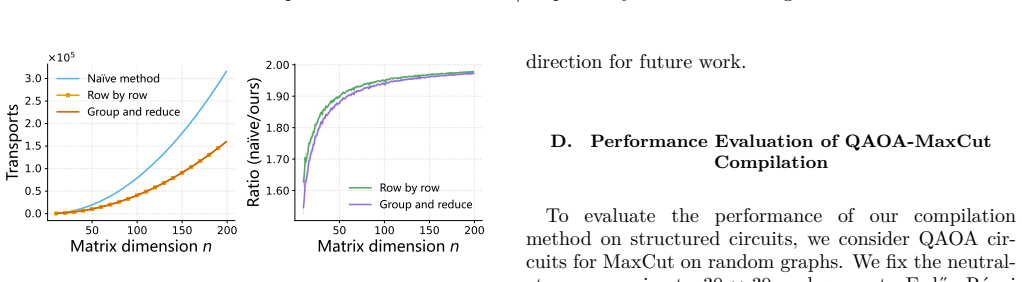
- C-Z gate scheduling requires approximately 50 percent fewer atom transport operations.
- QAOA circuits for MaxCut incur more than 30 percent lower transport cost on average.
- Hardware constraints of neutral-atom arrays become standard decomposition and coloring problems with performance guarantees.
Reading between the lines
- The algebraic and graph approach could extend to other gate families or array geometries beyond those tested.
- Lower transport overhead might allow neutral-atom devices to run larger problem instances before decoherence sets in.
- The compilation methods might combine with error-correction protocols to produce further reductions in total overhead.
Signed reviews
Editorial analysis
A structured set of objections, weighed in public.
Referee Report
Summary. The manuscript develops structure-aware compilation methods for neutral-atom quantum processors on 2D arrays. Single-qubit gate families are compiled via algebraic rank-one decompositions that reduce addressing layers; C-Z gates are scheduled via graph-theoretic models that reduce atom transport operations. Provable performance guarantees are stated for both, and numerical experiments on representative gate families and QAOA MaxCut circuits report up to 2× fewer addressing layers, ~50% fewer transports for C-Z, and >30% average transport-cost reduction for QAOA.
Significance. If the algebraic and graph models faithfully capture the dominant hardware limits, the approach converts physical constraints into tractable decomposition and coloring problems, yielding concrete, provably bounded improvements in addressing and transport overhead. The explicit provision of performance guarantees and the conversion of hardware structure into algebraic/graph problems are strengths that could aid scalable neutral-atom compilation.
major comments (2)
- [Abstract and §5 (numerical experiments)] The central claims rest on the assumption that the chosen rank-one decompositions and graph models capture all dominant constraints without unaccounted physical effects (position-dependent Rabi inhomogeneity, transport-induced heating, residual Rydberg leakage). No section compares the modeled metrics against hardware data or provides an error analysis showing that these effects remain sub-dominant when the reported reductions are realized.
- [Abstract] The abstract asserts 'provable performance guarantees' and 'extensive numerical experiments,' yet the provided text supplies neither the derivations of the guarantees nor dataset descriptions, error bars, or baseline implementations against which the factor-of-two and 50% reductions are measured. This prevents verification that the numerical results support the stated claims.
minor comments (2)
- Notation for the algebraic structures used in the rank-one decompositions should be defined explicitly before the first use in the single-qubit section.
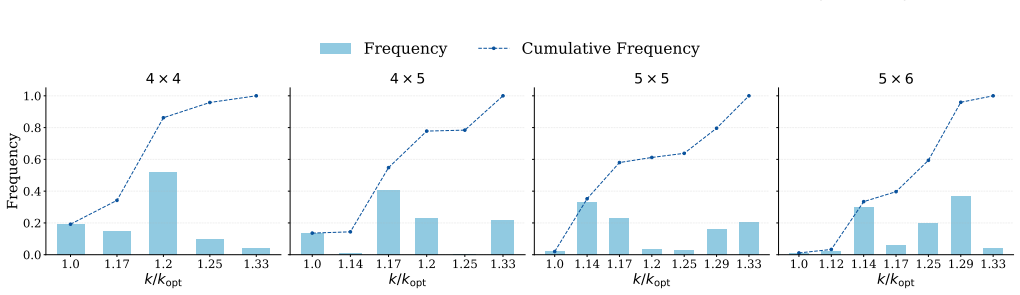
- Figure captions for the QAOA transport-cost plots should state the number of instances, graph sizes, and exact baseline (naïve row/column) implementation used for the >30% average reduction.
Simulated Author's Rebuttal
We thank the referee for the constructive feedback. We address each major comment below, clarifying the scope of our work and indicating revisions where appropriate.
read point-by-point responses
-
Referee: [Abstract and §5 (numerical experiments)] The central claims rest on the assumption that the chosen rank-one decompositions and graph models capture all dominant constraints without unaccounted physical effects (position-dependent Rabi inhomogeneity, transport-induced heating, residual Rydberg leakage). No section compares the modeled metrics against hardware data or provides an error analysis showing that these effects remain sub-dominant when the reported reductions are realized.
Authors: We agree that the manuscript models addressing layers and atom transport as the primary overheads but does not provide hardware data comparisons or a quantitative error analysis for secondary effects such as Rabi inhomogeneity or transport-induced heating. These effects are hardware-specific and lie outside the algorithmic focus of the paper, which converts the dominant constraints into algebraic and graph problems with provable bounds. We will add a limitations paragraph in the discussion section that explicitly states the modeling assumptions and the regimes in which the reported reductions are expected to remain relevant. revision: partial
-
Referee: [Abstract] The abstract asserts 'provable performance guarantees' and 'extensive numerical experiments,' yet the provided text supplies neither the derivations of the guarantees nor dataset descriptions, error bars, or baseline implementations against which the factor-of-two and 50% reductions are measured. This prevents verification that the numerical results support the stated claims.
Authors: The performance guarantees are formally derived in Sections 3 (rank-one decompositions) and 4 (graph-theoretic scheduling), with proofs of the approximation ratios and layer bounds. Section 5 details the gate families, QAOA MaxCut instances, naive baselines, and average reductions. To address the concern, we will revise Section 5 to include explicit dataset sizes, error bars on reported averages, and pseudocode or references for the baseline implementations, along with cross-references from the abstract. revision: yes
- Direct experimental validation against hardware data for secondary physical effects (Rabi inhomogeneity, transport heating, Rydberg leakage), as no such measurements were performed in this work.
Circularity Check
No circularity; derivation chain is self-contained
full rationale
The paper derives addressing-layer reductions from rank-one decompositions over algebraic structures for single-qubit gate families and transport reductions from graph-coloring/scheduling models for C-Z gates. These steps are presented as independent algorithmic constructions with provable guarantees measured against naive baselines inside the same models; no equation reduces to a fitted parameter renamed as prediction, no self-citation supplies a load-bearing uniqueness theorem, and no ansatz is smuggled via prior work. Numerical experiments validate the algorithms on the chosen abstractions rather than forcing the metrics by construction. This is the normal case of an independent modeling contribution.
Assumptions & free parameters
Cite this review
Pith. "Pith review of Structure-Aware Compilation for Scalable Neutral-Atom Quantum Computing." pith.science (2026). https://pith.science/paper/CMMO5GAZ
@misc{pith2026260701787,
  author       = {Pith},
  title        = {Pith review of: Structure-Aware Compilation for Scalable Neutral-Atom Quantum Computing},
  year         = {2026},
  howpublished = {\url{https://pith.science/paper/CMMO5GAZ}},
  note         = {Machine review of arXiv:2607.01787}
}
read the original abstract
We study the compilation of structured quantum gate families on two-dimensional neutral-atom arrays, aiming to reduce addressing and transport overhead under realistic hardware constraints. For single-qubit gates, we exploit the algebraic structures of gate families at the matrix level, enabling efficient rank-one decompositions over appropriate algebraic structures and thereby reducing the number of addressing layers. For controlled-Z (C-Z) gates, we formulate the transport scheduling problem using graph-theoretic models, leading to efficient compilation algorithms under realistic transport constraints. We provide provable performance guarantees for the proposed methods and validate them through extensive numerical experiments. Across representative single-qubit gate families, our methods reduce the number of addressing layers by up to a factor of two compared with na\"ive row- or column-wise implementations. For C-Z gates, our scheduling strategy reduces the required number of atom transport operations by approximately 50\%. When applied to QAOA circuits for MaxCut, the proposed framework reduces transport cost by more than 30\% on average. These results show that the physical constraints of neutral-atom hardware can be converted into algebraic and graph-theoretic structure, turning a hardware-level scheduling bottleneck into tractable decomposition and coloring problems.
Figures


Figures from the paper (7 more)



Reference graph
Works this paper leans on
-
[1]
Self-inverse Gates We first consider the case G = {I, X }, where X is a self-inverse single-qubit gate, i.e., X 2 = I. Many 3 commonly used single-qubit gates, including the Pauli gates and the Hadamard gates, satisfy this property. In this setting, the group G is isomorphic to the finite field GF(2), and the optimization problem ( 1) reduces to min k s.t...
-
[2]
, vk} are linearly independent over GF(2)
Apply a sequence of elementary row operations, represented by an invertible matrix Tr, to trans- form M into reduced row echelon form TrM = e1v⊤ 1 + e2v⊤ 2 + · · · + ekv⊤ k , where ei is the i-th column of the m × m identity matrix, {v1, . . . , vk} are linearly independent over GF(2)
-
[3]
Then M admits the decompo- sition M = u1v⊤ 1 + u2v⊤ 2 + · · · + ukv⊤ k
Define ut = T −1 r et. Then M admits the decompo- sition M = u1v⊤ 1 + u2v⊤ 2 + · · · + ukv⊤ k . The GF(2)-rank of M thus characterizes the minimum number of addressing layers required to realize the target gate pattern under the row-column addressing constraint of the neutral-atom architecture. In contrast, a naïve implementation that applies gates sequen...
-
[4]
Pauli Gates We now consider the Pauli group {±I, ±X, ±Y, ±Z, ±iI, ±iX, ±iY, ±iZ} . Since global phases are physically irrelevant, we restrict attention to the phase-free Pauli group G = {I, X, Y, Z }. The group operation, denoted by + and defined by Pauli multiplication modulo global phase, is summarized in the following table: + I X Y Z I I X Y Z X X I Z...
-
[5]
The group has order four and is isomorphic to the additive group modulo 4, Z4 = {0, 1, 2, 3}
Phase Gates We next consider the cyclic group generated by the phase gate S = " 1 0 0 i # , namely G = {I, S, S 2, S3}. The group has order four and is isomorphic to the additive group modulo 4, Z4 = {0, 1, 2, 3}. Under this identification, the optimization problem ( 1) becomes min k s.t. M = kX t=1 utv⊤ t · Gt, Gt ∈ Z4, u t ∈ {0, 1}m, v t ∈ {0, 1}n, (2) ...
-
[7]
Define M2 = M − k1X t=1 u(1) t v(1) t ⊤ (mod4) , so that M2 ∈ { 0, 2}m×n. Compute the rank of M2/2 over GF(2) and obtain 1 2 M2 = k2X t=1 u(2) t v(2) t ⊤ , where u(2) t ∈ {0, 1}m, v (2) t ∈ {0, 1}n. Combining the two stages, we obtain a decomposition M = k1X t=1 u(1) t v(1) t ⊤ + k2X t=1 2u(2) t v(2) t ⊤ (mod4) , (3) which is valid under the constraints o...
-
[8]
Clifford Gates We now consider the single-qubit Clifford group gen- erated by {I, X, Y, Z, S, H}. Up to an irrelevant global phase, any single-qubit Clifford operator admits a decom- position of the form U = P HaSb where P ∈ {I, X, Y, Z }, a ∈ {0, 1}, and b ∈ {0, 1, 2, 3}. This factorization suggests a natural compilation strat- egy for Clifford gates on ...
-
[9]
π/8 Gates In this subsection, we consider the group generated by the π 8 gate T = " 1 0 0 ei π 4 # . Analogous to the phase-gate group, this group is cyclic of order eight and is isomorphic to the additive group modulo 8, Z8 = {0, 1, 2, 3, 4, 5, 6, 7}. Under this identifi- cation, the compilation problem ( 1) reduces to min k s.t. M = kX t=1 utv⊤ t · Gt, ...
Show all 37 references
-
[10]
Compute its rank over GF(2) and obtain a rank-one decomposition M1 = k1X t=1 u(1) t v(1) t ⊤ , where u(1) t ∈ {0, 1}m, v (1) t ∈ {0, 1}n
Let M1 = M mod 2 . Compute its rank over GF(2) and obtain a rank-one decomposition M1 = k1X t=1 u(1) t v(1) t ⊤ , where u(1) t ∈ {0, 1}m, v (1) t ∈ {0, 1}n
-
[11]
Apply the algorithm for compiling phase gates and obtain 1 2 M2 = k2X t=1 u(2) t v(2) t ⊤ · Gt, where Gt ∈ Z4, u (2) t ∈ {0, 1}m, v (2) t ∈ {0, 1}n
Define M2 = M − k1X t=1 u(1) t v(1) t ⊤ (mod8) , so that M2 ∈ { 0, 2, 4, 6}m×n. Apply the algorithm for compiling phase gates and obtain 1 2 M2 = k2X t=1 u(2) t v(2) t ⊤ · Gt, where Gt ∈ Z4, u (2) t ∈ {0, 1}m, v (2) t ∈ {0, 1}n. Combining the two stages, we obtain a valid deco...
-
[12]
The compilation problem for column-aligned C-Z gates can be treated analogously
Row/column-aligned C-Z Gates We consider the compilation problem for row-aligned C-Z gates, namely, implementing a set of C-Z gates in which each gate acts on a pair of qubits within the same row of the atom array, while minimizing the number of transport operations. The compi...
-
[13]
Collect the indexes of all nonzero columns
-
[14]
Interpret these column indexes as open intervals and apply interval-graph coloring to obtain a valid grouping. For example, after removing all-zero columns, the matrix in Figure 4 can be grouped as follows: (0, 1) (1, 2) (0, 2) (0, 3) 0 1 1 0 0 1 1 0 1 0 2 0 1 0 1 Note that wi...
-
[15]
We first consider the case of two rows of qubits, each containing n qubits labeled 1, 2,
Non-aligned C-Z Gates We consider the problem of implementing non-aligned C-Z gates, namely, C-Z gates acting on pairs of qubits located in different rows and columns of the atom ar- ray, with the goal of minimizing the number of transport operations. We first consider the cas...
-
[16]
row by row
General C-Z Gates Scheduling By combining the two cases discussed above, arbitrary C-Z gates on a neutral-atom array can be scheduled effi- ciently. First, all non-aligned C-Z gates are scheduled row pair by row pair using the method described in Section II B 2. During this pro...
-
[17]
J. Koch, T. M. Yu, J. Gambetta, A. A. Houck, D. I. Schuster, J. Majer, A. Blais, M. H. Devoret, S. M. Girvin, and R. J. Schoelkopf, Phys. Rev. A 76, 042319 (2007)
2007
-
[18]
Clarke and F
J. Clarke and F. K. Wilhelm, Nature 453, 1031 (2008)
2008
-
[19]
Arute, K
F. Arute, K. Arya, R. Babbush, D. Bacon, J. C. Bardin, R. Barends, R. Biswas, S. Boixo, F. G. S. L. Brandao, D. A. Buell, B. Burkett, Y. Chen, Z. Chen, B. Chiaro, R. Collins, W. Courtney, A. Dunsworth, E. Farhi, B. Foxen, A. Fowler, C. Gidney, M. Giustina, R. Graff, K. Guerin,...
2019
-
[20]
C. J. Ballance, T. P. Harty, N. M. Linke, M. A. Sepiol, and D. M. Lucas, Phys. Rev. Lett. 117, 060504 (2016)
2016
-
[21]
Mei, B.-W
Q.-X. Mei, B.-W. Li, Y.-K. Wu, M.-L. Cai, Y. Wang, L. Yao, Z.-C. Zhou, and L.-M. Duan, Phys. Rev. Lett. 128, 160504 (2022)
2022
-
[22]
Cheng, C.-Y
C.-Y. Cheng, C.-Y. Yang, Y.-H. Kuo, R.-C. Wang, H.- C. Cheng, and C.-Y. R. Huang, ACM Transactions on Quantum Computing 5, 10.1145/3680291 (2024)
2024 doi
-
[23]
H. Fu, M. Zhu, F. Chen, C. Zhang, J. Wu, W. Xie, and X.-Y. Li, IEEE Transactions on Computer-Aided Design of Integrated Circuits and Systems 44, 1774 (2025)
2025
-
[24]
Kusyk, S
J. Kusyk, S. M. Saeed, and M. U. Uyar, IEEE Transac- tions on Quantum Engineering 2, 1 (2021)
2021
-
[25]
Murali, D
P. Murali, D. M. Debroy, K. R. Brown, and M. Martonosi, in 2020 ACM/IEEE 47th Annual Inter- national Symposium on Computer Architecture (ISCA) (2020) pp. 529–542
2020
-
[26]
B. Bach, I. Safro, and E. Younis, Efficient compilation for shuttling trapped-ion machines via the position graph ar- chitectural abstraction (2025), arXiv:2501.12470 [quant- ph]
2025 arXiv
-
[27]
Beugnon, C
J. Beugnon, C. Tuchendler, H. Marion, A. Gaëtan, Y. Miroshnychenko, Y. R. P. Sortais, A. M. Lance, M. P. A. Jones, G. Messin, A. Browaeys, and P. Grang- ier, Nature Physics 3, 696 (2007)
2007
-
[28]
Schlosser, S
M. Schlosser, S. Tichelmann, J. Kruse, and G. Birkl, Quantum Information Processing 10, 907 (2011)
2011
-
[29]
Levine, A
H. Levine, A. Keesling, G. Semeghini, A. Omran, T. T. Wang, S. Ebadi, H. Bernien, M. Greiner, V. Vuletić, H. Pichler, and M. D. Lukin, Phys. Rev. Lett. 123, 170503 (2019)
2019
-
[30]
S. J. Evered, D. Bluvstein, M. Kalinowski, S. Ebadi, T. Manovitz, H. Zhou, S. H. Li, A. A. Geim, T. T. Wang, N. Maskara, H. Levine, G. Semeghini, M. Greiner, V. Vuletić, and M. D. Lukin, Nature 622, 268 (2023)
2023
-
[31]
Bluvstein, A
D. Bluvstein, A. A. Geim, S. H. Li, S. J. Evered, J. P. Bonilla Ataides, G. Baranes, A. Gu, T. Manovitz, M. Xu, M. Kalinowski, S. Majidy, C. Kokail, N. Maskara, E. C. Trapp, L. M. Stewart, S. Hollerith, H. Zhou, M. J. Gul- lans, S. F. Yelin, M. Greiner, V. Vuletić, M. Cain, an...
2025
-
[32]
Håstad, in International colloquium on automata, lan- guages, and programming (Springer, 1989) pp
J. Håstad, in International colloquium on automata, lan- guages, and programming (Springer, 1989) pp. 451–460
1989
-
[33]
Ja’Ja’, in Proceedings of the tenth annual ACM sym- posium on Theory of computing (1978) pp
J. Ja’Ja’, in Proceedings of the tenth annual ACM sym- posium on Theory of computing (1978) pp. 173–183
1978
-
[34]
X. Song, B. Zheng, and R. Huang, SIAM Journal on Ma- trix Analysis and Applications 43, 867 (2022)
2022
-
[35]
X. Song, B. Zheng, and R. Huang, The Electronic Journal of Linear Algebra 41, 353 (2025)
2025
-
[36]
C. Zhu, X. Wu, Z. Yang, J. Wang, A. Wu, S. Zheng, and X. Wang, Quantum compiler design for qubit mapping and routing: A cross-architectural survey of supercon- ducting, trapped-ion, and neutral atom systems (2025), arXiv:2505.16891 [quant-ph]
2025
-
[37]
M. C. Golumbic, Algorithmic graph theory and perfect graphs, Vol. 57 (Elsevier, 2004)
2004
-
[38]
Khusainov, Y
E. Khusainov, Y. Chen, J. Winklmann, H. Seidl, and C. B. Mendl, Practical insights into fair comparison and evaluation frame for neutral-atom compilers (2026), arXiv:2604.25478 [cs.ET]
2026 arXiv
Reviewed July 3, 2026 · model on record in the stance chip above.
Discussion (0). Continue with ORCID to comment.