REVIEW 3 major objections 4 minor 54 references
You Only Charge Once 2.0 : A End-to-End Analog Computing-in-Memory Architecture with Reconfigurable Switched Capacitors
T0 review · 3 major / 4 minor · reviewed 2026-08-12 · deepseek-v4-flash
Pith's one-line read Charge-CIM claims one reconfigurable switched-capacitor fabric can carry an INT8 vector–matrix multiply from input to quantized output in the analog domain, cutting ADC energy by 91.7% in simulation.
desk verdict Clever slice-free charge-domain CIM that unifies DAC/MAC/SA/ADC in one capacitor network, but Phase 5's weighted shift-add lacks a specified switch topology and the input DAC capacitance budget doesn't obviously fit the array. read the letter →
The pith
A machine-rendered reading of the paper's core claim, the machinery that carries it, and where it could break.
The reading
What carries the argument
The load-bearing object is a reconfigurable switched-capacitor fabric: every memory-and-compute cell (MCC) contains SRAM weight bits and a unit capacitor $C_u = 2.66\,\mathrm{fF}$, and three switch networks ($S_{DAC}$, $S_{ACC}$, $S_{SA}$) rewire those capacitors between phases. In Phases 1–2 the row capacitors form an $N$-bit embedded DAC; in Phase 3 each capacitor conditionally stores $V_{\mathrm{in}}\cdot W$; in Phase 4 column switches average the partial products; in Phase 5 the $S_{SA}$ network regroups columns into binary ratios $1:2:\dots:2^{M-1}$; and in Phase 6 the same groups serve as the capacitive DAC (C-DAC) of a monotonic successive-approximation-register (SAR) ADC. This one-fabric reuse is what lets the design 'charge once' and convert only at the end, avoiding the repeated ADC invocations that follow from bit-slicing.
What would settle it
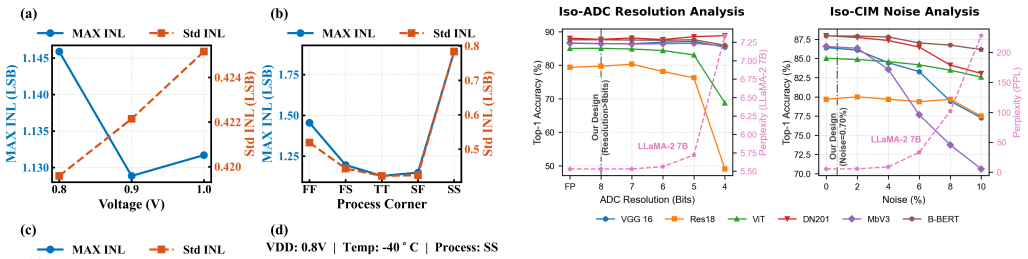
Fabricate the 256×128 macro in 28\,nm with $2.66\,\mathrm{fF}$ unit capacitors and measure the end-to-end transfer curve while sweeping all 8-bit input and weight codes; if the $S_{SA}$ regrouping cannot produce the $1:2:\dots:2^{M-1}$ capacitance ratios, the measured INL/DNL and end-to-end RMSE should exceed the reported $+1.12/-1.14$ LSB and $1.6\%$, falsifying the central claim.
Extended reading notes
Core claim
The central claim is that fully analog multi-bit computation is possible without arithmetic slicing: a 256×128 macro of memory-and-compute cells, each holding a unit capacitor and weight bit, can execute an 8-bit-input by 8-bit-weight VMM in six charge-sharing phases. Input bits charge binary-sized capacitor groups ($C_n = 2^n C_u$) that are then shorted row-wise to produce an analog input voltage; a NAND-like switch conditionally retains or discharges that charge according to each weight bit; column-wise charge sharing averages the partial products; reconfigurable $S_{SA}$ switches regroup the same unit capacitors into $1:2:\dots:2^{M-1}$ ratios to implement bit-weighted shift-add; and the same array becomes the capacitive DAC of a monotonic SAR ADC that quantizes in place. The paper derives the end-to-end expression $V_{out,j} = \frac{\sum_{m=0}^{M-1}\sum_{i=0}^{P-1}\sum_{n=0}^{N-1} 2^n X_i[n] \cdot 2^m W_{ij}[m]}{(2^M-1)P \cdot 2^N} V_{DD}$ and reports that the differential readout with inverse coding turns the ADC's natural subtraction into partial-sum addition, halving conversions and reaching pseudo-9-bit resolution. This is the 'You Only Charge Once' path: charge is injected once at the supply in Phase 1 and only leaves during ADC discharge. The paper claims this eliminates the standalone-DAC and intermediate-ADC costs that make up more than half of energy in prior charge-domain CIM.
Load-bearing premise
The design assumes that after column-wise charge sharing, the same unit capacitors can be rewired into exact $1:2:4:\dots$ binary groups for the shift-add step with no charge lost, and that the row has enough room to host both the $2^N$ unit capacitors for input conversion and the 8-bit weight mapping.
Editorial extensions
If this is right
- Bit-slicing disappears: an 8-bit input and an 8-bit weight contribute in one analog pass, so the number of ADC conversions per output drops from the product of slice counts to one per compute-bar read.
- The reused capacitor array removes the standalone C-DAC of a conventional ADC, shrinking converter area to 3% of total chip area and reducing ADC energy by 91.7% in the paper's simulation.
- Differential inverse coding folds partial-sum addition into the SAR comparison, halving the number of readout conversions and lifting the effective readout resolution to pseudo-9-bit.
- Configurable bit-width and base reformation let the same fabric switch between 8-bit, 4-bit, 2-bit, 1-bit, and non-binary coding without hardware changes.
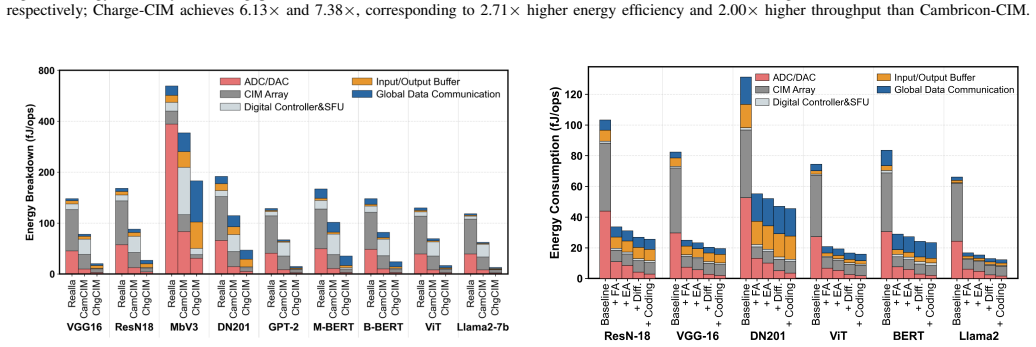
- Across nine CNN, Transformer, and LLM benchmarks, the claimed average gains are 2.71x energy efficiency and 2.01x throughput over Cambricon-CIM, with end-to-end VMM RMSE of 1.6% and accuracy loss at most 1.9 percentage points.
Reading between the lines
- The same one-charge principle, if it holds in silicon, should extend to higher bit widths (e.g., 16-bit) by adding more binary-weighted groups, though the $2^N$ unit-capacitance growth would eventually dominate area; the paper only demonstrates up to 8-bit configurations.
- The differential in-ADC accumulation could in principle merge partial sums from multiple spatially partitioned arrays, removing digital accumulation trees for large models; the paper applies it only within a macro's paired arrays.
- Because the arithmetic is fixed by capacitor ratios rather than by a fixed codebook, the fabric could be reprogrammed to non-binary bases (such as the coding-base reformation used by Cambricon-CIM) by reordering input bits; the paper gives one 3:4 example but does not search this design space.
- A silicon measurement of the Phase 5 regrouping would be the decisive test: if switch parasitics discard charge from unselected capacitors, the reported 1.6% end-to-end RMSE and 4.46 mV peak quantization error would not survive, independent of the architecture-level simulations.
Signed reviews
Editorial analysis
A structured set of objections, weighed in public.
Referee Report
Summary. Charge-CIM is a proposed charge-domain analog computing-in-memory (ACiM) macro architecture that reuses a switched-capacitor network for input digital-to-analog conversion, 1-bit multiplication, column-wise accumulation, binary-weighted shift-and-add across weight-bit columns, and in-situ SAR-ADC quantization. The paper derives an end-to-end VMM expression (Eq. 5), presents a differential readout with 'inverse coding' to accumulate paired partial sums, and evaluates the design with SPICE-based circuit simulation plus Timeloop/Accelergy architecture simulation. Against RAELLA and Cambricon-CIM, it reports 91.7% ADC energy reduction, 2.71x energy efficiency, and 2.01x throughput improvements across nine DNN/LLM benchmarks.
Significance. If the architectural feasibility were fully established, Charge-CIM would be a meaningful step toward eliminating the ADC wall in ACiM by replacing bit-sliced execution with a single charge-processing path. The paper's ideal-equation derivation is internally consistent, the offset-encoding treatment of signed arithmetic is correct, and the evaluation methodology (SPICE extraction, Monte Carlo mismatch, architecture-level simulation, ablation) is appropriate for the field. The claims are falsifiable and the paper provides a clear quantitative comparison. However, the central contribution depends on a physical reconfiguration that is not specified at the switch level; until that is resolved, the results should be treated as conditional.
major comments (3)
- [III.A, Phase 5, Eq. (4)] The paper never specifies the switch topology that realizes the binary-weighted regrouping in Phase 5. After Phase 4, all P unit capacitors in a given column are shorted by S_ACC, so each column contains P identical capacitors at V_acc[j][m]. Equation (4) requires the S_SA network to connect exactly 1, 2, ..., 2^{M-1} capacitors from successive bit columns to a common output node and to isolate the remaining P - 2^m capacitors. The text only states that 'S_SA switches configure the shared capacitance ratio between columns'; it does not say whether these are per-capacitor switches, per-column switches, or a ladder network. If S_SA simply shorts whole columns, the output is an unweighted average. If per-capacitor switches are assumed, their area and control overhead are absent from Table III, and the charge on the disconnected capacitors is discarded without a described reset. This is load-bearing: without a concrete S_SA topology, Eq. (4) is an ungrounded mathematical identity and the central slice-free multi-bit claim is not established.
- [III.A, Phase 2, Eq. (1) and Table III] The embedded DAC requires C_tot = 2^N C_u per row; for N=8 this is 256 unit capacitors per row. The macro is specified as 256×128 in Table III, giving only 128 columns (and hence 128 MCCs) per row, and Section III.A describes each MCC as containing 'a unit switched capacitor'. No explanation is given for how 256 unit capacitors fit in a 128-column row while also accommodating the weight-bit mapping. If each row truly contains only 128 unit capacitors, the maximum input precision is 7 bits, which would contradict the INT8 VMM claim. The paper should provide a concrete row layout (e.g., multiple unit capacitors per MCC, or a different macro dimension) or revise the precision claims.
- [IV-B, Eq. (8)] The inverse-coding scheme states that 'the V_N-side array is driven by pre-inverted inputs (I_inv = -I_N), generating a negative partial sum V_N = -I_N·W_N.' In the charge-domain implementation described in Section III, voltages are inherently non-negative (between 0 and V_DD), so a literal negative partial sum cannot appear on a single-ended capacitor node. The paper should clarify the physical mechanism: e.g., bitwise inversion combined with offset compensation, differential plate swapping, or a negative reference. As written, Eq. (8) is a mathematical identity rather than a demonstrated circuit behavior, and the claim of in-ADC partial-sum addition rests on this mechanism.
minor comments (4)
- [III.A(1)] The text says '2N MCCs are grouped via N SDAC switches in a binary ratio (1 : 1 : 2 : ... : 2^{N-1})'; this should be '2^N' (or '2^N - 1 unit capacitors'), since the binary ratio sums to 2^N - 1, not 2N.
- [Fig. 13 caption] The caption states 'Cambricon-CIM achieves geometric means of 2.26× and 3.69×, respectively' without specifying what those numbers refer to; the text reports 2.71× and 2.01× improvements for Charge-CIM. Please clarify the comparison direction and the meaning of the geometric means.
- [Table III] The MCC row lists '2.66 fF 2.15fJ/act 1.74µm^2' with mixed units; please separate capacitance, energy per activation, and area into distinct columns with clear headers.
- [V.A] The statement that the 256×128 macro is split into two 128×128 subarrays operating differentially should be reconciled with the embedded-DAC capacitance requirement per row; as written, it reinforces the concern in Major Comment 2.
Circularity Check
No significant circularity: the central VMM derivation is a charge-conservation identity with independently simulated energy/accuracy results; self-citations are background only.
full rationale
We walked the derivation chain. The six-phase operation defines the embedded DAC, multiplication, accumulation, shift-add, and SAR quantization as constructions on a switched-capacitor array; Eqs. (1)-(6) follow from charge conservation and the stated binary capacitor ratios, so the multi-bit VMM expression in Eq. (5) is a direct composition of those definitions rather than a hidden restatement of the claimed result. The offset-encoding equation (7) and inverse-coding equation (8) are exact algebraic identities used to realize signed arithmetic and differential in-ADC accumulation; they are design transformations, not fitted predictions. The 91.7% ADC-energy reduction, 2.7x energy efficiency, 2.0x throughput, and accuracy numbers are produced by SPICE/architecture-level simulation against external baselines (RAELLA and Cambricon-CIM), with noise parameters extracted from circuit simulation and Monte Carlo analysis rather than tuned to match the reported outcomes. The only self-citations are prior work by the same group (YOCO [49] and [48]) cited as background for charge-domain shift-add and ADC-free MAC; they are not load-bearing for the new differential embedded-ADC or inverse-coding contributions, and no uniqueness theorem or ansatz is imported from them. A switch-level topology for Phase 5's binary regroupings is indeed unspecified, but that is a feasibility/completeness risk, not a circularity, because the claimed equation is not made true by fitting a parameter to itself.
Assumptions & free parameters
free parameters (3)
- Unit capacitance C_u =
2.66 fF
- DAC and MAC noise variances sigma_DAC^2 and sigma_MAC^2 =
Not reported numerically; extracted from SPICE/post-layout simulation
- ADC ENOB =
8-bit ENOB
assumptions (7)
- standard math Ideal charge redistribution with binary-weighted capacitors
- domain assumption Analog multiplication by conditional discharge is exact and linear
- domain assumption Phase timing and settling error below 0.46 LSB
- domain assumption Gaussian independent DAC/MAC noise plus kT/C model captures analog errors
- domain assumption Differential SAR ADC with inverse coding realizes Eq. (8) without additional offset errors
- domain assumption Baseline architectures are faithfully reconstructed and normalized to 300 mm2
- standard math Offset encoding terms are computed with negligible cost
Cite this review
Pith. "Pith review of You Only Charge Once 2.0 : A End-to-End Analog Computing-in-Memory Architecture with Reconfigurable Switched Capacitors." pith.science (2026). https://pith.science/paper/CMXUMNP3
@misc{pith2026260811116,
  author       = {Pith},
  title        = {Pith review of: You Only Charge Once 2.0 : A End-to-End Analog Computing-in-Memory Architecture with Reconfigurable Switched Capacitors},
  year         = {2026},
  howpublished = {\url{https://pith.science/paper/CMXUMNP3}},
  note         = {Machine review of arXiv:2608.11116}
}
read the original abstract
Analog Computing-in-Memory (ACiM) accelerates deep neural networks by keeping weights inside memory arrays and executing dot products in the analog domain. However, modern ACiM accelerators are often limited by the "ADC wall": analog-to-digital converters consume a large fraction of energy and area, while bit-sliced execution repeatedly invokes these converters. Existing designs reduce this cost with low-resolution readout or time multiplexing, but they either lose output fidelity or introduce serialization overhead. Charge-CIM addresses this bottleneck by using switched-capacitor charge redistribution as a unified computing and conversion substrate. The same capacitor fabric performs input conversion, analog MAC, weighted shift-and-add, and readout quantization, reducing both standalone converter overhead and intermediate ADC invocations. A differential readout path further combines paired partial sums during ADC quantization, providing a highly compact and energy-efficient solution for array integration. With dataflow architecture support, we evaluated Charge-CIM on a suite of DNN benchmarks, from CNNs to Transformer models, and experimental results show that Charge-CIM reduces ADC energy by 91.7% under our evaluation setup and improves energy efficiency by 2.7x and throughput by 2.0x compared to the state-of-the-art charge-domain CIM accelerator.
Figures


Figures from the paper (11 more)




Reference graph
Works this paper leans on
-
[1]
T. Andrulis, J. S. Emer, and V . Sze, “Raella: Reforming the arithmetic for efficient, low-resolution, and low-loss analog pim: No retraining required!” inProceedings of the 50th Annual International Symposium on Computer Architecture, 2023, pp. 1–16
work page 2023
-
[2]
Cimloop: A flexible, accurate, and fast compute-in-memory modeling tool,
T. Andrulis, J. S. Emer, and V . Sze, “Cimloop: A flexible, accurate, and fast compute-in-memory modeling tool,” in2024 IEEE International Symposium on Performance Analysis of Systems and Software (ISPASS). IEEE, 2024, pp. 10–23
work page 2024
-
[3]
Cacti 7: New tools for interconnect exploration in innovative off-chip memories,
R. Balasubramonian, A. B. Kahng, N. Muralimanohar, A. Shafiee, and V . Srinivas, “Cacti 7: New tools for interconnect exploration in innovative off-chip memories,”ACM Transactions on Architecture and Code Optimization (TACO), vol. 14, no. 2, pp. 1–25, 2017
2017
-
[4]
Z. Chen, Z. Wen, W. Wan, A. R. Pakala, Y . Zou, W.-C. Wei, Z. Li, Y . Chen, and K. Yang, “Pico-ram: A pvt-insensitive analog compute-in- memory sram macro with in situ multi-bit charge computing and 6t thin- cell-compatible layout,”IEEE Journal of Solid-State Circuits, vol. 60, no. 1, pp. 308–320, 2024
work page 2024
-
[5]
Z. Chen, Z. Yu, Q. Jin, Y . He, J. Wang, S. Lin, D. Li, Y . Wang, and K. Yang, “Cap-ram: A charge-domain in-memory computing 6t-sram for accurate and precision-programmable cnn inference,”IEEE Journal of Solid-State Circuits, vol. 56, no. 6, pp. 1924–1935, 2021
work page 1924
-
[6]
Bert: Pre-training of deep bidirectional transformers for language understanding,
J. Devlin, M.-W. Chang, K. Lee, and K. Toutanova, “Bert: Pre-training of deep bidirectional transformers for language understanding,” inNorth American Chapter of the Association for Computational Linguistics,
-
[7]
Q. Dong, M. E. Sinangil, B. Erbagci, D. Sun, W.-S. Khwa, H.-J. Liao, Y . Wang, and J. Chang, “15.3 a 351tops/w and 372.4 gops compute-in-memory sram macro in 7nm finfet cmos for machine- learning applications,” in2020 IEEE International Solid-State Circuits Conference-(ISSCC). IEEE, 2020, pp. 242–244
work page 2020
-
[8]
An image is worth 16x16 words: Transformers for image recognition at scale,
A. Dosovitskiy, L. Beyer, A. Kolesnikov, D. Weissenborn, X. Zhai, T. Unterthiner, M. Dehghani, M. Minderer, G. Heigold, S. Gelly, J. Uszkoreit, and N. Houlsby, “An image is worth 16x16 words: Transformers for image recognition at scale,”ArXiv, vol. abs/2010.11929, 2020. [Online]. Available: https://api.semanticscholar.org/CorpusID:225039882
arXiv 2010
Show all 54 references
-
[9]
Analog compute-in-memory for ai edge inference,
D. Fick, “Analog compute-in-memory for ai edge inference,” in2022 International Electron Devices Meeting (IEDM). IEEE, 2022, pp. 21–8
2022
-
[10]
Funda- mental limits on energy-delay-accuracy of in-memory architectures in inference applications,
S. K. Gonugondla, C. Sakr, H. Dbouk, and N. R. Shanbhag, “Funda- mental limits on energy-delay-accuracy of in-memory architectures in inference applications,”IEEE Transactions on Computer-Aided Design of Integrated Circuits and Systems, vol. 41, no. 10, pp. 3188–3201, 2021
2021
-
[11]
Cambricon-cim: Enabling energy-efficient and error-resilient analog cim acceleration via reformation of coding bases,
H. Guo, T. Ma, Z. Du, M. Zou, Y . Hao, Y . Zhao, R. Zhang, W. Li, X. Hu, Z. Xu, Q. Guo, and T. Chen, “Cambricon-cim: Enabling energy-efficient and error-resilient analog cim acceleration via reformation of coding bases,” in2026 IEEE International Symposium on High Performance ...
2026
-
[12]
Cambricon- m: a fibonacci-coded charge-domain sram-based cim accelerator for dnn inference,
H. Guo, M. Zou, Y . Hao, Z. Du, E. Ren, Y . Liu, Y . Zhao, T. Ma, R. Zhang, X. Hu, F. Qiao, Z. Xu, Q. Guo, and T. Chen, “Cambricon- m: a fibonacci-coded charge-domain sram-based cim accelerator for dnn inference,” in2024 57th IEEE/ACM International Symposium on Microarchitectu...
2024
-
[13]
Deep residual learning for image recognition,
K. He, X. Zhang, S. Ren, and J. Sun, “Deep residual learning for image recognition,” inProceedings of the IEEE conference on computer vision and pattern recognition, 2016, pp. 770–778
2016
-
[14]
Searching for mobilenetv3,
A. G. Howard, M. Sandler, G. Chu, L.-C. Chen, B. Chen, M. Tan, W. Wang, Y . Zhu, R. Pang, V . Vasudevan, Q. V . Le, and H. Adam, “Searching for mobilenetv3,”2019 IEEE/CVF International Conference on Computer Vision (ICCV), pp. 1314–1324, 2019. [Online]. Available: https://api....
2019
-
[15]
Densely connected convolutional networks,
G. Huang, Z. Liu, and K. Q. Weinberger, “Densely connected convolutional networks,”2017 IEEE Conference on Computer Vision and Pattern Recognition (CVPR), pp. 2261–2269, 2016. [Online]. Available: https://api.semanticscholar.org/CorpusID:9433631
2017
-
[16]
15.1 a programmable neural-network inference accelerator based on scalable in-memory computing,
H. Jia, M. Ozatay, Y . Tang, H. Valavi, R. Pathak, J. Lee, and N. Verma, “15.1 a programmable neural-network inference accelerator based on scalable in-memory computing,” in2021 IEEE International Solid-State Circuits Conference (ISSCC), vol. 64. IEEE, 2021, pp. 236–238
2021
-
[17]
A survey on hardware accelerators for large language models,
C. Kachris, “A survey on hardware accelerators for large language models,”Applied Sciences, vol. 15, no. 2, p. 586, 2025
2025
-
[18]
Deep in-memory architectures in sram: An analog approach to approximate computing,
M. Kang, S. K. Gonugondla, and N. R. Shanbhag, “Deep in-memory architectures in sram: An analog approach to approximate computing,” Proceedings of the IEEE, vol. 108, pp. 2251–2275, 2020. [Online]. Available: https://api.semanticscholar.org/CorpusID:227123274
2020
-
[19]
A 65nm 4kb algorithm-dependent computing-in-memory sram unit-macro with 2.3 ns and 55.8 tops/w fully parallel product-sum operation for binary dnn edge processors,
W.-S. Khwa, J.-J. Chen, J.-F. Li, X. Si, E.-Y . Yang, X. Sun, R. Liu, P.-Y . Chen, Q. Li, S. Yu, and M.-F. Chang, “A 65nm 4kb algorithm-dependent computing-in-memory sram unit-macro with 2.3 ns and 55.8 tops/w fully parallel product-sum operation for binary dnn edge processors...
2018
-
[20]
Imagenet classification with deep convolutional neural networks,
A. Krizhevsky, I. Sutskever, and G. E. Hinton, “Imagenet classification with deep convolutional neural networks,”Advances in neural informa- tion processing systems, vol. 25, 2012
2012
-
[21]
A 28-nm 50.1-tops/w p-8t sram compute- in-memory macro design with bl charge-sharing-based in-sram dac/adc operations,
K. Lee, J. Kim, and J. Park, “A 28-nm 50.1-tops/w p-8t sram compute- in-memory macro design with bl charge-sharing-based in-sram dac/adc operations,”IEEE Journal of Solid-State Circuits, vol. 59, no. 6, pp. 1926–1937, 2023
1926
-
[22]
Timely: Pushing data movements and interfaces in pim accelerators towards local and in time domain,
W. Li, P. Xu, Y . Zhao, H. Li, Y . Xie, and Y . Lin, “Timely: Pushing data movements and interfaces in pim accelerators towards local and in time domain,” in2020 ACM/IEEE 47th Annual International Symposium on Computer Architecture (ISCA). IEEE, 2020, pp. 832–845
2020
-
[23]
A 10-bit 50-ms/s sar adc with a monotonic capacitor switching procedure,
C.-C. Liu, S.-J. Chang, G.-Y . Huang, and Y .-Z. Lin, “A 10-bit 50-ms/s sar adc with a monotonic capacitor switching procedure,”IEEE Journal of Solid-State Circuits, vol. 45, no. 4, pp. 731–740, 2010
2010
-
[24]
A modern primer on processing in memory,
O. Mutlu, S. Ghose, J. G ´omez-Luna, and R. Ausavarungnirun, “A modern primer on processing in memory,” inEmerging computing: from devices to systems: looking beyond Moore and Von Neumann. Springer, 2022, pp. 171–243
2022
-
[25]
Timeloop: A systematic approach to dnn accelerator evaluation,
A. Parashar, P. Raina, Y . S. Shao, Y .-H. Chen, V . A. Ying, A. Mukkara, R. Venkatesan, B. Khailany, S. W. Keckler, and J. Emer, “Timeloop: A systematic approach to dnn accelerator evaluation,” in2019 IEEE inter- national symposium on performance analysis of systems and softw...
2019
-
[26]
Ciminus: Empowering sparse dnn workloads modeling and exploration on sram-based cim architectures,
Y . Qi, J. Yang, R. Yang, C. Duan, X. He, Z. He, W. Pan, and W. Zhao, “Ciminus: Empowering sparse dnn workloads modeling and exploration on sram-based cim architectures,”IEEE Transactions on Computers, vol. 75, no. 1, pp. 380–394, 2025
2025
-
[27]
Language models are unsupervised multitask learners,
A. Radford, J. Wu, R. Child, D. Luan, D. Amodei, and I. Sutskever, “Language models are unsupervised multitask learners,” 2019. [Online]. Available: https://api.semanticscholar.org/CorpusID:160025533
2019
-
[28]
Compute trends across three eras of machine learning,
J. Sevilla, L. Heim, A. Ho, T. Besiroglu, M. Hobbhahn, and P. Villalobos, “Compute trends across three eras of machine learning,” in2022 international joint conference on neural networks (IJCNN). IEEE, 2022, pp. 1–8
2022
-
[29]
Isaac: A convolutional neural network accelerator with in-situ analog arithmetic in crossbars,
A. Shafiee, A. Nag, N. Muralimanohar, R. Balasubramonian, J. P. Stra- chan, M. Hu, R. S. Williams, and V . Srikumar, “Isaac: A convolutional neural network accelerator with in-situ analog arithmetic in crossbars,” ACM SIGARCH Computer Architecture News, vol. 44, no. 3, pp. 14–26, 2016
2016
-
[30]
A local computing cell and 6t sram-based computing-in- memory macro with 8-b mac operation for edge ai chips,
X. Si, Y .-N. Tu, W.-H. Huang, J.-W. Su, P.-J. Lu, J.-H. Wang, T.-W. Liu, S.-Y . Wu, R. Liu, Y .-C. Chou, Y .-L. Chung, W. Shih, C.-C. Lo, R.-S. Liu, C.-C. Hsieh, K.-T. Tang, N.-C. Lien, W.-C. Shih, Y . He, Q. Li, and M.-F. Chang, “A local computing cell and 6t sram-based comp...
2021
-
[31]
Very deep convolutional networks for large-scale image recognition,
K. Simonyan and A. Zisserman, “Very deep convolutional networks for large-scale image recognition,”arXiv preprint arXiv:1409.1556, 2014
2014 arXiv
-
[32]
Pipelayer: A pipelined reram- based accelerator for deep learning,
L. Song, X. Qian, H. Li, and Y . Chen, “Pipelayer: A pipelined reram- based accelerator for deep learning,” in2017 IEEE international sym- posium on high performance computer architecture (HPCA). IEEE, 2017, pp. 541–552
2017
-
[33]
Analog or digital in-memory computing? benchmarking through quantitative modeling,
J. Sun, P. Houshmand, and M. Verhelst, “Analog or digital in-memory computing? benchmarking through quantitative modeling,” in2023 IEEE/ACM International Conference on Computer Aided Design (IC- CAD). IEEE, 2023, pp. 1–9
2023
-
[34]
Model quantization for computing-in-memory: a survey,
S. Sun, J. Bai, H. Chen, K. Deng, Z. Xie, J. Li, B. Cao, H. Zhang, W. Kang, and W. Zhao, “Model quantization for computing-in-memory: a survey,”Science China Information Sciences, vol. 68, no. 11, p. 211401, 2025
2025
-
[35]
A survey of computing-in-memory processor: From circuit to application,
W. Sun, J. Yue, Y . He, Z. Huang, J. Wang, W. Jia, Y . Li, L. Lei, H. Jia, and Y . Liu, “A survey of computing-in-memory processor: From circuit to application,”IEEE Open Journal of the Solid-State Circuits Society, vol. 4, pp. 25–42, 2023
2023
-
[36]
Mobilebert: a compact task-agnostic bert for resource-limited devices,
Z. Sun, H. Yu, X. Song, R. Liu, Y . Yang, and D. Zhou, “Mobilebert: a compact task-agnostic bert for resource-limited devices,” inAnnual Meeting of the Association for Computational Linguistics,
-
[37]
A full spectrum of computing-in-memory technologies,
Z. Sun, S. Kvatinsky, X. Si, A. Mehonic, Y . Cai, and R. Huang, “A full spectrum of computing-in-memory technologies,”Nature Electronics, vol. 6, no. 11, pp. 823–835, 2023
2023
-
[38]
Llama 2: Open foundation and fine-tuned chat models,
H. Touvron, L. Martin, K. Stone, P. Albert, A. Almahairi, Y . Babaei, N. Bashlykov, S. Batra, P. Bhargava, S. Bhosale, D. Bikel, L. Blecher, C. Canton Ferrer, M. Chen, G. Cucurull, D. Esiobu, J. Fernandes, J. Fu, W. Fu, B. Fuller, C. Gao, V . Goswami, N. Goyal, A. Hartshorn, S...
2023 arXiv
-
[39]
A 64-tile 2.4- mb in-memory-computing cnn accelerator employing charge-domain compute,
H. Valavi, P. J. Ramadge, E. Nestler, and N. Verma, “A 64-tile 2.4- mb in-memory-computing cnn accelerator employing charge-domain compute,”IEEE Journal of Solid-State Circuits, vol. 54, no. 6, pp. 1789– 1799, 2019
2019
-
[40]
Attention is all you need,
A. Vaswani, N. Shazeer, N. Parmar, J. Uszkoreit, L. Jones, A. N. Gomez, Ł. Kaiser, and I. Polosukhin, “Attention is all you need,”Advances in neural information processing systems, vol. 30, 2017
2017
-
[41]
Dimc: 2219tops/w 2569f2/b digital in-memory computing macro in 28nm based on approximate arithmetic hardware,
D. Wang, C.-T. Lin, G. K. Chen, P. Knag, R. K. Krishnamurthy, and M. Seok, “Dimc: 2219tops/w 2569f2/b digital in-memory computing macro in 28nm based on approximate arithmetic hardware,” in2022 IEEE International Solid-State Circuits Conference (ISSCC), vol. 65. IEEE, 2022, pp...
2022
-
[42]
A charge domain sram compute-in-memory macro with c-2c ladder- based 8-bit mac unit in 22-nm finfet process for edge inference,
H. Wang, R. Liu, R. Dorrance, D. Dasalukunte, D. Lake, and B. Carlton, “A charge domain sram compute-in-memory macro with c-2c ladder- based 8-bit mac unit in 22-nm finfet process for edge inference,”IEEE Journal of Solid-State Circuits, vol. 58, no. 4, pp. 1037–1050, 2023
2023
-
[43]
Integer quantization for deep learning inference: Principles and empirical evaluation,
H. Wu, P. Judd, X. Zhang, M. Isaev, and P. Micikevicius, “Integer quantization for deep learning inference: Principles and empirical evaluation,”ArXiv, vol. abs/2004.09602, 2020. [Online]. Available: https://api.semanticscholar.org/CorpusID:216035831
2004 arXiv
-
[44]
Accelergy: An architecture- level energy estimation methodology for accelerator designs,
Y . N. Wu, J. S. Emer, and V . Sze, “Accelergy: An architecture- level energy estimation methodology for accelerator designs,” in2019 IEEE/ACM International Conference on Computer-Aided Design (IC- CAD). IEEE, 2019, pp. 1–8
2019
-
[45]
Smoothquant: Accurate and efficient post-training quantization for large language models,
G. Xiao, J. Lin, M. Seznec, H. Wu, J. Demouth, and S. Han, “Smoothquant: Accurate and efficient post-training quantization for large language models,” inInternational conference on machine learning. PMLR, 2023, pp. 38 087–38 099
2023
-
[46]
On the accuracy of analog neural network inference accelerators,
T. P. Xiao, B. Feinberg, C. H. Bennett, V . Prabhakar, P. Saxena, V . Agrawal, S. Agarwal, and M. J. Marinella, “On the accuracy of analog neural network inference accelerators,”IEEE Circuits and Systems Magazine, vol. 22, no. 4, pp. 26–48, 2023
2023
-
[47]
16.2 edram-cim: Compute-in-memory design with reconfigurable embedded-dynamic-memory array realizing adaptive data converters and charge-domain computing,
S. Xie, C. Ni, A. Sayal, P. Jain, F. Hamzaoglu, and J. P. Kulkarni, “16.2 edram-cim: Compute-in-memory design with reconfigurable embedded-dynamic-memory array realizing adaptive data converters and charge-domain computing,”2021 IEEE International Solid- State Circuits Confere...
2021
-
[48]
A brain-inspired adc-free sram-based in-memory computing macro with high-precision mac for ai application,
Z. Xuan, C. Liu, Y . Zhang, Y . Li, and Y . Kang, “A brain-inspired adc-free sram-based in-memory computing macro with high-precision mac for ai application,”IEEE Transactions on Circuits and Systems II: Express Briefs, vol. 70, no. 4, pp. 1276–1280, 2023
2023
-
[49]
Yoco: A hybrid in-memory computing architecture with 8-bit sub-petaops/w in- situ multiply arithmetic for large-scale ai,
Z. Xuan, Y . Yang, W. Xuan, Z. Su, S. Chen, and Y . Kang, “Yoco: A hybrid in-memory computing architecture with 8-bit sub-petaops/w in- situ multiply arithmetic for large-scale ai,” in2025 62nd ACM/IEEE Design Automation Conference (DAC). IEEE, 2025, pp. 1–7
2025
-
[50]
A 818–4094 tops/w capacitor-reconfigured analog cim for unified acceleration of cnns and transformers,
K. Yoshioka, “A 818–4094 tops/w capacitor-reconfigured analog cim for unified acceleration of cnns and transformers,”IEEE Journal of Solid- State Circuits, vol. 60, no. 5, pp. 1844–1855, 2024
2024
-
[51]
Light-cim: A lightweight adc/dac-fewer rram cim dnn accelerator with fully analog tiles and nonideality-aware algorithm for consumer electronics,
C. Zhao, J. Fang, J. Jiang, X. Xue, and X. Zeng, “Light-cim: A lightweight adc/dac-fewer rram cim dnn accelerator with fully analog tiles and nonideality-aware algorithm for consumer electronics,”IEEE Transactions on Computer-Aided Design of Integrated Circuits and Systems, vo...
2024
-
[52]
Towards unified int8 training for convolutional neural network,
F. Zhu, R. Gong, F. Yu, X. Liu, Y . Wang, Z. Li, X. Yang, and J. Yan, “Towards unified int8 training for convolutional neural network,” in Proceedings of the IEEE/CVF Conference on Computer Vision and Pattern Recognition, 2020, pp. 1969–1979
2020
-
[2019]
Available: https://api.semanticscholar.org/CorpusID: 52967399
[Online]. Available: https://api.semanticscholar.org/CorpusID: 52967399
-
[2020]
Available: https://api.semanticscholar.org/CorpusID: 215238853
[Online]. Available: https://api.semanticscholar.org/CorpusID: 215238853
Reviewed August 12, 2026 · model on record in the stance chip above.
Discussion (0). Continue with ORCID to comment.