REVIEW 3 major objections 5 minor 1 cited by
Mechanical Power Modeling and Energy Efficiency Maximization for Movable Antenna Systems
T0 review · 3 major / 5 minor · reviewed 2026-08-15 · deepseek-v4-flash
Pith's one-line read The paper establishes that a movable antenna driven by a stepper motor can achieve higher energy efficiency than a fixed antenna, provided the motor runs at maximum speed and position and transmit power are optimized.
desk verdict A correct but physically under-specified MA energy-efficiency paper: the optimization is sound, but the power model counts mechanical output as electrical consumption and the lead-screw kinematics are off. read the letter →
The pith
A machine-rendered reading of the paper's core claim, the machinery that carries it, and where it could break.
The reading
What carries the argument
The central object is the stepper-motor power function $P_M = \omega M(\omega)$, with $\omega = v/l_0$ and pull-out torque $M(\omega)$ decreasing in $\omega$. The proof of Proposition 1 rewrites the objective as $\mathrm{EE} = R(x_t, P)/(P + P_s + f(v)|x_t - x_0|)$ with $f(v) = P_M/(vT - |x_t - x_0|)$, and shows $f$ decreases with $v$ because $dM/d\omega < 0$. That monotonicity is what forces $v = v_{\max}$ and makes the remaining problem a one-dimensional power optimization plus a finite position search.
What would settle it
Measure the stepper motor's actual input electrical power over the speed range of Fig. 3 with the antenna load attached; if it does not fall to near zero at $\omega_{\max}$, or if the linear speed follows the lead screw's pitch rather than $l_0\omega$, then the monotonicity in Proposition 1 can break and an interior speed may be optimal.
Extended reading notes
Core claim
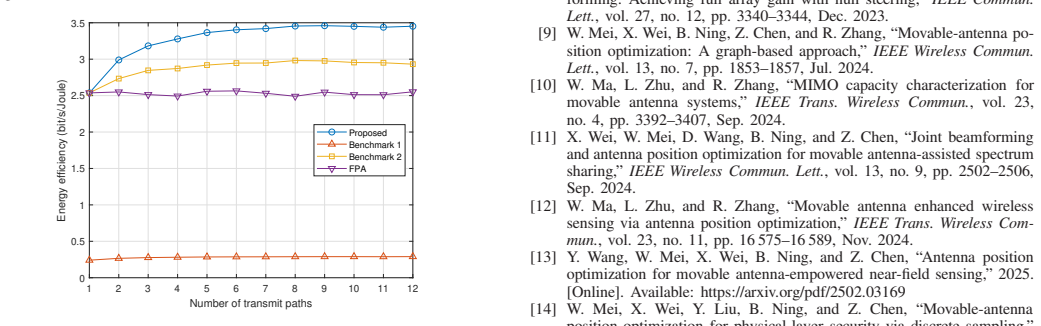
The paper's central claim has two parts. First, in the modeled stepper-motor system, the energy efficiency $\mathrm{EE}(P, x_t, v)$ is monotonically increasing in the moving speed $v$ for any fixed antenna destination and transmit power, because the motor's pull-out torque decreases with angular speed and the movement time shrinks as $v$ grows. Therefore the speed constraint binds: $v = v_{\max}$ is optimal. Second, for any fixed position, the optimal transmit power is the unique solution of a concave Dinkelbach subproblem, given in closed form as $P = \min\left([1/(\eta\ln 2) - \sigma^2/|h(x_t)|^2]^+, P_{\max}\right)$, and the optimal position is found by scanning the discrete candidate set. Numerical evaluation with the AM2224 stepper motor and a field-response channel model shows that the movable-antenna system outperforms the fixed-position antenna in energy efficiency, with optimized positions lying close to the initial position to save movement energy.
Load-bearing premise
The argument assumes the motor's electricity use equals its mechanical output $\omega M(\omega)$, which falls to zero at high speed, and that acceleration and deceleration cost nothing; if real electrical losses or start-up transients matter, top speed may not maximize efficiency.
Editorial extensions
If this is right
- The optimal operating point for a stepper-motor movable antenna is to move at maximum speed for the entire positioning phase; slowing down never improves energy efficiency in this model.
- With the speed fixed, the transmit-power subproblem has a water-filling-type closed-form solution, and scanning the candidate positions gives the global optimum in $O(J_x I_1)$ time.
- The optimal antenna position generally sits close to the initial position rather than at the best channel point, because movement energy and movement delay penalize long trips.
- As the channel coherence time grows, the mechanical-power penalty vanishes and the energy efficiency approaches the classical ratio $R/(P + P_s)$, matching earlier movable-antenna energy-efficiency studies.
- A movable-antenna system can beat a fixed-position antenna in energy efficiency even with mechanical power counted, but only if position and transmit power are optimized jointly; rate-only optimization loses energy efficiency.
Reading between the lines
- If the model were upgraded to electrical input power including resistive and core losses, $P_M$ would not vanish at high speed, and the monotonicity argument could yield an interior optimal speed; this is a testable extension, not a claim of the paper.
- The paper's kinematic relation $v = l_0\omega$ treats the lead screw's outer radius as the effective lever arm; with the standard lead-screw relation $v = (\text{lead}/2\pi)\omega$, the step size and the power curve change, which would alter the optimized positions reported in Section V.
- The same speed-monotonicity idea could be applied to multi-antenna or rotatable-antenna platforms, but only if their driver power also decreases with speed.
- A direct measurement campaign comparing this motor model with input power readings from a real stepper driver would calibrate whether the claimed zero-power no-load point is physically reachable.
Signed reviews
Editorial analysis
A structured set of objections, weighed in public.
Referee Report
Summary. The paper studies energy-efficiency (EE) maximization for a single movable-antenna (MA) system driven by a stepper motor through a lead screw. The authors propose a power consumption model in which the driver power is the product of the motor's angular speed and its pull-out torque (Eqs. (3)-(4)), formulate an EE maximization problem over antenna position, moving speed, and transmit power (P1), prove that EE is monotonically increasing in speed (Proposition 1), and then solve the reduced problem by Dinkelbach's algorithm for the transmit power plus enumeration over candidate positions (Algorithm 1). Numerical results show that the proposed scheme can outperform fixed-position antenna (FPA) and other benchmarks in terms of EE despite the mechanical power consumption.
Significance. If the power model were physically faithful, the paper would offer a useful hardware-aware EE formulation and an efficient, provably convergent solution: Proposition 1's derivative computation is correct under the stated model, the Dinkelbach update in Eq. (15) is the standard and correct water-filling-like expression, and the enumeration over discrete MA positions is straightforward. The manuscript also makes no attempt to fit targets; the motor parameters come from a datasheet and the proof is self-consistent. However, the central model equates mechanical output power with electrical input power, and the stress-test concern is valid: Eq. (3) is not the power drawn from the supply. Because the model error is load-bearing for Proposition 1, the optimization, and all Section V conclusions, the claimed MA-over-FPA gain is not established. The framework is reusable, but the physical model and all downstream results need to be reworked.
major comments (3)
- [§II-B, Eq. (3)] Equation (3) identifies the stepper motor's power consumption with its mechanical output power PM = ω M(ω). The electrical power drawn from the supply is P_elec = V I = PM + P_loss, where resistive (I^2 R), core, and no-load losses remain positive even at no load; a stepper motor spinning unloaded does not consume zero power. Since PM enters Etotal in Eq. (1) and EE in Eq. (6), Proposition 1 and the Section V comparisons optimize and evaluate mechanical output power, not the energy actually drawn by the driver. The authors themselves note that the zero-power no-load condition is unachievable, which exposes the issue. Additionally, M(ω) in Eq. (4) is the pull-out torque, i.e., the maximum torque available before losing synchronism, not the torque actually developed for the given antenna load; the mechanical power required to move the antenna should be based on load torque. These are load-bearing problems: replacing PM by a realistic electrical input model changes the shape of f(v) and can invalidate the monotonicity conclusion in Proposition 1.
- [§II-A and §II-B, v = l0ω and ds = ωD l0] The kinematic relation ω = v/l0, with l0 called the 'outer radius' of the lead screw, is not the kinematics of a lead screw. For a screw with lead L, the linear speed is v = (L/(2π))ω, and the displacement per step is (L/(2π))ωD, independent of the screw's outer radius. Using l0 changes the mapping between speed and angular speed, and therefore changes the shape of PM(v), the numerical values of vmax and ds, the candidate position set Ct, and all optimized positions reported in Section V. Figures 4-9 are specific to the radius-based mapping and need to be re-derived under correct lead-screw kinematics.
- [Algorithm 1, line 5] The feasibility check in line 5 is inverted. Constraint (11a) requires |xt-x0|/vmax ≤ T, so an infeasible candidate satisfies |xt-x0|/vmax > T. The code sets EE* = -∞ when the condition is < T, which is exactly when the position is feasible, and leaves truly infeasible positions to be processed. Under the simulation parameters all candidate positions are feasible, so the numerical figures are unaffected, but the algorithm as written does not enforce constraint (11a) in general and therefore does not solve (P2) as claimed.
minor comments (5)
- [§IV-A, after Eq. (10)] The text refers to 'Fig. 2(a)' when discussing the decreasing pull-out torque; the correct reference is Fig. 3(a).
- [§V, simulation parameters] The step angle is stated as ωD = π/12 rad/s; the unit should be radians (or degrees), not rad/s.
- [Fig. 3 and §II-B] The text says Fig. 3 plots quantities versus the load speed v, but the horizontal axes are labeled 'Angular speed (rad/s)'. The text and figures should be aligned, and the distinction between PM as output power and as electrical input consumption should be made explicit.
- [Eqs. (5)-(6)] In Eq. (5), R is a spectral efficiency in bit/s/Hz, while the EE in Eq. (6) is reported in bit/s/Joule; a bandwidth factor should be introduced, or the units should be stated consistently.
- [Algorithm 1, iteration indexing] The iteration indexing is confusing: with l=1 and P(l-1)=Pmax, the loop increments l before computing P(l). It would be clearer to state explicitly that η(0) is computed from the initial transmit power Pmax.
Circularity Check
No significant circularity: the EE maximization is derived self-consistently from an external power model and standard optimization tools, with no fitted quantity renamed as a prediction.
full rationale
The derivation chain is self-contained. The motor power model (3)-(4) is taken from the external textbook [20] and the AM2224 parameters from the datasheet [24], so P_M(v) is an input model, not a quantity fitted to the EE outputs. Proposition 1 starts from the EE expression (6), defines f(v)=P_M/(vT-|xt-x0|), and shows f'(v)<0 under the stated decreasing pull-out torque assumption; the conclusion v=vmax is a consequence of the model, not an assertion equivalent to the model's definition. The Dinkelbach update (15) is the standard solution of the concave subtractive form (13), and (16) is an exhaustive search over the finite candidate set C_t, so Algorithm 1 genuinely optimizes the formulated problem. The statement that the MA system is no worse than FPA is a feasibility observation (xt=x0 is allowed), not a fitted result. The only overlapping-author citation used as an input is [3], which supplies the field-response channel model for the numerical simulations; this is an independent, parameterized channel assumption and is not used to prove the optimality claims. There is no imported uniqueness theorem and no ansatz smuggled in via citation. Correctness concerns raised elsewhere, such as Eq. (3) modeling mechanical output rather than electrical input power, the lead-screw kinematics v=l0*omega, and the apparently inverted feasibility check in Algorithm 1 line 5, are substantive physical/implementation issues but are not circularity: they do not make the derivation equivalent to its inputs.
Assumptions & free parameters
assumptions (6)
- domain assumption The pull-out torque of the stepper motor follows M(ω) = pψV/√(R^2+ω^2L^2) - pωψ^2R/(R^2+ω^2L^2), as given in Eq. (4)
- ad hoc to paper The electrical power drawn by the stepper motor equals its mechanical output power ωM(ω), with no additional resistive or core losses
- ad hoc to paper The antenna's linear speed and the motor's angular speed are related by v = l0 ω, with l0 the 'outer radius' of the lead screw
- domain assumption The AP consumes negligible power while the antenna moves and the motor runs at a constant speed with no acceleration/deceleration phases
- domain assumption The channel is described by the MA field-response model of [3], with AoDs uniform over [-π/2, π/2] and path gains CSCG
- standard math Dinkelbach's algorithm converges monotonically to the global optimum for a concave-over-affine fractional program
Cite this review
Pith. "Pith review of Mechanical Power Modeling and Energy Efficiency Maximization for Movable Antenna Systems." pith.science (2026). https://pith.science/paper/CN5DRLES
@misc{pith2026250505914,
  author       = {Pith},
  title        = {Pith review of: Mechanical Power Modeling and Energy Efficiency Maximization for Movable Antenna Systems},
  year         = {2026},
  howpublished = {\url{https://pith.science/paper/CN5DRLES}},
  note         = {Machine review of arXiv:2505.05914}
}
read the original abstract
Movable antennas (MAs) have recently garnered significant attention in wireless communications due to their capability to reshape wireless channels via local antenna movement within a confined region. However, to achieve accurate antenna movement, MA drivers introduce non-negligible mechanical power consumption, rendering energy efficiency (EE) optimization more critical compared to conventional fixed-position antenna (FPA) systems. To address this problem, we develop in this paper a fundamental power consumption model for stepper motor-driven MA systems by resorting to basic electric motor theory. Based on this model, we formulate an EE maximization problem by jointly optimizing an MA's position, moving speed, and transmit power. However, this problem is difficult to solve optimally due to the intricate relationship between the mechanical power consumption and the design variables. To tackle this issue, we first uncover a hidden monotonicity of the EE performance with respect to the MA's moving speed. Then, we apply the Dinkelbach algorithm to obtain the optimal transmit power in a semi-closed form for any given MA position, followed by an enumeration to determine the optimal MA position. Numerical results demonstrate that despite the additional mechanical power consumption, the MA system can outperform the conventional FPA system in terms of EE.
Figures


Figures from the paper (4 more)


Forward citations
Cited by 1 Pith paper
-
Joint Radiation Power, Antenna Position, and Beamforming Optimization for Pinching-Antenna Systems with Motion Power Consumption
A joint antenna-position, radiation-power, and beamforming optimization for pinching-antenna systems reduces average power consumption when motion power is included.
Reference graph
Works this paper leans on
-
[18]
Y . Wu, D. Xu, D. W. K. Ng, W. Gerstacker, and R. Schober, “G lobally optimal movable antenna-enhanced multi-user communicati on: Discrete antenna positioning, motion power consumption, and imperf ect CSI,”
-
[19]
Energy efficiency maximization for movable antenna-enhanced system based on statistical CSI,
X. Chen, B. Feng, Y . Wu, and W. Zhang, “Energy efficiency maximization for movable antenna-enhanced system based on statistical CSI,” 2025. [Online]. Available: https://arxiv.org/pdf/ 2501.10694
arXiv 2025
-
[1]
Movable antennas for wireles s commu- nication: Opportunities and challenges,
L. Zhu, W. Ma, and R. Zhang, “Movable antennas for wireles s commu- nication: Opportunities and challenges,” IEEE Commun. Mag. , vol. 62, no. 6, pp. 114–120, Jun. 2024
2024
-
[2]
Movable antenna-enhanced wireless communications: General architectures and implementation methods,
B. Ning et al. , “Movable antenna-enhanced wireless communications: General architectures and implementation methods,” IEEE Wireless Commun., 2025, early access
2025
-
[3]
A tutorial on movable antennas for wi reless networks,
L. Zhu, W. Ma, W. Mei, Y . Zeng, Q. Wu, B. Ning, Z. Xiao, X. Sha o, J. Zhang, and R. Zhang, “A tutorial on movable antennas for wi reless networks,” IEEE Commun. Surveys Tuts. , 2025, early access
2025
-
[4]
Rotatable antenna enabled wireless communication: Modeling and optimization,
B. Zheng, Q. Wu, and R. Zhang, “Rotatable antenna enabled wireless communication: Modeling and optimization,” 2025. [Online ]. Available: https://arxiv.org/pdf/2501.02595
arXiv 2025
-
[5]
X. Shao et al. , “A tutorial on six-dimensional movable antenna enhanced wireless networks: Synergizing positionable and rotatable antennas,” 2025. [Online]. Available: https://arxiv.org /pdf/2503.18240
arXiv 2025
-
[6]
Multi-beam forming with mova ble- antenna array,
W. Ma, L. Zhu, and R. Zhang, “Multi-beam forming with mova ble- antenna array,” IEEE Commun. Lett. , vol. 28, no. 3, pp. 697–701, Mar. 2024
work page 2024
Show all 26 references
-
[7]
Flexible beam cover age optimization for movable-antenna array,
D. Wang, W. Mei, B. Ning, and Z. Chen, “Flexible beam cover age optimization for movable-antenna array,” in Proc. IEEE Global Commun. Conf., Cape Town, South Africa, Dec. 2024, pp. 4903–4908
2024
-
[8]
Movable-antenna array enhan ced beam- forming: Achieving full array gain with null steering,
L. Zhu, W. Ma, and R. Zhang, “Movable-antenna array enhan ced beam- forming: Achieving full array gain with null steering,” IEEE Commun. Lett., vol. 27, no. 12, pp. 3340–3344, Dec. 2023
2023
-
[9]
Movable-an tenna po- sition optimization: A graph-based approach,
W. Mei, X. Wei, B. Ning, Z. Chen, and R. Zhang, “Movable-an tenna po- sition optimization: A graph-based approach,” IEEE Wireless Commun. Lett., vol. 13, no. 7, pp. 1853–1857, Jul. 2024
2024
-
[10]
MIMO capacity characteriza tion for movable antenna systems,
W. Ma, L. Zhu, and R. Zhang, “MIMO capacity characteriza tion for movable antenna systems,” IEEE Trans. Wireless Commun. , vol. 23, no. 4, pp. 3392–3407, Sep. 2024
2024
-
[11]
Joint beamf orming and antenna position optimization for movable antenna-ass isted spectrum sharing,
X. Wei, W. Mei, D. Wang, B. Ning, and Z. Chen, “Joint beamf orming and antenna position optimization for movable antenna-ass isted spectrum sharing,” IEEE Wireless Commun. Lett. , vol. 13, no. 9, pp. 2502–2506, Sep. 2024
2024
-
[12]
Movable antenna enhanced wi reless sensing via antenna position optimization,
W. Ma, L. Zhu, and R. Zhang, “Movable antenna enhanced wi reless sensing via antenna position optimization,” IEEE Trans. Wireless Com- mun., vol. 23, no. 11, pp. 16 575–16 589, Nov. 2024
2024
-
[13]
Antenna pos ition optimization for movable antenna-empowered near-field sen sing,
Y . Wang, W. Mei, X. Wei, B. Ning, and Z. Chen, “Antenna pos ition optimization for movable antenna-empowered near-field sen sing,” 2025. [Online]. Available: https://arxiv.org/pdf/2502.03169
2025 arXiv
-
[14]
Movable-ant enna position optimization for physical-layer security via dis crete sampling,
W. Mei, X. Wei, Y . Liu, B. Ning, and Z. Chen, “Movable-ant enna position optimization for physical-layer security via dis crete sampling,” in Proc. IEEE Global Commun. Conf. , Cape Town, South Africa, Dec. 2024, pp. 4739–4744
2024
-
[15]
Movable antennas meet intelligent reflecting surface: Fri ends or foes?
X. Wei, W. Mei, Q. Wu, Q. Jia, B. Ning, Z. Chen, and J. Fang, “Movable antennas meet intelligent reflecting surface: Fri ends or foes?”
-
[16]
Mo vable antenna enabled integrated sensing and communication,
W. Lyu, S. Y ang, Y . Xiu, Z. Zhang, C. Assi, and C. Y uen, “Mo vable antenna enabled integrated sensing and communication,” IEEE Trans. Wireless Commun., 2025, early access
2025
-
[17]
Cram ´ er-rao bound minimization for movable antenna-assisted multiuse r integrated sensing and communications,
H. Qin, W. Chen, Q. Wu, Z. Zhang, Z. Li, and N. Cheng, “Cram ´ er-rao bound minimization for movable antenna-assisted multiuse r integrated sensing and communications,” IEEE Wireless Commun. Lett. , vol. 13, no. 12, pp. 3404–3408, Dec. 2024
2024
-
[20]
Acarnley, Stepping motors: A guide to theory and practice
P . Acarnley, Stepping motors: A guide to theory and practice . Iet, 2002, no. 63
2002
-
[21]
Energy efficiency optimization for MIM O broadcast channels,
J. Xu and L. Qiu, “Energy efficiency optimization for MIM O broadcast channels,” IEEE Trans. Wireless Commun. , vol. 12, no. 2, pp. 690–701, Feb. 2013
2013
-
[22]
Compressed sensing based ch annel estimation for movable antenna communications,
W. Ma, L. Zhu, and R. Zhang, “Compressed sensing based ch annel estimation for movable antenna communications,” IEEE Commun. Lett. , vol. 27, no. 10, pp. 2747–2751, Oct. 2023
2023
-
[23]
Channel estimation for movable-antenna MIMO systems via t ensor decomposition,
R. Zhang, L. Cheng, W. Zhang, X. Guan, Y . Cai, W. Wu, and R. Zhang, “Channel estimation for movable-antenna MIMO systems via t ensor decomposition,” IEEE Wireless Commun. Lett., vol. 13, no. 11, pp. 3089– 3093, Nov. 2024
2024
-
[24]
Stepper Motors, Series AM2224,
Faulhaber, “Stepper Motors, Series AM2224,” [Online] , https://www. faulhaber.com/en/products/series/am2224/
-
[2024]
Available: https://arxiv.org/pdf/2408
[Online]. Available: https://arxiv.org/pdf/2408. 15435
-
[2025]
Available: https://arxiv.org/pdf/2501
[Online]. Available: https://arxiv.org/pdf/2501. 15880
Reviewed August 15, 2026 · model on record in the stance chip above.
Discussion (0). Continue with ORCID to comment.