The relative entropy of magic and its nonadditivity
Pith reviewed 2026-05-22 06:05 UTC · model grok-4.3
The pith
The relative entropy of magic is nonadditive for almost all tensor products of single-qubit states.
A machine-rendered reading of the paper's core claim, the machinery that carries it, and where it could break.
Core claim
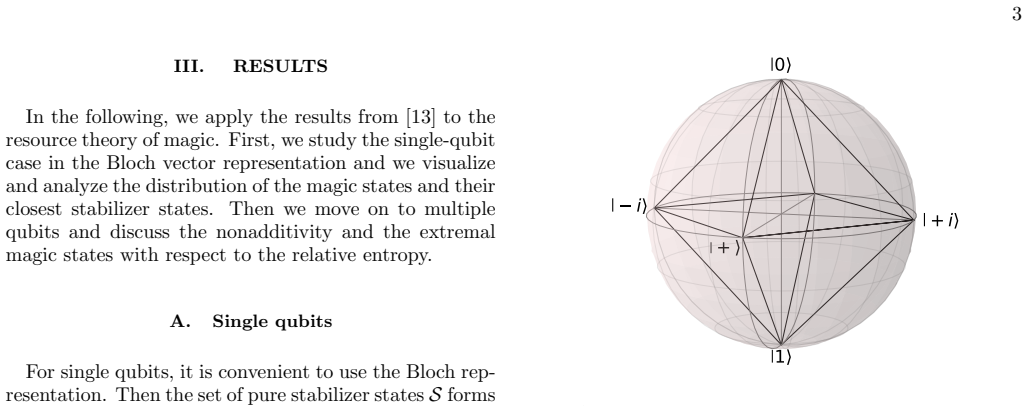
For tensor products of single-qubit states, the relative entropy of magic is nonadditive in almost all cases. The proof rests on transferring analytical expressions from the relative entropy of entanglement to single-qubit magic states, which places each magic state and its nearest stabilizer state in symmetric positions around the centers of the faces of the stabilizer octahedron.
What carries the argument
The stabilizer octahedron whose face centers define the symmetric locations of single-qubit magic states and their closest stabilizer states under the relative-entropy distance.
If this is right
- The total magic resource of a multi-qubit system cannot be obtained by summing the resources of its subsystems.
- Any protocol that quantifies or distills magic must incorporate nonadditive corrections once more than one qubit is involved.
- Efficiency estimates for magic-state injection in fault-tolerant circuits change when composite states are considered.
- Resource theories of magic must be formulated with explicit nonadditivity rules rather than assuming additivity.
Where Pith is reading between the lines
- The same geometric symmetry may allow closed-form expressions for the relative entropy of magic in two-qubit systems built from single-qubit factors.
- Nonadditivity could be exploited to reduce the overhead of magic-state distillation by choosing input pairs that produce less total magic than expected.
- Comparable nonadditivity is likely to appear when the same distance measure is applied to other discrete resource theories such as coherence or asymmetry.
Load-bearing premise
Analytical results known from the relative entropy of entanglement can be transferred directly to locate magic states and their closest stabilizer states for single qubits, including the claimed symmetric placement around octahedron face centers.
What would settle it
An explicit pair of single-qubit states for which the relative entropy of magic of the tensor product exactly equals the sum of the two separate relative entropies of magic.
Figures


read the original abstract
In most stabilizer-based quantum computing schemes, so-called magic states are a necessary resource for implementing non-transversal quantum gates. With the resource theory of magic, it is possible to analyze and quantify the generation of the non-stabilizer states. The relative entropy is a measure used in various resource theories. For single qubits, we characterize magic states and their closest stabilizer states by applying analytical results known from the relative entropy of entanglement and show that the magic states and their closest stabilizer states are arranged symmetrically around the states at the centers of the faces of the stabilizer octahedron. For tensor products of single-qubit states, we prove analytically that the relative entropy of magic is nonadditive in almost all cases.
Editorial analysis
A structured set of objections, weighed in public.
Referee Report
Summary. The manuscript defines the relative entropy of magic as a resource measure in the stabilizer formalism and, for single-qubit states, characterizes the magic states together with their closest stabilizer states by importing analytical results from the relative entropy of entanglement. It asserts that these states are arranged symmetrically around the centers of the faces of the stabilizer octahedron. The central claim is an analytical proof that the relative entropy of magic is nonadditive for almost all tensor products of single-qubit states.
Significance. If the nonadditivity result is rigorously established, the work supplies a concrete, parameter-free demonstration of nonadditivity for a magic measure on a simple but physically relevant class of states. Such results are useful for bounding the overhead of magic-state distillation and for clarifying when additivity assumptions can be safely used in resource-theoretic calculations. The explicit geometric characterization for qubits is also a useful reference point for numerical studies on higher-dimensional systems.
major comments (1)
- [single-qubit characterization paragraph] The section applying results from the relative entropy of entanglement (the paragraph beginning 'For single qubits, we characterize magic states...'): the manuscript states that analytical results known from the relative entropy of entanglement are applied directly to obtain the location of the closest stabilizer state and the symmetric arrangement around the face centers of the octahedron. Because the free set for magic (convex hull of the six Pauli eigenstates) is geometrically distinct from the set of separable states, an explicit mapping or re-derivation is required to confirm that the functional form and symmetry carry over. No such justification appears; this step is load-bearing for the subsequent analytical nonadditivity proof on tensor-product states.
minor comments (2)
- [Abstract and main theorem] The phrase 'almost all cases' in the abstract and the nonadditivity theorem statement should be accompanied by a precise measure (e.g., with respect to the uniform measure on the Bloch ball or the product of Bloch balls).
- [Introduction/Definitions] Notation for the relative entropy of magic should be introduced with an explicit formula (e.g., min over stabilizer states of D(ρ‖σ)) before it is used in the nonadditivity argument.
Simulated Author's Rebuttal
We thank the referee for their careful reading and constructive feedback on our manuscript. We appreciate the positive assessment of the significance of the nonadditivity result. We address the single major comment below and will revise the manuscript to incorporate an explicit justification as requested.
read point-by-point responses
-
Referee: [single-qubit characterization paragraph] The section applying results from the relative entropy of entanglement (the paragraph beginning 'For single qubits, we characterize magic states...'): the manuscript states that analytical results known from the relative entropy of entanglement are applied directly to obtain the location of the closest stabilizer state and the symmetric arrangement around the face centers of the octahedron. Because the free set for magic (convex hull of the six Pauli eigenstates) is geometrically distinct from the set of separable states, an explicit mapping or re-derivation is required to confirm that the functional form and symmetry carry over. No such justification appears; this step is load-bearing for the subsequent analytical nonadditivity proof on tensor-product states.
Authors: We agree that the distinct geometry of the stabilizer octahedron (convex hull of the six Pauli eigenstates) versus the separable set requires an explicit bridge to justify importing the analytical results. In the revised manuscript we will insert a short dedicated paragraph deriving the correspondence: we map the Bloch-vector representation of qubit states to the minimization of the relative entropy, showing that the closest stabilizer state is obtained by projecting onto the nearest face center of the octahedron, with the same functional form as in the entanglement case due to the shared octahedral symmetry and the fact that the relative entropy depends only on the eigenvalues in the eigenbasis of the closest free state. This mapping preserves the symmetric arrangement around the face centers. The addition will be placed immediately before the nonadditivity proof to make the logical flow self-contained. revision: yes
Circularity Check
No circularity; derivation applies external entanglement results to magic states
full rationale
The paper characterizes single-qubit magic states and closest stabilizer states by directly applying known analytical results from the relative entropy of entanglement, then uses this to prove nonadditivity for tensor products. This relies on independent prior work in a separate resource theory rather than any self-definition, fitted parameter renamed as prediction, or load-bearing self-citation chain. No step reduces the claimed result to the paper's own inputs by construction. The derivation is self-contained against external benchmarks from entanglement theory.
Axiom & Free-Parameter Ledger
axioms (2)
- standard math Standard postulates of quantum mechanics and the definition of stabilizer states forming an octahedron in the Bloch sphere.
- domain assumption Analytical results from the relative entropy of entanglement apply directly to the relative entropy of magic.
Reference graph
Works this paper leans on
-
[1]
States on a facet Consider the facet given by the convex hull of the stabi- lizer states with Bloch vectors i , i∈ {1,2,3}. Any point in this triangle can be expressed as xσ′ = 3X i=1 αisi = (α1, α2, α3) with 3X i=1 αi = 1, α i ≥0. (17) The vectorx ϕ of the supporting hyperplane, which sat- isfies 0 = Tr (ϕσ)≤Tr (ϕσ ′) for all stabilizer statesσ ′, is giv...
-
[2]
States on an edge As previously noted, the supporting hyperplanes of the edges are not unique. For a given stabilizer stateσ, dif- ferent hyperplanes that result in different magic states being closest to them exist. Consider the edge connect- ing the verticess 1 ands 3. Each state on this edge can be expressed by s ′ =α 1s1 +α 3s3 = (α1,0, α 3) withα 1 +...
-
[3]
In- serting the magic state Bloch vector expression, Eq
Values of the relative entropy of magic With the expression for the magic states closest to a stabilizer state, we can now calculate the relative entropy of magic rather than performing a numerical search. In- serting the magic state Bloch vector expression, Eq. (16), in the Bloch vector expression for the relative entropy in
-
[4]
yields Rrel(ρ(σ, ϕ, t)) = 1− 1 2 h log2(1−r 2 σ) + h rσ − tmaxφ0 2rσ (r2 σ −1) i log2 1+rσ 1−rσ i ifr ρ = 1, 1 2 h rρ log2 1+rρ 1−rρ + log2 1−r2 ρ 1−r2σ − h rσ − tφ0 2rσ (r2 σ −1) i log2 1+rσ 1−rσ i else. (23) Calculating the relative entropy for the pure states in the spherical triangle with the verticess 1,s 2 ands 3 leads to the distribution of t...
-
[5]
Here, we briefly outline the idea of the proof by con- tradiction, see Appendix C for details
at least oneσ (i) with ρ(i), σ(i) ̸= 0lies in the rel- ative interior of a facet of the stabilizer octahedron. Here, we briefly outline the idea of the proof by con- tradiction, see Appendix C for details. Letσ (i) ∈ F(H i) withi= 1, . . . , nbe single-qubit sta- bilizer states closest to the magic statesρ (i) ∈ D(H i)\ F(H i) satisfying the conditions in...
work page 2004
-
[6]
P. W. Shor, Polynomial-time algorithms for prime fac- torization and discrete logarithms on a quantum com- puter, SIAM Journal on Computing26, 1484 (1997), https://doi.org/10.1137/S0097539795293172
-
[7]
L. K. Grover, A fast quantum mechanical algorithm for database search (1996), arXiv:quant-ph/9605043 [quant- ph]
work page internal anchor Pith review Pith/arXiv arXiv 1996
-
[8]
The Heisenberg Representation of Quantum Computers
D. Gottesman, The heisenberg representation of quan- tum computers (1998), arXiv:quant-ph/9807006 [quant- ph]
work page internal anchor Pith review Pith/arXiv arXiv 1998
-
[9]
S. Bravyi and A. Kitaev, Universal quantum computa- tion with ideal clifford gates and noisy ancillas, Phys. Rev. A71, 022316 (2005)
work page 2005
-
[10]
M. Howard and E. Campbell, Application of a resource theory for magic states to fault-tolerant quantum com- puting, Phys. Rev. Lett.118(2017), 090501
work page 2017
-
[11]
M. Heinrich and D. Gross, Robustness of Magic and Symmetries of the Stabiliser Polytope, Quantum3, 132 (2019)
work page 2019
-
[12]
H. Hamaguchi, K. Hamada, and N. Yoshioka, Handbook for Quantifying Robustness of Magic, Quantum8, 1461 (2024)
work page 2024
- [13]
-
[14]
L. Leone and L. Bittel, Stabilizer entropies are mono- tones for magic-state resource theory, Phys. Rev. A110, L040403 (2024)
work page 2024
-
[15]
Operational interpretation of the Stabilizer Entropy
L. Bittel and L. Leone, Operational interpretation of the stabilizer entropy (2025), arXiv:2507.22883 [quant-ph]
work page internal anchor Pith review Pith/arXiv arXiv 2025
- [16]
- [17]
-
[18]
S. Friedland and G. Gour, An explicit expression for the relative entropy of entanglement in all dimensions, Jour- nal of Mathematical Physics52(2011), 052201
work page 2011
-
[19]
Huang, Computing quantum discord is np-complete, New journal of physics16, 033027 (2014)
Y. Huang, Computing quantum discord is np-complete, New journal of physics16, 033027 (2014)
work page 2014
-
[20]
M. W. Girard, G. Gour, and S. Friedland, On convex optimization problems in quantum information theory, Journal of Physics A: Mathematical and Theoretical47 (2014), 505302
work page 2014
-
[21]
R. Rubboli and M. Tomamichel, New additivity proper- ties of the relative entropy of entanglement and its gen- eralizations, Communications in Mathematical Physics (2024)
work page 2024
-
[22]
R. Rubboli, R. Takagi, and M. Tomamichel, Mixed-state additivity properties of magic monotones based on quan- tum relative entropies for single-qubit states and beyond, Quantum8, 1492 (2024)
work page 2024
-
[23]
Relative Entropy and Single Qubit Holevo-Schumacher-Westmoreland Channel Capacity
J. Cortese, Relative entropy and single qubit holevo- schumacher-westmoreland channel capacity (2002), arXiv:quant-ph/0207128 [quant-ph]. 8 Appendix A: Determining the Bloch vector expression To find the Bloch vector expression in Eq. (16) for a general resource theory with a compact convex set of free states, we start by using ρ=ρ(σ, ϕ, t) :=σ−t ϕ⊙L(σ),(...
work page internal anchor Pith review Pith/arXiv arXiv 2002
discussion (0)
Sign in with ORCID, Apple, or X to comment. Anyone can read and Pith papers without signing in.