REVIEW 3 major objections 3 minor 35 references
Topological numbers of Happer model with "puzzling" degeneracy in periodic magnetic field
T0 review · 3 major / 3 minor · reviewed 2026-08-14 · deepseek-v4-flash
Pith's one-line read In the Happer model, each band's Chern number is the negative of its conserved total angular momentum projection, and the 2L+1-fold degeneracy carries a unit topological charge for every nuclear spin L.
desk verdict The L=1,2 Chern-number results are solid, but the all-L universal claim and the semimetal analogy outrun the evidence. read the letter →
The pith
A machine-rendered reading of the paper's core claim, the machinery that carries it, and where it could break.
The reading
What carries the argument
The central object is the conserved total angular momentum projection $J_{\hat n_B} = \hat n_B\cdot(S+L)$, which commutes with the unperturbed Happer Hamiltonian; the paper's central claim is that the Chern number of each non-degenerate band is exactly its negative. For the degenerate subspaces the machinery is the Wilczek-Zee connection, a matrix-valued generalization of the Berry connection, whose curvature is traced and integrated over the $(\theta,\varphi)$ parameter sphere to produce the degenerate subspace Chern number. In the momentum-space comparison, the machinery is the substitution $\hat n_B/x \to \mathbf{k}$, which converts the projected Happer Hamiltonian into a $\mathbf{k}$-dependent model and turns the crossing point into a critical sphere at $|\mathbf{k}| = 3/2$, a 'Weyl sphere' replacing the usual Weyl point.
What would settle it
Compute the Wilczek-Zee Chern number of the $2L+1$-fold degenerate subspace at $x=2/(2L+1)$ for $L=3$ on a sufficiently fine $(\theta,\varphi)$ grid: the paper's claim predicts exactly $1$, so any stable deviation falsifies the general-$L$ statement; independently, checking $\mathrm{Ch} = -J_{\hat n_B}$ level by level for non-degenerate $L=3$ bands would test the conservation-topology identity beyond the two cases reported.
Extended reading notes
Core claim
On the paper's own terms, the central claim is a conservation-topology tie: for $H = \hat n_B\cdot S + x\, S\cdot L$ with $S=1$ and $L=1$ or $L=2$, every non-degenerate eigenstate satisfies $\mathrm{Ch} = -J_{\hat n_B}$, where $J_{\hat n_B}$ is the eigenvalue of the conserved operator $\hat n_B \cdot (S+L)$. At the degeneracy point $x=2/(2L+1)$, the non-Abelian Wilczek-Zee curvature integrated over the $(\theta,\varphi)$ sphere gives $\mathrm{Ch}_{\rm deg} = 1$, equal to the sum of the Chern numbers of the crossing levels (2+0−1 for $L=1$; 3−2−1−0+1 for $L=2$); the paper states this unit value holds for all $L$. With a non-zero spin-axis coupling the conserved value is destroyed except when the field and internuclear axis are parallel or anti-parallel, and the level crossings become anti-crossings in which individual Chern numbers change across the gap, attributed to Landau-Zener transitions. In the projected subspace, changing variables from field direction to a momentum vector yields a degeneracy sphere at $|\mathbf{k}|=3/2$; the lowest band's Chern number jumps there, which the paper calls a 'Weyl sphere' with 'magnetostatic shielding' in momentum space.
Load-bearing premise
The load-bearing premise is that the substitution $\hat n_B/x \to \mathbf{k}$ turns the projected Happer Hamiltonian into a genuine momentum-space model, a step whose physical basis the paper itself concedes is missing (footnote 21); without it the Weyl-sphere and magnetostatic-shielding conclusions would not follow, though the $L=1,2$ Chern-number results in Sec. II would stand.
Editorial extensions
If this is right
- Every non-degenerate band's Chern number is fixed by the conserved total angular momentum projection $J_{\hat n_B}$ alone, so the Happer model's band topology is independent of the electron spin's own orientation.
- At the degeneracy point $x=2/(2L+1)$, the degenerate subspace carries a Wilczek-Zee Chern number equal to the sum of the crossing levels' Chern numbers, which the paper states is $1$ for every $L$; the puzzling degeneracy therefore acts as a unit topological charge in parameter space.
- Turning on the spin-axis term breaks the conservation law for generic field directions, converts the crossings into anti-crossings, and changes the Chern numbers of nearby levels in the way expected from Landau-Zener transitions.
- In the projected momentum-space picture the degeneracy is a sphere rather than a point, so the lowest band's Chern number changes across the 'Weyl sphere' at $|\mathbf{k}|=3/2$, making the model a semimetal analogue with a critical surface instead of a critical point.
- Unlike the usual higher-spin semimetal where Chern numbers over all bands sum to zero, the projected Happer model has the sum of the $2L+1$ band Chern numbers equal to $1$.
Reading between the lines
- Beyond the paper: the claimed $L$-independence of the degenerate Chern number is immediately testable at $L=3$ or $L=4$, so a short numerical computation would settle whether the unit monopole is universal or an accident of $L=1,2$.
- Beyond the paper: the 'magnetostatic shielding' analogy suggests that, if a physical momentum-space realization were found, the projected Happer model would describe a nodal-surface (spherical) semimetal in a synthetic dimension, with a quantized flux through any enclosing surface.
- Beyond the paper: the role of $x$ as a control parameter that switches Chern numbers hints that tuning the ratio of the electron-nuclear spin coupling to external field strength in cold-molecule settings could drive topological transitions, though the paper does not address dynamics or many-body effects.
Signed reviews
Editorial analysis
A structured set of objections, weighed in public.
Referee Report
Summary. The manuscript studies the topological properties of the Happer model H = nB·S + xS·L under a periodic magnetic-field direction nB(θ,φ), with and without the spin-axis perturbation yS·(3âa−1)·S. For L=1 and L=2 the authors compute Berry phases and Chern numbers of the non-degenerate levels and report Ch = −J_nB, where J_nB = nB·(S+L) is the conserved total-angular-momentum projection (Eq. (8), Figs. 3 and 7). At the degenerate point x = 2/(2L+1), they compute the Wilczek-Zee Chern number of the degenerate subspace and find Ch_deg = 1 for L=1 and L=2 (Eqs. (15) and (19)), claiming this value is independent of L. They then study the removal of degeneracy by the spin-axis perturbation and finally replace nB/x by a momentum vector k, comparing the projected model with a spin-1 topological semimetal and introducing a 'Weyl sphere' and a 'magnetostatic shielding' analogy.
Significance. If the universal claims hold, the paper gives a clean and surprising result: the topology of every level of the driven Happer model is fixed by the total angular momentum quantum number J_nB, and the puzzling 2L+1-fold degeneracy carries topological charge 1 for all L. The L=1 and L=2 sections are the strongest part: the Chern numbers are computed directly from the Hamiltonian with no fitted parameters, the conservation-law relation is simple and convincing, and the explicit degenerate eigenstates in Appendix C are a useful check that can be reproduced independently. The general-L statement and the momentum-space interpretation in Sec. IV are, however, not supported at the same standard, and they are exactly the claims that appear in the abstract and conclusion.
major comments (3)
- [II.B.2 and Sec. IV] The universal statement Ch_deg = 1 for all L is load-bearing but unsupported. Sec. II.B.2 says 'from the calculations of eigenstates for general L, we deduce that the Chern number at the degenerate point is always 1' without showing any general-L calculation, and Sec. IV says the sum rule 'can be checked from the exact solution of the Happer model [14]'. However, reference [14] is a Yangian-symmetry paper that predates and does not contain any topological-invariant argument. The missing step is an algebraic sum rule: at x = 2/(2L+1), the trace of J_nB over the 2L+1-dimensional degenerate eigenspace must equal −1, so that the sum of the individual level Chern numbers is 1. This rule is neither stated nor proved, and without it the claimed L-independence goes beyond the L=1,2 numerics.
- [Sec. IV, Eq. (23)] The identification of the parameter nB/x with momentum k is a relabeling of the two-sphere, not a construction of a physical momentum-space Hamiltonian. Footnote 21 concedes that the basis has no physical interpretation in momentum space, especially for the projected subspace. Consequently, the 'Weyl sphere' at |k| = 3/2, the statement that the lowest-band Chern number jumps across it, and the 'magnetostatic shielding' analogy are analogies between parameter-space topology and semimetal physics rather than established momentum-space phenomena. The authors should either supply a genuine momentum-space realization with a valid physical basis or explicitly restrict Sec. IV to a mathematical analogy; as written, the abstract and conclusion present the momentum-space comparison as a result.
- [Sec. II, Eq. (8)] Equation (8) would give half-integer values for half-integer L, since J_nB eigenvalues are half-integers, while the Chern number defined in Eq. (6) is normally an integer. The paper itself displays L = 3/2 in Fig. 1(c) and claims the result holds 'in spite of the L values', but no normalization or separate treatment is given for half-integer total angular momentum. If the Happer model is intended only for integer nuclear spin, this restriction should be stated; otherwise the half-integer case needs a quantitative discussion.
minor comments (3)
- [Sec. II.B.1] In the L=2 subsection, the sentence about Berry phases 'at x ≠ 2/3' should read x ≠ 2/5 for consistency with the degeneracy point of L=2.
- [Throughout] There are several typographical errors that should be corrected: 'resent years', 'Wilzeck-Zee', 'calcualtions', and reference [6] with 'V olovik'.
- [Appendix B] The discretized connection in Eq. (B1) appears to omit the lattice-spacing factors 1/Δθ and 1/Δφ; the authors should clarify how A^{kl} in Eq. (B1) is related dimensionally to the continuum connection A^{kl}_λ in Eq. (7), since Eqs. (B2) and (B3) combine these objects.
Circularity Check
No circularity: the L=1,2 Chern numbers are direct numerical outputs of the Hamiltonian; the universal-L claim is an unsupported extrapolation, not a self-referential reduction.
full rationale
The paper's demonstrated central results are obtained by numerically integrating Berry and Wilczek-Zee curvatures over the (theta, phi) parameter sphere for the explicit Hamiltonian in Eq. (3) (L=1) and its L=2 analogue, with no fitted parameters and no prediction that is renamed from an input. The identity Ch = -J_nB (Eqs. 8 and 17) is verified independently for every non-degenerate level against the conserved total-angular-momentum quantum number; although it is consistent with the spin-monopole structure of the conserved quantity, the paper does not define the Chern number in terms of J_nB, and the verification is not a fit. The degenerate-point equalities Ch_deg = sum Ch_n (Eqs. 15 and 19) are likewise computed from the Hamiltonian. The only fragile step, namely the assertion that Ch_deg = 1 for all L (Sec. II.B.2) and the related sum-rule statement justified by citation [14] in Sec. IV, is an unproved generalization rather than a circular one: [14] is not used as if it established the Chern number from this paper's own definition, and no equation of this paper reduces the target claim to its inputs. The footnote-21 caveat about the momentum-space interpretation is a stated limitation, not a disguised circularity. Thus no circular step is present; the unsupported general-L claim is a correctness and completeness concern, not a circularity concern.
Assumptions & free parameters
assumptions (5)
- standard math Berry phase and Chern number formalism, including the Wilczek-Zee non-abelian generalization for degenerate subspaces
- domain assumption The Happer Hamiltonian (Eq. 1) and the rotating-field coupling nB·S (Eq. 2) are the physical starting point, with the 2L+1-fold degeneracy at x=2/(2L+1) taken as established by prior work (refs [12, 14, 15, 16])
- ad hoc to paper The substitution nB/x -> k in Sec. IV converts the parameter-space Hamiltonian into a momentum-space Hamiltonian H'p
- ad hoc to paper The degenerate-state basis in Appendix C is smooth on the sphere after orthogonalization and normalization
- ad hoc to paper The general-L result Ch_deg=1 follows from the exact solution of the Happer model in ref [14]
invented entities (2)
-
Weyl sphere S2 at radius |k|=3/2
-
Magnetostatic shielding-like phenomenon
Cite this review
Pith. "Pith review of Topological numbers of Happer model with "puzzling" degeneracy in periodic magnetic field." pith.science (2026). https://pith.science/paper/CNDJIGHJ
@misc{pith2026190804726,
  author       = {Pith},
  title        = {Pith review of: Topological numbers of Happer model with "puzzling" degeneracy in periodic magnetic field},
  year         = {2026},
  howpublished = {\url{https://pith.science/paper/CNDJIGHJ}},
  note         = {Machine review of arXiv:1908.04726}
}
abstract
The Happer model, as the variation of Rabi-Breit model, describes the interactions between the total nuclear spin and the total electron spin-1 of the triplet dimer molecules of ${}^{87}\text{Rb}$. One interesting physical consequence of the Happer model is its puzzling degeneracy. In this paper, under the periodic driven magnetic field on total electron spin, the topological properties of the Happer model are present. Specifically, we calculate the Chern number of the system, both for the non-degenerate and degenerate cases. We show that the Chern number is closely related to the total angular momentum of the system, instead of the electron spin. Furthermore, the perturbing spin-axis interaction term is also introduced for detecting the influence on the corresponding topological Chern number. At last, in momentum space, we compare the Happer model with the topological semimetal in the sense of topological numbers. In such model, a "magnetostatic shielding" --like phenomena occurs.
Figures

Figures from the paper (8 more)




Reference graph
Works this paper leans on
-
[14]
J. E. Moore, Nature 464, 194 (2010)
2010
-
[1]
For 3 (a)S = 1, L = 1:Berry phase
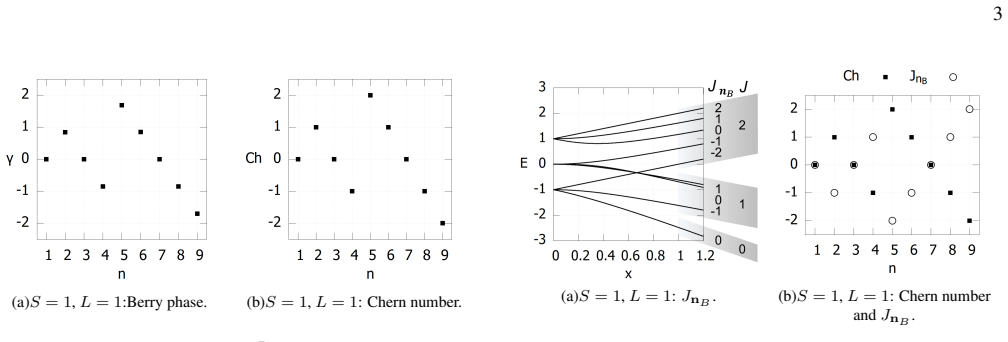
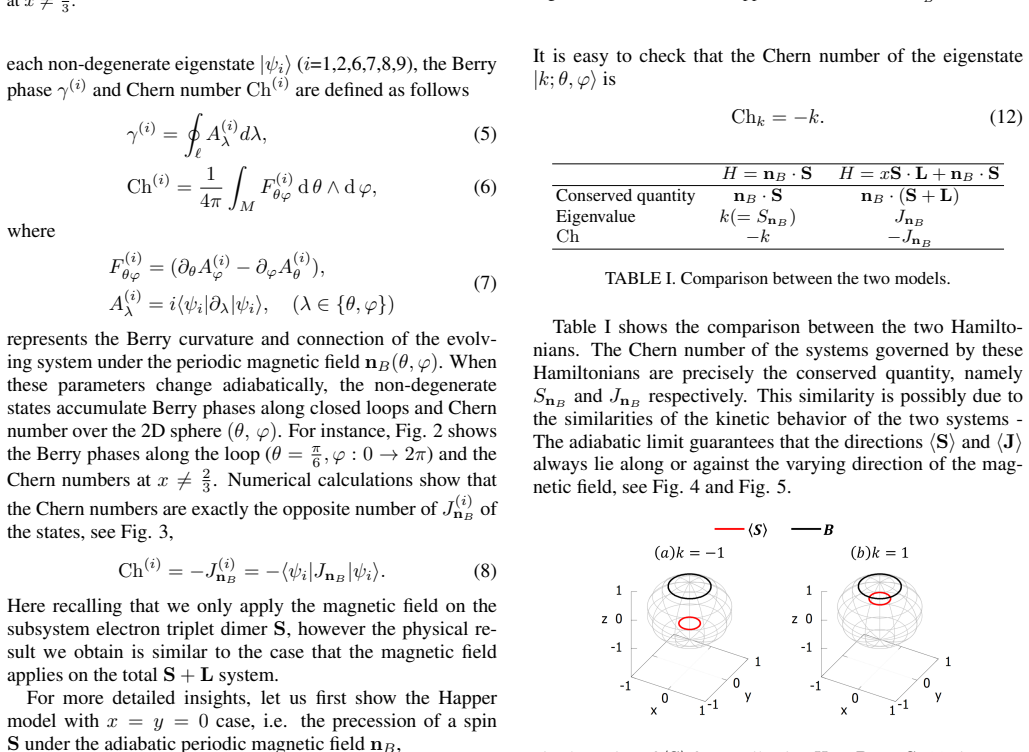
Non-degenerate states Here for completeness, we first present the topologi- cal Chern numbers of the six non-degenerate levels. For 3 (a)S = 1, L = 1:Berry phase. (b)S = 1, L = 1: Chern number. Fig. 2. Berry phase of the loop (θ = π 6,ϕ =ωt) and Chern number atx⁄= 2 3 . each non-degenerate eigenstate|ψi⟩ (i=1,2,6,7,8,9), the Berry phaseγ(i) and Chern numbe...
-
[2]
Degenerate states The three energy levels n = 3, 4, 5 cross and form a 3- fold degeneracy at the value x = 2 3, L = 1 . Here we deal 4 Fig. 5. Motion of⟨S⟩ and⟨L⟩ for HamiltonianH =xS· L+ nB· S. with these three energy levels. When x⁄= 2 3, the three states are non-degenerate and only accumulate Berry phases, sim- ilar to the previous subsection. The inte...
-
[3]
3, Ch(i) =−J(i) nB =−⟨ψi|JnB|ψi⟩
Numerical calculations show that the Chern numbers are exactly the opposite number ofJ(i) nB of the states, see Fig. 3, Ch(i) =−J(i) nB =−⟨ψi|JnB|ψi⟩. (8) Here recalling that we only apply the magnetic field on the subsystem electron triplet dimer S, however the physical re- sult we obtain is similar to the case that the magnetic field applies on the total ...
-
[4]
M. Z. Hasan and C. L. Kane, Rev. Mod. Phys. 82, 3045 (2010)
2010
-
[5]
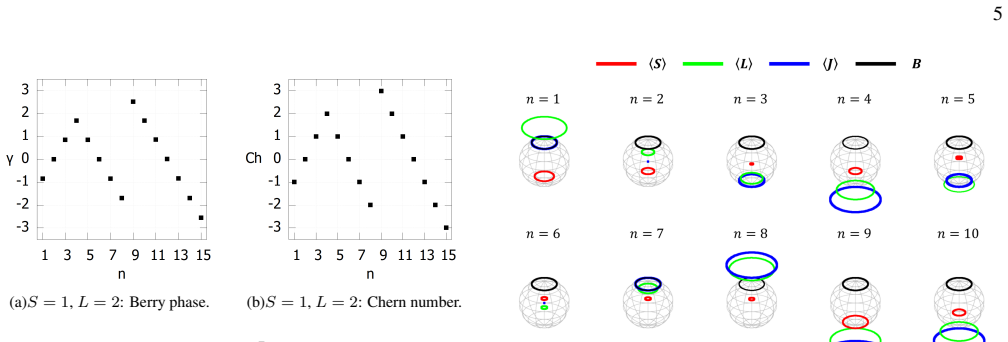
The states are numbered according to their energy from low to high atx→∞ byn. The states labeled by n = 1, 2, 3, 4, 10, 11, 12, 13, 14, 15 are non-degenerate states, while the other statesn = 5, 6, 7, 8, 9 have degenerate energy level atx = 2 5
-
[6]
7(a) shows the energy levels of our model for L = 2
Non-degenerate states Fig. 7(a) shows the energy levels of our model for L = 2. Here we focus on the ten energy levels without level cross- ing. The Hamiltonian is parametrized by the direction of the magnetic field, namely θ andφ in nB. When these parame- ters change adiabatically, non-degenerate states will accumu- late Berry phases as well as Chern numb...
-
[7]
Degenerate states The states n = 5, 6, 7, 8, 9 forms five-fold degeneracy at x = 2
Show all 35 references
-
[8]
Here we discuss the topological behavior of the five states for both x⁄= 2 5 andx = 2
-
[9]
when the parameter x⁄= 2 5, each state holds U(1) gauged Berry curvature in periodic (θ,ϕ )-space, and the Chern number is connected to the JnB eigenvalue. When the parameterx approaches the degenerate pointx = 2 5 either from the left or from right, the degenerate states form...
-
[10]
Weyl point
Similar to theL = 1 case, it shows that for degenerate statesn = 5, 6, 7, 8, 9 the Chern number Chdeg at the degen- erate pointx = 2 5 is exactly the sum of the Chern numbers of these states at non-degeneratex values, i.e. Chdeg ( x = 2 5 ) = 9∑ n=5 Chn ( x⁄= 2 5 ) = 3−2−1−0+1...
-
[11]
Weyl sphere
In the modelH′ p, when|⃗k| =√ k2x +k2y +k2z = 1/x > 3 2, the lowest energy band Chern number is 2, while for|⃗k| = √ k2x +k2y +k2z = 1/x< 3 2, the Chern number is 0. Hence the “Weyl sphere” in H′ p acts as 8 the role of critical sphere describing the jump between Chern numbers...
-
[12]
Zhu, Phys
S.-L. Zhu, Phys. Rev. Lett. 96, 077206 (2006)
2006
-
[13]
M. M. Wolf, G. Ortiz, F. Verstraete, and J. I. Cirac, Phys. Rev. Lett. 97, 110403 (2006)
2006
-
[15]
Qi and S.-C
X.-L. Qi and S.-C. Zhang, Rev. Mod. Phys. 83, 1057 (2011)
2011
-
[16]
G. E. V olovik, The universe in a helium droplet , V ol. 117 (Ox- ford University Press, 2003)
2003
-
[17]
Armitage, E
N. Armitage, E. Mele, and A. Vishwanath, Rev. Mod. Phys.90, 015001 (2018)
2018
-
[18]
Bradlyn, J
B. Bradlyn, J. Cano, Z. Wang, M. Vergniory, C. Felser, R. J. Cava, and B. A. Bernevig, Science 353, aaf5037 (2016)
2016
-
[19]
Z. Zhu, G. W. Winkler, Q. Wu, J. Li, and A. A. Soluyanov, Phys. Rev. X 6, 031003 (2016)
2016
-
[20]
Lv, Z.-L
B. Lv, Z.-L. Feng, Q.-N. Xu, X. Gao, J.-Z. Ma, L.-Y . Kong, P. Richard, Y .-B. Huang, V . Strocov, C. Fang, et al. , Nature 546, 627 (2017)
2017
-
[21]
H. Hu, J. Hou, F. Zhang, and C. Zhang, Phys. Rev. Lett. 120, 240401 (2018)
2018
-
[22]
Erickson, D
C. Erickson, D. Levron, W. Happer, S. Kadlecek, B. Chann, L. Anderson, and T. Walker, Phys. Rev. Lett. 85, 4237 (2000)
2000
-
[23]
Breit and I
G. Breit and I. Rabi, Phys. Rev. 38, 2082 (1931)
1931
-
[24]
Bai, M.-L
C.-M. Bai, M.-L. Ge, and K. Xue, in Lattice Statistics and Mathematical Physics (2002) pp. 15–21, arXiv:cond- mat/0105610 [cond-mat]
2002
-
[25]
E. A. Yuzbashyan, W. Happer, B. L. Altshuler, and S. B. Shas- try, J. Phys. A: Math. Gen. 36, 2577 (2003)
2003
-
[26]
S. S. Gubser, R. K. Bradley, et al., Adv. Theor. Math. Phys. 9, 593 (2005)
2005
-
[27]
M. V . Berry, Proc. Roy. Soc. London. A. Math. Phys. Sci.392, 45 (1984)
1984
-
[28]
Wilczek and A
F. Wilczek and A. Zee, Phys. Rev. Lett. 52, 2111 (1984)
1984
-
[29]
L. D. Landau, Phys. Z. Sowjetunion 2, 19 (1932)
1932
-
[30]
Zener, Proc
C. Zener, Proc. Roy. Soc. London. A. Math. Phys. Sci.137, 696 (1932)
1932
-
[31]
In topological semimetal, the bases are usually{a† k, ak}, where a† k(ak) rep- resents the fermionic operator in momentum space
Here we only compare the topological numbers of the Hap- per model and the topological semimetal model. In topological semimetal, the bases are usually{a† k, ak}, where a† k(ak) rep- resents the fermionic operator in momentum space. However in the Happer model, we are not able...
-
[32]
sec5(θ 2) 625ei5ϕ 8 √ 6 csc2(θ)(−6 csc2(θ)+6 cot(θ) csc(θ)+5) 125ei4ϕ − (5 cos(θ)+1) csc(θ
-
[33]
sec3(θ 2) 25ei3ϕ −2 csc2(θ)+2 cot(θ) csc(θ)+5 5ei2ϕ − 384 √ 2(cos(θ)−1) csc5(θ) 625ei5ϕ 96 √ 2(cos(θ)−1) csc4(θ) 125ei4ϕ − 16 √ 3(cos(θ)−1) csc3(θ) 25ei3ϕ 4 √ 2(cos(θ)−1) csc2(θ) 5ei2ϕ√ 2e−iϕ tan (θ 2 ) 0 0 0 0 −1 , (C7) ψdeg2 = ...
-
[34]
sec5(θ 2) 625ei5ϕ − 24(3−5 cos(θ))2 csc4(θ) 625ei4ϕ√ 6(−40 cos(θ)+25 cos(2θ)+31) csc3(θ) 125ei3ϕ −22 csc2(θ)+10 cot(θ) csc(θ)+25 25ei2ϕ 4 5 csc(θ)e−iϕ 96 √ 2(5 cos(θ)−3) csc4(θ) 625ei4ϕ − 24 √ 2(5 cos(θ)−3) csc3(θ) 125ei3ϕ 4 √ 3(5 cos(θ)−3) csc2(θ) 25ei2ϕ − 1 5 √ 2(5 cos(θ)− 3...
-
[35]
(C11) These are the bases in the 5-dimension degenerate state space and they are smooth in the parameter space
sec3(θ 2) 25ei3ϕ −22 csc2(θ)+10 cot(θ) csc(θ)+25 25ei2ϕ 2 5 √ 6 csc(θ)e−iϕ 0 0 4 √ 2(5 cos(θ)+1) csc2(θ) 25ei2ϕ − 1 5 √ 2(5 cos(θ) + 1) csc(θ)e−iϕ 0 0 0 0 −1 0 0 0 , (C10) ψdeg5 = −2 csc2(θ)+2 cot(θ) csc(θ)+5 5ei2ϕ 4 5 cs...
Reviewed August 14, 2026 · model on record in the stance chip above.
Discussion (0). Continue with ORCID to comment.