REVIEW 3 major objections 5 minor 16 references
Mathematical analysis of a flux-jump model in superconductivity
T0 review · 3 major / 5 minor · reviewed 2026-08-11 · deepseek-v4-flash
Pith's one-line read Flux jumps in a type II superconductor under a pulsed magnetic field are driven by the nonlinear term $(1-B)^2 T_x$ in the field's evolution equation, and therefore strike for pulses that last about the magnetic relaxation time, mostly at…
desk verdict Useful 1D critical-state model with a clean derivation, but the headline pulse-duration condition is contradicted by the paper's own simulations and needs a major correction. read the letter →
The pith
A machine-rendered reading of the paper's core claim, the machinery that carries it, and where it could break.
The reading
What carries the argument
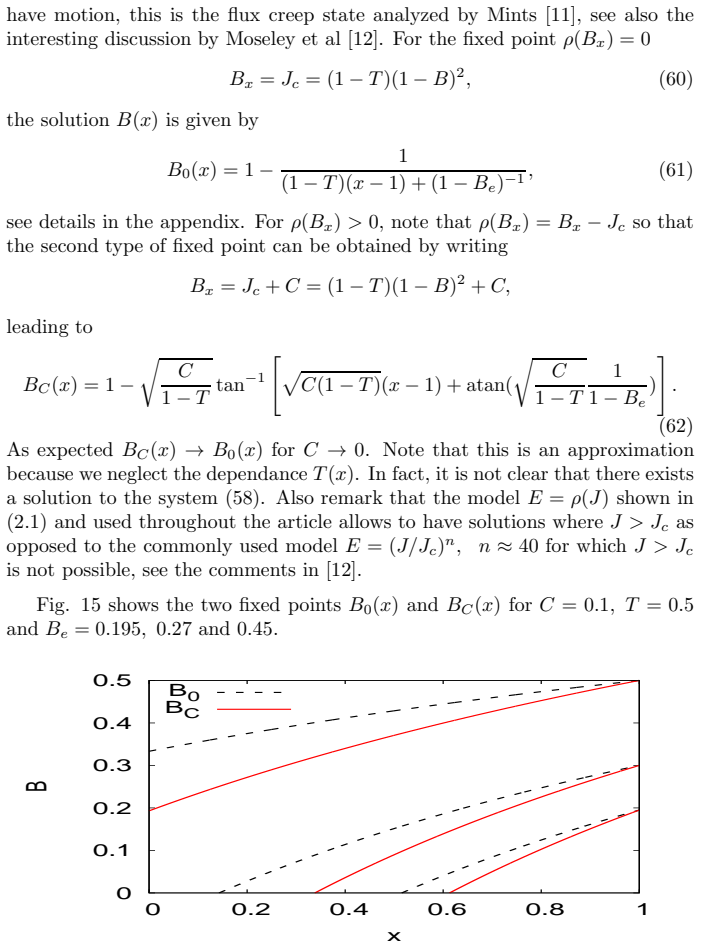
The central object is the regularized critical-state constitutive law $E=\rho(J)$, a tanh-smeared version of the Bean critical-state model with critical current $J_c=(1-T)(1-B)^2$, which turns Maxwell's equations plus heat diffusion into the coupled pair $B_t=\alpha\partial_x[\rho(B_x)]$ and $T_t=B_x\rho(B_x)+\beta T_{xx}$ (or $T T_t = \dots$ at low temperature). The argument is carried by the expanded evolution equation for $B$, whose third term $(1-B)^2 T_x$ is identified as the flux-jump driver, and by the two explicit fixed-point profiles $B_0(x)$ and $B_C(x)$ obtained from $B_x = J_c$ and $B_x = J_c + C$ under the assumption $T=T_e$; the jump is the switch between them. Nondimensionalization on the Joule-heating time $t_{\mathrm{heat}}$ reduces the physics to two parameters, $\alpha$ and $\beta$, whose sizes order the three time scales (magnetic, thermal-diffusion, and heating).
What would settle it
Modify the numerical code to set the term $(1-B)^2 T_x$ to zero in equation (64) while keeping the full temperature equation, and rerun the case that produced jumps ($t_p=3000$, $T_e=0.1$, $B_{\max}=0.5$, jumps at $B_e=0.3$ and $0.37$); the paper's claim predicts the jumps disappear. If they persist, the identified term is not the sole driver.
Extended reading notes
Core claim
On its own terms, the paper discovers that in the dimensionless 1D critical-state model, the evolution of the magnetic field obeys $B_t = \alpha \rho_{B_x}[2(1-T)(1-B)B_x + B_{xx} + (1-B)^2 T_x]$: the first two terms in brackets form a Burgers-type convection-diffusion front, while the third, $(1-B)^2 T_x$, couples the field to temperature and is identified as the agent of flux jumps. The authors interpret jumps as rapid switches between two fixed points of the coupled system—the screening profile $B_0(x)$ where $\rho(B_x)=0$ and the dissipative profile $B_C(x)$ where $\rho(B_x)=C>0$—and verify numerically that the magnetization curve $M(B_e)$ develops jumps only for pulses of duration $t_p \approx t_{\mathrm{mag}}$, at low temperature, with the jump position set by the ramp rate $dB_e/dt$. They further establish that the trapped field is maximal for medium-amplitude, long-duration pulses at low-to-medium temperature, that trapezoidal pulses outperform triangular ones, and that a second pulse at lower temperature increases magnetization, in line with reported experiments.
Load-bearing premise
The load-bearing premise is that during a slow pulse the fields reach a joint equilibrium at each instant, and that this equilibrium is well approximated by setting the temperature to the uniform bath value; the authors themselves flag that the existence of such a coupled equilibrium is unclear, so if the true equilibrium differs or is absent, the identification of flux jumps with a switch between the two computed profiles is unsupported.
Editorial extensions
If this is right
- For a given superconductor, flux jumps are avoided by choosing pulse durations far from the magnetic relaxation time $t_{\mathrm{mag}}$; the most dangerous window is $t_p \approx t_{\mathrm{mag}} < t_{\mathrm{diff}}$.
- At low temperature, where $C(T)=C_0T$, the temperature equation becomes nonlinear and flux jumps appear even for moderate field amplitudes; the jump position moves with the ramp rate $dB_e/dt$ and not with the plateau duration.
- Optimal pulse field magnetization uses medium-amplitude, long-duration pulses with low-to-medium bath temperature $T_e$, which maximizes the trapped field while keeping the sample superconducting.
- Trapezoidal pulses trap more field than triangular pulses of the same total duration, because the plateau regions let the profile relax from $B_C(x)$ to $B_0(x)$.
- A two-stage protocol—a first pulse followed by a second pulse at lower temperature and slightly higher amplitude—increases the remanent magnetization, as observed in experiments.
Reading between the lines
- If the $(1-B)^2 T_x$ term is truly the driver, then a numerical experiment that artificially zeroes this term (while keeping the full temperature equation) should eliminate flux jumps at the same parameter values; this is a direct way to test the causal claim.
- Because the fixed-point explanation computes $B_0$ and $B_C$ with $T(x)=T_e$ and the authors themselves note it is unclear that a coupled fixed point exists, the switching picture may need a rigorous existence proof; until then, the quantitative match to numerics is evidence but not a derivation.
- The two-parameter reduction suggests scanning the $(\alpha,\beta)$ plane to map the jump and no-jump regions, which would show whether the low-temperature, $t_p\approx t_{\mathrm{mag}}$ window is universal or specific to the parameter values inspired by MgB$_2$.
- The model's prediction that jumps are generic to critical-state laws with $J_c(T,B)$ implies similar flux-jump behavior should appear in other materials, such as YBaCuO, under the same scaled conditions; the experimental data cited in the paper could be re-examined to check this.
Editorial analysis
A structured set of objections, weighed in public.
Referee Report
Summary. The paper analyzes a one-dimensional critical-state model of a type-II superconductor, coupling a nonlinear diffusion equation for the magnetic field with a forced diffusion equation for temperature. The model is nondimensionalized on the Joule-heating time, reducing the problem to two parameters, and is studied numerically for pulse-field magnetization. The authors report flux jumps in the low-temperature regime, attribute them to a nonlinear driving term (1-B)^2 T_x in the evolution of B, and claim that flux jumps occur for pulses of duration close to the magnetic relaxation time and mostly at low temperature. They also compare triangular and trapezoidal pulses and discuss trapped-field optimization.
Significance. If the central claims held, the paper would provide a simple, parameter-light explanation of flux-jump phenomena and practical guidance for pulse-field magnetization. The authors deserve credit for a systematic nondimensionalization with only two parameters, for taking physical constants from the literature rather than fitting them to the flux-jump observations, and for explicitly deriving the nonlinear driving term. They also honestly flag the limitation of their fixed-point analysis. However, the headline quantitative claim about pulse duration is contradicted by the paper's own simulations, and the proposed fixed-point mechanism is not established. As a result, the main conclusions are not supported by the evidence presented.
major comments (3)
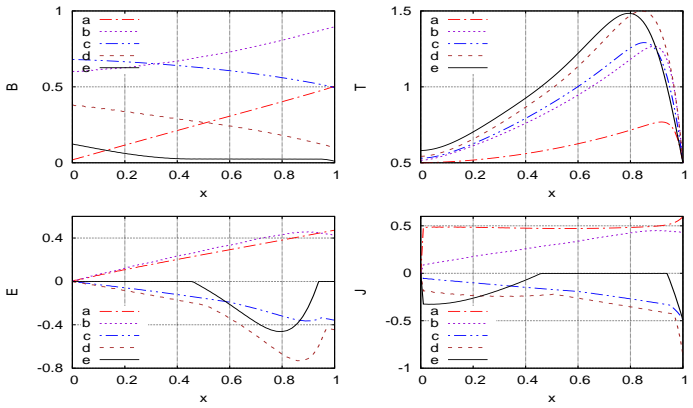
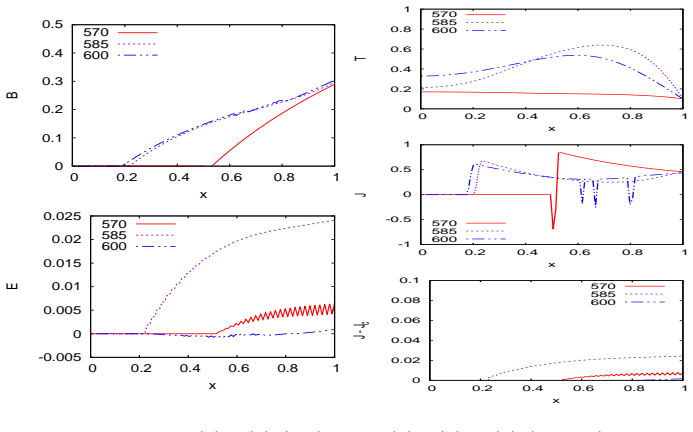
- [Abstract; §5.1; §4.2.1; §2.3.2] The claim that flux jumps occur for pulses of duration tp ≈ tmag < tdiff is contradicted by the paper's own numerical data. In the low-temperature regime, α ≈ 7.5×10^-2 (Eq. 45), so tmag = t0/α ≈ 13.3 t0. The flux jumps shown in Fig. 11 occur for tp = 1500 and 3000 in units of the Joule-heating time t0, i.e., about 113 and 226 tmag. These values are not close to tmag. Moreover, using the physical values in Eq. (46), tdiff ≈ 0.12 s and t0 ≈ 9.38×10^-5 s, so tp = 3000 t0 ≈ 0.28 s > tdiff, directly violating the inequality tp < tdiff stated in §5.1 and the abstract. This is a load-bearing quantitative prediction, and it fails on the paper's own evidence.
- [§5; Eq. (58); Fig. 16] The fixed-point explanation of flux jumps is not established. The text states that 'it is not clear that there exists a solution to the system (58)', and the fixed-point profiles B0(x) and BC(x) are computed by setting T(x)=Te, ignoring the large spatial temperature variations shown in Figs. 13 and 14 during jumps. The correspondence between flux jumps and switching from the C>0 fixed point to C=0 is therefore an assumption, not a demonstrated mechanism. Since the fixed-point analysis is central to the paper's explanation of flux jumps, this needs either a rigorous justification of the assumed quasi-static fixed-point approximation or a different explanatory framework.
- [§3; Eq. (25)] The normalized regularization width w' is introduced in the constitutive law (25) but its numerical value is never given anywhere in the paper. The resistivity profile ρ'(J') and, consequently, the numerical dynamics depend on w', so the simulations are not reproducible without this parameter. The authors should state the value of w' used in all runs and, ideally, show that the reported flux-jump behavior is not sensitive to this choice.
minor comments (5)
- [§2.1] There is a typo: 'supraconducting' should be 'superconducting'.
- [§4.2.1] The text reads 'presents large large flux jumps'; remove the duplicated 'large'.
- [§4.1.1] The phrase 'Bmax = 0.5nd' appears to be a typo for 'Bmax = 0.5 and'.
- [§5, Eq. (66)] In the derivation of B0(x), the assumption T(x)=Te is used but not stated explicitly at the point of Eq. (66); this should be made explicit to avoid confusion.
- [Fig. 18 caption] The caption lists '(a) Bmax = 0.6, Te = 0.3, (a) Bmax = 0.6, Te = 0.5'; the second label should be '(b)'.
Circularity Check
No circularity: the model parameters are taken from literature, the flux-jump mechanism is derived from the constitutive law, and self-citations are incidental.
full rationale
The paper builds a 1D critical-state model from Maxwell's equations and a regularized nonlinear resistivity, with the critical current Jc = (1-T)(1-B)^2 taken as a standard constitutive input. The dimensionless parameters α and β are computed directly from physical constants and literature values (Table 2), not fitted to the observed flux jumps, so the predictions are not statistically forced. The central mechanistic claim is equation (64), where the flux-jump driving term (1-B)^2 T_x appears as a mathematical consequence of differentiating ρ with respect to T, as shown in Appendix A. This is a derivation from stated assumptions, not a renaming of an input. The fixed-point solutions B0(x) and BC(x) are analytic solutions of the reduced equations under T = Te, and the paper explicitly flags the approximation: 'Note that this is an approximation because we neglect the dependance T(x). In fact, it is not clear that there exists a solution to the system (58).' That admitted limitation is a rigor/correctness concern, not circularity, because the comparison to numerics is qualitative and no parameter was adjusted to force agreement. Self-citations, e.g., [16] for Burger's front solutions and [6] for an Abelian-Higgs model, are used only as references for standard or parallel results and do not carry the derivation. The skeptical observation that the stated duration condition (tp ≈ tmag < tdiff) appears inconsistent with the paper's own simulations (tp = 1500-3000 in units of theat) is a factual consistency issue about the conclusions, not a circular reduction of the predictions to their inputs. No load-bearing step in the derivation chain reduces to a fit, a self-citation, or a definitional identity, so the circularity score is 0.
Assumptions & free parameters
free parameters (1)
- w' (normalized regularization width) =
not stated in paper
assumptions (5)
- domain assumption The 1D infinite-slab geometry with scalar B and no demagnetization captures flux-jump electrodynamics.
- domain assumption E=rho(J) with the tanh regularization is an adequate constitutive law.
- domain assumption Jc=J0(1-T/Tc)(1-|B|/Bc)^2.
- domain assumption At low temperature, C(T)=C0 T.
- ad hoc to paper During slow pulses, fields reach the fixed point of the coupled system at each instant, and the fixed point can be approximated with T(x)=Te.
Cite this review
Pith. "Pith review of Mathematical analysis of a flux-jump model in superconductivity." pith.science (2026). https://pith.science/paper/CNGGAOKE
@misc{pith2026241214691,
  author       = {Pith},
  title        = {Pith review of: Mathematical analysis of a flux-jump model in superconductivity},
  year         = {2026},
  howpublished = {\url{https://pith.science/paper/CNGGAOKE}},
  note         = {Machine review of arXiv:2412.14691}
}
read the original abstract
Type II superconductors can trap a transient magnetic field and become "cryomagnets" that are very useful for applications. During this process, flux jumps i.e. sudden jumps of the total magnetization occur and hinder the properties of these magnets. To understand the electrodynamics of these systems and in particular flux jumps, we analyzed mathematically a model based on Maxwell's equations and temperature in a 1D configuration. When a magnetic pulse is applied to a superconductor, three effects occur, from fastest to slowest: Joule heating, magnetic relaxation and temperature diffusion. Adimensionalising the problem, we obtain a nonlinear diffusion for the magnetic field coupled to a forced diffusion equation for the temperature with only two parameters. Two regimes occur, depending on temperature: for medium temperature the heat capacity of a sample can be assumed constant while for low temperature it depends on temperature causing a nonlinear temperature evolution. Flux jumps can be explained using the fixed points of the equations. We found that they occur for pulses of duration close to the magnetic relaxation time and mostly at low temperature because of the nonlinear dependance. Flux trapping is maximal for medium amplitude long duration pulses and low to medium temperatures, so these conditions are optimal to produce better cryomagnets.
Figures


Figures from the paper (15 more)







Reference graph
Works this paper leans on
-
[1]
J. H. Durrell, M. D Ainslie, D. Zhou, P. Vanderbemden, T. Bradsha w, S. Speller, M. Filipenko and D. A. Cardwell, Bulk superconductors: a roadmap to applications, Supercond. Sci. Technol. 31 (2018) 1035 01
work page 2018
-
[2]
C. Romero-Salazar, F. Morales, R. Escudero, A. Dur´ an, O. A. Hern´ andez- Flores, Flux jumps in hot-isostatic-pressed bulk MgB 2 supercondu ctors: Experiment and theory Physical Review B 76, 104521,(2007)
work page 2007
-
[3]
M Fracasso et al, Numerical study on flux-jump occurrence in a c up-shaped MgB 2 bulk for magnetic shielding applications Supercond. Sci. Techno l. 36 (2023) 044001
work page 2023
-
[4]
M. D. Ainslie, D. Zhou, H. Fujishiro, K. Takahashi, Y.-H. Shi and J. H. Durrell, Flux jump-assisted pulsed field magnetisation of high-J c bulk high- temperature superconductors, Supercond. Sci. Technol. 29 (2 016) 124004
-
[5]
A.M. Campbell and J.E. Evetts (1972) Flux vortices and transpor t cur- rents in type II superconductors, Advances in Physics, 21:90, 19 9-428, DOI: 10.1080/00018737200101288
-
[6]
J.-G.Caputo, I. Danaila and C. Tain, An Abelian Higgs model of pulsed field magnetisation in superconductors, J. Physics : Conference S eries, 2043, 012006, (2021)
work page 2021
-
[7]
P. S. Swartz and C. P. Bean, J. Appl. Phys. 39, 4991–8, (1968)
work page 1968
-
[8]
C. J. van Der Beek and P. H. Kes, Flux pinning, Handbook of Supercon- ductivity: Fundamentals and Materials , Volume One (2nd ed.). Cardwell, D.A., Larbalestier, D.C., and Braginski, A. (Eds.). (2021). CRC Press . https://doi.org/10.1201/9780429179181
Show all 16 references
-
[9]
J Zou et al, Supercond. Sci. Technol. 28 075009, (2015)
2015
-
[10]
Strauss, Partial differential equations: an introduction , Wiley (2007)
W. Strauss, Partial differential equations: an introduction , Wiley (2007). 26
2007
-
[11]
R. G. Mints, Flux creep and flux jumping, Phys. Rev. B 53 12311– 7, (1996)
1996
-
[12]
D. A. Moseley, G. A. B. Matthews, D. Zhou, V. Cientanni, Y. Tsu i, M. D. Ainslie, S. Speller and J. H. Durrell, Improved pulsed field magnetisatio n in MgB2 trapped-field magnets, Supercond. Sci. Technol. 34 (2021 ) 085018
2021
-
[13]
A. N. Moroz, V. A. Kashurnikov, I. A. Rudnev and A. N. Maksimo va, Thermal behavior of flux jumps and influence of pulse-shape on the trapped field during pulsed magnetization of a high-temperature supercond uctor, Journal of Physics: Condensed Matter, Volume 33, Number 35
-
[14]
Fujishiro, T
H. Fujishiro, T. Hiyama, T. Tateiwa, Y. Yanagi and T. Oka, Impo rtance of initial‘M-shaped’trappedfifield profile in a two-stage pulsefifield mag ne- tization (MMPSC) method, Physica C, 463-465, 394,–(2007)
2007
-
[15]
G. B. Whitham, Linear and nonlinear waves , Wiley, (1974)
1974
-
[16]
Caputo et Y
J.-G. Caputo et Y. Stepanyants, ”Front solutions of Richards equation”, ”Transport in porous media”, 74, 1-20, (2008). A Fixed point of the equations and oscillations of B If the heat capacity is large and the pulse is short, one can neglect t he evolution of the temperature a...
2008
Reviewed August 11, 2026 · model on record in the stance chip above.
Discussion (0). Continue with ORCID to comment.