REVIEW 2 major objections 5 minor 63 references
Experimental data re-uploading with provable enhanced learning capabilities
T0 review · 2 major / 5 minor · reviewed 2026-08-06 · deepseek-v4-flash
Pith's one-line read Separating data encoding from trainable rotations makes single-qubit data re-uploading PAC-learnable, with finite VC dimension VCdim = 2L+1 for L layers.
desk verdict A useful contrast between separated and compressed data re-uploading, and a genuine photonic implementation, but the multi-layer VC dimension proof is an upper-bound sketch, not the proven equality the main text claims. read the letter →
The pith
A machine-rendered reading of the paper's core claim, the machinery that carries it, and where it could break.
The reading
What carries the argument
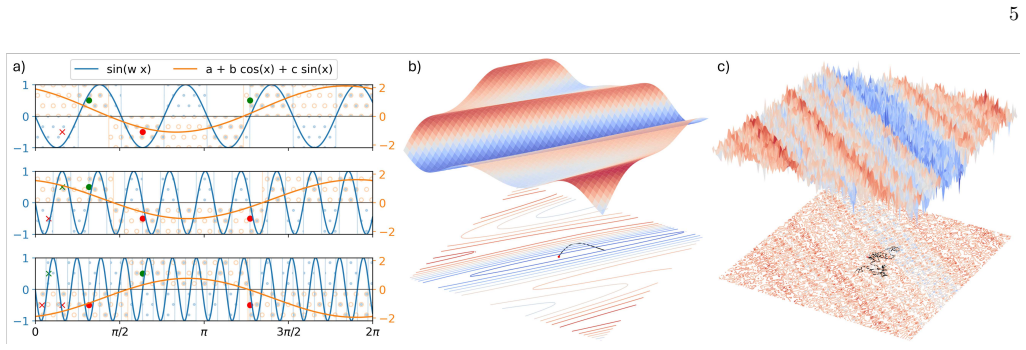
The load-bearing object is the hypothesis class of periodic interval classifiers produced by the separated layer structure: a single layer yields decision functions $\operatorname{sign}[a + b\cos x + c\sin x]$, equivalent to a periodic interval, whose VC dimension is 3; $L$ layers yield (up to parameter constraints) a degree-$L$ trigonometric polynomial with VC dimension $2L+1$. In the photonic hardware, each layer is a pair of Mach-Zehnder interferometers, one encoding the data via phases $x_1,x_2$, the other applying the trainable rotation, and the measured output probability is fed to a linear discriminant threshold. The contrast case is the compressed gate, whose single-layer hypothesis class is $\{x \mapsto \sin(\omega x)\}$ with infinite VC dimension.
What would settle it
Take $2L+2$ points on a circle and label them alternately $0,1,0,1,\ldots$; the proof says no $L$-layer separated circuit can classify all training points perfectly, and for $L=1$ it already forbids perfect classification of 4 alternating points. If such a circuit, with parameters found by any training procedure, achieved perfect training accuracy on the alternating labels, the VC-dimension bound would be falsified. A direct experimental test would train the photonic processor on this adversarial labeling and check whether it can memorize it.
Extended reading notes
Core claim
The paper's central claim is that the separated form of data re-uploading, a single qubit evolved by $L$ layers of the form $U_l(\vec{\theta}) U(\vec{x})$ followed by a projective measurement and a linear-discriminant threshold, defines a hypothesis class that is PAC-learnable. For one layer the implementable decision functions are exactly the periodic interval classifiers $H = \{x \mapsto \mathbf{1}_{[a+2\pi n, b+2\pi n]} \mid a,b \in \mathbb{R}, n \in \mathbb{Z}\}$, with VC dimension 3. For $L$ layers the class is identified with degree-$L$ trigonometric polynomials, giving VC dimension $2L+1$; the proof shows that $2L+1$ points can be shattered while the alternating label sequence on $2L+2$ points cannot. The compressed scheme, whose single gate maps $x \mapsto \sin(\omega x)$, has infinite VC dimension and therefore no PAC guarantee. The paper also shows the separated model remains a universal approximator, has flatter loss landscapes than the compressed model, and realizes the architecture on a photonic processor with Mach-Zehnder interferometers, reaching high test accuracy on circles, moons, tetromino, and overhead-MNIST classification with single-photon and coherent inputs.
Load-bearing premise
The multi-layer part of the proof assumes that the physical circuit's decision functions are well approximated by degree-$L$ trigonometric polynomials with unconstrained coefficients; the paper derives the single-layer class exactly but only asserts the multi-layer approximation, so the exact equality $\mathrm{VCdim}=2L+1$ for the physical parameter set is not proven.
Editorial extensions
If this is right
- A finite training set of size set by the VC dimension $2L+1$ guarantees bounded test error for the separated classifier, so the model can be deployed with confidence on new data.
- Adding layers raises the VC dimension by 2 per layer, so capacity grows predictably; the tetromino experiment shows when the layer count exceeds what the task needs, test accuracy drops, as overfitting theory predicts.
- The same photonic circuit works with single-photon and coherent-light inputs, so the generalization guarantee applies to both quantum and classical-optical inference.
- Flatter minima in the separated model's loss landscape, quantified by a Hessian lower bound near 0.23 versus $7.23 \times 10^{12}$ for the compressed model, make gradient training more reliable and less sensitive to noise.
- Because the separated model is also a universal approximator, its finite VC dimension does not limit the functions it can represent as the number of layers grows.
Reading between the lines
- The VC dimension bound is proven for the unconstrained trigonometric-polynomial class, but the physical MZI parameters are constrained; if the true class is smaller, the sample complexity is even better than stated, so the paper's safety margin is conservative.
- The same separation principle may transfer to deeper variational circuits: keeping data-encoding unitaries distinct from trainable unitaries could be a design rule for preserving PAC-learnability in multi-qubit models.
- The coherent-light results suggest that the classical-optical version of the same circuit inherits the PAC guarantee, which could be exploited for energy-efficient analog optical inference without quantum resources.
Editorial analysis
A structured set of objections, weighed in public.
Referee Report
Summary. The manuscript reports an experimental implementation of a data re-uploading quantum classifier on a photonic integrated processor, in which the encoding and trainable-processing gates are kept separate (the 'original' scheme). The authors claim that this separation yields a model that is both a universal approximator and an effective PAC learner, in contrast to the 'compressed' scheme where encoding and rotation are merged, which is claimed to have infinite VC dimension. The theoretical core is a VC-dimension analysis: the compressed scheme is said to have infinite VC dimension, while the original scheme is claimed to have finite VC dimension 2L+1 for L layers. The experimental part reports accuracies on circles, moons, tetromino, and Overhead MNIST classification tasks.
Significance. If the theoretical claims are rigorously established, this is a valuable contribution: it would provide a formal generalization guarantee for a one-qubit, photonic data re-uploading classifier and highlight an important structural distinction between the original and compressed re-uploading schemes. The single-layer VC-dimension derivation (Supplementary Note I.B, Eq. (8)) is clean and gives a valid upper bound for the single-layer physical model. The paper also includes a real experimental demonstration on a tunable photonic chip, which strengthens the practical relevance. However, as written, the multi-layer VC-dimension proof is incomplete, and the headline claim that the model is 'mathematically guaranteed' to be an effective learner is not fully supported. The missing step is likely repairable, but it is load-bearing and must be addressed.
major comments (2)
- [Section III and Fig. 4] The L-layer VC-dimension bound is not proven for the physical model. The supplement states that for two layers the system 'can be approximated by' the unconstrained degree-L trigonometric polynomial class (Eq. (16)) and then asserts that the system 'can again be written in the form of a periodic interval classifier.' Approximation does not imply containment; an upper bound on the VC dimension of an approximating superset transfers to the physical class only if the physical decision functions are a subset of that superset. The main text then reasons directly with periodic interval classifiers and concludes VCdim = 2L+1, but the shattering argument in Section III applies to that interval-classifier class, not to the constrained parameter manifold of the physical circuit. Even for the single-layer case, the paper derives the exact hypothesis class (Supplementary Eq. (8)) but does not prove that the constrained MZI parameters realize all members of that class or that the VC dimension is exactly 3 for the physical model. To support the PAC-learnability claim, the authors should derive the exact form of the probability difference for general L (as done for L=1 in Eqs. (9)-(11)) and prove that the resulting hypothesis class is contained in a class of finite VC dimension, or provide a direct upper bound on the VC dimension of the physical class.
- [Section III and Fig. 4] The trainability claim is supported only by a single numerical example: the largest Hessian eigenvalue at a minimum is reported as approximately 0.23 for the original scheme versus 7.23 x 10^12 for the compressed scheme, together with visual inspection of loss landscapes. This is anecdotal evidence, not a proof of a general trainability advantage. If the paper's 'provable enhanced learning capabilities' are meant to include trainability, the authors must either provide a general argument or explicitly label this as a numerical observation. The PAC guarantee, which is the central claim, depends on the VC-dimension bound and not on this Hessian example.
minor comments (5)
- [Section III] There are broken citations: 'inmohriFoundationsMachineLearning' and 'This follows bymohriFoundationsMachineLearning' should be replaced with proper references to Mohri et al.
- [Main text, Eq. (3)] The Jones matrix expression in Eq. (3) appears to have a missing closing parenthesis after the factor 'ie^{iθ/2}'; please verify the formula and its formatting.
- [Supplementary Note II] The universality proof in Supplementary Note II uses the 'approximated set' of implementable functions (Eq. (19)), which by itself does not establish universality of the physical model. The authors do cite an external result (Ref. [30]) for universality, but the text should clarify that the Fourier argument is heuristic and that the rigorous statement follows from the cited reference.
- [Abstract and Section III] The phrase 'mathematically guaranteed to be an effective learner' is stronger than what is currently proven, as the multi-layer VC-dimension bound is not established. The authors should either supply the missing proof or qualify the claim to the single-layer case.
- [Throughout] There are several typos and inconsistencies, e.g., 'particulary' in the Discussion, and the mixed use of 'generalisability' and 'generalizability'.
Circularity Check
No circularity: the derivation chain is grounded in external VC-dimension results and explicit circuit algebra, and the multi-layer approximation step is a technical completeness gap, not a circular reduction.
full rationale
The paper's central theoretical claims are the finiteness of the VC dimension of the separated (original) data re-uploading scheme and its PAC learnability. For a single layer, the implementable functions are derived exactly from the MZI Jones matrix (Supplementary Eq. 8), and the VC-dimension bound VCdim = 3 is obtained by the standard reduction to periodic interval classifiers, citing Mohri et al. for the interval-classifier VC dimension. For multiple layers, Supplementary Eq. 16 states that the system 'can be approximated by' a degree-L trigonometric polynomial with unconstrained coefficients 'with additional constraints'. This is an asserted containment/approximation rather than a fully derived equality for the constrained physical parameter set, so the exact claim VCdim = 2L+1 for the physical family is not rigorously established as written. That is a completeness or correctness gap, not circularity: the argument does not assume the target conclusion, and an upper bound on the unconstrained superset would still suffice for the PAC guarantee. The lower-bound shattering proof for periodic interval classifiers is an independent combinatorial argument, not a restatement of the circuit model. No fitted parameter is renamed as a prediction, and the only author-overlapping reference ([38], a general theory-of-deep-learning citation) is not load-bearing for the derivation. The paper is therefore not circular, despite the identified proof gap.
Assumptions & free parameters
free parameters (3)
- Trainable rotation phases ϑ_1..ϑ_{2L} (two per layer) =
Learned via Adam on training data in numerical simulation (values not published)
- LDA threshold t =
Set by Linear Discriminant Analysis on the training set output probabilities
- Compressed-scheme frequency ω (comparison model) =
Arbitrary real; chosen per label pattern in Eq. (6)
assumptions (5)
- standard math The set of functions {x → sin(ωx)} has infinite VC dimension (Mohri et al., Example 3.16).
- standard math The class of unions of at most L periodic intervals has VC dimension 2L+1.
- domain assumption The physical MZI implements the ideal lossless Jones matrix of Eq. (3).
- ad hoc to paper The multi-layer physical model's decision functions are contained in (or approximated by) the degree-L trigonometric polynomial class with unconstrained coefficients (Supplementary Eq. (16) and (17)).
- domain assumption The worst-case dataset used for the Hessian comparison is representative of trainability differences.
Cite this review
Pith. "Pith review of Experimental data re-uploading with provable enhanced learning capabilities." pith.science (2026). https://pith.science/paper/CNJVNULS
@misc{pith2026250705120,
  author       = {Pith},
  title        = {Pith review of: Experimental data re-uploading with provable enhanced learning capabilities},
  year         = {2026},
  howpublished = {\url{https://pith.science/paper/CNJVNULS}},
  note         = {Machine review of arXiv:2507.05120}
}
read the original abstract
The last decades have seen the development of quantum machine learning, stemming from the intersection of quantum computing and machine learning. This field is particularly promising for the design of alternative quantum (or quantum inspired) computation paradigms that could require fewer resources with respect to standard ones, e.g. in terms of energy consumption. In this context, we present the implementation of a data re-uploading scheme on a photonic integrated processor, achieving high accuracies in several image classification tasks. We thoroughly investigate the capabilities of this apparently simple model, which relies on the evolution of one-qubit states, by providing an analytical proof that our implementation is a universal classifier and an effective learner, capable of generalizing to new, unknown data. Hence, our results not only demonstrate data re-uploading in a potentially resource-efficient optical implementation but also provide new theoretical insight into this algorithm, its trainability, and generalizability properties. This lays the groundwork for developing more resource-efficient machine learning algorithms, leveraging our scheme as a subroutine.
Figures


Figures from the paper (2 more)

Reference graph
Works this paper leans on
-
[1]
Shor, P. W. Algorithms for quantum computation: discrete logarithms and factoring. In Proceedings 35th annual symposium on foundations of computer science , 124–134 (Ieee, 1994)
work page 1994
-
[2]
Grover, L. K. A fast quantum mechanical algorithm for database search. In Proceedings of the twenty-eighth an- nual ACM symposium on Theory of computing , 212–219 (1996)
work page 1996
-
[3]
Aaronson, S. & Arkhipov, A. The computational com- plexity of linear optics. In Proceedings of the forty-third annual ACM symposium on Theory of computing , 333– 342 (2011)
work page 2011
-
[4]
Lund, A. P., Bremner, M. J. & Ralph, T. C. Quan- tum sampling problems, bosonsampling and quantum supremacy. npj Quantum Information 3, 15 (2017)
work page 2017
-
[5]
Arute, F. et al. Quantum supremacy using a pro- grammable superconducting processor. Nature 574, 505– 510 (2019)
2019
-
[6]
Zhong, H.-S. et al. Quantum computational advantage using photons. Science 370, 1460–1463 (2020)
2020
-
[7]
Madsen, L. S. et al. Quantum computational advantage with a programmable photonic processor. Nature 606, 75–81 (2022)
2022
-
[8]
Biamonte, J. et al. Quantum machine learning. Nature 549, 195–202 (2017)
2017
Show all 63 references
-
[9]
& Briegel, H
Dunjko, V. & Briegel, H. J. Machine learning & artifi- cial intelligence in the quantum domain: a review of re- cent progress. Reports on Progress in Physics 81, 074001 (2018)
2018
-
[10]
& Latorre, J
P´ erez-Salinas, A., Cervera-Lierta, A., Gil-Fuster, E. & Latorre, J. I. Data re-uploading for a universal quantum classifier. Quantum 4, 226 (2020)
2020
-
[11]
& Petruccione, F
Schuld, M., Petruccione, F., Schuld, M. & Petruccione, F. Quantum models as kernel methods. Machine Learning with Quantum Computers 217–245 (2021)
2021
-
[12]
& Temme, K
Liu, Y., Arunachalam, S. & Temme, K. A rigorous and robust quantum speed-up in supervised machine learn- ing. Nature Physics 17, 1013–1017 (2021)
2021
-
[13]
Huang, H.-Y. et al. Power of data in quantum machine learning. Nature communications 12, 2631 (2021)
2021
-
[14]
Jerbi, S. et al. Quantum machine learning beyond kernel methods. Nature Communications 14, 1–8 (2023)
2023
-
[15]
Goto, T., Tran, Q. H. & Nakajima, K. Universal approx- imation property of quantum machine learning models in quantum-enhanced feature spaces. Physical Review Let- ters 127, 090506 (2021)
2021
-
[16]
Wootters, W. K. & Zurek, W. H. A single quantum cannot be cloned. Nature 299, 802–803 (1982)
1982
-
[17]
& Meyer, J
Schuld, M., Sweke, R. & Meyer, J. J. Effect of data encoding on the expressive power of variational quantum- machine-learning models. Physical Review A 103, 032430 (2021)
2021
-
[18]
& Wang, X
Yu, Z., Yao, H., Li, M. & Wang, X. Power and limi- tations of single-qubit native quantum neural networks. Advances in Neural Information Processing Systems 35, 27810–27823 (2022)
2022
-
[19]
Jerbi, S. et al. Quantum machine learning beyond kernel methods. Nature Communications 14, 1–8 (2023). 10
2023
-
[20]
Ono, T. et al. Demonstration of a bosonic quantum clas- sifier with data reuploading. Physical review letters 131, 013601 (2023)
2023
-
[21]
& Latorre, J
P´ erez-Salinas, A., L´ opez-N´ u˜ nez, D., Garc ´ ıa-S´ aez,A., Forn-D ´ ıaz, P. & Latorre, J. I. One qubit as a univer- sal approximant. Physical Review A 104, 012405 (2021)
2021
-
[22]
& Situ, H
Fan, L. & Situ, H. Compact data encoding for data re-uploading quantum classifier. Quantum Information Processing 21, 87 (2022)
2022
-
[23]
L., Rudolph, M
Wach, N. L., Rudolph, M. S., Jendrzejewski, F. & Schmitt, S. Data re-uploading with a single qudit. Quan- tum Machine Intelligence 5, 36 (2023)
2023
-
[24]
& Jiang, R
Easom-Mccaldin, P., Bouridane, A., Belatreche, A. & Jiang, R. On depth, robustness and performance using the data re-uploading single-qubit classifier. IEEE Access 9, 65127–65139 (2021)
2021
-
[25]
C., Gil-Fuster, E., Meyer, J
Caro, M. C., Gil-Fuster, E., Meyer, J. J., Eisert, J. & Sweke, R. Encoding-dependent generalization bounds for parametrized quantum circuits. Quantum 5, 582 (2021)
2021
-
[26]
& So- gabe, T
Chen, C.-C., Sogabe, M., Shiba, K., Sakamoto, K. & So- gabe, T. General vapnik–chervonenkis dimension bounds for quantum circuit learning. Journal of Physics: Com- plexity 3, 045007 (2022)
2022
-
[27]
& Bravo-Prieto, C
Gil-Fuster, E., Eisert, J. & Bravo-Prieto, C. Understand- ing quantum machine learning also requires rethinking generalization. Nature Communications 15, 2277 (2024)
2024
-
[28]
Pentangelo, C. et al. High-fidelity and polarization- insensitive universal photonic processors fabricated by femtosecond laser writing. Nanophotonics 13, 2259–2270 (2024)
2024
-
[29]
& Osellame, R
Corrielli, G., Crespi, A. & Osellame, R. Femtosecond laser micromachining for integrated quantum photonics. Nanophotonics 10, 3789–3812 (2021)
2021
-
[31]
& Englund, D
Hamerly, R., Bernstein, L., Sludds, A., Soljaˇ ci´ c, M. & Englund, D. Large-scale optical neural networks based on photoelectric multiplication. Physical Review X 9, 021032 (2019)
2019
-
[32]
& Killo- ran, N
Schuld, M., Bergholm, V., Gogolin, C., Izaac, J. & Killo- ran, N. Evaluating analytic gradients on quantum hard- ware. Physical Review A 99, 032331 (2019)
2019
-
[33]
Jolliffe, I. T. Principal Component Analysis . Springer Series in Statistics (Springer, New York, NY, 1986)
1986
-
[34]
Pearson, K. Liii. on lines and planes of closest fit to systems of points in space. The London, Edinburgh, and Dublin Philosophical Magazine and Journal of Science 2, 559–572 (1901)
1901
-
[35]
& Franklin, J
Hastie, T., Tibshirani, R., Friedman, J. & Franklin, J. The elements of statistical learning: data mining, infer- ence and prediction. The Mathematical Intelligencer 27, 83–85 (2005)
2005
-
[36]
Periyasamy, M. et al. Incremental data-uploading for full- quantum classification. In 2022 IEEE International Con- ference on Quantum Computing and Engineering (QCE) , 31–37 (IEEE, 2022)
2022
-
[37]
Vapnik, V. N. & Chervonenkis, A. Y. On the uniform convergence of relative frequencies of events to their prob- abilities. In Measures of complexity: festschrift for alexey chervonenkis, 11–30 (Springer, 2015)
2015
-
[38]
& Zech, J
Petersen, P. & Zech, J. Mathematical theory of deep learning. arXiv preprint arXiv:2407.18384 (2024)
2024
-
[39]
& Ben-David, S
Shalev-Shwartz, S. & Ben-David, S. Understanding ma- chine learning: From theory to algorithms (Cambridge university press, 2014)
2014
-
[40]
Valiant, L. G. A theory of the learnable. Commun. ACM 27, 1134–1142 (1984)
1984
-
[41]
& Goldstein, T
Li, H., Xu, Z., Taylor, G., Studer, C. & Goldstein, T. Visualizing the Loss Landscape of Neural Nets (2018). 1712.09913
2018 arXiv
-
[42]
& Schmidhuber, J
Hochreiter, S. & Schmidhuber, J. Flat Minima. Neural Computation 9, 1–42 (1997)
1997
-
[43]
& Tang, P
Keskar, N., Mudigere, D., Nocedal, J., Smelyanskiy, M. & Tang, P. T. P. On Large-Batch Training for Deep Learning: Generalization Gap and Sharp Minima. ArXiv (2016)
2016
-
[44]
Chaudhari, P. et al. Entropy-SGD: Biasing gradient de- scent into wide valleys*. Journal of Statistical Mechanics: Theory and Experiment 2019, 124018 (2019)
2019
-
[45]
& Chizat, L
Marion, P. & Chizat, L. Deep linear networks for regres- sion are implicitly regularized towards flat minima. URL http://arxiv.org/abs/2405.13456. 2405.13456
-
[46]
R., Humphreys, P
Clements, W. R., Humphreys, P. C., Metcalf, B. J., Kolthammer, W. S. & Walmsley, I. A. Optimal design for universal multiport interferometers. Optica 3, 1460–1465 (2016)
2016
-
[47]
Ceccarelli, F. et al. Low Power Reconfigurability and Reduced Crosstalk in Integrated Photonic Circuits Fab- ricated by Femtosecond Laser Micromachining. Laser & Photonics Reviews 14, 2000024 (2020)
2020
-
[48]
T” and “L
or directly on the quantum platform, where gradients are approximated through a parameter shift rule [32] (see Supplementary Material note III). In the end, after the retrieve of the optimal parameters (i.e. those which minimize the classification error on the training data) we...
-
[49]
Kingma, D. P. & Ba, J. Adam: A Method for Stochastic Optimization (2017). 1412.6980
2017 arXiv
-
[50]
Pedregosa, F. et al. Scikit-learn: Machine learning in python. the Journal of machine Learning research 12, 2825–2830 (2011)
2011
-
[51]
& Noever, S
Noever, D. & Noever, S. E. M. Overhead MNIST: A Benchmark Satellite Dataset (2021). 2102.04266
2021 arXiv
-
[52]
& Sanz, M
Rodriguez-Grasa, P., Ban, Y. & Sanz, M. Training em- bedding quantum kernels with data re-uploading quan- tum neural networks (2024). 2401.04642
2024 arXiv
-
[53]
& Jerbi, S
Freinberger, D., Lemmel, J., Grosu, R. & Jerbi, S. A quantum-classical reinforcement learning model to play Atari games (2024). 2412.08725
2024 arXiv
-
[54]
Facelli, G. et al. Exact gradients for linear optics with single photons (2024). 2409.16369. Supplementary Material I. VC DIMENSION OF QUANTUM LEARNING MODELS In order to determine the VC dimension of the investigated quantum l earning models, i.e. the compressed and original ...
2024 arXiv
-
[55]
& Sogabe , T
Chen, C.-C., Sogabe, M., Shiba, K., Sakamoto, K. & Sogabe , T. General vapnik–chervonenkis dimension bounds for quantum circuit learning. Journal of Physics: Complexity 3, 045007 (2022)
2022
-
[56]
& Talwalkar, A
Mohri, M., Rostamizadeh, A. & Talwalkar, A. Foundations of Machine Learning (Second Edition)
-
[57]
Y., Barthe, A
P´ erez-Salinas, A., Rad, M. Y., Barthe, A. & Dunjko, V. Univers al approximation of continuous functions with minimal quantum circuits. arXiv preprint arXiv:2411.19152 (2024)
2024
-
[58]
& Lat orre, J
P´ erez-Salinas, A., Cervera-Lierta, A., Gil-Fuster, E. & Lat orre, J. I. Data re-uploading for a universal quantum classifier. Quantum 4, 226 (2020)
2020
-
[59]
Goto, T., Tran, Q. H. & Nakajima, K. Universal approximation p roperty of quantum machine learning models in quantum- enhanced feature spaces. Physical Review Letters 127, 090506 (2021)
2021
-
[60]
M., Shakarchi, R
Stein, E. M., Shakarchi, R. & Stein, E. M. Fourier Analysis: An Introduction . No. 1 in Princeton Lectures in Analysis / Elias M. Stein & Rami Shakarchi (Princeton University Press, Prin ceton Oxford, 2003), 15. druck edn
2003
-
[61]
Tensorflow
Developers, T. Tensorflow. Zenodo (2022)
2022
-
[62]
Killoran, N. et al. Strawberry fields: A software platform for photonic quantum computin g. Quantum 3, 129 (2019)
2019
-
[63]
& Widmer, G
Dorfer, M., Kelz, R. & Widmer, G. Deep Linear Discriminant Analysi s (2016). 1511.04707
2016 arXiv
-
[64]
& Killora n, N
Schuld, M., Bergholm, V., Gogolin, C., Izaac, J. & Killora n, N. Evaluating analytic gradients on quantum hardware. Physical Review A 99, 032331 (2019)
2019
Reviewed August 6, 2026 · model on record in the stance chip above.
Discussion (0). Sign in to comment.