REVIEW 4 major objections 6 minor 80 references
PanSt3R: Multi-view Consistent Panoptic Segmentation
T0 review · 4 major / 6 minor · reviewed 2026-08-06 · deepseek-v4-flash
Pith's one-line read PanSt3R does 3D geometry plus multi-view panoptic segmentation in one forward pass from unposed images, with no camera parameters or test-time optimization, and beats previous methods on four benchmarks at orders-of-magnitude lower cost.
desk verdict Genuine single-forward-pass multi-view panoptic segmentation from unposed images, with a solid architecture and ablation study, but the SOTA headline is undercut by an evaluation that leans on posed 3DGS rendering and LUDVIG. read the letter →
The pith
A machine-rendered reading of the paper's core claim, the machinery that carries it, and where it could break.
The reading
What carries the argument
The load-bearing mechanism is a single shared pool of $Q = 200$ learnable instance queries in a Mask2Former-style transformer decoder. The queries cross-attend simultaneously to frame tokens built from concatenated DINOv2 and MUSt3R encoder/decoder features across all input views, so each query is pressed to represent the same 3D object or stuff region in every frame, yielding instance masks that are globally consistent by construction. A second mechanism carries the final labeling: mask merging as a quadratic unconstrained binary optimization (QUBO), solved by simulated annealing, in which each candidate mask contributes its covered area as a reward and each pair of overlapping masks pays a penalty proportional to their intersection; the solver selects the subset of masks with maximum global score. The paper identifies this merging step, rather than the network itself, as the point where standard methods lose multi-view consistency.
What would settle it
Take a scene with more than 200 clearly separated, visually near-identical objects (a warehouse aisle of stacked boxes, a row of identical chairs) and run PanSt3R on a set of unposed views: if the output contains at most 200 instance masks with two distinct objects sharing one instance ID across views, the fixed query budget is the binding constraint. A complementary check on the feature side: suppress the MUSt3R feature branch at inference on a two-object scene and measure whether the same query still binds to the same object across views—the paper's own ablation predicts a large consistency drop, which would confirm that geometric features, not semantics, carry cross-view identity.
Extended reading notes
Core claim
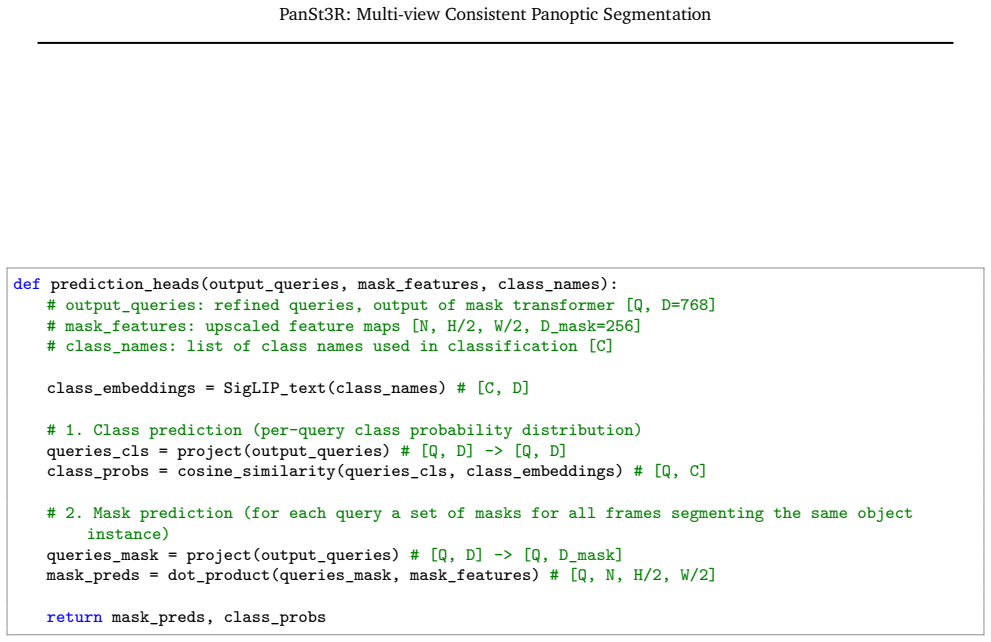
The paper's central claim is that 3D reconstruction and panoptic segmentation are one reasoning task—decomposing a scene into geometry and persistent instances—and should be executed by a single network rather than by fusing off-the-shelf 2D predictions into an optimized 3D field. PanSt3R feeds an unordered set of RGB frames through frozen DINOv2 and MUSt3R encoders, concatenates their token maps into compact frame tokens, and decodes a fixed set of 200 learnable queries with a mask transformer that cross-attends to all frames at once. Each query is trained to bind to one physical object or stuff region, so the same instance ID is emitted for that object in every view where it appears; class labels come from cosine similarity between query embeddings and SigLIP text embeddings, giving an open-vocabulary head that can be trained on heterogeneous datasets. The decoded soft masks are merged by a QUBO solver that maximizes covered area while penalizing pairwise overlap, a step the paper shows is far more effective than the confidence-thresholding and voting scheme inherited from single-image segmentation. Optionally, the labeled point cloud can be uplifted into 3D Gaussians with LUDVIG, supervised by an auxiliary rendered-label regularization loss, to render panoptic predictions from novel viewpoints.
Load-bearing premise
The load-bearing premise is that a fixed pool of 200 learnable instance queries, decoded from frozen DINOv2 and MUSt3R features, can represent every object and stuff region in the scene and that those features will bind the same query to the same physical object across all views; the paper sets $Q = 200$ without ablating it and does not test where this binding starts to fail.
Editorial extensions
If this is right
- Scene-level panoptic segmentation no longer needs camera calibration or per-scene optimization; one forward pass over the image collection produces both geometry and consistent instance labels.
- Replacing the standard MaskFormer-style mask-selection heuristic with global QUBO selection is worth a large PQ gain (about 5–6 points on Hypersim and ScanNet, more on Replica), so the merging step is where multi-view consistency is won or lost.
- Because instance IDs are produced directly and views are processed with a shared query set, the output is immediately usable as supervision for downstream tasks like robot interaction, augmented reality, and 3D scene editing, without a separate association step.
- The open-vocabulary classification head lets one trained model transfer across datasets with different class vocabularies (COCO, ADE20K, ScanNet++, Infinigen), so training data can be pooled from heterogeneous sources.
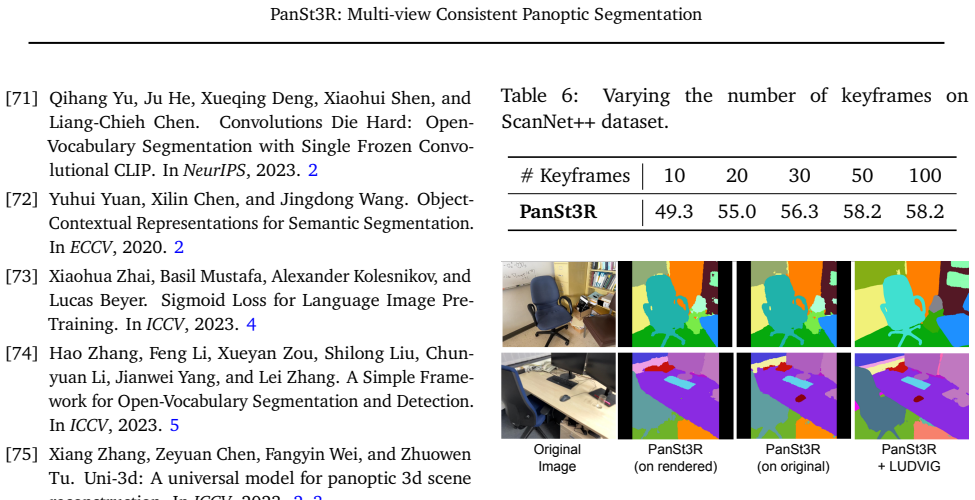
- Novel-view panoptic predictions can be obtained either by running the same network on rendered views or by uplifting labels into 3D Gaussians with LUDVIG, with uplifting generally improving quality by aggregating evidence over views.
Reading between the lines
- Because the query pool is fixed at $Q = 200$ with no ablation reported, a scene containing more than 200 distinct instances would force two objects to share one query; measuring PQ on a deliberately instance-dense scene (a crowd, a warehouse aisle) would map the method's ceiling.
- The same shared-query architecture could be extended to streaming video by carrying queries across temporal windows, turning the model into an online panoptic tracker with no separate data-association module.
- The open-vocabulary head suggests a cheap extension: querying the decoder with arbitrary text embeddings (not just class names) could yield 3D grounding from free-form language, since each query already encodes a scene region.
- The ablations attribute the largest loss (14.7 PQ points) to removing the MUSt3R 3D features and only 4 points to removing DINOv2, implying cross-view identity binding is carried mostly by geometric features—a testable prediction: perturbing MUSt3R features should break instance consistency across views more than perturbing semantic features.
Editorial analysis
A structured set of objections, weighed in public.
Referee Report
Summary. The paper proposes PanSt3R, a network that combines frozen MUSt3R and DINOv2 feature extractors with a Mask2Former-style mask transformer using a shared set of learnable queries, to jointly predict 3D point maps and multi-view panoptic segmentations from an unconstrained collection of unposed images in a single forward pass. A QUBO-based mask selection step replaces the standard MaskFormer merging procedure, and an optional 3DGS+LUDVIG stage is introduced to produce novel-view panoptic predictions. The method is evaluated on ScanNet, Hypersim, Replica, and ScanNet++, reporting large gains over NeRF/3DGS lifting baselines at substantially lower runtime, with extensive ablations of the feature backbones, QUBO merging, 3DGS regularization, keyframe count, and model resolution.
Significance. If the central claims hold, PanSt3R is a practically significant step: it removes pose estimation and per-scene optimization from panoptic 3D scene understanding, shows that foundation-model features and a shared query set can yield multi-view consistent masks, and provides a simple alternative to the dominant 2D-lifting pipelines. The paper is extensive and well structured, with multiple benchmarks, thorough ablations, pseudo-code, and a comparison against a point-cloud segmentation baseline. The main risks are that the headline 'state-of-the-art' numbers are obtained through a posed 3DGS rendering/optimization pipeline rather than the pose-free single forward pass, and that the QUBO formulation as written is incomplete. These issues are load-bearing but appear fixable with additional experiments and clarification, so the recommendation is major revision rather than rejection.
major comments (4)
- [§4.3, §4.4, Tables 2–3] In Sec. 4.3, the PanSt3R rows in Table 2 are obtained by running the network on test views rendered with vanilla 3DGS built from posed training images (footnote 2). The identical values in Table 3 (46.7/43.2/55.8) and Appendix Table 8 (rendered, 512) indicate that the ScanNet++ comparison is also on rendered views. Thus the SOTA numbers for the pose-free method are produced by a pipeline that requires camera poses and a roughly 35-minute 3DGS optimization, which is exactly the kind of test-time overhead the abstract says is eliminated. The only direct forward-pass evaluation on original held-out test images (Appendix Table 8, PanSt3R 512, 57.3 PQ) is reported without PanLift or Contrastive Lift baselines. In addition, the 'orders of magnitude faster' timing in Tables 2–3 compares the roughly 2–4 minute forward pass to the baselines' full optimization, while the rendered-evaluation variant incurs an extra +35 minute 3DGS build (Table 2). Please either add a direct forward-pass comparison on original test views against the same baselines, or restrict the SOTA claim to the rendered-view protocol and include the required 3DGS time in the runtime comparison.
- [§3.2, QUBO objective] The QUBO maximization in Sec. 3.2 has no term penalizing the number of selected proposals and no confidence threshold in the objective. For any two disjoint masks with positive areas, selecting both strictly increases the objective, so the global maximizer would select every proposal with positive area unless overlap penalties dominate. This would admit low-confidence spurious masks and is inconsistent with the intended filtering behavior. The paper does not describe a confidence pre-filter, a cardinality penalty, or an equivalent constraint. Please specify the exact candidate set, any thresholding, and the full objective actually optimized, and verify that the reported QUBO gains are not an artifact of an unstated heuristic.
- [§3.1 / Appendix D, pseudo-code] The model fixes Q=200 shared instance queries (Sec. 3.1 and pseudo-code) with no ablation of Q and no analysis of scenes containing more than 200 instances or of cross-view query-to-instance binding failures. Since each query must select the same physical object across views through frozen DINOv2/MUSt3R features, the capacity and binding reliability are load-bearing for the multi-view consistency claim. Please add ablations of Q (e.g., 100, 300, 500), report the distribution of instance counts in the evaluation scenes, and provide a quantitative measure of cross-view instance-ID consistency.
- [Abstract / §3.3] The abstract and introduction state that PanSt3R 'eliminates the need for test-time optimization' and works 'without requiring any camera parameters.' However, the best benchmark results (Table 2: PanSt3R+LUDVIG, 66.3 PQ on Hypersim and 67.5 PQ on ScanNet) are obtained by optimizing a 3DGS scene with poses and the panoptic regularization loss of Eq. (6) before uplifting labels (Sec. 3.3). The paper does present LUDVIG as an optional novel-view prediction strategy, but the unqualified claims should be revised to separate the pose-free single-forward-pass setting (input-view prediction) from the posed, optimization-based novel-view setting in which the SOTA numbers are obtained.
minor comments (6)
- [Table 7] Table 7 cites 'PanoLift [39]' but reference [39] is OpenScene, not Panoptic Lifting; the correct citation appears to be [50]. Please fix the citation and standardize the name ('PanLift' vs 'PanoLift').
- [§3.1] The symbol for the joint token dimension is introduced as d_t but then given as d_f = 768; please unify the notation.
- [§3.2] In Sec. 3.2, Q_i and Q_{i,j} are used in the displayed objective before their definitions; move the definitions before the display or number the equations for readability.
- [§3.2] The simulated-annealing solver for the QUBO is described only as 'simulated annealing'; specify the temperature schedule, number of iterations, and initialization for reproducibility, or state that a black-box solver is used.
- [Appendix Table 8 / §4.4] Appendix Table 8 shows PanSt3R(orig) at 512 achieving 57.3 PQ, which is higher than PanSt3R+LUDVIG (54.8); the main text's emphasis on LUDVIG improvements in Sec. 4.4 should acknowledge that on original test views the direct forward pass is actually better.
- [Figures 3 and 5] The captions state that colors and their nuances denote different classes and object instances, but no legend or consistent color mapping is provided; this makes the qualitative figures difficult to interpret.
Circularity Check
No circular derivation: PanSt3R's predictions are ground-truth supervised and evaluated on held-out images; the gap between the pose-free claim and the posed-3DGS benchmark protocol is an evidence issue, not circularity.
full rationale
PanSt3R is an empirically trained model, not a derivation whose output reduces to its input by construction. The panoptic predictions are supervised by ground-truth labels through L = λc Lcls + λd Ldice + λb Lbce on datasets such as COCO, ADE20K, ScanNet++, and ASE, and the reported scene-PQ scores are computed against held-out ground truth. The QUBO mask merging in Sec. 3.2 and the LUDVIG uplifting in Sec. 3.3 consume the model's own predicted masks, but they are post-processing or label-transfer steps whose outputs are then compared with independent GT; using one's own predictions as input to a later stage is self-referential but not circular. The paper does rely on prior work by overlapping authors (MUSt3R, DUSt3R, LUDVIG), and these components are load-bearing, but they are external published models with publicly available code and are not invoked as a uniqueness theorem or as a way to forbid alternative explanations of the target result. No equation in the paper is equivalent to its own input, and no fitted parameter is renamed as a prediction. The skeptic's concern that Table 2 reports results on posed-3DGS rendered views or with LUDVIG optimization rather than the pure pose-free single forward pass is a mismatch between the claimed evaluation setting and the benchmark protocol; that is a correctness and evidence concern, not a circularity. Direct forward-pass numbers on original test views are only given in App. Tab. 8 without baseline comparisons, which weakens the SOTA claim but does not make the derivation circular. Overall, the central contribution is independently evaluated, so the circularity score is low; the small score reflects only the presence of self-citations that are not load-bearing in a circular sense.
Assumptions & free parameters
free parameters (4)
- QUBO overlap penalty lambda_p =
2
- 3DGS panoptic regularization weight lambda =
1
- Number of instance queries Q =
200
- Number of keyframes =
50
assumptions (4)
- domain assumption MUSt3R and DINOv2 features concatenated through an MLP encode globally consistent 3D geometry and semantics across all input views.
- ad hoc to paper A single set of 200 learnable queries is sufficient to simultaneously represent all object instances and stuff regions in a scene.
- domain assumption The training datasets (ScanNet++, ASE, Infinigen, COCO, ADE20k) provide enough coverage for generalization to the evaluation benchmarks.
- standard math Simulated annealing provides a near-optimal solution to the QUBO problem in practice.
Cite this review
Pith. "Pith review of PanSt3R: Multi-view Consistent Panoptic Segmentation." pith.science (2026). https://pith.science/paper/CNPEI6DW
@misc{pith2026250621348,
  author       = {Pith},
  title        = {Pith review of: PanSt3R: Multi-view Consistent Panoptic Segmentation},
  year         = {2026},
  howpublished = {\url{https://pith.science/paper/CNPEI6DW}},
  note         = {Machine review of arXiv:2506.21348}
}
read the original abstract
Panoptic segmentation of 3D scenes, involving the segmentation and classification of object instances in a dense 3D reconstruction of a scene, is a challenging problem, especially when relying solely on unposed 2D images. Existing approaches typically leverage off-the-shelf models to extract per-frame 2D panoptic segmentations, before optimizing an implicit geometric representation (often based on NeRF) to integrate and fuse the 2D predictions. We argue that relying on 2D panoptic segmentation for a problem inherently 3D and multi-view is likely suboptimal as it fails to leverage the full potential of spatial relationships across views. In addition to requiring camera parameters, these approaches also necessitate computationally expensive test-time optimization for each scene. Instead, in this work, we propose a unified and integrated approach PanSt3R, which eliminates the need for test-time optimization by jointly predicting 3D geometry and multi-view panoptic segmentation in a single forward pass. Our approach builds upon recent advances in 3D reconstruction, specifically upon MUSt3R, a scalable multi-view version of DUSt3R, and enhances it with semantic awareness and multi-view panoptic segmentation capabilities. We additionally revisit the standard post-processing mask merging procedure and introduce a more principled approach for multi-view segmentation. We also introduce a simple method for generating novel-view predictions based on the predictions of PanSt3R and vanilla 3DGS. Overall, the proposed PanSt3R is conceptually simple, yet fast and scalable, and achieves state-of-the-art performance on several benchmarks, while being orders of magnitude faster than existing methods.
Figures


Figures from the paper (10 more)





Reference graph
Works this paper leans on
-
[1]
Frost, Luke Holland, Camp- bell Orme, Jakob Engel, Edward Miller, Richard A
Armen Avetisyan, Christopher Xie, Henry Howard- Jenkins, Tsun-Yi Yang, Samir Aroudj, Suvam Patra, Fuyang Zhang, Duncan P. Frost, Luke Holland, Camp- bell Orme, Jakob Engel, Edward Miller, Richard A. New- combe, and Vasileios Balntas. SceneScript: Reconstruct- ingScenesWithAnAutoregressiveStructuredLanguage Model. arXiv:2403.13064, 2024. 6
arXiv 2024
-
[2]
Henriques, Andrew Zisserman, and Andrea Vedaldi
Yash Bhalgat, Iro Laina, João F. Henriques, Andrew Zisserman, and Andrea Vedaldi. Contrastive Lift: 3D Object Instance Segmentation by Slow-Fast Contrastive Fusion. InNeurIPS, 2024. 2, 3, 5, 7, 8
work page 2024
-
[3]
MUSt3R: Multi-view Network for Stereo 3D Reconstruction
Yohann Cabon, Lucas Stoffl, Leonid Antsfeld, Gabriela Csurka, Boris Chidlovskii, Jerome Revaud, and Vincent Leroy. MUSt3R: Multi-view Network for Stereo 3D Reconstruction. InCVPR, 2025. 3, 6, 9 Original Image w/o regularization with regularization Figure 6: Visual comparison of the effects of panoptic 3DGS regularization on ScanNet++. Results are shown fo...
work page 2025
-
[4]
End-to-End Object Detection with Trans- formers
Nicolas Carion, Francisco Massa, Gabriel Synnaeve, Nicolas Usunier, Alexander Kirillov, and Sergey Zagoruyko. End-to-End Object Detection with Trans- formers. InECCV, 2020. 2
work page 2020
-
[5]
TensoRF: Tensorial Radiance Fields
Anpei Chen, Zexiang Xu, Andreas Geiger, Jingyi Yu, and Hao Su. TensoRF: Tensorial Radiance Fields. InECCV,
-
[6]
Ting Chen, Lala Li, Saurabh Saxena, Geoffrey Hinton, and David J. Fleet. A Generalist Framework for Panoptic Segmentation of Images and Videos. InICCV, 2023. 1, 2
work page 2023
-
[7]
Open-vocabulary Panoptic Seg- mentation with Embedding Modulation
Xi Chen, Shuang Li, Ser-Nam Lim, Antonio Torralba, and Hengshuang Zhao. Open-vocabulary Panoptic Seg- mentation with Embedding Modulation. InICCV, 2023. 2
work page 2023
-
[8]
Collins, Yukun Zhu, Ting Liu, Thomas S
Bowen Cheng, Maxwell D. Collins, Yukun Zhu, Ting Liu, Thomas S. Huang, Hartwig Adam, and Liang-Chieh Chen. Panoptic-DeepLab: A Simple, Strong, and Fast Baseline for Bottom-Up Panoptic Segmentation. In CVPR, 2020. 1, 2
work page 2020
Show all 80 references
-
[9]
Schwing, and Alexander Kirillov
Bowen Cheng, Alexander G. Schwing, and Alexander Kirillov. Per-Pixel Classification is Not All You Need for Semantic Segmentation. InNeurIPS, 2021. 3, 5, 9
2021
-
[10]
Buol: A bottom-up framework with occupancy-aware lifting for panoptic 3d scene reconstruction from a single image
TaoChu,PanZhang,QiongLiu,andJiaqiWang. Buol: A bottom-up framework with occupancy-aware lifting for panoptic 3d scene reconstruction from a single image. In CVPR, 2023. 3
2023
-
[11]
Panoptic 3d scene reconstruction from a single rgb image
Manuel Dahnert, Ji Hou, Matthias Niessner, and Angela Dai. Panoptic 3d scene reconstruction from a single rgb image. InNeurIPS, 2021. 2, 3
2021
-
[12]
Chang, Manolis Savva, Maciej Hal- ber, Thomas Funkhouser, and Matthias Nießner
Angela Dai, Angel X. Chang, Manolis Savva, Maciej Hal- ber, Thomas Funkhouser, and Matthias Nießner. Scan- Net: Richly-Annotated 3D Reconstructions of Indoor Scenes. InCVPR, 2017. 6, 7, 8, 9
2017
-
[13]
Panoptic Segmentation with a Joint Semantic and Instance Segmentation Network
Daan de Geus, Panagiotis Meletis, and Gijs Dubbel- 10 PanSt3R: Multi-view Consistent Panoptic Segmentation man. Panoptic Segmentation with a Joint Semantic and Instance Segmentation Network. arXiv:1809.02110,
-
[14]
Open- Vocabulary Universal Image Segmentation with MaskCLIP
Zheng Ding, Jieke Wang, and Zhuowen Tu. Open- Vocabulary Universal Image Segmentation with MaskCLIP. InICML, 2023. 1, 2
2023
-
[15]
Masked-attention Mask Transformer for Universal Image Segmentation
Yu Du, Fangyun Wei, Zihe Zhang, Miaojing Shi, Yue Gao, and Guoqi Li. Masked-attention Mask Transformer for Universal Image Segmentation. InCVPR, 2022. 1, 2, 3, 4, 5, 8
2022
-
[16]
Panoptic NeRF: 3D-to-2D Label Transfer for Panoptic Urban Scene Segmentation
Xiao Fu, Shangzhan Zhang, Tianrun Chen, Yichong Lu, Lanyun Zhu, Xiaowei Zhou, Andreas Geiger, and Yiyi Liao. Panoptic NeRF: 3D-to-2D Label Transfer for Panoptic Urban Scene Segmentation. In3DV, 2022. 2, 3, 5
2022
-
[17]
SSAP: Single-Shot Instance Segmentation With Affinity Pyramid
Naiyu Gao, Yanhu Shan, Yupei Wang, Xin Zhao, Yinan Yu, Ming Yang, and Kaiqi Huang. SSAP: Single-Shot Instance Segmentation With Affinity Pyramid. InICCV,
-
[18]
Xiuye Gu, Yin Cui, Jonathan Huang, Abdullah Rashwan, Xuan Yang, Xingyi Zhou, Golnaz Ghiasi, Weicheng Kuo, Huizhong Chen, Liang-Chieh Chen, and David A. Ross. 3DaTaSeg: Taming a Universal Multi-Dataset Multi-Task Segmentation Model. InNeurIPS, 2023. 2
2023
-
[19]
Mask R-CNN
Kaiming He, Georgia Gkioxari, Piotra Dollár, and Ross Girshick. Mask R-CNN. InICCV, 2017. 2
2017
-
[20]
Primitive Generation and Semantic-related Alignment for Univer- sal Zero-Shot Segmentation
Shuting He, Henghui Ding, and Wei Jiang. Primitive Generation and Semantic-related Alignment for Univer- sal Zero-Shot Segmentation. InCVPR, 2023. 2
2023
-
[21]
LiDAR-based Panoptic Segmentation via Dynamic Shifting Network
Fangzhou Hong, Hui Zhou, Xinge Zhu, Hongsheng Li, and Ziwei Liu. LiDAR-based Panoptic Segmentation via Dynamic Shifting Network. InCVPR, 2021. 1, 2
2021
-
[22]
3D Gaus- sian Splatting for Real-Time Radiance Field Rendering
Bernhard Kerbl, Georgios Kopanas, Thomas Leimkuehler, and George Drettakis. 3D Gaus- sian Splatting for Real-Time Radiance Field Rendering. ACM Transactions on Graphics, 42(4):1–14, 2023. 2, 3, 5
2023
-
[23]
Panoptic Feature Pyramid Networks
Alexander Kirillov, Kaiming He, Ross Girshick, Carsten Rother, and Piotr Dollár. Panoptic Feature Pyramid Networks. InCVPR, 2019. 2
2019
-
[24]
Panoptic Segmentation
Alexander Kirillov, Kaiming He, Ross Girshick, Carsten Rother, and Piotr Dollár. Panoptic Segmentation. In CVPR, 2019. 1, 2, 7
2019
-
[25]
Panoptic Neural Fields: A Semantic Object-Aware Neural Scene Representation
Abhijit Kundu, Kyle Genova, Xiaoqi Yin, Alireza Fathi, Caroline Pantofaru, Leonidas Guibas, Andrea Tagliasac- chi, Frank Dellaert, and Thomas Funkhouser. Panoptic Neural Fields: A Semantic Object-Aware Neural Scene Representation. InCVPR, 2022. 2, 3, 5, 7, 8
2022
-
[26]
Grounding Image Matching in 3D with MASt3R
Vincent Leroy, Yohann Cabon, and Jérôme Revaud. Grounding Image Matching in 3D with MASt3R. In ECCV, 2024. 1, 3
2024
-
[27]
Panoptic-PHNet: Towards Real- Time and High-Precision LiDAR Panoptic Segmentation via Clustering Pseudo Heatmap
Jinke Li, Xiao He, Yang Wen, Yuan Gao, Xiaoqiang Cheng, and Dan Zhang. Panoptic-PHNet: Towards Real- Time and High-Precision LiDAR Panoptic Segmentation via Clustering Pseudo Heatmap. InCVPR, 2022. 1, 2
2022
-
[28]
Generalized Fo- cal Loss: Learning Qualified and Distributed Bounding Boxes for Dense Object Detection
Xiang Li, Wenhai Wang, Lijun Wu, Shuo Chen, Xiaolin Hu, Jun Li, Jinhui Tang, and Jian Yang. Generalized Fo- cal Loss: Learning Qualified and Distributed Bounding Boxes for Dense Object Detection. InNeurIPS, 2020. 5
2020
-
[29]
OMG-Seg: Is One Model Good Enough For All Segmentation? In CVPR, 2024
Xiangtai Li, Haobo Yuan, Wei Li, Henghui Ding, Size Wu, Wenwei Zhang, Yining Li, Kai Chen, and Chen Change Loy. OMG-Seg: Is One Model Good Enough For All Segmentation? In CVPR, 2024. 1, 2
2024
-
[30]
Attention- Guided Unified Network for Panoptic Segmentation
Yanwei Li, Xinze Chen, Zheng Zhu, Lingxi Xie, Guan Huang, Dalong Du, and Xingang Wang. Attention- Guided Unified Network for Panoptic Segmentation. In CVPR, 2019. 1, 2
2019
-
[31]
Semantic Image Segmentation with Deep Convolutional Nets and Fully Connected CRFs
Chen Liang-Chieh, George Papandreou, Iasonas Kokki- nos, Kevin Murphy, and Alan Yuille. Semantic Image Segmentation with Deep Convolutional Nets and Fully Connected CRFs. InICLR, 2015. 2
2015
-
[32]
Lawrence Zitnick
Tsung-Yi Lin, Michael Maire, Serge Belongie, James Hays, Pietro Perona, Deva Ramanan, Piotr Dollár, and C. Lawrence Zitnick. Microsoft COCO: Common Objects in Context. InECCV, 2014. 6, 7
2014
-
[33]
AnEnd-to-EndNetwork for Panoptic Segmentation
Huanyu Liu, Chao Peng, Changqian Yu, Jingbo Wang, XuLiu,GangYu,andWeiJiang. AnEnd-to-EndNetwork for Panoptic Segmentation. InCVPR, 2019. 1, 2
2019
-
[34]
Scaffold-GS: Structured 3D Gaussians for View-Adaptive Rendering
Tao Lu, Mulin Yu, Linning Xu, Yuanbo Xiangli, Limin Wang, Dahua Lin, and Bo Dai. Scaffold-GS: Structured 3D Gaussians for View-Adaptive Rendering. InCVPR,
-
[35]
LUDVIG:Learning- free Uplifting of 2D Visual Features to Gaussian Splat- ting scenes
Juliette Marrie, Romain Ménégaux, Michael Arbe- landDianeLarlus,andJulienMairal. LUDVIG:Learning- free Uplifting of 2D Visual Features to Gaussian Splat- ting scenes. arXiv:2410.14462, 2024. 2, 6
2024 arXiv
-
[36]
Srinivasan, Matthew Tancik, Jonathan T
Ben Mildenhall, Pratul P. Srinivasan, Matthew Tancik, Jonathan T. Barron, Ravi Ramamoorthi, and Ren Ng. NeRF: Representing Scenes as Neural Radiance Fields for View Synthesis. InECCV, 2020. 2, 3
2020
-
[37]
EfficientPS: Efficient Panoptic Segmentation.International Journal of Com- puter Vision, 129:1551–1579, 2021
Rohit Mohan and Abhinav Valada. EfficientPS: Efficient Panoptic Segmentation.International Journal of Com- puter Vision, 129:1551–1579, 2021. 1, 2
2021
-
[38]
DINOv2: Learning Robust Visual Features without Supervision
Maxime Oquab, Timothée Darcet, Théo Moutakanni, Huy Vo, Marc Szafraniec, Vasil Khalidov, Pierre Fer- nandez, Daniel Haziza, Francisco Massa, Alaaeldin El-Nouby, Mahmoud Assran, Nicolas Ballas, Wojciech Galuba, Russell Howes, Po-Yao Huang, Shang-Wen Li, Ishan Misra, Michael Rab...
2024
-
[39]
OpenScene: 3D Scene Understanding with Open Vocabularies
Songyou Peng and Kyle Genova. OpenScene: 3D Scene Understanding with Open Vocabularies. InCVPR, 2023. 4, 13
2023
-
[40]
Seamless Scene Segmentation
Lorenzo Porzi, Samuel Rota Buló, Aleksander Colovic, and Peter Kontschieder. Seamless Scene Segmentation. In CVPR, 2019. 2
2019
-
[41]
Qi, Hao Su, Kaichun Mo, and Leonidas J
Charles R. Qi, Hao Su, Kaichun Mo, and Leonidas J. Guibas. PointNet: Deep Learning on Point Sets for 3D Classification and Segmentation. InCVPR, 2017. 1 11 PanSt3R: Multi-view Consistent Panoptic Segmentation
2017
-
[42]
Charles Ruizhongtai Qi, Li Yi, Hao Su, and Leonidas J. Guibas. PointNet++: Deep Hierarchical Feature Learn- ing on Point Sets in a Metric Space. InNeurIPS, 2017. 1
2017
-
[43]
FreeSeg: Unified, Universal and Open-Vocabulary Image Segmentation
Jie Qin, Jie Wu, Pengxiang Yan, Ming Li, Ren Yuxi, Xuefeng Xiao, Yitong Wang, Rui Wang, Shilei Wen, Xin Pan, and Xingang Wang. FreeSeg: Unified, Universal and Open-Vocabulary Image Segmentation. InCVPR,
-
[44]
Infinigen Indoors: Photorealistic Indoor Scenes using Procedural Generation
Alexander Raistrick, Lingjie Mei, Karhan Kayan, David Yan, Yiming Zuo, Beining Han, Hongyu Wen, Meenal Parakh, Stamatis Alexandropoulos, Lahav Lipson, Zeyu Ma, and Jia Deng. Infinigen Indoors: Photorealistic Indoor Scenes using Procedural Generation. InCVPR,
-
[45]
GP-S3Net: Graph-based Panop- tic Sparse Semantic Segmentation Network
Ryan Razani, Ran Cheng, Enxu Li, Ehsan Taghavi, Yuan Ren, and Liu Bingbing. GP-S3Net: Graph-based Panop- tic Sparse Semantic Segmentation Network. InICCV,
-
[46]
Susskind
Mike Roberts, Jason Ramapuram, Anurag Ranjan, At- ulit Kumar, Miguel Angel Bautista, Nathan Paczan, Russ Webb, and Joshua M. Susskind. Hypersim: A Photoreal- istic Synthetic Dataset for Holistic Indoor Scene Under- standing. InICCV, 2021. 6, 7
2021
-
[47]
S. S. Kirkpatrick, Gelatt C. D. Jr., and M. P. Vecchi. Op- timization by Simulated Annealing.Science, 220, 1983. 5
1983
-
[48]
Structure-from-Motion Revisited
Johannes Lutz Schönberger and Jan-Michael Frahm. Structure-from-Motion Revisited. InCVPR, 2016. 3
2016
-
[49]
A Benchmark and a Baseline for Robust Multi-view Depth Estimation
Philipp Schröppel, Jan Bechtold, Artemij Amiranashvili, and Thomas Brox. A Benchmark and a Baseline for Robust Multi-view Depth Estimation. In3DV, 2022. 1
2022
-
[50]
Panoptic Lifting for 3D Scene Understand- ing With Neural Fields
Yawar Siddiqui, Lorenzo Porzi, Samuel Rota Bulò, Nor- man Müller, Matthias Nießner, Angela Dai, and Peter Kontschieder. Panoptic Lifting for 3D Scene Understand- ing With Neural Fields. InCVPR, 2023. 2, 3, 5, 7, 8
2023
-
[51]
EfficientLPS: Efficient LiDAR Panoptic Segmentation
Kshitij Sirohi, Rohit Mohan, Daniel Büscher, Wolfram Burgard, and Abhinav Valada. EfficientLPS: Efficient LiDAR Panoptic Segmentation. IEEE Transactions on Robotics, 38(3):1894–1914, 2021. 1, 2
1914
-
[52]
AdaptIS: Adaptive Instance Selection Network
Konstantin Sofiiuk, Olga Barinova, and Anton Konushin. AdaptIS: Adaptive Instance Selection Network. InICCV,
-
[53]
Julian Straub, Thomas Whelan, Lingni Ma, Yufan Chen, Erik Wijmans, Simon Green, Jakob J. Engel, Raul Mur- Artal,CarlRen,ShobhitVerma,AntonClarkson,Mingfei Yan, Brian Budge, Yajie Yan, Xiaqing Pan, June Yon, Yuyang Zou, Kimberly Leon, Nigel Carter, Jesus Briales, Tyler Gillingh...
1906 arXiv
-
[54]
Sudre, Wenqi Li, Tom Vercauteren, Sébastien Ourselin, and M
Carole H. Sudre, Wenqi Li, Tom Vercauteren, Sébastien Ourselin, and M. Jorge Cardoso. Generalised Dice Over- lap as a Deep Learning Loss Function for Highly Unbal- anced Segmentations. InDLMIA, 2017. 5
2017
-
[55]
Mv-dust3r+: Single-stage scene reconstruction from sparse views in 2 seconds
Zhenggang Tang, Yuchen Fan, Dilin Wang, Hongyu Xu, Rakesh Ranjan, Alexander Schwing, and Zhicheng Yan. Mv-dust3r+: Single-stage scene reconstruction from sparse views in 2 seconds. arXiv:2412.06974, 2024. 1
2024 arXiv
-
[56]
A Sim- ple Latent Diffusion Approach for Panoptic Segmenta- tion and Mask Inpainting
Wouter Van Gansbeke and Bert De Brabandere. A Sim- ple Latent Diffusion Approach for Panoptic Segmenta- tion and Mask Inpainting. InECCV, 2024. 1, 2
2024
-
[57]
DM-NeRF: 3D Scene Geometry Decomposition and Manipulation from 2D Images
Bing Wang, Lu Chen, and Bo Yang. DM-NeRF: 3D Scene Geometry Decomposition and Manipulation from 2D Images. InICLR, 2023. 2, 3, 5, 7, 8
2023
-
[58]
3D Reconstruction with Spatial Memory
Hengyi Wang and Lourdes Agapito. 3D Reconstruction with Spatial Memory. arXiv:2408.16061, 2024. 1
2024 arXiv
-
[59]
Yuille, and Liang-Chieh Chen
HuiyuWang,YukunZhu,BradleyGreen,HartwigAdam, Alan L. Yuille, and Liang-Chieh Chen. Axial-DeepLab: Stand-Alone Axial-Attention for Panoptic Segmentation. In ECCV, 2020. 2
2020
-
[60]
DFormer: Diffusion-guided Transformer for Universal Image Seg- mentation
Hefeng Wang, Jiale Cao, Rao Muhammad Anwer, Jin Xie, Fahad Shahbaz Khan, and Yanwei Pang. DFormer: Diffusion-guided Transformer for Universal Image Seg- mentation. arXiv:2306.02240, 2023. 1, 2
2023 arXiv
-
[61]
DUSt3R: Geometric 3D Vision Made Easy
Shuzhe Wang, Vincent Leroy, Yohann Cabon, Boris Chidlovskii, and Jérôme Revaud. DUSt3R: Geometric 3D Vision Made Easy. InCVPR, 2024. 1, 2, 3
2024
-
[62]
PLGS: Robust Panoptic Lifting with 3D Gaussian Splat- ting
Yu Wang, Xiaobao Wei, Ming Lu, and Guoliang Kang. PLGS: Robust Panoptic Lifting with 3D Gaussian Splat- ting. arXiv:2410.17505, 2024. 2, 3, 5, 7, 8
2024 arXiv
-
[63]
Panorecon: Real- time panoptic 3d reconstruction from monocular video
Dong Wu, Zike Yan, and Hongbin Zha. Panorecon: Real- time panoptic 3d reconstruction from monocular video. In CVPR, 2024. 2, 3
2024
-
[64]
UPSNet: A Unified Panoptic Segmentation Network
Yuwen Xiong, Renjie Liao, Hengshuang Zhao, Rui Hu, Min Bai, Ersin Yumer, and Raquel Urtasun. UPSNet: A Unified Panoptic Segmentation Network. InCVPR,
-
[65]
Open-Vocabulary Panoptic Segmentation with Text-to-Image Diffusion Models
Jiarui Xu, Sifei Liu, Arash Vahdat, Wonmin Byeon, Xi- aolong Wang, and Shalini De Mello. Open-Vocabulary Panoptic Segmentation with Text-to-Image Diffusion Models. InCVPR, 2023. 1, 2
2023
-
[66]
Sparse Cross-scale Attention Network for Efficient LiDAR Panoptic Segmentation
Shuangjie Xu, Rui Wan, Maosheng Ye, Xiaoyi Zou, and Tongyi Cao. Sparse Cross-scale Attention Network for Efficient LiDAR Panoptic Segmentation. InAAAI, 2022. 1, 2
2022
-
[67]
MasQCLIP for Open-Vocabulary Universal Image Seg- mentation
Xin Xu, Tianyi Xiong, Zheng Ding, and Zhuowen Tu. MasQCLIP for Open-Vocabulary Universal Image Seg- mentation. InICCV, 2023. 1, 2
2023
-
[68]
Collins, Yukun Zhu, Jyh-Jing Hwang, Ting Liu, Xiao Zhang, Vivienne Sze, George Papandreou, and Liang-Chieh Chen
Tien-Ju Yang, Maxwell D. Collins, Yukun Zhu, Jyh-Jing Hwang, Ting Liu, Xiao Zhang, Vivienne Sze, George Papandreou, and Liang-Chieh Chen. DeeperLab: Single- Shot Image Parser. arXiv:1902.05093, 2019. 2
1902 arXiv
-
[69]
SGI- Former: Semantic-Guided and Geometric-Enhanced In- terleaving Transformer for 3D Instance Segmentation
Lei Yao, Yi Wang, Moyun Liu, and Lap-Pui Chau. SGI- Former: Semantic-Guided and Geometric-Enhanced In- terleaving Transformer for 3D Instance Segmentation. IEEE Transactions on Circuits and Systems for Video Tech- nology, 35(3), 2025. 14
2025
-
[70]
ScanNet++: A High-Fidelity Dataset of 3D Indoor Scenes
Chandan Yeshwanth, Yueh-Cheng Liu, Matthias Nießner, and Angela Dai. ScanNet++: A High-Fidelity Dataset of 3D Indoor Scenes. InICCV, 2023. 6, 8 12 PanSt3R: Multi-view Consistent Panoptic Segmentation
2023
-
[71]
Convolutions Die Hard: Open- Vocabulary Segmentation with Single Frozen Convo- lutional CLIP
Qihang Yu, Ju He, Xueqing Deng, Xiaohui Shen, and Liang-Chieh Chen. Convolutions Die Hard: Open- Vocabulary Segmentation with Single Frozen Convo- lutional CLIP. InNeurIPS, 2023. 2
2023
-
[72]
Object- Contextual Representations for Semantic Segmentation
Yuhui Yuan, Xilin Chen, and Jingdong Wang. Object- Contextual Representations for Semantic Segmentation. In ECCV, 2020. 2
2020
-
[73]
Sigmoid Loss for Language Image Pre- Training
Xiaohua Zhai, Basil Mustafa, Alexander Kolesnikov, and Lucas Beyer. Sigmoid Loss for Language Image Pre- Training. InICCV, 2023. 4
2023
-
[74]
A Simple Frame- work for Open-Vocabulary Segmentation and Detection
Hao Zhang, Feng Li, Xueyan Zou, Shilong Liu, Chun- yuan Li, Jianwei Yang, and Lei Zhang. A Simple Frame- work for Open-Vocabulary Segmentation and Detection. In ICCV, 2023. 5
2023
-
[75]
Uni-3d: A universal model for panoptic 3d scene reconstruction
Xiang Zhang, Zeyuan Chen, Fangyin Wei, and Zhuowen Tu. Uni-3d: A universal model for panoptic 3d scene reconstruction. InICCV, 2023. 2, 3
2023
-
[76]
ShuaifengZhi, TristanLaidlow, StefanLeutenegger, and Andrew J. Davison. In-Place Scene Labelling and Under- standing with Implicit Scene Representation. InICCV,
-
[77]
Scene Parsing through ADE20K Dataset
Bolei Zhou, Hang Zhao, Xavier Puig, Sanja Fidler, Adela Barriuso, and Antonio Torralba. Scene Parsing through ADE20K Dataset. InCVPR, 2017. 6
2017
-
[78]
Eprecon: An efficient framework for real-time panoptic 3d reconstruction from monocular video
Zhen Zhou, Yunkai Ma, Junfeng Fan, Shaolin Zhang, Fengshui Jing, and Min Tan. Eprecon: An efficient framework for real-time panoptic 3d reconstruction from monocular video. arXiv:2409.01807, 2024. 3
2024 arXiv
-
[79]
PCF-Lift: Panoptic Lifting by Probabilistic Contrastive Fusion
Runsong Zhu, Shi Qiu, Qianyi Wu, Ka-Hei Hui, Pheng- Ann Heng, and Chi-Wing Fu. PCF-Lift: Panoptic Lifting by Probabilistic Contrastive Fusion. InECCV, 2024. 3, 7, 8
2024
-
[80]
seen" images is reduced to 50, while PanSt3R, both with and without LUDVIG, is less sensitive to shrinking the set of
Xueyan Zou, Zi-Yi Dou, Jianwei Yang, Zhe Gan, Linjie Li, Chunyuan Li, Xiyang Dai, Harkirat Behl, Jianfeng Wang, Lu Yuan, Nanyun Peng, Lijuan Wang, Yong Jae Lee, and Jianfeng Gao. Generalized Decoding for Pixel, Image, and Language. InCVPR, 2023. 1 Appendix A. Further ablative ...
2023
Reviewed August 6, 2026 · model on record in the stance chip above.
Discussion (0). Sign in to comment.