REVIEW 4 major objections 7 minor 73 references
Topology-Aware Modeling for Unsupervised Simulation-to-Reality Point Cloud Recognition
T0 review · 4 major / 7 minor · reviewed 2026-08-06 · deepseek-v4-flash
Pith's one-line read Topology-aware modeling closes the sim-to-real gap for point cloud recognition without target labels.
desk verdict A solid empirical recipe for point cloud Sim2Real UDA with consistent gains, but some equation and validation issues to fix before I'd trust the exact numbers. read the letter →
The pith
A machine-rendered reading of the paper's core claim, the machinery that carries it, and where it could break.
The reading
What carries the argument
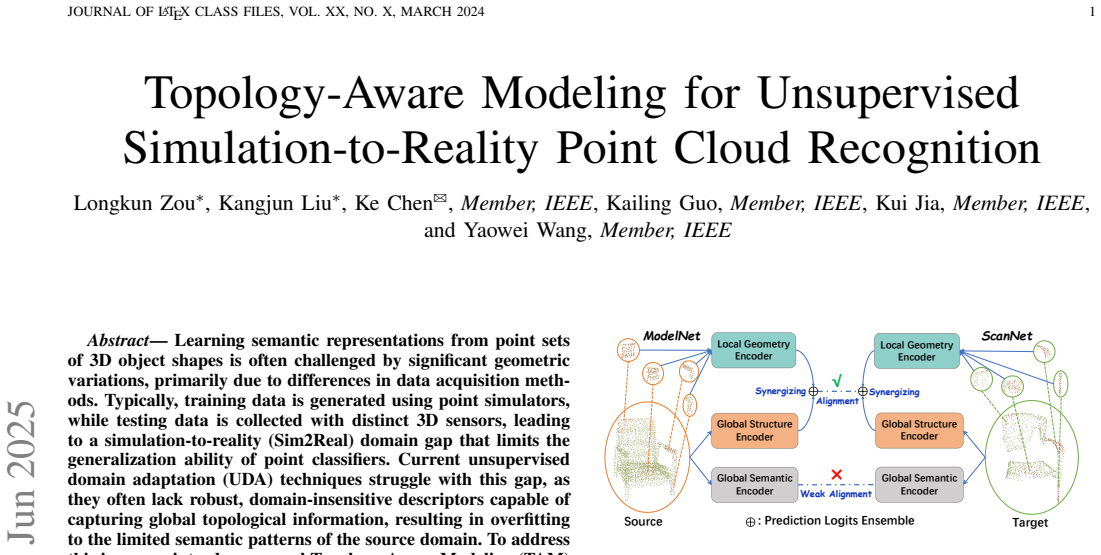
The framework's load-bearing pieces are four. Fourier Positional Encoding is a trigonometric map of point coordinates that exposes low-level high-frequency spatial structure and is used by the global branch. Cross-Domain Mixup (CDMix) forms convex combinations of a source and a target point cloud and penalizes the difference between the prediction on the mix and the blended virtual labels, regularizing the global representation. The local implicit field is a self-supervised decoder that takes a query point and the features of its k nearest points and predicts the projection direction and distance to a triangle approximation of the object surface. The Part-based Cloud Graph (PCG) treats the local implicit features as nodes, connects each node to its K nearest neighbors, applies graph convolution, and max-pools the result into a global descriptor that is aligned with the global feature by a cosine-similarity loss. Self-training with cross-domain contrastive learning then refines the representation with pseudo-labels while reducing the influence of noisy labels.
What would settle it
On a dataset that provides ground-truth object meshes, replace the triangle-approximated distances in Eq. 12 with exact mesh distances; if the accuracy of TAM changes materially, or if a variant trained under heavy occlusion and thin structures loses its advantage over source-only training, the surface-proxy assumption is shown to be load-bearing.
Extended reading notes
Core claim
The paper's central claim is that the simulation-to-reality gap in point cloud classification is best reduced by exposing and modeling topology, not by aligning global semantics alone. It argues that high-frequency 3D spatial structure, obtained through Fourier positional encoding of raw coordinates, is domain-insensitive and complements the local geometric information that deep networks tend to overfit. To capture local geometry in a domain-agnostic way, the paper learns implicit fields that encode, for each query point, the direction and distance of its projection onto an approximate surface formed by the nearest input points; these per-part features are then organized into a Part-based Cloud Graph whose node relations, pooled into a global descriptor, regularize the global feature. Finally, a self-training loop with category-level cross-domain contrastive learning assigns pseudo-labels to confident target samples while softening the alignment to reduce sensitivity to label noise. On PointDA-10 the method reaches 62.1% and 59.3% on the two Sim2Real tasks, on Sim-to-Real 76.19% and 63.85%, and on GraspNetPC-10 an average of 90.9% over the four adaptation scenarios.
Load-bearing premise
The framework assumes that the distance from a query point to the nearest triangle formed by its M nearest input points is a faithful, reliable approximation to the distance to the true object surface, and that the resulting projection direction is reliable supervision.
Editorial extensions
If this is right
- On PointDA-10, TAM with self-training reaches 62.1% and 59.3% on the ModelNet-10 to ScanNet-10 and ShapeNet-10 to ScanNet-10 tasks, exceeding the numbers reported for prior methods.
- On Sim-to-Real, TAM reaches 76.19% on ModelNet-11 to ScanObjectNN-11 and 63.85% on ShapeNet-9 to ScanObjectNN-9.
- On GraspNetPC-10, TAM averages 90.9% across the four sensor-transfer scenarios, with 97.8% on synthetic-to-Kinect and 82.6% on Kinect-to-Realsense.
- Ablations show that CDMix and local implicit fields are complementary: each alone gives modest gains, together they provide most of the improvement, and the contrastive self-training adds the remainder.
- Replacing the Fourier-encoded Point-PN global backbone with DGCNN, PointNet, or Point-NN lowers Sim2Real accuracy, indicating that high-frequency positional encoding is the main carrier of the global topology signal.
Reading between the lines
- Because the local implicit supervision only needs an approximate surface proxy, the same triangle-based distance could be used to adapt other point cloud tasks, such as part segmentation or single-view completion, wherever local geometry is shared across domains.
- The paper's evidence that high-frequency global structure transfers across domains suggests that Fourier positional encoding could be inserted into existing UDA methods as a plug-in module, potentially improving them without changing their alignment objectives.
- A direct test of the framework's core premise would be to vary the number of query points and neighbors in the PCG module while holding everything else fixed; if the accuracy gain tracks the quality of the surface proxy rather than the graph depth, the implicit-field supervision is the active ingredient.
- The reported noise-robustness table suggests TAM may also serve as a label-free calibration step for classifiers deployed on new depth sensors, before any target labels become available.
Editorial analysis
A structured set of objections, weighed in public.
Referee Report
Summary. The paper proposes Topology-Aware Modeling (TAM), an unsupervised domain adaptation method for Sim2Real point cloud classification. The framework combines Fourier positional encoding to capture global high-frequency spatial structure, a cross-domain mixup regularizer (CDMix), a self-supervised branch that learns local geometric implicit fields with Part-based Cloud Graph (PCG) aggregation, and self-training with cross-domain contrastive learning (CLST). Experiments on PointDA-10, Sim-to-Real, and GraspNetPC-10 report consistent improvements over prior methods, supported by ablations, error bars over three seeds, A-distance analysis, noise-robustness tests, and computational cost comparisons.
Significance. If the reported results hold, the paper makes a strong empirical contribution: it achieves state-of-the-art accuracy on three public Sim2Real benchmarks, and the ablation study in Table IV gives evidence that CDMix, the local implicit SSL branch, and CLST each contribute to the final accuracy. The A-distance analysis in Fig. 6 and the cost comparison in Table VIII are useful additions. However, the manuscript as written contains mathematical errors in the loss definitions and an underspecified hyperparameter selection protocol for the self-training threshold. These issues prevent me from endorsing the reported numbers as stated and require correction before the central claim can be accepted.
major comments (4)
- [III-B1, Eq. (14)] The self-supervised local implicit loss is written as L_imp = -1/N * sum_c ||ConCat(ê_n, ê_d) - ConCat(n, d)||_2. Minimizing a negative L2 term drives the predicted projection direction and distance away from the supervision targets; a regression loss of this form should have a positive sign. Because this loss supervises the entire local-implicit branch, and the ablation in Table IV attributes part of the gain to that branch, the derivation as printed does not support the method. Please correct the sign and confirm that the reported results use the positive L2 loss.
- [III-C, Eq. (26)] The category-based cross-domain contrastive loss is ill-posed as written: the denominator is sum_{i=1}^{n_t} φ(z_i^t, z^{s+}) + φ(z_i^t, z^{s-}), where the second term uses an undefined index i outside the summation and there is no summation over negatives. A valid per-sample contrastive loss would be -log[φ(z_i^t, z^{s+}) / (φ(z_i^t, z^{s+}) + sum_{z^-} φ(z_i^t, z^-))] with multiple negatives. Since CLST is one of the three components ablated in Table IV, please reformulate Eq. (26) precisely and specify how the positive and negative source features are defined for each target anchor.
- [IV-B and Fig. 7] Algorithm 1 initializes the self-training threshold to θ0 = 0.8 and the text says this is the default, yet Fig. 7 shows that M10→S*10 and M11→SO*11 perform best near θ0 = 0.8 while S10→S*10 and S9→SO*9 perform best near θ0 = 0.7. The paper does not describe a validation procedure for selecting these per-task thresholds. If the values were chosen using the target test accuracy reported in Tables I–III, the comparison is not made under a standard UDA protocol. Please either fix a single threshold, describe a validation-based selection, or report the sensitivity analysis without claiming the best per-task value.
- [III-B1, Eq. (12)] The local implicit branch assumes that the distance from a query point to the nearest triangle formed by its M nearest input points is a faithful approximation of the distance to the true object surface. On the target domains, which are described in Sec. IV-A as partial, noisy, and incomplete, the M nearest points can span holes or connect outlier points, so the resulting projection directions and distances may not correspond to the physical surface. The noise-robustness experiment in Table VII evaluates accuracy after adding test-time noise and does not assess the fidelity of this triangle proxy during training. Given that the SSL branch contributes the accuracy gains shown in the Table IV ablations, please provide evidence, either analytical or experimental, that the proxy remains reliable on noisy and partial target clouds.
minor comments (7)
- [IV-C heading] The section heading “Comparsion to the State-of-the-art” contains a typo and should read “Comparison.”
- [I, Contributions] One contribution bullet states that experiments were conducted on “two public benchmarks”, but the paper evaluates on PointDA-10, Sim-to-Real, and GraspNetPC-10; please make the count consistent.
- [III-C, Eqs. (23)-(24)] The prediction p^s_{i,c} is defined as the product p^{1s}_{i,c} p^{2s}_{i,c} of two probability vectors. The elementwise product of two probability distributions is not itself a normalized probability distribution; please clarify whether an ensemble average or another combination rule is intended.
- [III-B1] The query point sampling hyperparameters are not reported: the voxel resolution l, the distance range [D_l, D_u], the number of nearest points M, and the number of query points N are all left unspecified. Without these values the self-supervised branch is not reproducible from the paper alone.
- [III-A2, Eq. (10) and Algorithm 1] In Algorithm 1, line 5 writes “min_{Φ_REG} L_mix with (P^s_i, y^s_i) and P^t_i”, but CDMix in Eq. (10) uses only the point clouds and virtual labels; please clarify whether the source label y^s_i is actually used and how the virtual labels are formed in the algorithm listing.
- [III-B2, Eq. (22)] The notation around Φ_reg is confusing: Eq. (22) writes Φ_REG = Φ_cls(z_reg) ∘ Φ_reg(z_g), but the text then says Φ_reg denotes the global feature encoder Φ_g regularized by CDMix and PCG. Please define Φ_reg and z_reg consistently with its use in the equation.
- [Abstract] The source code URL in the abstract ends with “TAG.git”, which does not match the name TAM; please update the link if the repository name is different.
Circularity Check
Per-benchmark threshold selection on the target test sets makes some reported accuracies partly fitted; the core method derivation is otherwise self-contained.
-
fitted input called prediction
[Section IV-D, 'Influence of confidence threshold θ in self-training' (Fig. 7)]
"Therefore, to obtain a suitable threshold, we conducted multiple experiments with different thresholds on four Sim2Real settings. As shown in Fig. 7, we found that when the threshold θ is close to 0.8, M10→S*10 and M11→SO*11 achieve the best performance, and when the threshold θ is close to 0.7, S10→S*10 and S9→SO*9 achieve the best performance."
The reported PointDA-10 and Sim-to-Real accuracies are produced after choosing the self-training confidence threshold θ separately for each task, with the choice based on the best accuracy on the same target test benchmarks whose accuracies are later reported. For each task, the table entry is therefore a selected maximum over the evaluated thresholds rather than an independent evaluation at a fixed, pre-specified setting. Algorithm 1 initializes θ0=0.8, but the per-task 0.7 exception is introduced from test-set accuracy, so the fitted threshold is part of the evaluation loop and the reported 'consistent improvements' are partly fitted numbers.
full rationale
Apart from the threshold selection, the derivation chain is not circular. The self-supervised local-implicit branch (Eqs. 12-14) uses a triangle-proxy distance to the approximate surface computed from each input cloud; this proxy is a heuristic approximation that may be biased by noise or occlusion, but it is not equivalent to the classification output and does not use target labels. CDMix (Eq. 10) and SPST (Eqs. 24-25) use the model's own current predictions as virtual or pseudo labels; this is self-referential but standard consistency/self-training, and the final accuracy is not equal to those labels by construction. Fourier positional encoding, the PCG module, and the contrastive loss are grounded in cited prior work without a load-bearing self-citation chain. The one concrete fitted-input concern is the per-benchmark threshold tuning in Fig. 7, which inflates the specific reported numbers but does not by itself invalidate the qualitative comparison or the independent content of the proposed components.
Assumptions & free parameters
free parameters (6)
- Fourier positional encoding scale alpha =
100
- Fourier positional encoding frequency beta =
500
- CDMix beta distribution parameter kappa =
2
- Self-training confidence threshold theta_0 =
0.8 or 0.7 depending on task
- Self-paced threshold increment epsilon =
0.005
- Loss weights lambda_t, lambda_cdc, lambda_imp, lambda_mix, lambda_sim =
1, 1, 1, 1, 0.1
assumptions (4)
- domain assumption Fourier positional encoding captures global spatial topology that is invariant across source and target domains
- domain assumption Local geometric structures and their implicit fields are largely shared across domains
- ad hoc to paper A query point's distance to nearby triangles approximates distance to the underlying surface
- domain assumption Mixing source and target clouds with virtual labels regularizes the latent space
Cite this review
Pith. "Pith review of Topology-Aware Modeling for Unsupervised Simulation-to-Reality Point Cloud Recognition." pith.science (2026). https://pith.science/paper/CO2Y5HVB
@misc{pith2026250621165,
  author       = {Pith},
  title        = {Pith review of: Topology-Aware Modeling for Unsupervised Simulation-to-Reality Point Cloud Recognition},
  year         = {2026},
  howpublished = {\url{https://pith.science/paper/CO2Y5HVB}},
  note         = {Machine review of arXiv:2506.21165}
}
read the original abstract
Learning semantic representations from point sets of 3D object shapes is often challenged by significant geometric variations, primarily due to differences in data acquisition methods. Typically, training data is generated using point simulators, while testing data is collected with distinct 3D sensors, leading to a simulation-to-reality (Sim2Real) domain gap that limits the generalization ability of point classifiers. Current unsupervised domain adaptation (UDA) techniques struggle with this gap, as they often lack robust, domain-insensitive descriptors capable of capturing global topological information, resulting in overfitting to the limited semantic patterns of the source domain. To address this issue, we introduce a novel Topology-Aware Modeling (TAM) framework for Sim2Real UDA on object point clouds. Our approach mitigates the domain gap by leveraging global spatial topology, characterized by low-level, high-frequency 3D structures, and by modeling the topological relations of local geometric features through a novel self-supervised learning task. Additionally, we propose an advanced self-training strategy that combines cross-domain contrastive learning with self-training, effectively reducing the impact of noisy pseudo-labels and enhancing the robustness of the adaptation process. Experimental results on three public Sim2Real benchmarks validate the effectiveness of our TAM framework, showing consistent improvements over state-of-the-art methods across all evaluated tasks. The source code of this work will be available at https://github.com/zou-longkun/TAG.git.
Figures


Figures from the paper (5 more)


Reference graph
Works this paper leans on
-
[1]
Pointgl: a simple global-local framework for efficient point cloud analysis,
J. Li, J. Wang, and T. Xu, “Pointgl: a simple global-local framework for efficient point cloud analysis,”IEEE Transactions on Multimedia, 2024
work page 2024
-
[2]
Domain adaptive lidar point cloud segmentation with 3d spatial consistency,
A. Xiao, D. Guan, X. Zhang, and S. Lu, “Domain adaptive lidar point cloud segmentation with 3d spatial consistency,”IEEE Transactions on Multimedia, 2023
work page 2023
-
[3]
Cmnet: Component-aware matching network for few-shot point cloud classification,
L. Lai, J. Chen, G. Lin, and Q. Wu, “Cmnet: Component-aware matching network for few-shot point cloud classification,”IEEE Transactions on Multimedia, 2024
work page 2024
-
[4]
Geometric back-projection net- work for point cloud classification,
S. Qiu, S. Anwar, and N. Barnes, “Geometric back-projection net- work for point cloud classification,”IEEE Transactions on Multimedia, vol. 24, pp. 1943–1955, 2021
work page 1943
-
[5]
S. Yu, D. Zhai, Y . Xia, D. Li, and S. Zhao, “Cattrack: Single-stage category-level 6d object pose tracking via convolution and vision trans- former,”IEEE Transactions on Multimedia, vol. 26, pp. 1665–1680, 2023
work page 2023
-
[6]
Real-time 3d single object tracking with transformer,
J. Shan, S. Zhou, Y . Cui, and Z. Fang, “Real-time 3d single object tracking with transformer,”IEEE Transactions on Multimedia, vol. 25, pp. 2339–2353, 2022
work page 2022
-
[7]
Vpfnet: Improving 3d object detection with virtual point based lidar and stereo data fusion,
H. Zhu, J. Deng, Y . Zhang, J. Ji, Q. Mao, H. Li, and Y . Zhang, “Vpfnet: Improving 3d object detection with virtual point based lidar and stereo data fusion,”IEEE Transactions on Multimedia, vol. 25, pp. 5291–5304, 2022
work page 2022
-
[8]
Centertube: Tracking multiple 3d objects with 4d tubelets in dynamic point clouds,
H. Liu, Y . Ma, Q. Hu, and Y . Guo, “Centertube: Tracking multiple 3d objects with 4d tubelets in dynamic point clouds,”IEEE Transactions on Multimedia, vol. 25, pp. 8793–8804, 2023
work page 2023
Show all 73 references
-
[9]
Shapenet: An information- rich 3d model repository,
A. X. Chang, T. Funkhouser, L. Guibas, P. Hanrahan, Q. Huang, Z. Li, S. Savarese, M. Savva, S. Song, H. Suet al., “Shapenet: An information- rich 3d model repository,”ArXiv, vol. 1512.03012, 2015
2015 arXiv
-
[10]
Modelnet: Towards a datacenter emulation environment,
K. V . Vishwanath, D. Gupta, A. Vahdat, and K. Yocum, “Modelnet: Towards a datacenter emulation environment,” in2009 IEEE Ninth International Conference on Peer-to-Peer Computing, 2009, pp. 81–82
2009
-
[11]
Pointnet: Deep learning on point sets for 3d classification and segmentation,
C. R. Qi, H. Su, K. Mo, and L. J. Guibas, “Pointnet: Deep learning on point sets for 3d classification and segmentation,” inIEEE Conf. Comput. Vis. Pattern Recog., 2017, pp. 652–660
2017
-
[12]
Pointnet++: Deep hierarchical feature learning on point sets in a metric space,
C. R. Qi, L. Yi, H. Su, and L. J. Guibas, “Pointnet++: Deep hierarchical feature learning on point sets in a metric space,” inAdv. Neural Inform. Process. Syst., 2017, pp. 5099–5108
2017
-
[13]
Dynamic graph cnn for learning on point clouds,
Y . Wang, Y . Sun, Z. Liu, S. E. Sarma, M. M. Bronstein, and J. M. Solomon, “Dynamic graph cnn for learning on point clouds,”Acm Transactions On Graphics (tog), vol. 38, no. 5, pp. 1–12, 2019
2019
-
[14]
Kpconv: Flexible and deformable convolution for point clouds,
H. Thomas, C. R. Qi, J. Deschaud, B. Marcotegui, F. Goulette, and L. J. Guibas, “Kpconv: Flexible and deformable convolution for point clouds,” inInt. Conf. Comput. Vis., 2019, pp. 6411–6420
2019
-
[15]
Pointasnl: Robust point clouds processing using nonlocal neural networks with adaptive sampling,
X. Yan, C. Zheng, Z. Li, S. Wang, and S. Cui, “Pointasnl: Robust point clouds processing using nonlocal neural networks with adaptive sampling,”IEEE Conf. Comput. Vis. Pattern Recog., 2020
2020
-
[16]
Pct: Point cloud transformer,
M. Guo, J. Cai, Z. Liu, T. Mu, R. R. Martin, and S. Hu, “Pct: Point cloud transformer,”Computational Visual Media, vol. 7, no. 2, pp. 187–199, 2021
2021
-
[17]
V oxelnet: End-to-end learning for point cloud based 3d object detection,
Y . Zhou and O. Tuzel, “V oxelnet: End-to-end learning for point cloud based 3d object detection,” inIEEE Conf. Comput. Vis. Pattern Recog., 2018, pp. 4490–4499
2018
-
[18]
Modeling point clouds with self-attention and gumbel subset sampling,
J. Yang, Q. Zhang, B. Ni, L. Li, J. Liu, M. Zhou, and Q. Tian, “Modeling point clouds with self-attention and gumbel subset sampling,”IEEE Conf. Comput. Vis. Pattern Recog., 2019
2019
-
[19]
So-net: Self-organizing network for point cloud analysis,
J. Li, B. M. Chen, and G. H. Lee, “So-net: Self-organizing network for point cloud analysis,” inIEEE Conf. Comput. Vis. Pattern Recog., 2018
2018
-
[20]
Spherical cnns,
T. Cohen, M. Geiger, J. K ¨ohler, and M. Welling, “Spherical cnns,”ArXiv, vol. 1801.10130, 2018
2018 arXiv
-
[21]
Scannet: Richly-annotated 3d reconstructions of indoor scenes,
A. Dai, A. X. Chang, M. Savva, M. Halber, T. Funkhouser, and M. Nießner, “Scannet: Richly-annotated 3d reconstructions of indoor scenes,” inIEEE Conf. Comput. Vis. Pattern Recog., 2017, pp. 5828– 5839
2017
-
[22]
Revisiting point cloud classification: A new benchmark dataset and classification model on real-world data,
M. A. Uy, Q. Pham, B. Hua, T. Nguyen, and S. Yeung, “Revisiting point cloud classification: A new benchmark dataset and classification model on real-world data,” inIEEE Conf. Comput. Vis. Pattern Recog., 2019, pp. 1588–1597
2019
-
[23]
Classification of object point clouds: A practical perspective,
Z. Xu, K. Chen, C. Ding, Y . Wang, and K. Jia, “Classification of object point clouds: A practical perspective,”arXiv preprint arXiv:2012.10042, 2020
2012 arXiv
-
[24]
Transferable representation learning with deep adaptation networks,
M. Long, Y . Cao, Z. Cao, J. Wang, and M. I. Jordan, “Transferable representation learning with deep adaptation networks,”IEEE Trans. Pattern Anal. Mach. Intell., vol. 41, pp. 3071–3085, 2019
2019
-
[25]
Contrastive adaptation network for unsupervised domain adaptation,
G. Kang, L. Jiang, Y . Yang, and A. G. Hauptmann, “Contrastive adaptation network for unsupervised domain adaptation,” inIEEE Conf. Comput. Vis. Pattern Recog., 2019, pp. 4888–4897
2019
-
[26]
Domain-adversarial training of neural networks,
Y . Ganin, E. Ustinova, H. Ajakan, P. Germain, H. Larochelle, F. Lavio- lette, M. Marchand, and V . Lempitsky, “Domain-adversarial training of neural networks,”J. Mach. Learn. Res., vol. 17, pp. 2096–2030, 2016
2016
-
[27]
Maximum classi- fier discrepancy for unsupervised domain adaptation,
K. Saito, K. Watanabe, Y . Ushiku, and T. Harada, “Maximum classi- fier discrepancy for unsupervised domain adaptation,” inIEEE Conf. Comput. Vis. Pattern Recog., 2018, pp. 3723–3732. JOURNAL OF LATEX CLASS FILES, VOL. XX, NO. X, MARCH 2024 14
2018
-
[28]
Learning semantic represen- tations for unsupervised domain adaptation,
S. Xie, Z. Zheng, L. Chen, and C. Chen, “Learning semantic represen- tations for unsupervised domain adaptation,” inInt. Conf. Mach. Learn., 2018, pp. 5423–5432
2018
-
[29]
Transferrable prototypical networks for unsupervised domain adaptation,
Y . Pan, T. Yao, Y . Li, Y . Wang, C. Ngo, and T. Mei, “Transferrable prototypical networks for unsupervised domain adaptation,” inIEEE Conf. Comput. Vis. Pattern Recog., 2019, pp. 2234–2242
2019
-
[30]
Pointdan: A multi- scale 3d domain adaption network for point cloud representation,
C. Qin, H. You, L. Wang, C.-C. J. Kuo, and Y . Fu, “Pointdan: A multi- scale 3d domain adaption network for point cloud representation,” in Adv. Neural Inform. Process. Syst., 2019, pp. 7192–7203
2019
-
[31]
Self-supervised learning for domain adaptation on point clouds,
I. Achituve, H. Maron, and G. Chechik, “Self-supervised learning for domain adaptation on point clouds,” inProceedings of the IEEE/CVF winter conference on applications of computer vision, 2021, pp. 123– 133
2021
-
[32]
Geometry-aware self-training for unsupervised domain adaptation on object point clouds,
L. Zou, H. Tang, K. Chen, and K. Jia, “Geometry-aware self-training for unsupervised domain adaptation on object point clouds,” inInt. Conf. Comput. Vis., 2021, pp. 6403–6412
2021
-
[33]
Domain adaptation on point clouds via geometry-aware implicits,
Y . Shen, Y . Yang, M. Yan, H. Wang, Y . Zheng, and L. J. Guibas, “Domain adaptation on point clouds via geometry-aware implicits,” in IEEE Conf. Comput. Vis. Pattern Recog., 2022, pp. 7223–7232
2022
-
[34]
Self-supervised global-local structure modeling for point cloud domain adaptation with reliable voted pseudo labels,
H. Fan, X. Chang, W. Zhang, Y . Cheng, Y . Sun, and M. Kankanhalli, “Self-supervised global-local structure modeling for point cloud domain adaptation with reliable voted pseudo labels,” inIEEE Conf. Comput. Vis. Pattern Recog., 2022, pp. 6377–6386
2022
-
[35]
Quasi-balanced self- training on noise-aware synthesis of object point clouds for closing domain gap,
Y . Chen, Z. Wang, L. Zou, K. Chen, and K. Jia, “Quasi-balanced self- training on noise-aware synthesis of object point clouds for closing domain gap,” inEur. Conf. Comput. Vis., 2022, pp. 728–745
2022
-
[36]
Learning generalizable part-based feature representation for 3d point clouds,
X. Wei, X. Gu, and J. Sun, “Learning generalizable part-based feature representation for 3d point clouds,” inAdvances in Neural Information Processing Systems, 2022
2022
-
[37]
Deep convolutional networks do not classify based on global object shape,
N. Baker, H. Lu, G. Erlikhman, and P. J. Kellman, “Deep convolutional networks do not classify based on global object shape,”PLoS computa- tional biology, vol. 14, no. 12, p. e1006613, 2018
2018
-
[38]
Imagenet-trained cnns are biased towards texture; increasing shape bias improves accuracy and robustness,
R. Geirhos, P. Rubisch, C. Michaelis, M. Bethge, F. A. Wichmann, and W. Brendel, “Imagenet-trained cnns are biased towards texture; increasing shape bias improves accuracy and robustness,”arXiv preprint arXiv:1811.12231, 2018
2018 arXiv
-
[39]
Connecting the dots with landmarks: Discriminatively learning domain-invariant features for unsupervised domain adaptation,
B. Gong, K. Grauman, and F. Sha, “Connecting the dots with landmarks: Discriminatively learning domain-invariant features for unsupervised domain adaptation,” inInt. Conf. Mach. Learn., 2013, pp. 222–230
2013
-
[40]
Parts of recognition,
D. D. Hoffman and W. A. Richards, “Parts of recognition,”Cognition, vol. 18, no. 1-3, pp. 65–96, 1984
1984
-
[41]
Parameter is not all you need: Starting from non-parametric networks for 3d point cloud analysis,
R. Zhang, L. Wang, Y . Wang, P. Gao, H. Li, and J. Shi, “Parameter is not all you need: Starting from non-parametric networks for 3d point cloud analysis,”arXiv preprint arXiv:2303.08134, 2023
2023 arXiv
-
[42]
Reconstructing continuous distributions of 3d protein structure from cryo-em images,
E. D. Zhong, T. Bepler, J. H. Davis, and B. Berger, “Reconstructing continuous distributions of 3d protein structure from cryo-em images,” arXiv preprint arXiv:1909.05215, 2019
1909 arXiv
-
[43]
Nerf: Representing scenes as neural radiance fields for view synthesis,
B. Mildenhall, P. P. Srinivasan, M. Tancik, J. T. Barron, R. Ramamoorthi, and R. Ng, “Nerf: Representing scenes as neural radiance fields for view synthesis,”Communications of the ACM, vol. 65, no. 1, pp. 99–106, 2021
2021
-
[44]
Fourier features let networks learn high frequency functions in low dimensional domains,
M. Tancik, P. Srinivasan, B. Mildenhall, S. Fridovich-Keil, N. Raghavan, U. Singhal, R. Ramamoorthi, J. Barron, and R. Ng, “Fourier features let networks learn high frequency functions in low dimensional domains,” Advances in Neural Information Processing Systems, vol. 33, pp....
2020
-
[45]
Metasets: Meta- learning on point sets for generalizable representations,
C. Huang, Z. Cao, Y . Wang, J. Wang, and M. Long, “Metasets: Meta- learning on point sets for generalizable representations,” inIEEE Conf. Comput. Vis. Pattern Recog., 2021, pp. 8863–8872
2021
-
[46]
Improving semantic analysis on point clouds via auxiliary supervision of local geometric priors,
L. Tang, K. Chen, C. Wu, Y . Hong, K. Jia, and Z. Yang, “Improving semantic analysis on point clouds via auxiliary supervision of local geometric priors,”ArXiv, vol. 2001.04803, 2020
2001 arXiv
-
[47]
Pointcnn: Convolution on x-transformed points,
Y . Li, R. Bu, M. Sun, W. Wu, X. Di, and B. Chen, “Pointcnn: Convolution on x-transformed points,” inAdv. Neural Inform. Process. Syst., 2018, pp. 820–830
2018
-
[48]
Clusternet: Deep hierarchical cluster network with rigorously rotation-invariant representation for point cloud analysis,
C. Chen, G. Li, R. Xu, T. Chen, M. Wang, and L. Lin, “Clusternet: Deep hierarchical cluster network with rigorously rotation-invariant representation for point cloud analysis,” inIEEE Conf. Comput. Vis. Pattern Recog., 2019
2019
-
[49]
mixup: Beyond empirical risk minimization,
H. Zhang, M. Cisse, Y . N. Dauphin, and D. Lopez-Paz, “mixup: Beyond empirical risk minimization,”ArXiv, vol. 1710.09412, 2017
2017 arXiv
-
[50]
Manifold mixup: Better representations by interpolating hidden states,
V . Verma, A. Lamb, C. Beckham, A. Najafi, I. Mitliagkas, D. Lopez-Paz, and Y . Bengio, “Manifold mixup: Better representations by interpolating hidden states,” inInt. Conf. Mach. Learn.PMLR, 2019, pp. 6438–6447
2019
-
[51]
Cutmix: Reg- ularization strategy to train strong classifiers with localizable features,
S. Yun, D. Han, S. J. Oh, S. Chun, J. Choe, and Y . Yoo, “Cutmix: Reg- ularization strategy to train strong classifiers with localizable features,” inInt. Conf. Comput. Vis., 2019, pp. 6023–6032
2019
-
[52]
Puzzle mix: Exploiting saliency and local statistics for optimal mixup,
J. Kim, W. Choo, and H. O. Song, “Puzzle mix: Exploiting saliency and local statistics for optimal mixup,” inInt. Conf. Mach. Learn.PMLR, 2020, pp. 5275–5285
2020
-
[53]
Pointmixup: Augmentation for point clouds,
Y . Chen, V . T. Hu, E. Gavves, T. Mensink, P. Mettes, P. Yang, and C. G. Snoek, “Pointmixup: Augmentation for point clouds,” inEur. Conf. Comput. Vis.Springer, 2020, pp. 330–345
2020
-
[54]
Pointaugment: an auto-augmentation framework for point cloud classification,
R. Li, X. Li, P. Heng, and C. Fu, “Pointaugment: an auto-augmentation framework for point cloud classification,” inIEEE Conf. Comput. Vis. Pattern Recog., 2020, pp. 6378–6387
2020
-
[55]
Pointcutmix: Regularization strategy for point cloud classification,
J. Zhang, L. Chen, B. Ouyang, B. Liu, J. Zhu, Y . Chen, Y . Meng, and D. Wu, “Pointcutmix: Regularization strategy for point cloud classification,”Neurocomputing, vol. 505, pp. 58–67, 2022
2022
-
[56]
Interpolation consistency training for semi-supervised learning,
V . Verma, K. Kawaguchi, A. Lamb, J. Kannala, Y . Bengio, and D. Lopez-Paz, “Interpolation consistency training for semi-supervised learning,”Neural Networks, vol. 145, pp. 90–106, 2022
2022
-
[57]
Vision gnn: An image is worth graph of nodes,
K. Han, Y . Wang, J. Guo, Y . Tang, and E. Wu, “Vision gnn: An image is worth graph of nodes,”ArXiv, vol. 2206.00272, 2022
2022 arXiv
-
[58]
Deepgcns: Can gcns go as deep as cnns?
G. Li, M. Muller, A. Thabet, and B. Ghanem, “Deepgcns: Can gcns go as deep as cnns?” inInt. Conf. Comput. Vis., 2019, pp. 9267–9276
2019
-
[59]
Learning cross-modal contrastive features for video domain adaptation,
D. Kim, Y . Tsai, B. Zhuang, X. Yu, S. Sclaroff, K. Saenko, and M. Chandraker, “Learning cross-modal contrastive features for video domain adaptation,” inProceedings of the IEEE/CVF International Conference on Computer Vision, 2021, pp. 13 618–13 627
2021
-
[60]
Learning a nonlinear embedding by preserving class neighbourhood structure,
R. Salakhutdinov and G. Hinton, “Learning a nonlinear embedding by preserving class neighbourhood structure,” inArtificial intelligence and statistics. PMLR, 2007, pp. 412–419
2007
-
[61]
Improving generalization via scalable neighborhood component analysis,
Z. Wu, A. A. Efros, and S. X. Yu, “Improving generalization via scalable neighborhood component analysis,” inProceedings of the european conference on computer vision (ECCV), 2018, pp. 685–701
2018
-
[62]
Supervised contrastive learn- ing,
P. Khosla, P. Teterwak, C. Wang, A. Sarna, Y . Tian, P. Isola, A. Maschinot, C. Liu, and D. Krishnan, “Supervised contrastive learn- ing,”Advances in neural information processing systems, vol. 33, pp. 18 661–18 673, 2020
2020
-
[63]
Graspnet-1billion: A large- scale benchmark for general object grasping,
H. Fang, C. Wang, M. Gou, and C. Lu, “Graspnet-1billion: A large- scale benchmark for general object grasping,” inProceedings of the IEEE/CVF conference on computer vision and pattern recognition, 2020, pp. 11 444–11 453
2020
-
[64]
Adam: A method for stochastic optimization,
D. P. Kingma and J. Ba, “Adam: A method for stochastic optimization,” ArXiv, vol. 1412.6980, 2014
2014 arXiv
-
[65]
Batch normalization: Accelerating deep network training by reducing internal covariate shift,
S. Ioffe and C. Szegedy, “Batch normalization: Accelerating deep network training by reducing internal covariate shift,” inInternational conference on machine learning. pmlr, 2015, pp. 448–456
2015
-
[66]
Self-supervised deep learning on point clouds by reconstructing space,
J. Sauder and B. Sievers, “Self-supervised deep learning on point clouds by reconstructing space,” inAdv. Neural Inform. Process. Syst., 2019, pp. 12 962–12 972
2019
-
[67]
Self-distillation for unsupervised 3d domain adaptation,
A. Cardace, R. Spezialetti, P. Z. Ramirez, S. Salti, and L. Di Stefano, “Self-distillation for unsupervised 3d domain adaptation,” inProceed- ings of the IEEE/CVF Winter Conference on Applications of Computer Vision, 2023, pp. 4166–4177
2023
-
[68]
Domain adaptive sampling for cross- domain point cloud recognition,
Z. Wang, W. Li, and D. Xu, “Domain adaptive sampling for cross- domain point cloud recognition,”IEEE Transactions on Circuits and Systems for Video Technology, vol. 33, no. 12, pp. 7604–7615, 2023
2023
-
[69]
Synergizing contrastive learning and optimal transport for 3d point cloud domain adaptation,
S. Katageri, A. De, C. Devaguptapu, V . Prasad, C. Sharma, and M. Kaul, “Synergizing contrastive learning and optimal transport for 3d point cloud domain adaptation,” inProceedings of the IEEE/CVF Winter Conference on Applications of Computer Vision, 2024, pp. 2942–2951
2024
-
[70]
A theory of learning from different domains,
S. Ben-David, J. Blitzer, K. Crammer, A. Kulesza, F. Pereira, and J. W. Vaughan, “A theory of learning from different domains,”Mach. Learn., vol. 79, pp. 151–175, 2010
2010
-
[71]
Domain adaptation: Learning bounds and algorithms,
Y . Mansour, M. Mohri, and A. Rostamizadeh, “Domain adaptation: Learning bounds and algorithms,”ArXiv, vol. 0902.3430, 2009
2009 arXiv
-
[72]
Pointcloud saliency maps,
T. Zheng, C. Chen, J. Yuan, B. Li, and K. Ren, “Pointcloud saliency maps,” inInt. Conf. Comput. Vis., 2019, pp. 1598–1606
2019
-
[73]
Visualizing data using t-sne,
L. v. d. Maaten and G. Hinton, “Visualizing data using t-sne,”J. Mach. Learn. Res., vol. 9, pp. 2579–2605, 2008
2008
Reviewed August 6, 2026 · model on record in the stance chip above.
Discussion (0). Continue with ORCID to comment.