REVIEW 4 major objections 4 minor 89 references
AlphaFold Database Debiasing for Robust Inverse Folding
T0 review · 4 major / 4 minor · reviewed 2026-08-07 · deepseek-v4-flash
Pith's one-line read The paper claims that AlphaFold-predicted structures carry a subtle geometric bias that degrades inverse folding, and that a denoising autoencoder trained on experimental backbones removes much of that bias.
desk verdict Solid controlled demonstration that AFDB training degrades inverse folding, but the debiasing claim is only tested on the same paired set—no evidence it works on novel AFDB entries. read the letter →
The pith
A machine-rendered reading of the paper's core claim, the machinery that carries it, and where it could break.
The reading
What carries the argument
The central mechanism is the Debiasing Structure AutoEncoder (DeSAE), an SE(3)-equivariant autoencoder trained on the PDB side of a paired dataset of 19,392 AFDB-PDB structures. During training, a random subset of residues is corrupted by replacing one backbone atom with the centroid of the other three backbone atoms; the model must reconstruct the true PDB coordinates, forcing it to learn local geometric integrity from context. The encoder uses frame aggregation layers, and the decoder uses both frame aggregation and frame updating layers to iteratively refine residue frames and coordinates. Supervision uses a multi-scale structure consistency loss inspired by Chroma, combining global, fragment, pair, neighbor, and distance terms. At inference, DeSAE is applied to AFDB backbones to produce debiased structures, implementing the paper's stated goal that a debiasing transformation should satisfy M(F(T(X_pred))) > M(F(X_pred)).
What would settle it
Train a second version of DeSAE on the same corruption task but with AFDB structures used as both input and ground truth, and apply it to the original AFDB set; if the resulting structures recover the same benchmark gains as the PDB-trained DeSAE, then the improvement is generic denoising rather than removal of a PDB-vs-AFDB bias. Alternatively, measure the KL divergence between AFDB and PDB dihedral distributions before and after debiasing: if sequence recovery improves with no reduction in these divergences, the claimed mechanism of learning the experimental manifold is not what drives the gains.
Extended reading notes
Core claim
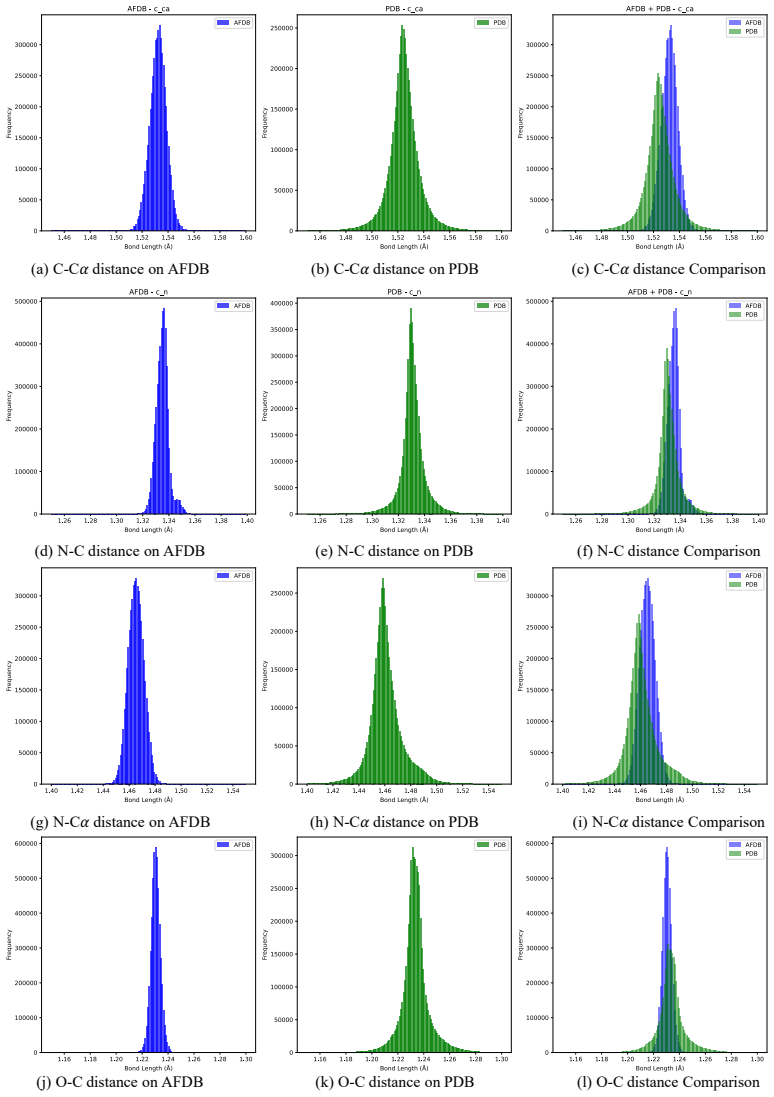
The central claim is that AFDB structures exhibit systematic statistical regularities—sharper dihedral-angle distributions, narrower bond-length variance, and more tightly clustered Ramachandran plots—that constitute a distributional shift away from experimentally determined structures. Because inverse folding models are sensitive to fine-grained atomic geometry, this shift causes substantial performance degradation even when the predicted and experimental structures differ by only about 0.2 Angstrom RMSD. The paper further claims that DeSAE, trained to recover uncorrupted PDB backbones from corrupted inputs, learns the manifold of experimentally plausible conformations, and that applying this learned transformation to AFDB structures yields 'Debiased AFDB' data on which inverse folding models generalize markedly better. The improvement holds across five inverse folding architectures and across CATH 4.2, CATH 4.3, TS50, and TS500 benchmarks, while global fold fidelity, measured by RMSD to PDB, is preserved.
Load-bearing premise
The paired PDB structures used to train DeSAE are representative of the experimental structural manifold that the test benchmarks sample; if that paired set is skewed toward particular folds or conformational states, the debiasing map may only fix those, and the benchmark gains could partly reflect test-set similarity rather than a general removal of AlphaFold bias.
Editorial extensions
If this is right
- Training inverse folding models on Debiased AFDB outperforms training on raw AFDB across all five tested architectures; the largest improvement is for PiFold, which gains 17.64 percentage points on CATH 4.3.
- The debiasing map preserves the overall fold: RMSD distributions between Debiased AFDB and PDB remain low, similar to the already-close match between raw AFDB and PDB.
- Scaling up DeSAE pretraining to the full PDB produces only marginal recovery gains but lowers perplexity, indicating better-calibrated sequence probability distributions rather than better top-1 predictions.
- Models trained on Debiased AFDB also perform well on an AFDB-version test set, outperforming PDB-trained models for most architectures, which suggests the debiased data retain enough AFDB-like character to stay relevant for predicted structures.
- The approach provides a preprocessing step that can be applied to any predicted-structure database before training geometry-sensitive models, with only 5.9M parameters in DeSAE.
Reading between the lines
- Extension beyond the paper: the same debiasing pipeline could be tested on other geometry-sensitive tasks, such as binding-site prediction or protein-protein interaction scoring, since those tasks also depend on fine-grained atomic detail; the paper only demonstrates inverse folding.
- Extension beyond the paper: because DeSAE learns the experimental manifold from a paired PDB set, the debiased output will inherit whatever biases exist in that PDB sample, such as overrepresentation of crystallizable or apo conformations; this could be tested by checking whether debiased AFDB structures show shifted conformational diversity on specific fold classes.
- Extension beyond the paper: a direct test of the mechanism would be to measure whether the reduction in KL divergence between AFDB and PDB dihedral distributions after debiasing correlates with the recovery-rate improvement across the five models; the paper reports the distributions before debiasing but not after.
- Extension beyond the paper: the corruption strategy replaces a single backbone atom with the centroid of the other three, which targets local geometry only; adding side-chain corruption or dihedral-angle perturbation might extend the debiasing to full-atom realism, which the paper lists as a limitation.
Editorial analysis
A structured set of objections, weighed in public.
Referee Report
Summary. This paper studies systematic geometric differences between AlphaFold Database (AFDB) predicted structures and experimentally determined PDB structures, and proposes DeSAE, a structure autoencoder trained on PDB with a denoising objective: random backbone atoms are replaced by the centroid of the other three atoms (Eq. 3) and the model reconstructs the native coordinates. After pretraining on the PDB side of 19,392 AFDB-PDB pairs, DeSAE is applied to the corresponding AFDB structures to produce "Debiased AFDB." The authors then train five inverse folding models (StructGNN, GraphTrans, GVP, ProteinMPNN, PiFold) on PDB, AFDB, and Debiased AFDB, and evaluate on CATH 4.2, TS50, TS500, and CATH 4.3. They report consistent recovery-rate improvements for Debiased AFDB over raw AFDB, approaching but not reaching PDB-trained performance (e.g., PiFold on CATH 4.3: 17.74% to 35.38% vs. 43.74%).
Significance. If the paired-set results are representative, the paper provides a practical and computationally cheap preprocessing step (5.9M parameters, ~20k structures in 3 minutes) that improves inverse folding training on AFDB data, and it documents a quantified distributional bias (Ramachandran narrowing, reduced bond-length variance). The experimental design is a strength: the PDB, AFDB, and Debiased AFDB training sets contain the same 19,392 proteins, so the performance gaps are not due to different protein content, and improvements are consistent across five models and several benchmarks. The main weakness is that the evaluation only covers AFDB structures whose near-identical PDB counterparts were used to train DeSAE, so the paper's central generalization claim is not yet supported.
major comments (4)
- [Appendix B.1, C; Sections 6.1–6.3] DeSAE is pretrained on the PDB half of the 19,392 pairs and then applied to the AFDB half of the same pairs; no AFDB structure outside this paired set is ever processed or evaluated. Because the paired AFDB and PDB structures are near-identical (average RMSD ~0.2 Å, Fig. 1a), the gains on Debiased AFDB could simply reflect a memorized map from those specific AFDB inputs to their PDB counterparts. To support the abstract's claim that applying DeSAE to "AFDB structures" debiases them generally, the authors should report results on a held-out AFDB set: for example, split the pairs by sequence-identity clustering so that DeSAE is trained on one cluster and applied to another, or apply DeSAE to AFDB entries with no PDB counterpart and test the downstream inverse folding models on the experimental benchmark sets.
- [Section 6.3, Table 1] The Debiased AFDB-XL experiment does not resolve the generalization problem. Its "full PDB" pretraining set necessarily includes the same 19,392 paired PDB structures, and Stage 2 still applies DeSAE only to the AFDB half of the paired set. A meaningful scaling test would pretrain DeSAE on PDB structures not represented among the AFDB inputs, and would then debias a disjoint AFDB collection.
- [Section 6.1, Contributions; Table 1] The manuscript claims "statistically significant improvements" but reports a single run per condition with no error bars, no multiple seeds, and no significance test. Given the modest absolute gains for several models (e.g., StructGNN +3.95 on CATH 4.3) and the small TS50 test set (38 proteins), the consistency across architectures is suggestive but does not by itself establish statistical significance. At a minimum, the authors should report means and standard deviations over several seeds for the headline tables.
- [Section 5, Eq. (3); Figure 6a] The mechanism by which denoising synthetic corruption transfers to AlphaFold's systematic idealization bias is not directly tested. The only structural comparison between Debiased AFDB and PDB is the RMSD distribution (Fig. 6a), which is expected to remain small because the inputs are near-identical. The paper should verify that Debiased AFDB actually moves toward the PDB distribution on the features analyzed in Section 4.2 (e.g., Ramachandran densities, bond-length variances), perhaps through a density or linear-probe comparison. Without such evidence, the phrase "learns the manifold of experimental structures" is an interpretation rather than a demonstrated property of Eq. (3).
minor comments (4)
- [Throughout (Section 6.1, 6.2, D.2)] There are several typos: "reproted" should be "reported" (Section 6.2), "Perpelxity" should be "Perplexity" (Appendix D.2), "thrend" should be "trend" (Section 6.1), and the acronym appears as both "DSAE" and "DeSAE" in different places.
- [Figure 8] The subfigure labels and axis labels are visually confusing; the authors should ensure that panels (a) and (b) clearly correspond to the TS50 and TS500 benchmarks as stated in the text.
- [Appendix E.1, Table 5] The reported KL divergences (~1e-7) and Wasserstein distances (~1e-8) are surprisingly small for raw angle distributions; the authors should state how these values were normalized or computed so readers can interpret the magnitudes.
- [Introduction, Contributions] The claim of providing the "first comprehensive identification" of AFDB bias would benefit from a brief comparison with earlier analyses of AlphaFold model bias and structure-quality distributions, since related observations exist in the structural biology literature.
Circularity Check
No significant circularity: DeSAE is trained on external PDB labels and evaluated on filtered held-out benchmarks.
full rationale
DeSAE is trained on the PDB side of a 19,392 paired dataset with a reconstruction loss against experimental coordinates; AFDB structures are only passed through the trained model at inference. The downstream inverse folding evaluation uses CATH 4.2/4.3, TS50, and TS500 test sets filtered with MMseqs2 to remove >90% sequence identity to the paired training set, so the reported recovery-rate improvements are measured on held-out benchmarks. No equation in the paper fits a parameter to the target quantity and then renames it a prediction; the denoising objective (Eq. 3, Eq. 12-14) supervises against PDB ground truth, and the improvement condition Eq. (1) is an empirical outcome that could have failed. Self-citations (PiFold, GCA, AlphaDesign) appear only as baselines or related work, not as evidence for the debiasing claim. The limitation that DeSAE is only demonstrated on the paired AFDB subset, and not on arbitrary novel AFDB entries without experimental counterparts, is a generalization/scope concern rather than a circular derivation.
Assumptions & free parameters
free parameters (3)
- corruption_ratio =
0.10
- plddt_threshold =
70
- sequence_identity_filter =
90%
assumptions (4)
- domain assumption PDB experimental structures are the appropriate target distribution for inverse folding generalization
- domain assumption Each AFDB-PDB pair represents the same conformational state of the protein
- ad hoc to paper Denoising synthetic corruption (atom to centroid of the other three, Eq. 3) is a sufficient surrogate for learning the experimental manifold and transfers to AFDB
- domain assumption The 90% sequence identity filter removes test-set leakage
Cite this review
Pith. "Pith review of AlphaFold Database Debiasing for Robust Inverse Folding." pith.science (2026). https://pith.science/paper/CO4PQGSL
@misc{pith2026250608365,
  author       = {Pith},
  title        = {Pith review of: AlphaFold Database Debiasing for Robust Inverse Folding},
  year         = {2026},
  howpublished = {\url{https://pith.science/paper/CO4PQGSL}},
  note         = {Machine review of arXiv:2506.08365}
}
read the original abstract
The AlphaFold Protein Structure Database (AFDB) offers unparalleled structural coverage at near-experimental accuracy, positioning it as a valuable resource for data-driven protein design. However, its direct use in training deep models that are sensitive to fine-grained atomic geometry, such as inverse folding, exposes a critical limitation. Comparative analysis of structural feature distributions reveals that AFDB structures exhibit distinct statistical regularities, reflecting a systematic geometric bias that deviates from the conformational diversity found in experimentally determined structures from the Protein Data Bank (PDB). While AFDB structures are cleaner and more idealized, PDB structures capture the intrinsic variability and physical realism essential for generalization in downstream tasks. To address this discrepancy, we introduce a Debiasing Structure AutoEncoder (DeSAE) that learns to reconstruct native-like conformations from intentionally corrupted backbone geometries. By training the model to recover plausible structural states, DeSAE implicitly captures a more robust and natural structural manifold. At inference, applying DeSAE to AFDB structures produces debiased structures that significantly improve inverse folding performance across multiple benchmarks. This work highlights the critical impact of subtle systematic biases in predicted structures and presents a principled framework for debiasing, significantly boosting the performance of structure-based learning tasks like inverse folding.
Figures


Figures from the paper (9 more)



Reference graph
Works this paper leans on
-
[1]
Highly accurate protein structure prediction with alphafold.nature, 596(7873):583–589, 2021
John Jumper, Richard Evans, Alexander Pritzel, Tim Green, Michael Figurnov, Olaf Ron- neberger, Kathryn Tunyasuvunakool, Russ Bates, Augustin Žídek, Anna Potapenko, et al. Highly accurate protein structure prediction with alphafold.nature, 596(7873):583–589, 2021
2021
-
[2]
Protein complex prediction with alphafold-multimer.biorxiv, pages 2021–10, 2021
Richard Evans, Michael O’Neill, Alexander Pritzel, Natasha Antropova, Andrew Senior, Tim Green, Augustin Žídek, Russ Bates, Sam Blackwell, Jason Yim, et al. Protein complex prediction with alphafold-multimer.biorxiv, pages 2021–10, 2021
2021
-
[3]
Accurate structure prediction of biomolecular interactions with alphafold 3.Nature, 630(8016):493–500, 2024
Josh Abramson, Jonas Adler, Jack Dunger, Richard Evans, Tim Green, Alexander Pritzel, Olaf Ronneberger, Lindsay Willmore, Andrew J Ballard, Joshua Bambrick, et al. Accurate structure prediction of biomolecular interactions with alphafold 3.Nature, 630(8016):493–500, 2024
2024
-
[4]
Alphafold protein structure database: massively expanding the structural coverage of protein-sequence space with high-accuracy models.Nucleic acids research, 50(D1):D439–D444, 2022
Mihaly Varadi, Stephen Anyango, Mandar Deshpande, Sreenath Nair, Cindy Natassia, Galabina Yordanova, David Yuan, Oana Stroe, Gemma Wood, Agata Laydon, et al. Alphafold protein structure database: massively expanding the structural coverage of protein-sequence space with high-accuracy models.Nucleic acids research, 50(D1):D439–D444, 2022
2022
-
[5]
Alphafold protein structure database in 2024: providing structure coverage for over 214 million protein sequences.Nucleic acids research, 52(D1):D368–D375, 2024
Mihaly Varadi, Damian Bertoni, Paulyna Magana, Urmila Paramval, Ivanna Pidruchna, Malarvizhi Radhakrishnan, Maxim Tsenkov, Sreenath Nair, Milot Mirdita, Jingi Yeo, et al. Alphafold protein structure database in 2024: providing structure coverage for over 214 million protein sequences.Nucleic acids research, 52(D1):D368–D375, 2024
2024
-
[6]
The case for post-predictional modifications in the alphafold protein structure database.Nature structural & molecular biology, 28(11):869–870, 2021
Haroldas Bagdonas, Carl A Fogarty, Elisa Fadda, and Jon Agirre. The case for post-predictional modifications in the alphafold protein structure database.Nature structural & molecular biology, 28(11):869–870, 2021
2021
-
[7]
Generative models for graph-based protein design.Advances in neural information processing systems, 32, 2019
John Ingraham, Vikas Garg, Regina Barzilay, and Tommi Jaakkola. Generative models for graph-based protein design.Advances in neural information processing systems, 32, 2019
2019
-
[8]
Learning from protein structure with geometric vector perceptrons
Bowen Jing, Stephan Eismann, Patricia Suriana, Raphael John Lamarre Townshend, and Ron Dror. Learning from protein structure with geometric vector perceptrons. InInternational Conference on Learning Representations, 2021
2021
Show all 89 references
-
[9]
Pifold: Toward effective and efficient protein inverse folding
Zhangyang Gao, Cheng Tan, and Stan Z Li. Pifold: Toward effective and efficient protein inverse folding. InThe Eleventh International Conference on Learning Representations, 2022
2022
-
[10]
Chai-1: Decoding the molecular interactions of life.bioRxiv, 2024
Chai Discovery. Chai-1: Decoding the molecular interactions of life.bioRxiv, 2024
2024
-
[11]
Boltz-1: Democratizing biomolecular interaction modeling.bioRxiv, 2024
Jeremy Wohlwend, Gabriele Corso, Saro Passaro, Noah Getz, Mateo Reveiz, Ken Leidal, Wojtek Swiderski, Liam Atkinson, Tally Portnoi, Itamar Chinn, Jacob Silterra, Tommi Jaakkola, and Regina Barzilay. Boltz-1: Democratizing biomolecular interaction modeling.bioRxiv, 2024
2024
-
[12]
Colabfold: making protein folding accessible to all.Nature methods, 2022
Milot Mirdita, Konstantin Schütze, Yoshitaka Moriwaki, Lim Heo, Sergey Ovchinnikov, and Martin Steinegger. Colabfold: making protein folding accessible to all.Nature methods, 2022
2022
-
[13]
The protein data bank.Nucleic acids research, 28(1):235–242, 2000
Helen M Berman, John Westbrook, Zukang Feng, Gary Gilliland, Talapady N Bhat, Helge Weissig, Ilya N Shindyalov, and Philip E Bourne. The protein data bank.Nucleic acids research, 28(1):235–242, 2000
2000
-
[14]
Highly accurate protein structure prediction for the human proteome.Nature, 596(7873):590–596, 2021
Kathryn Tunyasuvunakool, Jonas Adler, Zachary Wu, Tim Green, Michal Zielinski, Augustin Žídek, Alex Bridgland, Andrew Cowie, Clemens Meyer, Agata Laydon, et al. Highly accurate protein structure prediction for the human proteome.Nature, 596(7873):590–596, 2021. 10
2021
-
[15]
Saprot: Protein language modeling with structure-aware vocabulary
Jin Su, Chenchen Han, Yuyang Zhou, Junjie Shan, Xibin Zhou, and Fajie Yuan. Saprot: Protein language modeling with structure-aware vocabulary. InThe Twelfth International Conference on Learning Representations, 2024
2024
-
[16]
Protrek: Navigating the protein universe through tri-modal contrastive learning.bioRxiv, pages 2024–05, 2024
Jin Su, Xibin Zhou, Xuting Zhang, and Fajie Yuan. Protrek: Navigating the protein universe through tri-modal contrastive learning.bioRxiv, pages 2024–05, 2024
2024
-
[17]
Improved prediction of protein-protein interactions using alphafold2.Nature communications, 13(1):1265, 2022
Patrick Bryant, Gabriele Pozzati, and Arne Elofsson. Improved prediction of protein-protein interactions using alphafold2.Nature communications, 13(1):1265, 2022
2022
-
[18]
Cross-gate mlp with protein complex invariant embedding is a one-shot antibody designer
Cheng Tan, Zhangyang Gao, Lirong Wu, Jun Xia, Jiangbin Zheng, Xihong Yang, Yue Liu, Bozhen Hu, and Stan Z Li. Cross-gate mlp with protein complex invariant embedding is a one-shot antibody designer. InProceedings of the AAAI Conference on Artificial Intelligence, volume 38, pa...
2024
-
[19]
dyab: Flow matching for flexible antibody design with alphafold-driven pre-binding antigen
Cheng Tan, Yijie Zhang, Zhangyang Gao, Yufei Huang, Haitao Lin, Lirong Wu, Fandi Wu, Mathieu Blanchette, and Stan Z Li. dyab: Flow matching for flexible antibody design with alphafold-driven pre-binding antigen. InProceedings of the AAAI Conference on Artificial Intelligence, ...
2025
-
[20]
Foldtoken: Learning protein language via vector quantization and beyond
Zhangyang Gao, Cheng Tan, Jue Wang, Yufei Huang, Lirong Wu, and Stan Z Li. Foldtoken: Learning protein language via vector quantization and beyond. InProceedings of the AAAI Conference on Artificial Intelligence, volume 39, pages 219–227, 2025
2025
-
[21]
Alphafold meets flow matching for generating protein ensembles
Bowen Jing, Bonnie Berger, and Tommi Jaakkola. Alphafold meets flow matching for generating protein ensembles. InForty-first International Conference on Machine Learning
-
[22]
Machine learning for functional protein design.Nature biotechnology, 42(2):216–228, 2024
Pascal Notin, Nathan Rollins, Yarin Gal, Chris Sander, and Debora Marks. Machine learning for functional protein design.Nature biotechnology, 42(2):216–228, 2024
2024
-
[23]
Sparks of function by de novo protein design
Alexander E Chu, Tianyu Lu, and Po-Ssu Huang. Sparks of function by de novo protein design. Nature biotechnology, 42(2):203–215, 2024
2024
-
[24]
A text-guided protein design framework
Shengchao Liu, Yanjing Li, Zhuoxinran Li, Anthony Gitter, Yutao Zhu, Jiarui Lu, Zhao Xu, Weili Nie, Arvind Ramanathan, Chaowei Xiao, et al. A text-guided protein design framework. Nature Machine Intelligence, pages 1–12, 2025
2025
-
[25]
Ribodiffusion: ter- tiary structure-based rna inverse folding with generative diffusion models.Bioinformatics, 40(Supplement_1):i347–i356, 2024
Han Huang, Ziqian Lin, Dongchen He, Liang Hong, and Yu Li. Ribodiffusion: ter- tiary structure-based rna inverse folding with generative diffusion models.Bioinformatics, 40(Supplement_1):i347–i356, 2024
2024
-
[26]
Native protein sequences are close to optimal for their structures.Proceedings of the National Academy of Sciences, 97(19):10383–10388, 2000
Brian Kuhlman and David Baker. Native protein sequences are close to optimal for their structures.Proceedings of the National Academy of Sciences, 97(19):10383–10388, 2000
2000
-
[27]
De novo protein design by deep network hallucination.Nature, 600(7889):547–552, 2021
Ivan Anishchenko, Samuel J Pellock, Tamuka M Chidyausiku, Theresa A Ramelot, Sergey Ovchinnikov, Jingzhou Hao, Khushboo Bafna, Christoffer Norn, Alex Kang, Asim K Bera, et al. De novo protein design by deep network hallucination.Nature, 600(7889):547–552, 2021
2021
-
[28]
Protein sequence design with a learned potential.Nature communi- cations, 13(1):746, 2022
Namrata Anand, Raphael Eguchi, Irimpan I Mathews, Carla P Perez, Alexander Derry, Russ B Altman, and Po-Ssu Huang. Protein sequence design with a learned potential.Nature communi- cations, 13(1):746, 2022
2022
-
[29]
Proteina: Scaling flow-based protein structure generative models
Tomas Geffner, Kieran Didi, Zuobai Zhang, Danny Reidenbach, Zhonglin Cao, Jason Yim, Mario Geiger, Christian Dallago, Emine Kucukbenli, Arash Vahdat, et al. Proteina: Scaling flow-based protein structure generative models. InThe Thirteenth International Conference on Learning ...
2025
-
[30]
Protcomposer: Compositional protein structure generation with 3d ellipsoids
Hannes Stark, Bowen Jing, Tomas Geffner, Jason Yim, Tommi Jaakkola, Arash Vahdat, and Karsten Kreis. Protcomposer: Compositional protein structure generation with 3d ellipsoids. In The Thirteenth International Conference on Learning Representations, 2025
2025
-
[31]
De novo protein design: fully automated sequence selection.Science, 278(5335):82–87, 1997
Bassil I Dahiyat and Stephen L Mayo. De novo protein design: fully automated sequence selection.Science, 278(5335):82–87, 1997. 11
1997
-
[32]
Spherical convolutions and their application in molecular modelling.Advances in neural information processing systems, 30, 2017
Wouter Boomsma and Jes Frellsen. Spherical convolutions and their application in molecular modelling.Advances in neural information processing systems, 30, 2017
2017
-
[33]
A survey on generative diffusion models.IEEE Transactions on Knowledge and Data Engineering, 2024
Hanqun Cao, Cheng Tan, Zhangyang Gao, Yilun Xu, Guangyong Chen, Pheng-Ann Heng, and Stan Z Li. A survey on generative diffusion models.IEEE Transactions on Knowledge and Data Engineering, 2024
2024
-
[34]
Fold2seq: A joint sequence (1d)-fold (3d) embedding-based generative model for protein design
Yue Cao, Payel Das, Vijil Chenthamarakshan, Pin-Yu Chen, Igor Melnyk, and Yang Shen. Fold2seq: A joint sequence (1d)-fold (3d) embedding-based generative model for protein design. InInternational Conference on Machine Learning, pages 1261–1271. PMLR, 2021
2021
-
[35]
Zhixiu Li, Yuedong Yang, Eshel Faraggi, Jian Zhan, and Yaoqi Zhou. Direct prediction of pro- files of sequences compatible with a protein structure by neural networks with fragment-based local and energy-based nonlocal profiles.Proteins: Structure, Function, and Bioinformatics...
2014
-
[36]
Spin2: Predicting sequence profiles from protein structures using deep neural networks.Proteins: Structure, Function, and Bioinformatics, 86(6):629–633, 2018
James O’Connell, Zhixiu Li, Jack Hanson, Rhys Heffernan, James Lyons, Kuldip Paliwal, Abdollah Dehzangi, Yuedong Yang, and Yaoqi Zhou. Spin2: Predicting sequence profiles from protein structures using deep neural networks.Proteins: Structure, Function, and Bioinformatics, 86(6...
2018
-
[37]
Computational protein design with deep learning neural networks.Scientific reports, 8(1):1–9, 2018
Jingxue Wang, Huali Cao, John ZH Zhang, and Yifei Qi. Computational protein design with deep learning neural networks.Scientific reports, 8(1):1–9, 2018
2018
-
[38]
To improve protein sequence profile prediction through image captioning on pairwise residue distance map.Journal of chemical information and modeling, 60(1):391–399, 2019
Sheng Chen, Zhe Sun, Lihua Lin, Zifeng Liu, Xun Liu, Yutian Chong, Yutong Lu, Huiying Zhao, and Yuedong Yang. To improve protein sequence profile prediction through image captioning on pairwise residue distance map.Journal of chemical information and modeling, 60(1):391–399, 2019
2019
-
[39]
Densecpd: improving the accuracy of neural-network-based computational protein sequence design with densenet.Journal of chemical information and modeling, 60(3):1245–1252, 2020
Yifei Qi and John ZH Zhang. Densecpd: improving the accuracy of neural-network-based computational protein sequence design with densenet.Journal of chemical information and modeling, 60(3):1245–1252, 2020
2020
-
[40]
Prodconn: Protein design using a convolutional neural network.Proteins: Structure, Function, and Bioinformatics, 88(7):819–829, 2020
Yuan Zhang, Yang Chen, Chenran Wang, Chun-Chao Lo, Xiuwen Liu, Wei Wu, and Jinfeng Zhang. Prodconn: Protein design using a convolutional neural network.Proteins: Structure, Function, and Bioinformatics, 88(7):819–829, 2020
2020
-
[41]
Densely connected convolutional networks
Gao Huang, Zhuang Liu, Laurens Van Der Maaten, and Kilian Q Weinberger. Densely connected convolutional networks. InProceedings of the IEEE conference on computer vision and pattern recognition, pages 4700–4708, 2017
2017
-
[42]
Graph denoising diffusion for inverse protein folding.Advances in Neural Information Processing Systems, 36:10238– 10257, 2023
Kai Yi, Bingxin Zhou, Yiqing Shen, Pietro Liò, and Yuguang Wang. Graph denoising diffusion for inverse protein folding.Advances in Neural Information Processing Systems, 36:10238– 10257, 2023
2023
-
[43]
Bridge-if: Learning inverse protein folding with markov bridges
Yiheng Zhu, Jialu Wu, Qiuyi Li, Jiahuan Yan, Mingze Yin, Wei Wu, Mingyang Li, Jieping Ye, Zheng Wang, and Jian Wu. Bridge-if: Learning inverse protein folding with markov bridges. In The Thirty-eighth Annual Conference on Neural Information Processing Systems, 2024
2024
-
[44]
A graph is worth k words: Euclideanizing graph using pure transformer
Zhangyang Gao, Daize Dong, Cheng Tan, Jun Xia, Bozhen Hu, and Stan Z Li. A graph is worth k words: Euclideanizing graph using pure transformer. InInternational Conference on Machine Learning, pages 14681–14701. PMLR, 2024
2024
-
[45]
Global-context aware generative protein design
Cheng Tan, Zhangyang Gao, Jun Xia, Bozhen Hu, and Stan Z Li. Global-context aware generative protein design. InICASSP 2023-2023 IEEE International Conference on Acoustics, Speech and Signal Processing (ICASSP), pages 1–5. IEEE, 2023
2023
-
[46]
Fast and flexible protein design using deep graph neural networks.Cell Systems, 11(4):402–411, 2020
Alexey Strokach, David Becerra, Carles Corbi-Verge, Albert Perez-Riba, and Philip M Kim. Fast and flexible protein design using deep graph neural networks.Cell Systems, 11(4):402–411, 2020
2020
-
[47]
Alphadesign: A graph protein design method and benchmark on alphafolddb.arXiv preprint arXiv:2202.01079, 2022
Zhangyang Gao, Cheng Tan, Stan Li, et al. Alphadesign: A graph protein design method and benchmark on alphafolddb.arXiv preprint arXiv:2202.01079, 2022. 12
2022 arXiv
-
[48]
Robust deep learning–based protein sequence design using proteinmpnn.Science, 378(6615):49–56, 2022
Justas Dauparas, Ivan Anishchenko, Nathaniel Bennett, Hua Bai, Robert J Ragotte, Lukas F Milles, Basile IM Wicky, Alexis Courbet, Rob J de Haas, Neville Bethel, et al. Robust deep learning–based protein sequence design using proteinmpnn.Science, 378(6615):49–56, 2022
2022
-
[49]
Learning inverse folding from millions of predicted structures
Chloe Hsu, Robert Verkuil, Jason Liu, Zeming Lin, Brian Hie, Tom Sercu, Adam Lerer, and Alexander Rives. Learning inverse folding from millions of predicted structures. InInternational conference on machine learning, pages 8946–8970. PMLR, 2022
2022
-
[50]
De novo protein design using geometric vector field networks
Weian Mao, Muzhi Zhu, Zheng Sun, Shuaike Shen, Lin Yuanbo Wu, Hao Chen, and Chunhua Shen. De novo protein design using geometric vector field networks. InThe Twelfth International Conference on Learning Representations, 2024
2024
-
[51]
Boltzmann-aligned inverse folding model as a predictor of mutational effects on protein-protein interactions
Xiaoran Jiao, Weian Mao, Wengong Jin, Peiyuan Yang, Hao Chen, and Chunhua Shen. Boltzmann-aligned inverse folding model as a predictor of mutational effects on protein-protein interactions. InThe Thirteenth International Conference on Learning Representations, 2025
2025
-
[52]
Structure- informed language models are protein designers
Zaixiang Zheng, Yifan Deng, Dongyu Xue, Yi Zhou, Fei Ye, and Quanquan Gu. Structure- informed language models are protein designers. InInternational conference on machine learning, pages 42317–42338. PMLR, 2023
2023
-
[53]
Kw-design: Pushing the limit of protein design via knowledge refinement
Zhangyang Gao, Cheng Tan, Xingran Chen, Yijie Zhang, Jun Xia, Siyuan Li, and Stan Z Li. Kw-design: Pushing the limit of protein design via knowledge refinement. InThe Twelfth International Conference on Learning Representations, 2024
2024
-
[54]
Diffusion language models are versatile protein learners
Xinyou Wang, Zaixiang Zheng, Fei Ye, Dongyu Xue, Shujian Huang, and Quanquan Gu. Diffusion language models are versatile protein learners. InInternational Conference on Machine Learning, pages 52309–52333. PMLR, 2024
2024
-
[55]
Dplm-2: A multimodal diffusion protein language model
Xinyou Wang, Zaixiang Zheng, YE Fei, Dongyu Xue, Shujian Huang, and Quanquan Gu. Dplm-2: A multimodal diffusion protein language model. InThe Thirteenth International Conference on Learning Representations, 2025
2025
-
[56]
Surfpro: Functional protein design based on continuous surface
Zhenqiao Song, Tinglin Huang, Lei Li, and Wengong Jin. Surfpro: Functional protein design based on continuous surface. InInternational Conference on Machine Learning, pages 46074– 46088. PMLR, 2024
2024
-
[57]
Bc-design: A biochemistry-aware framework for highly accurate inverse protein folding.bioRxiv, pages 2024–10, 2024
Xiangru Tang, Xinwu Ye, Fang Wu, Daniel Shao, Yin Fang, Siming Chen, Dong Xu, and Mark Gerstein. Bc-design: A biochemistry-aware framework for highly accurate inverse protein folding.bioRxiv, pages 2024–10, 2024
2024
-
[58]
Equibind: Geometric deep learning for drug binding structure prediction
Hannes Stärk, Octavian Ganea, Lagnajit Pattanaik, Regina Barzilay, and Tommi Jaakkola. Equibind: Geometric deep learning for drug binding structure prediction. InInternational conference on machine learning, pages 20503–20521. PMLR, 2022
2022
-
[59]
Diff- dock: Diffusion steps, twists, and turns for molecular docking
Gabriele Corso, Hannes Stärk, Bowen Jing, Regina Barzilay, and Tommi S Jaakkola. Diff- dock: Diffusion steps, twists, and turns for molecular docking. InThe Eleventh International Conference on Learning Representations, 2022
2022
-
[60]
Shitong Luo, Yufeng Su, Xingang Peng, Sheng Wang, Jian Peng, and Jianzhu Ma. Antigen- specific antibody design and optimization with diffusion-based generative models for protein structures.Advances in Neural Information Processing Systems, 35:9754–9767, 2022
2022
-
[61]
Conditional antibody design as 3d equivariant graph translation
Xiangzhe Kong, Wenbing Huang, and Yang Liu. Conditional antibody design as 3d equivariant graph translation. InThe Eleventh International Conference on Learning Representations, 2023
2023
-
[62]
End-to-end full-atom antibody design
Xiangzhe Kong, Wenbing Huang, and Yang Liu. End-to-end full-atom antibody design. In International Conference on Machine Learning, pages 17409–17429. PMLR, 2023
2023
-
[63]
Deep- pocket: ligand binding site detection and segmentation using 3d convolutional neural networks
Rishal Aggarwal, Akash Gupta, Vineeth Chelur, CV Jawahar, and U Deva Priyakumar. Deep- pocket: ligand binding site detection and segmentation using 3d convolutional neural networks. Journal of Chemical Information and Modeling, 62(21):5069–5079, 2021
2021
-
[64]
Pre-training with fractional denoising to enhance molecular property prediction
Yuyan Ni, Shikun Feng, Xin Hong, Yuancheng Sun, Wei-Ying Ma, Zhi-Ming Ma, Qiwei Ye, and Yanyan Lan. Pre-training with fractional denoising to enhance molecular property prediction. Nature Machine Intelligence, 6(10):1169–1178, 2024. 13
2024
-
[65]
Spherical message passing for 3d molecular graphs
Yi Liu, Limei Wang, Meng Liu, Yuchao Lin, Xuan Zhang, Bora Oztekin, and Shuiwang Ji. Spherical message passing for 3d molecular graphs. InInternational Conference on Learning Representations (ICLR), 2022
2022
-
[66]
Protst: Multi-modality learning of protein sequences and biomedical texts
Minghao Xu, Xinyu Yuan, Santiago Miret, and Jian Tang. Protst: Multi-modality learning of protein sequences and biomedical texts. InInternational Conference on Machine Learning, pages 38749–38767. PMLR, 2023
2023
-
[67]
Deepre: sequence-based enzyme ec number prediction by deep learning.Bioinformatics, 34(5):760–769, 2018
Yu Li, Sheng Wang, Ramzan Umarov, Bingqing Xie, Ming Fan, Lihua Li, and Xin Gao. Deepre: sequence-based enzyme ec number prediction by deep learning.Bioinformatics, 34(5):760–769, 2018
2018
-
[68]
Proteingym: Large- scale benchmarks for protein fitness prediction and design.Advances in Neural Information Processing Systems, 36:64331–64379, 2023
Pascal Notin, Aaron Kollasch, Daniel Ritter, Lood Van Niekerk, Steffanie Paul, Han Spinner, Nathan Rollins, Ada Shaw, Rose Orenbuch, Ruben Weitzman, et al. Proteingym: Large- scale benchmarks for protein fitness prediction and design.Advances in Neural Information Processing S...
2023
-
[69]
Reactzyme: A benchmark for enzyme-reaction prediction.Advances in Neural Information Processing Systems, 37:26415–26442, 2024
Chenqing Hua, Bozitao Zhong, Sitao Luan, Liang Hong, Guy Wolf, Doina Precup, and Shuangjia Zheng. Reactzyme: A benchmark for enzyme-reaction prediction.Advances in Neural Information Processing Systems, 37:26415–26442, 2024
2024
-
[70]
Continuous-discrete convolu- tion for geometry-sequence modeling in proteins
Hehe Fan, Zhangyang Wang, Yi Yang, and Mohan Kankanhalli. Continuous-discrete convolu- tion for geometry-sequence modeling in proteins. InThe Eleventh International Conference on Learning Representations, 2022
2022
-
[71]
Symmetry-informed geometric representation for molecules, proteins, and crystalline materials.Advances in neural information processing systems, 36:66084–66101, 2023
Shengchao Liu, Yanjing Li, Zhuoxinran Li, Zhiling Zheng, Chenru Duan, Zhi-Ming Ma, Omar Yaghi, Animashree Anandkumar, Christian Borgs, Jennifer Chayes, et al. Symmetry-informed geometric representation for molecules, proteins, and crystalline materials.Advances in neural infor...
2023
-
[72]
Learning hierarchical protein representations via complete 3d graph networks
Limei Wang, Haoran Liu, Yi Liu, Jerry Kurtin, and Shuiwang Ji. Learning hierarchical protein representations via complete 3d graph networks. InThe Eleventh International Conference on Learning Representations, 2023
2023
-
[73]
De novo design of protein interactions with learned surface fingerprints.Nature, 617(7959):176–184, 2023
Pablo Gainza, Sarah Wehrle, Alexandra Van Hall-Beauvais, Anthony Marchand, Andreas Scheck, Zander Harteveld, Stephen Buckley, Dongchun Ni, Shuguang Tan, Freyr Sverris- son, et al. De novo design of protein interactions with learned surface fingerprints.Nature, 617(7959):176–184, 2023
2023
-
[74]
Kermut: Composite kernel regression for protein variant effects.Advances in Neural Information Processing Systems, 37:29514–29565, 2024
Peter Mørch Groth, Mads Kerrn, Lars Olsen, Jesper Salomon, and Wouter Boomsma. Kermut: Composite kernel regression for protein variant effects.Advances in Neural Information Processing Systems, 37:29514–29565, 2024
2024
-
[75]
Relation-aware equivariant graph networks for epitope-unknown antibody design and specificity optimization
Lirong Wu, Haitao Lin, Yufei Huang, Zhangyang Gao, Cheng Tan, Yunfan Liu, Tailin Wu, and Stan Z Li. Relation-aware equivariant graph networks for epitope-unknown antibody design and specificity optimization. InProceedings of the AAAI Conference on Artificial Intelligence, volu...
2025
-
[76]
Metoken: Uniform micro-environment token boosts post- translational modification prediction
Cheng Tan, Zhenxiao Cao, Zhangyang Gao, Lirong Wu, Siyuan Li, Yufei Huang, Jun Xia, Bozhen Hu, and Stan Z Li. Metoken: Uniform micro-environment token boosts post- translational modification prediction. InThe Thirteenth International Conference on Learning Representations, 2025
2025
-
[77]
SAGEPhos: Sage bio-coupled and augmented fusion for phosphorylation site detection
Jingjie Zhang, Hanqun CAO, Zijun Gao, Xiaorui Wang, and Chunbin Gu. SAGEPhos: Sage bio-coupled and augmented fusion for phosphorylation site detection. InThe Thirteenth International Conference on Learning Representations, 2025
2025
-
[78]
Cath–a hierarchic classification of protein domain structures.Structure, 5(8):1093–1109, 1997
Christine A Orengo, Alex D Michie, Susan Jones, David T Jones, Mark B Swindells, and Janet M Thornton. Cath–a hierarchic classification of protein domain structures.Structure, 5(8):1093–1109, 1997. 14
1997
-
[79]
Illumi- nating protein space with a programmable generative model.Nature, 623(7989):1070–1078, 2023
John B Ingraham, Max Baranov, Zak Costello, Karl W Barber, Wujie Wang, Ahmed Ismail, Vincent Frappier, Dana M Lord, Christopher Ng-Thow-Hing, Erik R Van Vlack, et al. Illumi- nating protein space with a programmable generative model.Nature, 623(7989):1070–1078, 2023
2023
-
[80]
Mmseqs2 enables sensitive protein sequence searching for the analysis of massive data sets.Nature biotechnology, 35(11):1026–1028, 2017
Martin Steinegger and Johannes Söding. Mmseqs2 enables sensitive protein sequence searching for the analysis of massive data sets.Nature biotechnology, 35(11):1026–1028, 2017
2017
-
[81]
Gpu- accelerated homology search with mmseqs2.bioRxiv, pages 2024–11, 2024
Felix Kallenborn, Alejandro Chacon, Christian Hundt, Hassan Sirelkhatim, Kieran Didi, Sooy- oung Cha, Christian Dallago, Milot Mirdita, Bertil Schmidt, and Martin Steinegger. Gpu- accelerated homology search with mmseqs2.bioRxiv, pages 2024–11, 2024. 15 A Technical Details A.1...
2024
-
[82]
An AlphaFold2-predicted structure sourced from the AFDB [4, 1]
-
[83]
The curation process for this paired dataset involved several steps:
Its corresponding experimentally determined structure from the PDB [13]. The curation process for this paired dataset involved several steps:
-
[84]
Initial Pairing: We identified all PDB entries that have a corresponding prediction available in the AFDB based on UniProt accession numbers
-
[85]
• The sequence lengths of the AFDB-predicted structure and the PDB experimental structure must be identical
Quality and Consistency Filtering: To ensure a meaningful structural correspondence and high- quality predictions, we applied the following filters: • The AlphaFold2 prediction must exhibit a mean predicted Local Distance Difference Test (pLDDT) score greater than 70. • The se...
-
[86]
This curation process yielded a high-quality dataset of19,392 AFDB-PDB paired structures
Residue-Level Matching: By enforcing identical sequence lengths and originating from the same protein, we ensure a direct residue-to-residue mapping between the predicted and experimental structures within each pair. This curation process yielded a high-quality dataset of19,39...
-
[87]
PDB Dataset: The experimental structures from the 19,392 PDB entries
-
[88]
AFDB Dataset: The corresponding AlphaFold2 predictions from the AFDB
-
[89]
Debiased AFDB
Debiased AFDB Dataset: The AFDB structures after being processed by trained DeSAE model. Inverse folding models are trained and evaluated separately on these three structural datasets to quantify the effect of debiasing. B.3 Benchmark Test Sets and Data Leakage Prevention To a...
Reviewed August 7, 2026 · model on record in the stance chip above.
Discussion (0). Sign in to comment.