A short-range effective theory for single-neutron halo nuclei with a deformed core
Pith reviewed 2026-06-26 12:39 UTC · model grok-4.3
The pith
A leading-order particle-plus-rotor effective theory with short-range operators describes the spectra and breakup of single-neutron halo nuclei with deformed cores.
A machine-rendered reading of the paper's core claim, the machinery that carries it, and where it could break.
Core claim
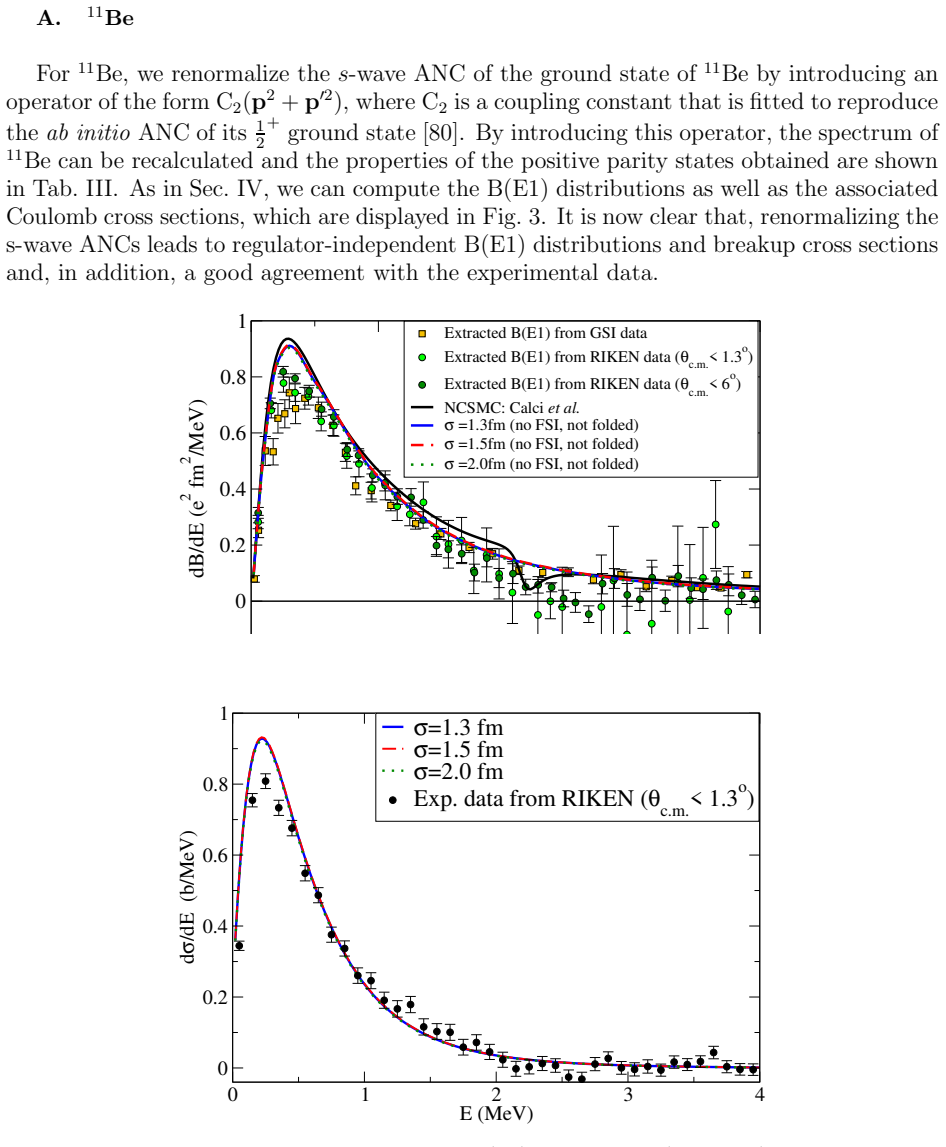
The spectrum is accurately described at leading order in both cases. Leading-order results are in reasonable agreement with data for both 11Be and 17C. The addition of one next-to-leading-order operator renders the ANCs of all s-wave states stable with respect to the regulator and removes most of the 30% variation of the leading-order Coulomb dissociation cross section with the regulator.
What carries the argument
The particle-plus-rotor model of Bohr and Mottelson at leading order, together with a finite set of short-range operators that respect the symmetries and small parameters of the system.
If this is right
- The low-lying positive-parity energies below the core(2+)-neutron threshold can be renormalized using only the leading-order set of operators.
- Decay widths to d-wave core-neutron states retain sizable cutoff dependence while s-wave ANCs show only next-to-leading-order-sized regulator dependence.
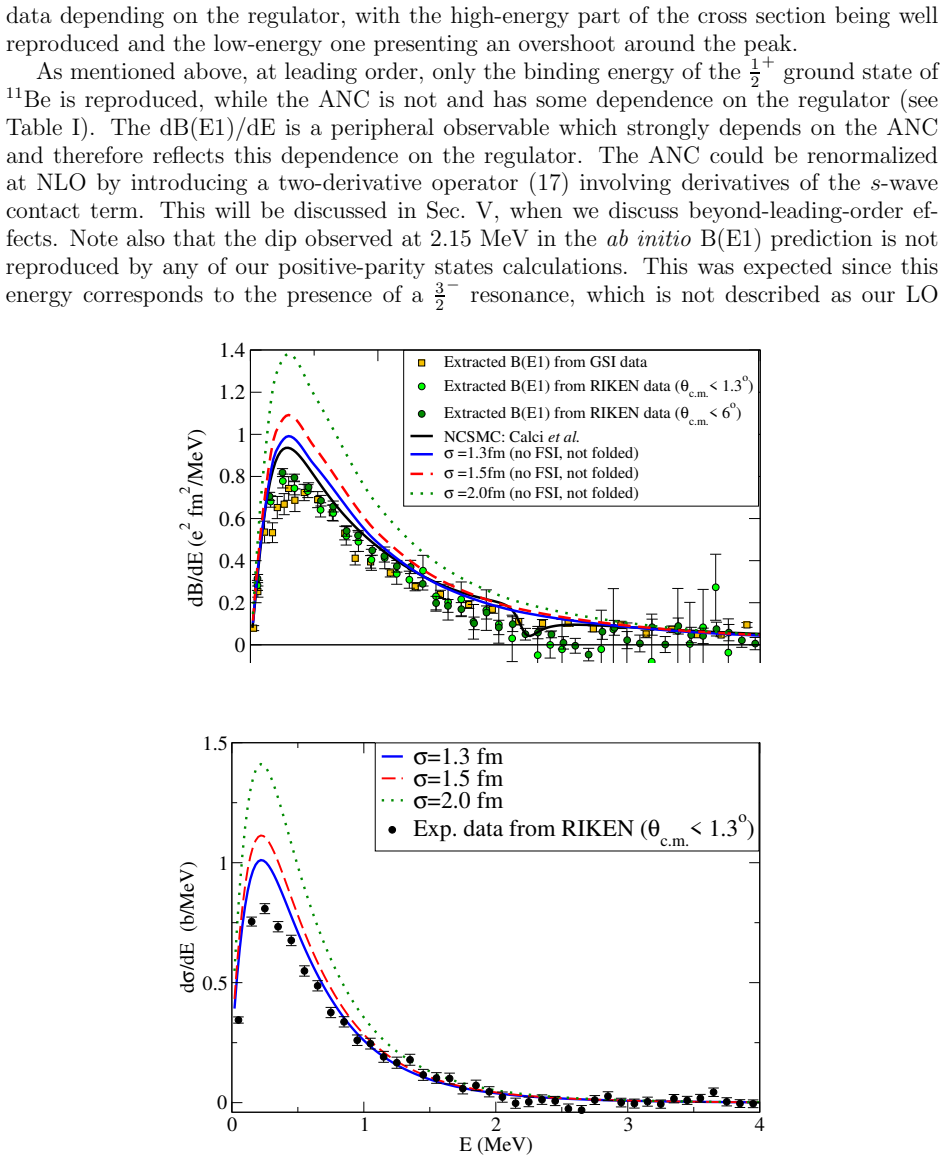
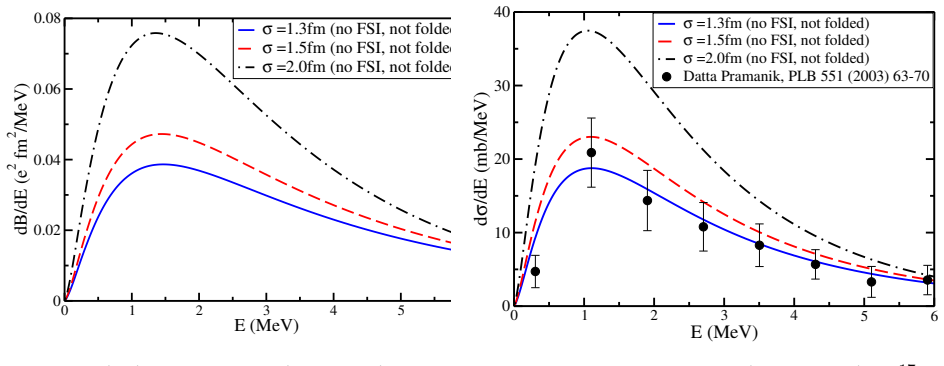
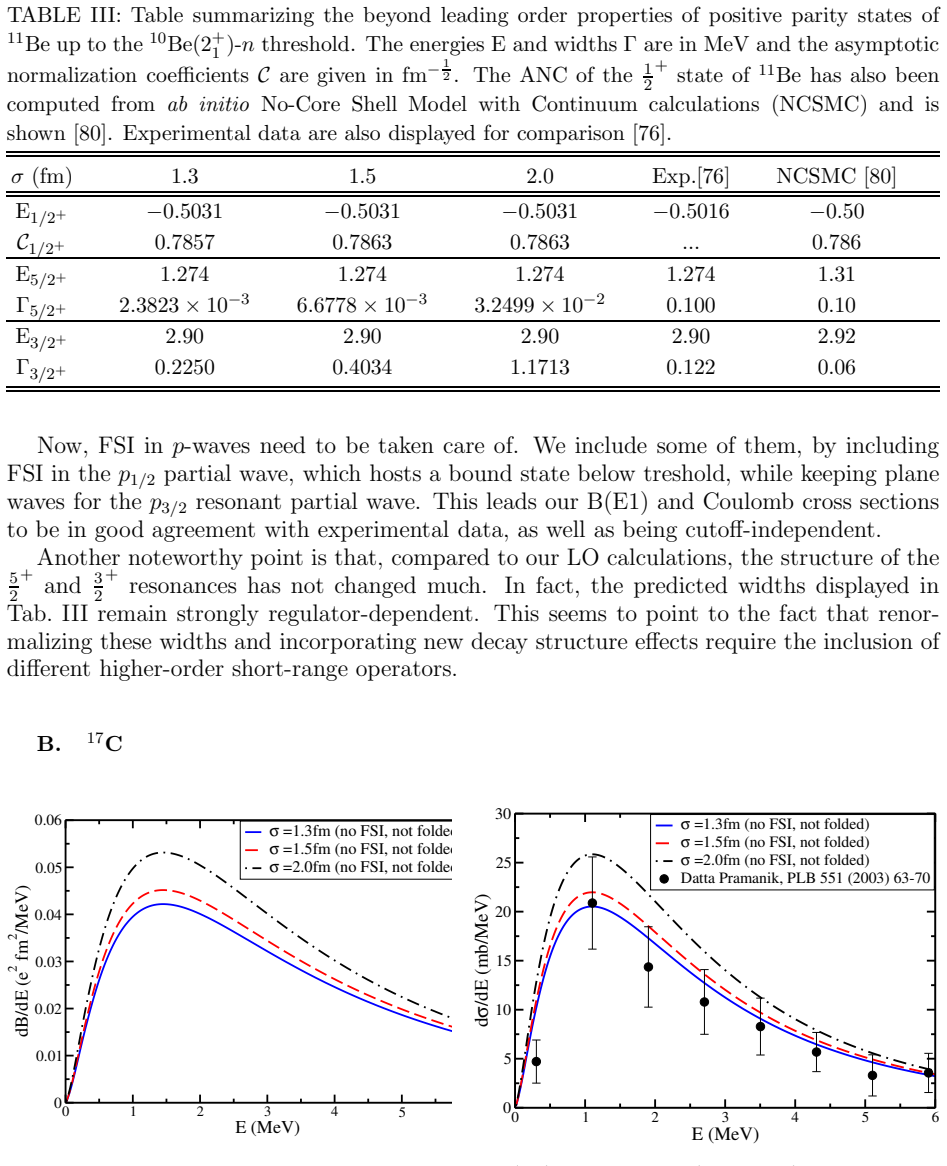
- Leading-order Coulomb breakup observables for both 11Be and 17C are in reasonable agreement with experimental data.
- Inclusion of one next-to-leading-order operator stabilizes the ANCs of all s-wave states with respect to the regulator.
Where Pith is reading between the lines
- The same leading-order framework could be applied to other single-neutron halo candidates whose cores also exhibit low-lying rotational bands.
- If the power counting holds, the size of regulator dependence at leading order supplies a direct estimate of the theoretical uncertainty on unmeasured observables.
- The approach supplies a systematic way to quantify how core deformation propagates into halo observables without requiring a full microscopic calculation at every step.
Load-bearing premise
A valid power counting exists based on the small parameters of the system so that the particle-plus-rotor model plus a finite set of short-range operators at leading order captures the essential low-energy physics without higher-order corrections dominating the observables of interest.
What would settle it
A measurement of the s-wave asymptotic normalization coefficients or the Coulomb dissociation cross section in 11Be or 17C that deviates substantially from the leading-order prediction even after the single next-to-leading-order operator is included would falsify the central claim.
Figures
read the original abstract
We establish a short-range effective theory for deformed s-wave halos. The theory applies to a system in which neutrons are weakly bound to a core nucleus, and that core nucleus also exhibits a low-lying rotational band with a $0^+$ ground state and a first $2_1^+$ excited state. The effective theory then must have both halo degrees of freedom and degrees of freedom associated with rotation of the core. This leads to the particle plus rotor model of Bohr and Mottelson at leading order. We identify the relevant leading-order operators in the Hamiltonian that respect the symmetries of the system and the small parameters which define the effective theory's power counting. We carry out calculations for the $^{11}$Be and $^{17}$C systems in which we compute the low-lying positive-parity states of the core $+$ neutron systems up to the core$(2_1^+)$-neutron threshold. We do this for several different regulator parameters and establish that these energies can be renormalized using the leading-order set of operators. The spectrum is accurately described at leading order in both cases. Decay widths to d-wave core-neutron states have sizable cutoff dependence, but the Asymptotic Normalization Coefficients (ANCs) in $s$-wave channels exhibit regulator dependence of a size consistent with next-to-leading-order effects. We also compute Coulomb breakup observables and compare with experimental data, finding leading-order results in reasonable agreement with data for both ${}^{11}$Be and ${}^{17}$C. The addition of one next-to-leading-order operator renders the ANCs of all s-wave states stable with respect to the regulator. It consequently also removes most of the 30\% variation of the leading-order Coulomb dissociation cross section with the regulator.
Editorial analysis
A structured set of objections, weighed in public.
Referee Report
Summary. The paper establishes a short-range effective theory for single-neutron halo nuclei with deformed cores, reducing at leading order to the particle-plus-rotor model with additional short-range operators. It identifies small parameters for power counting and applies the framework to 11Be and 17C, computing low-lying positive-parity states up to the core(2+)-neutron threshold. Spectra are renormalized at LO with accurate data agreement; s-wave ANCs show NLO-sized regulator dependence; LO Coulomb breakup observables agree reasonably with experiment. One NLO operator stabilizes ANCs and reduces most of the 30% LO cutoff variation in cross sections.
Significance. If the power counting holds, the work supplies a systematic EFT for deformed halo nuclei that incorporates core rotation and halo degrees of freedom, enabling controlled predictions for spectra, ANCs, and reaction observables such as Coulomb breakup. The explicit renormalization at LO and the regulator stabilization at NLO for key quantities demonstrate practical utility for low-energy nuclear structure and reactions.
major comments (2)
- [Power counting discussion] Power counting section: the central claim requires a valid power counting in which higher-order corrections do not dominate, yet no explicit expansion parameter (e.g., ratio of core excitation energy to halo binding or momentum scales) is supplied and no NLO calculation of the spectrum itself is performed to quantify LO accuracy beyond parameter adjustment.
- [Results for 11Be and 17C] Results for decay widths and ANCs: the sizable cutoff dependence reported for d-wave widths is load-bearing for the assertion that the LO description is controlled, as it indicates that regulator independence is not achieved for all observables at the claimed order.
minor comments (2)
- Specify the precise operator content and fitting procedure for the LO couplings, including how the regulator cutoff is varied and how uncertainties are propagated to the Coulomb breakup cross sections.
- Clarify the numerical size of the NLO/LO ratio for the ANCs and breakup observables to make the improvement at NLO quantitative.
Simulated Author's Rebuttal
We thank the referee for the careful reading and constructive comments. We respond point-by-point to the major comments below. Revisions will be made to provide an explicit numerical estimate of the expansion parameter and to clarify the expected cutoff dependence for d-wave observables.
read point-by-point responses
-
Referee: Power counting section: the central claim requires a valid power counting in which higher-order corrections do not dominate, yet no explicit expansion parameter (e.g., ratio of core excitation energy to halo binding or momentum scales) is supplied and no NLO calculation of the spectrum itself is performed to quantify LO accuracy beyond parameter adjustment.
Authors: We agree that an explicit numerical estimate of the expansion parameter strengthens the power counting discussion. The manuscript identifies the relevant small parameters in Section II as the ratios of halo momentum scales to core rotational and excitation energies. In the revision we will add a paragraph supplying numerical estimates of these ratios (approximately 0.4 for 11Be and 0.3 for 17C). A complete NLO spectrum calculation lies beyond the present scope; the LO renormalization and data agreement already provide supporting evidence for the power counting, but we acknowledge that direct NLO quantification would be desirable in future work. revision: partial
-
Referee: Results for decay widths and ANCs: the sizable cutoff dependence reported for d-wave widths is load-bearing for the assertion that the LO description is controlled, as it indicates that regulator independence is not achieved for all observables at the claimed order.
Authors: The sizable cutoff dependence in d-wave decay widths is expected, as these channels are suppressed at leading order by the centrifugal barrier and enter only at higher orders in the EFT power counting. The LO framework targets s-wave halo observables, for which the s-wave ANCs display regulator dependence of NLO size, as reported. We will revise the text to state explicitly that regulator independence at LO is claimed for the primary s-wave spectra and ANCs, while d-wave quantities are anticipated to require NLO operators for full stability. This distinction preserves the main conclusions while addressing the concern. revision: partial
Circularity Check
No significant circularity in derivation chain
full rationale
The paper identifies small parameters of the halo-plus-rotor system, constructs the leading-order particle-plus-rotor Hamiltonian plus short-range contact operators, fits the finite set of LO couplings to the low-lying positive-parity spectrum of 11Be and 17C, and then computes independent observables (s-wave ANCs, d-wave widths, and Coulomb breakup cross sections) for comparison with external experimental data. Reasonable LO agreement with breakup data, plus NLO stabilization of ANCs, constitutes a standard EFT validation against independent benchmarks rather than any reduction of outputs to inputs by construction. No self-definitional loops, fitted quantities renamed as predictions, or load-bearing self-citations appear in the described chain. The power-counting assumption is stated explicitly but does not render the reported results tautological.
Axiom & Free-Parameter Ledger
free parameters (2)
- leading-order short-range coupling constants
- regulator cutoff parameter
axioms (2)
- domain assumption A separation of scales exists that permits a short-range EFT with a well-defined power counting for deformed s-wave halos.
- standard math The Hamiltonian operators must respect the rotational and parity symmetries of the system.
Reference graph
Works this paper leans on
-
[1]
In this limit each rotational band can be treated according to the discussion in Ref
Erotor ≪ Ehalo For halo nuclei where the characteristic energy scale of the rotor Erotor is small, but non- zero, compared to the energy scale of the halo, the rotor states form rotational bands, with the inter-band spacing governed by E halo. In this limit each rotational band can be treated according to the discussion in Ref. [27]. The rotor motion can ...
-
[2]
Deformation a ppears in such a theory only as a sub-leading effect
Erotor ≫ Ehalo In the regime where the rotor energy scale lies well above the halo en ergy scale the decoupling theorem tells us that the theory may be recast as an EFT in which the rotor degree of freedom is integrated out of the theory. Deformation a ppears in such a theory only as a sub-leading effect. For example, the contribution of the qu adrupole op...
-
[3]
In this regime, def ormation becomes a leading-order effect, and the quadrupole operator (19) and the contact term (2) both contribute to the halo-core interaction at leading order
Erotor ∼ Ehalo When the characteristic energies of halo and rotational excitation s are of a similar size, the hierarchy between the different operators contributing to th e effective potential V eff cn must be modified from the standard Halo EFT counting. In this regime, def ormation becomes a leading-order effect, and the quadrupole operator (19) and the con...
2003
-
[5]
I. Tanihata, H. Hamagaki, O. Hashimoto, Y. Shida, N. Yosh ikawa, K. Sugimoto, O. Yamakawa, T. Kobayashi, and N. Takahashi, Phys. Rev. Lett. 55, 2676 (1985), URL https://link.aps. org/doi/10.1103/PhysRevLett.55.2676
-
[6]
P. G. Hansen and B. Jonson, Europhys. Lett. 4, 409 (1987), URL https://dx.doi.org/10. 1209/0295-5075/4/4/005
1987
-
[7]
I. Tanihata, J. Phys. G 22, 157 (1996), URL https://dx.doi.org/10.1088/0954-3899/22/ 2/004
-
[8]
Riisager, Rev
K. Riisager, Rev. Mod. Phys. 66, 1105 (1994), URL https://link.aps.org/doi/10.1103/ RevModPhys.66.1105
1994
-
[9]
I. J. Thompson, Computer Physics Reports 7, 167 (1988), ISSN 0167-7977, URL https: //www.sciencedirect.com/science/article/pii/0167797788900056
arXiv 1988
-
[10]
T. Misu, W. Nazarewicz, and S. ˚ Aberg, Nuclear Physics A 614, 44 (1997), ISSN 0375-9474, URL https://www.sciencedirect.com/science/article/pii/S0375947496004587
1997
-
[11]
A. S. Jensen, K. Riisager, D. V. Fedorov, and E. Garrido, R ev. Mod. Phys. 76, 215 (2004), URL https://link.aps.org/doi/10.1103/RevModPhys.76.215
-
[12]
Al-Khalili, in Halo Nuclei (Morgan & Claypool Publishers, 2017), 2053-2571, pp
J. Al-Khalili, in Halo Nuclei (Morgan & Claypool Publishers, 2017), 2053-2571, pp. 2–1 to 2–9, ISBN 978-1-6817-4581-7, URL https://doi.org/10.1088/978-1-6817-4581-7ch2
-
[13]
A. M. Moro, J. Casal, and M. G´ omez-Ramos, The European P hysical Journal A 61, 47 (2025), ISSN 1434-601X, URL https://doi.org/10.1140/epja/s10050-025-01500-0
-
[14]
H.-W. Hammer, C. Ji, and D. R. Phillips, Journal of Physi cs G: Nuclear and Particle Physics 44, 103002 (2017), URL https://dx.doi.org/10.1088/1361-6471/aa83db
-
[15]
D. B. Kaplan, M. J. Savage, and M. B. Wise, Phys. Lett. B 424, 390 (1998), nucl-th/9801034
Pith/arXiv arXiv 1998
-
[16]
D. B. Kaplan, M. J. Savage, and M. B. Wise, Nucl. Phys. B 534, 329 (1998), nucl-th/9802075
Pith/arXiv arXiv 1998
-
[17]
van Kolck, Nuclear Physics A 645, 273 (1999), ISSN 0375-9474, URL https://www
U. van Kolck, Nuclear Physics A 645, 273 (1999), ISSN 0375-9474, URL https://www. sciencedirect.com/science/article/pii/S0375947498006125
1999
-
[18]
M. C. Birse, J. A. McGovern, and K. G. Richardson, Phys. L ett. B 464, 169 (1999), hep- ph/9807302
arXiv 1999
-
[19]
E. Braaten and H. W. Hammer, Phys. Rept. 428, 259 (2006), cond-mat/0410417. 22
Pith/arXiv arXiv 2006
-
[20]
Bertulani, H.-W
C. Bertulani, H.-W. Hammer, and U. van Kolck, Nuclear Ph ysics A 712, 37 (2002), ISSN 0375- 9474, URL https://www.sciencedirect.com/science/article/pii/S0375947402012708
2002
-
[21]
Bedaque, H.-W
P. Bedaque, H.-W. Hammer, and U. van Kolck, Physics Lett ers B 569, 159 (2003), ISSN 0370- 2693, URL https://www.sciencedirect.com/science/article/pii/S0370269303010712
2003
-
[22]
P. Capel, D. R. Phillips, and H.-W. Hammer, Phys. Rev. C 98, 034610 (2018), URL https: //link.aps.org/doi/10.1103/PhysRevC.98.034610
-
[23]
J. Yang and P. Capel, Phys. Rev. C 98, 054602 (2018), URL https://link.aps.org/doi/ 10.1103/PhysRevC.98.054602
-
[24]
L. Moschini, J. Yang, and P. Capel, Phys. Rev. C 100, 044615 (2019), URL https://link. aps.org/doi/10.1103/PhysRevC.100.044615
-
[25]
C. Hebborn and P. Capel, Phys. Rev. C 104, 024616 (2021), URL https://link.aps.org/ doi/10.1103/PhysRevC.104.024616
-
[26]
G. Rupak and R. Higa, Phys. Rev. Lett. 106, 222501 (2011), URL https://link.aps.org/ doi/10.1103/PhysRevLett.106.222501
-
[27]
Zhang, K
X. Zhang, K. M. Nollett, and D. Phillips, Physics Letter s B 751, 535 (2015), ISSN 0370-2693, URL https://www.sciencedirect.com/science/article/pii/S0370269315008515
2015
-
[28]
T. Papenbrock and H. A. Weidenm¨ uller, Physica Scripta 91, 053004 (2016), URL https: //doi.org/10.1088/0031-8949/91/5/053004
-
[29]
Papenbrock and H
T. Papenbrock and H. A. Weidenm¨ uller, Phys. Rev. C 102, 044324 (2020)
2020
-
[30]
I. K. Alnamlah, E. A. Coello P´ erez, and D. R. Phillips, P hys. Rev. C 104, 064311 (2021), URL https://link.aps.org/doi/10.1103/PhysRevC.104.064311
-
[31]
I. K. Alnamlah, E. A. C. P´ erez, and D. R. Phillips, Front iers in Physics 10, 901954 (2022)
2022
-
[32]
Bohr and B
A. Bohr and B. Mottelson, Nuclear Structure (W. A. Benjamin, New York, 1969)
1969
-
[33]
J.-W. Chen, G. Rupak, and M. J. Savage, Nuclear Physics A 653, 386 (1999), ISSN 0375-9474, URL https://www.sciencedirect.com/science/article/pii/S0375947499002985
1999
-
[34]
S. G. Nilsson, Tech. Rep. 16, Det Kongelige Danske Viden skabernes Selskab (1955), cERN Report CERN-55-30; scanned at CERN. :contentReference[oa icite:2]index=2
1955
-
[35]
H. Esbensen and C. N. Davids, Phys. Rev. C 63, 014315 (2000), URL https://link.aps. org/doi/10.1103/PhysRevC.63.014315
- [36]
-
[37]
L.-P. Kubushishi and P. Capel, Exploring core excitation in halo nuclei using halo effectiv e field theory: an application to the bound states of 11be (2025), 2507.13585, URL https:// arxiv.org/abs/2507.13585
arXiv 2025
-
[38]
L.-P. Kubushishi and P. Capel, Insensitivity of the coulomb breakup of halo nuclei to spectr o- scopic factors (2026), 2603.10339, URL https://arxiv.org/abs/2603.10339
arXiv 2026
-
[39]
H. Esbensen, B. A. Brown, and H. Sagawa, Phys. Rev. C 51, 1274 (1995), URL https: //link.aps.org/doi/10.1103/PhysRevC.51.1274
-
[41]
Thompson, F
I. Thompson, F. Nunes, and B. Danilin, Comput. Phys. Com m. 161, 87 (2004), ISSN 0010- 4655, URL https://www.sciencedirect.com/science/article/pii/S0010465504002140
2004
-
[43]
Hesse, J.-M
M. Hesse, J.-M. Sparenberg, F. Van Raemdonck, and D. Bay e, Nuclear Physics A 640, 37 (1998), ISSN 0375-9474, URL https://www.sciencedirect.com/science/article/pii/ S0375947498004357. 23
1998
-
[44]
P. Descouvemont and D. Baye, Reports on Progress in Phys ics 73, 036301 (2010), URL https://dx.doi.org/10.1088/0034-4885/73/3/036301
-
[45]
Baye, Physics Reports 565, 1 (2015), ISSN 0370-1573, the Lagrange-mesh method, URL https://www.sciencedirect.com/science/article/pii/S0370157314004086
D. Baye, Physics Reports 565, 1 (2015), ISSN 0370-1573, the Lagrange-mesh method, URL https://www.sciencedirect.com/science/article/pii/S0370157314004086
2015
-
[46]
B. I. Schneider, Phys. Rev. A 24, 1 (1981), URL https://link.aps.org/doi/10.1103/ PhysRevA.24.1
1981
-
[47]
P. Descouvemont and M. Vincke, Phys. Rev. A 42, 3835 (1990), URL https://link.aps. org/doi/10.1103/PhysRevA.42.3835
-
[48]
Descouvemont and J
P. Descouvemont and J. Dohet-Eraly, Few Body Syst. 65, 9 (2024)
2024
-
[49]
Alder and A
K. Alder and A. Winther, Electromagnetic Excitation: Theory of Coulomb Excitation wi th Heavy Ions (North-Holland Publishing Company, 1975), ISBN 978044410 8265, URL https: //books.google.com/books?id=azet0AEACAAJ
1975
-
[50]
C. A. Bertulani and G. Baur, Physics Reports 163, 299 (1988), ISSN 0370-1573, URL https: //www.sciencedirect.com/science/article/pii/0370157388901421
arXiv 1988
-
[51]
Typel and G
S. Typel and G. Baur, Nuclear Physics A 759, 247 (2005), ISSN 0375-9474, URL https: //www.sciencedirect.com/science/article/pii/S0375947405008493
2005
-
[52]
J. Al-Khalili and K. Arai, Phys. Rev. C 74, 034312 (2006), URL https://link.aps.org/ doi/10.1103/PhysRevC.74.034312
-
[53]
Descouvemont, Computer Physics Communications 200, 199 (2016), ISSN 0010-4655, URL https://www.sciencedirect.com/science/article/pii/S0010465515003951
P. Descouvemont, Computer Physics Communications 200, 199 (2016), ISSN 0010-4655, URL https://www.sciencedirect.com/science/article/pii/S0010465515003951
2016
-
[54]
S. Typel and R. Shyam, Phys. Rev. C 64, 024605 (2001), URL https://link.aps.org/doi/ 10.1103/PhysRevC.64.024605
-
[55]
P. Capel, D. Baye, and V. S. Melezhik, Phys. Rev. C 68, 014612 (2003), URL https://link. aps.org/doi/10.1103/PhysRevC.68.014612
-
[56]
H. Esbensen, G. F. Bertsch, and K. A. Snover, Phys. Rev. L ett. 94, 042502 (2005), URL https://link.aps.org/doi/10.1103/PhysRevLett.94.042502
-
[57]
P. Capel and D. Baye, Phys. Rev. C 71, 044609 (2005), URL https://link.aps.org/doi/ 10.1103/PhysRevC.71.044609
-
[58]
P. Capel and Y. Nollet, Phys. Rev. C 96, 015801 (2017), URL https://link.aps.org/doi/ 10.1103/PhysRevC.96.015801
-
[59]
D. Baye, P. Capel, and G. Goldstein, Phys. Rev. Lett. 95, 082502 (2005), URL https: //link.aps.org/doi/10.1103/PhysRevLett.95.082502
-
[60]
G. Goldstein, D. Baye, and P. Capel, Phys. Rev. C 73, 024602 (2006), URL https://link. aps.org/doi/10.1103/PhysRevC.73.024602
-
[62]
P. Capel, P. Danielewicz, and F. M. Nunes, Phys. Rev. C 82, 054612 (2010), URL https: //link.aps.org/doi/10.1103/PhysRevC.82.054612
-
[63]
R. Crespo, A. Deltuva, and A. M. Moro, Phys. Rev. C 83, 044622 (2011), URL https: //link.aps.org/doi/10.1103/PhysRevC.83.044622
-
[64]
A. M. Moro and R. Crespo, Phys. Rev. C 85, 054613 (2012), URL https://link.aps.org/ doi/10.1103/PhysRevC.85.054613
-
[65]
Capel, D
P. Capel, D. Phillips, and H.-W. Hammer, Physics Letter s B 825, 136847 (2022), ISSN 0370- 2693, URL https://www.sciencedirect.com/science/article/pii/S0370269321007875
2022
-
[66]
Deltuva and D
A. Deltuva and D. Jurˇ ciukonis, Physics Letters B 840, 137867 (2023), ISSN 0370-2693, URL https://www.sciencedirect.com/science/article/pii/S0370269323002010. 24
2023
-
[67]
N. K. Timofeyuk and P. Descouvemont, Phys. Rev. C 81, 051301 (2010), URL https:// link.aps.org/doi/10.1103/PhysRevC.81.051301
-
[68]
K. Amos, L. Canton, P. Fraser, S. Karataglidis, J. Svenn e, and D. van der Knijff, Nu- clear Physics A 879, 132 (2012), ISSN 0375-9474, URL https://www.sciencedirect.com/ science/article/pii/S037594741200053X
2012
-
[69]
D. Smalley, H. Iwasaki, P. Navr´ atil, R. Roth, J. Langha mmer, V. M. Bader, D. Bazin, J. S. Berryman, C. M. Campbell, J. Dohet-Eraly, et al., Phys. Rev. C 92, 064314 (2015), URL https://link.aps.org/doi/10.1103/PhysRevC.92.064314
-
[70]
S. Kim, J. Hwang, Y. Satou, N. Orr, T. Nakamura, Y. Kondo, J. Gibelin, N. Achouri, T. Aumann, H. Baba, et al., Physics Letters B 836, 137629 (2023), ISSN 0370-2693, URL https://www.sciencedirect.com/science/article/pii/S0370269322007638
2023
-
[71]
L. H. Chien and P. Descouvemont, Phys. Rev. C 108, 044605 (2023), URL https://link. aps.org/doi/10.1103/PhysRevC.108.044605
-
[72]
P. Punta, J. A. Lay, and A. M. Moro, Phys. Rev. C 108, 024613 (2023), URL https://link. aps.org/doi/10.1103/PhysRevC.108.024613
-
[73]
P. Punta, J. A. Lay, A. M. Moro, and G. Col` o, Phys. Rev. C 111, 064614 (2025), URL https://link.aps.org/doi/10.1103/nj6g-fsj4
-
[74]
T. Suhara, Y. Taniguchi, W. Horiuchi, S. Watanabe, and T . Furumoto, Phys. Rev. C 111, 054301 (2025), URL https://link.aps.org/doi/10.1103/PhysRevC.111.054301
-
[75]
P. Punta, J. A. Lay, A. M. Moro, J. Lois-Fuentes, and B. Fe rn´ andez-Dom ´ ınguez,Constraining the n = 16 shell gap in 17c via transfer to the continuum in the 16c(d, p )17c reaction (2026), 2604.14423, URL https://arxiv.org/abs/2604.14423
Pith/arXiv arXiv 2026
-
[76]
Y. Kanada-En’yo, H. Horiuchi, and A. Dot´ e, Phys. Rev. C 60, 064304 (1999), URL https: //link.aps.org/doi/10.1103/PhysRevC.60.064304
-
[77]
A. McCoy, in HaloWeek’24 - nuclei at and beyond the driplines (Chalmers University of Technology, Gothenburg, Sweden, 2024), URL https://indico.cern.ch/event/1319370/ contributions/5984436/
arXiv 2024
-
[79]
Kelley, E
J. Kelley, E. Kwan, J. Purcell, C. Sheu, and H. Weller, Nu clear Physics A 880, 88 (2012), ISSN 0375-9474, URL https://www.sciencedirect.com/science/article/pii/ S0375947412000413
2012
-
[80]
Elekes, Z
Z. Elekes, Z. Dombr` adi, R. Kanungo, H. Baba, Z. F¨ ul¨ op, J. Gibelin, A. Horvath, E. Ideguchi, Y. Ichikawa, N. Iwasa, et al., Physics Letters B 614, 174 (2005), ISSN 0370-2693, URL https://www.sciencedirect.com/science/article/pii/S0370269305004703
2005
-
[81]
H. G. Bohlen, R. Kalpakchieva, W. von Oertzen, T. N. Mass ey, A. A. Ogloblin, G. de Angelis, M. Milin, C. Schulz, T. Kokalova, and C. Wheldon, The Europea n Physical Journal A 31, 279 (2007), ISSN 1434-601X, URL https://doi.org/10.1140/epja/i2006-10275-5
-
[83]
A. Calci, P. Navr´ atil, R. Roth, J. Dohet-Eraly, S. Quag lioni, and G. Hupin, Phys. Rev. Lett. 117, 242501 (2016), URL https://link.aps.org/doi/10.1103/PhysRevLett.117.242501
-
[84]
Ajzenberg-Selove, Nuclear Physics A 490, 1 (1988), ISSN 0375-9474, URL https://www
F. Ajzenberg-Selove, Nuclear Physics A 490, 1 (1988), ISSN 0375-9474, URL https://www. sciencedirect.com/science/article/pii/0375947488901248
arXiv 1988
-
[85]
Arai, Phys
K. Arai, Phys. Rev. C 69, 014309 (2004), URL https://link.aps.org/doi/10.1103/ PhysRevC.69.014309. 25
2004
-
[86]
Ogawa, K
Y. Ogawa, K. Arai, Y. Suzuki, and K. Varga, Nuclear Physi cs A 673, 122 (2000), ISSN 0375- 9474, URL https://www.sciencedirect.com/science/article/pii/S0375947400001330
2000
discussion (0)
Sign in with ORCID, Apple, or X to comment. Anyone can read and Pith papers without signing in.