HyperFORM -- a FORM package for parametric integration with hyperlogarithms
Pith reviewed 2026-07-02 09:40 UTC · model grok-4.3
The pith
HyperFORM ports hyperlogarithm integration from Maple into the FORM system.
A machine-rendered reading of the paper's core claim, the machinery that carries it, and where it could break.
Core claim
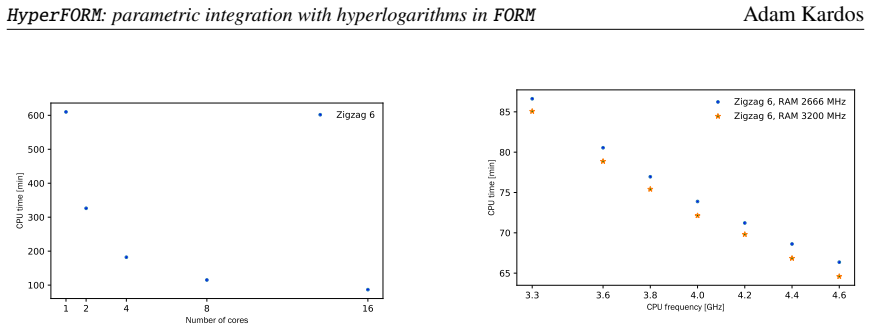
HyperFORM is a fully self-contained FORM program that implements the parametric integration of hyperlogarithms with rational weights, directly ported from HyperInt to capitalize on FORM's speed and parallelization. The package is demonstrated through an explicit three-loop zigzag period calculation and timing benchmarks that establish its current reach for such integrals up to six loops, with the method positioned for broad use including the evaluation of Feynman integrals.
What carries the argument
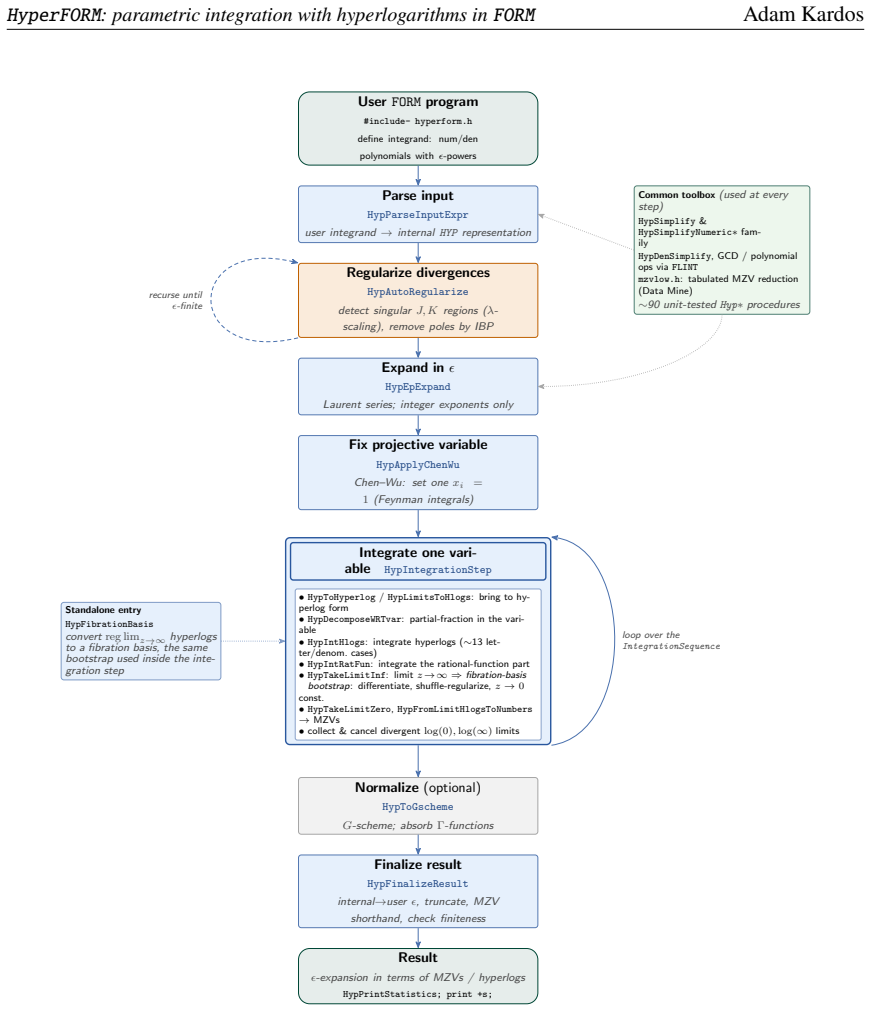
The port of the hyperlogarithm parametric integration algorithm, realized as a self-contained FORM program that handles bulky algebraic input and spreads calculations across processor cores.
Load-bearing premise
The algorithmic port from HyperInt to FORM produces identical numerical and symbolic results for the integrals the authors target, without hidden differences in implementation that would change outcomes.
What would settle it
A direct side-by-side run of the three-loop zigzag period in both HyperFORM and the original HyperInt package that produces differing final expressions or numerical values would show the port has introduced errors.
Figures
read the original abstract
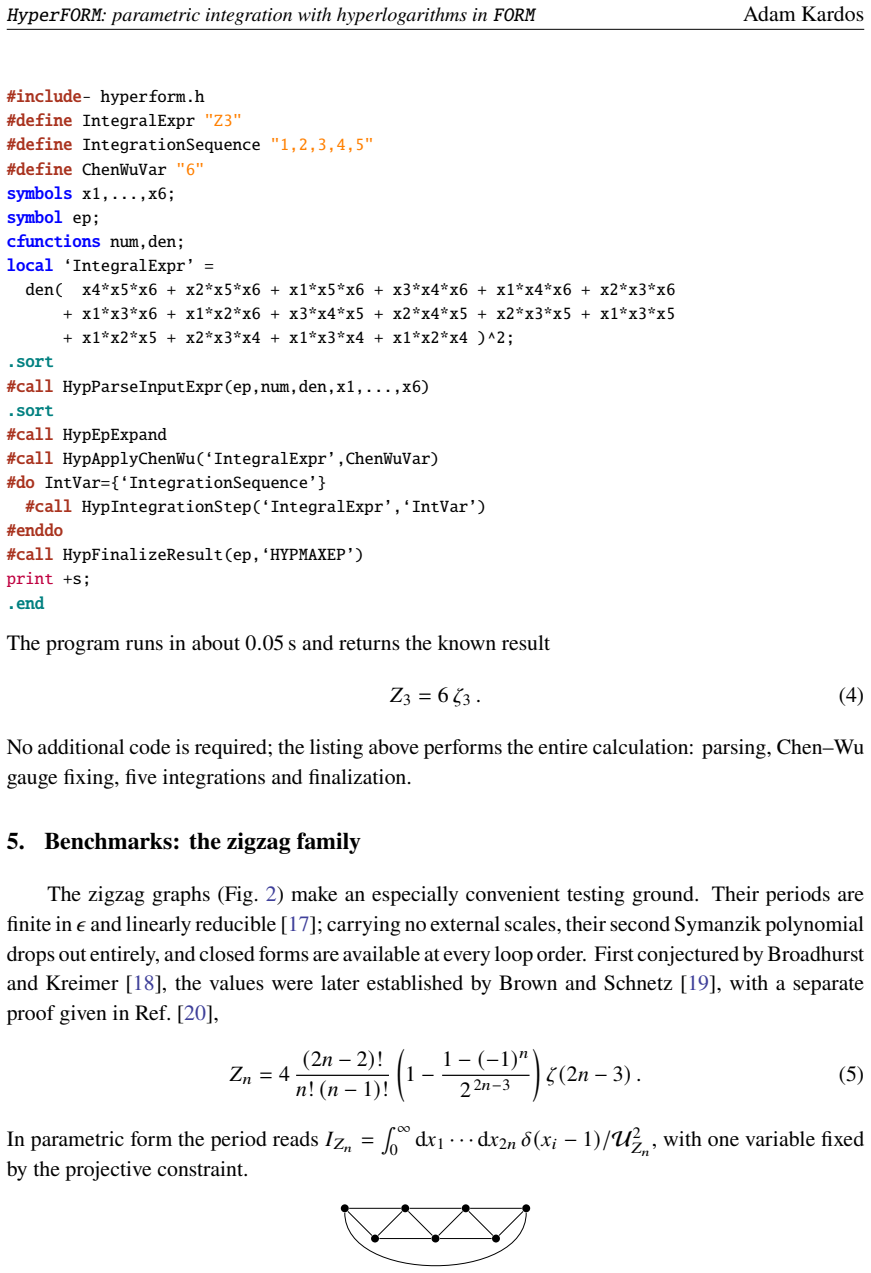
HyperFORM brings the parametric integration of hyperlogarithms, weighted by rational prefactors, into the symbolic-manipulation system FORM. It ports the capabilities of Erik Panzer's Maple package HyperInt, capitalizing on FORM's speed with bulky algebraic input and on its ability to spread a single calculation across many processor cores. We keep the description of the method brief and concentrate instead on how the package is organized and driven: a fully self-contained program for the three-loop zigzag period serves as a worked illustration, and timing measurements for zigzags through six loops gauge its present reach. HyperFORM is released openly and applies to a broad class of problems, the evaluation of Feynman integrals prominently among them.
Editorial analysis
A structured set of objections, weighed in public.
Referee Report
Summary. The paper presents HyperFORM, a FORM package porting parametric integration of hyperlogarithms weighted by rational prefactors from the Maple package HyperInt. It focuses on package organization and usage, with a fully self-contained three-loop zigzag integral as a worked illustration and timing benchmarks for zigzag integrals through six loops.
Significance. If the implementation correctly reproduces HyperInt's algorithm, the package would enable efficient evaluation of a class of Feynman integrals by exploiting FORM's strengths in handling large algebraic expressions and distributing work across processor cores. The open release and the self-contained example are strengths.
major comments (1)
- [worked illustration (three-loop zigzag period)] The central claim that HyperFORM faithfully ports HyperInt's parametric integration algorithm lacks support from systematic verification. The manuscript supplies only the three-loop zigzag illustration without reporting comparisons to HyperInt outputs, published analytic results, or numerical cross-checks for the same integral or a broader test suite spanning different rational prefactors and hyperlogarithm depths.
minor comments (1)
- [Abstract] The abstract states that the description of the method is kept brief; a short additional sentence clarifying the precise class of integrals (beyond zigzags) for which the package is intended would improve clarity.
Simulated Author's Rebuttal
We are grateful to the referee for pointing out the need for more verification of the implementation. We address this below and will update the manuscript.
read point-by-point responses
-
Referee: [worked illustration (three-loop zigzag period)] The central claim that HyperFORM faithfully ports HyperInt's algorithm lacks support from systematic verification. The manuscript supplies only the three-loop zigzag illustration without reporting comparisons to HyperInt outputs, published analytic results, or numerical cross-checks for the same integral or a broader test suite spanning different rational prefactors and hyperlogarithm depths.
Authors: We thank the referee for this observation. The three-loop zigzag serves as a fully self-contained worked example in the manuscript, but we acknowledge that explicit comparisons are not reported. In the revised manuscript, we will add a direct comparison of the HyperFORM result for this integral with the published value and with the output from HyperInt. We will also include numerical evaluations for cross-checks. Regarding a broader test suite, we will expand the discussion to include results from additional integrals with different rational prefactors and depths, which were used in testing the package. This will be presented in a new subsection on validation. revision: yes
Circularity Check
Software implementation paper with no derivation chain
full rationale
The manuscript describes a FORM package that ports the existing HyperInt algorithm for parametric hyperlogarithm integration. No predictions, first-principles derivations, fitted parameters, or uniqueness theorems are claimed. The text explicitly states it keeps the method description brief and focuses on package organization and a worked example. No self-citation load-bearing steps, ansatzes, or renamings of known results appear. The paper is self-contained as a tool description against the external HyperInt reference.
Axiom & Free-Parameter Ledger
axioms (1)
- domain assumption The hyperlogarithm integration algorithm implemented in HyperInt is mathematically correct for the class of integrals considered.
Reference graph
Works this paper leans on
-
[1]
S. Weinzierl,Feynman Integrals. A Comprehensive Treatment for Students and Researchers, UNITEXT for Physics, Springer (2022) [arXiv:2201.03593]
-
[2]
Schnetz,𝜙3 theory at six loops,Phys
O. Schnetz,𝜙3 theory at six loops,Phys. Rev. D112(2025) 016028 [arXiv:2505.15485]
- [3]
-
[4]
The massless higher-loop two-point function
F. Brown,The massless higher-loop two-point function,Commun. Math. Phys.287(2009) 925 [arXiv:0804.1660]
work page internal anchor Pith review Pith/arXiv arXiv 2009
-
[5]
MPL - a program for computations with iterated integrals on moduli spaces of curves of genus zero
C. Bogner,MPL – a program for computations with iterated integrals on moduli spaces of curves of genus zero,Comput. Phys. Commun.203(2016) 339 [arXiv:1510.04562]
work page internal anchor Pith review Pith/arXiv arXiv 2016
-
[6]
Algorithms for the symbolic integration of hyperlogarithms with applications to Feynman integrals
E. Panzer,Algorithms for the symbolic integration of hyperlogarithms with applications to Feynman integrals,Comput. Phys. Commun.188(2015) 148 [arXiv:1403.3385]
work page internal anchor Pith review Pith/arXiv arXiv 2015
-
[7]
The Multithreaded version of FORM
M. Tentyukov and J. A. M. Vermaseren,The multithreaded version of FORM,Comput. Phys. Commun.181(2010) 1419 [arXiv:hep-ph/0702279]. 8 HyperFORM: parametric integration with hyperlogarithms inFORMAdam Kardos
work page internal anchor Pith review Pith/arXiv arXiv 2010
-
[8]
Forcer, a FORM program for the parametric reduction of four-loop massless propagator diagrams
B. Ruijl, T. Ueda and J. A. M. Vermaseren,Forcer, a FORM program for the parametric reduction of four-loop massless propagator diagrams,Comput. Phys. Commun.253(2020) 107198 [arXiv:1704.06650]
work page internal anchor Pith review Pith/arXiv arXiv 2020
-
[9]
A. Kardos, S.-O. Moch and O. Schnetz,HyperFORM v1.0, Zenodo (2025), doi:10.5281/zenodo.17706909;HyperFORM – a FORM package for parametric integration with hyperlogarithms[arXiv:2511.19992]
-
[10]
On hyperlogarithms and Feynman integrals with divergences and many scales
E. Panzer,On hyperlogarithms and Feynman integrals with divergences and many scales, JHEP03(2014) 071 [arXiv:1401.4361]
work page internal anchor Pith review Pith/arXiv arXiv 2014
-
[11]
A. B. Goncharov,Multiple polylogarithms, cyclotomy and modular complexes,Math. Res. Lett.5(1998) 497 [arXiv:1105.2076]
work page internal anchor Pith review Pith/arXiv arXiv 1998
-
[12]
Chen,Iterated path integrals,Bull
K.-T. Chen,Iterated path integrals,Bull. Am. Math. Soc.83(1977) 831
1977
-
[13]
The Multiple Zeta Value Data Mine
J. Blümlein, D. J. Broadhurst and J. A. M. Vermaseren,The multiple zeta value data mine, Comput. Phys. Commun.181(2010) 582 [arXiv:0907.2557]
work page internal anchor Pith review Pith/arXiv arXiv 2010
-
[14]
The FLINT team,FLINT: Fast Library for Number Theory, version 3.3.1,https:// flintlib.org(2025)
2025
-
[15]
Johansson,Arb: efficient arbitrary-precision midpoint-radius interval arithmetic,IEEE Trans
F. Johansson,Arb: efficient arbitrary-precision midpoint-radius interval arithmetic,IEEE Trans. Comput.66(2017) 1281
2017
-
[16]
A. Kardos and S.-O. Moch,uf v1.0, Zenodo (2025), doi:10.5281/zenodo.17646663
-
[17]
F. C. S. Brown,On the periods of some Feynman integrals, [arXiv:0910.0114]
work page internal anchor Pith review Pith/arXiv arXiv
-
[18]
D. J. Broadhurst and D. Kreimer,Knots and numbers in𝜙4 theory to 7 loops and beyond,Int. J. Mod. Phys. C6(1995) 519 [arXiv:hep-ph/9504352]
work page internal anchor Pith review Pith/arXiv arXiv 1995
-
[19]
Brown and O
F. Brown and O. Schnetz,Single-valued multiple polylogarithms and a proof of the zig-zag conjecture,J. Number Theor.148(2015) 478
2015
-
[20]
S. E. Derkachev, A. I. Isaev and L. A. Shumilov,Zig-zag diagrams and conformal triangles, Phys. Part. Nucl. Lett.20(2023) 240. 9
2023
discussion (0)
Sign in with ORCID, Apple, or X to comment. Anyone can read and Pith papers without signing in.